God in the Machine

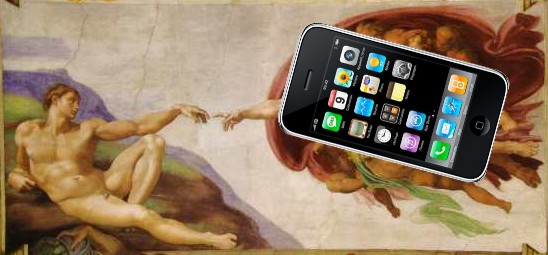
“O brave new world! That has such people in it!” Or at least such software. A couple of days ago my wife pointed out a news story on MSNBC rounding up the year (2011) in science. The story contains eleven science videos that challenge our perceptions and show us directions we are going, whether we want to or not. The first video shows what happens when Cornell University researchers connected two Chatbots to each other and allowed them to carry on a conversation. Like my own experience with Cleverbot last year, the conversation soon turned to God. Even artificial intelligence seems interested in the eternal questions. I should put a finer point on it: artificial intelligence derived from the dubious wisdom of the Internet. We are getting closer and closer to replicating the human brain electronically—even my iPhone scares me at times—and yet, to engage in conversations with humans (or each other) these intelligences must know about God.

Many theories exist about the origins of the god concept. Scientists argue that it is hardwired in our brains, that it is genetic, or that it is merely socialization that gives us this idea. The truth is that nobody really knows. The religious take this as license to claim that territory for the god of the gaps—if we can’t answer a question, God rushes in where angels (or logic) fear to tread. The truth is more likely that we don’t yet have the tools to flesh out (or psych out) our theories on why the supernatural is an indispensable component of our thoughts. If artificial intelligence takes its cues from human intelligence, however, it is a certainty that god will be part of the equation.

People possess a deep need to feel unique. Our uniqueness is part of our religion. Humans are “the crown of creation,” the only animals (debatable to some) with souls (debatable to others). Even the Chatbots get confused when God-talk comes up. Mentioning God leads one Cleverbot to ask the other if it is Christian. God is not limited to Christianity, of course, nor is the divine limited to monotheism. The old science fiction chestnut of a robot takeover, however, seems to have missed a salient point: if robots are programmed by humans, they will have God in their silicon chips just as surely as we do in our carbon-based brains. The god in the machine. Many atheists have declared the death of god, but we have placed the divine into our apps and devices and software. When the robot apocalypse comes it will include at least some Cleverbots declaring that the rationale to eliminate humans is heresy. Torquemada meets Iron Man. Already 2012 feels less safe than 2011.

Robot preacher of the iron age?

Persistence of Demons

Although released in April, Insidious is a film for the long nights of winter. At least with my schedule of keeping up with a culture that is moving too fast, this feels like a reasonable rationale for having just watched it. I tried not to read reviews of the movie when it came out since I prefer to experience the thrills first hand when I watch a film. Like many horror movies, Insidious revolves around the supernatural. Specifically, Insidious takes on the specter of the afterlife. Unlike The Exorcist, the demon in Insidious is not expelled by a priest, but by a psychic, borrowing a few celluloid feet from Poltergeist. Adding a couple of ghost hunters to the plot reinforces the idea of the secular demon that so often appears in the learned discussions of the TAPS team as they tilt with unseen entities on SyFy.

In an increasingly secular society, the fear of the dead is very much alive. Even a casual stroll through Barnes & Noble (the only show in town now) will demonstrate the popularity of the paranormal. Somehow sitting in pews listening to a sweaty orator go on about what he (sometimes she) thinks God is wanting us to do has disconnected us from the realm of the dead. Paul Tillich famously declared that God is a person’s “ultimate concern.” In an age when technology is hovering on the edge of keeping consciousness alive forever, people wonder what happens to the self when the body dies. Call it soul, consciousness, mind, or personality, we can’t deny—no matter how secular—that something inside makes each of us unique. The myth of flying about with angels playing harps doesn’t match everyone’s expectation of an afterlife any more. At least some of us hope for electric guitars.

Insidious opts for a realm like Limbo known as “the Further.” This is a place we have been before. The hopelessly corny The Seventh Sign gave us “the Guf” as a now empty federal reserve of souls. The Greeks gave us Tartarus and the Zoroastrians “the place of worst existence.” No matter what we call it, our brains like to believe there is some place out there that we go when the biomass we drive each day finally hits the wall. Increasingly it has become a negative place where darkness reigns. Insidious’s “the Further” is a hopeless realm of the dead, acting out their evil intent. There are no angels, but demons abide. It seems that we’ve outgrown the concept that angels are watching over us, but we can’t escape the creeping sensation that diabolical entities are peering at us from the shadows. During these long nights of winter, Insidious invites us to take a journey to where there is no heaven, but hell is surely not hard to find. All we have to do is close our eyes.


Alas, 2012

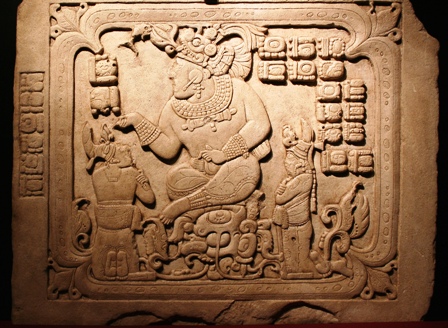
Having just survived a year with two purported Christian apocalypses, we now enter 2012 with its more potent Mayan apocalypse. The mysterious Mayan people, we are led to believe, could not foresee a world beyond 2012, and many otherwise rational people are seriously nervous about it. Whether it is the unread pages of the Bible or some stone inscription in a language most people have no hope of verifying, we venerate ancient wisdom. Especially when that wisdom indicates the dissolution of the entire world. I would suggest that the reason we do this has to do with the society the Bible built.

All the available evidence suggests that many early Christianities existed. Even the early disciples couldn’t always agree among themselves. Serious research over the past several years has indicated that what won out as “orthodox” Christianity was but one stream of the many faiths inspired by Jesus’ life and teaching. Gnosticism, surviving only in very small pockets today, was equally deserving of the title “Christian” and perhaps even outnumbered the “orthodox” variety early on. Other sects and splinter groups counted themselves among the followers of Jesus only to be labeled “heretics” by more dominant groups. Eventually one branch received government sanction and became the official copyright holder of the title “Christianity.” Amid all this confusion brewed a concern of correct teaching. The main reason was that many early Christianities believed the end of the world was imminent.

Gathering the writings to prove their point (more or less) into the Bible, this “orthodox” variety continued to grow and splinter. By the end of the First World War, technology had revealed just how much damage people could do to one another. “The war to end all wars” proved to be anything but, launching the world into a sequel within less than two decades. These wars were apocalypses in the own right for millions of people. Armchair theologians yearned for that old time religion and since saints and apostles were all long gone, the Bible was the only thing tangible left. Throughout the twentieth century the Bible grew in grace and stature until it became a god itself. Because of the veneration of this now ancient document, other ancient texts became sacred by association. Enter and exit the Mayans. These people would have been forcibly converted to Christianity, had they hung about. Because their writings are old, however, they are treated like Scripture. Therefore we tremble.

You don't have to read it to believe it!

We have lost our fluency with ancient rhetoric. Our finesse with self-destruction has underscored the point. 2012 will not see the end of the world unless it is caused by our own death-wish that has grown from the Mayan earth heavily fertilized by misinterpreted writings of early Christianities.


The Newt Roars

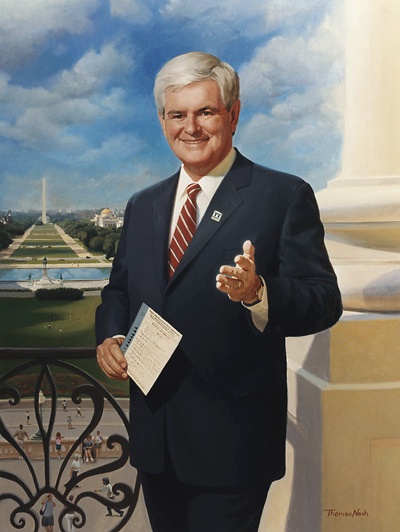
Today marks the final day of my Iowa odyssey. The state that is about as heart-of-the-nation as you can get is chaffing under the weight of political lard as the caucuses near. According to the Huffington Post, Newt Gingrich is roaring mad about the negative ads that are choking the airwaves. You’d think with a life in politics he’d be used to it by now. Religion, of course, is playing an undue role in this season’s GOP contest—everyone knows Mitt Romney is a Mormon and publishers are scrambling to get out books on that religion as fast as their authors can write. Rick Perry, to the chagrin of many, bears a Methodist affiliation and the religious sensibility of Genghis Khan. Of course, Newt appears relatively calm as a Catholic, at least for the time being. Jack Kennedy, however, he is not.

The Republican Party began a flirtation with religious conservatives as early as the Nixon years. Pundits realized that, like the Alaskan oil reserves, religious fundamentalists were an untapped resource to grease the rails to election day. Overjoyed to have a voice in high profile public office, the conservative Christian crowd began to wilt from the perceived failure of Jimmy Carter and began to glom onto the media image projected by Ronald Reagan. We all suffered through the Bush years, hearing more about God from the president than we heard about the soaring national debt or the coming crash that would implode upon the working class that elected him to office (so they say). Now, facing the choice of candidates wealthy enough to run for office, many are finding the choices on the shelves of the spiritual marketplace a little understocked.

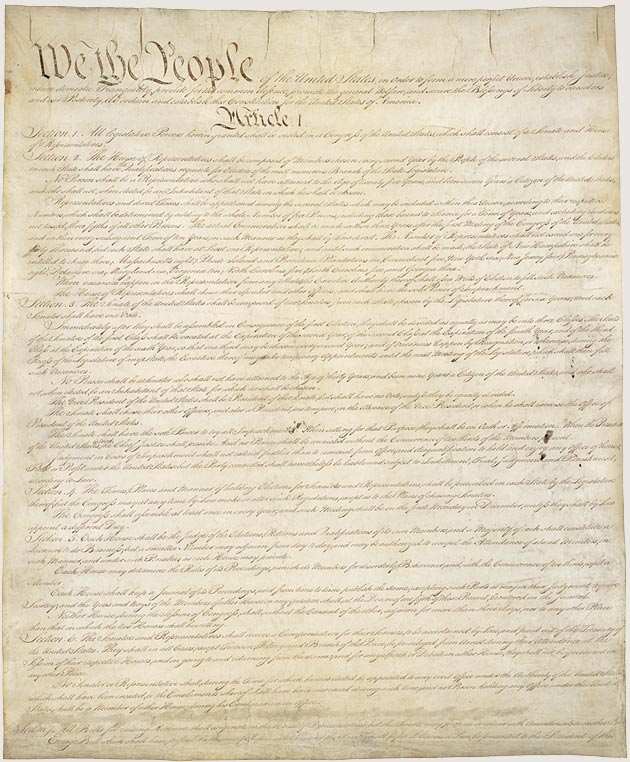
Back in the days when America was young, the founders laid down rules declaring that no religious tests would be imposed on those running for public office. Their fears proved prescient and uncannily accurate. Today perhaps the biggest test any candidate has to pass is his or her religious affiliation. Can we imagine a Mike Huckabee, Sarah Palin, or Michele Bachmann without their Bibles tucked under arm? Religion has no corner on the market for sanity. Many, in fact, would argue that the indications sometimes point in the other direction. The corner America has painted itself into is not so much shaded with red, white, and blue, as it is with the muddy brown of religious slurry that has become the new politics. Newt, newly minted from his Southern Baptist heritage, is mad about mudslinging. I think Americans should be enraged about religion slinging instead.


Apples and Evil

I’m not really a mall person. Since I’m not really a techie either, however, I find myself in malls where Apple Stores are located when I can’t get by without a little help from my friends. So it was that I spent several hours at a mall earlier this week. While there I browsed an oriental imports store—the kind of place with a no-frills, I-might-be-gone-tomorrow kind of feel to it. In the front window they showcased a display of swords. Since dragons are a major motif in Chinese folklore, the transition to medieval images of dragon-slayers seemed to be at play here. I am not certain of the last time an actual dragon was reported in central Iowa. One of the swords had a Latin inscription along its blade. My Latin is very rusty, but I did recognize the word “God” amid the fantasy spell. The connection between religion and violence was facing me in that unused (I hope) weapon.

Religion often serves as an outworking of human violent tendencies. Our violence is, no doubt, a product of our godless evolution. As we ascended the tree of life that gave us birth, some other creatures on that tree thought we were tasty. In an unintentional effort to defend ourselves, we grew larger and larger brains that gave us the edge as predators. As a collective, humans tend to be overachievers. We’ve whittled away most of our large predators to the endangered list so that we might shop with relative comfort. If there is guilt about it, we can always blame God.

Evolution did not endow us well with body armor or sharp teeth and claws. People seem to have evolved mostly for running away—that’s what our physiognomy suggests. Among the earliest of weapons was the blade. To be effective a blade must have reach. The sword, the favored weapon of the Bible, grew until weight and balance became optimal. To harm another person you had to be close enough to look that person in the eye. If we look we find another person like us, and we need an excuse for our violence. Religion is readily farmed as the ground for justifying such violence, for religions combat evolution and any differences of opinion. What I was seeing through this mall window was a cross-section of the human story. The sword was ornamental and had clearly never been used. Unfortunately, such weapons are rare. Rarer than my trips to the mall, Apple Stores notwithstanding.


Bible Review

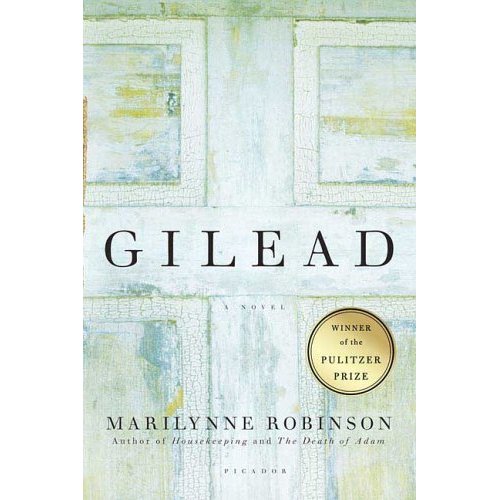
The Christmas edition of the New York Times Book Review begins with the Bible. Appropriate enough for a book that gave us “in the beginning” and the Christmas story in the first place. Reviewed by Marilynne Robinson, the Pulitzer Prize winning novelist, the Bible is presented as the unacknowledged source of much of our literary culture. It is a message that bears repeating every now and again, since the Bible itself is often equated with those who thump it instead of trying to comprehend it. The Bible is often guilty by association. Like any book, it has parts that we wish weren’t in it, but that is only problematic for those who think of the Bible in authoritarian terms, a book that must be rebuilt into modern culture, jot and tittle. Taken alongside other ancient writings, however, the Bible is a fine example of human evolution. It represents a segment of our developing culture. And, every now and again, atheist and evangelical should acknowledge, the Bible gives us profound insights.

Robinson’s article mostly focuses on reiterations. The Bible’s influence is deep, and in the English literary world, nearly universal. What authors have written in the past—and what they are still writing today—bears the stamp of the Bible. It was the first formative book in western culture, and to dismiss it completely is to throw away a valuable part of our selves. At the same time, even so able a writer as Robinson can’t escape the subtle supersessionism that coheres to the mythic reading preferred by a large cross-section of society. The Bible is a self-referential text, but the Bible does not know that “the Bible” exists. Books that eventually made it into the collection were written without an awareness that they would become authoritarian tomes millennia down the road. Modern believers still invest the books with the mystique of divine authority, often in subtle ways.

A point made by Robinson should be read by those aspiring presidential candidates super-bussing their ways across Iowa. “Moments of the highest import pass among people who are so marginal that conventional history would not have noticed them,” she writes of the biblical narrative. The vast majority of us are marginal in this sense. Those in seats of power frequently forget that it is the unassuming compliance of those further down the food chain that lends them their power. The Bible is nearly always on the side of the oppressed. The Bible, however, can also empower those deprived by the crass world of politics. It must be rescued first. Once they are done kissing babies and shaking hands, once they settle in their opulent offices built with the money that would have otherwise gone to those babies, politicians forget the basic truths of the Bible. As long as it can be thumped once in a while, however, they will keep it in the bottom drawer until it is needed again. Only by dealing with the Bible sensibly can its abuse be stopped.

There is, I hear, balm there.


Church of Siliconism

Some of us have been dragged into the electronic age kicking and screaming. Our apartment at home is full of books, and they are made of paper, not plastic. In college, some of my friends and I vowed we would never use computers—harbingers of a cold, new age. It was a vow I kept until working on my doctorate (pretty much). Despite keeping this blog, I really have very little native intelligence about the world of circuit-board, integrated circuit, and chip. I would probably be the last person to have thought to ask for an iPhone—I frequently forget to take my cell phone with me, and when I do, I sometimes neglect to turn it on. So I was stunned to find an iPhone with my name on it yesterday. I looked at it like an alien baby, wondering what it might eat. As the day wore on, however, I started to see some of what it might offer.

Siri, the software personal assistant for iOS, responds in a friendly voice to questions asked. “She” (and you can’t help personifying her) is like a personal portal to the mind of the Internet. You want a pizza? Siri knows the location of all the places in your neighborhood that deliver. You wonder what the most recent nation in the world is? Siri will look that up for you. (South Sudan, as of yesterday, according to her sources.) My brother-in-law, intrepid with electronics, and knowing my background, asked Siri about God. She replied, “Humans believe in spiritualism. I believe in siliconism.” Someone at Apple clearly has a sense of humor, but the more I began to parse this statement, the more I realized Siri could use a personal assistant in the religion field.

Spiritualism is not the same as spirituality; the former is the belief in ghosts and the religions that accompany that belief, such as Theosophy. Clearly in an American market, any product that denied belief in God, even by implication, would become the product of a witchhunt. The sad image of heaps of iPhones being melted as leering evangelicals look on is disturbing but unfortunately easy to conjure. Best to program Siri to deflect any potential ire with humor. The second component of her pithy reply is siliconism. As a religion, it is clearly underway all ready. Who reading this blog can imagine life without electronic media? Be honest! What does a computer believe? Do androids dream of electric sheep? Does Siri say her prayers as she’s being shut down for the night? What does it mean to believe? So now I have an iPhone. The day before yesterday I couldn’t find my app with both hands. Now I have a personal religion consultant. I suspect I’ll be starting a new religion by the end of the day—the First Church of Christ, Programmer. Its headquarters will be wherever a true believer is located at the moment, as long as s/he has an iPhone. Blackberry users will, of course, be considered heretics.


Silent Might

Iowa is a state for reflection. For many years Christmas in Iowa was a family tradition, but living on the east coast makes such pilgrimages rare. On Christmas Eve in Ames, we drove past a Nazarene Church decked out for the holiday with a sign reading, “Jesus Came for You.” Perhaps I watch too many movies, but the images that came to mind were of Rambo and The Terminator—menacing figures who’ve sought out their victims for revenge. Coming for you was a threat rather than a promise. Who can forget Arnold’s “I’ll be back”? Was the child who came sent with a mission of punishment or of peace? To hear presidential candidates and other evangelicals tell the Christmas story, it is clearly the former—the Rambo of God who blows away the sins of the world—that we should expect. The Prince of Pieces.

That version of Christianity that likes to present itself as the default, the natural form of what the church has taught all these years, has a strong current of threat running through it. God never shows up unless there is a problem—an absentee father only too swift to remove his ample belt to begin a sound thrashing. Religion often thrives in the context of menace. Teaching that people are evil by nature and only good when under promise of Hell, such believers understand the coming of Jesus to be cause for fear and alarm. According to Luke, the angels began their message with “Fear not.”

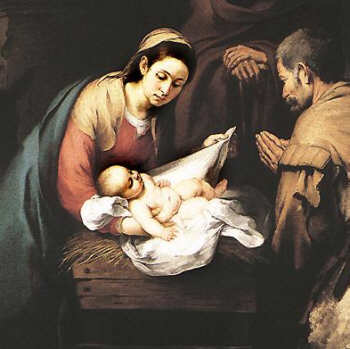
How Christmas is understood reflects on the view of Christianity that believers choose. For the advent and arrival of an emissary can be cause for celebration or of fear. In some mangers the infant conceals a cudgel and woe to those who suggest equal treatment of all or a non-literal reading of favorite prooftexts. This time of year stands as an excellent test of what this child will grow up to be in the minds of his latter-day cohort. What arrival should we anticipate? If it is the Jesus of the politicians and evangelicals, we only have to look at the headlines to discover the answer.

What child is this?


England’s Christian Gift

As much a part of the holiday season as Santa Claus and baby Jesus, the Salvation Army bell-ringers are out in full force. As I drop a quarter in the bucket, I ponder the strange lineage of this denomination. When the cheerful holiday shopper convivially donates spare change, few, I suspect, know that they are supporting a church. The Salvation Army is one of the bewildering number of denominations to spring from English Christianity. The Church of England, small in the United States, but imperial in much of the world, grew amid a religious unrest that spun off countless dissenters. We all know the story of Henry VIII and his not-so-merry wives. His political move to focus the official religion of England on the crown led to the Puritan resistance. Puritans left England for the Netherlands, and then on to America where they flocked to New England to develop into Calvinistic Congregationalists.

Meanwhile back in Amsterdam, some of the English Separatists evolved into Baptists. Baptists were also congregational in polity and also found the religious freedom of America to be appealing. (Now they select our elected officials.) The Puritans had helped develop the Presbyterian movement as well, with dissenters in Switzerland. Still at home in Britain, the Church of England waffled between Catholicism and Protestantism for some time. The evangelical fervor that emerged with the Wesley family led to the Methodist Church, which remained attached to the Church of England until its founder’s death. In America the Methodist Church grew rapidly. During the era of religious revivals the Adventist movement grew out of Methodism, as did the Church of the Nazarene, the Holiness movement, and Pentecostalism. All of them today are major denominations. Even the Anabaptists tip their wide-brimmed hats in the direction of the English dissenters. The Plymouth Brethren, inventors of the Rapture, were another English-derived denomination, as were the Wesleyan Churches.

What does all of this have to do with the Salvation Army? The Salvation Army was founded in London by a Methodist minister, William Booth, and his wife Catherine. The movement adopted quasi-military mythology and ranks, and soon grew into a church of its own that supported what would later become the Social Gospel cause. Known primarily for their charitable works, they are yet one more splinter from the tree of English Christianity. Perhaps the Christmas tree is an appropriate analogy for the Christianities to spring from Henry VIII’s loins. Like the pine’s many branches, each with its ornaments, Christianity in England sent its twigs in all directions. Counted together, the descendants of English Christianity far outnumber any other Protestant grouping. Just a thought to share while waiting for the quarter to drop.


Tebow or Not Tebow?

It is time to bow to the inevitable. I am not now, nor have I ever been, a sports fan. Every web page I open, however, seems to feature Tim Tebow, as if the media had never seen an evangelical before. Where have people been? What is even more amazing is that this athletic kid has invented an entirely new human gesture, “the Tebow.” Incredible what young folks can accomplish these days. And as Saturday Night Live has showed us, Jesus really isn’t that much of a football fan after all.

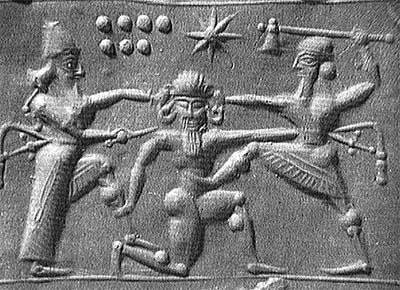
Ashamed at my naiveté, I decided to research the history of tebowing. What I found shocked and amazed me. Like so many modern day marvels, Tebowing seems to have been invented by those prescient Sumerians. Even before humans perfected the Tebow, semi-divine characters showed them how. This cylinder-seal depicts the monster Humbaba illustrating the correct posture to Gilgamesh and Enkidu. They do not, apparently, take kindly to his correction.

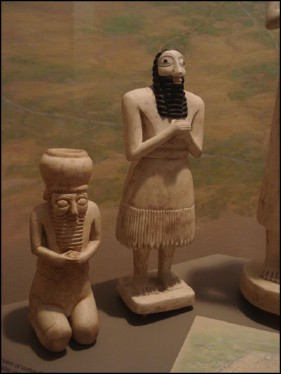
In the example below we see a rare double-kneed Tebow performed by an Asian football god while a hopelessly underchurched Joe Paterno looks on, hopelessly standing.

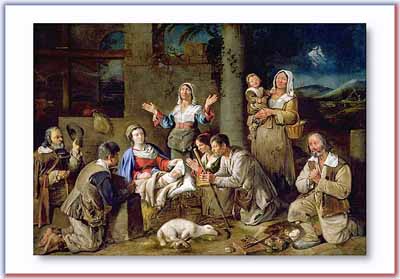
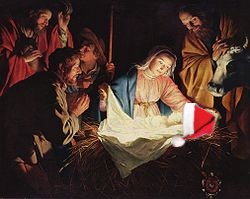
Fast forward a few centuries to a seasonal scene and we find shepherds tebowing to some baby. It is a fair guess that they suppose the baby to be a football incarnate.

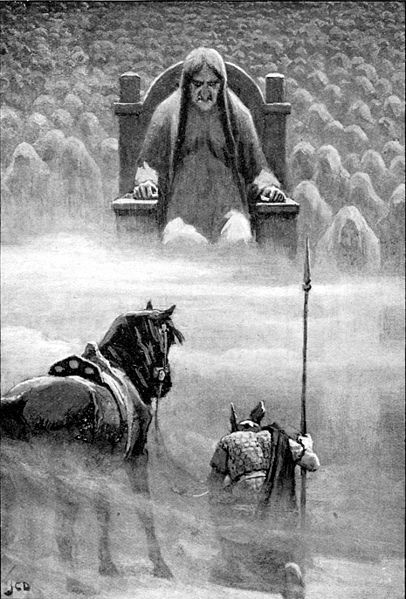
Lest we think the Tebow has been coopted by the Christian crowd, we must remember that no religion has a copyright on humility. In this scene from Norse mythology, a clearly pagan Hermod tebows before the goddess Hela. She does not look amused.

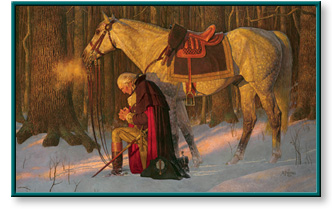
Americans, who after all claim to have invented the Tebow, can trace the gesture back to our founding father himself. In this famous painting of George Washington at Valley Forge, just after the crucial touchdown, the great man can be seen tebowing in the snow.

The snow is a great segue to the Cold War. Here, in a government photo, we see Soviet naval infantry tebowing as they contemplate the big game. They are not now, nor have they ever been, Broncos.

Now, none of this resembles the education I received during my three degrees in religious studies. No matter. ‘Tis the child becomes the man, as they say. And since a little child shall lead them, we can all learn to tebow as if there were no tomorrow. If the actual Tebow is as bright as the sports-scholarship students I taught at Oshkosh, Rutgers, and Montclair, the education of the future will include a lot lower academic expectations and, I suspect, lots and lots of Levis with holes in the knees.


And Lowe

Hate is harder to muster for people just like us. I mean, if they live like us and look like us, what grounds do we have to distrust and fear them? This appears to be one of the premises behind the TLC show “All-American Muslim.” Many people know Muslims without knowing it and fear them without being aware of whom they fear. With this insidious kind of fear and hatred, religion must be involved.

Over the weekend, CNN online ran an article noting how Lowe’s is pulling advertising from the program. It seems that conservative Christian outcry is rising like the children of Israel in Egypt; the Muslims aren’t shown as bad guys—they’re like your next-door neighbor! Fear of takeovers has long been on the Neo-conservative agenda. If Romney is elected we will by overrun by Mormons. If we sleep, we’ll awake to Muslim neighbors. And we certainly can’t expect to all get along. If it weren’t for the media, we would probably never even know they held a different religion.

I’ve lived lots of places. With the exception of Grove City College and Nashotah House, I never once was aware of the religion (if any) of my neighbors. If they are civil and respect my right to believe what I will, they are entitled to the same. Religious supersessionism and maybe a pinch of jealousy play into this attitude of keeping others a minority. Is it because Muslims and Mormons are more effective at winning converts? The modern evangelicals have been relying on political bullying to get their way. Why not learn to appreciate your neighbor’s religion instead?

Religious freedom is a two-edged sword. Many of those who are worried now were quite happy when they were in the clear majority. When the lines get blurry the trigger finger gets itchy. Come on, Lowe’s! Educating ourselves about other religions is the best home-building project out there.


‘Tis the Season

A news story last week related how a traditional park area in Santa Monica, California had been “taken over” by atheists who wanted equal time with traditional Christmas displays. The park, which houses 21 display areas generally populated by nativity scenes of one sort or another, had so many requests for space this year that a lottery was instituted—a lottery that the atheist groups won. Claiming 18 of the spaces, the atheists groups have vastly reduced the visibility of traditional Bethlehem mythology. Does anybody else feel a culture war coming on?

The whole “Keep Christ in Christmas” campaign that has been fermenting over the past decade or so has made many Christians paranoid. Society has forgotten, they claim, whose birthday we’re celebrating. A plain view of the facts, however, calls this assertion into question. No one bothered to record the date of Jesus’ birth. The stories about it, in the Gospels of Matthew and Luke, were written after a lifetime of reflection by people who were not eyewitnesses to any of the events. Historians of the era mention no celestial anomalies and there are no records of crazy old Herod killing babies among his own people. (His domestic affairs, however, may be quite another story.) What is absolutely clear is that the stories have grown with the telling. Many a child can tell you the names of the three wise men. Luke doesn’t even place them at the first Christmas, does not name them, and does not say there were three. No records of Zoroastrian migrations to Israel verify this story either.

The true loss is the loss of story. We live in a society that abuses the words “just” and “only.” That’s just a myth. That’s only a story. Ancient people—from the time of Jesus—appreciated the truths a story conveys. Consider the parables of Jesus. They cite not sources neither do they seek verification. They are only stories. They are also cited as the basis of many church teachings. Even atheists can be taught to appreciate the value of stories. Who could object to a myth advocating peace, harmony, and goodwill? Even if it’s just a myth.

Santa Claus might come to Santa Monica’s rescue. Yes, diehard fans of historical veracity will say there was a saint called Nicholas. We all agree that he didn’t wear red velvet trimmed in white and that he didn’t possess magical, northern latitude cervid stock. Even before the days of forced air heat he didn’t slither down every chimney in the world in one night. Few would dispute, however, the value of giving gifts of good will. Just ask any member of the Salvation Army who appear at this season every year. Instead of arguing about whom to exclude, why don’t we invite everyone to our celebration? Jesus, angels, Santa, Jack Frost, Heat Miser, and Christopher Hitchens—what a party this could turn out to be!

Is there no room in the manger?


Don’t Need No Righting

“If you can read this, thank a teacher.” So the old saying goes. Besides the virtue of venerable age, this proverb has the added advantage of being true. When I first peered at a page full of complex combinations of minute, triangular wedge-marks and was told I’d learn how to read them, I needed to head outside for a few gulps of cold air. My first attempt at Akkadian was doomed to failure, but eventually I learned to read cuneiform through the gateway language of Ugaritic. After that the bewildering sprawl of Mesopotamian languages didn’t seem so threatening. I don’t exactly remember when I was first exposed to English cursive in the classroom, but I do recall that same breathless fear of the unknown. The language I’d learned to print out neatly all seemed to be melting into curly figures that looked remarkably alike. How would anyone ever be able to read this?

According to a story in Sunday’s New Jersey Star-Ledger, schools are moving away from teaching cursive. Beginning next year 46 states will no longer require it. Beyond that, some politicians are questioning why teachers should be wasting their time instructing students in printing, or even keyboarding. The gold standard they are worried about is identity. Can you sign your name (to endorse this campaign check)? If we have another way of identifying you—eyeball scans seem to be very popular suggestion—why should you bother to scrawl your name? Keyboarding, well, kids already know that by the time they start school these days. If the texting craze really takes off we may evolve future generations with just thumbs. School is for teaching students science, math, business—practical stuff. Oh yes, and intelligent design. (Got to keep the gods, or anthropic principles, happy.)

In a world where languages are dying out at a disturbing rate (each language is a thought process as well as a way of stringing sounds together), we have become very cavalier about the very innovation that has allowed us to develop as we have. I used to tell my students that less than seventy years separated the Wright brothers from the moon landing. A human lifespan where technology outstripped our ability to think. And the pace has only accelerated since then. Are we premature in leaving out cursive from the curriculum? There is coming a day when future archaeologists will discover a strange substance that seems to have been manufactured from wood pulp. On it they will find scrawls with loops and curls that form a pleasing pattern in the repetition, but from which no intent can be discerned. And if they are like modern technocrats, they will quickly realize the utility of the wood pulp for starting a fire.

What's it say?


On the Move

Truth is increasingly a moving target. And when the Chronicle of Higher Education runs an article about religion, academics take notice. Actually, the article is about irreligion. An interview with Routledge author and Pitzer College professor Phil Zuckerman was the centerfold for November 23’s Chronicle Review. Zuckerman’s article, “Taking Leave of Religion” follows up from the book I reviewed on the sociology of religion. On the very same day, in an article my wife pointed out to me, MSNBC online published an article about the church and the Internet. Interviewed was Heidi Campbell, another Routledge author, at Texas A & M. What struck me in both of these cases was not so much what was said, but how.

In these days of higher education under siege, the media has come to love the young scholar. It has gotten to the point that I can hardly watch a documentary on the ancient world without seeing a friend or colleague on screen. I suppose the interviewing of scholars is not itself new, but the burgeoning of the celebrity scholar gives pause. Was a time when scholars wrote for other scholars. There are problems with that approach, mostly the issue of social irrelevance. Let’s be honest—when’s the last time we read a heavily footnoted, dry, academic monograph for fun? Honestly. So scholars have taken to the media. In popular forums with trendy words they make scholarship accessible.

What could be wrong with that?

The fact that I am writing this blog demonstrates that I believe in the public sharing of knowledge. I find it crass when experts charge for sharing what they’ve learned, but, I suppose knowledge is a kind of commodity in the marketplace of ideas. Herein lies the rub. The business of education. Scholars have become entertainer-specialists in the realm of commerce. Back in the day you had to seek the guru on the top of the mountain. Now he, or not uncommonly she, can be accessed from the comfort of your own couch or chair. Frequently there is no debate. Truth handed down, byte after exotic byte.

Perhaps we have lost the capacity for honest, if dusty, debate. Not only that, but the media now reserves the right to determine the truth we will receive. The target is moving, but the receiver is not.


Ignorance Should Be Bliss

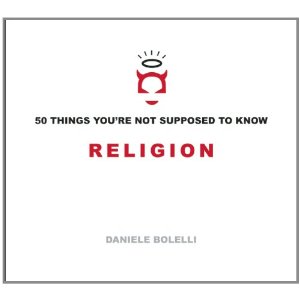
Even before we elected a president who was only a single year older than me, I had the creepy sensation that no one really knows what is going on. Call it what you will, but I am told, that for my own good, some information is kept from me. I can’t recall how old I was when I first came across the word “disinformation,” but the concept—a favorite of conspiracy theorists—has stayed with me ever since. It is that Kafka-esque sense that something is off kilter. Some time back I stumbled across a website called Disinformation, and was immediately intrigued. True to the nature of the title, the site keeps you guessing. I was pleased, therefore, when I was sent a prepublication copy of Daniele Bolelli’s forthcoming title, 50 Things You’re Not Supposed to Know: Religion. Disinformation has a plucky series of books in the 50 Things You’re Not Supposed to Know series, so I was decidedly curious about this new volume.

Not a heavy academic tome, 50 Things You’re Not Supposed to Know: Religion is written in a vein similar to this blog: reflective, unconventional, but not really earth-shattering. It is good fun. Bolelli does a great job pointing out less advertised aspects of otherwise socially respectable religions, not taking cheap shots, but simply rephrasing events as they really happened (mostly). Within all of this, however, some true wisdom lies. In thing 36 (of the 50), “Tao is the Sh*t,” Bolelli notes, “Many are those who, infatuated with all things ‘spiritual,’ forget that real spirituality is nothing but daily life lived with full awareness.” It is clear that Bolelli has an appreciation for eastern religions, but he is not so bourgeois as to let even those escape unscathed.

Often the reading of a book is the sharing of the author’s soul. The acknowledgements were so intense that I immediately felt that Bolelli has a hidden story. As the author of the highly regarded On the Warrior’s Path: Philosophy, Fighting, and Martial Arts Mythology, Bolelli is both a professor and a fourth-degree black belt. Clearly a man with whom to be reckoned (or better, reconciled). I too have been very influenced by a teacher who knows martial arts and who has one of the clearest heads around. I learned from him that there is a spiritual component to martial arts, and that spirituality seemed, rightly or wrongly, to be present even here in this book. Bolelli is willing to take on religions. In our alarmist society that stance is often confused with lack of morals or spiritual insight. From my idiosyncratic position, however, I found Bolelli’s small book engaging and irreverent and provocative (in every sense of the word). Do yourself a favor and read it. If you’re not careful, you’ll snigger a time or two and learn something along the way.