Religion Al Dente

I first learned of the Flying Spaghetti Monster while teaching a course on the Bible and Current Events a number of years ago at the University of Wisconsin Oshkosh. Being freed from the confines of my humorless seminary teaching post, I was free to explore innovative ways to approach my subject matter. When discussing evolution, it was helpful to bring in Pastafarianism as an example of how some highly intelligent—and very creative—people deal with the ridiculousness of Creationism. Lest I be accused of unfairness here, Pastafarianism is also ridiculous. That is precisely the point. The Church of the Flying Spaghetti Monster (FSM) was formed to demonstrate that any inane idea might pass as a religion and should be given equal time with those who use ultra-conservative views on the Bible to effect public policy.

A friend sent me a link to a BBC story of an Austrian man who has finally been successful in his attempt to wear a pasta-strainer on his head in his driver’s license photo. Claiming the headgear to be demanded by the Flying Spaghetti Monster, Niko Alm wished to have his official ID photo taken with the symbol of his faith. I sense an evolution taking place here. The Church of FSM has gone mainstream in many respects; there is a Bible available, you can buy a bumper-magnet to rival a Jesus fish, adherents have designed a slick website, and it boasts many, many followers. While the website of the Church of FSM defiantly refuses to be taken seriously, it makes legitimate claims—religions do not require literal belief, and therefore Pastafarianism is a true religion with believers not being held to any particular doctrine.

The outcry against the FSM movement (which began roughly early in the new millennium) demonstrates its effectiveness. Are there really people who believe this religion? A tour of the website should be proof enough. The claims made by the group have analogues in traditional religion; many major religions teach events and doctrines that are equally unbelievable in the confines of the physical world in which we find ourselves. It is difficult to believe that Niko Alm actually takes this seriously, but who are we to judge? The FSM has moved from making fun of Intelligent Design to casting the very definition of religious belief into sharp relief. Who’s to say we haven’t all been touched by his noodly appendage?
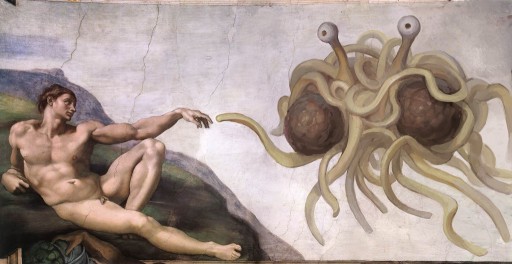
Touched by his Noodly Appendage

Cherry Pie

It is one of those days when it is too hot to move. The heat is the kind that gives you a headache, and the Internet beckons. Thus I came across Cherry Hill Seminary. Having been a seminary professor in a previous life, I’m always interested in the craft. This particular seminary, however, is unlike any other. Advertising itself as “the first and only graduate-level education for Pagan ministry in the world,” Cherry Hill offers pastoral education for those who identify themselves as Pagan. I find the concept fascinating. In an age where the standard offerings of the religious marketplace are experiencing their own kind of recession, the alternatives seem to be flourishing.

Just last night I was explaining to my class how the difference between the religious and the pagan is simply a matter of perspective. Used pejoratively “pagan” means any non-Christian, generally. “Infidels,” “heathens,” or “godless fill-in-the-blanks”—religions crave the handy moniker to make those who are different into “the other.” It is easier to detest a person with a label. Cherry Hill Seminary, however, offers a respectful view towards religious education. The school, which offers its program online, has the goal of educational accreditation. From some of the seminaries I’ve experienced, the bar should not be too high. My only concern is that the uniqueness of this program might fade into the background against some of the weirdness that ATS accredits among the mainstream schools.

Starting at least as early as the Bible, religions have looked upon each other as dogs straying into a bigger dog’s yard. Each one wishes to be the strongest one, the most respected and applauded. Why should paganism be excluded? Requiring a bachelor’s degree for admission, Cherry Hill offers courses in Text, Tradition & Interpretation; Nature, Deity & Inspiration; Pagan Pastoral Counseling; Public Ministry & Expression; and Pagan Advocacy & Leadership. Some of these offerings sound more informative than various seminary classes I suffered through. And on days when it’s hot like this, fantasies come easily. It is not too hard to imagine, especially based on my own experience, being treated more humanely by a pagan than by one who claims my own religious heritage.

When the cherry tree blossoms...


Religion Underground

Imagine a world where the affluent live in lofty houses and the poor, working class citizens trudge to long, dreary, factory shifts in order to keep the system working from their underground world. Although it’s not exactly post-recession America, it is not too hard to imagine. On my final day of vacation from relative unemployment, I watched Metropolis for the first time. A 1927 silent film, this movie of a dystopian world run by an unsympathetic ruling class is experiencing somewhat of a revival. Panned by early critics, the film is now often categorized as a classic of the silent era. It was also the most expensive silent movie ever filmed. Shot in Germany between the two world wars, the story follows a surface dweller who has fallen in love with a troglodyte. It even has robots.

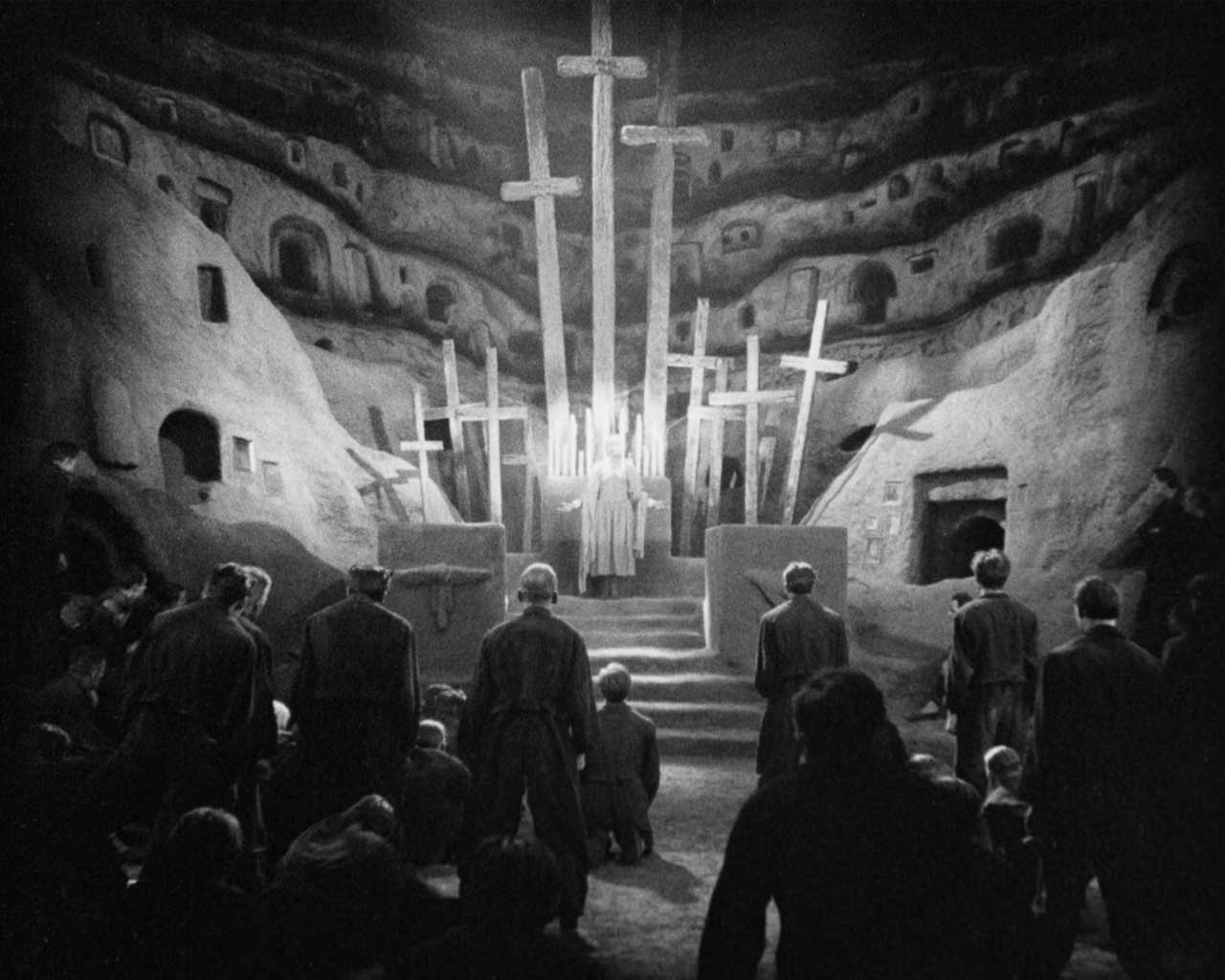
This Fritz Lang film fits in this blog because of its many biblical references and themes. Freder, the protagonist, falls in love with Maria, a working-class preacher among the underground laborers. Following Maria to the underworld, Freder sees the gargantuan machinery that runs the lives of the poor, and when workers die in an accident he calls out “Molech!” Molech, the putative god of child sacrifice in the Hebrew Bible, is shown as a fiery factory door consuming the forlorn men who dutifully march inside. Maria, however, teaches love and patience in suffering. In an underground cathedral she is the sole cleric long before most denominations recognized women as ministers. She compares the skyscrapers of the rich to the tower of Babel and insists that a mediator will come. With its strange blend of Christian and communist themes, this film made a significant impact in its time.

In our own day of entrepreneurship with faux-Christian backing it goes unnoticed that the Christianity of the first century was what might be called communistic. According to the book of Acts, early Christians keep their goods in common to ensure that everyone had what they needed. Among the disciples, Judas kept the common purse. What marked these early Christians as exceptional in the eyes of their earthly overlords was the concern that they had for one another—selfishness had no part in their religion. When Christianity became the religion of empire the lure of worldly goods distorted it almost beyond recognition. Christian industrialists built the tower of Babel with its leering Molech beneath the surface of the ground. Judas, it seems, has become the ideal role model for such a religion.

Maria's underground cathedral


Stobor and Dogs

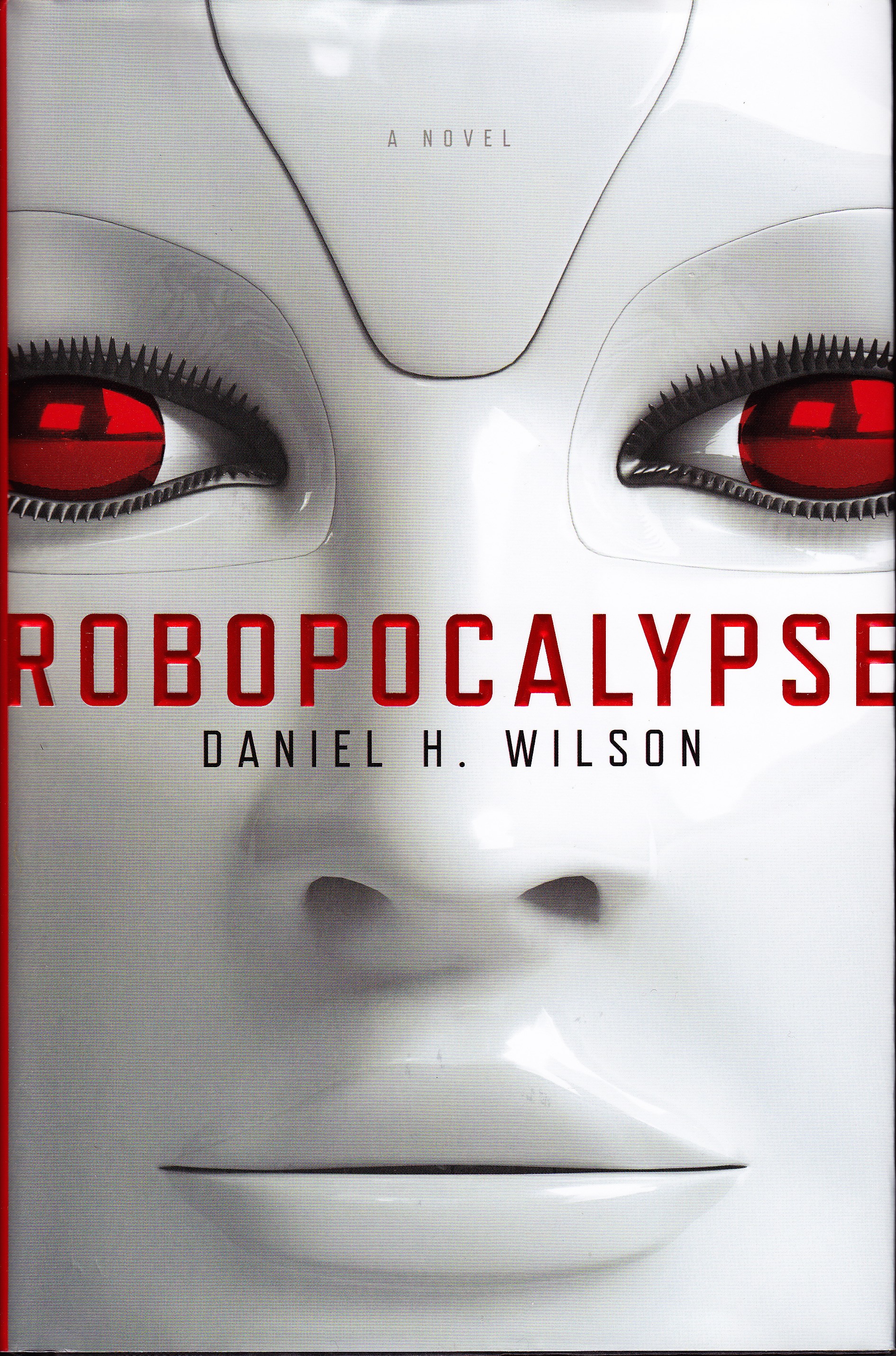
Having spent seventeen hours on public transit of various sorts yesterday, I had plenty of time to read. My chosen book for this trip was Daniel H. Wilson’s Robopocalypse. In my recent reading spate of dystopia novels Wilson’s vision seems more likely than others and thus perhaps a bit scarier. An obvious reason for this is that much of our tax money goes toward military projects that are, naturally, secret. A large part of Robopocalypse deals with military robots gone feral. Well, not really feral. The robots are controlled by a mastermind computer virus. In the first chapter this robot overlord declares to its creator, “I am your god.”

That statement is probably, metaphorically, true already. We live in a world where culture would change irrevocably without our current technology. Without it even fewer people would be reading the words I daily post here. Without it industry would shift into reverse back to the days of Thomas Edison or Eli Whitney. Present-day culture would be unrecognizable. Although not the best-written novel I’ve read, Wilson’s story does raise a salient issue—at some point the tool becomes the master of its user. For many years those who loudly proclaimed the superiority of Homo sapiens declared that we were the only tool-making animals. Subsequent observation has, of course, proven that to be inaccurate. Nevertheless, once knowledge of tools is acquired a trajectory is set. We lose a little bit of control.

Has technology replaced God? For some it clearly has. God is a symbol of comfort and meaning. As I watch thumbs busily texting away on planes, trains, automobiles—and especially in the middle of lectures—I realize that this altar of technology boasts many worshippers. There are very few scenarios where advanced technology is not present, like an omniscient being. Thankfully we have a few more years before Raymond Kurzweil’s artificial brain comes online. We should use those few remaining years to prepare ourselves for either an epiphany or an apocalypse. When the slaves become the masters, we are firmly in the territory of dystopia, at least from a human perspective.


Kings and Codes

I readily acquiesce to the suggestion that others are smarter than myself. In a world of overly competitive commerce that has wormed its way into higher education, I have found myself ill-equipped to compete against those who are more clever at working the system. At times I can be decidedly pre-medieval in my perception of fairness. Thus it was a combination of self-denigration and legitimate surprise to find a brief piece in the May edition of Wired magazine on the Code of Hammurabi. In this arena I would have supposed myself to be on firmer ground. The piece by Joel Meares appeared in the Blast from the Past section of the “Humor Issue” of the erudite magazine. The writers at Wired are by default well beyond my ability in the tech scene, but this piece was a consideration of how Hammurabi’s justice still plays its way out in popular culture. Beginning with the 1970’s movie series Death Wish, Hammurabi is given credit for inspiring Hamlet, The Count of Monte-Cristo, Red Dead Redemption, Frankenstein, Moby Dick, and Batman. Holy pedigree, Hammurabi!

Each semester I try to explain to my students why study of the ancient world is still relevant. It may be overly simplified to suggest that Hammurabi directly inspired all these works (the Akkadian language wasn’t really deciphered until the middle of the nineteenth century, CE, long after Shakespeare), but clearly the trajectory had been set long ago. Even before Hammurabi. The earliest known law-codes predate Hammurabi by many centuries and demonstrate that our sense of justice and fair play were being bandied about by the gods long before Hammurabi was a twinkle in Shamash’s eye. If we want others to play nice, the best way to convince them to do so is to lay the dicta in the realm of the gods.

Maybe I can’t figure out where Death Wish and Moby Dick share anything beyond a cursory resemblance to Hammurabi, but it is clear that the Mesopotamians were the first to articulate the idea that the gods set the rules and it is our duty not to upset them. Of course, in our society fair play is frequently sublimated to corruption at various levels. Someone is always willing to bend the rules if the covert payment is enticing enough. After all, doesn’t it look like Hammurabi is placing his fingers to his lips while receiving a kickback from Shamash on the pinnacle of the famous stele bearing the code that now bears his name?

Hammurabi winks at Shamash


Metaphor

Author Neal Stephenson, inspired by fellow author George B. Dyson, built a baidarka a few years back. The baidarka, an Aleutian version of the sea kayak, was such a necessity of life among the Aleut that it was treated as a living being. Whenever I find myself at the same latitude and longitude as the baidarka Neal built, I like to take it out for a relatively safe lake voyage. I’m not much of a swimmer, and taking boats out on the big water always chills me before the water actually touches my skin, but this is a kind of ritual that I feel compelled to observe. It is a participation in the mythic world of the Aleut. As spiritual beings, kayaks were a necessary part of life for island dwellers. In their own way, I suppose, they are saviors.

Author and partner in the baidarka

Traveling by water, I find, is a spiritual experience that eschews scientific quantification. It is a feeling, not a measurable commodity. To quote the great sage Rat in Kenneth Grahame’s The Wind in the Willows, “There is nothing—absolutely nothing—half so much worth doing as simply messing about in boats.” We are born of water, mostly made of water, and ineluctably drawn to the water. Rachel Carson suggested in her classic, The Sea Around Us (always one of my favorite books), that having evolved from the sea we are forever yearning to get back to the sea. Water is life as much as blood is.

broken water

When water breaks by being forced into an unyielding shore or by being thrown over a cliff to become a waterfall, flinging refreshing spray into the air, its great energy is released. Although its flow may be interrupted it will break apart granite and basalt, literally moving mountains and carving coastlines. Water that is placid in the morning may be raging by the end of the day. Water is life, and if life is anything more than a metaphor no one has yet convinced me of it.


Troying Around

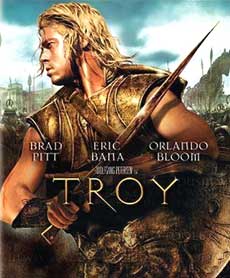
While discussing Homer with my relatives, it was decided that we should watch the movie Troy. Although conceived as a blockbuster retelling of the Iliad, the presentation reminded me significantly of The Clash of the Titans (2010). In both instances the directors and writers attempted to portray a realism of sorts, making Achilles and Perseus into just regular guys with issues. There is something of the fallen hero here, and perhaps a misunderstanding of the way the Greeks understood their greats. While it can’t be denied that heroes were intended as figures of unattainable stature, they were in some sense conceived as role models for mere mortals. The Iliad is an exploration of the anger of Achilles and the unpredictable influence of the gods.

As the critics pointed out when the movie was first released, the absence of the gods from the film is a serious departure from the Iliad. Without the gods, Achilles takes on a level of prominence never intended by Homer (whoever he was) and the playing out of his revenge begins to feel like a bad western. Although the Iliad does focus on Achilles, it requires an ensemble cast. None of the characters are evil like the movie portrays Agamemnon. He, along with his brother Menelaus, is the hapless inheritor of the curse of the house of Atreus. No matter what Agamemnon does, he is doomed. This fatalism is cut short in Troy as Menelaus, Ajax, and Agamemnon fall in the foreshortened battle of Troy.

The Trojan War is a myth. There is no history to portray accurately here. Instead there are gods and heroes. In removing the gods—a subtle nod toward many modern sensitivities—the movie loses its soul to beat the bank. And so perhaps it is a modern parable for a society that values money above all else. Whether the gods are real or not is immaterial, for they are but projections of the human spirit. Without them we are mere molecules conglomerated into biological entities with no purpose. Troy is a movie that falls short of truly mythical status, but at the same time holds a mirror to modern culture and asks “are you so sure that you can live without the gods?”


Patriot Games

Earlier this week I had the occasion to find myself in Newark’s Liberty Airport. I had mentally prepared myself for a government-sponsored groping (I find full-body scanners immoral and, no matter what the Patriot Act says, illegal) but I managed to make it through with just emptying my pockets and walking around in my stocking feet. Once I arrived at the gate area, I was once again struck by the duplicitous use of religion in America. Posted above each gate was a small banner reading “God Bless America” surrounding a stylized flag. I thought of the Hindus, Buddhists, and atheists flying out of that terminal (and in Newark I am certain there were all three species, in spades). Since 9/11 the staffs of the large New York City airports are justifiably cautious, but the blending of nationalism with divine will always makes me nervous. Especially since the weightier implications are so readily ignored.

In the biblical world the ideal was that travelers would be treated fairly. Someone away from home is already at a disadvantage. In ancient times the traveler deserved special consideration, not to be swindled or met with unfairness. Looking around at the prices merchants charge for those who’ve gone beyond the gate and have no choice, it struck me how when religion and economy collide, economy always continues on unscathed. The weary traveler, according to the Bible, especially deserves fair treatment. Charging extra to someone already at a disadvantage violates just about every biblical standard that echoes through those unread pages. God bless America? Only if it fills the coffers.

The sentiment expressed in “God bless America” is vastly at odds with the way we behave. Taking advantage of others is the bane of prophets and messiahs alike. Taking care of the poor, the disadvantaged, the traveler—this is the biblical ideal. Instead it is easier to band-aid over our sins with posters asking God’s blessing on our insincerity. Many people fear Islamic fundamentalists without taking into account the more subtle damage done by our own homegrown variety, giddily holding hands with an unfettered free market. Cheating the traveler may not be as wicked as blowing up an airplane, but both these tangled vines, in the biblical view, spring from the same root.


How Great Thy Art

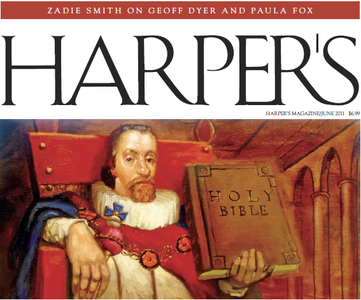
Celebrating the four hundredth birthday of the King James Bible, last month’s Harper’s magazine featured seven popular writers giving their take on various passages from the Bible. Noting the Bible more or less gave the English language its shape, this little exercise in eisegesis represents, in small measure, the power of the Bible even today. While many lament that America is no longer Bible-centered, with its misuse and abuse in the political arena the Bible still seems to be the heavyweight champion of the country, albeit altered through the eyes of certain key players. I was happy to note Harper’s chose novelists and poets to respond rather than theologians, biblical scholars, or—God help us—televangelists or politicians (frequently the same thing). What emerges is a tapestry that alike puts biblical scholars’ teeth on edge and makes fundamentalists wince.

Novelist Howard Jacobson looks at the creation story and takes the angle that God is a lonely artist. Writes Jacobson on the creation of light: “It’s good because it reveals an idea. The artist isn’t obligated to explain what that idea is.” Here, in the words of a non-specialist (can one say “amateur” of an accomplished novelist?) lies the heart of the matter. Art is creation and creation must be interpreted. Anyone who has undertaken a creative enterprise knows the feeling—the casual, disinterested glance at your work hurts. Any artist wants to be appreciated. Once the metaphor of God’s authorship of the Bible is recognized, there is a group of human artists hiding somewhere outside the annals of history. One of the great mysteries of the Bible is that we know very little about who wrote it (with the exception of Paul in the Christian Scriptures.)

The Bible is a work of art on a broad canvas. Today it is frequently criticized for the abuses it endures, but if we allow it its original purpose the view should become more sympathetic. The Bible was composed by individuals struggling with ideas. For millennia it served as a useful guide to the human experience until the church became politically powerful during the reign of the emperor Constantine. From that point on, deep knowledge of the Bible became power. For centuries the church guarded that power, keeping it in the hands of the clergy. Now that the Bible has become democratized, it threatens to take over democracy itself. Out there, somewhere unseen, the original artists are snickering as they chink their glasses and toast their accomplishment—they are writers who changed the world. But I suspect Paul is there too, warning them against partying too much.


Black and What?

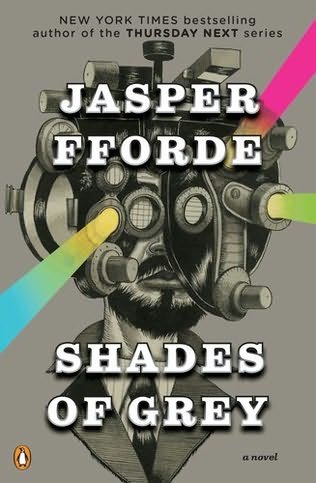
Dystopias are not all of the same stripe, or, in this case, color. Jasper Fforde’s Shades of Grey is perhaps the most colorful look at a bleak future I have ever read. The premise, funny and strangely serious, is that in the distant future color perception ability determines social rank. A cast of odd characters who see predominantly only one color vie for superiority while keeping to the rules of the founder of this society. The hilarious results often carry profound consequences. Those who live within this highly stratified culture fear those who do not, including a mysterious group known as the monochrome fundamentalists. The founder of the social order, Munsell, has achieved god-like status and his writings have the force of scripture.

This dystopia reflects, whether intentional or not, the social impact of many religions. Reading about the prefects, the political leaders of this culture, is like reading about the clergy who mistake spiritual guidance for power. The transition from pastor to politician is simple enough among social creatures like ourselves: we need those with persuasive powers to make decisions in accord with our best interests. Prefects and priests, however, are both eminently corruptible (let us say nothing of politicians) and evolution favors those who look out for themselves. The trick is to make others buy it.

Fforde’s dismal future includes Leapbacks where useful technology from the past is discarded in order to make people more compliant. In a world where color is a rare commodity, a modern usage of the rainbow seems apropos. Everything we are learning from psychology and biology—sciences still in their youth—suggests that sexual orientation is deeply ingrained, more so that just preferences or likes. The mainstream religions, however, have actively discriminated against those who are aware of their deepest needs. I know many excellent, caring individuals who’ve been kept from the ministry because of their orientation. Others who are clearly deleterious to the church climb to positions of power based on their approved sexual appetites. And society falls into lockstep with them. I don’t know Jasper Fforde’s political views, but along with him I would suggest that the ability to see shades of gray might be the best thing for any society, whether in the distant future, or especially, in the present.


Religious Reflections

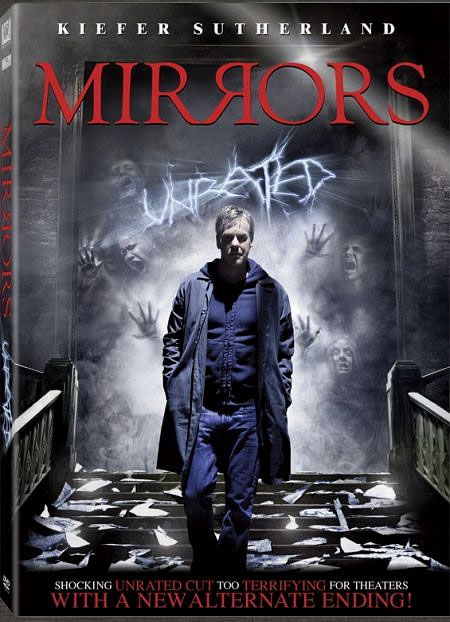
In a stunning display of alacrity, over the weekend I viewed the movie Mirrors only three years after it was released. Since I watch horror films with a view to how they portray religion, I was preparing myself for disappointment when well over halfway through no overt, or even subtle references seemed to have been made to any holy topic. As Ben Carson, security guard, discovers that the mirrors of his night-watch building are haunted, the story seemed to be evolving into the standard ghost movie. When the missing character of Anna Esseker was finally found, I breathed a sigh of relief—she was living in a convent (because there were no mirrors there). What I supposed was a ghost movie was really a demon movie, and I found yet another example of how fear and religion interact.

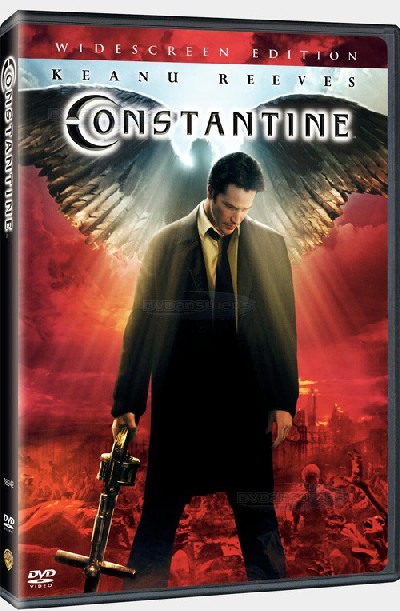
Since I’m currently preparing a program for a local church on the way that Christianity is represented in the movies, I’ve been rewatching a couple of standard films to gauge the scope of this interaction. So this weekend I also watched Constantine. This has never been one of my favorite movies, but as imbued as it is with Christian mythology it cannot really be ignored. When Gabriel is explaining to Constantine why he is bringing the devil’s son into the world, I realized that the reason coincided with some of my observations. Gabriel notes that humans need fear to appreciate God. By bringing fear into the world, Gabriel will force humans to become more pious. Intertextuality in the movies.

If I might indulge in some theological (that word makes me shudder) speculation that may not have been intended by the writers/producers, both of these movies utilize the concept that demons are trapped by mirrors. This may be a reflection truer than ever intended—we are our own demons. Mirrors reflect the vanity of visual appeal; our looks fade and our true self remains. Is that self an angel or a demon? Christian tradition states they are one and the same. Demons are only fallen angels. I’ve seen enough horror films to know that religion is not a universal element, but it often does appear in the role of producer of both good and evil. In this sense, at least, the movies are very honest.


Voted Off the Island

One of my readers sent me an article about the Church of Sweden. According to this article only about 15 percent of the members of this national church “believe in Jesus.” The question raised by this statistic is a vital one in a world where politics and religion become inextricably intertwined: what is Christianity and who decides? As the recent vote in New York permitting gay marriage (about time!) shows, many who identify themselves as Christians in America equate that religious outlook with conservative political views (even on issues the Bible says little about). It is what the believer says they “believe” that defines the religion. Ancient religions, as I have noted before, show that this outlook on devotional practice is not the only alternative.

Religions began as a matter of praxis—what people did rather than what they believed. What does an almighty deity gain from theological assent in the heads of believers? Is it a warm, fuzzy feeling or something more? Belief, a very strong motivating factor in humanity, is a psychological phenomenon, not a spiritual one. Many religious groups today are reluctant to accept that psychology covers the territory formerly covered by spirituality. Both phenomena (or the phenomenon) occur in the brain. If a brain does not assent to the typical belief structure, is it thereby deported from the gathering of a religious body? Many times in religious history that has been the case, but what do we say to the Church of Sweden? Kick out 85 percent of your members? I can see many unhappy, unemployed clergy in such a future.

What does it mean to be Christian? Is it to deny civil rights to anyone who differs in outlook or lifestyle from you? Is it sleepily to say “yea” when you wake up after a sermon? Or is it following the teachings of Jesus? The same one who once taught his followers to love those who differed from them, to turn the other cheek instead of proactively pulling out their handguns? It seems that in the modern furor to laid hold of claims of absolute righteousness humanity has somewhere fallen between the cracks. I’ve never been assaulted by a Swede, and I don’t recall, in recent years, Sweden invading other countries to further its economic fortunes. Could it be that, to paraphrase a religious thinker of antiquity, a Swede shall lead them?


Contriving the Rapture

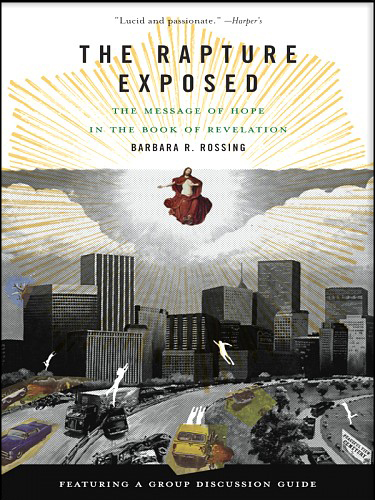
In the light of last month’s failed rapture attempt, I decided to read a book that I picked up some years ago that had been written in the wake of the millennial scare. Having grown up with nightmares of the rapture, I learned during my first college class on the book of Revelation that it was relatively modern meme, invented in the nineteenth century. Barbara Rossing’s The Rapture Exposed seemed a good way to refresh my memory without having to go through all those boxes of books in the attic to find my original textbooks. Rossing, a Lutheran minister and New Testament professor, brings to light some very important facts beyond the historical roots of this theological fabrication—facts that should concern religious and secular alike. The rapture was invented by John Nelson Darby, a founder of the Plymouth Brethren and convoluted biblical scholar. Basing his roadmap of the future singularly on Daniel 9, he concocted the rapture to make sense of his apocalyptic epiphany. Drawing diverse sections of Paul’s letters to the Thessalonians, the Gospel of Matthew, and the book of Revelation together, he mixed thoroughly, half-baked it, and pulled the rapture out of the oven.

The idea caught like wildfire. Today young people who’ve never read the Bible and who’ve seldom attended religious services know what the rapture is. What they do not realize is that nearly all of the Christian tradition rejects it, seeing it for what it is—a Johnny-come-lately of amateur theology that sees the Bible through the lenses of dilettante-sensibilities like those of Michael Drosnin (The Bible Code man). Instead of seriously reading the Bible and trying to understand it, society prefers to see it as a little bit of magic in the midst of our scientific and technical world view. It is a safe place where bits of the supernatural are preserved and that defies rational explanation. Rossing’s book does a good job of exposing the wrong-headedness of LaHaye’s Left Behind conclave, but she overlooks an important feature of this coterie: they have an unconfessed agenda.

The unspoken agenda is best summed up by Lt. Frank Drebin of Police Squad when he says, “blowing away a fleeing suspect with my 44 magnum used to mean everything to me. I enjoyed it, well who wouldn’t?” Rossing misunderstands Fundamentalism when she expresses surprise at the bloodlust present in the Left Behind novels. What she doesn’t take into account is that, as a collective, Fundamentalists thrive on self-righteousness. Feeling the same violent urges that others do—all humans experience violent emotions—they sublimate that aggression and save it for the unrighteous—God’s enemies. When the gloves come off in the apocalypse, that hatred bursts out in good, old-fashioned bloodletting—albeit with combat helicopters and high-tech weaponry. Of the Christians I know who own guns, the Fundamentalists are most avid in their rights to do so. In college I met my first Christian survivalists and I learned that the rapture was a ruse. It is a deadly mix, especially when this warped theology makes it into politics. Although Rossing’s vision of a new earth in the second half of her book may not appeal to everyone, Americans should read at least the first few chapters to learn why the rapture will never occur.


American Haunted

Serendipity, although rare, still occurs in university life. As an adjunct instructor whose livelihood revolves around the number of courses that may be squeezed into a limited number of days, I have been considering online courses. As an avid watcher of horror movies—excellent preparation for adjunct life these days—I have attempted to sample the genre widely. It is therapeutic to see people in fictional situations worse than my own. While attending a training course on constructing online courses earlier this week I was surprised to find out my instructor was Brent Monahan, a versatile and talented individual of whose presence at Rutgers I was unaware. Most famously Dr. Monahan wrote the novel and screenplay for An American Haunting, a movie I had written a post on back in January.

Compulsive in my desire to be on time, I generally show up to all appointments early. For this particular session I was the first person present, so, not recognizing my teacher, we struck up a conversation about my field of studies. (He asked; I try not to lead with my chin.) He was nonplussed about the fact that I am affiliated with the religious studies department—in general this is a conversation stopper since, along with politics, it is a forbidden topic in polite company. Before I realized who he was he suggested that perhaps people go into this field because of their internal struggle with good and evil. It was a perceptive statement and it made sense when it came out that he was a writer of horror films and novels.

Since I’ve been exploring the nexus between religion and horror I have wondered what the deeper connection might be. Clearly fear of the unknown, the overly powerful, and the randomness of life in an uncaring universe play into it, but perhaps it is also the struggle of good and evil. Horror films often present the “what if” scenario: what if the side of evil were allowed free reign? Often the fount of that evil, in horror films, is religion gone awry. Certainly in An American Haunting a pious man is driven by inner demons to the abuse of his own child. That he is a religious man is made plain from the near-constant presence of a clergyman in his house once the haunting starts. While the exact relationship remains to be parsed, it is clear that fear and religion reside very near one another in our brains, perhaps as near as good resides to evil.


Floods and Fairytales

Never mind that the Bible gives only a cursory description of “Noah’s ark.” Never mind that the story in Genesis is clearly derivative from Mesopotamian originals such as the epics of Ziusudra, Atrahasis, and Gilgamesh (the Utnapishtim version). Never mind that all species of animals cannot survive within a single, extremely limited biosphere without evolving afterward into the diversity that the world currently hosts, even counting extinctions. Never mind that not enough water exists (with apologies to Kevin Costner) to cover all landforms without every mountain being pounded flat and stacked neatly on top of the ocean floor. In short, never mind reality—people will continue to build replicas of Noah’s ark. As a literary trope the ark has proved invaluable; many of my posts demonstrate how it appears and reappears in books and movies as a symbol of human irresponsibility. And yet, in order to demonstrate the veracity of an ancient myth, we continue to build fundamentalist arks.

Yesterday my wife pointed me to a msnbc story of an ark being built—and sailed—in the Netherlands. Certainly those in the “low countries” have global warming to deal with more immediately that those on higher (geologically, not morally, speaking) ground, and the engineer of this particular ark does not strike the viewer as a rabid literalist (he is a little too unkempt for that, and his shirt is not white and he wears no tie). John Huibers, however, worries about a more localized flood in the Netherlands. The ark may be overkill since polar bears, koala bears and panda bears are rare in Amsterdam, at least when one is not medicated. Arks, however, make great tourist attractions.

In Hong Kong the Kwok brothers built an ark replica in 2009. Greenpeace has one in Istanbul. A Christian theme-park featuring a full-size ark is under development in Kentucky, and just two years ago I drove past a roadside ark being built in Maryland. Most of these arks, interestingly, follow the design in the Sun Pictures’ production In Search of Noah’s Ark rather than the more traditional, mythic design in my children’s Bible. It is a natural human tendency to mistake form for substance. The story of Noah is a cautionary tale that has taken on daunting real-life implications in our treatment of our planet. Water is the signature of life, but for us land-dwellers too much is not a good thing. Thankfully, should a flood come, there will soon be enough arks around the world that would-be Noahs may find themselves in a buyers’ market.

Still my favorite ark