Proselytizing Phylacteries

Two related stories appeared in today’s newspaper, both of which concern the Bible in public life. A commercial airliner was forced to undertake an emergency landing in Philadelphia while en route from New York to Louisville, Kentucky yesterday because of terrorist concerns. The cause for alarm? A Jewish teenager’s use of his tefillin in public. Often translated as “phylacteries,” tefillin are prayer boxes worn on the arm or forehead during prayer in some sects of Judaism. This idea is not really obscure if someone has basic religious training. People on the US Air flight, afraid that the scripture-bearing artifact might be a bomb, had their lives disrupted while the boy calmly explained what he was doing. After landing, TSA officials came aboard, just to make sure. That’s a comfort! TSA officials seem unable to spot a real bomb but take a more than academic interest in a boy saying his prayers. Perhaps reading a Chaim Potok novel should be required training for TSA service? As my wife observed: what if someone took out a rosary or a crucifix? Would the flight be diverted to van Helsing’s residence? The level of this religious ignorance belies the grumbling in my post yesterday. Religious study is vitally important in an increasingly global society.

Is this phylactery da bomb or what?

The second story, again courtesy of my wife, was first run on MSNBC earlier this week and reprised in the paper today. Trijicon, a major defense contractor for the U.S. military, has for years been stamping Bible verse references on its rifle scopes. Concerned citizens, perhaps after watching sniper Private Jackson quoting the Bible in Saving Private Ryan, have raised concerns that Bible verses on rifle scopes constitute proselytizing. In Muslim countries, after all, those who have been shredded by a bullet before they ever saw their assaultant might be tempted to convert if they ever glimpsed the rifle scope and saw the Bible emblazoned on it.

Today’s story indicates that Trijicon has agreed to provide “Bible verse removal kits” to the military so that the verse references might be easily erased. What is so sad about this situation is that no one seems concerned that the maker of lethal weapons adds Bible citations to their products. The purpose of these devices is the killing of other people. The Bible seems an odd choice of supporting literature for this cause. Well, maybe not. The Bible knows how to call down the wrath of the Almighty on enemies as well. And the Bible gives instructions on how to pray with a phylactery. These stories demonstrate as clearly as possible how selective reading of the Bible leads to hypocritically varying results in an overly religious, but religiously uninformed, society.



Portrait of Poe as a Young Man

An obscure portrait of Edgar Allan Poe has come to light and is scheduled to be auctioned off. Reports indicate that the watercolor painting reveals a young man without the world-weariness of the more familiar images of Poe. He may even be smiling.

Poe has long been one of my personal muses. His writing captivated my imagination as a young man, and his sense of tragedy encased a golden nobility. Although many consider his works to be juvenile, like the slightly later stories of Sherlock Holmes by Arthur Conan Doyle, Poe grew to a mature sensibility concerning life that rivals that of Job. Intrigued, years ago I wrote a high school term paper about the writer and discovered a spiritual compatriot who couldn’t outstrip the “unmerciful Disaster [that] Followed fast and followed faster.” Now on the side of years beyond the lifespan of my muse, I begin to understand how a happy young man becomes a Qohelet in his time. In his personal difficulties, Poe was able to speak for many of us.

To me this young portrait is cast in the tint of Dorian Gray. The real image of Poe is that of a man given few breaks in life. A man of keen sight and keener insight. There have been thinkers like Poe from ancient times, but they are generally resigned to the depths rather than to be found basking in sublime sunlight. When Ludlul bel Nemeqi or Khun-Anup pour out their souls to an unhearing sky, they create a fellowship for latter day Poes and Melvilles and Lovecrafts. I hope the portrait of a young Poe finds a good home and the message of its subject rings as loudly as the bells.

Poe-ever Young


Who Owns History?

Jordan has been asking for the Dead Sea Scrolls to be given back by Israel. During the Six-Day War of 1967 some of the ancient documents were absconded by Israel, according to the Jordanian point-of-view. (Nothing in the Middle East is every truly neutral or non-biased.) According to the newspaper, now Jordan wants them back.

This controversy is part of a larger trend for nations to demand “their” antiquities from foreign powers who have claimed and displayed them (in many cases) for large numbers of people to see. They are part of the world’s heritage and the modern day countries from which they emerged want them back. Why? To bolster national pride? Because of their inherent cultural value? To draw in tourist crowds who are interested in antiquities? The ownership of history is a touchy question. History itself belongs to the entire human race while individual artifacts may be stolen, purchased, or destroyed. Some are in the hands of major museums, minor museums, or in the houses of private collectors. Nations struggling for international respectability often want their heirlooms back, and this is only natural. At the same time, these nations may not have the infrastructure to preserve the artifacts securely. Think of the Baghdad Museum. When any government becomes unstable national treasures are at risk.

The Dead Sea Scrolls owe much of their public appeal to scandal. The story of their discovery and sale, rich with intrigue and skullduggery, is widely known. They capture headlines like 2000-year-old sex symbols; their chic name and aura of mystery assure public interest. As a scholar of the Hebrew Bible, however, I have always found the Ugaritic texts to be of far greater importance. Nevertheless, while living in Wisconsin some years back, and teaching at Nashotah House, I arranged a field trip to the Field Museum in Chicago where a roving Dead Sea Scroll exhibit was settled for a limited time engagement. The seminarians were excited, and we decided to make a family trip of it. My daughter was a pre-schooler at the time, and we towed her along to be acculturated. In a dimly lit room, the feeling of an authentic Middle East chaos attended the display, people wandering blindly around, not quite sure of what they were looking at (this based on overheard conversations). People wanted to be near history, even if they didn’t know why. I had seen the famous scrolls in the Shrine of the Book some years before, but it was easy to feed off the excitement. When we got home we asked our daughter what she enjoyed the most from the bus ride and day out. “Seeing the Dead Sea Squirrels,” she replied.

History involves seeing what we want to see. Nobody owns it. Everybody owns it. Who should keep the artifacts? I don’t know. It seems that history is larger than petty desires for cultural fame. But then, that is what history records — our desires to stand out from the crowd.


Rushing in Where Angels Fear to Tread

As my daughter’s public school undertakes its humble efforts to raise funds for the devastated nation of Haiti, contributing the little that unemployed children can raise, Rush Limbaugh unapologetically proclaims that Americans shouldn’t contribute to the earthquake relief. The New Jersey Star-Ledger notes that on Wednesday Limbaugh declared that Americans already support Haiti through their tax dollars and shouldn’t feel the need to contribute anything beyond that to the poorest nation in our hemisphere. This is true Christianity, according to the Neo-Con gospel.

Rush Limbaugh basks in the limelight as the outspoken representative of the “Gott und Ich” school of religious politics. With an estimated annual salary around the $400 million mark, Limbaugh comfortably sits back and watches the world burn around him. Together with James Dobson, Pat Robertson, and others who support the new, compassionless version of Christianity (Christianity 2.0), they inveigh directly into the ears of high-ranking politicians with coarse voices declaring that God wills for them to be the sole arbiters of what is right. I only hope that Americans are really listening. Really listening.

Religion has always been a form of social control. From earliest times, those who claim to know the will of the gods tell others what they need to do to placate the angry deities that hover all around. Earthquakes are the work of such angry gods. What do they demand? Listen to your local priest. America has been beset with a plague of Religious Right voices that are well-funded and so parsimonious that seldom can the gentle voice of reason be heard. While Limbaugh enjoys his enormous wealth kids who have never known anything like basic comfort are dying in the thousands in a nation right next door. And the people say, “Amen.”


Eager for Eden

In a recent email from the Clergy Letter Project, Michael Zimmerman reports that the movie Creation is shortly scheduled to be released in the United States. To quote from the Project newsletter:

“You may have heard that the film, Creation, about Charles Darwin and his struggle with his faith after his daughter, Annie, died had trouble finding a US distributor because it was seen as being too controversial for the American public, particularly after being attacked on Movieguide.org, an influential site which reviews films from a supposedly ‘Christian perspective’.”

It is disturbing that a non-fiction film has been blocked from American viewers because distributors found the content too controversial. The controversy has nothing to do with sex or violence, but an assault on the fantasy of a literal interpretation of Genesis. Disturbing fact challenges comfortable fantasy.

In a related story, an article on CNN.com explores the sense of depression that several viewers of Avatar felt after the movie ended. While the reasons are deep and complex, the overall theme seems to be that these viewers can’t shake the image of a pristine world that seemed so real for two-and-a-half hours. They long for a paradise that doesn’t exist. A paradise that has never existed. I am not unsympathetic. Although I could not view the film, I left from the theater with a similar, if less intense, feeling. It is a similar emotion to that when a truly special event takes place and the mind plays it over and over like a new and significant song. Impressions and hazy images and euphoria wash over you, and a longing for a moment that can never be recaptured consumes your consciousness. These are some of the most bittersweet moments of life. They are the very heartbeat of fantasy.

There never was an Eden. Human existence has been brutal and harsh since we first stood upright and wondered why we could think. America is a nation in deep denial about this harsh reality. We would rather believe the biblical Eden is a literal paradise and that our aching imaginations are somehow giving us glimpses of a fabled utopia where life was perfect. Well, almost perfect. The movie Avatar presents a paradigm that many Americans can relate to: an electronic world of endless possibilities shielding us from the stark realities of illness, pollution, tragedy, and death. We are insulated in our surreal environment that we have created for ourselves.

The human capacity for wonder is perhaps the greatest asset that consciousness has deigned to bequeath us. We can imagine a world where all creatures live in harmony with their environment and love and peace flourish. But that is not our world. A good corrective to these tempting fantasies is to read some good old classic Greek tragedies. These imaginative explorations of the human condition are as true to life as dreams of utopian worlds are removed from it. It is all a matter of perspective. And the Greeks were writing B.C.E. — Before the Computer Era — when reality had not been hidden behind a haze of ephemeral electrons.


Prophets in Disguise

Yesterday I decided to take a break from austerity and take my family to see Avatar. Not just on the big screen (a rare enough treat), but in 3-D Imax format. In my zeal I had forgotten about my debilitating congenital problem with motion sickness. I have had trouble since I was a child sitting in the backseat, or riding backward on a train, or even turning my head around too fast. Once I was talked into riding a county fair ride by some high school friends and found myself still getting nauseous two weeks later. I have learned to live with this embarrassing problem, but sometimes I forget that the mere suggestion of motion will send me over the edge. I managed the first twenty minutes of the movie before having to close my eyes and bow my head for the rest of it. It is an interesting experience to listen to a movie. Following the basic plot wasn’t too hard, at least when I wasn’t thinking about all the talk of great special effects and the money I’d spent to see them.

Like most science-fiction movies, Avatar makes substantial use of biblical and mythological themes. The planet is named Pandora, after the “Greek Eve,” and I could hear traces of the hero quest throughout. When the indigenous people were introduced, however, my ears pricked up (as I understand those of the characters do). The Na’vi, it turns out, share the name of the prophets of the Bible. The Hebrew title for prophet is nb’, pronounced the same as the movie characters. I thought about this as I wondered what was going on during the action sequences that I could not see. Those who guard the traditional ways are the prophets, silenced by the grinding machinery of modernization.

Even avatars have their origins in religion. The first I had heard of avatars in science fiction was in Neal Stephenson’s Snow Crash. The idea felt so fresh then that I had to remind myself that Hinduism had given the world avatars as earthly manifestations of deities centuries ago. Placing oneself in another form ultimately stimulates the question of which is the true self, the ultimate reality. It is an inherently religious question.

The morning after, the room is still swaying about me, I can’t scroll down on the computer screen, and I am asking the questions of reality again. It cheers me that Avatar is doing so well at the box office. Any movie, even if unseen, that causes the viewer to question a frequently painful reality is worth the price of admission.

Another blue avatar


Prosperity Fail

Every so often I receive unsolicited mailings from impersonal churches intimately addressed to “Resident.” Invariably these churches tell me that God wants me to prosper (although he has a funny way of showing it sometimes), offer to send me some totem to make it possible, and assure me of their general goodwill. Yesterday’s mail brought me a packet from Saint Matthew’s Churches offering to help me become wealthy by receiving a free golden cross just for responding — post paid! — to their offer. Clearly such mailings are intended to target readers down on their luck. Since I’ve been without a full-time job since July, I meet their demographic rather well. My response, however, may not be what they hoped for: I plan to send no money.

I wonder how deeply these prosperity clergy consider the impact of an unemployed individual receiving their vain promises. Sometimes when the under-employed receive such hollow promises it feels like a god-slap. Oh! If only I had been wearing this free cross I wouldn’t have had to suffer such bouts of depression and self-doubt! It was just that simple! And the Holy Bible says so too!

Those of us who’ve tried to make a living of studying the Bible don’t just read the cheery bits. The Bible is full of suffering, despair, and difficulty endured by those who tried to do the right thing. So, in fairness to the spirit of empirical inquiry, I’ve decided to respond to this offer. The control will be the last seventeen years of my professional life, during which prosperity has eluded me. It may take another seventeen years, but if I carry my free cross around, things are sure to turn my way. The accompanying literature says so. I’ll set myself a task in Outlook for 2026 to see if, A. the world hasn’t ended in 2012, and B. the magic golden cross really works.


Illusions of Permanence

Blogging about the ancient world presents idiosyncratic problems. Quite apart from the fact that few readers show much interest in the shadowy ages of antiquity when new tunes and flicks are available to download just mouse-clicks away, the worldview of ancient people is difficult to comprehend. Most people before the common era probably focused their energies on their crops and beasts, hoping to survive for as long as possible in a subsistence world. I’m sure they would have appreciated an i-pod as they were out plowing or were at home weaving and cooking, but theirs was a solid, practical world where reality could be brutally felt.

Fast-forward to our day. I can’t teach a class of undergraduates without noticing their constant attention to their electronic arsenals forever at hand. Cell-phones, i-pods, laptops, and god-knows what-else making as much buzzing and chirping noise as a meadow in springtime. This constant interruption is what Linda Stone has coined “continuous partial attention.” Kids are raised to juggle many sources of input or stimulation at one time, an activity that befuddles those of us raised when television was black-and-white and telephones were heavy devices solidly settled in one place. The disconnect is palpable.

I read in Wired magazine some years back a whimsical analysis of data storage. A chart indicated the most reliable means of keeping data over long periods. Electronic media suffers from rapidly increasing technology (does anyone have a 5-and-a-quarter inch floppy drive I can borrow?) as well as the transience of the media itself (electrons marching in order). On the top of Wired’s chart for durability was the humble clay tablet with a period of about 5000 years. I chuckled at the chart, but deep in my psyche I know that a major power-outage, or a catastrophically failing server could plunge my electronic compositions and data into oblivion. We have so much information out there, but what happens if it flies away in the tale of an errant comet? My suggestion to the younger generation is to learn cuneiform. It may take a few years, but as a storage solution it is rock-solid.

The original hard copy


Moby Dickens

One of the perks, or perhaps afflictions, of not having cable is missing the constant stream of current culture daily rushing by. When I hear others discussing the latest chic program I feel helplessly Bronze Age in the cell phone generation. Occasionally, when visiting family members who can afford to be fully wired, I catch glimpses of what the thousands of networks have on offer. During a visit to my mother’s house last year I caught an episode of Whale Wars. This reality program follows the exploits of the Sea Shepherd Conservation Society as crews attempt to foil whalers going about their daily slaughter. The truly disturbing part of the episode I watched was the enmity of the whalers towards these cetacean saviors — let alone their utter disregard for the intelligent creatures in our seas who have the misfortune of not having evolved opposable thumbs. Armed with weapons for disabling, and potentially killing, their species-conscious fellow homo sapiens, the whalers defiantly claim it is their right to destroy these gentle giants.

I confess to having been an advocate of our animal companions since I was a child. I used to contribute regularly to Greenpeace until the non-negotiable bills of adult life routinely began to outstrip my extremely modest income. These great creatures, the largest our planet has ever yielded, are seriously endangered because of the machinations of their only predators — us. Despite the fact that most whale products are not really necessary for economically deprived families, the gruesome harvest continues. Today’s newspaper carried the story of how the Sea Shepherd’s new ship, Ady Gil, was rammed and sheered in two by an angry Japanese whaling crew’s vessel.

In the light of all this, it may seem hypocritical to admit that my favorite novel of all time is Herman Melville’s Moby Dick. I cringe every time I read his descriptions of nineteenth century whaling, but I draw my comfort from knowing that Ahab’s nemesis is not a physical whale but an invisible, silent, immortal deity. As the tortured captain hurls harpoon after harpoon at the implacable god who caused him so much personal harm, no barb can ever kill Moby Dick. The echoes of Melville’s own subterranean cries against cosmic injustice reverberate so clearly through his prose that I simply can not put the book down once I start to read it over again. My heart goes out to the physical whales, however. They are the innocents being hunted by a predator they can’t stop as they are forced by nature to surface for air. In the cetacean version of Moby Dick, which surely must exist in some form of whale consciousness, they too are being relentlessly pursued by unfeeling gods.


Old Father Hubble

“Space. The final frontier.” So I grew up hearing as Captain Kirk and Mr. Spock raced through the galaxy and plucky Will Robinson explored the cosmos with Robot despite the machinations of Dr. Zachary Smith. In Seattle a few years back I visited Paul Allen’s Science Fiction Museum and as I stood before the original Enterprise console and viewed Robot in person, it was almost a personal epiphany. This was my childhood all in one room.

Experience Music Project and Science Fiction Museum, courtesy Gnu

NASA has just announced the release of more deep space images snapped by the new and improved Hubble Space Telescope. These images show objects, galaxies, back to a mere 600 million years after the Big Bang. Look any further back and you’re liable to find yourself staring God right in the eye! These incredibly ancient images are humbling to a scholar of ancient times. In the cosmic calendar Sumer isn’t even on the map. And now we can see back almost to the Big Bang itself. It is another kind of epiphany.

Here's lookin' at you, kids - Hubble's new view

Cosmology is inherently religious. Even Stephen Hawking leaves room for the unknown, “religious” entity in his popular writing. As the infinitesimal biological apex of evolution on our own planet, we are somewhat less than cosmic dust on the grand scale. When we reach out to that cold blackness of outer space metaphors fail us until we fall back on God language. I look forward to the day when the Big Bang is captured on film (or digitally). I am almost certain that when that happens science will become far stranger than fiction.


Bible Lite

Over the holiday weekend I listened to an amusing recording my wife gave me as a holiday gift. A comedy troupe known as the Reduced Shakespeare Company produced a recording of their sketches entitled The Bible: The Complete Word of God, abridged. As might be expected from a comedic treatment of sacred writ, there were a few moments that were calculated to make those who take their religion very seriously tremble a bit, but overall the recording was quite funny. While listening to it, however, I became aware of just how much time the Company was spending on Genesis.

Not a sophisticated, exegetical approach to the Bible, a comedy album is not the place to assess the status of serious biblical study. Nevertheless, a deep truth emerges from this lighthearted treatment of the Bible — people today tend to focus too much on the beginning. Every semester I ask my students, “What is Genesis about?” and inevitably the answers begin with, “the creation of the world.” Genesis is not about the creation of the world, despite its unfortunate title. Genesis provides two of the many biblical creation accounts, but its primary purpose is to introduce the Israelites and the special relationship Yahweh has with them. Nearly four-fifths of Genesis deals with Abraham and the next two generations of proto-Israelites. Once Exodus is reached, we are fully within the realm of Israel’s story.

This misunderstanding of how to read the Bible has led to countless uninformed attempts to make the Bible into a narrative of the science of cosmology. Nobody was present for the creation of the cosmos, and the point of Genesis is not to state what actually happened. In borrowing mythic themes from Mesopotamia and Egypt, at the very least, the biblical writers start their account of Israel’s origins with a “a long ago in a land far away”-style introduction. Modern-day readers are trained to latch onto first sentences for vital clues as to what happens further along in the story. The Bible was never intended to be read this way. When we mix ancient ideas of setting the scene with modern attempts to understand our world, it might be better to listen to the Reduced Shakespeare Company than to pundits who claim that earth’s light was created before the sun.

In the beginning was a laugh


Money Driven Life

An Associated Press story this weekend fetes Saddleback Church’s Rick Warren’s ability to raise 2.4 million dollars at his megachurch in an economy where many are suffering because of our national plague of greed. I find the story distressing not because people are willing to put out money for what they believe in — that is human nature — but because what they believe in is so shallow. Oral Roberts is not yet a month in the ground, and megachurches are again begging for money. Worse, they are getting money.

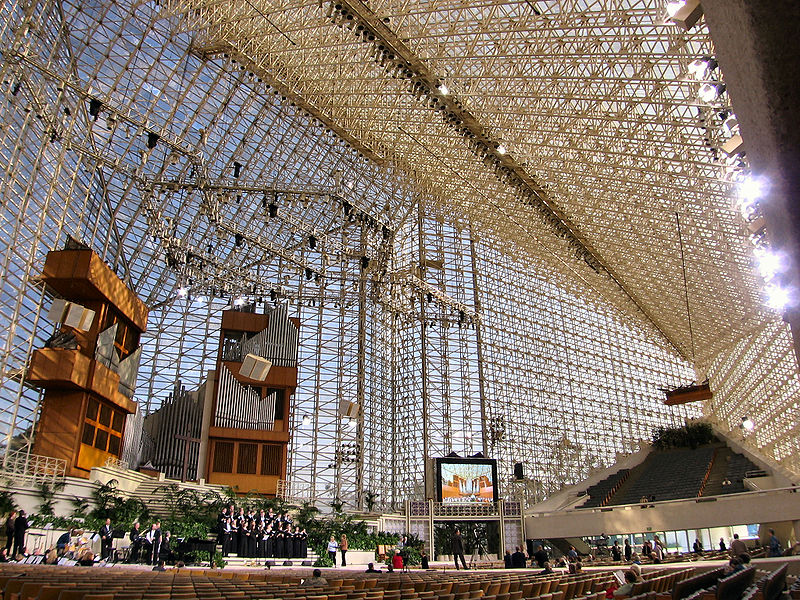
The greatest stumbling block to the humble message of the teachings of Jesus has always been the greed and concupiscence of the church. Whether it be the Vatican or some evangelical Crystal Cathedral, churches that stockpile wealth, although they may indeed distribute some to worthy causes, ultimately become a major part of the problems that create an unjust society. The concentration of wealth into the hands of any religious body will corrupt it. I have known clergy to purchase vestments costing hundreds of dollars per piece while their children were fed with food stamps. I have seen televangelists wearing suits that cost more than a month’s salary for many of their parishioners. I have heard them giving God the praise for their personal glorification.

Glory to God at what cost?

Once the glitz is removed, whether it be priceless Renaissance art or the supreme comfort of a Rocky Mountain resort or southern California ranch, the real purpose behind such driven lives becomes clear. No amount of prevaricating will make the working-class founder of the religion touted by wealthy clergy a friend of the rich as long as the poor continue to suffer.


Decade Fail

In a recent newspaper report on the state of the nation, local journalist Tom Moran cites a Pew survey in which most Americans surveyed rated the current and swiftly ending decade as the worst one of their lives. As a professional academic who was ousted from a highly rated, long-term teaching post this decade after a Fundamentalist takeover of the school where I taught, I am inclined to agree. Five years later I am still searching for any kind of meaningful full-time work, while yesterday I spied an ad for a “Ghost Twitterer” (as if someone is so important that they can’t write their own 140 daily words) and bowed my head in sorrow. Maybe we really have sunk to a new low.

What really caught my eye, however, was the statement of a fellow professor at Rutgers (where I have been an adjunct for nearly three years). Ross Baker noted that “It has always taken calamities of almost Biblical proportions to shake this country out of its smugness and complacency.” While I agree with his assessment, the use of the phrase “biblical proportions” demonstrated once again that my chosen field of specialization has a solid place in the popular imagination. Generally “biblical proportions” is a phrase used to refer to disasters, something along the magnitude of a world-wide flood, the destruction of Sodom and Gomorrah, or the plagues of Egypt. These mythological episodes have left a deep impression on our culture that the message of the Bible is a fitting one for the first decade of the twenty-first century.

Perhaps we are really in trouble if this facile view of the Bible is wedded to a facile misuse of the same book for constructing prejudicial public policies and ill-conceived conservative “reforms.” If the past decade has been a wash in this country, I would attribute it to a conservative evangelical political machine that churned out a president who literally would have been pleased to bring on the mythical Armageddon. During this bushesque reign of biblical proportions, I lost a secure job teaching Bible and haven’t been able to find any other full-time work. I would continue my rant but I have to polish up my résumé, and hone my succinctness skills, and try for a Ghost Twitterer position.


Chris-myth

Mythology is beyond any single individual. I was reminded of this recently while discussing Joseph Campbell with a colleague. Joseph Campbell was an unconventional academic who exploded to public prominence largely through the immense influence of Star Wars, the original episode. George Lucas had famously latched onto Campbell’s Jungian use of archetypal imagery as the basis for good story-telling, and thus, by extension, good movie-making. With his books written at a level that is accessible to the average reader, Campbell assured his fame in a world starved for mythology. Others have interpreted mythology quite differently, but often more quietly. The fact is, mythology is alive and well in our culture. We simply fail to recognize it.

Joseph Campbell, mythographer

We are in the midst of the Christmas season, a period of intense mythopoeia in modern American culture. As can be seen in the Christmas Complex essay under the Full Essays section of this blog, the growth of Christmas characters and stories has been intense over the past several decades, and it shows no sign of slowing. Although not everyone will recognize Heat Miser or Zwarte Piet, many cannot imagine Christmas without Frosty the Snowman or Jack Frost, although they are not specifically associated with the holiday. This is the nature of mythology – it grows to encompass the many concomitant features of its immediate culture. Northern European and northern American experience of Christmas includes the snows of winter, so they become part of the Christmas myth.

While many this year, and every year, protest leaving the “Christ” out of “Christmas,” they fail to recognize that the snowballing Christmas myth has rolled far beyond the control of Christianity. The origins of Christmas predate Christianity, and the birth of Jesus is yet another element that has adhered to the mythology of the winter solstice. As the days grudgingly grow longer, and light begins to return into the chillingly crystalline days of January in the northern part of the northern hemisphere, mythological souls everywhere breathe a sigh of relief. Our fear of the long, dark, cold night is primal and very deep. C. S. Lewis, another mythographer, at least got it right with the Narnian concept of winter without Christmas being a kind of hell to northerners. The mythology of Christmas in the southern hemisphere is another complex mythopoeia in the making. How it grows will be an interesting exercise in the ongoing human quest for meaning as summer’s heat is just beginning.

C. S. Lewis, mythographer


Compassion Divine

A very generous relative graced this holiday season with the gift of the first season of Star Trek, the original television series. I am not now, nor have I ever been, a “trekkie.” I did, however, enjoy the show as a child and have come to appreciate it even more as an adult. I can’t cite episode and scene like a trekkie can, and a surprise FBI raid would not turn up any pointy Spock ears or a model phaser (although my wife’s cell-phone looks like a sophisticated communicator). As a child the show appealed to my love of science fiction, and as an adult the morality play aspect of the original series fascinates me. Yesterday we watched an early episode where a crew member has his mind boosted by a trip beyond the edge of the galaxy (a la Forbidden Planet). As this character becomes more and more omniscient and powerful, he refers to himself as a god. Captain Kirk, in his attempt to stop his old friend calls out that gods are marked by compassion rather than strength.

I have been rereading Homer’s Iliad in preparation for a course on mythology. Quite apart from the fact that Star Trek borrowed heavily from classical mythological themes, one of the features I have especially picked up on in this reading has been the appeals to the compassion of the gods. As Diomedes, Odysseus, and Ajax (and finally Achilles) battle Hector and Paris both sides call out for the kindness of Zeus, appealing to his compassion (as well as to his baser instincts). Reflecting the ancient perception of the world, Zeus’ responses are fickle.

Biologists have been probing the origins of human sympathies ever since Darwin. Creationists used to argue that compassion, altogether lacking in the animal world, could not have evolved naturally. Many recent studies, however, have demonstrated a naturalistic base for our altruism and compassion. These traits are certainly displayed in a number of animal species, particularly mammals. The ancient Egyptians believed animals to be superior to humans in many respects, lacking our weaknesses and being more adept at survival. It seems that they were right and some of the nobler human traits evolved from our animal milieu. If so, what is divinity beyond the gospel according to Star Trek — compassion to those in need by those who find themselves in positions of power?