Search Your Engines

It’s been fascinating to watch.  We tend to think things appear instantaneously on the internet, and sometimes they do.  Book announcements, however, are less prone to that.  The Wicker Man, my book for the Devil’s Advocates series, was first announced to the world (apart from me) on Oxford University Press’s website because they distribute books by Liverpool University Press.  It took several weeks before it appeared on LUP’s site (I’m projecting here, it still hasn’t showed up there).  Like an anxious father, I checked every few days to see if word was getting out.  After about two weeks it showed up on Barnes and Noble’s website, but not Amazon or Goodreads.  Then it appeared on ecampus, a textbook seller.  Days later it appeared on Amazon’s site in Spain only.  Word gets out slowly.
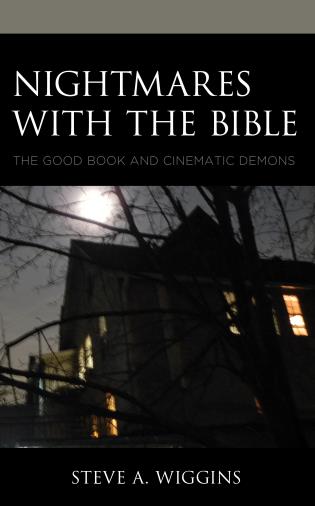
Some things hit immediately, of course.  Everyone in the world knows about them seconds after they happen, whether they should or not.  Some young folks, who grew up with the internet, are having trouble letting go of the, well, troubles of the world that jet through the 24/7 news cycle.  Books by unknowns travel much more slowly.  Of course, I’ve been trying to reinvent myself.  In as far as I’m known, I’m known as an ancient Semitic goddess scholar.  (The ancient part is correct, in any case.)  I turned to writing about religion and horror about a decade ago and if web searches mean anything, my most searched book seems to be Holy Horror.  That makes sense since Nightmares with the Bible is so expensive that I can’t afford additional copies even with the author discount.  The Wicker Man will be up near forty dollars, but that’s cheap these days.  At least it will be paperback.

Maybe I have been checking more than I let on, but I’ve also noticed something else odd.  Ecosia, the tree-planting search engine, comes up with more results (based on the ISBN) than Google does.  That astonished me.  Google apparently isn’t as good at searching as it would have us believe that it is, at least for obscure information.  (In my case, very obscure.)  Ecosia even outperformed Bing.  With this internet full of stuff, you’re obviously missing out if you don’t use multiple search engines.  Yahoo added yet one more site with the book.  I’m wondering when the actual publisher, or Amazon’s main site, will catch up.  Giants do move slowly, I guess.  Maybe once the cover image is released…

Another Exorcist

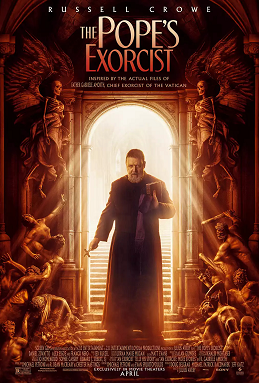
I learned from the wonderful Theofantastique that Russell Crowe’s new movie is The Pope’s Exorcist.  (I guess Crowe hadn’t read Nightmares with the Bible to think to send me a personal notice.)  I knew instantly, from the title, that it had to be about Fr. Gabriel Amorth.  Say what you will about him, he inspired William Friedkin to make a documentary titled The Devil and Father Amorth.  It’s pretty unnerving to watch, no matter what is really going on.  Catholic officials aren’t trilled about Crowe’s movie—I wasn’t impressed with his portrayal of Noah in Darren Aronofsky’s take on the flood story a few years back.  It takes a certain kind of director (like Friedkin) to be able to handle theologically dense material in a believable way.  I can’t say anything about Julius Avery’s The Pope’s Exorcist, of course, without having seen it.

I can say, however, that those who publish books at $100 miss many opportunities.  My book is one of very few written by a credentialed religious studies scholar on demons in movies.  A quick web search will reveal that it remains basically unknown and uncited.  (The only Amazon review is a two-star job by an evangelical who didn’t like what I was doing.)  Pay $100 for a book with a two-star review?  Most people, reasonably, have better things to do.  I once got around this in the past by posting a PDF of one of my book for free on Academia.edu, where, at recent count, it has been viewed over 6,000 times.  Academic publishers don’t realize the appeal of most of the books they publish.  Even demons can’t open a wallet to a Franklin level.

So while I’m waiting for enough royalties to afford seeing The Pope’s Exorcist, I’ll focus on my current book project.  Of course it’s on something completely different.  The Wicker Man should be coming out in September, but my mind will likely be elsewhere.  Those of restless intellect are condemned to wander, it seems.  Of course, I have Theofantastique to keep me busy.  There are other kindred spirits out there.  They don’t know the way to my website, I suspect, but I’m not alone in being excited about a new exorcist movie.  I’m not expecting anything to surpass The Exorcist, however.  Like The Wicker Man, The Exorcist turns fifty this year.  One guess which was the more popular film.  Given Crowe’s profile I’m surprised there hasn’t been more buzz about his new film.  Demons can be funny that way.


The Original

A dozen years ago, I had a novel under contract.  I write my fiction under a pseudonym, of course.  I was thrilled because I had never seen the conceit (in the sense of “concept”) anywhere before.  For once, I was going to be first in line.  But then the editor who’d responded “Loved it!” left the press.  After dithering for about a year, the publisher decided not to publish it.  This was a small, independent press—I wasn’t anticipating it would be a New York Times bestseller.  Then I saw a weekend add in the New York Times—just recently—touting a novel with the exact same concept as mine as “original” and worthy of being read.  Ironically, just the day before I had once again submitted my novel to an independent publisher.  I can’t blame the author, of course, but the system doesn’t work for everyone.

After the killing of my darling, I naturally tried to find another publisher.  I have been trying for twelve years.  I’ve been pushing the idea as original and of general interest.  Editors and agents disagreed about the “of general interest” part.  In fact, I’ve had rejections from nearly 100 literary agents over the years, one of them responding that I was a good writer but they couldn’t see where the story was going.  Maybe I didn’t handle it as well as this new book, with its glittering endorsements, but a guy likes to get credit for his work.  Now if it ever does get published I’ll be considered a copycat.  You see, my main driving force as a writer is originality.  My published stories are unlike others I’ve read and most of them go through multiple rounds of rejection before some editor “gets it.”

The publishing industry, however, is a strange one.  Most publishing houses want work that imitates bestsellers since they’re a known quantity.  Money in the bank (or what banks used to be).  The internet has changed that a bit, but not completely.  It does mean those skilled at such things as self-publishing can sometimes challenge the hegemony of the big five.  It also means a lot of sub-standard fare is out there as well.  I’m a little late establishing a literary reputation it seems.  Although being raised poor does qualify me as “diverse” it’s not in any way visible.  It is obvious if people get to know me because the poverty mentality never goes away.  So my novel has been waiting while the same idea occurred to someone else (not straight white male) and has received notice.  So I follow and hope to learn.


Feeling Chilly?

David Cronenberg perhaps defies the tame image we tend to have of Canadians.  I know that’s a parochial thing to say, perhaps reflecting my lifelong admiration of those north of the border.  I even have Canadian family members, from back when it was possible to cross over without a passport.  In any case, David Cronenberg has always been a controversial director.  As the progenitor of “body horror,” his films are often not for the squeamish.  I nevertheless find him one of the more intellectual auteurs, and his movies leave me thoughtful.  One of his early films, Shivers, has long been on my syllabus of “must see movies.”  If you read my pieces regularly you also know that living on an Ed Wood budget, I can’t afford to pay for frequent films and have to wait for a free venue.  Thank you, Tubi, for obliging.

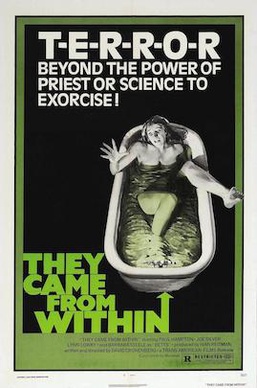
By the way, the poster here shows one of several alternative titles for the movie: “They Came from Within” (aka “The Parasite Murders”).  The film is pretty graphic body horror, but as scholars now focus on embodiment, it seems like this should be explored.  Set in an almost utopian island community, Starliner Towers, the movie opens by touting its perks.  Intercut with that is a graphic murder-suicide taking place within the paradisiacal apartment tower.  A parasite, as one of the alternative titles suggest, has been unleashed by what might be called a mad scientist.  And that parasite has two main effects—prompting orgies and violence.  (Hey, the official title of this blog is Sects and Violence in the Ancient World, after all.)

Religions, Christianity in particular, in the west, are often uncomfortable with the body.  In religious studies approaches to embodiment, it’s stressed that everyone has to reconcile themselves with what it means to be a physical being.  So much so that the mad scientist developed this parasite because he believed people thought too much.  They’d forgotten the mindless reality of bodies.  We’re sometimes uncomfortable being reminded of our bodily existence—at least those who perhaps think too much are—and that comes with both good and bad.  The interesting thing about the film is that it refuses to condemn the results of this experiment gone awry.  Everyone eventually falls victim to it (sorry if that’s a spoiler, but the film was released nearly half-a-century years ago).   Cronenberg is difficult to pin down, but his films, perhaps despite the message, always give me things to think about.


Moments of Happiness

“When happiness shows up, give it a comfortable seat,” Fezziwig says.  I wonder just how much like old Ebenezer Scrooge I am—apart from the abundant money, of course.  This isn’t going where you expect, I promise you!  I don’t come across as a happy person.  I was forced out of my ideal career many years ago by Fundamentalists, and I struggle to keep my writing going.  That old rabbinic adage that you can’t be both wise and happy probably doesn’t help.  So I sit here worrying about the everyday cares and concerns of a sexagenarian (not as sexy as it sounds) and watching horror films to help me cope.  That doesn’t mean, however, that moments of happiness don’t appear.  When they do they shine bright and hot and shed enough light to help me make it to the next beacon that some thoughtful lamplighter has set ablaze.

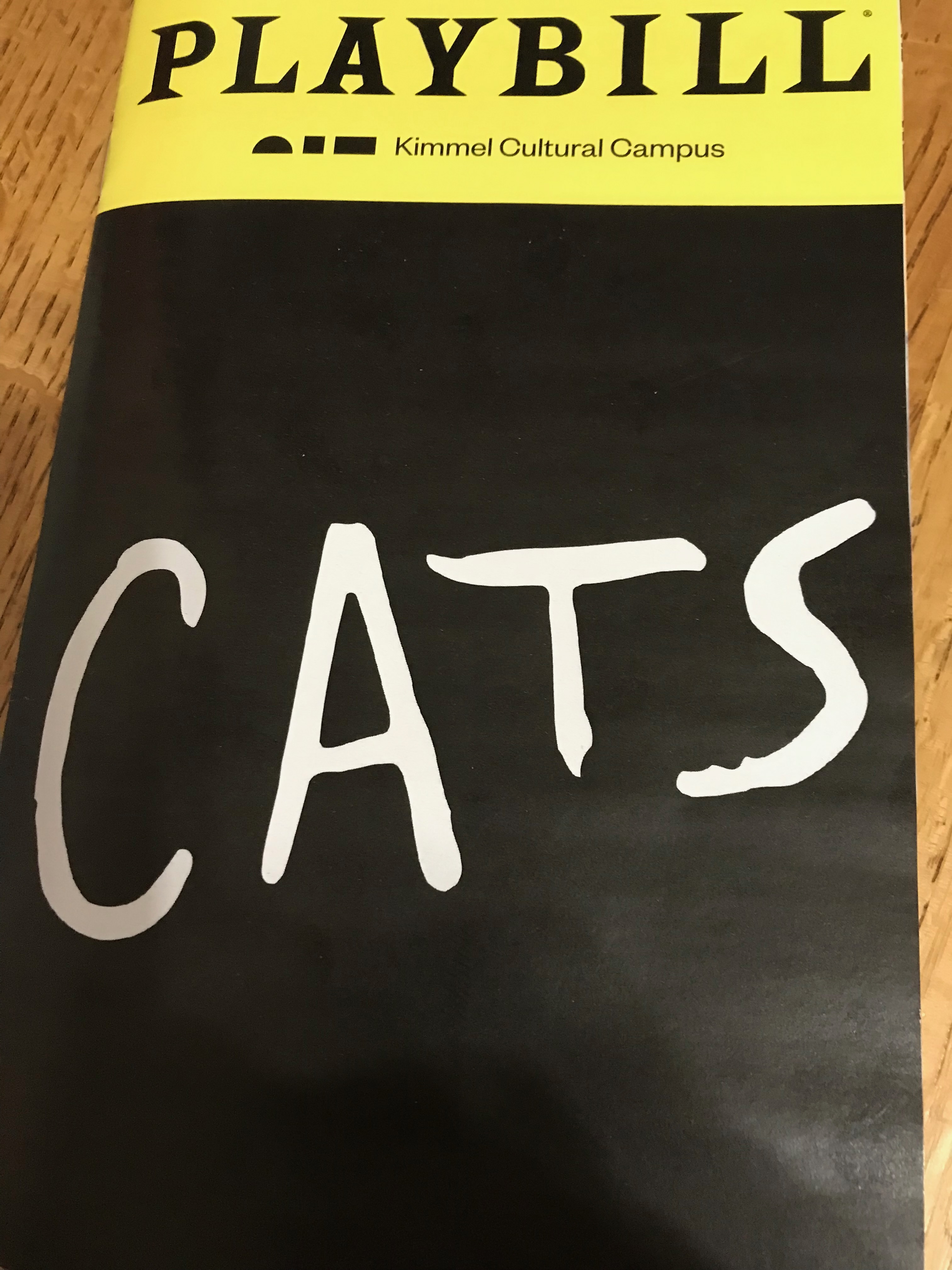
For a birthday gift, we gave a family member a trip to see Cats live in Philadelphia.  Everything about that day comes back to me through rose-tinted lenses.  The worry and stress of driving in Philly—I’ve done it a few times and it’s always nerve-wracking.  Finding the theater, negotiating parking, finding a place to accommodate a vegan, a vegetarian, and an omnivore for lunch.  Locating seats only to discover they’re further back than they looked on the schematic map, and then the lights dim and the music begins and you’re in a different world.  All the worry and fear melt away.  Happiness has appeared and you know she’s sitting right next to you.  Even with evening Philly traffic still looming ahead and a drive when I’m beginning to feel drowsy, I’ve had an experience almost of a religious nature.

It’s no wonder that many early evangelical Christian leaders warned about the theater.  Live performances reach that spiritual place that weekly Sunday services only wish they could.  Of course, it helps that Cats is my favorite show—I’ve seen it live five times over the years.  It’s a show about happiness and finding redemption.  I’ve written before about the religious undertones to the musical, but here I’m thinking about how the day after always has a special glow.  Yes, the quotidian worries are still there.  The attempts to grow wiser and stay solvent.  The difference is that something transcendent—all the more valuable for being rare—has happened.  It has shaken me out of my comfort zone and my daily routine.  And I can’t wait for happiness to come knocking again.


Sleepy Once More

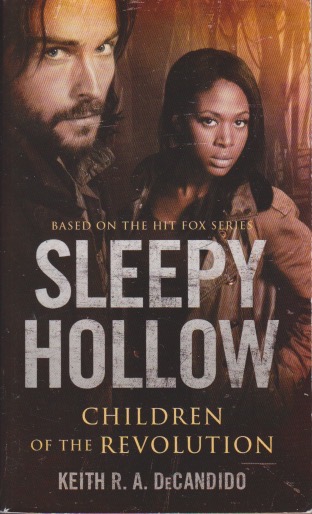
I think this is the last of my recent nostalgia reads for a while.  When trying to recapture the feeling of watching that first season of Sleepy Hollow without actually spending all the hours necessary to do so, the spin-off novels are a quick fix.  Keith R. A. DeCandido obviously has quite a bit of experience of writing novels that tie into pop culture.  Many of us were pretty enthralled and impressed in 2013 (already a decade ago!) when Sleepy Hollow first came on the air.  This literary member of what was an emerging new legend is a novelized episode that is slotted into season one, referring back to what had happened earlier in the season without betraying the cliff-hanger ending for the 2013–14 run. Sleepy Hollow: Children of the Revolution is a guilty pleasure read and a jaunt back to a decade that now seems long ago.

Here the story involves an attempt to resurrect (one of the main themes of the show) the witch Serilda of Abaddon.  Serilda had her own night in the moon earlier in the series (the episode “Blood Moon” was dedicated to her).  This novel asks, what if a coven of her followers, one of them a former policewoman, tried to bring her back?  It does so by using historical scenarios—much like the series—such as Washington’s crossing of the Delaware, and impregnating them with magical subtexts.  Here there are congressional awards that have been secretly engraved with runes.  George Washington knows about them, of course.  When brought together they can transform Serilda into a real monster.  Remember, Moloch was still an active concern in the first two seasons of the show.  In the present day, these artifacts have been regathered by the coven, and you can guess that all Hades will break loose.

I often ponder how, with the series Sleepy Hollow, the story began to fall apart when the Bible fell out of it.  It was in the process of tying together great American mythologies such as Irving, Revolutionary-Era history, and biblical self-identification.  These formed a compelling net that brought in many viewers.  Season one ended with two of the four horsemen of the Apocalypse in Sleepy Hollow, and a third had been nodded toward earlier in the series.  Instead of finishing out that line of thought, the storyline dispensed with Moloch and gave the headless horseman a head.  The plot ran out of steam.  Books like this demonstrate that there was other fertile ground to plow.  Had the original conceit kept intact, we might still be watching it.  Of course, novels like this are good for reliving those days a decade ago.


Wicker Man Comes

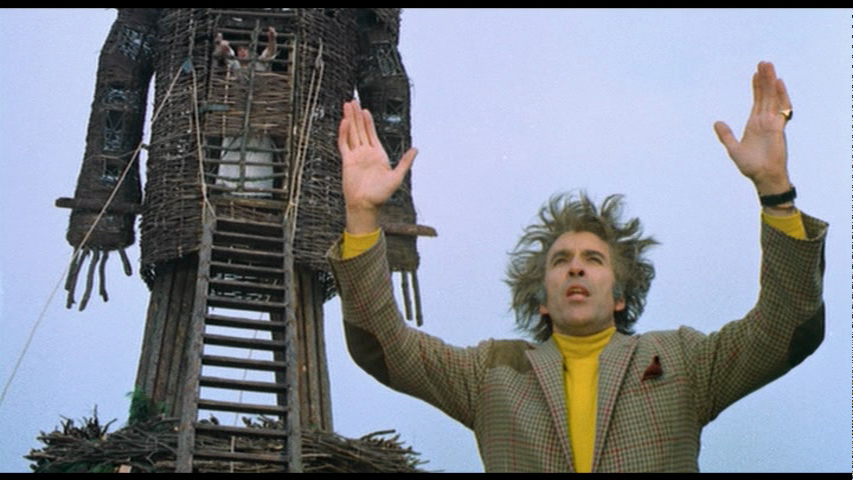
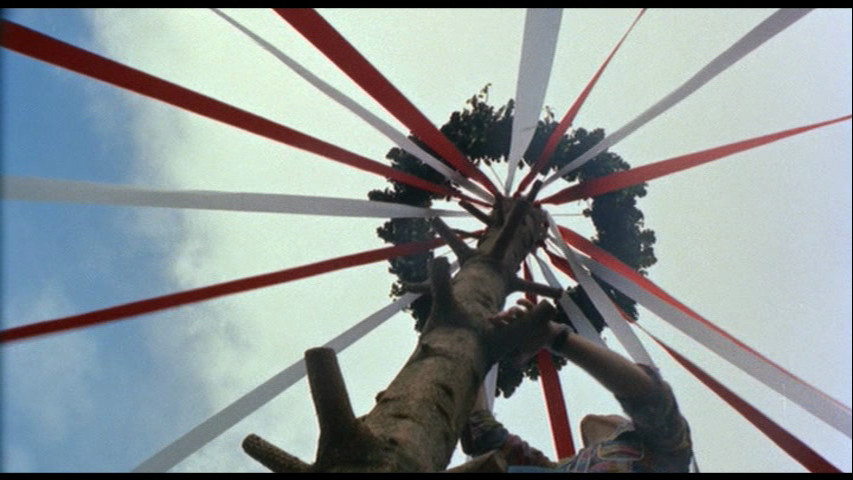
Not that I would know bodily, but it seems like a book being published is something like giving birth.  It takes several months (perhaps years, in the case of books) from conception to delivery and there are certain milestones along the way.  And you worry like Rosemary.  Has something gone wrong?  Is this still going to happen?  The book production process is a long and complicated one.  Just this week, however, the next recognizable stage occurred for The Wicker Man.  An ISBN has been assigned and a new book announcement has fed out through various channels.  It’s not on Amazon just yet but a Google search of 9781837643882 will bring it up.  I’d been worried about this because I saw a new book announced on The Wicker Man due out in October.  This is the fiftieth anniversary of the film, and I suspected I wasn’t the only one who’d noticed that.

Ironically, another film turns 50 this year.  The Exorcist released in December of 1973 to far greater acclaim than The Wicker Man.  Both films became classics in their own right, but The Exorcist would become a household name.  Even if they’d never seen it, most people had heard of it.  The Wicker Man is more of a cult classic.  It’s known among horror fans and a certain kind of Anglophile.  And those interested in paganism, particularly of the Celtic variety.  Although the cover isn’t available yet, I was glad to see the feed for my book going out.  It looks like I might scoop the other book by a month or so.  If that happens it will be the first time that I’ve actually had a book on horror release before Halloween.  The last two missed the deadline by a couple of months.

Having said that, if you’ve had your appointment with The Wicker Man you already know, it takes place on May Day.  And you likely know that a large number of people claim it isn’t a horror film at all.  Indeed, the horror element only becomes clear in the last ten minutes or so.  It’s the build-up that makes the movie.  And it was really a one-film wonder for the director, Robin Hardy.  He did other movies, but this was the one that lasted, and spawned imitations and parodies.  It’s exciting to see that the discriminating, or very persistent, searcher can now find the book announcement online.  I haven’t seen much to-do about the 50th anniversary just yet, but now when I do I’ll have something to point to.  More on this to come!


Love’s Life

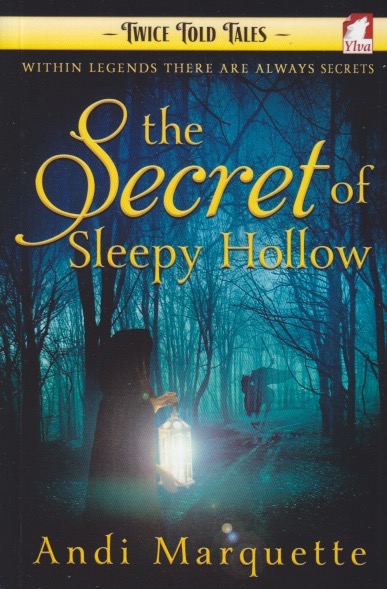
One of the things about literary classics is they open themselves to reinterpretation.  It’s often a lot of fun to trace these.  Andi Marquette is obviously an educated writer.  Her The Secret of Sleepy Hollow is one of those reinterpretations that has a unique take on the tale.  Set in modern times and featuring a member of the Crane family—Abby—as a graduate student, this story brings the tale into a contemporary context.  Abby meets another graduate student—Katie—in Sleepy Hollow and the two fall in love.  It turns out that Katie is a member of the Van Tassel family, thus bringing the two main families of Washington Irving’s “Legend of Sleepy Hollow” together again.  There’s even a headless horseman.

Like the biblical book of Ruth, this is a gentle tale of women’s love.  There’s no overt violence, no heads get chopped, but two women love and care for one another.  Many of the more modern repackaged versions of Sleepy Hollow tend to go for the violent, sometimes drug-fueled tales of bored youth in a small town facing an angry ghost.  Here the interest is more literary, a gothic romance.  The fact that it’s a lesbian love story makes me wonder why so many people have trouble with others’ love lives.  People are prone to curiosity about sex—that’s a simple fact.  What isn’t so simple is that mores based on culturally specific ideas from millennia ago don’t stand the test of time and yet cause misery in modern lives because they can’t accept what we now know—sex and love are anything but simple.

Marquette’s book is marked by that anxiety.  When people discover a love that’s often misunderstood, they face ridicule or worse.  The book of Ruth provides a good guide here—the acceptance of a normally forbidden love can bring good and happiness to people in what is often a difficult world.  There’s trouble enough—there are headless horsemen out there—that we don’t need to be causing more by judging the loves of others.  Even a cisgender heterosexual can understand that.  Life is complicated and we all try to find our way through.  Love is one of those things that can help to make it more bearable.  I found The Secret of Sleepy Hollow compelling in that way.  It may not be a literary classic—few books are—but it takes on a complex topic intelligently and with heart.  It’s a new take on an old story that still fits the modern world.


Monster Bride

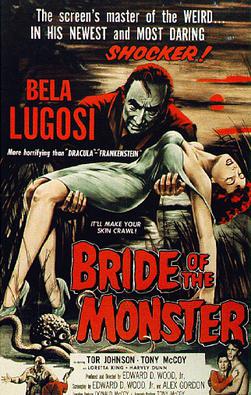
I’ve been taken with Ed Wood lately.  It’s quite possible, lost somewhere in my memory banks, that I saw one of his movies as a kid.  If I did it would’ve been Bride of the Monster.  Just in case I hadn’t, I decided to watch it again.  As I’ve noted about Wood before, I admire someone who persists in the face of constant criticism.  Someone who refuses to back down, even if they end up alcoholic and dying too young, in poverty.  Now he’s coming to his deserved recognition.  Even if his movies weren’t intentionally bad, when I laugh out loud I’m not laughing at Ed Wood.  No, it’s the absurdity of fame and the price it both expects and exacts.  Wood paid that price and now that it’s too late he’s grown a considerable fan base.  Or maybe it’s never too late.

Bride of the Monster brings Bela Lugosi back to the screen as a mad scientist.  Rejected and mocked (I’m sure some of this was personal), he locates an isolated swamp house from which he plans his revenge on the world.  He’s somehow managed to build a nuclear reactor in his hidden lab and he intends to make a race of giants to conquer the earth.  Naturally enough, he starts with an octopus.  As the story unfolds, we learn that he was also responsible for the Loch Ness Monster.  He’s employed a human (but somehow bullet-proof) henchman, Lobo, to help him in his quest.  When a nosy reporter and her police detective boyfriend get involved, well, you might imagine the results.

The stories behind Ed Wood films, it seems, are as entertaining as the movies themselves.  This one, for example, has as its protagonist an acting unknown (Lugosi was the name draw).  Tony McCoy was the son of the owner of a meat-packing plant.  He received the lead role as part of his father’s stipulations for funding the movie.  Another stipulation was that it had to end with an atomic explosion (which it does).  Wood would go to any length to see his movies made, even agreeing to casting choices and plot points made by those who had no other connections to the film.  That’s part of the charm of Ed Wood’s movies—they were made to order.  And they demonstrate that deepest of human desires—to tell a story.  If I didn’t see this as a kid, I would’ve loved it if I had. 


Too Haunted

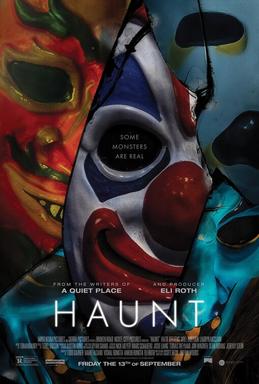
It’s past the season, I know.  But I have no control on when streaming services acquire new titles.  So it was winter by the time I saw Haunt.  Maybe it was the seasonal disconnect, or maybe I’m not all that fond of slashers—whatever the cause, I found it disturbing.  As a horror watcher, I really don’t like being afraid during movies.  And Haunt has those most troubling of characters—the unpredictable kind.  So let’s set this up properly.  Six young people—four women and two men—decide to visit a haunted house attraction on Halloween.  Although they take a random turn on a rural road outside Carbondale, Illinois, they end up at a haunted house attraction, with an illuminated road sign.  I’ll admit it; I don’t like fun houses.  They scare me too much.  So when the creepy clown at the entrance indicates, nonverbally, how they get in (taking no money) and puts their cell phones in a lockbox, I’d have told the others I’d wait in the car.

As we might expect, since this is horror, after a fakey plastic skeleton and some cheap props, it turns our that the terrors are real.  One by one, the young people are killed by a group that practices extreme body modification to make themselves look like real monsters.  For an unexplained reason, they kill everyone who comes to the attraction.  Sadism, one suspects, might be behind this.  In any case, it ends up with a final girl and final boy making it out alive and seeking medical attention.  The haunted house is burned down since Harper, said final girl, and her new boyfriend end up killing most of the killers.  The creepy clown, however, survives to try to hunt Harper down.

The film received pretty high ratings, but it seemed to me there wasn’t much beyond the terrors I normally experience at a fun house.  The body horror verges on torture porn, which is a sub-genre that I simply do not like.  In fact, I only watch it by accident.  My dilemma is that I don’t like to read summaries or watch trailers before seeing a movie.  I prefer to approach it fresh.  I suppose that’s why I keep a list of films that others have recommended, so I know they’re likely good.  I prefer intelligent horror rather than shock horror, although the two can overlap.  Movies that focus on the the pain humans can inflict on each other aren’t the kind I prefer.  Give me a garden-variety monster any day.  Even if it’s a winter weekend, and not Halloween.


Recalling the Story

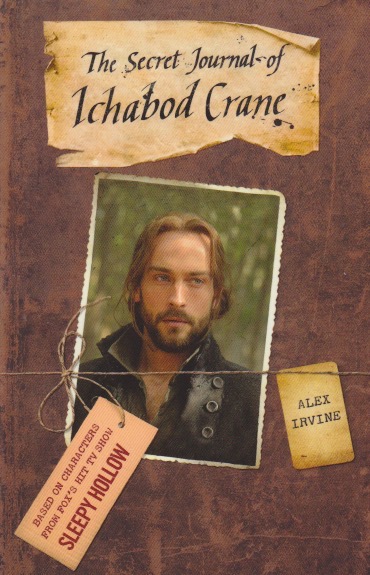
Remembering how a story goes.  That’s one of a book’s functions, particularly if a tale’s complex.  Running a season behind, I was one of those enamored of Sleepy Hollow when it first aired from 2013 through 2017.  In fact, that was the first story that I tried to explore, somewhat academically, in the horror genre.  At the time I hadn’t realized how many spin-off media had come out, based on these new characters.  I recently read The Secret Journal of Ichabod Crane in which Alex Irvine provides the service of summarizing the first season through the conceit of the main character’s secret diary.  It has to be secret because in the series he’s never shown keeping a journal, and the title explains why we’re just finding out about this now.  (Or then, since it was published while the series was still on the air.)

Reading it reminded me of just how complex the plot was.  I suspect that’s one reason so many people were taken with it.  Week-to-week you weren’t sure where it was going.  And the plot integrated religious themes from the first episode on.  That’s what first drew me to my current research trajectory.  The show wasn’t perfect, and some plot elements grew tired after a while, but overall it was compelling.  Mixed with the natural comedy of someone from centuries past trying to learn how to get along in a rapidly technologizing world provided light moments amid the death and bloodshed.  And, of course, the pairing of the patrician but progressive white man with a young black professional in the fight against evil was novel and necessary.

Irvine’s book is rather like the novelization of a movie.  In terms of hours, however, a television series outstrips the maybe two hours of a typical film.  A lot has to be left out, including scenes in which Crane wasn’t present, although he was pretty steadily in the camera’s gaze.  Initially suspected as a criminal, he had to be kept under pretty close watch, so his was a good perspective for a journal.  Its secrecy continues the trope of hidden documents that ran throughout the series.  Another aspect was that it addressed the Hamilton era when that show was becoming immensely popular.  And Sleepy Hollow was quite literary, with references to books from early writers.  There was a lot to like about the show.  It burned itself out in four seasons, though, and after season two there would seem to be little need for any further secret journals as the story grew even more complex.  This one, however, is a good reminder of how the story goes.


More Dark Academia

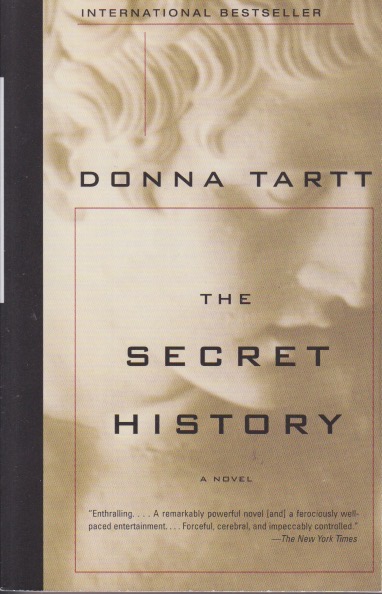
It could be that I’m not smart or sophisticated enough.  Or maybe I’ve just lived a sheltered existence, although I grew up with an alcoholic parent and among a blue-collar drug culture.  Despite this, I attended a “preppie” liberal arts college, but it wasn’t in Vermont.  All of which is to say I had a difficult time getting into Donna Tartt’s The Secret History.  There may be spoilers here, so if it’s on your reading pile, maybe wait to read this.  Then tell me if you don’t agree.  So here goes.  The narrator, a perhaps unreliable Richard, is from a working-class dysfunctional family (check).  He attends a liberal arts college on scholarship (check).  It’s modeled on Bennington (the checks start stopping here).  There he works his way into an exclusive group of five highly intelligent students in a private study Greek curriculum (this is also a partial check).

The days are filled with intensive work in Greek and the nights with alcohol and drugs and cigarettes.  So many cigarettes.  I found myself wondering how such highly intelligent students accomplished so much when they were stoned all the time outside of class.  In any case, with two of the now six students not present—including Richard—they accidentally kill a man during a Bacchanal.  Their professor covers for them.  Then the other excluded student finds out and begins blackmailing the four.  Like the rest of them he’s fond of booze and he begins to let slip what he knows.  Spoiler alert: so they kill him.  This is followed by more drugs and alcohol and when the professor finds out he simply leaves his tenured post to do something else.  A rift develops in the remaining five that ends—another spoiler—the way dark academia often does, with a suicide.

Overall the story is captivating.  Overdone on the substance use and abuse, but it does keep you engaged, once you get through the first hundred pages or so.  I like dark academia, but I also like characters with whom I can sympathize.  Like Richard, I’d gone to what was at the time a selective college from a working class family.  There was drinking even at the notoriously dry Grove City College, and there were drugs.  Perhaps those from elite families indulged.  I hung out with scions of middle-class families (I didn’t know anyone else that was poor) and they didn’t spend their hazy nights under controlled substances.  Having been a professor at a gothic school, and having studied Classics-adjacent, though, I found much of this hard to believe.  It’s a book that becomes better upon reflection than in the actual reading.  Still, I’m sure that I didn’t get it because I’m not sophisticated enough.


Creepy

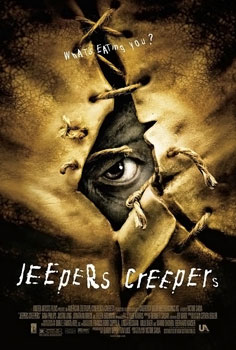
There’s some symbolism here that I haven’t had time to sort out.  (Some of us need time to just sit and think—time that work won’t allow.)  I’d been wanting to watch Jeepers Creepers for quite some time but streaming services said it was unavailable.  I suspect that was because a sequel has been running in theaters and those who own the rights want to capitalize on it.  So it goes.  When it finally did show up on Freevee, so you have to subject yourself to commercials, I had to see it.  Now I need some time to think.  In case you’re even slower than me, the film involves a couple siblings driving home for spring break when they encounter a monster/demon, Creeper.

Creeper smells peoples’ fear and consumes parts of those who have something it needs to regenerate itself.  The brother and sister encounter Creeper on one of those long stretches of road without civilization that you find in parts of America (in this case, the unspecified south).  I won’t spoil the ending, but for my money (or actually, Freevee patience), the first half is pretty scary.  The whole is not bad either.  So what do I need to think about?  Well, Creeper stores its victims’ corpses in a church basement.  The church is abandoned, but still.  This overlap between religion and horror is an aspect that has fascinated me time and again.  Shouldn’t a church be a safe place?  (For many of us, that’s a myth long debunked.)  Is it because it’s abandoned that a demonic monster has moved in?  Or does religious symbolism not bother it?  Or perhaps attract it?

Not only that, but the movie also has a prophet.  While she’s not called that, this local woman has dreams of things involving Creeper that haven’t happened yet.  Like Cassandra, however, everyone ignores her.  It seems that Jeepers Creepers experienced a budget cut during production that led to a rewritten, and cheaper, ending.  While I won’t spoil it, I will say that it is a bit of a letdown from how the film started.  A lot is left unexplained, but the story is pretty good and the acting, at least by the siblings, and the always entertaining Eileen Brennan, was impressive.  They have a way of conveying fear that’s believable and contagious.  The religion theme, however, appears to have been dropped once the church burns down.  It may be that it was somehow revisited in the ending that money forced to change.  Regardless, it is worth watching, and, if you have the time, pondering.


What People Like

It must be like showing up at a party wearing a flashy shirt that somebody else is also wearing.  Embarrassing, no?  A few years back I read Brian Jay Jones’ biography of Washington Irving.  As you may know, I recently finished Andrew Burstein’s.  The two were published within a year of each other, but both after a seven-decade gap in such biographies.  I suspect the renewed interest in Irving sprang up in the surge of public interest after Tim Burton’s Sleepy Hollow appeared.  Movies have power.  Books, especially big books, take a long time to write.  I don’t know if Jones and Burstein were aware of each other’s efforts or not.  Both are quite good, but they do stand as a testament to how fame can be fleeting.  Irving is infrequently taken as a genius writer today but he started more than one big thing.

What I’m particularly interested in is how Burton’s film seems to have kickstarted a new millennium interest in this old story.  I recently had a discussion with a couple of folks who felt that movies were too manipulative to be enjoyable.  Of course, nobody forces you to watch a movie, but I have found that they are powerful ways of influencing people.  And society.  Movies have been one of the more impactful forms of fiction media, spawning ideas that can change society.  Indeed, they may be modern mythology.  I wouldn’t yet make that exalted claim for Sleepy Hollow, but for those who follow such things, it has influenced the way we look at things.  And we can learn something from paying attention to them.

The Headless Horseman Pursuing Ichabod Crane by John Quidor

I suspect that is one of the perennial mistakes of higher education.  Assuming that something is popular means that it shouldn’t be worthy of scholarly attention.  If we want to understand what it means to be human, rather than just raping and plundering our planet until we choke it to death, we need to consider what it is that appeals to people.  What are the Classics if not the popular literature of antiquity, dating back to the time before most people could read?  What do we lose by trying to understand what motivates others?  There are those who spend their money on such things, after all.  Consider game developers.  They rake in the money because that’s what people like to do.  We don’t mind being manipulated, as long as we do so voluntarily.  We’ve wandered away from Irving at this party, but it does seem that Burton’s movie kickstarted our interest in America’s early wit again.  We ignore what interests hoi polloi at our peril.


Bad Movies

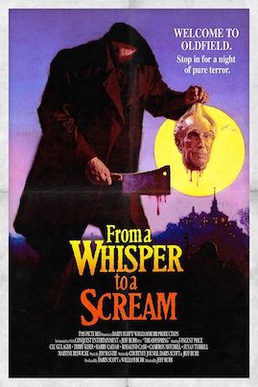
I watch bad movies so you don’t have to.  Maybe that’s my ticket to retirement (it certainly isn’t working the usual way).  In any case, my habit of trying to find something “free” on a network I already pay for often leads to films that keep me awake on a drowsy weekend afternoon, but really don’t offer much else.  Sometimes you learn something nevertheless.  I recently watched From a Whisper to a Scream.  It was free and got more than five stars out of ten, but I didn’t really work for me, even with Vincent Price.  A vignette movie, it presents four episodes from Oldfield, Tennessee, making the claim that it’s a place infected with evil.  The first involved necrophilia, with consequences.  The second—more in a moment—was about eternal life.  Lovecraft’s circus comes to town in the third, and the fourth is about the founding of the town during the Civil War.  Of course, the framing is a “bonus” mini-story as well.

The second episode, “On the Run,” has a wounded ne’er-do-well, shot by some southern rivals, falling into a swamp boat.  He’s rescued by an older African American who lives alone in said swamp.  Noticing him practicing hoo-doo (cue The Skeleton Key), the miscreant soon figures his rescuer has found the secret of staying alive forever (which he has).  Naturally greedy, the petty criminal “kills” the African American and ransacks his shack for the secret potion that keeps him alive.  Being horror, the dead come back and the owner of the shack returns to punish the white man who is trying to steal what he already has.  The Black man had given him the potion to bring him back to life.

There’s a bit of a parable quality to this particular story.  Each vignette predictably has the evil-doer punished, with the exception of “Lovecraft’s Traveling Amusements,” where the Black woman owns those who work her carnival.  And she gets away with it.  None of the characters, apart from the Black man in the swamp and the children in “Four Soldiers,” are really sympathetic.  Religion does also come in the Civil War segment since, drawing cues from Children of the Corn, the kids have created their own god.  So, a diverting film, if not a great (or even a good) one.  This was Vincent Price’s last true horror film, making it worth seeing for that reason alone.  His role is limited to the framing story which, as we might expect, becomes part of the collection of horrors from Oldfield.