Quiet Company

Even as a lifelong fan of speculative fiction, some of the most effective horror is that where a reader is kept guessing.  One of the acknowledged masters of this is Henry James, whose The Turn of the Screw is considered a classic.  There are perhaps too many writers active today to predict who will be considered authors of classics a century or two down the road—writing has to take a long view.  Nevertheless Laura Purcell’s The Silent Companions is, in this reader’s opinion, quite effective.  And ambiguous.  I’m on the constant lookout for gothic novels that work and this is one that surely does.  I’ll try not to give spoilers here, but I do recommend it for those who want a gothic atmosphere.  It is also genuinely scary.  A great deal of this is because the reader is never quite sure what has happened.

The eponymous companions are decorative curios purchased to impress royal visitors in the seventeenth century.  Life-like cutouts of people, they are silent.  Throw in an old, sprawling house in need of repair and a widow who had abusive parents and who’s inherited resentful servants and you’ve got a recipe for an eerie atmosphere.  The novel splits its time between the nineteenth and seventeenth centuries, focusing on the former.  Elsie Bainbridge is a protagonist with many secrets, and not a few skeletons in her closet.  The house she inherited also has a past that included accusations of witchcraft and cruel masters interested in self-promotion.  Told from the point-of-view of the women in a patriarchal society, there is an authenticity to the victimhood even of strong women.

It would be difficult to tell too much of the plot without giving away some of the creepier moments.  There’s a lot going on here and although it’s not a short book it doesn’t drag the reader down with filling too many gaps.  It’s also a novel that allows imagination to outstrip rationality.  Good speculative fiction will do that.  Even some of Poe’s work makes the reader wonder just what is happening—is this in the mind of the observer or is it objectively real?  Think “The Tell-Tale Heart.” Literature takes us into such places and gothic literature does so with more shadows and ambiguity.  Throw in some betrayals, and keep a few well-placed secrets and the recipe is in place for a creepy novel that will keep you reading.


Shadowy House

The more you learn the more you realize just how little you know.  The House of Dark Shadows was like a key, a missing puzzle piece for me.  Dark Shadows has been on my mind quite a bit lately.  I’m the first to admit that I’m no expert.  I never saw the whole series on television—I saw many episodes once, during my childhood.  Enough to know who the characters were—especially Barnabas—but when I stopped watching it (when? Why?) I started reading the novels by Marilyn Ross.  Clearly the soap opera was gaining enough ratings to merit the building of a franchise.  But the thing was, there is so much in life that I never concentrated on it.  I read the novels occasionally, and I never saw House of Dark Shadows when it came out in 1970.  Not, in fact, until 2022.

Since I was only eight when it came out, even though it was rated PG, I would’ve had neither the means nor the money to get to a theater.  I had, in fact, never even heard of it.  Having been raised a Fundamentalist, I have a tendency to believe there is just one way a story goes.  I know there are variations—they occur in the canon of Scripture, even—but something deep-seated tells me it should go this way.  House of Dark Shadows (which explains a lot of Tim Burton’s decisions for his movie reboot) has a different story line.  Given that it was 1970 it would have been in the midst of the initial series broadcast.  The movie was quite successful.  Still, Barnabas ends up victimizing Carolyn (which in the novels he is reluctant to do), and Roger, and outright killing a number of people.

I spent the movie trying to process how the story should go.  Of course, I haven’t seen the soap opera enough to know.  This Dark Shadows franchise is episodic and it doesn’t add up.  The film was shot quickly and leaves gaps in the story.  It certainly doesn’t track well with the tale of the Maine family who knows about “cousin Barnabas”and that he visits Collinwood from time to time.  Our course, between the series and the novels there are many, many avenues to select.  When Tim Burton got the idea to make a movie he had an abundance of stories from which to choose.  The House of Dark Shadows isn’t a great movie.  It is gothic and moody and a standalone story.  And it has me wondering about what other dark shadows conceal.


Looking North

As organized religion continues its slow decline, mythology remains.  Indeed, it seems to be growing in interest.  The problem with many mythologies, for monolinguals, is that they come in languages other than English.  Translation always loses something, which is why, I suspect, Neil Gaiman was tapped to retell the Norse myths.  A very talented story-teller, Gaiman has written about gods before.  He knows their literary potential.  Norse mythology is rather odd in the canon of western thought.  The stories feature gods with as many foibles as humans and with conflicting motivations.  In some ways they are more believable than the monotheistic tradition.  They are both fun to read and poignant.

At the same time Norse Mythology is a somewhat perplexing book.  It’s difficult to tell, without being an expert, what is Gaiman and what is ancient.  In fact, the book sits next to another one with the exact same title on my shelf.  That one is labeled nonfiction, and it’s a bit more academic.  Perhaps it’s an occupational hazard that I tend to want to approach mythology in original languages, if possible.  I’ve never studied Nordic tongues and it would be a little difficult to justify starting now, with all the other things I’ve got to do.  It’s not that I don’t trust Gaiman, it’s just that every retelling is an interpretation.  Still, I’m sure the book gives the flavor of the records that survive.  One of the fascinating features of Norse mythology is that gods die.  Since it ends with Ragnarok, that seems inevitable.

Many mythologies have the world ending with the establishment of the happy reign of a singular deity.  Ragnarok, which Gaiman (and perhaps the originals) sets in the past, sees the gods dying on the battlefield against Loki and the giants.  As the earlier myths make clear, however, death in battle is the most glorious way for the Norse to end their lives.  (And seeing how it has led to a pretty peaceful adult nation, one wonders if the mythology had a calming effect.)  I’ve not read extensively in other versions of Norse mythology so I don’t know if Gaiman’s ending with Balder returning and the world starting anew is his innovation or part of the original.  Having gods who die, however, seems like a potential leveler for humans who suffer from greater powers.  There’s a sobriety to it that lends gravitas to the whole.  And like all good books, Norse Mythology has left me hungry for learning more.


The Best Religious Horror Movies Streaming Now

Here’s an extra-special second guest post this week, enjoy!

Many horror movies have religious themes, plotlines or undertones. Here are a handful of the best religious horror movies to make you pray the bad away, in order of release.

Rosemary’s Baby (1968)

Rated R

Director: Roman Polanski

Starring: Mia Farrow, John Cassavetes, Ruth Gordon

A young couple moves into a NYC apartment with a haunted past. When the wife gets pregnant, she experiences an array of strange feelings, believing her baby may be the spawn of Satan.

Stream Rosemary’s Baby on Hulu, Sling TV, The Roku Channel and Amazon Prime Video.

The Exorcist (1973)

Rated R

Director: William Friedkin

Starring: Ellen Burstyn, Linda Blair, Max von Sydow

An increasingly strange-acting 12-year-old girl causes her mother to volley between scientific and supernatural explanations. Ultimately, she seeks the aid of a priest who himself is experiencing a crisis of faith.

Stream The Exorcist on Netflix.

The Exorcist spawned two sequels: Exorcist II: The Heretic (1977) available to stream on Apple TV, Vudu and DirecTV and The Exorcist III (1990) available to stream on Apple TV and FuboTV. There was also a 2016 television remake of The Exorcist that lasted two seasons and is now available to stream on Hulu and Amazon Prime Video.

Carrie (1976)

Rated R

Director: Brain De Palma

Starring: Sissy Spacek, Piper Laurie

Based on a novel by Stephen King, the master of horror himself, this is the story of a shy, introverted and sensitive teen bullied by her schoolmates and abused at home by her highly religious mother. Then, she becomes imbued with the devilish power to take revenge on them for the suffering and humiliation they’ve made her endure. This is such a timeless and beloved horror classic, it’s been remade twice: once made-for-TV in 2003 starring Angela Bettis and Patricia Clarkson in the leading roles and again in 2013 starring Chloë Grace Moretz and Julianne Moore in the leading roles.

Stream all three versions of Carrie on Apple TV, Vudu and AMC On Demand.

The Omen (1976)

Rated R

Director: Richard Donner

Starring: Gregory Peck, Lee Remmick, David Warner

When the wife of an American diplomat gives birth to a stillborn child, he adopts a child named Damien. After the child’s first nanny commits suicide, the family calls in a priest, who delivers a dire warning: the child may be the anitchrist himself.

The original The Omen spawned two sequels and one remake.

Stream the original The Omen on Hulu, Paramount+, Epix on Amazon Prime Video or Epix On Demand, Tubi and DirecTV.

Stream Damien: Omen II (1978) and Omen III: The Final Conflict (1981) on Apple TV and Vudu,

Stream the 2006 remake of The Omen on HBO Max.

Summary

Catch up on these, and you can say you’ve survived the most harrowing classic religious horror films of all time.


Collecting the Past

Some readers, probably, react with embarrassment when I go on about Dark Shadows.  The fact is, however, that our childhoods somehow define us and mine included frequent doses of Dark Shadows after school.  This was complemented by the series of potboiler novels by William Edward Daniel Ross, writing as Marilyn Ross.  We didn’t have much money when I was a child (some things never change) and the only means I had of procuring the books in our small town was Goodwill.  The novel series ran from 1966 to 1972, roughly concurrent with the television show.  Since I was buying them second-hand I could never tell which, if any, I would find in the book bins.  If I did find any, I’d buy them.  I got rid of them when I “grew up.”

Dark Shadows, however, has come back to me at various points in my life and about a decade-and-a-half ago I began, somewhat shamefacedly, trying to rebuild that earlier collection.  The individual volumes are considerably more than the nickels and dimes I’d originally paid for them.  In fact, the rate of change has been somewhat astronomical.  Some of the volumes are rare.  Given the prices, I suspect I’m not the only nostalgia-poisoned child of the sixties and seventies who’s buying them.  There’s a sense of satisfaction that comes with having finally completed a task years in the making.  When the box containing the last volume arrived, it was a moment of private ecstasy.

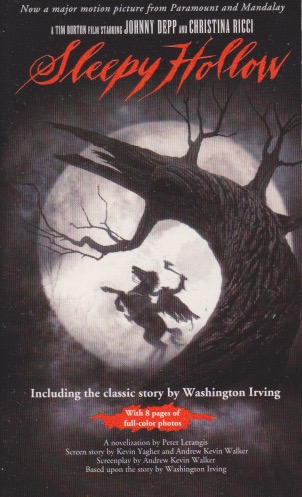
All of this has me thinking about other influences Dark Shadows has had on me personally.  It is probably responsible for my lifelong love of Maine.  The television show was filmed mostly in Terrytown, New York, better known by the name given in Washington Irving’s tale, Sleepy Hollow.  I wasn’t aware of this on my visit to Terrytown—which was before the more recent television series based on, but not filmed in that location, aired.  My first publication regarding religion and horror was based on Sleepy Hollow.  There’s a sense of connectedness here.  To get the final volume, which is rare, I had to buy a collection of several of the books.  Like a man who found a pearl of great price went and sold all that he had so that he could buy the field in which the pearl was.  We’re never told what he did with the rest of the field.  If I had to venture a guess I’d say he used it to house his Dark Shadows collection.


Moving Movies

I read something recently which began something like, “Do you remember when you first saw…?” (fill in the blank with a title of a movie).  This got me to thinking.  Movies used to be community events.  I’m not the first to notice this, but your community would wait (especially if it wasn’t especially urban) until a hyped up movie came to a local theater.  Everyone would see it and it was all that they’d talk about for days.  The internet makes all of that rather obsolete.  Even the part where you were the less popular sort who had to wait for the film to be shown on television to get in on the fun.  You can set up an account to see the movie at home while those who aren’t afraid of Covid go to the theater.  Or you may be like me—so busy that years pass before you get to it.  Hopelessly behind.

There is definitely a benefit to being able to catch a movie you missed at the theater when it’s convenient to do so.  You might be a bit late to the party, though.  And, depending on your tastes, you may be watching the movie alone.  I can’t recall having ever gone to a theater alone until recent years.  Once when my wife was away, pre-pandemic, I went to a local theater to catch the latest Annabelle movie.  Since I’m an early person the theater was pretty empty—at least one guy and his girlfriend, or a girl and her boyfriend, depending, were there with me.  Maybe a couple others I didn’t know.  Nobody to talk it over with.  Like bowling alone, I suppose.  The last movie I saw in a theater, The Conjuring 3, I was literally the only one there.

Photo by Denise Jans on Unsplash

I did recall the first time I’d seen the movie in the article.  I was watching with headphones on, sitting in my bedroom.  Sometimes it’s the living room.  I do recall my reaction, which is, after all, what the article is about.  Still, it was a movie that was watched without discussion, without seeing the reactions of others.  Watching it was, nevertheless, an enjoyable enough experience.  An intellectual one, even.  But as a former teacher I still have this haunting sense that if there’s no-one with whom to exchange information, remembering that first time becomes somewhat muted.  I suppose that’s why I keep this blog going.  I can interact with others on the internet and, collectively, recall seeing our movies together.  Attempt to be part of the discussion.


Son of Comfort

So the other day I was reading a book proposal for another editor.  It mentioned the mononymous Barnabas.  Since the proposal wasn’t from a biblical scholar I wondered if this was the same Barnabas mentioned in Acts as the sometime traveling companion to Paul of Tarsus.  As I began to type this into the search box—and this was on my work computer, which, I hope, doesn’t know my reading habits—it autosuggested Barnabas Collins as the first choice.  One of the frustrating things about devices these days is they know who we are and sometimes we want an objective opinion from the internet.  Is Barnabas Collins as popular as I like to think he is, or is it just a case of my work computer anticipating my off-hour whims?  I sincerely hope it’s the former.

The proposal, by the way, was surprisingly referencing Paul’s Barnabas.  I wasn’t aware that he was much known outside biblical studies circles.  Probably about as rarely as Barnabas Collins is known in such circles.  There has been a resurgence of interest in Dark Shadows that has taken place in spite of, or perhaps partially because of, Tim Burton’s movie.  The film made many missteps, but people from my generation who’d never heard of him before began to reference Barnabas Collins to me.  I’ve never been a soap opera watcher.  It does seem that many college students used to go through such a phase—again, it’s the story that draws them in—but that never really happened to me.  I’d grown up watching Dark Shadows, however, and I’ve been tempted a time or two to start watching the series again.  With well over a thousand episodes, some of which are lost, it would be a major time commitment.  And besides, it wouldn’t recapture those grade-school afternoons watching what my mom thought was a waste of time.

The name Barnabas probably means something like “son of comfort.” I don’t know how the somewhat desperate writers, trying to gain back a slipping audience, came up with the name.  Their introduction of the supernatural into the daily drama did, however, transform television.  The usual demographic for the show was a bit older than me when it was being aired and I didn’t by any stretch see the entire series.  I did see enough, however, to forever frame my view of vampires.  There have been efforts, including one current, to reboot the series on television.  It may eventually rise again from its coffin. Featuring, of course, Barnabas.


Learning to Fly

“Be afraid.  Be very afraid.” This quote originates with David Cronenberg’s The Fly.  Of course, after watching the original, how could I not watch its successful remake?  I initially saw this one upon its 1986 release in a Boston theater.  I hadn’t seen it in some 35 years but some of the scenes were as fresh in my memory as if I’d seen it last year.  It’s safe to say that it made an impression on me.  Even usual critics of horror gave the film high marks.  Both it and its predecessor with the same title were quite successful in the financial department and became part of popular culture.  The remake ends without the philosophical statement of Vincent Price in the original, choosing despair instead.  I’ve never seen the sequel.

I picked this up as a used DVD many years ago.  Mainly I wanted to have it on hand in case the mood struck to see it again.  I did recall that, as a Cronenberg film, it was a gross-out of body horror.  So much so that it’s difficult to classify it as science fiction.  It, along with its near contemporary Alien, demonstrated that the fusion of the genres was possible.  Perhaps inevitable.  At the same time, movies, like most other media, have proliferated to the point that such standouts are rare.  Yes, there are still Academy Awards and Golden Globes, but who but a professional can see all the offerings out there?  It feels like we’ve moved beyond the time when a movie could define a generation.  But on a deeper level, that’s why The Fly is about.

We, on the far end from the white male oligarchs, are blending.  We’re no longer simply accepting what we’re told.  We’re becoming more global and more people are starting to break into the power structures.  Even if they sometimes transform if they do.  I saw a recent newspaper article about what to do with your second home, as in decorating it.  Second home?  The majority of us are having trouble up keeping our one home, and that’s if we’re even owners.  Society needs a telepod.  The end results may be messy, for sure, but we need to stop thinking in exclusive terms.  Cronenberg indicated back in the eighties that the movie was about disease and aging and letting those we love go.  That gives the film its poignancy, in a kafkaesque way.  At the same time it may be a teaching tool.  Yes, we can be afraid, very afraid, and still learn.


Wordle

Each year in late capitalism seems to begin with a new fad.  This has been pronounced with the pandemic (which I almost wrote as “academic”) keeping people indoors.  Last year sea shanties were the rage with many of us finding ourselves humming something about a wellerman during the oddest times.  This year’s initial fad seems to be Wordle.  In case you’ve been living on the dark side of the moon, Wordle is an online game that is best described as Mastermind with five-letter words.  Mastermind, in case you were born after the Republican Party turned evil, is a game where you have six colored pegs that one person sets in a board a sequence of four.  The other player can’t see them, but has to try to replicate the colors in the right sequence.  At each guess the one who selected the sequence gives the guesser the following information: which pegs are the right color and which pegs were the right color in the right place.  (It occurs to me that explaining Mastermind could have been left out and I could’ve just described Wordle.  But what’s the fun in that?)

In any case the Wordle player has six chances to guess the right word based on the same clues: the right letter in the wrong place (yellow), or the right letter in the right place (green).  The hook is that you can only get one puzzle per day (otherwise many of us would be starving to death and out of work).  As a kid, I have to say, I could play Mastermind for hours.  I even brought our daughter up on it.  There’s something beguiling about trying to figure out what’s in somebody else’s mind.  There is a dark side to it, however.

I read a lot.  Lately I find that when I’m reading I’m secretly scanning for five-letter words that might be a good initial guess for Wordle.  The ideal word has no repeated letters and at least two vowels.  You need to narrow down the vowels first because every word has to have one of those six letters, since “y” functions as a vowel.  The other day I was thinking “s” has enough lubricant to function as a vowel too, but I digress.  Isn’t that the point of Wordle, though?  To digress?  There’s so much despair in the world with autocrats in power and the planet melting down that we need a little boost.  If only I could let myself read normally again, all might be well with the world.


Horror Shortly

Some short books have an outsized punch.  Especially when dealing with a large topic such as “horror.”  This isn’t just horror movies, which could easily fill such a book, but also literature and other media as well.  Darryl Jones has proven himself on this topic before and this Very Short Introduction is a showcase of what is a fascinating genre.  I’ve read a number of books in this series and this stands out as one that works admirably within extreme limits—they are very short—in making good decisions about representative aspects in what is really a sprawling field of inquiry.  The introduction lays the task out well and I came away from each chapter feeling inspired.  Of course, not all of horror can be covered in less than 150 pages.  Some may find their favorite fear unaddressed, but they’ll learn something nevertheless.

In his first content chapter, Monsters, Jones focuses on vampires and zombies.  These are both forms of cannibals as they’re currently conceived, zombies being relative newcomers to most favored monster status.  His next chapter, on the occult and supernatural, takes on the Devil himself before addressing satanists, demons, and ghosts.  These are, of course, religious monsters.  Although Jones doesn’t dwell on that aspect, the close relationship is nevertheless evident.  For those of us who explore religion and horror this framing proves helpful.  It’s worth pausing here to consider how all of these entities overlap a bit.  As anyone familiar with ghost hunters knows, ghosts and demons may both be found haunted places, and the Devil is the head demon.  Of course, horror is a fiction genre but many people believe in these entities.  That brings religion and horror within the same room.

Body horror occupies the next chapter, and here werewolves come into the picture.  Other aspects of body horror are also discussed, but the painful transformation of the shapeshifter is prime territory.  Horror and the mind brings us to psychological thrillers and the gothic fear of madness.  The topic segues nicely into science, which the next chapter covers.  Not only science itself but the mad scientist.  Finally, the lengthy afterword looks at where horror has gone, and may be going, in the new millennium.  Something that struck me, and which brings this back into religion, is how frequently Darwin and evolution are mentioned.  This concept challenged the human place in the divine hierarchy and led to much of what we think of as horror.  This book is a great resource in a small package.


Whose Baby?

Some books are better known as movies.  I suspect that I, like many, saw the movie Rosemary’s Baby without ever reading the book.  It turns out that they’re very similar.  The book takes the action a few minutes beyond the end of the movie, but otherwise they’re quite close.  Reading a horror novel where you know everything that’s going to happen isn’t exactly the recipe for thrills and chills, but I’m nevertheless glad to have done it.  For a book published as long ago as it was (1967) it still isn’t easily found used.  New copies tend to be just as expensive as new books.  I just wanted to have a read to see if Roman Polanski stayed close to Ira Levin or not.

Levin had a string of successful novels, but Rosemary’s Baby is probably still his best known.  He is quoted as saying he didn’t believe in the Devil and felt guilty that his book (and movie) may have led to many people taking on that belief.  In many ways Polanski’s movie kicked off the age of modern horror, being released the same year as George Romero’s Night of the Living DeadRosemary, however, opened the door to horror with overt religious themes.  It paved the way for The Exorcist and The Omen.  The latter, written by David Seltzer, was another example of a movie based on the Devil by an author who didn’t believe in him.  Personal belief aside, that trinity of movies remade the horror scene and led to one of the strangest cooperations in cinematic history.

In the book versus movie scenario often there’s a clear winner.  On other occasions the movie is so powerfully made that it overshadows its novel.  Rosemary’s Baby, along with The Exorcist, tended to do so.  (The Omen was novelized from the screenplay by the screenwriter.)  I wonder if that might not be because religion pays right into cinematic representation.  The novels, after all, can take several days of reading on a normal workaday schedule.  The film, if well done, transports the viewer there for a couple of hours and leaves you feeling as if you’ve been through, in the case of Rosemary, a traumatic pregnancy.  It so happened that the unholy trinity of religious horror tapped into that rapt storytelling of which celluloid proves so capable a medium.  Still, reading the novel fills in many of the gaps and brings to mind the benefits of the written word.  And this is, like a birth, something to be celebrated.


Love on a Monday

I hope you may find love on a Monday.  I have a feeling that if we took Valentine’s Day more seriously the world would be a better place.  Capitalism, however, abhors interruptions (unless you buy lots of stuff) so many of us are at work this Monday.  I was recently reading how the full, unbroken eight hours’ sleep is a product of the industrial revolution.  I’d never thought of that before.  Everyone is different, of course, but it is natural for our species to wake in the night and be up for an hour or two and then to fall back asleep.  That, of course, interferes with the nine-to-five (925) that capitalism holds so dear.  In response, humans have altered their natural sleep patterns to conform.  The results are predictable: a line at the coffee machine every day at the office.

When I raised this with a friend, I was reminded that much of our life-style has been determined by the industrial revolution.  Certainly the concept of the weekend was.  And the constant feeling of never having enough time to, well, exist.  I awake when my body tells me it’s slept enough.  Generally that’s around 3:00 a.m.  I begin work early because Protestants have this work ethic going, but then I always get sleepy around 8:00 a.m.  Napping on the job is essentially the same as being a communist, so like many others I struggle through the rest of the day, not quite as efficient as I was for the first couple of hours.  In many cultures a nap is built into the after lunch slump.  Intravenous coffee is preferred by capitalists everywhere.

What if love catches you on a Monday?  Is it a sick day?  A vacation day?  A personal day?  Or all of the above?  It’s an opportunity to be human, but less than a true capitalist.  Someone could be making money off your time!  And whoever heard of more than ten paid holidays in a year?  I’m not complaining.  I love weekends and the scattering of holidays I receive, I really do.  Still, I miss the spontaneity of life.  The flight from a predator.  The shutting of the eyes when tired.  The celebration of love when it’s found.  A Faustian bargain was made when Christianity wed capitalism.  We’re encouraged to buy valentines for our sweeties, but show up to work and be there bright and early again the next morning.  May you nevertheless find love on your Monday.


Secret Formula

When writing fiction, I’ve never tried a series.  Some, such as Harry Potter, can set a writer for life.  I’ve always had the sense that the Dark Shadows novels were more potboilers.  There was a built-in fan base, and somehow in the sixties and seventies we didn’t expect Rowling-level writing.   It was the entire package: the Gothic, the recurring characters, the moody setting of Collinwood.  And of course, Barnabas Collins.  These novels may be journeyman writing, but here at number 25 in the series, Barnabas, Quentin, and the Magic Potion, there are some signs of literary improvement.  They are slight, rather like the first tinging of leaves with yellow as August begins to settle in, but they are there.  The series is nearing its end for me (provided I can actually find the last few books), but maybe it’s getting better.

What’s my reason for such a burst of enthusiasm?  Well, in this episode we see some features of Quentin that are more in line with how I remember him.  First of all, Ross tries some misdirection.  Quentin is presented as a master of disguise in the series and here there’s some clever hinting that, if you’re trying to think it through, leads you to mis-guess early on.  Not only that, but there’s a more positive view of Quentin here.  He’s not the evil satanist that he is earlier in the series.  Perhaps Ross had figured out by now that if people liked the idea of a Barnabas who is a conflicted victim, the same might apply to Quentin.  He’s not evil, but when you’re a werewolf, well, what can you do?

The “magic potion” is just as contrived and sketchy as most of the plot devices in this series—Harry Potter this is not.  It’s just a get rich quick scheme for a reprehensible old man and serves to move the plot along without really adding anything to it.  Carolyn here discovers that Barnabas is a vampire and, it seems to me, some of the plot devices for the Tim Burton movie might’ve been picked up from this particular novelization.  Although still not belle lettres by any stretch, the story here seems to have made some progress over the previous 24.  As a child, of course, I didn’t read these in order.  I relied on what I found at the bin in Goodwill, when I could find them.  I never had the whole series.  While trying at times, reading them may be a worthy exercise as an adult.  Perhaps series too grow up.


Being Vigilant

While keeping to a budget, I’ve been tying to sample some new movies as therapy.  Interestingly, Hulu has had three on my long-time “to see” list, including The Vigil.  I heard about this one as soon as it came out.  Religion and horror have been a recent area of fascination, so how could I not?  A horror film partly in Yiddish is a novelty for me, and the haunting, endlessly haunting holocaust is never far from the surface.  Jacov, a young man with psychological issues caused by the death of his much younger brother, has left Orthodox Judaism.  He’s hard up for money, however, and agrees to sit as a shomer, a watcher who keeps vigil with a corpse of a person who has no family to do it, for pay.  The rabbi informs him the shomer he hired left because he was afraid, but since Jacov has done this before, he’s sure he can handle it.

Sitting in a creepy Brooklyn house with a corpse is made even more difficult by the widow’s Alzheimer’s disease and Jacov’s seeing things.  Unsettling events take place.  The problem is revealed to be a mazzik, a kind of Jewish demon.  As I explore in Nightmares with the Bible, and Holy Horror, the Jewish idea of demons took quite a different track from the Greek-inspired Christian concept.  Jesus was Jewish, but living in a Roman context.  What we in the west understand as demons is largely based on The Exorcist.  In Judaism demons weren’t the same obsession they were for Christians.  The dybbuk tends to be the soul of an evil person that can’t rest after death.  A mazzik is more a demon sent to harm, as a form of divine punishment.

The Vigil presents Jacov in that pincer of having left a religion only to find himself needing it in a time of crisis.  His Orthodox upbringing hasn’t prepared him for the world of having to interact with women, or even gentiles (as wicked as they can be).  The mazzik has haunted the man who’s just died—a holocaust survivor—and is now looking for another broken person.  Ever since the death of his brother, Jacov has been broken.  The film make effective use of several horror tropes, and is quite claustrophobic in the small house.  Even though set in New York City, isolation is the real threat.  More than that, the movie eloquently articulates how religion and horror rely on one another.  And how they might learn from each other.


Nine Secrets

By their very nature they make us wonder what they’re up to.  Secret societies, I mean.  That’s part of their appeal.  Those on the outside speculate and usually the ideas swirl around mysterious rights and probably sex and money.  Leigh Bardugo takes it in a different direction in Ninth House.  Since I try not to read reviews before getting into a book, I wasn’t aware of the premise that the secret societies of Yale University were the nine houses referred to in the title.  Bardugo’s imagination takes the route of suggesting that they all specialize in different kinds of magic.  That makes this kind of a fantasy horror novel because the protagonist, Galaxy Stern (“stern” is, of course, German for “star”), can see ghosts.  And some of the professors aren’t who you think they are.

Somewhat gritty, Alex (Galaxy) isn’t exactly college material, let alone Yale.  She’s a recovering drug runner who has a past that would keep her out of most universities, particularly those of the Ivy League.  Still, she’s invited to Yale and she has some personal motivations, not necessarily academic, to accept.  She’s brought there by the ninth house, Lethe, because of her ability to see ghosts.  As portrayed in the novel Lethe is the secret society that makes sure the others don’t go beyond their bounds, the police, if you will.  Each society specializes in a specific kind of magic and it uses it to help its members benefit in school and career.  That’s why the university is so well funded.  It paints a compelling image of New Haven and it manages to capture the mystery many of us felt about attending college in the first place.

Yale is one of the two Ivy League campuses I’ve never been on (the other is Dartmouth).  Even so, Bardugo writes in a way that makes you feel as if you’ve been there.  The story is a page-turner that goes quickly for its size.  Alex, who is a novice in Lethe, spends the novel trying to find her mentor, Darlington, who’s been missing since some bad magic got him.  There are many unexpected twists along the way.  Although I don’t know much about Bardugo’s past, it seems likely that she knows some people in the drug culture.  Maybe she’s even seen some ghosts.  All of this combines to make a magical read that should appeal to Neil Gaiman fans as well as those of Stephen King.  And, of course, those who like to speculate about secret societies.