Live Long

Maybe you went through it too.  In your teenage years the fascination began.  Before you knew it, you had a stack of them tucked away, each well-thumbed and ogled over.  Guinness Books of World Records, I mean, of course.  We’re captivated by extremes.  While working on a fictional story the other day, I started wondering about longevity claims.  The Good Book suggests that once upon a time a century was the equivalent of becoming a teenager, and people were acting like teenagers well into their eighth or ninth centuries.  Modern scientific analysis provides an alternative narrative, putting upper limits at 120, with only one verified, and disputed, case putting someone over it.  Curious, I looked at Wikipedia.  Two pages (at least) address the issue, one on human longevity tout court and another on verified claims.  Since the lists include home nations, I began to notice a pattern.

The verified records tend to feature the United States, Japan, Canada, and Europe.  The unverified Russia, Latin America, and Western Asia.  This disparity struck me as perhaps a bias concerning the source of reliable information.  Not only affecting longevity reports, concerns about reliable data impact all our sources of information.  I’ve written about internet resources before, but here I’m mainly worried about the bias of “first world” records as opposed to the records of less developed countries.  Not only that, but in the case of longevity claims, those born in outlying areas—beyond the reach of official government recorders—are suspect when compared to those kept by city dwellers.  We tend to trust our own kind, especially when it comes to extreme claims.

Like John Mellencamp, I was born in a small town.  Official records, comfortably handwritten, indicate when and where that happened, to the nearest day.  (Birth is a process, of course, and doesn’t always obey conventional human time-marking practices.  Organic events are often that way.)  The fact of the existence of other people indicates that they too have been through this in some form.  The event was marked in the way of local custom.  It’s locally true.  I knew a doctor trained in Sweden.  She couldn’t practice medicine in the United States for fear of what boils down to competing forms of belief.  Xenophobia in medical practice extends to other areas of human knowledge as well.  We are taught to trust the information given by our own authorities, but not those of other cultures.  I’m suppose to accept that without question, but I wasn’t born yesterday.

Ghouls and Dolls

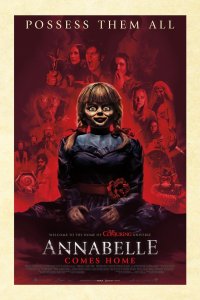
It was my plan—as if plans ever really work out—to see Annabelle Comes Home on opening weekend.  July got away from me but I finally found my way to the theater yesterday.  My current book, Nightmares with the Bible, deals with demons in cinema.  One of the chapters covers The Conjuring universe, and since this is the sixth film in that diegesis (with one tangentially attached spin-off) watching the movie was as much research as it was fun.  While the demon utilizing the doll Annabelle is clearly the main villain, the film, as in most of the franchise, interjects any number of entities.  Ed and Lorraine Warren, in real life, kept a museum of occult objects in their house.  This room contained items that had figured in their cases—they maintained demons didn’t possess objects, but people—including the doll Annabelle.

The new film maneuvers three girls (Judy, the Warrens’ daughter, her babysitter, and a friend) into the house alone.  One of the girls releases Annabelle from her blessed case, and a nighttime of terror ensues.  The demon behind Annabelle animates several of the haunted objects, so the girls have to deal with many ghoulish threats.  The film knows it is following tropes such as a car breaking down by a cemetery at night, and the idea of a babysitter being attacked by monsters, and at times it gives a slow wink to fans of the genre.  Still, there are plenty of genuinely creepy moments and a few jump startles.  It also shows the clearly demon in its “true form” at the climax of the film.  When it does so, it matches traditional renditions.

Set to become the highest grossing horror series of all time, The Conjuring universe mixes films that claim to be “based on a true story” and others, such as Annabelle Comes Home, that use real settings but without claiming to follow actual events.  What I found engaging about this particular movie was the fact that the youngest girl, Judy Warren, was the one who figured out how to re-capture the demon.  There are holes in the plot, of course, but featuring a young woman not requiring a man’s help to trap a demon is somewhat unusual in a Catholic diegesis.  True, she doesn’t perform an exorcism, but Judy does contain the evil without a priest, or even her father’s direct help.  As this diegesis wends its way into American folklore, moments like this are increasingly important.  Even though there are demons here, the women don’t require men to do the heavy lifting. 


Sighs

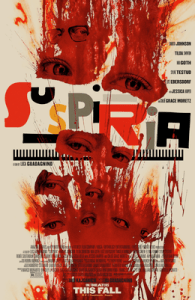
Suspiria is a movie intentionally difficult to follow.  The original 1977 version was an Italian film about witches posing as dance instructors.  After watching it, I felt I didn’t have enough backstory to understand the action.  Then a remake was released last year and I felt I needed, like a dancer, to try again.  I have to confess I’m not a dancer.  Luca Guadagnino’s remake left me scratching my head again, although it underscored a point I make in Holy Horror: in horror films with remakes the role of the Bible changes.  Now, it’s been years since I’ve seen the first Suspiria, but I don’t recall the Bible appearing.  It does, however, in the 2018 remake.  The protagonist, Susie Bannion, is an American enrolled at a German dance school.  She is, in the remake, a Mennonite from Ohio.

Not only does this situation allow religion to take once again an important role in a horror film, it is also the opportunity to show the Bible visually.  Susie’s mother, who objects to her daughter engaging in such a showy profession as dancing (and given the performance of Volk in the film, the nature of this objection can be easily guessed), is dying as the film begins.  Her Mennonite community watches and prays over her, sitting with Bibles clutched in their hands.  To take a page from Holy Horror, this suggests that the Good Book is powerless to save.  While the movie itself is a little confusing on this point, it seems that Susie’s mother dies as her daughter becomes the head witch of the dance academy.  Since Holy Writ famously contains verses condemning witches, the impotence of Scripture is underscored.

Italian folklore about witches appears to be remarkably robust.  From Strega Nona to Suspiria, the wizened women of society have power against which men are powerless.  Some of the bleakest moments in the film (from the point of view of the male gaze) are when the witches taunt powerless, naked men who cannot in any way defend themselves.  Turnabout, of course, is fair play—at least if folk sayings have any validity.  Here it’s worth considering that if male religions hold females down—the Mennonite women are shown in bonnets and uncomfortable clothes—then being a witch is remarkably freeing.  Indeed, there is the energy of a life-force evident in the dancing of the young women and the academy is closed to men, apart from public performances.  I’m still scratching my head over Suspiria, but it seems that the direct engagement with religion and the power of women makes this a movie worthy of rewatching and attempting to understand.


Universals

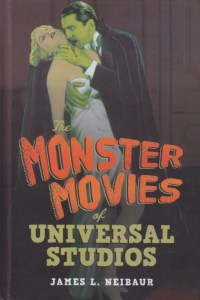
It was on television that I met them.  The Universal monsters.  The entire run of films from Dracula to The Creature Walks among Us had been shot, printed, and screened before I was born.  In other words, I’m a late monster boomer.  By the time I was old enough to handle monster movies, they were on television and my early memories of them are tinged with the nostalgia that accompanies what seemed like better times, although each era is about equally difficult.  When I saw James L. Neibaur’s The Monster Movies of Universal Studios I knew I had to read it.  Neibaur goes through all the films in the series, chronologically, encapsulating the Draculas, Frankenstein’s monsters, mummies, invisible men and women, wolf-men, and the gill-man.  As I child I never watched them systematically, being subject to television schedules, among other things.

Not understanding studios or business, and certainly not copyright, I never understood why other favorites such as Jekyll and Hyde, the phantom of the opera, and various assorted ghosts and ghouls weren’t part of the collection.  Nevertheless, this study in discrete, brief chapters, treats the official canon reasonably well.  The line between religion and monsters is sometimes crossed in these movies, which gets at an underlying theme of my own interest—how horror and religion interact—but that’s not Neibaur’s purpose.  That dynamic is, however, the driving force behind my two most recent books.  A tie-in to the paranormal may also be found there.

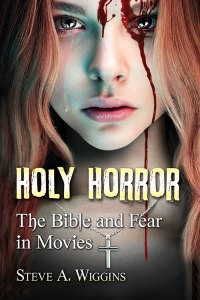
As I dropped off some promotional material for Holy Horror at an area bookstore recently, the events manager revealed her interest in the paranormal.  In my mental schematic, it’s wedged in there between monsters—which are fictional—and religion, the antithesis of fiction for most people.  What do we do with ghosts and others that don’t fit into the neat lines of a theology that draw a stark line between the supernatural and human?  Universal’s monsters sometimes ran into problems with the Production Code for stepping over that line.  Of course, the Universal monsters are pretty tame in comparison with today’s fare.  Still, they were the monsters who showed, in many ways, what it was to be human.  Neibaur isn’t going for an in-depth analysis here, and his treatment is readily readable by anyone interested in revisiting the monsters of yesteryear.  Some of the descriptions reminded me of movies from my childhood that I’d forgotten.  It is pleasant to relive them for a few moments while the real monsters in the real world lurk not far from my door.


Internet Epistemology

Where do we find reliable information?  I’m asking this question on an internet-based medium, which itself is ironic.  While spending time with some younger people, it’s become clear that the web is their source of truth.  You find purveyors of information that you trust, and you accept their YouTube channels as representing correct data.  This can be a disorienting experience for an old doubter like me.  One of the reasons for studying for a Ph.D., apart from the vain hope of finding a career in higher education, is to hone critical thinking skills.  When I went through the process, that involved reading lots and lots of print material, assessing it, and weighing it against alternative views, also in print format.  You learn who really makes sense and you judge which publishers have good information more frequently.  As you navigate, you do so critically, questioning where they get their information.

Now, I’m not one of those people who think the younger generation is wrong (in fact, there are YouTube educational videos about just that).  The situation does, however, leave me wondering about how to fact-check when you don’t know the publisher.  It may be an older person’s problem, but it’s essentially the same dilemma behind self-publishing—the reason you trust a self-published book depends on the author alone.  Is s/he persuasive?  Did s/he document the sources of her/his information?  Are those sources good ones?  The young people I know seem quite adept at filtering out obviously biased information.  Many YouTube personalities footnote their presentations with links to sources (many of them online), and after an hour of watching I’m left questioning what’s really real at all.

You see, many of these internet personalities have sponsors.  Sponsors bring money, and money biases anyone’s angle toward the truth.  In fact, many of these YouTube sources call out the lobbying groups that influence public opinion for political ends.  Only someone completely naive—no matter their generation—would not acknowledge that government runs on money provided by corporations with interests to be protected.  There have been reliable sources, even from the days of print, that prove beyond any reasonable doubt just how corrupt governments tend to be.  But who has time to fact-check the government when the rest of the information we receive is suspect?  Those of us with training in advanced critical thinking aren’t immune from biased information.  It’s just that there’s so much data on the web that my head’s spinning.  I think I need to go read a book.


Making Monsters

It’s not so much I’ve been away from monsters lately, but that life has intervened between them and me.  Life can be scarier than monsters sometimes.  In any case, the summer is when my mind turns back to haunting even as on the breaks during heat waves a whiff of autumn can be caught on the air of a July morning.  Yes, we’ve past the solstice and days are getting shorter.  Slowly, of course, but that’s what builds suspense.  And there are local signs that I need to get my haunting in gear.  It is finally time to get Holy Horror out of wraps and give the book a proper launch.  Being published around Christmas last year was poor timing for a subject so readily coded for fall.

I received the welcome news this week that the Moravian Book Shop—the oldest continually operating bookstore in the country—will be hosting a book signing for Holy Horror in October.  This is a fortuitous turn of events because when I first approached them with the idea the price of the book made the idea look unrealistic.  But we’re now thinking of autumn, and with autumn comes Halloween.  There have been a spate of horror films this summer, all of which I’ve unfortunately missed.  Time, as Morpheus notes, is always against us.  There does, however, seem to be a lively interest in the genre and the curious wonder what it has to say about what we believe.  Horror loves religion, and indeed, thrives on it.  So it’s been from the beginning.

October will also see the Easton Book Festival in this area.  I will be on the program for that as well.  While none of this is earth-shattering, these events represent the first successes in trying to build awareness of Holy Horror.  This was a book written for a general readership, but not priced for one.  Working in the academic publishing world, this is a phenomenon with which I’m all too familiar.  Many colleagues offer to read and spread news about your book.  It seldom happens, though.  Academic presses can’t afford book tours (especially if they have to price books at $45), but these self-driven presentations are opportunities to spread the interest in ideas.  That’s what those of us who write really want—to be part of the conversation.  We’re in the midst of a heat wave here.  It’s the height of summer.  Even so, those who know about monsters can feel them coming, even from here.


Alien Ideas

One of the iconic moments in all of cinema, known well beyond the confines of sci-fi and horror fans, is the alien bursting out of Executive Officer Kane’s chest.  The movie, of course, is Alien.  The screenwriter, Dan O’Bannon, was also known for contributing to Star Wars, Total Recall, and Return of the Living Dead.  Alien is one of those horror films I was too afraid to watch when it came out in 1979.  I was sixteen at the time, and had been primed by commercials that still haunt me.  I would eventually, in seminary, see Aliens and prompted by curiosity, eventually went back to watch the original.  It has since become one of my favorites, and analysts of genre fiction and religion quite often point to the iconic role of Ridley as worthy of theological mention.  Her self-sacrifice in the third installment has been heralded as one of the many cinematic messianic moments.

Science fiction and horror are closely related genres.  They can be teased apart in Alien only with extreme finesse.  Consider the most famous scene again.  Kane, while on the derelict alien vessel on LV-426, has the unfortunate experience of an alien larva sealing itself to his face.  The crew of the Nostromo can’t get the creature off—whenever they provoke it, it wraps its tail more tightly around Kane’s throat or leaks acid.  Then it falls off and dies.  Everyone, not least Kane, is relieved.  He joins the rest of the crew for a meal, but then shows signs of distress.  Something is eating him from inside.  The alien rips out and the line from sci-fi to horror is irrevocably crossed.  That unforgettable scene immediately became a classic of the genre.

Dan O’Bannon, the screenwriter, suffered from Crohn’s Disease.  He attributed the alien-bursting scene to his own experience with the condition, which eventually took his life.  Someone in my family was recently diagnosed with Ulcerative Colitis, a disease similar to Crohn’s.  In response I did something I’d never done before; I started a fundraiser on Facebook.  The Crohn’s and Colitis Foundation is a non-profit organization funding research into these debilitating illnesses.  It offers support to those who suffer with the diseases, the incidence of which is on the rise.  I once told my family member about O’Bannon’s use of his own suffering as the inspiration for that cinematic moment.  It brought a rare smile in the midst of a flare, a smile with a little too much understanding for a young person.  If only Ripley were here to take control of a menace far too human.


Good Ground

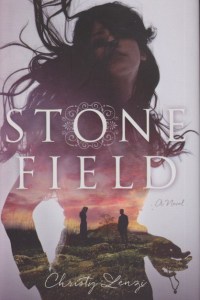
Young adult literature gives me hope.  The quality, speaking for a guy who grew up in a small town with limited choices, has improved astronomically over the past several years.  One of my favorite (adult) novels is Wuthering Heights, and so it’s no surprise that I found Christy Lenzi’s debut novel Stone Field quite engaging.  Set in a different time and place, and with a younger readership in mind, it retells the story of forbidden love based on xenophobia.  The message has never been more relevant.  Although it avoids explicit language, it does include adult situations and features a strong female protagonist in an age of explicit gender inequality.  During the chaos leading up to the Civil War, star-crossed lovers are set against one another because prejudice is a most effective poison.

While not a religious story, the iconic Bible plays a large role in it.  One of the main characters is a preacher, but even without him Catrina Dickinson’s family and friends are ready to quote the Good Book as unquestioningly as a Republican (with my apologies to fiscally conservative friends untainted by this aberration).  This is beyond a realistic portrayal of American life of the 1860s, it reflects the way that many people continue to think of Scripture.  Nevertheless, in one crucial episode of the story set in the church at Roubidoux, Missouri, the iconic role of the Bible becomes clear.  It is deftly woven throughout the story in a way that might serve as a lesson for modern writers seeking verisimilitude.  Many authors fear to address religion, but the Good Book is alive and well in these post-frontier days.

Often the desire to avoid religious motivations leads to stories that lack a key element of the social fabric.  In my own attempts at fiction religion is seldom absent.  It is the way average people live.  Lenzi presents Cat as being aware of but unwilling to be cowed by the Bible.  Indeed, as the story unfolds with several tragic events (remember, Wuthering Heights) she demonstrates that Catrina knows but doesn’t accept the strictures of Scripture.  The issue of theodicy hangs heavily in the atmosphere of the novel.  To me, this makes stories appear more life-like than tales that simply suppose religion doesn’t impact people.  When tragedy strikes, many people question what God, or their stand-in for the divine, is doing.  Anyone who’s asked “why me?” has directed that question into the world of theodicy, whether intentionally or not.  Reading this story while going through a family illness may have drawn this to the surface, but it underscores just how effective it may be for a realism that is otherwise lacking, whether in fact or young adult fiction.


The Joy of Techs

Those of us with Luddite tendencies prefer to hide them.  Tech is the ultimate good, right?  You’ve got a smart phone in your pocket or purse and it contains the entire internet and what more could anyone possibly want?  Besides an upgrade, that is.  I recently misplaced part of the charger for my old iPhone 4S.  Yes, a phone that old can still work, no matter what they tell you!  I went to the store to replace said part only to find that you had to purchase an upgraded replacement that costs twice as much as the old part did.  Why?  It had a new type of USB port, in addition to a “traditional” USB.  Pardon my ignorance, but I thought the U stood for “Universal.”  Now even vocabulary has to change to meet the demands of tech?  Whoever the tech god is, s/he is extremely mercurial.

So I was in a meeting the other day.  A guy older than me was talking about the future of tech.  It occurred to me that guys my age (who didn’t get to take early retirement) are trying to act like those half our age, as if we really understand technology.  Growing up with something is the only way, it seems, to adapt to it in any kind of naturalized way.  There are kids today, if the internet’s to be believed, who don’t understand that you had to lift the receiver on an old-style telephone before dialing.  And if that dial is rotary, well, let’s just say the pizza’s not going to be delivered anytime soon.  Those who grew up with the internet and smart phones have a native understanding that people my age lack.  I still write ideas down on paper.  I prefer DVDs and CDs to streaming.  And I believe books should be made of paper.

Changes in the tech world vindicate me.  I heard that iTunes is going to be retired.  This is after I’ve spent plenty of money downloading songs that I could’ve bought on DVD and have in “hard copy.”  Indeed, friends are telling me to back up my MP3 files on some kind of storage device before iTunes goes the way of UltraViolet.  And we’re supposed to trust tech.  I’ve lost ebooks by switching devices.  Some of my tunes have been licensed away because I downloaded them on an older computer.  What’s one to do?  Buy them again.  In a new format.  On a platform that will eventually be retired so you’ll need to repeat the purchase a third time.  Or you can buy it once in paper or plastic and have it for good.  Now there’s a radical idea.  If only I had something to write it down on.


Ghostly Thoughts

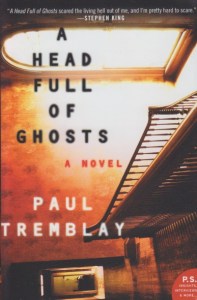
Ghosts tend to be on my mind in the autumn.  Paul Tremblay’s A Head Full of Ghosts, however, has been on my reading list for quite some time.  As a novel about possession, it has some scary moments, but it’s difficult to compete against The Exorcist in that regard.  Tremblay handles the topic with an ambiguity worthy of Shirley Jackson, however, and there are a few clear nods to her work here.  At the risk of giving out spoilers (you have been warned!) although it’s pretty clear by the end that much of the demonic was a cry for attention, the family member behind the tragedy is clearly left obscure.  We find out whodunit, but we’re left unsure as to the real reason behind it.

For fear of giving away too much (although my Goodreads assessment might be guilty of this), I’d like to consider something that I address in Nightmares with the Bible.  Demonic possession is largely coded as a feminine phenomenon.  The reasons for this are likely complex, but they are clearly related to the idea behind witch hunts and fear of women’s power in “a man’s world.”  Possession narratives, while they predated William Peter Blatty, became an essential part of the revived interest in demons brought on by The Exorcist.  Tremblay’s story is clearly aware of this, as he has his characters citing both fiction and non-fictional treatments of the topic.  Since researching the subject on my own, I’ve been wondering if anyone else has been able to handle it as deftly as Blatty did, and although Tremblay has two girls under threat, the question of whether it’s real or not tends to outweigh the pathos of believing Marjorie really has a demon.

In the end, it seems as if her father might be the real source of the family’s haunting.  An unemployed man looking for a way to support his family, he turns to religion.  This scenario is all-too-real to life.  And religion gives us not only a rationale for demons, but also a solution in the form of procedures and proper responses.  There are priests here—the males who alone can deliver the females—but whereas Blatty clearly made them the target of a demon that was pretty obviously real, Tremblay doesn’t play that card.  The priests come and go, and deliverance takes a form not expected for such a narrative.  A Head Full of Ghosts raises lots of questions and, like all good fiction, leaves us pondering at the end.  There’s still time to read it this coming fall.


Dark Theology

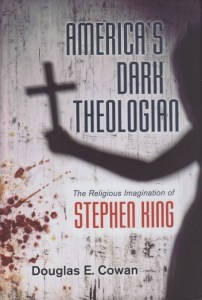
I’ve been struggling for several years, I expect it’s no secret, with how horror and religion relate to one another.  Many think the task itself pointless, as if pop culture can simply be brushed off like an annoying bug.  But flies keep coming back.  They won’t be ignored.  Almost a decade ago I discovered Douglas E. Cowan was also walking this spooky path past the cemetery.  I also know that as an academic he must demonstrate his chops in technical projects.  America’s Dark Theologian: The Religious Imagination of Stephen King was extremely welcomed by me.  Like many people I’ve read some Stephen King.  Like Cowan, I’ve noticed how often and how deeply religion is entangled in his story-worlds.  Before King is simply dismissed, we must reckon with the fact that movies based on his novels and stories have a long  pedigree and almost canonical status.

This is not the place to analyze America’s Dark Theologian in depth, but it is a place that would highly recommend the book.  Cowan takes several aspects of King’s works and shows how they tie explicitly to traditional religious thinking and longing.  I haven’t read nearly all the books Cowan cites here, nevertheless, the analysis he offers is compelling.  Scholars of disciplines outside religious studies have tended to dismiss it as being moribund.  Cowan shows that those who make a living in pop culture disagree.  King makes no bones about the fact that he sees the application not only of religion, but also theology, as one of the driving forces for his fiction.  We dismiss such observations at our peril.  Think of you favorite King novel and ponder; is there religion there?

Clearly religion’s not always the cause, but Cowan gives a careful consideration to much of King’s oeuvre, and there’s no denying he’s onto something.  As he points out, King is far more interested in the questions than in the answers.  Those who know religious studies—theology, if you must—know that the same is true there.  I’ve studied religion my entire intellectual life.  One of the reasons students evaluated my teaching so positively, at least I hope, is that because I encouraged the questions and did not privilege the answers.  In this field, answers are merely speculations.  We only really fall into serious danger when we cease asking questions.  Cowan does an excellent job of parsing out some various pieces that will make some kind of basis for a systematic theology of Stephen King’s thought-worlds.  We would be wise, I believe, to pay attention.


Utterly Indifferent

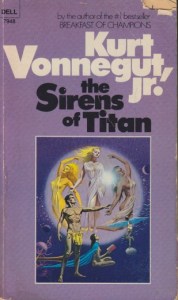
One of the main purposes of this blog, apart from being a kind of daily tablet for my thoughts, is to demonstrate that religion continues into the age of secularity.  It would be an uncomfortable stretch of the imagination to suggest Kurt Vonnegut was a religious writer, but it would also be a disservice to him to ignore just how much religion shows up in his novels.  Often the remarks are subtle and perhaps easily missed, but one of his early works, The Sirens of Titan, treads pretty solidly in that territory.  From the fact that monument to the twelve great religions was made by artisans who don’t know what those religions are to the founding of a new religion to unify humankind, this story never strays far from it.  It’s also, in my experience, the most science-fictiony of Vonnegut’s books.

The Church of God the Utterly Indifferent is the goal of Winston Niles Rumfoord’s doomed Martian attack on earth.  Because the Martians are actually brainwashed earthlings, they are sacrifices to the grand vision of all people sharing a single religion that recognizes God does nothing to help humans and humans, therefore, should not worry about serving God.  Clearly a religion that functions the opposite way of most actual religions—which try to keep God happy, often by harming other humans—Rumfoord’s vision is a united Earth.  One of the pawns in his scheme is his unhappy wife, and another is the biblically named Malachi Constant.  Constant built a ship to take humans to Mars.  Christening it The Whale, Constant took the pseudonym Jonah, which is something readers are increasingly ill-equipped to understand, but which demonstrates Vonnegut knew his Bible.

Religion plays throughout Sirens of Titan in ways that both poke fun at the seriousness with which religion is treated and with a certain respect for its power.  Vonnegut’s famous nihilistic leanings pervade the novel with an almost Job-like portrayal of Rumfoord, and several ethical questions lie beneath the apparent space-travel story.  Genre fiction, as I’ve intimated before, is intended to be slotted easily into recognized categories.  Critics reserve the sobriquet of “literary fiction” for those pieces that don’t really fit other patterns—not all fiction obeys the rules—and that’s where I’d put Sirens.  Yes, people zoom around in flying saucers and invasions from space are standard sci-fi tropes.  Engagement with religion, even if it is to question it, tends to move fiction into more serious categorizations, excluding, of course, novels written to promote a particular religion.  None of them would suggest a Church of God the Utterly Indifferent.  Unless, of course, they came from Kurt Vonnegut.


In Middle Earth

I try to make the best of business travel.  I had all-day obligations this time around, but fortunately my hotel was next to a place of some renown.  The house where J. R. R. Tolkien lived was practically right next door.  This is the place where the Lord of the Rings came into the world.  I have always tried to visit sites of literary significance when in new places.  When we were more able to do so, my family would take such literary pilgrimages annually, especially in the autumn.  Being a believer in the confluence of science and spirit, I can’t help but think there’s something sacred about the place where great literature was born.  Of course, in Oxford you can find sites for Lewis Carroll and C. S. Lewis, as well, among many others.  These days everyone seems to associate the place with Harry Potter, although J. K. Rowling started that particular series in Edinburgh.

Tolkien has become a deity in his own right, I suspect, for creating an entire world to which millions of fantasy fans come.  His actual house, however, is privately owned.  Besides, I’m here on business.  Still, falling asleep so close to where Tolkien dreamed his Middle Earth dreams is akin to inspiration.  Writing as an avocation makes such encounters almost worshipful.  I read the Ring trilogy and The Hobbit many years ago.  I haven’t seen any of the movies, however, since my own imagination seems sufficient for me.  Tolkien took me, for many hours, into another world.  Somewhat like work has done this week, I guess.  Were it not for business, Oxford could be a magical place.  Living in a location where imagination is valued and encouraged makes a huge difference, I expect.

Years ago, Edinburgh was an inspirational place to reside.  Although my main writing output at the time was a 300-page doctoral dissertation, it was a place that has inspired much of my fiction.  Tolkien, in truth, was just as human as the rest of us.  His work was largely based on ancient Germanic traditions that were also reflected in Wagner’s Ring cycle.  We are all borrowers, in some sense.  Adapters.  Oxford is one of those places with a long sense of continuity with the past, in a singular tradition.  It has become modern in parts, but with medieval streets.  There are cars parked along Northmoor Road, and nobody else seems to be here for a pilgrimage today.  Perhaps it’s for the best; how could the workaday world possibly improve for the use of imagination?


The Lagoon

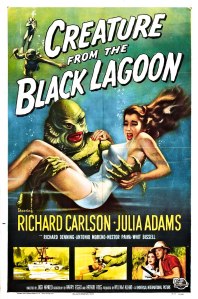
My current book project has me watching The Creature of the Black Lagoon again.  One of the Universal monsters—indeed, arguably the last of them—the Gill-man fascinated me as a child.  There was a strange contradiction here.  The creature had evolved in the Devonian Era and remained unchanged into the 1950s.  But the movie opens with a voiceover of Genesis 1.1.  There’s a mixed message here, appropriate for scriptural monsters.  Watching the film again brought back many of the innocent perceptions of youth, as well as the trajectory of my own life.  I don’t often get to the theater to see horror movies anymore, but at the same time the Universal monsters aren’t quite the same thing as modern horror.  As a genre it had to evolve.

Strangely, as a fundamentalist child, the evolution aspect didn’t bother me.  I was after the monster, you see.  The backstory was less important.  Growing up, at least in my experience, means that the backstory becomes more essential.  It has to hold together.  There are, of course, inaccuracies in the story—many of them, in fact.  Still, within the first three minutes Genesis and evolution are thrown together in a happy harmony that belied what I was being taught at church.  The Gill-man is a monster mainly for being a creature out of time.  When modern humans invade his lair, he defends his territory.  The story might’ve ended there, had he not spied Kay.  He doesn’t so much want to kill her as get to know her better.  For a movie posthumously rated G, it has a body count.  Five men die but the Gill-man apparently just wants to evolve.

There’s been a recent resurgence of interest in Creature from the Black Lagoon with both the publication of The Lady from the Black Lagoon and the death of Julie Adams this year.  The Gill-man seldom shows up in the same billing with Dracula or Frankenstein’s monster, or the Wolf-man.  He’s a bit more inaccessible in his watery abode.  Both cold and hot-blooded, he represents how science and Scripture might get along, at least on the silver screen.  The film holds up remarkably well, if a modern viewer can handle the pacing.  Underwater filming was pretty new back in the day, and watching humans swim in many ways suggests the truth of evolution in its own right.  These aren’t the childhood observations of the movie, but rather the reflections of a guy wondering if there might not be some hidden wisdom in the monsters of yesteryear.


Dolls and Puzzles

Maybe you’re anticipating it too.  Annabelle Comes Home, I mean.  My latest book, Nightmares with the Bible, has a chapter on The Conjuring universe, and with the recent death of Lorraine Warren I’ve been working on another piece trying to fit this whole puzzle together.  “What puzzle?” did I hear you ask?  The puzzle, I answer, between what really happened in the Ed and Lorraine Warren investigations.  You see, the paranormal is one of those things we’ve been taught to laugh at, and we’re told that people who “see things” are dweebish kinds of gnomes that don’t see the light of the sun enough.  Reality television has brought some of these ideas into vogue, what with ordinary people gathering “scientific” evidence of ghosts and the rest of us scratch our heads while hoaxes are revealed on the B reel.  But still, Annabelle lives.

It has also been announced that The Conjuring 3 is in development.  For some of us—and I’m well aware that movie-making is an industry and that profit is its goal—the question of what’s real can be as haunting as any ghost.  You see, I buy into the scientific method, as far as it goes.  That caveat is necessary, however, since science is neither able to nor interested in assessing all the strange things people see.  Our senses can be fooled, and a great many people haven’t developed the critical ability to scrutinize their own observations skeptically.  Skepticism itself, however, need not become orthodoxy.  It’s like any other tool in our mental box—each has its own purpose.  A car engine is dismantled in order to rebuild it in working order.  And there may be a ghost in the machine.

That’s what gets me about this whole Conjuring thing, and beyond that the contested livelihood of the Warrens.  There may be such a thing as mass hysteria (the current state of the US government can hardly be explained any other way), but the Perron haunting that was the subject of the first film provides, I think, a good test case.  A family of seven living in a house where they experienced things not only collectively and individually but also in different combinations would seem to be a place where multiple angles could be used.  According to Andrea Perron’s written account, the Warrens’ investigation never really took off there.  That didn’t prevent a very successful movie franchise from being launched, loosely based on their story.  And getting at the truth is never as simple as buying your ticket online and waiting for the show to begin.