Re-reading the Rite

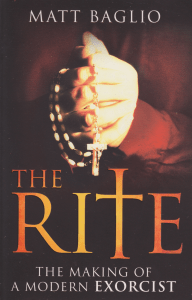
I’ve written on The Rite before. My current book project, however, led me to reread this account after watching the movie based on it a couple of times. The film dramatizes, of course, the somewhat understated demonic activity in the book. The protagonist loses about 30 years in age and isn’t yet a priest. As is usual, the book is better than the movie. Matt Baglio’s story follows Fr. Gary Thomas from parish ministry in California to his discovery of possession and appointment as an exorcist. As part of the Vatican initiative to have an exorcist appointed in every diocese, Fr. Thomas was sent to Rome to take a course on exorcism. His experience was all academic until he began to attend actual exorcisms with an unconventional Capuchin monk. Very little described in the book is difficult to believe.

This time around the curses nabbed my attention. Among exorcists of the Roman Catholic stripe, there is a strong belief in the reality of curses. Not only the reality of curses, but the belief that curses can lead to demonic possession. Knowing that Catholicism has struggled with accusations of being unsophisticated and behind the times, the fact that this isn’t more widely known is pretty self-explanatory. Growing up Protestant, I was always taught that curses are make-believe. They don’t really have any influence on a person’s life. The world of demons, however, is a supernatural one and the concept of curses still holds sway in this universe, as the book shows.

Another arcane aspect that resurfaced when I reread this book is just how elaborate the Catholic backstory is. Many Catholics, it’s clear, distance themselves from such topics as the Devil and demons, but there’s no escaping the Virgin Mary and the drama of Jesus versus the powers of evil, as well as the intercession of saints. The problem is that many of the players are personified in the Bible. It’s pretty hard to say the Good Book got it wrong. That worldview lends itself to belief in supernatural impingement on this sphere. Not that that’s a bad thing. Many people, however, would rather believe in a materialist world with physical cause and effect being the main operating paradigm. Demons complicate all that. But then, so does the idea of Mary being a perpetual virgin, and even the patrilineal heritage of Jesus himself. The Rite brings to the light something many would perhaps prefer to be kept under a bushel. Strange things do happen in this world, and they do tend to respond to the backstory that’s been told. That makes such books difficult to classify, even with the backstory.


Body Count

While I’m privileged and proud to have been part of one of millions protesting over the weekend with our nation’s youth, I can’t help but be a little reflective. Why does our world continue to shortchange women? You see, I had the honor to be a man invited to march in Washington, DC on January 21, 2017. I was there the day before, when the devil in the red hat assumed control. Helicopters were buzzing all over the place, flying low and dramatically over the scene. There were some small riots, to be sure, and I saw police action up close. The day of the march itself, however, all was peaceful. Including the skies. The helicopters were home, their blades drooping listlessly. The women marched. Few paid attention.

It’s hard to tell how many people there are when you’re in a crowd on the streets. There’s no stadium seat numbers to guide you. The National Park Service, which has metrics for counting visitors, probably knows best. As we thronged toward the capitol building we asked an NPS officer if they had any estimates. She nodded. “We’re estimating it’s 1.3 million.” When the headlines squeaked the next day all they said was “hundreds of thousands.” The White House was saying maybe 500,000. Of course, this was now the era of fake news. Nobody worth their testicles could say that the Women’s March drew more than a million to the capital, but it did. Because it was led by women, we have to scale the numbers down. It’s a trick employers use all the time.

This past weekend’s rallies and marches are being noticed by a reluctant press. Official estimates in DC are at a million. The Washington Post noticed that Metro ridership was “far behind” the Women’s March. Women are finding their voices. They were cheated out of the first female presidency by an electoral college that forever will bear the badge of shame for electing a candidate who lost by three million popular votes. People don’t like to be cheated. Women, who throughout history have been the victims of unfair policies upholding male privilege, are half of the human race. They number in the billions. Those who steadfastly hold to Trump—who’ve abandoned their tribe—have the right to be heard as well. They, however, must listen to their sisters. This is not about fiscal conservancy. This is not about unborn babies. This is about the most basic human right of all. We march because this is about the numbers. Women are equal to men. And we will march until the numbers are counted as they actually stand.


The Power of Literature

Among the uber-wealthy families that America has produced were the Dukes. Most famous for the university that bears the family name, they made their money in tobacco and then electricity. And what a lot of money it was! Although many people can point to North Carolina as the home of Duke University, many don’t realize that they liked to vacation in New Jersey. A large property, regally landscaped, rests just outside the unlikely town of Hillsborough. When the last Duke heir died, the foundation opened the property to the public, taking Green initiatives to heart. It’s good to see money with a conscience once in a while. Since we’re not far from Hillsborough, when cabin fever sets in and there’s actually sunshine on a late winter weekend, Duke Farms is a convenient getaway for a few hours.

Surrounded by a rock wall, the main property once housed luxury that most people will never experience. Ancient sycamores line one avenue that leads to a coach barn far nicer than the houses hoi polloi live in. Although we’ve visited the grounds many times, we haven’t seen all of it by a long stretch. Over the weekend we came across a gravel trail we’d never taken. The main avenues are wide, blacktop, pedestrianized boulevards that lead past aging structures, fountains, ponds, statues, and quaint bridges. The gravel trail meanders back and forth through small hills and glens, and it’s easy to believe you’re in the middle of the woods from time to time. At the top of one of these hills we came to the pet cemetery, amid the leafless trees.

We can all understand the emotional attachment to pets. Even the wealthy feel it. The cemetery was large for non-humans, with stones going back to 1953. Even a pair of camels were buried there. I can’t visit a pet cemetery, however, without thinking of Stephen King. It was a blustery, chilly day. We were alone on this remote trail we’d just discovered, and thoughts of resurrection didn’t seem that far fetched. The rich, after all, can do anything they please. Nevertheless, there was a pathos here. We were being given a glimpse into private lives. The names of other people’s pets, and sometimes their species. The things that had touched the monied class deeply. I’ve buried a few pets in my time, and it is always a solemn activity. One from which not even wealth can protect anyone. And here was another testament to the power of literature. Groping for a way to understand this place, a favorite horror novel seemed just about right.


Testamental Annihilation

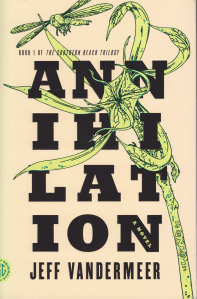
I’d be a hypocrite if I didn’t tell you there may be spoilers below. The book to which I alluded last week—the one made into a movie—was Jeff Vandermeer’s Annihilation. I first saw the book in a Green store in Ithaca, New York. I figured it must have a planet-friendly message if it were being sold at such a venue. I’ve finally had time to read it. There may be spoilers, so if you plan to see the movie, be warned.

Set in a kind of edenic dystopia not far from now, the novel gives none of its characters names. The narrator is the biologist of a four-member team sent into Area X—a region in the south from which no expedition has returned. Clearly intended to be part of a series, the novel does leave quite a few things hanging. Among the many unanswered questions is what has happened here. One of the problems with having Bible-radar is that you can’t overlook references to the Good Book. Without going into too much detail, the story has mysterious writing on the wall. That itself is a biblical trope, of course, but when the biologist discovers notebooks from previous expeditions, she considers that the writing is like something from the Old Testament. This description made me pause and ponder. The Hebrew Bible has, in the popular imagination, been cast in the role of a harbinger of doom and gloom. Granted, there are many passages that have earned that reputation, but on the whole it’s a very mixed bag. Still, in popular culture “Old Testament” means things are going wrong.

While not a horror novel, there are elements of horror here. People transforming into plants and animals, sloughing human skin. And resurrection—how New Testament! This made me think that maybe a penchant for horror isn’t such a strange thing for a guy who spent a decade and a half teaching the Hebrew Bible. My motivation for going in that direction had more to do with my interest in origins, but nevertheless, I also grew up watching monster movies. Maybe, unbeknownst to me, I was bringing the two together in this field of study. It’s difficult to tell at the end of book one what the overall message will be. But since I’m discussing the Hebrew Bible maybe I’ll take a stab at prophecy and predict that the second book of the series will be in my future. And I wouldn’t want to be a hypocrite.


Belief Matters

What you believe matters. This is shown clearly in the case of exorcism. Brian P. Levack admits to personal reasons for interest in this dark subject. His The Devil Within: Possession and Exorcism in the Christian West is a masterful treatment of a topic that it considers from many angles. As a form of Christian practice it goes all the way back to the beginning—Jesus’ initial fame was as an exorcist of sorts. He didn’t require any ritual or authority to expel demons, but he became a public figure largely because of his ability to do so. Levack’s study focuses mainly on the Middle Ages and the Early Modern period. The latter was the high-water mark of possessions until the resurgent interest of the post-Exorcist twentieth century.

An aspect of exorcism that had raised my curiosity more than once was its Catholic disposition. Many Protestants believe in demons, but only the Roman Church has the grand ritual to drive them out. There are Protestant exorcisms, but they have a different goal—they’re intended to eliminate sin. This leads Levack to a strong contrast between Catholicism and that most extreme of Protestant traditions, Calvinism. Few Calvinists suffered from possession. Those who did were not held blameless, as in Catholicism (if you were being controlled by a demon you could hardly be held responsible for your actions). Calvinists believed only the sinful could be possessed and since their God is Republican you can hardly count on any mercy. In fact, if you were possessed, chances were you would become a witch. And everyone in early modernity knew what the cure for that would be.

We tend to think that the Enlightenment drove such beliefs extinct. In fact, the height of both witch hunts and demonic possession came after the scientific paradigm took hold. Levack makes the point that this is a kind of theater—performance undeniably plays a part in exorcisms. Both science and Calvinism, taken neat, can leave a body feeling cold and in need of some emotion. As the book notes, you could generally find a Catholic priest who’d be glad to drive out your demons. It seems that the great forces of good and evil play themselves out not only in the spiritual realm, but in the varieties of religious experiences in the all-too-political world of the church. The Devil Within is a fascinating book with a plausible thesis written by an author who understands that ideas have consequences that aren’t always easy to expel.


Spoiler Alert

I work in a cubicle. That’s just one word shy of the famed “six word novel” challenges. I’m wondering what qualifier I should add. To understand this dilemma you have to realize a few things. My first professional job (professor) included a three-room office to myself. Also, I am a middle-aged man amid a work-pool of mostly twenty-somethings (everyone else my age has their own office). My cubicle has walls six feet high, so I can’t see, but can hear my just-out-of-college neighbors. Very few people talk to me at work. In fact, I can go an entire week without anyone saying anything to me, right here in the largest city in the country. The office is generally very quiet. You can hear everything. This leads to my concern with a very specific peril regarding work in a cubicle.

Much of the meaning in my life comes from what I read. In addition to all the books I review here on this blog, I have quite a few fiction projects going at any one time. I happen to be reading a book just now that was recently made into a movie. The reason I know it’s been made into a movie? My unseen, 20-something colleagues began talking about it yesterday morning. Complete with spoilers. Now, they couldn’t see the contortions on my face, hidden in my cubicle. The people who sit next to me work in a different department than mine and I have no reason to speak to them—they don’t even know who I am. Should I, like the voice of God, thunder unseen from my cube, “No spoilers!”? Or should I just continue to sit here with my fingers jammed firmly into my ears and hope that when I pull them out I don’t learn anything more about what I haven’t read yet?

I know it’s just me. I don’t read the blurbs on a book before reading the book itself. I don’t read reviews of movies before seeing the film. Guys my age appreciate the craft of story, building up to the reveal, not getting it in Monday morning water-cooler talk. I finally got up and walked away from my desk. There’s nowhere private to go on my floor, so I went to the stairwell and pointlessly climbed to the top floor and back down again. I returned to my desk and they were still talking about it. Not only was it Monday morning in a New York City where nobody had spoken to me in the three hours since I arrived in town, but there wasn’t even a spoiler warning for one of my favorite pastimes. Such are the perils of cubicle life.


Exercising Exorcism

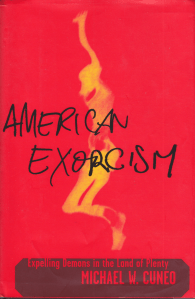
About the last people, ironically, that you’ll find researching demons are religion scholars. That’s perhaps a slight exaggeration, but there’s an embarrassment to the topic that serious academics just can’t shake. Nobody wants to be thought truly believing in that stuff. Michael W. Cuneo, who teaches sociology and anthropology at Fordham University, isn’t afraid to look. His American Exorcism: Expelling Demons in the Land of Plenty is a user-friendly, often witty look at what is an amazing phenomenon. Exorcism had pretty much gone extinct by the middle of the twentieth century. Then The Exorcist happened. Cuneo makes no bones about it—Hollywood wrote the script on what was to become a somewhat bustling business through the end of the millennium and beyond. And it wasn’t limited to Catholics. Protestants, mainly of Evangelical stripe, cottoned onto Deliverance ministry and joined the fray against the demonic.

American Exorcism reflects Cuneo’s personal account of attending exorcisms. As he puts it at the end, no fireworks occurred. In fact, he’s skeptical that demons exist and he strongly suspects exorcisms work in the same way that a placebo does. He’s well aware that the majority of people he met and talked with in the making of this book disagree on that point. Cuneo himself attended at least fifty exorcisms, both Catholic and Protestant, and shysters among the exorcists were rare. Most were sincere, devoted people who are helping others in distress for no fees, no glory, and no promotion. They see a need, believe they know the diabolical cause, and take the devil by the horns (metaphorically speaking).

There is a solid mistrust between academics with their studied skepticism and exorcists with their eyewitness accounts that defy belief. Cuneo suggests that even what they think they see may not really be happening in the real world. My question, coming down to the end of the fascinating book, revolves around what exactly this real world is. There can be no doubt that present day concepts of exorcism are largely based on “the movie.” Cuneo seems just a bit reluctant to say what I also declared in my forthcoming book—pop culture, the movies, dictate reality for many people. At least in the realm of religion. Sacred institutions have lost their authority to make ex cathedra pronouncements about what is real and what is not. Few bother to, or can, delve into the tedious work of reading academic studies on the subject. It’s far easier to let the unseen presences behind the camera take over. Isn’t that what possession is about, after all?


Panthers and Prophets

Prophetic is a word I seldom use for movies. Prophetic, by the way, doesn’t mean predicting the future. Prophecy was about establishing rightness on the earth. Dress it up with God or dress it down to a girl being shot for wanting an education, prophecy is a necessary ingredient in being human. Black Panther is a prophetic movie. I don’t keep up with comic books, and many regions of the Marvel Universe are unexplored by me. I have no idea if the comics bear the strong message of social justice that this film does, but I left the theater blown away. If those who have the power could only be interested in good rather than personal gain, what a world we could have.

The message of not making race, but humanity, central is one that we have yet to learn. It is so basic, so simple that a child understands it. Somehow world leaders don’t. Any secret advantage is kept in order to make things better for ourselves. To make us feel more secure. To put us in the place of making decisions for others. In Black Panther even the enemy isn’t evil. Humanity is it’s own enemy. We sometimes forget that we have it within our ability to make life fair and equitable. We can share what we have and end jealousy. The Gospel of Adam Smith, however, has supplanted that of Jesus Christ. Just ask the one-percent. The one percent who haven’t most assuredly seen this movie.

I had no idea what to expect when I walked into that theater, but it was nothing short of an epiphany. As it has been from ancient times, one can always tell when they’ve been in the company of a prophet. We’ve come to dislike prophets because they make us uncomfortable. They possess something we can’t have. Integrity. The dignity of the conviction of what anyone can see is rightness. Such things can’t simply be taken, crammed onto a boat, and sold. Prophets bear the burden of speaking the truth. Black Panther may be unlike most prophets in that it is reaching a huge audience. And rightfully so. It is the antidote to the poison that’s surging through the veins of this country for far too long. Even those who will dismiss it simply as another fantasy—it’s a superhero movie—need to see this vision of what a world can be. It’s not very often that a prophetic movie appears, but the days of prophecy, it seems, aren’t over yet.


On Time

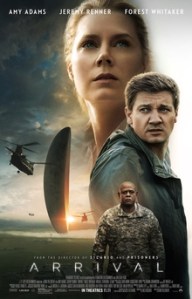
Getting to the movie theater is not only costly, but increasingly difficult to schedule. This can be problematic for someone who likes to write about movies, but the realities of the commuting life aren’t very malleable. So it was that I finally had a chance to watch Arrival, on the small screen. It had been recommended, of course, and although it’s not horror it has aliens and a linguist as the hero—my kind of flick. Once it began, I wondered if religion would play any role in the story. Alien contact would certainly rate as one of the more formative religious events of all time. The only reference that was obvious, however, was the suicide cult shown on a news story in the background, immolating themselves as the aliens became known.

Louise Banks, a linguist who has security clearance, has a sad story. Spoiler alert here! If you’re even more tardy than me you might want to fire up Amazon Prime and read on afterward! The movie opens with her watching her daughter grow up, only to watch her succumb to a rare disease as a young woman. Then the aliens arrive and she’s whisked off to Montana to try to communicate with them. It’s only after repeated encounters, learning the written language of another race, that she asks who this little girl she keeps dreaming about is. The child is in her future. The aliens see time as cyclical, not linear, and by learning their language she begins to think like them—knowing the future holds a tragedy for her. The intensity of the experience makes her fall in love with Ian Donnelly, another academic, who will become the father of her child but who will leave when she reveals the future to him.

Just as the aliens prepare to leave, not religion but philosophy takes over. A question posed by none other than Nietzsche goes: if you could live your life over exactly the same as you lived it this time, would you? Nietzsche’s point was that those who say “no” deny life while those who answer in the affirmative, well, affirm it. Ian says what he would change. Louise, however, embraces life with the tragedy she knows will inevitably come. While religion is off in a corner doing something that shows just how nonsensical belief can be, philosophy stands tall and faces the difficult question head-on. Although the movie follows some expected conventions—aliens bring peace but militaries want war—it rests on a profound question to which, I’ll admit, I haven’t got an answer.


Ashy Valentines Day

It’s been 73 years since it’s happened. Happy Valentines Day! And depressing Ash Wednesday. This is more of a popular culture conundrum than a sacerdotal one. I noticed in my many years at Nashotah House that Saint Valentine doesn’t make the liturgical calendar. This struck me as odd, but perhaps it shouldn’t have. The church has always had a difficult time with love. At least when it starts to get physical. Even if Valentine was a saint—and nobody knows for sure which Valentine it was—he surely didn’t become beatified because of his amorous inclinations. Nothing helps to put you out of the mood like being told “You are dust, and to dust you shall return.”

As a society we’ve been living in an Ash Wednesday that has been prolonged for over a year now. A government of St. Narcissus, for the only love there is love of self. Yet when I thumb through the liturgical calendar Valentine’s still not there. Ironically evangelicals—the name now belongs to those who support Trump—dismiss love as having anything to do with Christianity. This isn’t about love. It’s about showing hatred to the poor and stranger, the kicking out of those in need. It’s about military parades and “Sieg Heils” and law makers who vote themselves even more power with our tax dollars to fund their insidious schemes. There’s no need to gerrymander around the church—it’s on your side. Is it Ash Wednesday or is it Valentine’s Day? Surely it can’t be both.

Love is valued only in so far as it can be commodified. If you can get people to spend money on cards and chocolates and condoms then you’ve got a holiday worth celebrating. Otherwise you might as well join old Job sitting on his ash heap. The last time these holidays coincided the world was at war. The President had set up safety nets to catch those who were the victims of the greed that led to the Great Depression that is now all but forgotten. Nazis were a bad thing then. Now all we have to do is blubber about “fake news” and declare the truth a lie. Christians prefer Ash Wednesday to Valentine’s Day anyway. I admit to feeling a bit conflicted about this. Patriots and lovers used to be compatible concepts. We’ve been told that America is being made great again, but they called that Depression great too. From where I sit it looks an awful lot like Ash Wednesday to me.


Apologizing for Whatever

Maybe you’ve felt it too. The insecurity of liking something other people don’t. Having grown up an Evangelical, I had to try to explain myself at multiple points for liking scary stuff. I love Halloween. I spent my young Saturday afternoons watching monster movies on our black-and-white television. After losing a long-term job at a decidedly gothic seminary, I began consoling myself with horror films. I don’t know why. I also don’t know why other people shun those of us with this particular habit. It’s not like I’m going to make you sit down and watch them with me if you don’t want to. You don’t even need to buy my book, and if you do (thank you!) you don’t have to read it.

One of the issues I’ve often grappled with is why “Christians” dislike horror. Reading the accounts of the martyrs is way worse than almost anything I’ve seen on screen. Revelation, let’s face it, is a horror show of Schadenfreude and ultra-violence. The Calvinistic idea that God would create the vast majority of people to burn in an eternal Hell of fire for reasons best kept to himself (yup, he’s a guy) is hardly charitable. So why do Christians say you shouldn’t watch horror? One of the observations from this lowbrow viewer is that the message behind horror is often good. Moral. Ethical even. We have trouble getting around the form of the message to see its substance.

I seldom talk about horror movies. Maybe that’s why I write about them so much. But the fear of judgment remains strong, even with maturity. The lurking Evangelical fear is that watching horror will entice the young to become interested in evil. I think it’s fair to say that all Christians are somewhat fascinated by evil—where does it come from? Why doesn’t God stop it? Horror films seldom glorify the monster. The protagonists, often flawed, fight evil and sometimes succeed. Do I really need to justify this interest at all? It’s no exaggeration to say that, although no longer an Evangelical I still feel the weight of both their stares and those of others who can’t understand why a nice guy watches such unbecoming things. My book doesn’t answer those kinds of questions, but it may contain implicit answers within. Of course, you’ll only know that if you read it. Not that I’m asking you to do so—it doesn’t even have a title yet.


Exiting Amityville

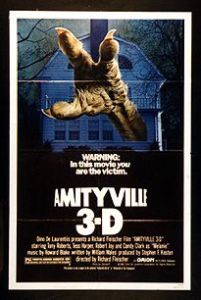
Okay, I confess. I watched Amityville 3-D. One of the standard features of horror, you see, is the sequel. As a rule the members of the franchise degenerate until they don’t earn enough money to keep Hollywood’s attention. In the case of The Amityville Horror, the story only made it three deep. I’m no film critic, but with missteps at almost every turn, Amityville 3-D almost made a farce of itself and horror fans take that as an insult. (Good horror comedy is an exception, of course.) The original story is well known: the Lutz family moved into the DeFeo murder house and moved out again just over a month and a half later. The tale has been considered both a hoax and a legitimate haunting, but subsequent families haven’t reported supernatural happenings on the property.

I had some hopes for this installment, as it was also known as Amityville III: The Demon. The second feature film was part of my viewing late last year, and it was okay. I never thought the original was that good, in any case. As I watched III I realized something was missing. Religion. Any sign of it. No priests were involved—this was the fear vector for the first two films of the series. Although John Baxter moves into the house knowing the history, he’s a skeptic and seems not even to believe as the house blows up in a silly finale before his very eyes. When the flies start buzzing around everywhere he thinks they’re just pests, not making the connection with the original account. The entire series is, of course, an extension of the Beelzebub—“Lord of the flies”—myth. That’s what gives it its demonic thrust.

When it finally comes time to wrap things up, and no priest has been called, and no religious imagery has been shown, there’s nothing here to scare but cheap startles. Eliot West, the leader of the cadre of paranormal investigators, attempts to free Baxter’s drowned daughter from the turquoise, boiling well that was dubbed “the gate to Hell,” a demon pops up and grabs him. There’s no explanation of who or what the demon is. Like everything else here it’s secular to a fault. And though it may startle, it can’t scare.

Not all horror uses religion, of course. Even some movies about demons avoid it and manage to be scary. If the premise, however, rests on religion gone awry—as in the first two films of the franchise—exorcising it completely is asking for trouble. Even if the telephone number for the realtor at the start of the film does begin with a secular 666.


Title-less

I’ve been offering a few teasers about my forthcoming book. One of the reasons for not making an announcement is that the title hasn’t been settled yet. It’s pretty hard to promote a book without one. I’ve written enough about it that readers can tell it’s about horror movies. The publisher is McFarland, an independent academic publisher that specializes in pop culture and has an impressive list concerning monsters and other frightening things. Once we get a title down, I’ll say more. In the meantime, I can take the opportunity to say a bit more about the publishing industry. Not that people generally ask me about it, but I suspect many authors secretly want to know some insider tips. If not, I suspect there’s one or two other blogs to read today.

I’ll admit up front that I tried unsuccessfully to interest agents in this book. At least four wrote back to tell me it was a great idea, but a writer without a platform is like, well, an editor. I help other people get their ideas published—always a bridesmaid, as they say—physician heal thyself. When I realized I was wasting months trying to find a professional to promote my book, I decided to revert to the tried and true. When you want to know who to approach about your book, look at the spines of the books you read to write yours. Who are the publishers who produce books in this area? Sometimes the interests of a publishing house will change with the editors, so the more recent your comps, the better.

Horror sells. My project wasn’t really mercenary in that way, but rather it was the result of years of watching horror, usually by myself, and finding some commonality in the films. What exactly that commonality is will, I hope, become clear once I can freely write about my book topic. Others, you see, could swoop in and take my thesis—a perpetual fear of someone who barely has time to scribble out a blog post a day. Finding the time to write books in the off-work and off-commute hours is a real juggling act. In my case, perhaps a jugular act. Without an agent, I turned to McFarland. Many of their books helped me form the ideas for my own. Besides, they have a Scottish connection, and that means something to this old Edinburgh alum. If you want to get published, it helps to know the players. That may become even a bit easier once I’ve got a title.


Frankenstein and Co.

Authors, I expect, don’t anticipate that their work will be annotated. Since I deal with annotated Bibles on a daily basis, I often ponder that the anonymous writers—we know of few biblical writers with any degree of certainty—had no idea that they were writing the Bible. Nor did they realize that some day many people would make their livelihood from interpreting that book. Among the interpreters are annotators. When my wife gave me Mary Shelley’s Frankenstein for Christmas I was at first puzzled. I have a copy of Frankenstein already. In fact, I read it again just last year. Then I realized it was an annotated edition: Annotated for Scientists, Engineers, and Creators of All Kinds. Edited by David H. Guston, Ed Finn, and Jason Scott Robert, the book contains the original text and an introduction, as well as the said annotations. Like a typical study Bible, it also contains essays. The editors joke that it’s kind of like a Frankenstein monster itself.

The “value added” material isn’t all about science. In fact, quite a lot of it has to do with human relationships, and particularly women’s rights. Mary Shelley was an early feminist and her novel shows what goes wrong when men try to reproduce without women. Another recurring theme that, amazingly, had never dawned on me while reading Frankenstein was the Adam and Eve story. Victor Frankenstein, like God, creates a man. Then he creates a woman. Well, almost. Afraid what might happen should his creature find a companion too companionable, he destroys the second creature before she’s finished. The biblical parallels are nevertheless there.

Originally subtitled The Modern Prometheus, the novel was based on pre-Christian myth as much as on Holy Writ. Nevertheless, the Bible suffused British culture in the nineteenth century just as it has continued to overwhelm American culture to the present day. We ignore it at our peril. Morality in science is a major focus of the essays in this volume, but I wondered how many scientists might be enticed to read a piece of feminist fiction in order to learn some ethics. The largest ethical conundrum we face in the United States is that so few people read for personal growth. Spending time with a book is a sacred activity for those committed to the principles of literacy. Frankenstein isn’t a prefect novel; the pacing is pretty slow even for a gothic masterpiece. There are loose ends left hanging. The protagonist is often insufferable. Still, as the editors and annotators have demonstrated, there’s much to learn from this old story. All it takes is the willingness to read and deeply reflect. And perhaps read the annotations.


Noah’s Phone

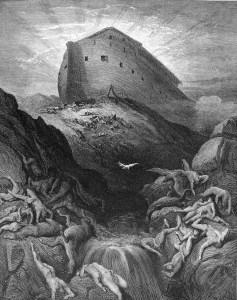
The world-wide flood is a great story. We find it in many cultures, so the idea obviously captured the attention of ancients as well as moderns. What’s strange is that, with the development of human knowledge so many people continue to accept it literally. The only science that can be bent enough to make it work is one where God breaks all the laws of physics and biology to kill everyone, just to make a point. Why bother to make it rain 40 or 150 days? Why not just create the requisite water instantaneously? It would be just as believable. Nevertheless, literalists look for explanations for how this might’ve happened. It’s not to convince God, of course. The goal is to convert unbelievers by showing that the myths of Genesis are literally true.

When I came across a story on Mysterious Universe by Paul Seaburn titled “Academic Claims Noah had Cell Phones, Drones and Nuclear Power,” I was hooked. The academic is a Turkish professor of marine sciences. Using modern technology—rather like the detritus seen scattered in the background of Darren Aronofsky’s recent movie version—he postulates that this could’ve happened. The real issue is why. Not why the flood; the Bible answers that. Why would a scientist feel the need to prove a myth scientifically? Biblical scholars call the flood story an etiology. An etiology is a story to explain the origins of things. That’s its purpose.

Noah’s flood explains why it rains. It also explains why this dome that covers our flat earth doesn’t fill all the way up anymore. It explains why animals are sacrificed and why rainbows occasionally appear to grace the sky after it rains. We also know that the story borrows from an even earlier Mesopotamian myth where the god who causes the flood isn’t even Yahweh. The people of Israel were conquered by the Assyrians and Babylonians and they told flood stories about their gods. The Bible counters with two stories (yes, just like the creation accounts) mixed together in this snow-globe universe of Genesis. Is it easier to believe this or to claim that Noah had access to Verizon, steel manufacturing, Einsteinian physics, remote-control flying machines, and artificial insemination (to help the animals recover)? It’s like when someone suggests natural explanations for the plagues of Egypt. Such special pleading doesn’t prove miracles, but rather it demonstrates that all this could happen without any gods involved. And you’re still going to have to mop up all that water when it’s over. I’m sure it will make for a great story some day.