Playing Piano

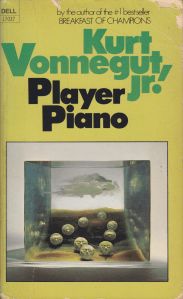
It must be very difficult to write books that make the future believable. With the speed of technological change, it’s getting more difficult all the time. Some exceptions are modern dystopias that take civilization back to square one. We’ve come close enough in reality already to be able to imagine such things. While not really a dystopia—although it kinda is—Kurt Vonnegut Jr.’s Player Piano extrapolates what a future in the service of machines might look like. Some elements are incredibly 1950s—everyone still smokes, all communication is on paper, computers run by punchcards, and attitudes are hopelessly parochial—while others are on point for today. The world has been mechanized and an even more obvious class system than our current one has been established. Of course, those top few reap all the rewards and wonder why those below them are dissatisfied.

What’s really noteworthy, though, is that Vonnegut uses religion to address the situation. In this, his first novel, he has a minister leading the revolution against the system. This clergyman does so by finding and nominating a “messiah”—a figure around whom the dissatisfied might coalesce. In a world many characters characterize as evil, the solution is offered by religion. Well, not exactly. Vonnegut’s famous satire is beginning to appear even here and the revolution that religion fuels can’t overcome the human love of machines and gadgets. In many respects, this book is an extended parable. I can’t help but think that Vonnegut would’ve recognized our love of devices as a symptom of his humanity being declared useless by machines.

Kurt Vonnegut isn’t a religious writer, but like many authors he recognizes the motivating power of belief. There are agnostics aplenty in Player Piano, Indeed, the protagonist is never sure of what he believes. The larger questions, however, still persist: do we advance human potential by making things easier? All of us now have to be varying degrees of experts on computers to find even the most rudimentary jobs. There is really no opt-out anymore, and what’s more, few would take it if there were. The phone in my pocket has changed my life in ways I can’t call entirely good. As we get closer and closer to our media, we’ll want more intimate contact—implants are already starting to exist. Vonnegut, in his sardonic way, was asking even in the early 1950s if we had really improved our lot via such invention. In the end, of course, it doesn’t really matter because for better or worse, our tech is here to stay.

Jedi Bible

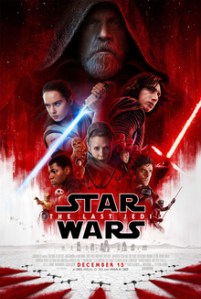
A long time ago in a galaxy far away there was no paper. This is something I didn’t realize until I read a book of essays by Ryan Britt a couple years back. George Lucas, although a limited visionary, saw a Star Wars universe without paper. When I thought back over the original trilogy, and the harsh prequel trilogy, that seemed to be true. Nobody picks up a piece of paper to read anything. Like many people I went to the theater to see The Force Awakens and left stunned. After being battered by episodes I through III, it was good to see the old form return. It was as if the force really had awakened. Then I went to see The Last Jedi.

Overly long and often plodding, I wondered, after it was over, what was so different this time. Not only was Luke Skywalker annoyingly noncommittal to the force, but backstory and counter-backstory made the truth hard to discern. There was a lot more talk of the Jedi religion as a religion. From my perspective, of course, this isn’t a bad thing. I would like to know more about this. There’s a secret tree on Luke’s island wherein are the sacred Jedi scriptures. Yoda shows up and calls down lightning like a little green Elijah and burns the Jedi library and its Keebler home. Then it hit me: not only is there paper in this universe, there are actual books. Scriptures.

We’re never shown the inside of any of the books, but if the fact that fans tend to fill in the blanks holds true we may well see future publications of the Jedi Bible. H. P. Lovecraft’s Necronomicon, a fictitious tome, now exists because his devotees couldn’t live in a world without it. And paper scriptures add an entirely new dynamic to any religion. Most world religions (at least on this planet) have some form of text. Books tell us what to believe and how to live our lives. Given enough time people will realize that they were written by other people and need to be interpreted by people. After all, if God could write the Bible, what would prevent him from writing the Qur’an, or the Book of Mormon? So stuck here in the middle of a trilogy the rules have changed. First paper has appeared in Star Wars. And although it’s a little too early to be sure, it looks like Jediism will never be the same.


The Big Shill

Once in a while I have to shill. As an erstwhile academic I’m aware of the cachet my employer bears for colleagues and the elite among the general public. Still, I find articles on the Oxford Dictionaries blog irresistible. I don’t work for the Dictionaries division, but I sometimes wish I did. A recent post by guest blogger Rebecca Teich discusses pulp fiction neologisms that have made their way into mainstream vocabulary. It’s not so much the individual words that interest me as much as does the phenomenon itself. Pulp fiction is antithetical to the sophisticated literature of the cultured class. Yes, there is status snobbery involved in such an assessment—we know those who find anything “common” to be vulgar and indicative of a lack of good breeding. The fact, however, that pulp fiction words make it to the mainstream belies the singular direction of cultural influence.

Many of us who grow up in working class families aspire to better things. We see (or used to see) on television and in movies how other people live. They have things and experiences that we covet. We work hard for many years to try to get there, often being kicked back down the stairs along the way. And yet we find some of our cheap, common vocabulary creeping into the consciousness of those who can afford better. There’s even a phrase for it. Guilty pleasures are those enjoyable books or other media that are really “beneath us,” but which we secretly enjoy. I post once in a while about Dark Shadows novels which are, quite literally, among the pulp fiction I grew up reading. They reached cultural cachet with a decidedly disappointing Tim Burton movie based on that universe, but regardless, they reached mainstream respectability.

Respectability. I suspect that’s what it’s all about. We want to be shown that our dirty collars and rolled-up sleeves mean something in this world of billionaire playboy presidents and congress that aspires only to greater wealth for itself. My first job, which I started when I was 14, involved physical labor. Brooms, paint rollers, and sledge hammers. I spent my evenings watching television and some of my weekends writing fiction. Pulp through and threw. Part of me finds its bliss in knowing that other rough-hewn writers have stamped their hallmark on the literary world by pounding out gritty stories of authentic human experience. Yes, I may be a corporate shill in this respect, but then, the shill is a respected member of the pulp fiction community.


Let the Memory

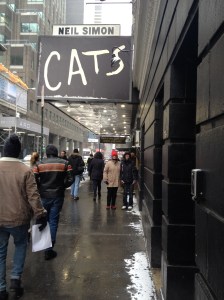
One of the rare and long-anticipated treats of being near New York City is the prospect of a live show. For practical reasons we don’t go to shows very often—years separate the occurrences—but once in a great while we manage to afford such a boon. Yesterday we attended the penultimate performance of the Cats revival on Broadway. The experience was transcendent. I’ve seen the movie version a number of times, and over the years I’ve caught a few live performances here and there. For whatever reason, this musical speaks to me. Although it doesn’t really have much of a plot—it’s more a series of vignettes—it is about redemption and being comfortable in one’s own skin. T. S. Eliot was a poet who knew spirituality intimately. Andrew Lloyd Webber, no one needs me to say, writes stirring music.

Cats, unlike many shows I’ve seen, requires athleticism as well as vocal ability. The performers are in nearly constant motion as they play out their roles, often with acrobatic flourishes. Most of the parts are for the young, while those dwelling on the experience of older characters—Gus, Grizabella, and Old Deuteronomy—tend to be recollections of youth as a commodity that slips away leaving as residue the wisdom that comes with age. It’s quite biblical in that respect. Even the old can appreciate back flips and double cartwheels and the grace of ballet. For this particular production the lighting stood out as an integral part of the story. Illumination, I might add, is a powerful metaphor.

In our family discussions afterwards, comparison with other versions dominated. Although my wife and I saw a community theater production long ago (placing us, I reluctantly suppose, in the ranks of the older characters), our main introduction was through the filmed adaptation. Again, like the Bible, we tend to think of canonical versions. This is how it should go. Because of both its running time and its demands on the players, not all vignettes are included in each production. The character who narrates the story may change. Choreography is adjusted. Each show, as is the case with live theater, is a little different. Standing in the snow on a cold, New York City December afternoon awaiting the opening of the doors, we wondered what would be changed. The original Broadway run had ended while we lived in the Midwest, so this was both our first exposure but also our fourth rendition over the decades. None, it turns out, could be called canonical. That, however, took nothing away from the inspiration of the event unfolding before our very eyes.


All Is Calm

For those who prefer their solstice celebrations in Christian flavor, today’s Christmas Eve. As various denominations warn us to keep Christ in Christmas, secular NORAD provides a radar tracker to follow Santa through the skies. One hopes he’ll be cautious over North Korea this year. He may skip the White House altogether. And yet some will insist that there was no Christmas before Christ. But there was. Celebrations of the lengthening of the days began when humans reached temperate zones, at the very least. Prehistoric monuments throughout the British Isles were aligned with the sun’s position at solstices even before the Bible was scribbled on its first bit of parchment in warmer climes far away. We eagerly await the light.

Many religious traditions tell of that light within. Quakers, Unitarian Universalists, and some Asian religions focus on the divine spark, or secular light, within humankind. We are light-bearers, no matter what our religion. Back in my Nashotah House days, when Evening Prayer was a communal, daily expectation, the hymn Phos Hilaron, “gladsome light,” or, in the more liturgical mode, “O gracious light,” was the part that moved me most. We observe the coming of darkness with the hope that light might somehow continue. When days grow brief our hope grows fervent that the light will miraculously return. That it does so by the working of nature makes it no less of a wonder. We have been living in nighttime, and that light within us seems to flag at the persistent gloom. Then solstice. Christmas Eve captures that light in angelic voices.

Those who insist it’s all fake—the Tiny Tim crutch of feeble minds—need only look at NORAD today. The defense system built to keep the northern hemisphere safe from the endless winter of the nuclear species today shows a mythical object streaming across the stars with good will and cheer. Not just for Americans. Not just for Christians. Not just for true believers. No, Christmas Eve, the solstice, is for all people. Not just men. All people. Perhaps I’ve let my guard down just a little, and I’m letting my naiveté show just a bit much, but I do believe in that light. It may be that the tilt of the planet’s axis makes it inevitable, but a night when shepherds are startled and a woman brings hope to the entire world, we bask in what we deem a silent and holy night, knowing dawn will bring a longer day. And hopefully a world at peace.


Why Horror?

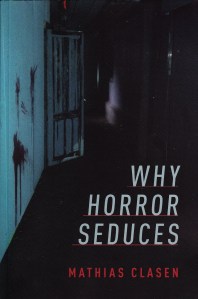
Some people wonder why I like horror. Well, “like” is hardly the proper verb here, I’d rather go the passive route—why I’m compelled by horror. That fits better. But isn’t compel a transitive verb? What’s the object? It really depends on the circumstance—compelled to read, watch, or look at. Quite apart from grammatical imponderables, I keep finding myself coming back to horror and I frequently wonder why. Mathias Clasen may have answered that question for me. Why Horror Seduces is a fascinating study that considers biological and psychological explanations for why we’re compelled to watch or read or play horror, even when we find it distasteful. And it’s not just excusing bad behavior!

As fairly weak creatures that are prey as well as predators, human beings have always placed a high value on security. We’ve driven most of our predators to extinction, but we still have other people to worry about. And microbes. And things that come from space. And, after all that, we still die. These are, realistic or not, things we must face. Horror allows us to confront them and assists us in considering “what would I do if…?” Clasen delves into an evolutionary theory of horror—we’ve evolved to need it. Negative emotions are some of the most ancient, leading us to self-preservation in a hostile environment (something our own government is teaching us anew even now). Watching or reading how people cope in such settings provides us with valuable information. In other words, horror is a learning opportunity.

From that perspective, it doesn’t feel so bad to have written a book about horror movies. I’m participating in the long struggle of humankind against forces that are out to get us. As with most things evolutionary, we need not know why we do them for the whole thing to make sense. Our brains reward us for behavior that is conducive to survival—we like to eat, sleep, and reproduce. Reward centers in our heads go crazy. Then we go to the theater to see the latest, greatest horror film. What may seem counterintuitive here is that we are engaging in a similar kind of activity to other atavistic survival techniques. Watching these movies, reading these books, (and for those who do so, playing these games,) has a basic biological utility. Who knew? And once I get brave enough to crawl back out from under the bed, I may feel better about myself for admitting I like horror.


Inventing Christmas

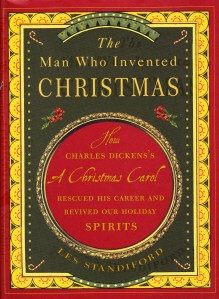
While not always classified among the most intellectual of writers, Charles Dickens was a complicated man. Able to conjure words that reflect emotions, often making readers laugh and cry, he was the undisputed bestselling author of his day. This holiday season the movie The Man Who Invented Christmas explores one of the probable reasons for Dickens’ celebrity—the resuscitory success of his first holiday novel, A Christmas Carol. The film was based on a non-fiction work by the same title, written by Les Standiford, subtitled How Charles Dickens’s A Christmas Carol Rescued His Career and Revived Our Holiday Spirits. As an author who found early fame, it might seem counterintuitive to those of us who’ve never found any that Dickens’ career would need rescuing. In the publishing world, fame has to be sustained since few books keep on selling and selling. And Dickens didn’t always help himself.

Dickens’ choice of Christmas as a theme was, obviously, driven by his own warmth regarding the season. As Standiford makes clear, however, it was also driven by money. Like many in today’s world, Dickens had established his comfort at pecuniary liability—he lived on credit. He also supported other family members and although he cared for the poor he often resented those who cost him money through irresponsibility. Christmas was a time when, he hoped, people might be encouraged to give. Some of that money, naturally, would go toward the purchase of his book. Although the story was secular, it gained the approbation of many in the church—it encourages thinking of others and being generous. Complicated.

As we get closer to Christmas this year, it seems that Dickens’ message bears loud and constant repeating. Here in the States, our government has taken on a decidedly Scrooge-like cast when it comes to the poor and unfortunate. Indeed, “bah, humbug” might well be the new motto of the Grand Old Party. Shown evidence of the guilt of the miser in chief they only claim that those who discover such truth are lovers of false truth, such as claiming that the poor really suffer with want. They close ranks to ensure that the downtrodden can never vote them out of power and claim that Bob Cratchit’s problem is that he’s lazy and Tiny Tim is a burden on the misunderstood wealthy who only ever wanted to help others. A huge difference is that Dickens knew his novel was fiction. This holiday season the ghosts visiting us will be the emaciated spirits of democracy past, present, and future, and that of human decency.


Anneliese or Emily?

If it weren’t for the movie The Exorcism of Emily Rose, the name of Anneliese Michel would undoubtedly be less recognized than it is. Probably the first exorcism movie since The Exorcist to move the genre in a new direction, Emily Rose was based on the real life case of Anneliese Michel. There were significant differences between film and reality, however. Michel was from Bavaria, and she died at the age of 23 rather than being an American teenager like Emily. The story caught media attention because it was discovered that Michel had died after an extensive, months-long exorcism. Charges were made and the priests and Anneliese’s parents were found guilty of negligent homicide. The movie plays the whole thing out in the courtroom with flashbacks of the possession.

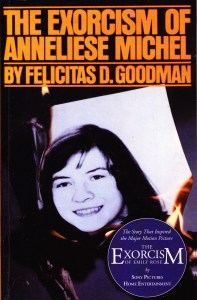
The book which led to the film was The Exorcism of Anneliese Michel, by Felicitas D. Goodman. Goodman, who died in 2005, was a rare academic who wasn’t afraid to address the supernatural. Trained as a linguist, she had years of anthropological fieldwork experience and a medical background. She was also not dismissive of religious experiences. Naturally, this makes her suspect among academics, but her treatment of Michel’s case is both sympathetic and masterful. After narrating events pieced together from court records, diaries, tapes of the exorcism, and information supplied by some of those involved, she offers her own hypothesis of what actually happened. Anneliese Michel was a religious girl caught up in a religious altered state of consciousness that was treated scientifically by drugs. The result was fatal.

Throughout history, and even today, shamanistic persons exist. Whereas in tribal cultures they tend to become prominent, in the “developed world” they are often quite hidden. They experience what Goodman calls religious states of altered consciousness, and are sometimes misdiagnosed as requiring chemical healing. There have been many thoroughly documented cases where such individuals do “impossible” things. The rationalistic world has no place for them, however, for like capitalism, materialism takes no prisoners. Religion is part of who we are. Human beings do have spiritual needs. Such needs can be placated by other means at times, and we can continue to believe that everything in this universe is made of atoms, or super-strings, or quarks. Or we can perhaps admit that theres’s much we do not know. Goodman admits that her solution is an educated guess, but it does put all the pieces together rather nicely. And she doesn’t declare unilaterally whether demons are physical or not. In the case of Anneliese Michel, however, they were undeniably real.


Home of Cthulhu

Travel by train seems to be so much more civilized than flying. You don’t need to arrive at the airport two hours in advance for the privilege of standing in long lines to be practically strip-searched. You just hop on the train and find a seat. The wifi is free and you don’t have to set your phone on “train mode.” Amtrak isn’t perfect, of course, but it’s not bad. When I’m flying I often wonder where I am. I guess at each large town we fly over, although some natural features can’t be mistaken from the air. The Great Lakes, Grand Canyon, and even Niagara Falls are all pretty obvious. The names of many towns, however, remains unknown from above. On the way from New York City to Boston, each stop is announced, small towns and large. I noted that one of the later latter was Providence.

Providence is, of course, many things to many people. To me it will always be the home of Cthulhu. Yes, I know that Brown University and Providence College are both located there, but higher education doesn’t seem to have a room for me, so I revel in the imagined monsters of H. P. Lovecraft. You can’t help but experience a bit of Lovecraft’s New England on the train. Skirting not far inland, the tracks take you through swampy lowlands with grand houses and dilapidated hovels overlooking them. Miskatonic University, as is widely known, is based on Brown, which Lovecraft never attended. He was a writer keenly aware of place. These tracks take me through the world of his murky water gods on the way to Boston.

The train station in Providence turns out to be subterranean. Well, not really, but it is under the street level with no noticeable distinguishing features. Lots and lots of graffiti cover every concrete surface along the tracks coming into the city. It’s hard to tell from the train, but none seem to make reference to Cthulhu. I thought of Lovecraft’s gravestone with it’s famous epitaph, “I am Providence.” Idling in the shadowy station, unable to see anything of the enjoyable town I recall from my few visits here, it’s easy to suppose that this might be Cthulhu’s home after all. Caught somewhere between civilization and the sea, in the half-light of a late autumn day, buried under what we think is somehow progress, I think perhaps Lovecraft was right. Cthulhu may be dead, but he is dreaming still.


Devolving Apes

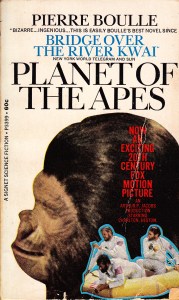
It would be difficult to overestimate the effect the movie Planet of the Apes had on me as a child. Raised a biblical literalist, evolution was, naturally enough, anathema to me. And yet here was a movie based on the idea that evolution had taken a different course. It was a transgressive film, but the screenplay had been written by Rod Serling, so well known for his trusted work on The Twilight Zone. I was utterly fascinated by it. Until the most recent iteration, I’d seen every sequel, spinoff, and reboot ever made. So important was this story line that as a child I found a copy of the book, in English, of course. Pierre Boulle told the story somewhat differently. Spying the book on my shelf after some four decades of my own evolution, I decided to read it again.

We all evolve. I noticed the improbabilities more this time through. The fact that, unlike the movie, humans wore no clothes at all must’ve scandalized my young eyes. I would’ve agreed, however, with Ulysse Mérou’s sentiments that humans were created in the image of God, not apes. In fact, there is an undercurrent of a somewhat conservative theological outlook here. Humans may experiment on animals, but when it’s reversed, it’s evil. In many ways, the cinematic version improves the story, but Boulle’s telling grows in intensity as the novel unfolds. Mérou develops a moral sense that includes the apes as well as human beings. The story, of course, is largely about prejudice and its evils. In that respect, it’s timeless.

As a child I realized that we lose something if we accept the fact of evolution. We lose that special feeling of having been intentionally created by a deity that made us God-shaped. Ironically, I also came to realize that those who rejected evolution often treated their fellow humans like animals. They held onto prejudices against other “races.” They castigated the poor for being lazy. They wish to remove healthcare from those made in the image of God. The contradictions and cruelties simply don’t comport with the Good Book they adore and ignore. Evolution, with the realities of nature impinging on our security, is far less dangerous than what biblical literalism has evolved to be. I can’t say why this book and its cinematic renditions became so deeply embedded in my young mind. But having read the book again, it’s pretty clear that the ideas have remained there, even as they have modified, with descent, over time.


Astronomers and Pirates

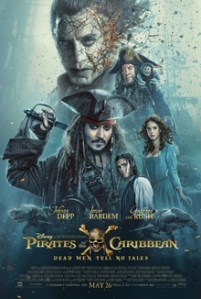
In an effort not to travel, the internet offers a great resource while it’s still free. If you don’t want to wander from home, it brings movies you might’ve missed right to your domicile. This year has been so busy that we’d missed completely Pirates of the Caribbean: Dead Men Tell No Tales. I know, as the Pirate movies spin on and on they become more special effects extravaganzas with insipid, if complex, plots. Still, we’ve been watching from the beginning, so last night we decided to see it through. The movies are fun, if less well written than they were at the beginning (and the movie began without a script). There are moments worth attention, however.

The story follows Carina Smyth as she attempts to discover her father through following his diary. This, of course, brings her path across that of Captain Jack Sparrow. Smyth is an astronomer and horologist. Because she’s female and this is the eighteenth century, she’s labeled a witch. Both the proximate and ultimate cause of the accusation is her gender. Although she proves to be the real hero of the film, the men can’t help thinking she’s a witch although she’s using science to find answers. In fact, if a male astronomer did the same things she did, there’d be no story here. This is a post-Galileo world. It’s also post-Salem. We don’t watch these films for history, of course, but it is true that although the witchcraft trials ended at the turn of that century, the accusations continued for some time after. The woman of science is a threat to the male establishment. She alone, however, discerns the truth.

Swashbuckler cinema was a male invention. Still, even in the twenty-first century too much of it comes at the expense of women. Jack Sparrow’s famous compass, for example, is passed on to him aboard a ship called the “Wicked Wench.” Surely this is meant to be funny, but at whose expense? The other women in the movie hardly come off better. Shansa actually is a witch, working for the establishment. Beatrice Kelly, in Jack Sparrow’s noose wedding, is portrayed as an undesirable bride, purely for laughs. Disney is famous for its princesses, but also for its wicked women. Even the strong female characters such as Mulan, Moana, and Anna find themselves being helped to success by male characters. Obviously the genders do interact in real life, and as recent history has shown us, men will demonize women if it helps them get ahead. You might think a movie of anti-heroes, however, would show the most intelligent character receiving a bit more respect. Especially since she’s a woman in a pirate’s world.


Predestined?

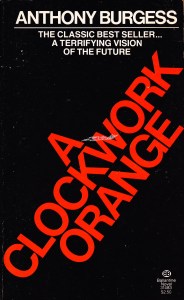
This particular doctrine struck me as evil. It violated every experience and thought I’d ever had, even raised as an unquestioning Christian as I was. Then, at Grove City College I was faced with it for the first time—predestination. If free will is an illusion, what crueler God can be conceived? I couldn’t avoid such thoughts upon re-reading Anthony Burgess’ A Clockwork Orange. A non-conforming non-conformist at the college assigned it in a science fiction class, so it has been decades since I’d read it. Now I found it perhaps more profound than before. Much has happened since my initial reading of the book, o my brothers. (And sisters.)

The framework of the story is well known. Alex and his friends are teenage punks who love ultra-violence. Alex is betrayed and imprisoned. Considered incorrigible, he’s reprogrammed to the point that he can’t even defend himself in a society that’s grown even worse during his time in jail. In the hospital after a suicide attempt, he awakes to find his old self restored, whether this is a good thing or not. The main point that’s behind this, it seems, is that without free will, repentance means nothing. In fact, in my edition of the book, an afterword by Stanley Edgar Hyman makes the point that some interpret A Clockwork Orange as a fictional defense of Christianity. Certainly the comparisons are there, from Judas through Jesus, healing, sin, and suffering. How much it actually meets that idyllic vision of God in Heaven directing the lives of individuals is, of course, an open question.

The idea that human beings are born as Hell-fodder posits a cruel and sadistic deity. Not only are the majority of human beings going to face eternal punishment for matters beyond their control, there is a divinity who planned it that way. We are all, literally, puppets in a universal morality play written by a being whose moral compass is horribly skewed. Indeed, even at Grove City some of the faculty would state that philosophically there could be no contest—free will was right. But, they would add, tapping the Bible, it’s not true because the Word of God says so. When I protested, it was declared, without irony, that even my protest had been predestined. In other words, in this clockwork universe I was clearly an Alex. Upon closer inspection, however, the truer analogy would be that we are all the victims of Alex and his droogs. But only if we have the freedom to make such an observation.


Horror Divine

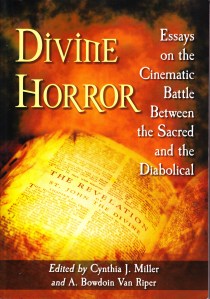
There’s a validation about finding something you figured out written in a book. For me that happened just about this season, some years back. At the Society of Biblical Literature annual meeting I found Sacred Terror by Douglas Cowan—the first book I’d discovered that discussed religion and horror films. Not only discussed them, but made the case that they have considerable common ground. Divine Horror: Essays on the Cinematic Battle Between the Sacred and the Diabolical, edited by Cynthia J. Miller and A. Bowdoin Van Riper, addresses the same theme but in more detail. Some of the essays in this volume get to the heart of the relationship between the sacred and the scary. As I mentioned, there’s a validation here for those of us who find horror movies fascinating. Others have noticed.

Genre fiction, as many fans know, comes with a subtle sense of shame. Low brow. Unsophisticated. Garish. Those with more refined tastes prefer subtlety and muted colors. Horror appeals to more basic instincts—but it’s also a form of expression that allows for the safe exploration of fear. There’s good horror and there’s bad horror. The eighteen essays in this book explore a bit of both. One conclusion that is unavoidable, however, is that religion—particularly Judeo-Christian religion—thrives in the context of horror cinema. The surprising part is that they often affirm the same message, but you need to look for it. Those who seek the origins of religion itself peer into the realms of awe and fear.

My own forthcoming book looks at similar territory. I don’t mind being classified as low brow. Raised in a blue collar world, that’s a fair assessment. What’s more, life confirms the reality of the connection between fear and religion. Consider the political moment in which we find ourselves. Much of the horror coming out of DC originates in religious “think tanks” trying to make evangelical Christianity the default faith stance of all our legislation. It means death and suffering to many, but the view of heaven for some becomes the tax haven for all. I know low brow when I see it. Horror comes in many forms—some lurid and some insidiously sneaky. Miller and Van Riper have pulled together a collection for our times here. The movies their authors discuss are part of a culture that is prominently religious and very afraid. If we want to understand what’s happening around us, we have to be willing to be scared.


Creating Annabelle

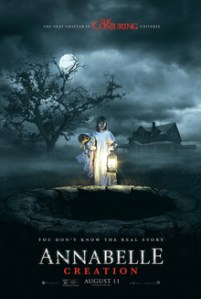
You might go crazy trying to piece it all together. The buzz for The Conjuring had a spinoff prequel, Annabelle, in the making even as the movie hit theaters. Love it or hate it, horror makes money. A more traditional sequel, The Conjuring 2, is leading to two further spinoffs, The Nun and The Crooked Man. And this summer a prequel to the prequel, Annabelle: Creation, came out. Only Annabelle isn’t really so much a prequel since it doesn’t have to do with Ed and Lorraine Warren. In any case, I finally had a chance to watch Annabelle: Creation and found it one of the more stunning examples of the genre in a long while. Intelligent, intricate, and slotted into the series in ways that required serious thought, it works as a stand-alone film or as part of a series. And, like much horror, it is deeply invested in religion.

First of all, the orphans moving into the Mullins’ large home are from a Catholic orphanage that has been closed. They are overseen by Sister Charlotte, so we expect religion to interdigitate with the horror here. Confession of sins, prayer, and crucifixes appear amid the unfolding lives of the girls in an isolated house inhabited by a demon. Some of the tricks we’ve seen before, but there’s enough new here to reinforce the thesis that religion and fear are close kin. Despite all this, and having a priest on call, no exorcism takes place. The doll, Father Massey declares, is just a doll. After the house has been blessed, there’s no need to fear. Of course we’ve already seen what comes next so we know the priest is wrong.

Some people watch horror to be scared. Others of us watch it looking for something a bit deeper. Not for everyone is religion a source of fear. We do, however, tend to cling to our beliefs because the world is such an uncertain place. We’re aware that we won’t last forever. Horror exploits that openly and without shame. Threats are constant and unrelenting, even if contrived. Religion is often a place to find consolation in the face of fear, so it becomes even more frightening when the place to which you’ve fled is the very place that’s out to get you. Annabelle: Creation is aware of this dynamic. The crucifixes, the Bibles, the prayers—none of this helps. What’s more, the girls manage to pull themselves together for safety when there are no men around. The real danger, after all, is inhuman.


Amityville Revisited

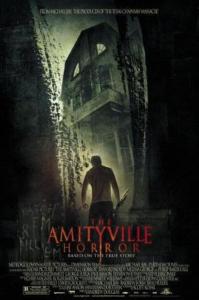
Remakes, standard wisdom holds, are seldom as good as the originals. When the original wasn’t great to begin with, the bar should be lower. Should be. I’ve been curious about the Lutz haunting in Amityville, having just read the book that started the phenomenon back in the late 1970s. I saw the movie first. That was several years ago now, but I do recall that even as horror movies go it had its failings. Some of that goes back to the book (presuming that anything happened)—nobody had a solid grip on whether this was a ghostly haunting or a demonic infestation. What the movie did do well is show how fragile family relationships can be, especially when under the pressures of supernatural supervision, not of the positive kind. Although, as is to be expected, the book was scarier.

Overcome by curiosity I finally watched the remake from 2005. Clearly I’m not the only one still curious about this alleged haunting, alleged hoax. I also have the alleged burden of looking for religion in horror. Only on this final count was it not disappointing. Well, that and in featuring burgeoning scream queen Chloë Grace Moretz. Although Father Callaway’s role is late in the film and brief, early on religious ideas are implicated. If the movie hadn’t tried so hard to be The Shining these themes might’ve been developed to good advantage. Instead it introduces Rev. Jeremiah Ketcham (also late in the film) as the first owner of the house in 1692 (did the real-estate agent’s mention of that date make you shiver?). Ketcham was a sadist to the Indians under his care, torturing them to death in the house. No time is left to explore the sinister minister’s motivation as the family implodes in its attempt to escape the house by boat.

As is frequently the case with the supernatural, we’ll likely never know what happened at the Amityville house. The story Jay Anson told is now generally classified as a novel. The preternatural can be judged neither in the courtroom nor the laboratory. The best that we can do is make celluloid adaptations to make some money on the deal. The DeFeo murders happened in living memory. The Lutzes left the house in a hurry shortly after purchasing it. Anson’s Indian “asylum” was never really there—and there were no such Native American practices in any case. What the remake left out was demons. Although the movie attempted other religious scares, the house just isn’t the same without them.