Financial Ethics

In a conversation with a professional colleague recently, I was discussing what might happen to ethics when sex with machines becomes common.  That statement might seem a little bizarre out of context, so let me widen the net a bit.  We were discussing the Bible and sexual ethics.  This led to the question of how those who apply the Bible straight from antiquity might apply their beliefs to a world vastly different than first century Palestine.  In biblical times, in other words, sexual options were limited and people didn’t understand the whole issue of human sperm and eggs, neither of which can be seen without a microscope.  Applying their outlook directly to today is problematic, and so how do we apply a book without outdated views to a world vastly more complicated?

Someone recently paid me a small debt via PayPal.  If sex is complicated, then let’s not even get started on Bitcoin or Apple Pay—for some of us money is money and even getting paid electronically is somewhat suspicious.  I sometimes buy things online with PayPal.  It goes straight onto one of my credit cards and then I write an old-fashioned check to pay for it.  So I had to approach the altar of PayPal itself to figure out what it meant to have money in my account.  What am I to do with it?  Then I found the FAQ—TFIA (The Future Is Acronyms).  One of the questions: “What is PayPal’s policy on transactions that involve sexually oriented goods and services?”  Now, here’s a question of biblical proportions.

Paying for sexual “goods and services” goes all the way back to the book of Genesis when none other than the ancestor of David and later progeny did so.  This is nothing new.  But the question of ethics now looms extra large.  For those who pay for such things, a new layer of complexity has apparently been added—can you pay with PayPal?  My transaction had to do with tickets purchased for a concert online, where we wanted seats together so someone had to do the buying for everyone.  What if the purchase had involved a somewhat more intimate setting?  Who needs paper or plastic when a string of 16-digits, or even a username and password, will do?  That’s to say nothing regarding the ethics of the transaction—this is, as it were, purely mechanical.  What would Moses say?  Surely this is a question of appropriate tips, for Tamar veiling herself by the side of the road had the moral high ground over her father-in-law who was simply looking for a good time.  A staff and seal, however, were no less complicated that paying for goods and services online.


Enoch Enough

For a person referenced so little in the Bible, Enoch captured popular imagination in a way difficult to comprehend.  Even in ancient times speculation about him was rampant.  The seventh generation from Adam, and great-grandfather of Noah, Enoch lived a remarkably short 365 years before “he was not, for God took him.”  Now, there are lots of obscure people in the Bible.  Many of them have very little afterlife in later tradition.  Enoch, however, became the putative author of a collection of booklets that goes by the name of 1 Enoch.  This book fed speculation in antiquity and became a vehicle for many esoteric traditions that continue even into the present day.  It might seem that there’s little information to go on for an entire book, but James C. VanderKam’s Enoch: A Man for All Generations finds plenty of material with which to work.

A careful scholar like VanderKam doesn’t delve much into speculation, and he rather cautiously examines many of the ancient texts that discuss Enoch and draws some basic conclusions.  There’s a lot of information in this book.  With my own fascination concerning the Bible and popular culture, what stood out to me was how Enoch went from the “mere” man who didn’t die to become, in some traditions, the Metatron, or “the lesser Yahweh.”  Having been a fan of Dogma since teaching at the perhaps too sanctimonious Nashotah House, I’d never researched the late, great Alan Rickman’s character.  I supposed the Metatron was a character like the Muse—some extra-biblical quasi-divine functionary thrown in for fun.  I didn’t doubt such a figure was known in early Jewish or Christian writings, but I had no idea that Enoch had been promoted to that level.

Since I’ve been researching demons lately, the book of 1 Enoch has been a major source of interest.  One of its sections, The Book of the Watchers, expands on that odd story from Genesis 6 where the sons of God lust after the “daughters of men.”  Ever coy, the biblical passage doesn’t directly say that their offspring were giants, but this idea was developed by sources like 1 Enoch.  And these fallen angels—the nephilim—in some traditions, become demons.  Studying Enoch is a fine introduction to a mythological world every bit as rich as Dogma.  These characters—Enoch, nephilim, watchers, and demons—populated the imagination of early readers of the Good Book as much as they do modern speculators’ worlds.  Not bad for a character barely mentioned at all in the Bible.


A Few of My Favorite Monsters

It was a guilty pleasure read.  We’d just moved and I needed a new novel for bed-time reading.  Most of our undamaged books were still boxed up and, well, enough excuses: I like Dark Shadows novels.  Hardly well written, these pulp potboilers are like extended, Gothic Scooby-Doo episodes.  I first started finding them used at Goodwill when I was a kid and I’ve re-collected a number of them as an adult.  Although they feature a vampire, and sometimes a werewolf and witch, the crisis of the story generally devolves to a hoax at Collinwood.  So it was with Barnabas, Quentin and the Avenging Ghost.  I hadn’t thought to write a blog post about it until I came across a passage mentioning Rocain.  In context, one of the characters explains how Rocain, the son of Seth, shows that sorcery goes all the way back to Genesis.

Genesis was one of my lines of research during my academic career, although I never published anything I was working on.  I didn’t, however, recall having read about Rocain.  The internet quickly pointed me to Legends of Old Testament Characters by Sabine Baring-Gould, chapter 8.  Clearly this was where Marilyn Ross, or his source, got his information.  Baring-Gould sits on my shelf as the author of The Book of Were-Wolves.  He also wrote the hymn “Onward, Christian Soldiers.”  There was an era, overlapping with Baring-Gould’s lifetime, when a minister could be an independent scholar of repute.  Although much that’s found in his many publications is now disputed, his was a lively and lifelong curiosity that led to several books.  

Upon reflection, Sabine Baring-Gould, who was a priest fascinated by occult topics, would have fit quite well into the Dark Shadows diegesis.  Although set in the late 1960s into the mod ‘70s when the television show aired, these were Victorian vignettes of a conflicted vampire and his strange, wealthy, and somewhat clueless family.  All kinds of guests, some of them quite Lovecraftian, drop into the Maine mansion and its grounds.  The writing of the novels is tepid at best, but the series was surprisingly literate.  Dark Shadows is nevertheless undergoing a kind of revival these days, and friends sometimes tell me they’ve just discovered this oddly compelling world.  I invite them in.  I’ve unpacked a few more boxes since selecting this pulp novel, and one of them, I note, holds books by Sabine Baring-Gould.  The guilty pleasure read?


Special Delivery

Apotropaic is a word that can be translated as “turning away evil.”  For all that, it’s a perfectly good English word, although seldom used outside realms such as religious studies and anthropology.  Although the word itself may be unfamiliar, the concept is one that everyone recognizes—the charm that wards off evil is the most common example.  The rabbit’s foot means good luck (except for the rabbit) because it’s an apotropaic device.  In perhaps one of the oddest twists in Christianity’s somewhat lengthy history is the fact that the Bible itself has become an apotropaic device.  You’ll see this quite a lot in horror films, and if you read Holy Horror when it comes out you’ll see it quite a bit, although I don’t use the technical term for it.  Apotropaic outlooks also pervade society as a whole.  A recent article on Mysterious Universe proves the point.

Pennsylvania is a weird state.  Having grown up here, I know that to be the case.  In Wilkes-Barre (which itself is a strange name) a ghost-hunter was arrested for breaking into a haunted house bearing a sword, shotgun, and Bible.  That should cover your bases.  Of course, I couldn’t help but notice the odd equivalence of these three weapons.  One is intended for close combat (the sword), one for a reasonable distance (the shotgun), and one for an enemy so close that they might get inside (the Bible).  Make no mistake about it; the Bible is indeed a weapon.  Probably intended as an apotropaic device in this context, it was nevertheless an object to defend the ghost hunter from evil.  The sword and shotgun, however, seem to betray a lack of trust in Holy Writ.

The Bible has been used for offensive purposes ever since people figured out that it can be used to control others.  Coercion, in whatever form, is a kind of violence.  Interestingly, reading the Good Book would seem to indicate that such usage of holy things is inappropriate.  Then again, the Bible doesn’t refer to the Bible.  The idea of Scripture as a powerful object developed only after the Good Book had become an iconic object.  The final authority.  Who can argue with what is claimed to be the word of God?  That idea has become more important than what the Bible actually says, as any “Bible-believing” Trump follower will prove.  Against ghosts, however, it might serve as an apotropaic device, but it won’t prevent you from being arrested, it seems.  A lesson worth pondering.


Trending Horror

It’s not often that I can claim to be ahead of the curve.  A “late bloomer,” I was a timid child whose reaction to most of the world was a species of phobia.  It probably didn’t help that I watched monster movies and was an early fan of the original Dark Shadows.  As I learned to relate to others and take consolation in religion, these more macabre interests became latent rather than obvious, only to come out into the open when working at a Gothic seminary in the woods of Wisconsin and then being fired from said seminary, casting me into the outer darkness.  I found myself being interested in horror again although I’d put it aside from bachelor’s to doctorate.  Now it started to feel therapeutic.

My wife sent me an NPR story by Ruthanna Emrys titled “Reading Horror Can Arm Us Against A Horrifying World.”  The premise is one I’d read before—we find horror compelling because it gives us skills that we need to survive.  It teaches us how to separate evil from mere shadow and how to (or not to) fight such evil.  In other words, horror can be heuristic.  Those who know me as a generally calm, quiet—shy even—individual express surprise when I confess to my secret fascination.  One of the most common responses is the question of “why?”  Why would anyone want to watch such stuff?  My observation is that those who ask haven’t tried.  Horror is not often what it seems.  Or perhaps they have better coping mechanisms than I have already in place.

The names of many writers of what might be considered horror have gained mainstream respectability.  Stephen King’s name alone is enough to assure the success of a novel.  These days you can mention the name Lovecraft and a fair number of people will have at least heard of it (him) before.  Jorge Luis Borges has respectability for having been Argentine.  Joyce Carol Oates for being both an academic and a woman.  If you’ve read their works, however, there’s no doubt that something scary is going on here.  As Emrys points out, with our world becoming a more polarized and frightened place, horror may be ready to hang out its shingle saying “the mad doctor is in.”  In fact, it may become even more popular than it is already.  We human beings set ourselves up for horror constantly and repeatedly.  I’m seldom ahead of the curve.  I hang back to see what might happen to those out in front.  Call it a survival technique.


Hidden Origins

This blog was born at the very lake I’m about to leave.  Although it’s relaxing, there’s an element of chaos to a family vacation that stirs up creativity.  Tomorrow’s long day of travel back east, however, will mean another day without a post.  Flights leave so early that you barely have time to slither out of bed to the shuttle, and the airport hotspots want your money to connect.  I’d rather maintain radio silence for a day.  That doesn’t mean I won’t keep my eyes open for religion hidden in the interstices of American life.  Since religion and mythology share sleeping quarters, I’m reminded of something I saw up here in the northwest the other day.  While in a local grocery and souvenir shop (for all groceries in this area carry souvenirs) I saw sasquatch dolls.

Such cryptids are unknown to science, of course.  Even if they really exist, their liminal status now places them firmly in the realms of mythology.  Being in the wilderness can be an uncanny experience.  Long accustomed to dwelling in cities and towns, we feel vulnerable out in the open.  Taking walks in the woods might just put you in the path of black bears, grizzlies, or mountain lions.  Who knows what else might be hiding in these woods?  It’s easy to believe in our myths here.  Vacation, in addition to being the ultimate reality, counts as time borrowed against work and its punishing rationality.  Religion thrives in the quiet moments when you’re not sure what might be hiding just out of view.

Did ancient people devise belief in such circumstances as this?  (Well, without the wifi and indoor plumbing, of course.)  It’s not hard to feel the spirit of the lake.  Standing chest-deep in the water, being rolled by the waves, there’s a kind of secular baptism taking place.  In the quiet unearthly voices can be heard.  No television or newspaper tells you that it can’t be happening.  Listening is much easier with no distractions.  These woods are vast.  Human access to them is limited to marked and maintained trails.  Beyond these borders, who knows?  Science comforts us with the assurance that there are no monsters out there.  Standing isolated from any other human beings, surrounded by ancient trees, you might begin to wonder if such assurance is as certain as it sounds.  The sasquatches are children’s toys, and the sense of the numinous you feel can, like all extraordinary things, be explained away.


Bitten by Religion

The Essex Serpent isn’t what it appears to be.  Sarah Perry’s debut American novel (although it’s her second elsewhere, publishing being the strange beast that it is) was much anticipated.  Like the serpent itself, the novel is difficult to describe.  It comes down to a minister, a widow, and the people with whom they associate.  Instead of going through the complex storyline, I would instead note that once again a novel that explores religion has garnered quite a lot of attention.  It’s difficult to believe the official narrative that we’re constantly fed that religion is well beyond its expiration date when it continues to appear in print media as a prime motivator for people in all kinds of situations.  Novels, however, aren’t popular in the way television, movies, and video games are, so this is worth pondering.

While novels are sometimes disparaged in higher education, their clientele tends to be an educated one.  It takes more commitment to sit down and read a 400-page tome than it does to flip on some device and meander from app to app, channel to channel, or website to website.  Novel reading takes some concentrated effort.  Remembering characters and connections across a span of days or weeks as you wend your way through.  And one thing novelists do, at least in my experience, is explore the way religion makes us who we are.  I don’t choose novels for that reason; I thought The Essex Serpent would be a monster story (remember, I don’t read reviews before reading the book).

My guess is that if you read this blog you’re a potential reader of novels like this, so I won’t offer any spoilers.  The book is suffused with biblical language, as befits a story with a clergyman as a major character.  The protagonist, however, is an irreligious widow on a journey of self-discovery.  Having been dominated by a wealthy husband, she now explores paleontology in a Victorian context.  Although the year is never stated, the novel manages to find that Gothic near-ghost-story feel with the close interplay of death by consumption and fear of the dark.  It’s not a scary book by any means, although there’s plenty of mist in Essex, and a little gruesome detail of what people can do to each other.  The novel caught my attention via reviews I never read and has left me pondering what I’ve just experienced.  And it has reinforced my conviction that, despite what the critics may say, religion is what motivates us, whether we admit it or not.  And serpents may not be what they seem.


You’ve Never Seen

In spite of accusations of puerile voyeurism, horror is a genre containing many deep films. I have no training as a film critic, but it’s evident that among the more weighty of horror heavyweights is The Exorcist. Mark Kermode is, on the other hand, a film critic, and his book named after the movie demonstrates just how much a viewer can see. I’ve watched The Exorcist quite a few times and there were things I’ve consistently missed. I also realize that I’ve only ever seen The Version You’ve Never Seen (the 2000 theatrical re-release). Having been too young and far too skittish to have seen its debut, I’ve been happy—if that’s the right word to use with such a production—with the version I’ve seen. That’s the human condition, I guess. Kermode made me wonder what it would’ve been like to have experienced it before the spoilers became universally known.

Yes, there are striking special effects—especially for the early 1970s—but the message is what really holds the depth. The story is the classic struggle of good and evil. Demons are, after all, a form of evil personified. The fact that a young girl is the victim may be a little too true to life, but it also gives the drama considerable emotional resonance. In the end, according to the view of the writer and director, good wins. The struggle, as they portray it, is real and costly. It’s always informative to find out what those who made a film thought it was about. Even with the motive of making money, many involved in the industry still have the hearts of artists. Maybe even priests.

Having learned at the feet of post-modernists, we know that no interpretation—even that of the creators—is privileged. Just as there’s no such thing as “only reading,” no one “only watches” cinema. The acts of reading and watching inherently involve interpretation. Kermode draws that out nicely in this little book. His interpretation, as insightful as it is, is but one way of looking at it. Was The Exorcist the version originally released in 1973? Bill Blatty and Bill Friedkin disagreed to the end about what the definitive version was. The many sequels and spin-offs have reinterpreted the story in their own ways. So it is with the struggle against evil. There’s no one single way to go about it. Some make horror movies to demonstrate that point precisely. At least in my view they do.


Wolves Again

Although I don’t read movie reviews until after I’ve seen a film, I have a confession to make. With rumors swirling of The Conjuring 3, and since a chapter of Nightmares with the Bible will involve The Conjuring, I was a little curious what it might be about. Word on the street—and by “street” I mean “internet”—is that it will feature the case of Ed and Lorraine Warren that’s presented in Werewolf. Co-written by William Ramsey (the victim) and Robert David Chase, the book describes the strange malady of Ramsey, who never actually changed into a wolf, but for inexplicable reasons (at the time) thought himself a wolf and took on a wolfish look as he attacked people. The reports suggest he had preternatural strength at such times.

Since most of the Warrens’ books are concerned with demons, it should come as no surprise that in this case that was the diagnosis as well. With no real reason given, once upon a childhood evening Ramsey was possessed and occasionally broke out into violent fits. He landed in a psychiatric hospital a couple of times, but was eventually released. Noticed by the Warrens on one of their trips to England, Ramsey was invited to come stateside for an exorcism. According to the book, the rite was successful at least up until the time of publication. That’s the thing about demons—you can’t always tell for sure when they’re gone.

It’s pretty obvious why such a story line would appeal for a horror flick. You’ve got a werewolf, an unnamed demon, and an exorcism—there’s a lot to work with here. Weird things happen in the world, and there’s not too much to strain the credulity in this case. It would seem possible that a mental illness could cause much of what’s described as plaguing Ramsey, though. Its episodic nature is strange, I suppose, and the Warrens had a reputation for spotting demons. I did miss the conventional elements of the exorcism, however. No demon forced to give its name, no levitating and no head-spinning. Not even a bona fide bodily transformation. They’ll be able to fix that in Hollywood, I’m sure. Credulous or not, there will always be people like me who feel compelled to read such books. And since there’s no final arbiter but opinion in cases of the supernatural, that can leave you wondering.


Mythologies

Now that Holy Horror will be appearing soon, I’ve been neglecting my horror movies. It’s not on purpose, I assure you. I don’t feel comfortable speaking as a writer—publishers tend to agree with that, and besides, my job is more of being a reader—but my experience of it suggests you never have enough time. (Or money; movies never come with no costs.) With another book under contract and a lot more going on behind the scenes than I reveal on this blog, as Morpheus says, “Time is always against us.” So when my wife showed me a story about Hereditary, I knew my list of must sees would only continue to grow. I haven’t even seen Get Out yet!

Beyond being simple guilty pleasures, horror films area also a means of coping. I know this because although they’re generally very successful at the box office, I’ve rarely met anyone who admits to watching them. Horror thrives on secrets. We act one way in public, and a different way when we shut the door and pull the drapes. Since we’ve outlived our belief in gods and heroes, cinema has taken the role of mythology in modern life. Crammed with archetypes—and yes, stereotypes—movies act out age-old themes in impressive displays of color and sound. You might even learn something without trying. Mythology may have originated in stories told around the campfire, but science never displaced the need for hearing them again and again in different media.

I’ve taken to writing books about films because it’s clear that meaning lies there for many people. The invention of cinema and television forever changed culture. Yes, there’s cheap, thoughtless material available in both formats. Still, movies have an ability to convey truths in a way that sermons often fail to do. The values they depict are often very human ones. Horror, for example, isn’t about blood and gore. It’s about survival. That’s not to say the protagonists always reach a happy ending, but we learn from their mistakes. There’s a reason you shouldn’t open closet doors in a house not your own. Those who do, however, often find uncomfortable truths inside. Holy Horror looks in the closet at the way the Bible functions iconically in horror. Since writing it I continue to notice the Bible in horror and I feel affirmed in the conclusions I drew. And if only I had a bit more time, I’d be watching more mythology. And the list only keeps getting longer.


Credulity

So I went to see The Incredibles 2. Like the first movie, it deals with the complexities of family life amid the feelings of inadequacy when people are kept from their full potential. The idea of humans being enslaved by their screens seemed real enough. If you’ve ever tried to walk through Manhattan in a hurry you know that one of the clearest dangers is the pedestrian staring at his or her phone. People used to come to New York to see the scenery. Now you can get the full experience all online. There’s little doubt that we do need to be saved from our screens. Meet virtual reality. After only one encounter you can drop the “virtual.” Ironically, we were all sitting in a theater looking at a great big screen.

What was even more interesting was the fact that the film began with an apology for taking so long to make a sequel. An actual apology. As if no movie ever could, or should stand on its own. It’s common knowledge that sequels seldom live up to the originals. Interestingly, the villain in the movie states that people will always choose convenience over quality. That much is certain, and in an ironic way it applies to the film in which it’s uttered. I don’t believe in the crisis for creativity. It’s still out there. Original ideas are endemic to human nature. Ideas that bring in lots of money are more rare, and so we rely on the sequel. Sure things.

Publishers play this same game. Books that are completely new ideas frequently find their way from editors’ slush piles to their rejection piles. Publishers want something similar to what they’ve done before. Even better, something similar to something that sold well last time. The odds, in a capitalistic society, are stacked against creativity. It’s money that’s important, not originality. Yes, there have been books written extolling the wonders—virtues even—of originality. Such books are more easily published if they’re written by somebody already famous. So here was the dilemma in the theater: enjoy the movie or accept the message of the movie? The rare days I’m away from the screen, I’m old enough to admit, I don’t really crave it. When I come back in the door, however, the first thing I do is login to see if I’ve missed anything. Screens can lead to a strange uniformity. As long as we’re willing to pay for it, nobody will complain.


Behind the Scenes

Although I confess to being a horror aficionado, it took many years before I could convince myself to watch The Exorcist. I finally saw it in the mid-20-aughts, and have watched it many times since. It’s a movie that I discuss in Holy Horror, and it will star in Nightmares with the Bible as well. Although younger people often don’t experience the movie as scary—certainly the increasing trust in science and growth of secularity contribute to this—there is a sincerity about it that earns it its deserved place in the pantheon of horror. Bob McCabe surely counts as a fan for his The Exorcist: Out of the Shadows. Sub-subtitled The Full Story of the Film, this book is a gallimaufry of anecdotes, interviews, and facts about the movie and even its sequels. It’s like of like a sustained reaction shot.

The book doesn’t lack insight and McCabe is surely right that this was one of the most influential movies of the early 1970s. It has become a frame of reference on its own and it has defined, in large measure, what people believe about demonic possession. One of the quotes from McCabe’s treatment however, uses the phrase “metaphysical unknown” to explain why the film retains its power to scare, and there’s a great deal of wisdom in that assessment. Fear of the unknown, of course, is prime real estate for horror, and one of the most interesting things about demons is how little the Bible, or other ancient texts, really says (or say) about them. They are an embodiment of the unknown that can take over a person and make her somebody else. But it’s that metaphysical that’s really scary.

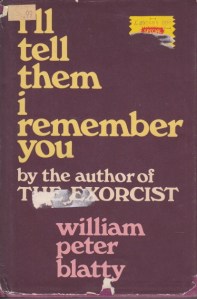
As we continue into a time of less and less that remains unclaimed by scientific theory, those metaphysical unknowns continue to lurk and to frighten. Maybe it’s the concept of the metaphysical itself that scares—can there really be something larger, more intelligent than us? The human psyche bruises easily, and we don’t like to be reminded that we lack the control we suppose we have each day. The metaphysical challenges all that. Since it refuses to submit to empirical verification, it remains unknown. A great many people interpret this as the same as not believing in it. Every once in a while, however, a powerful statement such as The Exorcist comes along. Few people thought about demons before William Peter Blatty’s novel and subsequent film. Then the world was full of them again. Requests for exorcisms are on the rise, and the metaphysical unknown haunts us now as much as it ever has.


Cult of Paris

The cult of celebrity is dangerous. The results of both biological and psychological sciences inform us that mammals, especially primates, hold “alpha” individuals in awe. We don’t know what quality makes them irresistible to some, but in the case of humans before you know it everyone is talking about this Kardashian or that Trump. Valorizing the power of media as we do, those who appear ubiquitously on screen gain in magnitude merely by the attention paid to them. Others have vetted the details, and those who are deemed important enough for constant, widespread television exposure are worthy of our worship. Most of the time it seems banal, harmless. But when those without scruples are willing to exploit it, it is dangerous.

Paris rejecting the cult of celebrity

For example, the other day my wife and I rewatched An American in Paris. I know my wife likes the movie, but when it was over I couldn’t help noting that Jerry Mulligan chauvinistically claims his right to a woman he’s just met, and who is, moreover, engaged to a friend of his who had just lent him money. The fact that he doesn’t know about the engagement is no excuse. Lise tells him “No,” and when she gives him a false telephone number he doesn’t take the hint that she doesn’t want him to call her. He stalks her in a selfish and predatory way. Only because she laughs at his antics with some perfume bottles does she agree to meet with him later. He takes advantage of another woman who clearly has feelings for him and who sponsors him, using her money but not reciprocating her feelings. He’s aggressive and eavesdrops to get Lise’s name. He lies to her and about her (saying he knows her so her friends don’t object) and refuses to take no for an answer. Laying out my grievances, my wife politely listened and then said, “But it’s Gene Kelly.”

Like many people, I was jilted a time or two when I was younger. Losing out to a rival lover leaves a lasting scar. How can we hope that on New Year’s Eve Lise will leave Henri for the interloper Jerry? But it’s Gene Kelly. The cult of celebrity allows those on various pedestals to get away with many things. Trump was likely correct in saying he could stand in the middle of a crowded street and shoot someone and his base would not object. The cult of celebrity ’sn’twonderful, ‘sdangerous.


Rains and Bows

It’s raining and I’m here for an outdoor event. Here, in this case, is Ithaca, New York. The event is the parade that’s an integral part of the Ithaca Festival. As people have been laying out their chairs and blankets along the route since morning, it’s a fair guess that if we don’t stake out our few feet of available public space we’ll miss the parade. And yes, it will rain on my parade. The problem is waiting in the rain. With one hand holding an umbrella and water getting in anyway like a leaky roof, there’s only so much you can do. Reading a book—my default activity—is out of the question. I know very few people here and since I’m acting as a placeholder, there’s nobody to talk to. Tom Petty was right after all.

The parade itself turned out to be a celebration of diversity. Ithaca is what America could be. The various liberal organizations, eager to educate, marched by to cheers and bonhomie. There’s nobody judging here. This became clear in a particularly striking juxtaposition (for which I have no photos, because it was raining) in the parade lineup. A group of Mad Max-themed metal rockers went by in a gnarly truck decorated with torches protruding from fake human skulls. Dressed in future period costumes from the movie diegesis, they produced the guttural, primal roar that is an accusation against current society. Then, like Mel Gibson shifting to The Passion of the Christ, the group immediately behind was a Bible Baptist Church. Add water and mix.

For this I’d sat in the rain for a couple of hours. Forced to relax, I watched the water on the fabric over my head as beads crawled together, joined one another, and scurried, animal-like, from the umbrella to the ground. The drops may look uniform from a distance, but they’re diverse. They come in different sizes, and perhaps because of the distorting character of the nylon, they took different shapes. Placed together in one location, it was natural, it seemed, for them to come together for a common goal, which was the ground. There was a parable playing out here right over my head. While it didn’t seem to be the case at the time, it clearly was a lesson to be shared. Had it been sunny, I would’ve been reading a book. Sometimes it takes sitting in the rain to learn something that should be obvious no matter what the weather.


Fictional Facts

“If you want truth,” Indiana Jones famously said, you need to go to philosophy class. The sad fact is most people have little practical training when it comes to such issues as discerning truth. Some time ago I read an article about how fake news travels faster and is more deeply believed than actual truth. I suspect that’s because the truth is hard. The age-old trope used to be a wizened elder sitting atop a mountain in the lotus position. A lifetime of thinking through the labyrinthian corridors of wishful belief to get to what is finally and unassailably true. Our president, with the full complicity of the Republican Party, is out to dismantle the concept of truth once and for all.

Indiana Jones was contrasting facts to truth in this scene from The Final Crusade. The idea was that facts sometimes make you question truth. In GOP University, however, facts have alternatives. He who bellows the loudest is the harbinger of truth. Never mind that still small voice that comes after the raging wind. The voice that can stop a fiery prophet in his tracks—a man who could raise the dead, for crying out loud—but even his successor called Herod a FOX. In the culture of the shrug, who really cares? Finding the truth is so much navel-gazing. There are real enemies to bomb and somebody has some money that I can take away and claim as my own. To do so we can make up facts as we go along and lies will see us through. With the Evangelical seal of approval.

Even with rumors of a fifth film swirling, I miss Indiana Jones. In his formative days fascists were the enemies, even of the Republicans. Although he was showing his age in Crystal Skull, Jones still couldn’t countenance oppressive regimes. Scientific studies show people would rather believe fake news. We’re hopelessly prone to fantasy, I guess. Even as I volunteered on the archaeological dig at Tel Dor, although I had little money a fedora was required. There was a difference, however. I knew I really wasn’t Indiana Jones. I was digging for facts so solid that they could be held in my hand. Unlike Dr. Jones’ students, I did go down the hall to Dr. Trammel’s philosophy class. Surrounded by the young Republicans of Grove City College, none of us doubted that truth was spelled with a capital T. Now Truth is apparently an artifact buried in the sand, awaiting a hapless archaeologist to bring it to light. Amid all the forgeries that non-specialists can’t tell apart.