All Hallows Eve

I can tell that I’ve been far too busy when I don’t have time to prepare for Halloween. I don’t mean commercially—running out and buying decorations and the like—but mentally. For reasons perhaps only understood by psychologists, Halloween is my favorite holiday. I love the comfort of being with my small family on Thanksgiving and Christmas, huddled inside while the cold whistles against our windows. The sense of relief at not having to go to work even though it’s a weekday, and that increasingly rare luxury of simple breathing space. Still, Halloween takes me back to a childhood with which I resonate in a way against which other holidays only vibrate in sympathy. The days are undeniable darker. My fears, I’m told, are not unfounded. I wear a mask and am free to be myself.

Commuting prevents me from getting out to see the decorations for which some neighborhoods have become notorious. The large, billowing, air-filled frights, however, are just hot air. Even the younger generation at the office, whispering among themselves that this is also their favorite holiday, decorate their cubicles in a way that’s more cute than chilling. No, I’m not a fan of gore—this is more subtle than that. Those who’ve long dwelt with existential angst are connoisseurs of dread. We know, for example, that it will be many months now before we step out into the morning light or come home from work able to see our way clearly. The shades of darkness aren’t always the same. There’s a texture to them. To prepare properly, you need time. The very commodity of which I’m being drained.

Those who know me as a mild, “uncomplicated” sort of person don’t know me. They’ve only become accustomed to the Halloween mask that I wear almost constantly now. Life can do that to you. Instead of the creepy novels which generally crowd my autumn, I’ve been spending time with the existentialists, listening to them reflect on death and its meaning. Or lack thereof. Religions, of course, hurl themselves into that void offering plans of escape. And yet in October that man who walks his dog before dawn wearing a white bathrobe sure looks like a ghost to me. And I’m standing on this street corner utterly alone as the wind blows down the avenue, chasing frightened leaves past me, sending a chill down my spine. I’m looking forward to sitting on a bus to get out of the cold. I’m complicit, I realize, in the death of Halloween.

Amityville

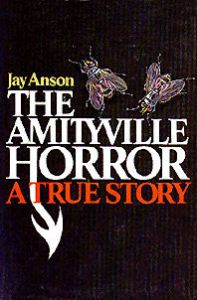
Surely one of the most controversial haunting stories of my own lifetime was that which came to be known as The Amityville Horror. After the tragic deaths of the DeFeo family in 1974, the next occupants of the fatal house, the Lutz family, claimed to have experienced 28 days of terror before moving out in the middle of winter and taking no belongings with them. Their story, written by Jay Anson, became a sensational bestseller. Published just four years after the unexpected cinematic success of The Exorcist, a movie was quickly signed and it was all the talk of my high school before I was quite at the stage of watching real horror films. By the time I got around to seeing the DVD, the tropes were so well known that it wasn’t really that scary. I realized that I had never read the book.

Whether you find Anson’s account scary or not probably depends on your level of belief in demons. Although he concludes his book with the suggestion that a combination of ghosts and a demon plagued the Lutzes and their priest, the focus of the narrative is clearly on the demonic. Fr. Mancuso suffers because the demon wants to keep him out of the house. The multiplication of flies, the constant waking up just after 3:00 a.m., and the smell of excrement all point to demonic activity. The book does have its share of historical inaccuracies and embellishments. It has been declared a complete hoax by some while others claim that at least some of what was described in the book happened to the blended family that called it home for less than a month. If you don’t accept demons, there’s little here to frighten you beyond a couple of benign ghosts.

As with any story claiming supernatural activity, we’ll never really know what happened. The Amityville Horror is often classified as a novel now. Our minds are conditioned to reject anything so terribly out of the ordinary that it is difficult to accept what you’re reading. The DeFeo family was undoubtedly murdered in the house by one of their own. The Lutz family did buy and then abandon the house in fairly short order for such an expensive purchase. There was a priest involved. The question marks hover about the supernatural elements, as they generally do. These are the ghosts and demons of the rational world which we inhabit. We safely confine them to fiction. Then we sleep at night with the lights left on.


Scared Space

Ghosts appear whether they exist or not. People have seen them, we know, since as early as written records permit us to know. I first ran into Colin Dickey’s name in a review of the new Ghostbusters movie. The bio made mention of his book, Ghostland: An American History in Haunted Places. Then it was a matter of waiting until autumn to read it. It’s a book that will long stay with me. Dickey’s not out to prove or disprove ghosts—they are simply there (and sometimes not). Ghosts, however, teach us quite a lot about the living. What we value. What we fear. What we disdain. Some of the ghost stories in this book are famous and familiar, others obscure and pedestrian. What they all have in common is a sense of place.

This book is primarily about place. Ghosts seem to be generated by the fact that people have lived here before us. Focusing on the United States, Dickey points out that land stolen from others has inhabitants already. On top of Native American sites, we now have a few hundred years of European and African and Asian building. Lives lived on top of other lives. And although we can’t say for sure what ghosts are, they do seem to be associated with buildings, or at least places. Organized in a kind of concentric structure, the book describes ghosts of haunted houses, then haunted businesses and public buildings, including haunted outdoor spaces. And finally haunted cities. These hauntings are residue of our own making. We build, we inhabit, we die. Whether ghosts are just memories or uncanny feelings, they are ghosts nevertheless.

Combining a couple of my favorite ideas—ghosts and the sense of space—Ghostland is a rare blend of history and folklore. The architecture of our constructions functions like tombs for our imagination. We are spiritual beings, whether religious or not. Even if we’re in denial of that spirituality, we sense that somehow life doesn’t simply end. We’ve left a mark, a scratch, a dent. As long as those who’ve known us live, we continue on in their minds and lives. And some, it seems, remain beyond even that to be seen by strangers centuries later, maintaining the sacredness of space once familiar while living. Ghost stories are human stories, and Dickey is a sure guide along the way. He doesn’t tell you what to believe, but he tells you something you already may know but not realize. No matter whether they’re ever proven, or whether they even really exist, as long as there are human beings there will also be ghosts.


Contrary Living

“Where, o where, are you tonight?” If your mind has supplied the tune and pitchfork, you know just what I’m talking about. Or perhaps you too remember this old chestnut: “Gloom, despair, and agony on me…” Those who know me often think I’m just another middle-class professor-wannabe like all the others. The truth of the matter is that I grew up culturally backward, living in a place that looked up to hillbillies as our sophisticated superiors. I’m no classist. When I say blue collar I may be exaggerating the shade of gray working-class outerwear actually represents. The myth when I was young was that getting an education meant you’d improve your lot in life. Yet here I am with a car in the garage that won’t start and a president who courts my kind for reelection when he should be thinking about trying to govern.

Now that we’ve got a Beverley Hillbilly White House, I think we ought to bring Hee Haw back. For those who might secretly doubt my redneck pedigree, I was raised on a steady diet of the country-western music and comedy variety show and WWF Wrestling. And there was, at least in the former, some wisdom to be had. Reading the headlines I see that what the Democrats need is somebody that people like. Celebrities are the political future. We’ve seen enough Ronald Reagans, Sonny Bonos, Jesse Venturas, and Arnold Schwarzeneggers to tell us that. Ironically, many entertainers are Democrats. The problem is our party likes intellectuals to run the country. It’s not a bad idea, really it isn’t. The electoral college has become the Nielsen ratings board.

No matter how many times I watched the “Where, o where, are you tonight” sketch, I always turned my attention to the TV when it came on. You never knew who the second singer would be, or how the verse might change for the week. And the down and outs on the dilapidated front porch with their moonshine always sang of “deep dark depression, excessive misery.” What I didn’t know then is that Hee Haw was ahead of its time. Of course, back then the rural south tended to vote Democrat. Why, even the opening title card had a donkey on it. Perhaps I’m stretching for a little too much sophistication here. I wouldn’t know, because I grew up with back-woods sensibilities. I just wish that since Jed is in the White House we might have a little comedy once in a while to lighten things up on the way to World War III.


Haunting Toyland

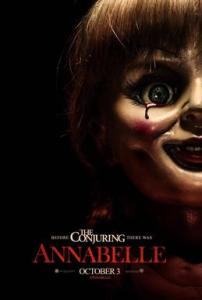
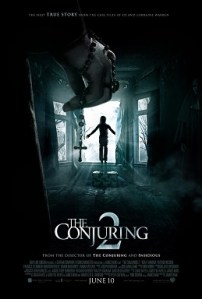
Although it hasn’t always been this way, one of the most characteristic aspects of the modern horror film is the sequel. Some franchises spin into countless sequels and remakes, until their iconic anti-heroes become household names. The Conjuring diegesis participates in this somewhat, but instead of having a repeat fiend, it’s a theme that comes up time and again, tied together by the work of Ed and Lorraine Warren. I’ve written about The Conjuring before, as well as The Conjuring 2. Prior to the sequel there was a prequel of sorts—more properly a spinoff—Annabelle. Not attaining the critical regard as its originator, Annabelle nonetheless did quite well at the box office, as horror movies often do. The idea behind the movie was to give some backstory to the doll that appeared in The Conjuring.

According to the Warrens, there really is such a haunted doll. Technically it’s not haunted. They call it a conduit through which a demon seeks to entrap a human soul. This past summer a prequel to the prequel, Annabelle: Creation, received higher critical marks than its initial installment. All of this is to say that I had to see the original Annabelle in order to try to make sense of this whole series. Despite its failings, the movie once again shows the interlaced nature of horror and religion. It opens in a church and the priest, Fr. Perez, makes several appearances in the story as the Form couple struggles with the demon inside the doll. Pregnant and vulnerable, Mia Form is traumatized when two cult members invade and then die in her home. Annabelle Higgins, one the intruders, dies holding the doll, bleeding into it. She and her accomplice are satanists, trying to raise a demon for nefarious purposes. (I suppose those are the only kinds of purposes to raise a demon, actually.)

The plot takes various twists and turns, never veering far from the main conceit that the demon wants Mia’s soul. I won’t give any spoilers in case any readers are even further behind in their movie viewing than me. Suffice it to say, this is one of the most thoroughly religious horror films I’ve seen. The Conjuring 2 will pick up the story again with the Warrens and a demon disguised as a nun (and a sequel to both The Conjuring universe and the nun are in the works). Critics are certain religion is dying. If popular culture is any measure, that conclusion is far from certain. Sometimes it’s a bit preachy, but it’s there in horror. Even a possessed doll knows that.


Novelty Religion

Religion is dead. So they say. They have been wrong before. One of the great things the web has given us is book fan sites. There are a number of them, and my wife frequently sends me stories from BookRiot. Often they are lists, and the most recent one is Teresa Preston’s “100 Must-Read Novels about Religion.” As I scanned through the tons of tomes to see which I’d read, it struck me once again just how many novels touch on—at the very least—religion. Many are based on it. That’s because religion is an inherently fascinating phenomenon. We don’t really understand it, and even the staunchest of atheists believe something, no matter how secular. Novelists are those who, successfully finding a publisher, express their views of living on this planet in terms of fiction. It’s often factual fiction.

One of the best bits of advice I can give to academics who want to write for a wider readership is this: read fiction. There’s been a time-honored stigma, of course, outside literary studies, of academics reading fiction. Once, at a conference, I was awaiting an author meeting. It was a small conference so I had taken a book to read between appointments. When my author came up, he asked what I was reading. (I’d cautiously removed the book jacket before taking my novel along, not wanting this topic to come up.) “Just some fiction,” I explained. His eyebrows shot up and he questioned why an academic should be reading fiction at all. I have known academics successful in the fiction market, but they’ve had to use a pseudonym because their real name might discredit their scholarship. We are a divided, perhaps schizophrenic, society.

Not all academic novels, of course, are cases involving religion. Still, it’s often there. I recently finished Annie Proulx’s The Shipping News and Neil Gaiman’s The Ocean at the End of the Lane. Both involved religious themes at various points. This is so much the case that unless it’s really obvious or unusual I don’t always discuss such tropes on this blog. (Although I do register the books I read on Goodreads, yet another excellent book fan site.) If they want to appeal to the deepest of human needs, novels must address religion from time to time. Paying respect to the dead is, after all, a very human thing to do. And should it prove true that rumors of its demise have been greatly exaggerated, we shouldn’t be surprised. Like they say, reading is fundamental.


Gendered Lupines

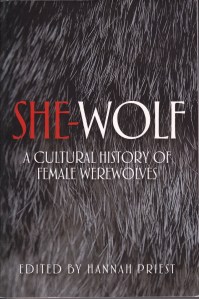
No doubt an excuse isn’t required for reading about werewolves this time of year. Something about October encourages that sort of thing. Hannah Priest edited a collection of essays from various scholars titled She-Wolf: A Cultural History of Female Werewolves. As is to be expected among academics, there are several interpretations wrapped together here and the book covers female werewolves from the Middle Ages—where they are sometimes associated with witches—up through modern cinema. A number of literary sources and a few television representations, and even an RPG, are also part of the mix. The problem with multi-contributor books is that it’s difficult to draw any overarching conclusions, but some observations do come up repeatedly here, and they are worth pondering.

The connection of the female with the animal nature of human beings is stressed for the female werewolf. As might be expected in a patriarchal culture that is becoming more so daily, this is considered an aspect of inferiority. The connection between lunar cycles and werewolves as an inherent feminization of the monster is also brought up more than once. The bodily transformations of puberty also play a role. What we can clearly see amid all of this is that although male werewolves outnumber females in literature and film, and, with a few exceptions, in folklore, the very nature of the werewolf is coded as feminine. This is something that isn’t obvious until a book like this points it out.

Given my own idiosyncratic interests, I was surprised how much religion came into the discussion. Among classic monsters, werewolves tend toward the secular end of the spectrum. There was, however, from the Medieval Period up through early modernity, an ecclesiastical fascination with werewolves. This fascination often came in the form of recriminations against women—attempts to subject them to the wills of men. The church often blamed werewolves on women out of the control of menfolk. And of course, you may kill a monster with no need to feel guilt. More modern views of female werewolves—particularly in movies—are more, well, humanizing. Recognizing that wildness is part of being an evolved animal means that we’re more sympathetic (or had been until November of last year) to the woman who is able to let go of convention and become truly liberated. Now that we experience the poignant lengthening of nights that stir our primal fears, werewolves come naturally to mind. If only we could learn what they have to teach, we might all howl at the harvest moon.


Church Vampires

For people my age manga is a new form of reading that is easily ignored. Although I’ve read a graphic novel or two, “comic books,” no matter how adult the theme, seem juvenile. Note that word “seem.” I do know some younger folks, and one of them insisted that I read Kouta Hirano’s Hellsing. This particular friend is as interested in vampires as I am, and, knowing my history with religion, suggested this might down my alley. Dubious, I gave it a try. In this manga universe Hellsing is a Protestant organization for fighting vampires and ghouls (non-virgin vampire victims who come back as zombie-like creatures who are very hard to stop). Their activity is in England, but when they cross into Ireland they encounter a Catholic organization that kills all vampires, including the “secret weapon” of Hellsing, who is indeed a vampire.

What made reading this tale so interesting is that the reader’s sympathy is drawn to the Protestant sect. The Hellsing characters are engagingly drawn—handsome or beautiful, resilient, and naturally good fighters. The Catholic characters are ugly and maniacal. They kill all monsters, regardless of their “heart.” In this the direction from the movie Van Helsing is reversed. There Van Helsing is a hireling of the Catholic Church who won’t kill a monster unless it’s evil. The idea of the graphic novel is that religious rivalry runs deep between these two Christian organizations. Thinking about this, I wondered how Christianity might look to someone from Japan. In this context, it makes sense. Christian missionaries penetrated east Asia from both Protestant and Catholic evangelistic efforts. Although they worship the same deity, they are quite different religions. At least it must look so to anyone not raised in this strange milieu.

Colonialism, in all its forms, has forced peoples to make decisions about new religions in a somewhat violent way. Imagine someone confronting you with your way of life and warning you that you’re going to suffer never-ending torment unless you accept a faith of which you’ve likely never heard. Then you discover that there are two very different versions of that faith that mutually condemn each other. The natural result, if you acquiesce at all, would be to choose the one that either makes the most sense, or the one that got to you first. Hardly the way to gamble with eternal life. I’m not sure Hellsing is intended as commentary on the experience of the colonized. It seems reasonable to me. And if vampires are a problem, you’ll want to be sure to select the right belief system the first time around.


Getting Exorcize

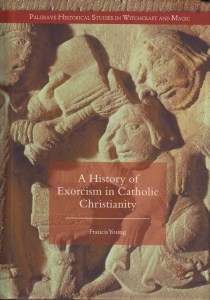
Supply and demand may seem to be an odd framework to apply to religion, but it obviously exists within the polity of churches, synagogues, and mosques. What the people want does influence what’s on offer. Watching movies about demonic possession isn’t something that comes naturally to me. Demons are scary, and it doesn’t help that, historically speaking, they’ve never really been properly defined. Francis Young has provided a service to the curious with his book A History of Exorcism in Catholic Christianity. The book is just what it says, an examination of how Catholics have formally dealt with demons, or more properly, demoniacs, over the centuries. Young notes the protean nature of demons at the beginning—they meet cultural expectations of their time rather than obeying theological niceties. What to do about them?

Long relegated to the realm of epilepsy and mental illness, possession has gone through several periods of ascendency and decline. Indeed, in the nineteenth century it looked as though exorcism, in Catholicism, might have been on the endangered species list. Science was calling the reality of the spiritual world into question and nobody likes to be thought naive. With few exceptions, the move toward eliminating the role of the exorcist was gaining steam. Then in the twentieth century the demand for exorcism revived. As Young notes, a large part of the increasing interest arose from the novel and subsequent movie, The Exorcist. Possession was something so little talked about for so many years that it proved a rich ground for a new kind of monster that was eminently believable. The church, after all, never said there weren’t demons. Since that time, interest has been waxing once again.

Part of the reason would seem to be that humans are meaning-seeking creatures. When our main sources of authority in that realm are eroded, we start looking elsewhere to find succor. Ironically, outside Catholicism the mainstay of exorcism has been among various evangelical Protestant groups. They may not have an ancient ritual to use, but what they lack in experience they make up for in enthusiasm. Their demons are culled from a literal reading of the Bible. And interest among Catholics, in this strange supply and demand rubric, has meant that more exorcists are being trained and made available. The world that Young leads his readers through is one in which strange things reside. He makes no judgment about demons or their reality. He does, however, provide a very thorough history of what the Catholic Church has done about them, when the demand exceeds supply.


Beam Me Where?

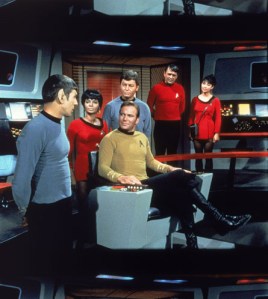
It’s kind of like the transporter dilemma on Star Trek. Where is the person/Vulcan/Klingon when their atoms are being disassociated in one location and reassembled in another? In the classic series, McCoy was never happy with the technology, and even today our doubts linger about what constitutes a person. The other day in a routine medical procedure, I underwent anesthesia. Lying there in the corridor, staring at the calmly themed over-head light colors (no, they actually were themed covers; the drip hadn’t started yet), I wondered where I was about to go. I’ve only had anesthesia once before that I can remember, and I recalled awaking suddenly from the most profound, dreamless sleep ever. It was very different from ordinary sleep. So where was my consciousness at the time?

We have no satisfactory answer to the question of what consciousness is, let alone where it is. Materialists would say, literally, it’s all in your head. Consciousness is a happy mixture of electro-chemical signals in a dull gray organ that’s busing churning out this illusion that Steve A. Wiggins is something more than, well, a mixture of electro-chemical signals. Those of us who’ve experienced enough to question such simple answers wonder a bit more deeply about it. What is consciousness? We’ve all had that feeling, I suppose, of awaking from a dream and being disoriented, even throughout the day at points, as to whether it was real or not. Or, alternatively, remembering something but not being sure if it “really happened” or might’ve been a dream. Ordinarily we recognize the difference between waking and dreaming consciousness, but sometimes the line is blurred.

My experience this time around was the same as last. One moment you’re talking to an anesthesiologist and the next you’re awaking from a completely blank state of mind, a little confused about where you are. You haven’t been in dreamland since there was nothing there. The exact mix of chemicals isn’t the same as when you fall asleep. For all intents and purposes, you are completely gone for that span of time. When I woke up I remembered the anesthesiologist and the watch he was wearing. His accent. His assuring me that the bubbles in the tube were okay. Between that moment and this, nothing. A complete blank. I went in hoping that I might explore alternate states of consciousness in those few disassociated moments, but that’s not how it happened. I think I’m ready to beam back aboard now, though. I trust my consciousness will follow my gray matter, even as I’m being beamed through the ether.


More Conjuring

Among the most revered traditions of the horror film is the sequel. Originally a financially driven feature, sequels have now become an expectation among fans. And although in general we prefer to appeal to our higher cultural aspirations, many horror movies do remarkably well at the box office. I’m not much of a sequel-watcher, but sometimes in my effort to understand the close connection between religion and horror, I succumb. So it was I watched The Conjuring 2. As with the formula for the initial movie, cases actually investigated by Ed and Lorraine Warren are brought together with exaggerated special effects and demonic entities. Starting out in Amityville, the demon Valak is introduced. It later appears as the source of the Enfield poltergeist.

In real life controversy never strayed far from the Warrens and their investigations. Amityville and Enfield have both been implicated as hoaxes. The Hodgson girls, just like the Fox sisters in upstate New York, confessed to some faking, and, of course once that dam has been breeched, there’s no stopping the flood to follow. Nevertheless, such incidents make for good horror film fare. In the case of The Conjuring 2, bringing a named demon into the mix keeps the religious pot roiling. Ironically, the demon takes the form of a nun. This character is a complete departure from both the Amityville and Enfield of record, although demonic influences were posited for both cases. Valak appears to go back to The Lesser Key of Solomon, a grimoire familiar to watchers of the now departed Sleepy Hollow.

Even with the hoax light cast on the “based on a true story” tagline, The Conjuring is well on its way to spawning a cinematic universe. Annabelle was a spinoff, and Annabelle: Creation scored high marks this summer. The success of The Conjuring 2 has led to work on The Nun, scheduled out next year. There’s talk of a third Conjuring film as well. As religion becomes less obvious in the traditional forms of weekly worship gatherings, it crops up more in other areas of culture. Don’t get me wrong—there’s plenty of secular horror as well. What does stand out is that when religion knocks at that creaking door of horror, nobody’s especially surprised. The Conjuring 2’s climax is quickly resolved once the demon’s name is remembered. The fallen angel is banished, not so much back to Hell as to another sequel. Eternal life is, after all, a religious idea as well.


Doomsday, Again?

It’s hard to keep a good apocalypse down. Ever since Jesus of Nazareth did his best Arnold Schwarzenegger impression of “I’ll be back” some of his followers have obsessed when just when that will be. Sorry for the late notice, but the current prediction is for tomorrow. If you’ve got any weekend plans, you might want to rethink them. I know traffic in Jersey is already bad enough without white horses breaking through the clouds. An article my wife promptly sent me from NPR, “Is The Apocalypse Coming? No, It Isn’t!” by Marcelo Gleiser, addresses the documentary The Sign. No doubt about it, there’s some impressive astronomical gyrations here, but planets moving through constellations do not an apocalypse make. As Gleiser points out, the real question is why people believe such predictions so passionately.

Larry Norman’s song “I Wish We’d All Been Ready” captures the mood nicely. Growing up in a tradition that believed, as only literalists can, that this world is the center of the cosmos, Norman’s song haunted my teenage years. These were the heady days of Hal Lindsey and a very hot Cold War. I had to register for the draft. There was unrest in the Middle East. Sonny and Cher had split up. The signs were aligned, it seemed. As they had been nearly every year since about 30 CE. Paul of Tarsus was waiting. And John of Patmos. And Timothy LaHaye. True believers all. Conviction begets conviction. Seeing another fully convinced is a powerful incentive.

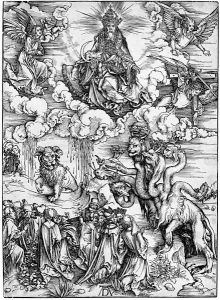
Even now, if I’m honest, I shudder a little when I hear such predictions. What if, by some odd chance, they are right? Raised in that tradition, it’s nearly impossible to jettison that private fear. Rationally I know that clever people can make all kinds of connections that have nothing to do with the Bible. I know that John’s Revelation isn’t about the end of the world. I know that the views of Paul were bound by the developments of his age. I know the Rapture was invented in the nineteenth century (CE). Still, the chill slithers through me when I consider how it felt as an uncertain teen on the brink of Armageddon. I could envision it clearly. Some who were utterly sure swayed me. Specific dates and times weren’t biblical, but the wait for any moment now was even more terrifying. Tomorrow will begin and end just as any other day on planet earth. And another apocalypse will enter the planning stages, coming soon to a universe near you.


The Name of the Game

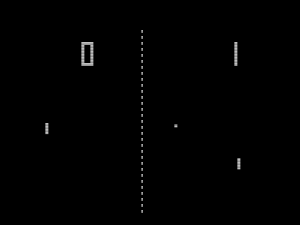
I have a confession to make. I’m not a gamer. Just like everyone old enough to be aware in the 1970s, I was amazed at Pong. Television, which had always only been a passive producer of entertainment, could now be interactive. Slower than real table tennis, the game nevertheless easily consumed hours of life otherwise productively spent. I went off to college and left the burgeoning video game market behind. Then in the late 1990s Myst appeared. The new Macs of those days came loaded with action games about dinosaurs stealing eggs. My daughter was fascinated and so I played. Then I lost interest again. That had been family bonding time, so it wasn’t completely wasted. Now we live in a world where, writers tell me, the real money lies not in movie rights to your novel, but game rights.

Kids, developmental psychologists assure us, need to play. It’s how they explore their world. As the human world becomes more and more electronic, games become more a part of virtual life. Some even have plots and genuine character development. A friend sent me a link to a story on Mashable, “Jesus battles the Buddha in fighting game hellbent on offending.” Victoria Ho describes Fight of Gods where deities of all denominations duke it out for dominion. After posting about god novels recently, it seems to me that we’ve begun to enter a time when the divine world hasn’t disappeared, but has transmuted. In this new world while all gods are not exactly created equal, they all have a shot at supremacy. It’s a matter of who can hit hardest.

No matter whether one finds this offensive or not, there is an element of profundity here. Historically religions have made gods of the things we fear. Storms, diseases, wars, and death—all of these have been, and continue to be, represented as deities. Human insecurity is deeply rooted in our psychology. We’re afraid of things we can’t control. In periods of governmental chaos, phobias naturally rise to the level of personal panic. What can we do in the face of such forces? Especially when prominent figures tell us all religious belief is for the weak-minded and feeble? Don’t we have to strap on our virtual armor and hope some powerful divinities are on our side? In such times as this we need our gods, no matter their tradition of origin. For me, I fear I won’t be able to spin this dial fast enough and that strangely square ping-pong ball is going to get past my virtual paddle.


Clown King

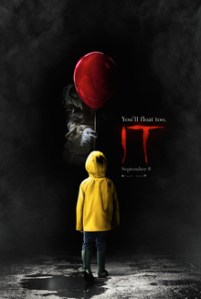
Like many people, I enjoy a Stephen King novel from time to time. King has a talent for drawing you into his tales, and whether or not they’re scary you feel a kind of relief when they’re over. A few years back I read IT. I was prepared to be scared because many people talked about fears of bathrooms after reading it, and, of course, of the terrifying clown. Not being a fan of serialized television movies, I never saw the 1990 movie adaptation. Besides, reading a novel that long is a serious investment of time, and since I like to hear lots of different voices in my reading, I spread out the wealth. In any case, the novel didn’t scare me beyond the neighborhood bullies (who’ve since moved to Washington DC) and I moved on to other things. The new film adaptation has people talking about IT again, and clowns, and clowns always remind me of college.

During the late 1970s and early ‘80s, it was fashionable for Christians to clown around. Taking cues from Paul’s one-liner about being fools for Christ, evangelicals began to experiment with clowns as a means of witnessing. I got involved my freshman year at Grove City College. I researched clowns. Where had they come from? What was the proper way to do it? Was there a deeper meaning? A friend recently sent me a video from Origin of Everything on the subject. I see a lot has been added to the history that I once studied. The idea of the circus clown is one of the more recent innovations of a character that was, in origin, a bit frightening. In classic horror movie style, heavy makeup functions like a mask and we rely on faces to know if someone is friend or foe.

We were taught, in our rudimentary training, that clowns do not talk. To express yourself you had to exaggerate gestures. I learned that makeup did indeed free you from social constraints. The Christian clown, however, had to be good. We weren’t meant to scare anyone into heaven. As nights are growing longer and people’s thoughts are coming to grips with the end of summer, clowns make good companions in the dark. IT may not be King’s scariest novel, but he did understand that bullies and clowns are fears that never go away. And when you combine the two, and move them into the White House, vaunting white faces and corrosive social values, well, maybe it’s time to go to the movies and try to have artificial fears for a while.


Reason to Believe

Gods, the experts say, are on the way out. Have been for some time. The loudest voices in this arena are the New Atheists who suggest science alone explains everything. Problem is, the gods won’t let go. My wife recently sent me an article from BookRiot. (That’s a dangerous thing to do, in my case.) Nikki Vanry wrote a piece titled “Dallying with the Gods: 16 Books about Gods and Mythology.” Most of what she points out here is fiction, and that makes sense because gods and fiction go together like chocolate and peanut butter. The first book she lists is Neil Gaiman’s American Gods—a book I read years ago and which has subsequently become an American phenomenon. There’s even a television series based on it now. Like Angels in America, only more pagan.

What surprised me most about this list is the books I hadn’t read. Or even heard of. After American Gods, I got down to number 10—Christopher Moore’s Lamb—before reaching another I’d read. Then down to 16, Till We Have Faces, by C. S. Lewis. There are, as Vanry notes, many more. Our experience of the world, as human beings, suggests there’s more to it than what we see. Not everyone would call these things gods, nevertheless there certainly does seem to be intentionality to many coincidences. Things pile up. Then they topple down on you all at once. Seeing such things as the works of the gods makes for a good story. At least it helps explain the world.

Many materialists do not like to admit that humans believe. Call it the curse of consciousness, but the fact is we all believe in things. Even if that belief is as strange as thinking fiction only comes from electro-chemical reactions in a single organ in our heads. Gods often appear in fiction. Frequently they’re in the background. Sometimes they’re called heroes instead of deities. At other times they’re right there on the surface. Such books carry profound messages about believing. It doesn’t matter what the authors believe. Believe they do. And such books sell. As a culture, we may be in denial. What we sublimate comes out in our fiction. There are gods everywhere. Singular or plural. Female, male, or genderless. Almighty or just potent. Reading about them can be informative as well as entertaining. We’ve got to believe in something, so why not gods?