My Fellow Americans

It’s important to keep the old gods happy. By now everyone probably knows that Stephen King composed a tweet suggesting that Donald Trump was Cthulhu. In response an angry tweet came from Cthulhu himself, since, as we know, he declared his intention to take over the world long before Trump. Cthulhu is no stranger to this blog, being the brainchild of H. P. Lovecraft. As I’ve suggested before, however, it is really the internet that gave life to the ancient one. His name is instantly recognizable to thousands, perhaps millions, who’ve never read Lovecraft or his disciples. In parody or in seriousness, the worship of Cthulhu is here to stay.

I’ve often wondered if the internet might participate in the birth of New Religious Movements. In an era when a completely unqualified plutocrat can run for president just because he has other people’s cash to burn, anything must be possible. Cthulhu, as we all know, lies dead but dreaming beneath the sea. His coming means doom for humankind, or, at the very least insanity. It seems that Stephen King might be right on this one. I’m getting old enough to recognize the signs; after all John F. Kennedy was president when I was born. I’ve seen the most powerful office in the world devolve into a dog-and-pony show where lack of any guiding principle besides accrual of personal wealth can lead a guy to the White House. At Cthulhu’s tweet indicates, reported on the Huffington Post, at least he’s honest. Unlike some political candidates, many people believe in Cthulhu.
img_2791

Perhaps the interest in Cthulhu is just a sophisticated joke. Long ago I suggested to a friend of mine in Edinburgh that perhaps the Ugaritians were writing funny stories (i.e., jokes) on their clay tablets, imagining what future generations would say when the myths were uncovered. Like Cthulhu, they were the old gods too. Like Cthulhu, there are people today who’ve reinstituted the cult of Baal and the other deities that would’ve led to a good, old-fashioned stoning back in biblical days. New Religious Movements are a sign that we’re still grasping for something. Our less tame, or perhaps too tame, deity who watches passively while charlatans and mountebanks dole out lucre for power must be dreaming as well. Of course, Lovecraft, the creator of Cthulhu, was famously an atheist. Belief is, after all, what one makes it out to be. At least Stephen King’s father reinvented his surname with some transparency. And those who make up gods may have the last laugh when the votes are all in.

Zoo or Farm?

It comes as no surprise, I hope, that I read lots of fiction. While not every book I read makes it onto this blog, a good many of them do, along with some I haven’t read yet. Bill Broun’s Night of the Animals is one of the latter. A suspicion is itching way down deep telling me that I’ll probably end up a fan. Part of my suspicion comes from having read a story on NPR about the book. First of all: dystopia. Need I say more? I admire those who try to paint a future with a lighter palette, but I’ve been observing the way those in power behave and it kind of makes me think optimism about improvement is just a tad naive. People are too easily lulled into apathy by things like sports and the internet. The Romans used bread and circuses. Meanwhile those in power help themselves to a bit more until you can’t even get on an airplane without a total stranger seeing you sans briefs. If I can’t be trusted by those I elect, what cause do I have for hope? But enough about me. The book’s the thing.

DSCN1969

Night of the Animals, according to the NPR piece, is kind of a reverse ark. The animals in the London Zoo are understood by a man and they ask him to release them. I don’t know what happens, but I sure hope to find out. When interviewers ask Broun what it was like to spend fourteen years working on a novel, he responded in a way that, I suspect, many writers would understand. He said that it was a spiritual journey. Writing this book was his search for God. Many of us must nod our heads to that.

Concentration is becoming a dying art. I’ve written a number of books in my life—by far the greatest number remain unpublished—and I know there’s nothing like the intense concentration you experience when lost in such a world. Yes, it is spiritual. It is also a cry to be heard. As George Orwell well knew, we are the animals hoping to be heard. Zoos represent entrapment. Broun states that he wanted to explore how people are trapped in his novel. Looking at a system that rewards greed and keeps workers in unfulfilling jobs just so they can keep the system going while their CEOs buy another hotel chain or sports team and decide to run for office, I begin to hear the oinks, whinnies, and neighs all around me. And I haven’t even read the book yet.


Mysterium Tremendum

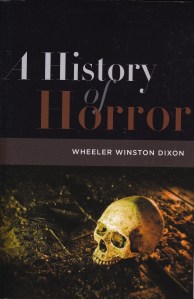
HistoryHorrorFor those of us accustomed to ancient things, horror movies are remarkably new. That doesn’t mean, however, that they are scarce or even easy to understand. While it is beginning to erode, the academic derision of popular culture has long avoided the decidedly low brow genre of horror. It doesn’t know what it’s been missing. Wheeler Winston Dixon’s A History of Horror is an insightful attempt to make some order out of a century of monsters and mayhem. Beginning at the stage when “horror film” was still just a demonic gleam in some vampire’s eye, Dixon points out that from the very earliest experiments with movies “horror” was a popular trope. It seems only natural that the idea of a full-length scary movie would be the expected development. What happened in Universal Studios in the 1930s is that business began making money out of monsters. Where there’s money, there be monsters.

Dixon takes us through the early days into the tired era in the 1950s when life was, apparently just so darned good that people weren’t really thinking about monsters. (Dixon’s analysis is a bit more sophisticated than that.) Horror films matured in the 1960’s and spun out of control in the ‘80s. His book continues up to the first decade of our current century. There’s obviously a lot that can be said about this, but what caught my attention, naturally, was how quickly religion entered the discussion. Those of us who approach horror with an open mind know that religion is its next-door neighbor. Indeed, one of the nihilistic aspects of the proliferation of horror movies since the 1980’s has been the lessening of this getting to know the neighbors. Horror, as Dixon notes, seems to have devolved to brutality and cruelty with no real message.

I’ve never been a fan of gore. I’ve watched my share of slashers, I suppose, but they’re not my favorites. Horror can—in the best of its offerings—be very profound. Indeed, it can even inspire thoughts not so terribly far from those generally classed as religious. For what is worship if not carefully managed horror? The concept of the holy as mysterium tremendum underscores this dynamic. Part of this connection is the appeal to emotion. Horror movies make you feel something, and that is a large part of their appeal. They can be more, however. A smart horror movie will feed your brain rather than just having zombies eat it. Academics, eventually, will catch up with it. Dixon starts to show the way.


Eye of Survivor

I don’t watch television. This isn’t any kind of moral stance. It’s financial. We can’t afford any “triple play” plans for the little free time we have for television. My wife and I both work long hours. We like to read, so we don’t have time for the tube. We buy the shows we want (it’s more honest than advertisements) and movies are a one-off thing. I sometimes lose track of culture, though. Maybe I’m two-faced. I grew up watching television. Then I grew up. But I still occasionally read about television. When we stay with relatives or in a hotel sometimes we imbibe. What I’ve noticed the past few times we’ve been away from home is reality television. Programs with more and more bizarre “real” situations fascinate those who don’t get out much on their own. One of the venerable ancestors of the genre is “Survivor.” I’ve never seen it but even I know what getting “voted off the island” means.

A recent piece in the New Jersey Star-Ledger celebrates a local young man on the show, now in its thirty-third season. This youth, who fancies himself, well, a survivor, notes that his role models are Jesus Christ and Ronald Reagan. I shudder for the future of our species. This young man says he likes to “screw with people’s heads and lie every chance I get.” Is that Reagan or Jesus? Or is it all just a game? The piece by Amy Kuperinksy goes on to quote the boy as saying his tactic for survival is to manipulate people, getting one over on others. But then he’ll use Christianity to build bonds. Machiavelli might have been a better choice of role model here, but then, who has time to read when “Survivor” is on TV?

Photo credit: Smithsonian Institution

Photo credit: Smithsonian Institution

This isn’t going to devolve into an old person’s jeremiad about the younger generation. Nor is it a castigation of television. (As Homer Simpsons reminds us, many of us were raised by television.) Rather, this is a question posed to our future selves. Perhaps we simply can’t see far enough ahead to get an idea of the consequences of our actions, but my question is what values do we wish to see in our society? Rugged individualism may have worked in the early days, but it led to genocide. Have we gotten over all that? Have we come to the point where we make stars out of those who don’t even pretend to be someone else any more? Maybe I’ve got that wrong—lying and manipulation may well be acting after all. Reagan was among that pantheon. I’m just not sure where Jesus Christ enters the picture.


Of the Night

August isn’t too early to start thinking about vampires. The nights are already noticeably longer than they were in June and some leaves are just beginning to change on the trees. I’m thinking of vampires because one of my readers sent me a link to some investigative reporting about the “Highgate Vampire.” I’ve posted about this before, but the brief story, if you don’t have time to browse through my “monster” category, is that beginning in the 1970s a group of people came to believe a vampire haunted London’s Highgate Cemetery. This led to the publication of written accounts of the hunt for the undead. On a trip to London in 2012 I visited the Highgate Cemetery as my host for the trip lived quite close by. Apart from being the resting place of many famous people, the cemetery is moody and Gothic and it’s easy to see how, in days when it was neglected, it could’ve spawned such tales. Thing is, we know vampires don’t exist. So we’re told.

IMG_0061

Back to the story. My reader pointed me to the website Vamped, and now I’m afraid my limited time has just grown more limited. More specifically, there is a story by Erin Chapman entitled “5 Reasons Why a Wampyr Didn’t Walk in Highgate Cemetery.” The article investigates claims made in Sean Manchester’s book on the subject (reviewed elsewhere on this blog), demonstrating that his locations, photographs, and narrative don’t add up. The piece on Vamped shows a meticulous level of detail, comparing notes and photos in a way some of us simply don’t have time to do. Now I’ll sleep more securely on my next visit to London. I hope. The conclusions are disputed.

At this point some may be asking why an educated, rational adult is even addressing such questions. Why worry about something that isn’t even real? This brings to mind the realm of religion. Archetypes, whether they have an objective existence or not, are part of our consciousness. Supernatural beings of many varieties inhabit our heads, no matter how much garlic or holy water we happen to have lying around. Ignoring them can lead to problems. Do I think there is/was a vampire in Highgate Cemetery? I don’t think so. Do some other people sincerely believe it? I have to think yes. No matter which religion people follow, there will be entities that other people don’t believe. That doesn’t mean that they should be ignored. The Highgate Vampire isn’t real for most people, but it is for others. And just in case, I’ll keep a bit of garlic around as the nights begin to grow longer.


Let Us Prey

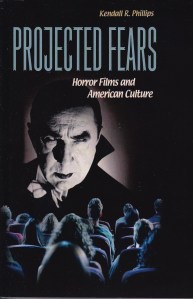
ProjectedFearsI grew up with horror films. Not that my mother encouraged or approved this behavior, but I was a kid with a lot of phobias. With no father around to protect us from what dangers might lurk out there, I tried to learn how to cope by watching others face monsters. That innocent childhood pass-time, like most simple pleasures, disappeared into the adult world of analyzing and being serious and making money. Then it came back. After a series of unsuccessful relationships the old rejection phobias led me back to my beloved monsters. I suspect that’s why I like reading about horror films so much—it’s an exercise in self-understanding. Kendall R. Phillips’ Projected Fears: Horror Films and American Culture is a pleasant Saturday afternoon’s viewing, but for adult monster boomers like myself. Phillips admits up front that academic respectability is hard to come by for horror movies, but that is starting to change. We are beginning to read the script.

Phillips walks the reader not only through the ten movies he’s selected, but also through what was happening in American culture at the time. The horror movie proper is not yet a century old, having begun with Universal’s 1931 monster pair of Dracula and Frankenstein. Phillips shows that what scares a culture changes over time. Indeed, one gets the sense that it is horror movies that lead us in our fears. Highlighting ten culturally significant films, this book guides us through the highs and lows of the last century. The last entry in the book dates from 1999, nicely encapsulating what made us afraid during a most remarkable and, if we’re honest, a most messed up century. Clearly those who purvey horror will have their own choices for significant entries. Phillips does an admirable job of justifying his choices: Dracula, The Thing from Another World, Psycho, Night of the Living Dead, The Exorcist, The Texas Chainsaw Massacre, Halloween, The Silence of the Lambs, Scream, and The Sixth Sense. Each reflects its age, and each impacted its culture.

It should come as no surprise that religious elements—both in culture and in the movies—are up for discussion here. Consciously or not, religion deals with our fears and frequently moves us into the realm of horror. Now that we’ve entered a new era—much has happened already this millennium—the nature of our fears has been changing. To assess cultural impact we need some distance. Books like this help us to understand ourselves, but only after sufficient time has passed. I am confident, however, that when future analysts look back on this insane time that they will find unexpected answers to questions we can only begin to utter. We stare at the monster in the room with us, paralyzed and unable to scream. Or even text. And they will note that religion played a role in our nightmares even as we expected technology to save us.


Gray Magic

Fashion. Okay, I’ll wait here while you check your URL to make sure you’re on the right webpage. Back? Okay. Fashion is something about which I care so little that it surprises even me that I’m addressing it. I can blame my wife, since she sent me the article. In The Guardian. Entitled “Salem style: why this is the season of the witch.” Now it all starts to add up, even if it doesn’t make sense. Witches are among my favorite topics. If I have to go through fabric swatches to get there, I will. So it seems that the fashion world has cast its eyes back on Salem this year. A number of recent, high-profile books have addressed witches, and a number of movies have backed them up. As Priya Elan points out in his article, the political situation helps too. We’ve got a witch-hunter as the GOP candidate and, like in the good old days, being a woman is enough to qualify you as as witch in the language of elephants. Could it be that the fashion industry is making social commentary?

DSCN0565

Why are witches so compelling? Perhaps the failure of true gender equality to take hold has spawned a backlash. Women are still paid less than men for the same work. White men line up at the white elephant sale to say how marginalized they are. How hard it is to exist in a world where you can’t even buy a slave or two any more. Unless you call them employees and then you have to pay them something. Primate society rebels against unfairness. This, pure and simple, is evolution. Biologically, we’re told, evolution has no goals. Where we are, however, is progress. We don’t live in the Dark Ages, after all. In the Dark Ages they believed in witches. Wait, what?

Our throwbacks to Salem should be telling us something. The Witch remains one of the most haunting movies of last year. In just a month the Blair Witch reboot opens in theaters. The Harry Potter series has come back from the dead. Like Rosemary opening the brown paper parcel, we realize witches are everywhere. We fear those with power over us. We call them evil and try to find legal ways to burn them at the stake. Or hang them. Or invoke the second amendment. I may not care for fashion, but I can still spot a prophecy some distance off. It doesn’t take a witch to see the future. Or perhaps it does.


Mature Monsters

When I first began this blog, generally focused on religion, I felt the need to justify posts about monsters. Now, some seven years and several books later, I have come to assume monsters and religion are close kin. Many scholars who explore monsters are those in that amorphous field of “religious studies” who’ve come to realize that terror and the sacred are not far apart. In fact, the Bible contains many stories that could be understood as horror, if taken literally. When my wife sent me a story in The Guardian, “Guillermo del Toro: ‘I love monsters the way people worship holy images’” I once again found the connection reinforced. In the article by Jordan Riefe, del Toro comes more than once to religious themes as he describes his fascination with the macabre. Here’s a guy about my age who’s not afraid to admit that he likes the scary stuff and has, indeed, become famous for it.

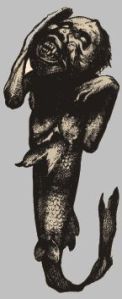
Feejee_mermaidI have to admit that Guillermo del Toro has a way of pressing my buttons. I’ve watched a number of his films and they can be scary even with subtitles to read. Perhaps the reason is that del Toro understands implicitly the tie between religious thinking and the monstrous. An invisible man of infinite power whose revealed will comes in contradictions is certainly a source of fear. So is a child who wears a burlap sack painted like a mask over his head. Known for his fear-inducing creatures, del Toro was raised a Mexican Catholic. He ties this upbringing with monsters in this story. Riefe records him as saying, “I felt there was a deep cleansing allowing for imperfection through the figure of a monster. Monsters are the patron saints of imperfection.” In a mythical world where perfection rests only with divinity and people are told to be perfect, monsters are certain to emerge.

Until quite recently horror was considered a lowbrow genre by academics. As such it wasn’t really worthy of exploration. Perhaps it isn’t surprising, then, that scholars of religion—the new lowbrow—were among the first to take their disfigured friends seriously. Science tells us there are no monsters. We live in a rational world with evolution taking logical steps—if unguided—to more efficient means of survival. That doesn’t stop us from lowering the shades as night draws on. The monsters may be in our heads, but we might also find them in our souls. When we’re informed that such souls are nothing more than imagination we have a very good reason to be afraid indeed.


Spirit of Equality

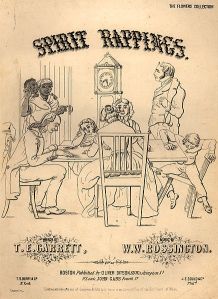
A few weekends back I watched the new Ghostbusters in the theater. Since tuition bills loom larger than life, it takes a powerful draw to get me to spend the money to see a movie in its natural setting. As my regular readers know, I loved it. Critics have tended to, well, criticize the movie, largely for its main drawing feature—the female leads. A thoughtful piece in by Colin Dickey in New Republic points out some of the unusual dynamics at play here. Looking at the history of Spiritualism as the basis for the modern interest in ghosts, Dickey suggests that women have been involved in the long-term fascination with the dead from the beginning. Their motive, however, was generally communication. Women wanted to relate with ghosts to make a connection. The original Ghostbusters movie represented a male, rationalistic approach to ghosts. As Dickey points out, instead of communicating, the men hunt and trap rather than trance and rap.

436px-Spirit_rappings_coverpage_to_sheet_music_1853

Ghostbusters, in all three cinematic presentations, is for laughs. Sometimes classified as supernatural comedy, the film is meant as humor while, admittedly, leaving the door creaking open for some serious thought about the implications. In a reductionistic world there’s no room for ghosts. It’s not possible to say, scientifically, what they might be. From the perspective of traditional belief, however, ghosts are the lost spirits of the departed. Traditional Christian theology places the dead squarely in Heaven or Hell, and they shouldn’t be wandering around down here. That hasn’t stopped people from reporting ghosts. They’ve been recorded almost as long as there has been writing. Today “Ghosthunters,” arms defiantly crossed, use “science” to try to prove the entities exist. This is lightyears from the traditional seance. A ghost under a microscope isn’t very scary.

One of the reasons I found the new Ghostbusters so compelling is that it managed to tiptoe that line between science and spirit that is so rare in the real world. The women, downgraded though they are in the story, are academics. They know, and experience, the dangers of taking haunting seriously. The movie is seriously funny. Like most truly funny efforts, there is a great deal of truth hidden in the humor. Dan Aykroyd’s cameo is one of the scenes that plays on its own loop in my head. “I ain’t afraid of no ghosts,” he says before he drives off toward Downtown. Women, in the film, have a healthy respect for the departed. Not exactly afraid, but not exactly unafraid, they handle ghosts as persons. This may be one of the points Dickey is making in his article. To understand a human one must be human. Spiritualist or Ghostbuster, women have always been superior guides to what is truly important. If only men could learn to listen.


Hollow, Sleepy Hollow

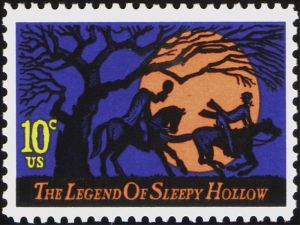
Legend_of_Sleepy_Hollow_U.S._Stamp

It was recently announced that Fox has renewed Sleepy Hollow for a fourth season. Please! No spoilers in the comments (as if)! I’m running a season behind so I want to protect my innocence. The announcement coincided with the happy news that my article on the Bible in Sleepy Hollow has been accepted for publication in the Journal of Religion and Popular Culture. I’m irrationally chuffed about this since my past publications have been primarily textual explorations of documents in languages nobody reads any more. Having something contemporary accepted for publication felt—dare I say it?—cool. As if I were part of the supernatural television crowd. It also affirmed my decision for which book to pursue next. When I say “pursue” I mean “write.”

You see, as a young scholar I struggled trying to decide what direction my research would take. After writing my book on Asherah, I was a bit sated with Ugaritic goddesses, although I started a book on Shapshu, goddess of the sun. The sun gave way to the weather and I wrote Weathering the Psalms. I lost my job in the midst of my revision of that project and it has taken a decade to find my way back to academic publishing. Research, however, takes on a vastly different form when you’re not hired to do it. Colleagues say, “I can get you access to my university library.” Such a kind thought, but my mind always says “when?” When would I have time to visit a library? I get up at 3:30 for my commute and get home in time to go to bed so that I can wake up again at 3:30 the next day. Research reading on the bus is dicey at best. Weekends are for getting the things done that are neglected all week long. Research has to be squeezed into the interstices.

That’s why I’m pleased about Sleepy Hollow. Watching television, even if on DVD, can be research. I’ve got decades of backlogged reading upon which to draw. When my tastes for light horror integrate with what I’m interested in researching it is a happy day. “The Legend of Sleepy Hollow” captured my imagination as a child. It was probably based on the Disney version, but even so, I never lost the fascination. Tim Burton’s Sleepy Hollow is still one of my favorite movies. Watching the episodes of the Fox series takes time, but now I know that time is not just simple relaxation. No, it’s research. Now to find the time to write that book that’s brewing in my head. Inspired, perhaps prophetically, by a Headless Horseman.


The Cost of Chaos

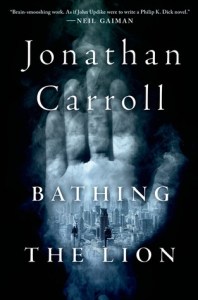
BathingTheLionJonathan Carroll’s novels are always thought-provoking. My reading patterns tend to be driven by book sales and secondhand stores since my reading vice is particularly aggressive. The Ghost in Love is now already years in my past, but I found a copy of Bathing the Lion that I could afford and I was soon dropped into a world of chaos and order. I won’t try to summarize the complex plot here, but I would note the story’s participation in one of the oldest themes of literature—the struggle of order against chaos. The characters called “mechanics” in this book are those who attempt to maintain order throughout the cosmos. Many retire to earth. There, or here, they continue to work against the ever-encroaching chaos.

According to Genesis 1—not the earliest literature, but still fairly ancient—creation is God making order out of chaos. The universe, prior to creation, consists of uncreated, chaotic raw material. Order is what makes our world recognizable. Elsewhere in the Bible creation takes the form of a struggle against a conscious monster that represents chaos. This motif is reflected elsewhere in the ancient world in texts such as the Enuma Elish. Actually, the theme is so common as to be classified as a standard trope of ancient religions with its own name—Chaoskampf. Chaos is always waiting in the wings, ready to break back in and make a mess of our nicely settled existence. The flood story, placed as it is just after creation, is an example of what happens when chaos regains the upper hand.

The battle to maintain order represents a kind of ancient awareness of entropy. If energy isn’t expended, that which is accomplished becomes a wet, stinking mess and anyone who survives has to start all over again. This story is deeply embedded in human consciousness. To our way of thinking, we’re integral to the running of this universe. Spending time in nature gives the lie to this thought. There aren’t that many predators left, but those that are here—cougars and grizzly bears especially—remind us that in the eyes of nature we can be just another meal. Our outlook cannot accept such a low position. As Carroll has the mechanics say, they are not gods. Like human beings, however, they take on a role next to that of divinity. Chaos is the enemy, even garbed in the colors of making us great again. There are still those who will bathe the lion.


Equal Frights

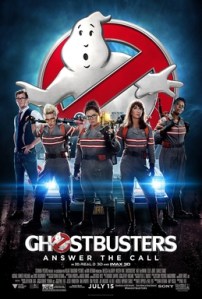
Ghostbusters_2016_film_poster

Working in Midtown Manhattan, it’s rare for a week to go by without passing through a street that’s set up for a film or television shoot. New York isn’t the largest city in the world, nor does it have the tallest buildings, but it is a city instantly recognizable at a glance. It is also a haunted city. The original Ghostbusters was a New York movie, but the reboot may be even more so (although largely shot in Boston). I’m having difficulty remembering the last time I enjoyed a movie so much. I laughed until the tears came, and the theme of spirits loose in the city appealed to that part of me that loves the strange and unusual. With several nods to the original, and cameos from the surviving cast, this is a child of love that outshines its parent. It’s almost as if it makes the original even better than it was to begin with. This is a movie with a mission.

Clearly one of the factors in making the film so good was the fact that women were the leads. They show at once the empathetic, and funny, intelligent, and challenging—roles that women routinely both possess and face. The characters have trouble being taken seriously by the males around them, yet they are fully as qualified as and indeed, know more than the establishment. Discouraged and downtrodden, they press on, saving New York City. This may be the first time women have been envisioned is such a salvific role. They are scientists, scorned for their brains and for their gender, and yet they overcome.

Sure, there’s fantasy involved here, but fantasy with a message. I applaud this movie that not only entertains, but also makes profound statements at the same time. It gives a rare glimpse of what the world would be like if men were treated with the demeaning outlooks that they already frequently give to women. It is a feminist movie, but not an angry one. I left the theater genuinely elated. Of course, I loved the first Ghostbusters, despite all the cigarettes and sausages. Still, those who made the movie had the grace to bless this new venture that takes viewers into a world where we rely on women to solve the problem. Once it’s solved, however, they are shoved into the background so that the powers that be can take the credit. It is a movie for our times. I would’ve gone to see it for the ghosts alone. I came out, however, knowing that I had seen something not only enjoyable, but which might, if taken seriously, begin to change attitudes and prejudices which haunt us to this day.


Look Both Ways

Like many kids of the sixties I grew up watching Batman. I mean Batman—the campy, goofy, live-action version of the caped crusader that was must-see TV for young boys and other hero wannabes. This was all hung upside-down, as it were, by Tim Burton’s reboot of the troubled crime-fighter. Then came Christopher Nolan’s canon. The Dark Knight remains one of my favorite movies as it seems unstintingly honest. We are all part Joker and part Batman. Neither is ideal. More than that, this movie was my first introduction to Harvey Two-Face Dent. You see, I didn’t grow up reading Batman comics, and the television adventures never featured him. At least not as far as I can remember. Two-Face is a fearful foe because you can never tell when he’s telling the truth. That can be very scary.

The other day I asked my mother about someone I remembered from church growing up. This was a woman I hadn’t seen since the Nixon Administration and I was curious how she was doing, and even if she was still alive. My mother told me she was still around, but she doesn’t talk to her any more because the friend is “two-faced.” Among evangelical Christians this is one of the most feared of epithets. Telling different “truths” to different parties is a certain way to demonstrate want of moral fiber. Hypocrisy. It’s also a non-refundable ticket on the bus heading south, if you get my meaning. Christians want to be thought of as honest, if nothing else. Harvey Dent would’ve had real trouble being an evangelical (with some noteworthy exceptions).

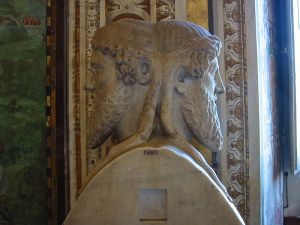
JanusVatican

Businesses, however, are disciples of Janus. I often ponder the sheet number of items that companies classify as “public facing.” What, I wonder, is the antonym? I’ve even heard of corporations that will take legal action against former employees who honestly admit how business is done. No one is permitted to speak of what happens in the entrepreneurial boudoir. Corporations, under the law, are persons. They are afforded the secret inner life of real individuals. There was a “naked business” craze in early in the millennium, but that petered out. We have a public facing face and a reality that no one is allowed to know. Trade secrets. Information that only one corporation may have. Over in Gotham, Two-Face slips into a dark alley and escapes. In little white churches across the country, those who speak different truths are shunned. In the corporate high-rise, businesses are now people. They are, however, two-faced. I miss the Batman of my youth.


Up, Up and Away

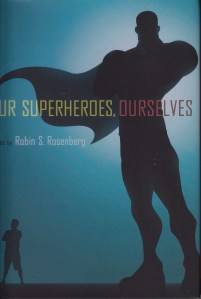
OurSuperheroesIntellectuals often have difficulty, it seems, taking popular culture seriously.  I remember feeling slightly guilty taking a class on Science Fiction in college and actually getting credit for it.  At the time—I remember the Dark Ages—a course on comic books, or even superheroes, would’ve been laughed out of the academy.  And not in a good way.  Monsters, likewise, were considered the opiate of the small-minded.  I’m not sure what happened to turn all of this around, but I think my generation growing up may have had something to do with it.  Scholars began to pay attention to more than the cheap paper and eye-catching, if impractical, costumes.  There were, unnoticed by standard readers, messages embedded in comics.  Superheroes may have been telling us something about ourselves.  Now tenured professors can write about various caped crusaders without fear of ridicule.  Some of the books are quite good.

Robin S. Rosenberg’s Our Superheroes, Ourselves, is a rare example of a uniformly fascinating edited volume.  Contributions from a variety of psychologists and psychologists explore several of the deeper aspects of  the superhero phenomenon.  Insightful and thought-provoking, this little book gives the lie to the frequent admonition of my youth that reading such things was a waste of time.  Anything but.  Now, I didn’t have the level of commitment to comics that Big Bang Theorists do, but I recall being entranced by much of what I read.  Some comic panels are still vivid in my head, although I haven’t seen the original in more decades than I’d like to admit.  They are, as one of the essays suggests, a form of modern mythology.  Another form of modern mythology is the movie.  Superhero movies are discussed as well as the print versions.  These cheap, easily read books were more, it seems, than meets the eye.  I’ve fallen a little behind in my superhero movies, but perhaps it is time to start trying to catch up with Superman.

What is really striking, to me, is the discussion of super-villains.  As more than one contributor points out, you can’t have a superhero without the nemesis of an arch-criminal.  This quite naturally leads to the discussion of abstracts: good and evil.  Early comics tended to be Manichaean in this regard.  In our world evil may be much more subtle than it appears on the outside. The book appropriately ends with a reflection on morality. More than one ethical system may be found in superhero tales. Super-villains, apart from becoming role models for some political candidates, allow us to explore our own dark sides. In the end, however, we know that Batman must overcome the Joker, no matter how appealing he may be.


Sense of Place

Visiting the Holocaust Museum was one of the most wrenching activities of my life. I was in Washington DC for a meeting of the Society of Biblical Literature when my friend Jeff came across the Atlantic to attend. He wanted to see the Museum and I reluctantly agreed to accompany him. About half-way through I found a secluded bench, sat, and wept. I simply couldn’t take the weight of the sadness and cruelty this represented. I have trouble telling another person “no,” let alone striking, or harming them. How could millions of people simply be discounted? Murdered for being born who they were? Could there be anything more inhumane? A quote from the recently departed Elie Wiesel hung on the wall behind my bench. “Never shall I forget those moments that murdered my God and my soul and turned my dreams to ashes.” My wife asked if I would be okay. “I don’t know,” I said.

I have to admit to being a Pokémon illiterate. I don’t know who or what Pokémon is. I do know it/he represents a game universe that originated in Japan. The last “game” I ever played was Myst. Before that it was Pong. I suspect that growing up without computers made real games seem, well, real. I don’t have time for computer games and I wouldn’t know an X-Box if if fell on my head. I don’t even know if they still exist. You’d have to be dead, however, not to know that Pokémon Go is all that anyone cares about any more. An app that lets you “find” Pokémon in various places, adults and kids alike are blindly walking out in front of cars to get her/it. One of the undying lessons of my childhood was, “if the ball rolls out into the street, don’t run after it!” Natural selection at work.

So what do Pokémon and the Holocaust Museum have to do with each other? Nothing at all. Or thus it should be. A story in the Washington Post shares the plea of the museum for people to stop seeking Pokémon there. One of the sites programmed for the whimsical creatures is more sacred than a church, synagogue, or mosque. Genocide is not a game. Headlines boldly proclaim that Pokémon Go is great for businesses. The Holocaust Museum is not about business. It is a mass grave on a scale that the human mind simply can’t conceive. A place to remind us where hatred and fascism lead. As difficult as it may be, we need to visit that terrifying place and we need to remember that it began as distrust of those who are different.

Photo credit: AgnosticPreachersKid, Wikimedia Commons

Photo credit: AgnosticPreachersKid, Wikimedia Commons