Halloween in December

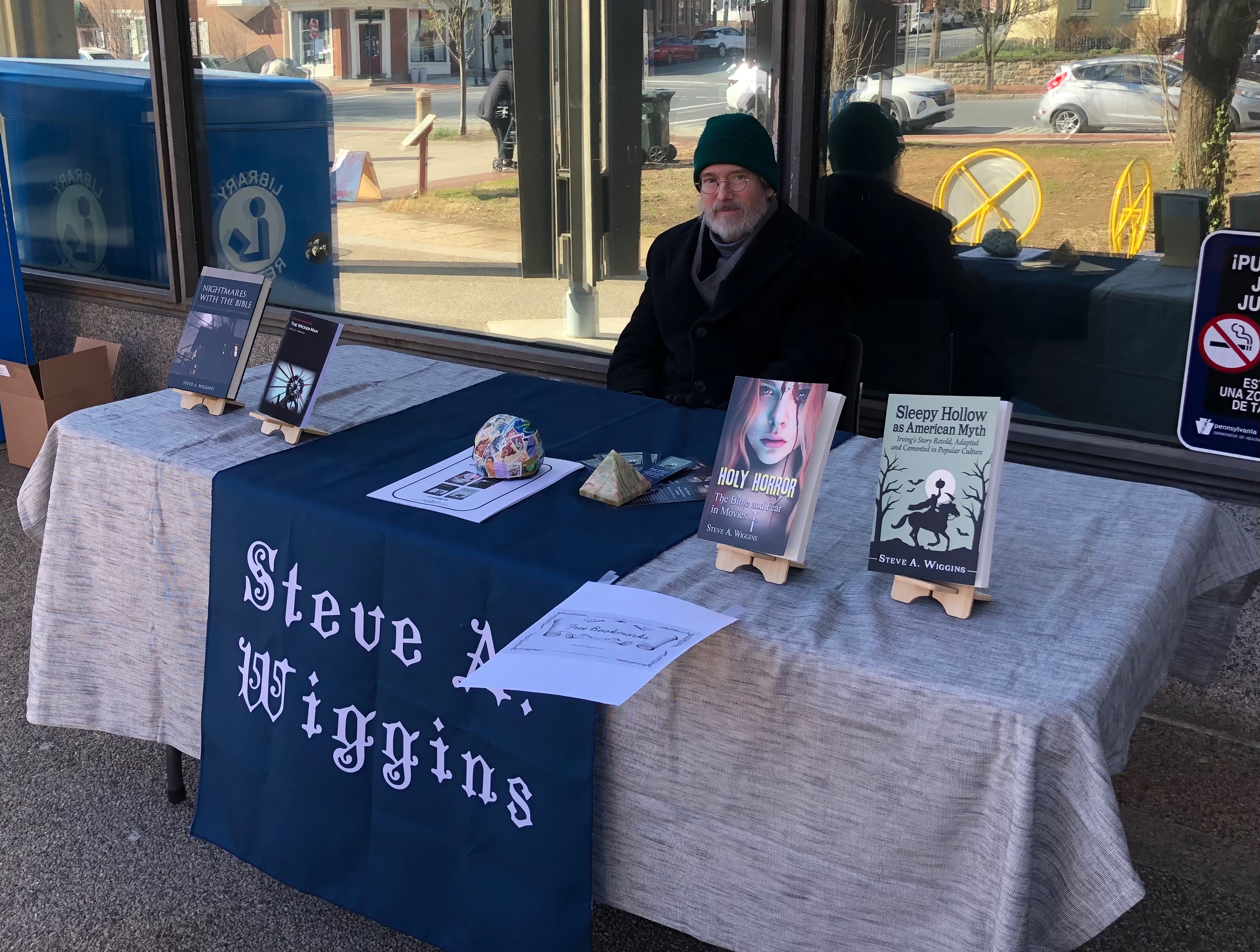
The wind was frigid.  We were still in the cold snap that layered the northeast in its gelid blanket for the first part of December.  We had advance tickets for Christkindlmarkt, a Bethlehem tradition.  As we wandered through the tents I was thinking of one of the few Facebook groups I follow, Halloween Madness.  Most of the posts are repurposed from the internet but the last few weeks, since Thanksgiving, the offerings have been blending Halloween and Christmas.  Most people don’t stop to think how closely related the two holidays are.  (I devote a chapter to Halloween in Sleepy Hollow as American Myth, where I explore this connection in a preliminary way.)  But in this bleak December—we’ve seldom seen the sun for more than a couple hours at a time since the aforementioned Thanksgiving—my thoughts emigrated towards horror.

For those of you who’ve never been to Christkindlmarkt, it’s a germanic themed market consisting of four (or more) large tents, full of vendors.  Many of them are Christmas themed, but not all.  Those that are Christmas themed tend toward the Currier and Ives version of the holiday, but some consider the more ghostly side of the season.  Although I didn’t see any booths explicitly devoted to horror themes or monsters, a few of them had a bit of this aesthetic to them.  I’m no fan of capitalism, but I have to wonder if this isn’t a missed opportunity.  I think there’d be some fans.  I do enjoy Christmas for its symbolism and optimism and coziness.  I really do.  But when I have a few free moments in the holiday season I sneak in reading a scary book or watching a horror movie.  There is a connection, but you have to study the holidays to see it.

I fear that this year I was trying pretty hard to preserve any bodily warmth between the tents and didn’t really have much time to think about it until the next day.  I’m always mindful that Edgar Allan Poe’s “The Raven” is set in December.  And that both Charles Dickens and M. R. James associated Christmas time with ghosts.  I suspect most people, however, prefer the cheerful, happy side of the holidays.  I don’t blame them.  Life can indeed be harsh, as harsh as this windchill, for much of the rest of the time.  There are some of us, however, who do find a little lift by peering into the darker corners, even at this festive time of year.  And with natural light in such short supply, there are a lot of shadows about this chilly December.


American Revolution

In these days when America seems to be a nation purely for purposes of stoking Trump’s ego, and the Supreme Court agrees that’s our purpose, many of us are looking for some sense of balance.  I think that was behind, at least subtly, our family trip to Valley Forge this summer.  It was there that we purchased The 10 Key Campaigns of the American Revolution, edited by Edward G. L’Engel.  Now, I’m no fan of reading about wars; I’ve always believed that “rational” beings could come up with better ways of resolving differences.  Some guys like to fight, I know.  And in the case of American liberty we had a king who only wanted to use America for his personal glory.  Wait.  What?  In any case, I would not likely read a book about war, but I feel I need to find some connection to the country that existed before 2016.

My wife and I read this book together.  It is an edited collection, which means that the chapters are uneven.  Some military historians like to get down to the details whereas I prefer a wider sweep.  Nevertheless, as a whole the book gives a pretty good sweep of what happened during those revolutionary years.  Starting with Lexington and Concord, prior to the Declaration of Independence, and moving through the campaign to take Quebec, the loss of New York City, the battles of Trenton and Princeton, Ticonderoga and Saratoga, Philadelphia, Monmouth, the battles in and around Charleston, and finally, Yorktown, the essays give an idea of the breadth of the fighting.  The authors also make the point that this was a civil war, the first of at least two in this country.

Americans have, until the internet, learned to get along with those who are very different.  Now we hang out in clusters of those like us and hate everyone else.  That’s one of the reasons why, living many years in New Jersey, that we unplugged and got out to see these sites.  I visited Lexington when I lived in Boston, and we visited the scene of the battles at Princeton and Monmouth, as well as Washington’s Crossing, when we were in Jersey.  We’ve been to New York City and Philadelphia, of course, but these cities have changed much, showing what can happen when people cooperate instead of being divided against each other.  The same is true of Charleston, which we visited a couple years back.  Although not my favorite book of this year, strangely this one gave me hope.  Maybe America can overcome this present crisis as well.


Half-Way Through

Here’s a writing phenomenon.  Maybe it only happens to me (I am self-taught), but when I’m writing a book a strange thing happens.  When I’m doing my rewrites, and there are usually several, about halfway through I’ll have an epiphany.  Something I should’ve been doing from the beginning.  Then you’re left standing at a crossroads: should I go back to the beginning again now?  But still need to address a basic rewrite as well as the new approach in the second half, so should I just carry on and then start rewriting from the beginning, catching up with the second half?  That may sound like a trivial question, but I assure you it’s not.  You see, right now I have two books in a complete stage.  “Complete” here means done in draft form.  When I write a book it gets rewritten several times before I consider finding a publisher, but when an important point comes to you halfway through, you’re between worlds.

Now, I work alone.  I am part of a local writers’ group and I’m only now starting to get to know others who’re willing to talk about writing.  I know several writers who don’t talk about it.  They’re still friends, but for me, there are few topics I’d rather discuss.  That’s how I learn.  You see, I have no idea what’s normal.  Do other writers labor over multiple rewrites?  I know some do, but I suspect some don’t.  I know that when I write a short story sometimes the first version seems best to me, but try to get such a thing published.  No, you need to rewrite.  Polish.  Make it shine.  But what if one half is shinier than the other?  This is starting to be a regular occurrence.

Inspiration is fickle.  That’s something we can all agree on.  But when you’ve been scrawling on a topic for weeks, or months, and then a realization dawns, you’ve just added yourself additional weeks or months of revision.  I’m sure a great deal of it is due to my own psychology.  Another part is due to writing under the constraint of a 9-2-5 job.  There are only so many productive hours in a day, and since mine come early they necessarily end when the work day begins.  I’ve tried writing after work but my brain and body feel like a CPR dummy when work’s through with me.  The next morning I start at it again, but the question is still should I finish this up with my new insight, or should I go back to the beginning?


No FOMO

Some fringe websites (of course I do!) present the case for reincarnation via past lives memories, particularly of children.  You see, adults hear/read/see a lot of things as the years weigh down and we might misremember something we encountered somewhere else.  Children have less exposure and therefore make more credible witnesses.  I know perfectly rational adults who believe in past lives as well.  I must confess, however, that this is one of the scariest things I can imagine.  I’m glad to have lived, most of the time, and I’m not in a hurry to end it prematurely, but the thought of doing it all over again is terrifying.  Even if it’s a different and better life.  You see, I entered life with a lot of questions and I have to say, over six decades later, I’m still uncertain about many of the answers.

If reincarnation means starting from scratch all over again, that scares me.  I’ve spent much of my life building walls to protect myself from the things that hurt me.  I avoid overly risky activities.  I handle sharp objects with great care.  I spend quite a bit of time by myself.  I don’t like being hurt.  That may be one reason that I watch horror movies.  They help to desensitize that particular phobia.  Still, I have to think of all the hard lessons I’ve learned in this life and have to think about how I might improve upon it all with another go-round.  In religions of East and Southeast Asia, where belief in reincarnation is common, the idea is often that you want to break out at the end.  Nirvana.  The place were you don’t have to queue up again.  Even Plato thought reincarnation might explain a lot.  But the very thought makes me feel weary.

If you could be rebooted with the knowledge of your previous life intact, that’d be one thing.  The idea of one day finding myself in another mother’s arms, not knowing anything, learning each microsecond, well, it’s frightening.  My parents weren’t educated people.  They taught me the blue-collar hard knocks of life (which I don’t want to have to learn again).  The white-collar hard knocks are sometimes even worse.  I tried to live this life as a clergyman, but that never really panned out.  I sometimes wonder if the Abrahamic religions/monotheistic traditions, didn’t develop Heaven and Hell out of fear of reincarnation.  The idea certainly makes sense, in some contexts.  And it’s one of the scariest things I can imagine.


Flighty Thoughts

Life, domain, kingdom, phylum, class, order, family, genus, species.  My apologies if I’m bringing back bad memories of high school biology, but I’m doing an experiment.  It has to do with the class level.  (I have to confess that this has become more complicated since high school since there are a lot more of them than I remembered.)  Specifically, I was thinking of those of us with backbones (which seems to exclude many congressional Republicans these days), namely fish, amphibian, reptile, bird, and mammal.  I read somewhere—I can’t recall where; I seem to be reading all the time—that the only other order of animals that human beings see every single day, apart from other mammals, is birds.  I suppose some of this depends on location, but it seems to be true even for landlubbers who don’t work in zoos.  I’ve been watching, however, to see if I do see birds every day.

I work in an office with two windows, one facing south and another facing west.  There are trees outside the west window and during spring, summer, and fall birds are abundant.  Yes, I see them every day.  Winter, however, is a bit more dicey.  Songbirds famously either migrate or retreat into more sheltered places for the season.  The other day, during a cold snap, I got to thinking I hadn’t seen any birds at all.  The only thing that rescued the allegation was that I remembered I saw some birds that I startled out on my jog, before it was fully daylight.  The rest of the day I keep my peripheral vision on alert for any motion outside my windows.  Late in the day I saw a crow dart between two trees.  I do see birds most days, but I’ll be keeping a watch this winter for birdless days.

It’s not that I want to prove this author wrong—I can’t even remember who s/he was.  No, this experiment is driven by pure, naked, curiosity.  I’m pretty sure that the author wasn’t writing in a literalist tone (that’s more of a problem with my wiring).  The point that was being made is that people pay special attention to birds since they are so prevalent in our world.  They’ve adapted from conditions of arctic to desert and they can get around many obstacles that might prove troublesome to our class, even bats.  I know that I rarely see amphibians, reptiles, or fish.  Certainly not on a daily basis.  So birds do seem to be top of the class, and, so far, I have seen at least one every day since reading this from a fellow mammal.


Final Rites?

The Conjuring: Last Rites, aka The Conjuring 4, is more of the same.  Reusing tropes that have ceased to be scary, it draws Annabelle back into the story and sets up the possibility of future films by getting the Warrens’ daughter Judy involved.  It is kind of a downbeat to pick up the Smurl haunting since this is widely considered to have been a hoax.  And the movie pulls out all the stops.  Levitation, upside down crosses, and demonic faces suddenly appearing have all been done before.  The conceit that a demon is using ghosts to torment the Smurls is familiar from earlier films in the series.  The franchise, however, remains quite Protestant despite its Catholic trappings.  The somewhat heavy-handed suicide of Father Gordon once again demonstrates the lack of deep comprehension of how Catholicism operates.  It is meant to parallel the suicide that starts the movie, but really adds nothing to the plot beyond shock.

The film tries to do too much and loses any pathos among the Smurls because of the strong subplot, if not the main plot, of the threats against Ed and Judy Warren.  To do this they had to make the real life Judy much younger than she is in real life and cast the unnamed demon threatening the Smurls back to an attack on Lorraine, while pregnant with Judy, in the 1960s.  This allows for a Stranger Things aspect of the 1980s for the action.  It also strangely misrepresents Pennsylvania.  The script seems to presume West Pittston is near Pittsburgh (it’s not, but rather close to Scranton) and it shoots the location in England, obviously for cinematic reasons.

There’s a lot of insider knowledge presumed here—you need to know the fictionalized backstory the series has been building up over eight films.  This comes to a head in the revisiting of actors from the past Warren cases at Judy’s wedding.  Perrons, Hodgsons, and a Glatzel attend, valorizing the often controversial work of the Warrens.  (They were ejected from the Perron house and visited the Hodgsons for maybe part of a day.)  The other movies in the series tend to hang together better but the lack of deep understanding of Catholicism remains perhaps the largest hurdle.  Interestingly, at the box office this has been the highest performing film in the franchise so far.  Since the Conjuring universe is encroaching on 3 billion dollars (2.7 at the moment) gross profit, clearly it strikes a chord.  And there’s every reason to suppose, prequel or sequel, it’s not really the last rites after all.


Reading Habits

I keep track of my reading on both this blog and Goodreads.  It’s a little easier to follow the numbers on Goodreads, so I tend to use their stats.  One thing I’ve noticed in tracking my pacing this year is that academic books slow me down.  I desperately hope this isn’t endumbification, but I feel the need to consult the experts even as I try to write for a wider audience.  Having been trained as a professional researcher, it’s difficult to let go and just read the popular books—those with the style I need to learn to emulate.  But academic books take so long to get through.  Maybe it’s because they’re consciously designed not to be fast reading.  They take time and have concepts that require thought as your eyes consume the words.  They’re also the language I spoke for a good few decades.

My nonfiction reading pile constantly grows taller and I can’t seem to keep up.  Largely it’s because many of them are academic books.  I’m aware that in the real world, where books sell more than a couple hundred copies, that those who can’t claim “Ph.D.” after their names make the most successful writers.  A few of my colleagues have broken through to mainstream publishing, but they generally have university jobs, and tenure.  They don’t have a 9-2-5 schedule that holds their feet to the fire for the lion’s share of every day.  There are writers, I’m learning, who hold down jobs and write more successful books.  They generally aren’t academics, however.  Normal people with intense interests that they express beautifully in words.  Then they go to work.

I’m trying to break into that world.  I know that the publishers I’ve resorted to have been academic publishers.  They don’t really compete with the trade world, nor do they really even try.  Their’s is a business model adjusted for scale.  When you can’t sell in volume, you need to jack up the price.  But to have something intelligent to say about a subject, you have to read books.  I guess I need to learn to read non-academic non-fiction.  Kind of like I have to drink decaf when I have coffee (rarely) and have them add oat milk to make it a latte.  This is difficult for an old ex-academic like me.  I want to know how writers know what they do.  What are their sources and how deeply did they dig?  As I set my shovel aside I realize that I’ve begun to dig that academic hole yet again.


Elementary, Academia

Continuing my dark academia streak, I enjoyed Brittany Cavallaro’s A Study in Charlotte.  Although I’m not really a Sherlock Holmes fan, I know enough of the lore to appreciate how deeply steeped this novel is in Sherlockiana.  In the world of the novel Sherlock Holmes and John Watson were real people.  Watson wrote the books authored by Sir Arthur Conan Doyle in real life.  The books are well known and widely read in the universe of A Study in Charlotte.  The adventures in those novels and stories are, here, factual.  The book is narrated by Jamie Watson, a descendant of John Watson.  While at Sherringford Academy in Connecticut he finally meets Charlotte Holmes, descendent of Sherlock.  They become friends and have a campus murder to solve (thus, dark academia).  I have to confess that I had the image of Jenna Ortega, of Wednesday, in my head as Charlotte.  The two (Wednesday and Charlotte) are similar in many ways.

Although flawed, Charlotte is an inherently likable character.  The story contains enough fun to prevent it from being too grim, even with the death of a Sherringford student and the violent attack of another.  The murderer goes to great lengths to frame Charlotte, and the novel introduces some of the Moriarty descendants as well.  Watson tries to get close to Holmes, but she holds everyone at a distance.  The story includes some family dynamics—the Holmeses rational to the point of being cold, Watson’s mother constantly warning him to stay away from Holmeses while his father eagerly observes how Charlotte works.  Putting the action in Connecticut allows for a trans-Atlantic element since both families are, naturally, British.  The story is well told.

The novel should appeal to those who enjoy detective stories and who appreciate a smart, if troubled female lead.  In this latter aspect, Cavallaro shows herself a perceptive Doyle fan.  Sherlock Holmes isn’t always a perfect character.  He uses drugs and is an eccentric.  This story transfers all of that to Charlotte but making her a young woman while Watson is a rather love-lorn young man, opens the potential for a relationship unlike the classic Holmes and Watson.  I don’t say “romantic” relationship, because Charlotte isn’t really receptive to romance, although her strict rationalism wears thin when something goes seriously wrong.  We all like to believe that there are people a few steps ahead of everyone else, as long as they’re good.  The Moriartys are also masterminds but the novel doesn’t allow us to decide that they’re all bad.  This is an intriguing tale that fits into dark academia in an elementary way.


Oz Undone

Horror is notoriously difficult to define.  Two friends recently suggested that I watch Return to Oz, which, for them, was horror.  Although rated PG, it does shade into horror at several points.  It begins with an eerie soundtrack and a disturbing idea: Dorothy hasn’t been sleeping and really believes in Oz, so she’s to receive electroshock therapy.  She escapes the gothic hospital during a storm and after almost drowning, lands in an Oz gone wrong.  Any number of scary things happen there, and the story is one of constant tension.  First Dorothy encounters the “wheelers,” which equal blue-faced, flying chimps for terror.  She is taken to the residence of a wicked princess who has a collection of heads and changes them at will.  At one point she chases Dorothy with no head on at all, perhaps referencing the headless horseman.  People turn to stone or sand, depending on whether the Gnome King or the deadly desert gets them first.

Dorothy tries to find the Scarecrow but he’s been captured and imprisoned by the Gnome King, who turns people into objects.  When she frees the Scarecrow the gnomes—scary monsters, not bearded little people—attack.  Dorothy and friends are chased to a point that they’re about to be eaten by the Gnome King.  This is dark Disney.  There’s a minor Halloween theme and a living jack-o-lantern.  Fairuza Balk, who plays Dorothy, would go on to play horror and gothic roles.  Even Pumpkinhead, the jack-o-lantern, would be used as the title of a legitimately scary horror movie.  All in all I was impressed with how well this fits into PG horror.  It’s scarier than some other intentional horror with the same rating.

I missed Return to Oz when it came out in 1985.  I’d graduated from college and began seminary that year, so I was a bit distracted.  The movie has gathered a cult following and was praised by Neil Gaiman.  Interestingly, the writer/director Walter Murch noted in an interview that he’d used the book Wisconsin Death Trip, a nonfiction book of unusual events and deaths in a small section of, well, Wisconsin, to get ideas for the script.  This seems a strange inspiration for a Disney film, and indeed, Murch had a rocky time as the director.  The end result is strangely affecting and fits what might be considered horror for children.  The squeaky clean image that Disney has cultivated in recent decades hides a history of films that can legitimately scare the young.  Return to Oz is one of them.  And it has a fascinating back story.


Shipping Tracking

It’s an anxious season. What with porch pirates being a thing and the holiday season near, I think it’s about time to rate shipping trackers.  Please, I am not rating the actual delivery persons—theirs is a difficult job, I know.  On the receiving end, there’s always an anxiety that an item left on the porch will be raptured before discovered by the person who ordered it, so I try to arrange my schedule to be home on delivery day, during delivery hours.  The post office (USPS) has always been a little suspect.  I’ve had “item delivered” messages from them only to find it wasn’t even out for delivery that day.  And don’t get me started about two local distribution centers that appear to have no idea what state they’re in, let alone what other towns might be nearby.  USPS isn’t near the top of my list.  With apologies for the spoiler, Amazon understand logistics.  I know many people who don’t like Amazon for various reasons, but say what you will, they generally know where your package is, in my experience.

There is a service on the bottom of the list, regarding trackers, but before I get there I need to say that these are shipping companies we’re discussing.  Their raison d’être is to move items from one place to another.  I also realize that the older companies that ship had to integrate computer tracking into already existing structures.  USPS was around centuries ago, and it’s understandable that integrating tech into the rather straightforward process of getting an item from A to B is a challenge.  I’ve worked for companies that have tried to integrate tech into pre-existing structures, and it’s always messy.  Still, it would seem that if your business is delivery and everything from GPS systems and advanced software make that more efficient, why wouldn’t you integrate it?

Which brings me to the bottom of my personal list.  I’m sorry UPS (not USPS), it’s you.  The tracking info is often virtually junk.  The number of times I’ve seen a package to be delivered that day only to have some half-hearted excuse, such as “Delayed” pop up on the timeline, with no explanation, followed a day or more later with a vague “we’ll get it to you when we can” message, hardly inspires confidence.  All the more’s the pity since UPS was the “United Parcel Service,” with the goal of being a package delivery service industry.  And it was founded more than a century ago.  You’d think that they might be able to scrape together a few dollars to hire some kind of systems architect to figure out where the software’s falling down on the job.  Of course, I should be charitable with the spirit of the season. It’s just that I’m anxious.  There are porch pirates in the neighborhood.


Scary Television

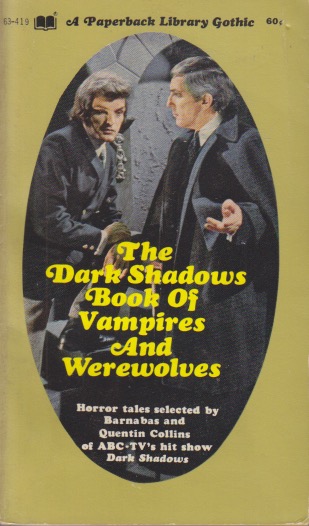
Since noting some months ago that I’d discovered Dark Shadows on Amazon Prime, it’s no surprise that I’m squeezing in an episode here and there, where I can.  Amazon begins “Season 1, Episode 1” at the point Barnabas Collins appears.  This was actually ten months into the daily, but it saves a few hundred dollars buying the DVDs.  I honestly remember little more than impressions of the soap opera from childhood.  I can’t say which episodes I saw during the initial run, but I do know that they were formative in my appreciation of horror.  It turns out that many famous people in various media were childhood fans of the show.  It certainly wasn’t the slickest production but it manages a mood that’s difficult to match.  It’s what Edgar Allan Poe called “effect,”—he felt that a short story should maintain a single effect, something that he did most notably in his macabre tales.

I recently watched, in Amazon’s numbering (and I realize Amazon didn’t come up with this, it was a rebroadcast release that someone decided should start when the show became popular) episode 22 in season one.  This particular episode surprised me in that it actually had a legitimately scary ending.  Now, soap operas are very slow unfolding of stories, as most television watchers know.  Things don’t change quickly and action-packed content requires a lot of time to set up and film, whereas daily shows simply don’t have the time to do that.  They rely on people being drawn into the story and wanting, needing, to find out what happens next.  By episode 22 the savvy viewer had already figured out that Barnabas Collins was the vampire.  Nobody had explicitly said so yet, however.

Maggie Evans, his favorite victim, has been “ill” in bed from loss of blood.  Under Barnabas’ spell, she sends away her boyfriend and Victoria Winters—the original impetus for the entire series—has come to sit with her through the stormy night.  As the two women argue about the proper care for Maggie’s condition, the storm continues, flashing lightning through the French doors in Maggie’s room.  The wind blows the doors open and a flash of lightning shows the silhouette of Barnabas standing in the garden.  I have to admit, even at my age and with my background of horror movie watching, that moment scared me.  The genius of the show is that Barnabas is such a likable character.  As the narrative develops, as it does beginning in episode 23, we come to see that Barnabas is a sad, reluctant monster.  Perhaps if I’ve time enough, I should write a book about it.  But then, I barely have a moment to squeeze in an episode now and again.


Being Written

Some books want to be written, no matter what major publishers have to say.  The truth is, being an author is more like being a radio receiver than a transmitter.  Books come to you, begging to be written.  Given our culture, we equate importance with money.  Tomes that earn the most are obviously the most important and erudite.  So the (capitalistic) wisdom goes.  We follow the lucre.  If you read this blog you’ve probably had an experience like this: you find a book that you’ve never heard of that captures your interest.  You read it, transfixed.  When you tell others, nobody seems to have heard of it.  I’d say a number of books I’ve blogged about fall into that category.  The “general reader” follows what the big five publishers suggest they should.  It becomes a feedback loop.

Academic presses—university presses and others that cater to either students or professors as their primary readerships—produce some fascinating books.  Often they’re priced a bit higher than we want to pay.  That’s because they don’t sell at the volume that a big five book does.  The higher the quantity the lower the unit cost, right?  Books that wanted to be written but either price themselves out of sales, or aren’t backed up by a team of marketers and publicists, may be some of the most interesting reading material out there.  You’d never know it, though.  From the point of view of an author, most of my books came begging to me.  I occasionally think of commercial potential because, well, if you’re going to put years of your leisure time into something, you’d like to get at least a little back.  And you’d be glad for feedback, or someone what wanted to ask you about what you’d been begged to write.

Sadly, we have tunnel vision.  It only sees the shining spots crowded with dollar signs.  And since others are willing to pay for it, we have to assume that it’s good.  I’m working on my next set of imploring projects praying to be written.  I can’t handle them all, being gainfully employed helping others who write books that want to be written.  We write them for each other.  I figure that if I’m receiving the signal somebody must be sending it.  And I have a difficult time turning down an idea that pleads with me.  And if someone unexpected picks one of our books up and gives us a like, we show that even receivers can smile.


Posting

I’ve seen The Post before.  Maybe it took recovering from a vaccine to make me realize, however, just how much we’ve lost with the rise of electronic publication.  Yes, there is now a shot at recognition by the lowliest of us, but publication used to mean something important.  Consider how Watergate, the coda to the film, brought down Nixon.  Now we have a president who could’ve never been elected without the world of the internet, and who is coated with teflon so thick that even molesting children can’t harm him.  I work in publishing these days.  I often reflect on how important it used to be.  Ideas simply couldn’t spread very far without publication.  That’s what makes The Post such an important movie.  It’s the story of how the Washington Post came to publish The Pentagon Papers.  Said papers revealed that the United States was well aware that the Vietnam War was unwinnable, even as the government sent more and more young men to their deaths.

There are many ways to approach this film, including the doubt that it instills in even free democracy, but what struck me as the vaccine was wearing off is how publication has become a more challenging and endangered as the Wild West of the internet continues to expand.  Newspapers used to be the harbingers of truth.  Early in the history of the broadsheet, however, there were those who’d make things up in order to sell copies.  (Capitalism is always lurking when skulduggery is afoot.)  Over time, however, certain papers gained a hard-earned reputation for reliable reporting and publication with integrity.  A story going out in the early seventies in the Washington Post could influence history.  Now it’s owned by Jeff Bezos.

There was a time when a book might change the world.  Now there’s a little too much competition.  Publishers of print material struggle against the free, easy access of the internet.  All that publishers really have to offer is their reputation.  Those that have been around for a long time have earned, the hard way—you might say “old school”, the right to tell the world the truth.  Now the truth comes through Twitter, or X, or whatever it’s called these days and more often than not consists of lies.  Of course I don’t believe the internet is all bad.  I wouldn’t contribute daily content to it if I believed that.  Still, I fear we’ve lost something.  Something important.  And right now we have nothing to replace it.


Naming Things

There’s this thing that you saw and you don’t know what it was called.  It was, say, an architectural or engineering part of a bridge.  Specifically a railroad bridge.  You’ll find that even with dedicating quite a lot of time to it, the internet can’t tell you what is is called.  I was recollecting something that happened to me as a child that involved a railroad bridge.  I can picture the bridge quite clearly in my head, and I wanted to know what a specific feature was called.  Google soon taught me that there are far too many types of bridges to get the answer to my specific question.  No matter how many bridge pictures I examined, even specifically railroad bridges, I couldn’t come up with one sharing the feature I was remembering.

What I need is to sit down with a roomful of experts, make a drawing on the whiteboard, and see if one of them can answer the specific question: what’s this called?  The web is a great place for finding information, but the larger issue of finding the name of something you don’t know is even larger than the web.  Is that even possible?  Yes, for the human imagination it certainly is.  People tend to be visual learners.  (This is one reason that book reading is, unfortunately in decline.)  Videos online can convey information, and some even “footnote” by listing their sources in the description.  The problem in my case is, they’re not interactive.  To get a question answered, you need to ask a person.  I don’t trust AI as far as I can retch.  It has no experience of having been on a railroad bridge as a child when a train began to approach.

Technically, walking along railroad tracks is trespassing.  Mainly this is because it’s dangerous and potentially fatal.  (And somebody else owns the property.)  Growing up in a small town, however, one thing guys often do is walk along the tracks.  They are good places for private conversations with your friends.  The added air of danger adds a bit of zest to the undertaking.  Rouseville, one of my two childhood towns, was quite industrial.  That meant a lot of railroad tracks.  I had an experience on one of the bridges at one time and I really would like to know what the various parts are called.  Just try searching for illustrations of exploded railroad bridge parts.  If you do, you may find the answer to the question that I have.  But the only way I’ll know that for sure is if I can point to it and ask you, “what is this called?”


Machine Intelligence

I was thinking Ex Machina was a horror movie, but it is probably better classified as science fiction.  Although not too fictiony.  Released over a decade ago, it’s a cautionary tale about artificial intelligence (AI), in a most unusual, but inevitable, way.  An uber-wealthy tech genius, Nathan, lives in a secured facility only accessible by helicopter.  One of the employees of his company—thinly disguised Google—is brought to his facility under the ruse of having won a contest.  He’s there for a week to administer a Turing Test to a gynoid with true AI.  Caleb, the employee, knows tech as well, and he meets with Ava, the gynoid, for daily conversations.  He knows she’s a robot, but he has to assess whether there are weaknesses in her responses.  He begins to develop feelings towards Ava, and hostilities towards Nathan.  Some spoilers will follow.

Throughout, Nathan is presented as arrogant and narcissistic.  As well as paranoid.  He has a servant who speaks no English, whom he treats harshly.  What really drives this plot forward are the conversations between Nathan and Caleb about what constitutes true intelligence.  What makes us human?  As the week progresses, Ava begins to display feelings toward Caleb as well.  She’s kept in a safety-glass-walled room that she’s never been out of.  Although they are under constant surveillance, Ava causes power outages so she can be candid with Caleb.  She dislikes Nathan and wants to escape.  Caleb plans how they can get out only to have Nathan reveal that the real test was whether Ava could convince Caleb to let her go by feigning love for him.  The silent servant and Ava kill Nathan and Caleb begs her to release him but, being a robot she has no feelings and leaves him trapped in the facility.

This is an excellent film.  It’s difficult not to call it a parable.  Caleb falls for Ava because men tend to be easily persuaded by women in distress.  A man who programs a gynoid to appeal to this male tendency might just convince others that the robot is basically human.  It, however, experiences no emotions because although we understand logic to a fair degree, we’re nowhere near comprehending how feelings work and how they play into our thought process.  Our intelligence.  Given the opportunity, AI simply leaves humans behind.  All of this was out there years before Chat GPT and the others.  I know this is fiction, but the scenario is utterly believable.  And, come to think of it, maybe this is a horror movie after all.