Son of Comfort

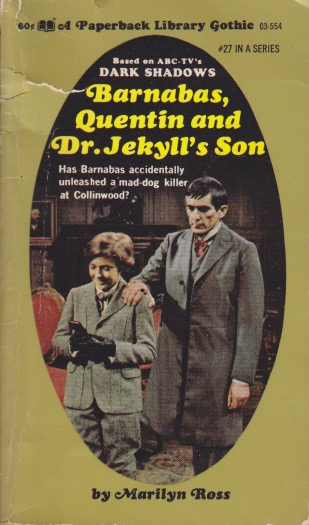
So the other day I was reading a book proposal for another editor.  It mentioned the mononymous Barnabas.  Since the proposal wasn’t from a biblical scholar I wondered if this was the same Barnabas mentioned in Acts as the sometime traveling companion to Paul of Tarsus.  As I began to type this into the search box—and this was on my work computer, which, I hope, doesn’t know my reading habits—it autosuggested Barnabas Collins as the first choice.  One of the frustrating things about devices these days is they know who we are and sometimes we want an objective opinion from the internet.  Is Barnabas Collins as popular as I like to think he is, or is it just a case of my work computer anticipating my off-hour whims?  I sincerely hope it’s the former.

The proposal, by the way, was surprisingly referencing Paul’s Barnabas.  I wasn’t aware that he was much known outside biblical studies circles.  Probably about as rarely as Barnabas Collins is known in such circles.  There has been a resurgence of interest in Dark Shadows that has taken place in spite of, or perhaps partially because of, Tim Burton’s movie.  The film made many missteps, but people from my generation who’d never heard of him before began to reference Barnabas Collins to me.  I’ve never been a soap opera watcher.  It does seem that many college students used to go through such a phase—again, it’s the story that draws them in—but that never really happened to me.  I’d grown up watching Dark Shadows, however, and I’ve been tempted a time or two to start watching the series again.  With well over a thousand episodes, some of which are lost, it would be a major time commitment.  And besides, it wouldn’t recapture those grade-school afternoons watching what my mom thought was a waste of time.

The name Barnabas probably means something like “son of comfort.” I don’t know how the somewhat desperate writers, trying to gain back a slipping audience, came up with the name.  Their introduction of the supernatural into the daily drama did, however, transform television.  The usual demographic for the show was a bit older than me when it was being aired and I didn’t by any stretch see the entire series.  I did see enough, however, to forever frame my view of vampires.  There have been efforts, including one current, to reboot the series on television.  It may eventually rise again from its coffin. Featuring, of course, Barnabas.


Look It Up

Say you remember something, but imperfectly.  Maybe it’s from years ago.  You have distinct recollection of a word or two, but other details (author’s name, publisher) escape you.  In the case of a book maybe you remember the cover.  If a journal article you’re out of luck there.  Not even Google can help you.  (I use Ecosia regularly, because they plant trees, but sometimes you just need to google.)  This happened to both my daughter and myself recently.  She was trying to remember a childhood book and I was trying to recollect an article I’d read while working on my dissertation.  And although I remember Edinburgh very well, that was, uh, three decades ago.  I tried searching different combinations of key words, but there’s just too much stuff on the internet.

One of the strange features of ancient Near Eastern mythology is that it’s extremely popular online but not in academia.  Departments have been closed down.  Smart people left unemployed.  But just take a guess whose websites come up first when you google a god?  After Wikipedia, it’s often fan and fantasy material for page after page.  Universities haven’t figured out how to monetize this interest, so it remains the purview of those who’ve read a book or two (or done a lot of web surfing) and have popularized the deity.  If universities offered courses that caught people where they lived, there’d be a steady audience.  That fickle lover academia, however, is quite coy.  In my daughter’s case it was fairly easy for my wife to locate the title and bibliographic details.  My case was a little harder.

Most sources I consulted on my dissertation are in my book, A Reassessment of Asherah.  (It is available in PDF form for free on Academia.edu).  Back in the day, I made extensive bibliographies.  I pulled it from the shelf and ran an index card down through the entire bibliography.  Apparently I hadn’t listed it there.  Or I was remembering the title incorrectly.  There’s a distinct possibility that I imagined it.  When you’re an active researcher you keep ideas current by going over them time and again.  I can still remember some individual articles that were used to make a point some thirty years ago, but those beside the point have somehow vacated my gray matter.  In the end I never did find the reference.  Perhaps some day, like bread cast upon the water, it will come back to me.  Like said bread, it too will likely be soggy by then.


Masking the Devil

There are many books on the Devil.  In fact, entire horror movies such as The Ninth Gate are based on that fact.  Since writing a book on demons (Nightmares with the Bible), I read a few of the many.  I’ve continued to read some further since, and one of them is Luther Link’s The Devil: A Mask without a Face.  The first thing to note about this book is that it is the same as The Devil: The Archfiend in Art from the Sixth to the Sixteenth Century, as it was published simultaneously in the United States.  (The former was published in the United Kingdom.)  Many authors don’t realize that when you sign a publishing contract you’re selling the rights (the copyright) for your book.  Some publishers or agents will sell the rights in different territories to different publishers.  They don’t have to use the same title largely because, prior to Amazon it was difficult to buy UK published books in the US and vice-versa.  Now a lot of “buying around” happens so books published anywhere can be purchased anywhere.  (Except in authoritarian states.)

In any case, this book is a study of the Devil in art.  The UK subtitle, A Mask without a Face, focuses on the conclusions drawn, whereas the US subtitle is more descriptive of the contents.  There are a number of interesting points made by Link.  One of the most important is that of his conclusion—the Devil, in the biblical and theological worlds of the long Middle Ages, really isn’t so much a character or “person”as a representation of “the enemy.” His looks and actions depend on the circumstances.  As Link points out, to the Pope Luther was inspired by the Devil, to Luther the Pope was inspired by the Devil.  Both, Link concludes, were dealing with a mask without, well, a face. Further, since the Devil does God’s bidding, whether he can be considered evil or not must be questioned.

Another interesting point is the strange continuity and lack thereof that characterize the representations of the Devil.  Some of the continuities go back to an antiquity (such as ancient Mesopotamia) that had by lost by the Middle Ages.  There was no real avenue of transmission since who remembered Humbaba after the tablets of Gilgamesh had been buried for centuries?  This seems to point to what Jung would’ve considered archetypes.  Or it could be that the same things scare people across the ages.  The point of the book isn’t to be comprehensive, but it does make a good point.  Anyone accusing someone of being the Devil opens themselves to the exact same charge.


Leathers

It’s an occupational hazard for the vegan Bible editor.  Leather.  Leather Bibles, although expensive, are popular.  If you want free fetishistic deliveries of colored leather to arrive at your door, well, it’s part of a Bible editor’s life.  Morally I’m opposed to leather and I eagerly await the day when cactus leather is considered a suitable alternative.  Leather began being used in bookbinding early on, when books were treasured possessions.  It was readily available because animal slaughter was a part of everyday life.  It’s also extremely durable.  These days it’s just a status symbol.  When Bibles are produced there’s generally a market for whatever translation in leather.  In my time I’ve seen some well enough used to perhaps justify such extravagance, but not very often.  Usually it’s merely for show.

There’s an entire vocabulary associated with leather bookbinding.  Tooling, or engraving the smooth leather to look like something else, embossing, or pressing a design in the leather, gilding, or the use of gold paint on leather, and dentelle, or having a border run around the outside edge.  All of these were (and still are) signs of the artistry of the binder.  The practice dates back to before the nineteenth century when books were bound by booksellers, not publishers.  Perhaps this is why we shouldn’t judge a book by its cover.  In any case, apart from tradition there’s no need to kill animals to bind books any more.  Law books and Bibles are the major purveyors of leather binding.  It continues simply because it continues.

One term used for traditions unwilling to change is “hidebound.”  While this seems originally to have referred to emaciated cattle, it has come to be associated with codified, as in leather books.  Pigskin, or other cheaper hides, are often used.  Or “bonded leather,” which is as much plastic (if not more) than actual leather.  The Bible isn’t a terribly animal-friendly book.  Dogs are unclean and cats aren’t mentioned at all (except the large, wild kinds).  Yes, there are shepherds—both good and bad—but sheep were kept to be exploited.  And perhaps turned into leather.  There’s something strangely symbolic about this.  And not in a propitious way.  Where does obeying the rules get you?  Sheep are praised for their docility, their willingness to be thoughtlessly exploited, slaughtered, skinned, and eaten.  To do the job, a Bible editor must learn about leather.  Perhaps its a profession best left to carnivores.


Learning to Fly

“Be afraid.  Be very afraid.” This quote originates with David Cronenberg’s The Fly.  Of course, after watching the original, how could I not watch its successful remake?  I initially saw this one upon its 1986 release in a Boston theater.  I hadn’t seen it in some 35 years but some of the scenes were as fresh in my memory as if I’d seen it last year.  It’s safe to say that it made an impression on me.  Even usual critics of horror gave the film high marks.  Both it and its predecessor with the same title were quite successful in the financial department and became part of popular culture.  The remake ends without the philosophical statement of Vincent Price in the original, choosing despair instead.  I’ve never seen the sequel.

I picked this up as a used DVD many years ago.  Mainly I wanted to have it on hand in case the mood struck to see it again.  I did recall that, as a Cronenberg film, it was a gross-out of body horror.  So much so that it’s difficult to classify it as science fiction.  It, along with its near contemporary Alien, demonstrated that the fusion of the genres was possible.  Perhaps inevitable.  At the same time, movies, like most other media, have proliferated to the point that such standouts are rare.  Yes, there are still Academy Awards and Golden Globes, but who but a professional can see all the offerings out there?  It feels like we’ve moved beyond the time when a movie could define a generation.  But on a deeper level, that’s why The Fly is about.

We, on the far end from the white male oligarchs, are blending.  We’re no longer simply accepting what we’re told.  We’re becoming more global and more people are starting to break into the power structures.  Even if they sometimes transform if they do.  I saw a recent newspaper article about what to do with your second home, as in decorating it.  Second home?  The majority of us are having trouble up keeping our one home, and that’s if we’re even owners.  Society needs a telepod.  The end results may be messy, for sure, but we need to stop thinking in exclusive terms.  Cronenberg indicated back in the eighties that the movie was about disease and aging and letting those we love go.  That gives the film its poignancy, in a kafkaesque way.  At the same time it may be a teaching tool.  Yes, we can be afraid, very afraid, and still learn.


Sacred Sites

The sacred is hard to define.  Calling it “holy”is only to pass the buck, and I can’t get beyond the feeling that we need something more up-to-date than Rudolf Otto.  Something that takes into account what the religious world looks like in the next century.  No matter which direction we turn we run into undefinable words—numinous, heightened, transcendent.  Wonderful words that fail to capture the essence of the experience.  This has been on my mind because I’ve been thinking about sacred spaces.  No matter how secular we may be, we all know such places exist.  They may be places significant to large numbers of people, or to a set of one.  Perhaps there are many kinds of sacred spaces and many ways that they may be made so.

The place where a significant event in life took place, for good, is recorded in that way our brains have of switching into slow-motion, high-attention mode.  Were we not so secular we might say something spiritual was going on.  Pilgrimage sites worldwide are often associated with what’s interpreted as a religious event.  Those of us who weren’t there at the time feel compelled to visit.  To breathe the air of that place.  To linger in wonder.  Is there something still there?  I tried desperately to feel this when I visited the Church of the Holy Sepulcher in Jerusalem.  It was difficult with so very many other people there.  I went alone and I was thinking maybe something might happen.  Like what happened to me at the Church of All Nations next to Gethsemane.

As I was pondering this, many such sites came to mind.  The birthplaces or living spaces of great writers have always drawn me into such a reverie.  Standing in Poe’s house in Philadelphia, knowing that one of the world’s iconic writers saw these same walls, walked these same floors, but for him it was likely ordinary.  For the rest of us it’s something more.  Yet I’m no closer to defining it.  Thinkers like Otto had professions that included unstructured thinking time.  Many of us don’t have that luxury.  We feel the urge but the clock for our 925 keeps inexorably ticking, like the beating of the heart beneath the floorboards that make a place sacred.  Many of these places are far too personal to write about in a public place.  They await someone with the time and inclination to think on these things to give us to words to define them.


Spring Forward

Spring officially arrives in the northern hemisphere today.  Days will be longer than nights for six months after this and many pagans will be celebrating Ostara.  Named after Ēostre, the goddess who apparently gave Easter its name, Ostara is an amalgam of the various equinox feasts and observations of antiquity.  The ancient Celts, as far as we know, held four particular holidays that fall roughly halfway between the solstices and equinoxes, with February marking Imbolc and Beltane yet to come in May.  We don’t know that they celebrated the equinox, but we don’t know that they didn’t either.  Equinoxes are a bit difficult to measure precisely with the sun’s position overhead, but we know the clever folks responsible for Stonehenge and Maes Howe could do such things, even in antiquity.

Ostara, maybe

According to Bede the Anglo-Saxons had several feasts for the goddess Ēostre.  Luckily (from his perspective), Christians had Pascha (Easter) some time near the equinox.  It’s late this year, however, since we just had the full moon (the “Worm Moon”) on Friday.  Easter is the first Sunday after the first full moon after the vernal equinox.  So today we’ve got Ēostre.  We know little of her beyond Bede.  Ancient Germanic peoples, like the ancient Celts, didn’t keep extensive written records.  Their religions, based on what we know of most ancient religions, were likely lively affairs.  Spring is a celebratory season and already buds and blossoms are appearing around here.  Goddess or no, there’s a feminine wonderment about the season.  It’s difficult not to feel at least a little hopeful.

Ancient deities have long been a source of fascination.  Eclipsed by an aggressively political Christianity, many of them vanished without leaving us many traces at all.  The human mind seems inclined to create gods to explain this strange but wonderful world we inhabit.  It’s clear that it wasn’t made just for us.  The birds and insects, and even the elusive reptiles and amphibians, are beginning to reappear.  Many mammals and some birds rough it through the cold hoping to emerge again into the warmth of spring.  We’ve had some warm days already, but there are likely more cold ones to come.  As the pagan gods, as Ēostre remind(s) us, transitions come in fits and starts.  Setbacks are part of progress.  Many of us believe the moral arc of the universe tends toward what is good and right.  It may take a long time to arrive, but the equinox, in its very name, bears the clue.


Not Really New

It’s called the New Books Network.  I have no idea what its stats are, but it is a place to get word out about your book that the academy has apparently overlooked.  I pitched Nightmares with the Bible to them some months ago and I recently had an interview about it.  I’ll keep you posted when it appears.  I suppose those who read this blog for the horror content sometimes think I may’ve forgotten about it.  The fact is I think of horror every day but there’s more to my psyche than just that.  This blog is a romp through part of what’s on my mind.  Sometimes it’s the quotidian horror of everyday.  At times it’s full of curiosity and wonder.  Sometimes I just trying to figure out how to work this thing.

So with the New Books Network.  I found out about it from an interview I heard with the guy who started it.  Funny—one interview leads to another.  He encouraged those listening to pitch their books.  I don’t have an institution to support mine, or students to have to buy a copy (and I’ve received zero royalties for it), so I figured what’ve I got to lose?  It was quite a nightmare (speaking of which) to arrange a time that worked for both interviewer and interviewee.  I think we rescheduled about half-a-dozen times, but then finally we both had a few free minutes together to chat.  Perhaps it’s a good thing I’ve been reading about the Devil.  

This was actually my third interview about this book.  Perhaps it’s a measure of how small the impact it’s had has been that I can recall each one so precisely.  You’ve got to start somewhere, so why not here?  The last question asked was about the next book.  I do hope I have a few more left in me.  I started writing early but publishing late.  Just because you write doesn’t mean people will read what you produce.  I find writing the most hopeful avocation ever.  Like a sower with his or her seeds, broadcasting them across the air, hoping they’ll land legible.  If there’s anything worth reading here there’s always the possibility it’ll be discovered someday.  That’s optimism with a glass half empty!  In any case, check out the New Books Network.  There are hundreds of books there to learn about.  And, I suspect, many authors who’d like the world to know what they’ve written.


Future Ministry

I’ve been on the Green Committee at work almost since I started the job.  Occasionally for Earth Day we’ll have a book discussion.  Usually it revolves around nonfiction books that my press publishes.  This year they selected Kim Stanley Robinson’s The Ministry for the Future.  It’s an environmentalism tale of what global warming may well be like and the political machinations it might take (and the millions of deaths along the way) before we stop burning carbon.  It’s a long and detailed and political story.  Robinson is known as an intellectual science fiction writer and there are sci-fi elements to the book, but its style is realist and its outlook, while ultimately hopeful, is staid.  Even when humans start to move in the right direction.  It’s also a very long book.

Reading it got me to thinking again of a somewhat bewildering truth: environmentalism books tend not to sell overly well and sustained reading, even by supporters, is difficult.  Many of us know that we’re beyond the tipping point for environmental disaster.  The Trump years assured us that it is coming.  One of the elements Robinson makes clear is just how politically entrenched it is.  Perhaps that’s one of the reasons for the despair.  The vast majority of people in the world want a more environmentally conscious government, but plutocracy tends to bring narcissists to the top and the needs of all others are less important.  In Robinson’s version of the story, targeted violence is the only thing that works.  Near the end of the story an interesting idea is raised: the Ministry of the Future (which is a government ministry, not the church kind) concludes a new religion is needed.

The masses of people, you see, are followers.  Religious leaders reinforce the idea that God told their founders—and by extension their followers—the only truth.  Their jobs (and ministries are jobs) include reinforcing those ideas to people who’ve been raised or converted to that particular brand of religion.  A number of New Religious Movements, and even a couple of prescient ancient religions, have been purposely constructed.  The trick is to get followers to accept that the religion is legitimate.  Most western religions around today have been based on the idea that humans can do whatever they want with the planet—even destroy it to force God to return.  I kind of like Robinson’s idea better.  Perhaps that’s why religions form around movies like Avatar.  Not a bad thought, when your job has you reading a sci-fi novel.  A religion saving the earth feels like a novel idea.


Going Green

It’s easy to get eager at this point in the year.  A month and a half after Groundhog Day, we’re at St. Patrick’s, and just a few days from the equinox itself.  Around these parts we’ve had some warm weather after last weekend’s bomb cyclone and most of the snow is now gone.  We’re ready for progress.  We’re tired of winter and huddling indoors.  The crocuses are defiantly open although the warning saying in Wisconsin went “three snows on the crocuses.”  St. Patrick’s green is the fecund green of spring.  Although nobody gets them off from work, the seasonal holidays are signs of hope.  It doesn’t matter which season into which we’re transitioning, there’s beauty ahead.  It’s the kind of change many people enjoy.

Look closely at a flower.  (If the crocuses aren’t up yet in your area they will be soon.)  Open and inviting, it offers insects what they need in return for a bit of cross-pollination.  Yesterday I saw my first wasp looking for a place to build a nest on our house, reminding me to be careful opening doors now because no transition is completely smooth.  Spring is hope in season form.  As much as we may appreciate winter with its pristine chill, spring reminds us that food is soon to be available from the bosom of the earth itself.  The songbirds, now back in force, have been eagerly anticipating it.  They are the heralds of transition, the little winged messengers of assurance.

Photo credit: Andreas F. Borchert, Wikicommons

It’s time to step outside and breathe deeply.  The muddy smells of a thawing earth blend with the first fruity hints of buds beginning cautiously to open.  The transition’s not straightforward.  There will be setbacks and chills yet to come.  Nevertheless, the die is cast—St. Pat waves his clover as if to say “This is what lies ahead, as brown becomes green.” Our world tilts as it spins and brings us the delight of seasonal changes.  Saints and birds and flowers must agree on this, even should they differ on the details of what is needful.  It’s a day for celebration, even though it’s a Thursday, a work day with perhaps a respite—after hours of course—to have some fun.  Green is about to reappear.  We wear it today to encourage the timid plants, yes, we need hope.  We look around the world and know that hope is what we really all crave.  


Thinking, Critically

A woman—I don’t know her name—photobombed a Russian newscast with a sign telling the Russian people that they’re being lied to.  Detained by police, her whereabouts are unknown.  I admire that woman.  She may pay with her life  in her effort to encourage what is dear to every teacher everywhere: critical thinking.  Many of the world’s problems are the result of the dearth of critical thinking.  There’s no other way to explain the election of Trump and his main squeeze Vlad.  Thick as thieves, the saying goes.  I recently gave a talk to a small group about publishing.  One of the points I was making is that critical thinking is essential in getting to the truth.  Compare sources, use reason, and never trust a snake-oil salesman.

People vote with their feelings rather than with their rational faculties.  Trump openly admires Hitler, as Putin does Stalin.  These should be signs of warning to those who think critically.  The Second World War wasn’t even a century ago and we’ve apparently forgotten all the lessons it should’ve taught us.  In high school we were shown examples of propaganda and told how to avoid it. Now we see it and can’t recognize it at all. Critical thinking is often frowned upon in modern society.  Being comfortable with the status quo is perhaps valued higher than social justice and the necessary work to get us to where it might happen.  It’s easier to hate than to think.  It’s easier to follow than to question what you’re following.  Education teaches us survival skills, and among them are the ability to think through a situation.  Authoritarianism is seldom—I’m tempted to say “never”—the way to a good result.

Perhaps the saddest irony of all is that those who run outlets like Fox News (and its Russian equivalents) are thinking critically of ways to get followers not to.  Realizing that critical thinking will lead to a more fair and equitable world, they decide to keep their positions of privilege by discouraging their followers from engaging with the basic comparison of sources and weighing of facts.  Instead, promoting “alternative facts” and emotionally outraged rhetoric, they are able to stir up crowds to try to take over the government.  Conspiracy theories are easier to believe if you don’t know how to check facts for yourself.  And the internet has made us all experts on everything.  Russia’s narrative about the war is far from the reality on the ground.  Objective observers have seen what is really happening.  One heroic woman in Russia said enough is enough.  In all likelihood nobody in the world will ever see her again.


Monasticism

The other day I was reading about monasticism (as one does), and something curious occurred.  The article, which was describing a famous monastery, mentioned that monks lived in the convent.  Now, lest you think anything about religion is simple, I must clarify that in English it is common usage to refer to “monasteries”as places where monks (male) live.  Again, in English usage “convents”are for nuns (female).  The words, however, have a more interesting history than that.  Not exactly interchangeable (can you imagine the confusion?), they do originally refer to different kinds of institution.  

Often monasticism is traced back to Anthony of Egypt.  Anthony famously kept himself away from other people to devote his life to God.  This, of course, led other people to seek him out, wanting what he’d found.  Eventually, the narrative goes, the idea occurred that lots of guys could live together in common, but shut away from the rest of the world.  Thus monasteries were born.  The story’s actually more complicated and I can’t give you the full picture here.  We do know that even in Judaism, before Christianity came along, there were separatist sects.  One of them, known for convenience as “the Essenes,” set up a commune not far from where the Dead Sea Scrolls were discovered.  They lived lives of purity and prayer and women were strictly forbidden.  They seem even to have had a monastic rule.  They lived on the edge of the desert and perhaps were responsible for the famous scrolls.  Monasticism thus had early roots.

The European Middle Ages were the high-water mark for monasticism.  Like our own day, people were dealing with plagues and strong-arm kings and lack of adequate infrastructure.  Many powerful monasteries had been founded, and they could be for monks or nuns, generally not in mixed company.  There were also solitary monks (it was more difficult for women to wander about alone), called mendicants.  Such people needed places to stay now and again, and that was what was called a convent.  A monastery could be for either sex, and the word “nunnery”eventually helped to make this clear.  The English use of the words, while convenient, can lead to confusion because established monasteries could have convents as part of their design.  I suppose not many people are really interested in monasticism these days.  Looking at what’s happening in the world, however, I wonder if we might not be on the cusp of a modern replacement for them.  It would be something curious indeed.


D Evil

The Devil, they say, is in the details.  T. J. Wray and Gregory Mobley look into those details in The Birth of Satan: Tracing the Devil’s Biblical Roots.  It’s often a surprise to Christian readers that the Devil clearly evolves in the Bible.  From being virtually absent in the Hebrew section, he appears, almost full blown, in the New Testament.  This, of course, flies in the face of the idea that the truth was pretty much revealed from the beginning and that it’s consistent throughout.  The Devil in the details proves that it’s not.  The Bible has multiple suggestions of whence evil arises, God among them.  The Devil came to be one explanation of the origin of evil, but he’s not the only biblical one.

One of the things I found fascinating here, however, was that the authors often refer to popular culture to illustrate their point.  They particularly favor movies.  The authors are biblical scholars and it’s not at all unusual to find movie fans among them.  I suspect that since biblical scholars (apart from the linguists) specialize in stories it’s only natural that movies appeal.  They aren’t given extended discussion here, and indeed, a book about the Devil in the movies would be very thick if it attempted to be comprehensive.  Satan is a movie star.  Since he evolves into the embodiment of evil this is probably not surprising.  A good plot needs some evil in it, and one character in the western canon is the granddaddy of all evil.

Those looking for a fuller biography of the Prince of Evil may be disappointed that this book keeps to its remit—the biblical Satan.  There are, however, many more books about the Devil.  Maybe even more than movies in which he appears.  Scholars and laity both seem interested in this character.  He appears late on the scene, only within the last century or so of the biblical writing period.  His fullest portrait there is the highly symbolic book of Revelation.  And no matter what else you say about it, we can all admit Revelation is tricky to understand.  Since we take the Bible so seriously, one aspect of Satan that isn’t addressed here is his role as trickster.  Folkloric characters who cause chaos (which the Devil does) are often tricksters doing it for no particular reason.  We don’t know why the Devil is bad.  The Bible has no clear origin story for him, since he’s built up from several other cultures’ ideas of bad deities.  To sort it all out requires, well, the details.


Saving What?

It’s soul-tormenting.  For those who always awake in the dark, February starts to offer the hope of some early morning light.  It brings cheer and optimism into late winter.  We are awaking from the long night, only to be plunged back into darkness in an act of sheer, collective insanity.  For many weeks we’ll be tired all the time.  Less productive.  Automobile accidents will increase.  Finally, around mid-April, the early light will return.  Now please don’t misunderstand me.  I like Daylight Saving Time.  I see no logical reason, however, to set our clocks back in the fall.  What good does it do?  Gradual change is much easier on the human psyche, so why do we force a sudden shock to the system twice a year?  If the apocalypse ever actually happens it will be when we set our clocks forward.

Human hubris messes with time.  Many people simply accept the time shift as something we “have to do.” We don’t.  In the technological age there is no reason to continue what was initially a war-time effort to use light to increase production.  Hey, look, it didn’t prevent wars from happening.  All it causes are wicked huge yawns and their knock-on effects.  Time is a valuable commodity and yet we waste it twice annually, with abandon.  People as a group are a lethargic bunch.  The threat of war led the world to adopt a measure to shift light into the evening time, but for only part of the year.  Why not all the year?

When I commuted into New York City I often stood waiting for the bus in the dark.  Late February would come and some cheer at standing in the cold (there was no bus shelter) was possible with the faint streaks of dawn arriving before the bus, like the earth finally opening its sleepy eye.  March would come and I was once again in the dark.  Finally, about a month later the light would return.  Is it necessary to climb the same hill twice?  Can’t we just spring forward and leave it at that?  There will be lots of yawns at work tomorrow.  People will be careless while driving.  It may even lead to deaths.  There’s no reason to do this, but we keep on, as if it were some kind of divine command.  I’ve yet to meet one person—no wait, there was one—who thinks this system works.  Empty ritual is the worst kind.


Original Fly

Thinking about it made me do it, I suppose.  Watch The Fly, that is.  This is a movie I grew up knowing about.  I knew the basic plot but somehow was never in the right place at the right time to see it.  Until now.  For a movie from 1958 it remains strangely affecting.  I was wondering whether religion would enter into it, and indeed, in a moment drawn from Frankenstein, André Delambre expresses that he knows what it feels like to be God.  No thunder to drown it out this time.  A short while later his wife Hélène asks him what he’s doing as he is relaxing in the back yard.  He says he’s looking at the sky, or maybe looking at God.  In the light of other mad scientist movies this is a somewhat self-aware moment.

The Fly is one of those movies that had great influence on popular culture.  Although critics at the time thought of it as a gross-out (they obviously had no idea what David Cronenberg would do!) it nevertheless managed to find its way into dialogue with other movies.  The correlation to Willie Wonka and the Chocolate Factory’s Mike Teevee’s scene is remarkably close.  (Adult’s who’ve read Roald Dahl and who’ve paid attention to the movie know that this is kid-friendly horror.)  I’m also pretty sure some of the writers from The X-Files knew The Fly as well.  The Fly, coming during the atomic age, is clearly a warning about using technology that we don’t understand.  Although the movie made a great return on investment for the time, the message still hasn’t been received.

In many ways The Fly set Vincent Price’s trajectory toward being a horror star.  After all, just two years earlier he’d been in The Ten Commandments.  Isn’t he another connection between religion and horror?  Although not the lead in The Fly, as André’s brother François, Price has the most philosophical line: “The search for the truth is the most important work in the whole world and the most dangerous.”  Like the warning about technology, this is a bit of information that might have usefully been heeded.  The political events of 2016 to 2020 demonstrated just how important the search for truth is (and demonstrated religion and horror).  Even with a partial fly brain, André Delambre destroys his notes after making Hélène promise never to reveal what happened.  The truth gets out, of course, leading to the observation behind many mad scientists’ ravings: what is really being sought is the rush of knowing what it feels like to be God.