Literary Life

Trying to live a literary life is, I suppose, irresponsible.  Especially if your efforts and writing bring basically no money.  It takes considerable effort to make daily time to read and write, and so much else remains to be done.  At times I feel guilty for trying.  My books have all been published, for various reasons, with academic publishers.  Academic publishers don’t try to sell many copies of an individual book, relying as they do on the long tail philosophy.  Most academics have good paying jobs that expect research and writing in return.  For the outsider, however, there are other pressing matters.  The nine-to-five being the largest among them.  And any social organizations you join to keep you sane and connected.  Then there’s social media to take your time.  And the lawn’s ready for mowing.

I’ve always believed lack of time was (is) a theological problem.  I came up with that when I was an academic and had time to ponder such things.  Unlike many of my colleagues, I did research and write.  Now I want to move into that world where you might earn a little from all the effort.  And yet, that old Protestant guilt has a way of getting its talons around you.  You’re reading?  Shouldn’t you be doing those minor repairs you can handle without a contractor?  (Or at least think you can handle?)  Or maybe shouldn’t you be looking for a job that pays enough to hire someone to do such things?  And don’t you dare let that word “retirement” anywhere near your head.  What are you, irresponsible?

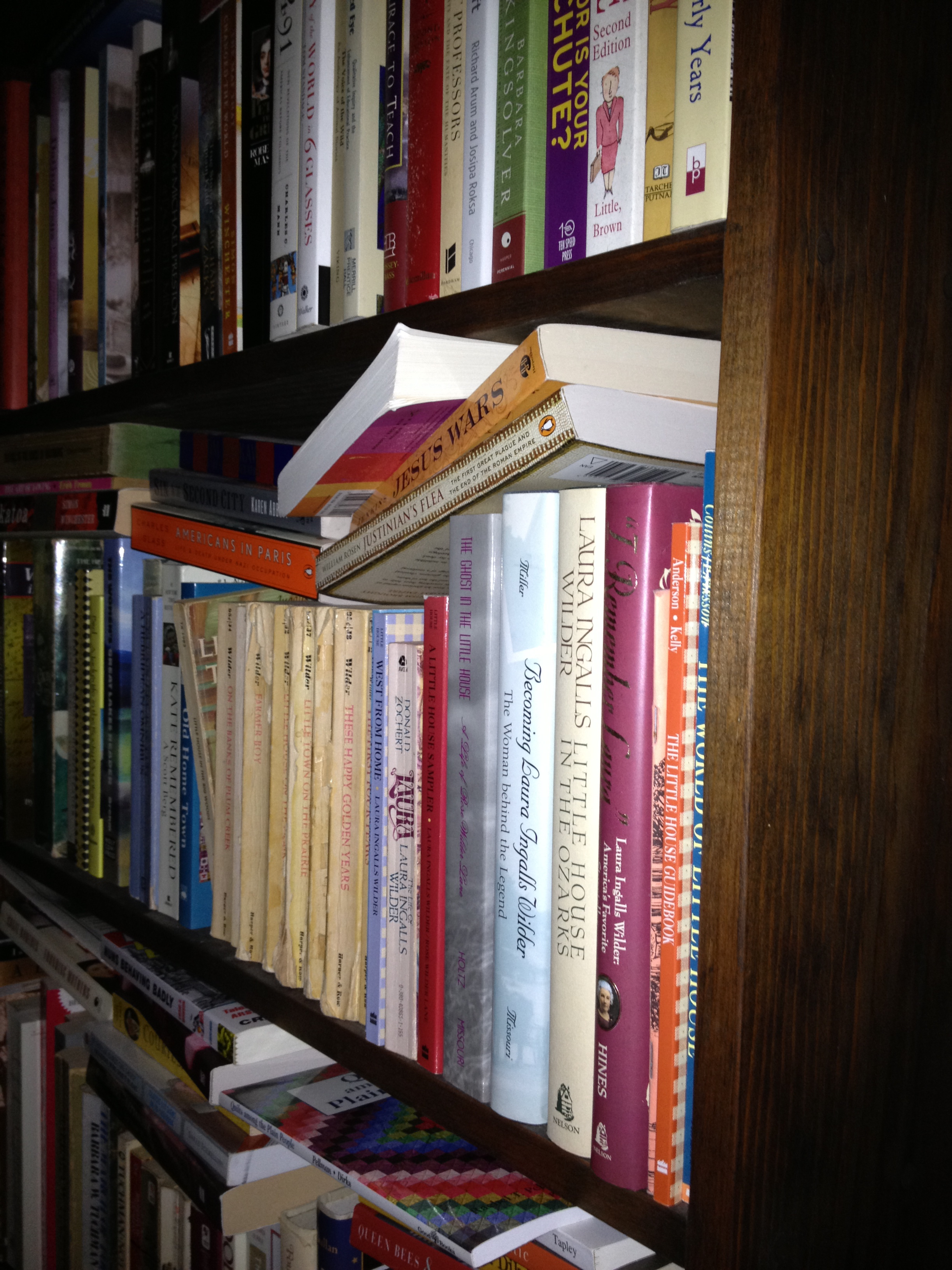
Reading takes commitment.  I try to read, on average, at least a book a week.  It requires a lot of time.  And a literary life includes giving back.  You want to share your writing with the world.  Hoping that either your fiction or nonfiction might eventually bring you some notice.  That’s the plan anyway.  The starving artist paradigm doesn’t feel so comfortable when you’ve got a mortgage.  Still, the imagination refuses to be tamed.  I’ve often said I could be content on a desert island as long as I had a huge stack of paper and never-ending supply of pens.  But that’s not the reality I inhabit.  That mortgage pays for a roof over my books and writing computer, always complaining it’s full.  It may not be glamorous.  In fact, it’s about the exact opposite of that.  But it is, after all, a literary life.


Time To Think

Although I’m not Roman Catholic, I often thought about joining a monastery as a teen and twenty-something.  The idea of spending all my time devoted to contemplating the ultimate reality still has a strong appeal.  I know quite a few rationalists who have no time for spirituality, but it seems to me that we all need it for facing death.  Most people, I know, avoid the topic if at all possible.  Contemplatives, on the other hand, spend quite a bit of time preparing for it.  Since it’s inevitable that makes sense.  I often wonder why people consider the most common thing in human experience with such trepidation.  If it’s a source of anxiety, shouldn’t it be confronted?  That’s not to say we need to look forward to it, but it does mean we shouldn’t run from it either.

Carlos Schwabe, Death of the Undertaker; Wikimedia Commons

The combination of Christianity and rationalism, it seems to me, lead to this terror.  Christianity because it views death as an enemy, and rationalism because it has no comfort to offer.  I’ve been reading about how pre-Christian cultures thought of death.  They didn’t display the fear that Paul seems to have introduced into the equation.  Since American culture is so heavily influenced by the Bible (as was European culture before it), we have adopted the scriptural view that death is a problem.  The Hebrew Bible, in which there was no real afterlife, was less concerned with making sure you avoided Hell—they had no Hell to avoid.  The anxiety seems to have been introduced by, ironically, the concept of resurrection.

I’ve noted on pieces I’ve written for other websites that resurrection is among the favorite themes for horror films.  One of the reasons is precisely this discomfort in taking death at face value.  Our religions keep us aware of the spiritual side of our nature.  They have developed around the world in different forms and all of them address death in some way.  Most without a profound sense of anxiety.  There is some irony in cultures that adopt resurrection as a theological tenet are among those that try to avoid death most assiduously.  It plays into those cultures’ views on abortion and capital punishment.  As well as their performance of social justice.  While Paul asked death where its sting was, and seems legitimately not to have feared it, in the centuries following his position seems to have eroded.  There seems to be plenty to contemplate here, if only secular society had monasteries.


You Are Data

The dark web.  The very idea conjures up images of extremely seedy technophiles with ambitions that run from illegal to just plain inhumane.  It’s a place I never want to go.  Still, it was brought to mind by a recent article in Threat Post.  (If you ever want an excuse to unplug and curl up with your head under the blanket, Threat Post might be a good place to start.)  The particular story was about the theft of millions of users’ data from LinkedIn.  This followed shortly after major data theft from Facebook.  In the world of the web-addicted the hacker is king.  Data are used for who knows what nefarious purposes, but primarily, I suspect, to try to sell you stuff.  Anyone who’s produced something (such as, say, a book) knows how difficult it is to get that product noticed.  Forcing it into someone’s inbox is one potential way.

What bothered me the most about this story was a line from an official in cyber-protection research (not a choice of major when I was in college).  It was noted there that although the data contained no financial information, it does contain information of value, “which is why it’s not published it for free.”  Those last two words: “for free.”  Data are, apparently, available for sale.  The computer people I know (all of whom are younger than me) tell me data mining is common on everything from social media to web browsers.  When you choose to go online you’re offering information about yourself to others.  Some of them dwell in the dark web.

Personally, I don’t know what they’d want from me beyond the scary thought of getting ahold of the digits that define me.  I’m not a fan of shopping and tend to buy only what I need.  (Yes, books are a necessity.)  I have probably succumbed to purchasing something seen in an online ad once or twice, but it is generally only if a holiday’s approaching or if it’s something I’d already thought I needed.  The fact is we can get along with a lot less.  If only we knew how to grow our own food.  Which is something, I suspect, that we could look up online.  But beware, your agricultural interest will be noted, and likely sold.  There’s money to be made on the web.  And before long you’ll end up with John Deere ads tailor made to suit your interests, and liquid assets.


Lessons from Mars

It’s a parable.  This week, on a planet weeks away, earthlings achieved heavier than air flight.  Considering that we flew for the first time on our own planet only 118 years ago (within feasible limits of a very successful human lifetime), the achievement is remarkable.  What I found most fascinating about the live stream provided by NASA, however, was the human element in the control room.  Not only did all the engineers look young enough to have been my children, I was cheered almost to tears to see several women among them.  We’ve come a long way.  And I don’t mean just to get to Mars.  There’s a lot of work yet to be done on the planet on which we evolved, but it does me good to see scientists recognizing the contributions women make to progress.

While many cultures worldwide still consider women the property of men, that scene showed that with women in leadership roles we can achieve remarkable things.  Only with the priorities of diversifying the workplace could we realize a dream that began long before Kitty Hawk.  People of all genders and all ethnicities have much to offer our growing sense of accomplishment.  Mars is millions of miles away.  Perseverance and Ingenuity are being controlled across this godlike distance by a group of humans that consists not just of angry white men who want to rule this world.  Although the palpable  excitement in the room was for what was happening far away, my spirits were buoyed by what was happening here.

Our biology defines us, but it becomes a sin when it confines us.  We are capable of more.  We’ve flown on another planet, and yet we still need to learn that on this planet all people deserve fair and equitable treatment.  It boggles my mind that on that reddish speck I can see on a clear night, a speck so small that my pinkie held at arm’s length can obliterate it, we have landed a car-sized rover and a helicopter.  The math involved staggers this old mind, but the imagination inspires it.  We come to moments like these when women and men of various backgrounds come together and dream.  Double-masked and socially distant, young people have shown us a world far beyond what angry white men could even imagine.  Watching the video of a helicopter taking off, hovering, and landing on another planet, looking at the people in the room, I realize there is a parable here.


Creepy Houses

Definitions, I’m learning, are often a matter of one’s experience and taste.  I’ve read a lot of gothic novels and have tried to pinpoint what it is that creates a gothic feel for me.  I say “for me” because other people sometimes suggest works that I would put into a different category.  In any case, it’s clear that The Little Stranger, by Sarah Waters, is a gothic novel by any measure.  A large, isolated house.  A tainted family slowly fading away.  A remorseless, 400-page winter.  Inevitable decay.  The story is ambiguous and moody as Dr. Faraday, the narrator, falls in love with Caroline Ayres, the only daughter of an aristocratic family in decline.  The house may be haunted.  Or the family may be breaking down mentally.  Like The Turn of the Screw, it’s up to the reader to decide.

My preferred gothic has elements of the supernatural in it.  Melancholy without existential threat isn’t really enough to tip the scale for me.  The Little Stranger has enough of both to keep the reader guessing right up to the end.  Reader-response theory—the underlying basis for what’s being called “reception history”—posits that the reader assigns meaning.  The author has her idea of what happened in mind, but the reader contributes their own understanding.  This idea has influenced my own writing.  Once a piece is published the readers will make of it what they will.  In this way I can read Little Stranger as a haunted house story.  Although it was made into a movie I have to confess that I only heard of the novel recently while searching for gothic novels I might’ve missed.

The ambiguity fits the ambiguity of life.  The same circumstances can be interpreted by one person as entirely natural while another will add a super prefix.  No one person has all the answers and reality can be a matter of interpretation.  In that way Sarah Waters’ art follows life.  Interestingly, religion plays very little role in the story.  Church, when it appears, is perfunctory.  The source of tension here is on a rational, medical interpretation of events versus the gloomy lived experience of the Ayres family.  They believe themselves haunted and the scientific answers have difficulty convincing readers that there’s nothing more going on.  This is a gothic novel with a capital G.  Nevertheless, the debased cleric would have been welcome, but you can’t have everything.


Well Grounded

Earth Day feels like it’s actually Earth Day for the first time in four years.  Many of those with more common sense than gullibility know that we have only one planet.  Even as we have achieved flight on Mars, any hope of going elsewhere (and some of us would rather not) is many years away.  Earth is our home and we can live on our planet without destroying it.  Other animals also change the environment, of course.  The problem arises when one species becomes unchecked and begins changing things for their benefit only.  Or what they perceive as their benefit only.  Life evolved on this planet deeply integrated.  The more we study nature the more we see how interconnected it is.  Thinking ourselves special, we’ve placed a wall between humankind and everything else.  It’s an artificial wall.

If you read about nature you’ll be amazed.  Trees, perhaps the true heroes of this planet, make our life possible.  They couldn’t exist without the fungi that partner with their roots in a symbiotic relationship.  If there had been no trees our ancestors would’ve been easy prey to larger predators and would likely not have survived.  Large industrial corporations destroy trees as if they’re a nuisance.  They are our life.  Even as governments with “strong men” leaders destroy the forests in “their” countries, we are losing the very biodiversity that makes life possible on this planet.  There’s room for humans to get along here without destroying the environment that supports our very life.

One of the hidden motives in this scenario is a strange development within Christianity.  A literalism that would’ve shocked even old Augustine developed around the turn of the last century.  That literalism was used by corporations that saw the earth as a resource to be exploited and claimed that we, unlike animals, owned the planet.  If you own a home would you destroy it just because you could?  What good would it do?  No, this Earth Day let’s take the time to consider our religion and its implications sensibly.  The Bible does not advocate destroying what God created.  It may have been written too early to comprehend evolution, but that was never a problem for early theologians.  When fused with capitalism, however, this religion provided everything greedy businesses needed to exploit the planet for its own purposes—the god Mammon.  Just this week we flew our first flight on an inhospitable planet far away.  Today let’s think of how we might protect the only home we have under our feet. 


He’s Dead, Jim

So there’s this thing called Spotify.  Like most modern contraptions, I approach it warily.  I’m not sure how it works.  Do the artists get paid?  What’s the catch?  Is it only having to listen to a commercial for Amazon every three or four songs, like the radio?  I don’t have a lot of time to listen to music, but when I do have time I like to discover something new.  Then there’s the oldies.  And I can’t help but feel a deep sense of loss at the death of Jim Steinman.  I discovered Steinman earlier than I realized it when “Total Eclipse of the Heart” came out the year my first romantic relationship ended.  That song can still reduce me to a quivering lump of emotion.  All I knew at the time was that it was a Bonnie Tyler song.

Growing up fundamentalist, even album titles like Bat out of Hell, Meatloaf’s Steinman breakthrough, were enough to scare said toponym right out of me.  I never knowingly listened to any of the songs on that album until after earning my doctorate.  When I did I was hooked.  My research skills had grown by that time to include finding out who the writer of a song was.  I discovered that “Wagnerian rock” really spoke to me.  And the only guy who seemed to know how to write it was Jim Steinman.  Most kids, I suppose, settle into their music tastes much younger, but in my thirties and forties I found Steinman a most compelling artist.  I listened to his older stuff, and his newer stuff.  I found out some surprising things, such as that even Air Supply’s “Making Love out of Nothing at All” was a Steinman song.

I seem to be hopeless at playing musical instruments.  I’ve studied piano and taken guitar lessons, leaving bewildered teachers in my wake.  My wife tried to teach me the recorder.  Despite my failure as a player, music means a lot to me.  I don’t listen to it unless I can pay attention to it.  For me it’s not background noise.  When I learned to identify operatic rock, I soon came to realize that it was the work of a singular genius who was covered by a wide variety of artists.  No one else, it seems, could capture the feeling of being young like Steinman could.  Now he’s gone.  In my noodling around with this thing called Spotify, I wonder if I can discover any more of his songs.  Meanwhile, I’m thankful that I found him when I did.


Leap Night

I was quite young when I saw Night of the Lepus for the first time.  Well, I had to have been at least ten, but when I recently sat down to watch it only one or two scenes looked familiar.  Like most poorly done horror films, Night of the Lepus has gained a cult following.  The story is loosely based on Russell Braddon’s comedic novel Year of the Angry Rabbit.  Without the comedy.  Or at least without intentionally being funny.  In an effort to control rabbit overpopulation in Arizona, a new virus is released into the population.  Instead of killing off the bunnies, it makes them grow as large as wolves and become carnivorous.  They go around attacking people with big, nasty, pointy teeth (to be fair, Monty Python and the Holy Grail wouldn’t be out for three more years).

Night of the Lepus was criticized for not being scary at all—a cardinal sin for a horror film.  I was kind of embarrassed when my wife walked in and found me watching it.  Nostalgia can do funny things to a person.  It is almost painful to watch the public officials make such obvious missteps each time they start to get an idea of what’s happening.  They’re almost as imbecilic as the Trump administration was.  Meanwhile rabbits are hard to make scary.  Perhaps William Claxton should’ve read Watership Down.  Ah, but Richard Adams’ classic was only published in 1972, the year the movie was released.  What was it about the mid-seventies and rabbits?  

Part of the problem is that Night of the Lepus takes itself seriously without the gravitas required to do so.  Who can believe actual rabbits are vicious when, to make them monstrous, the movie simply shows rabbits against miniature scenery?  Their human handlers occasionally smear their mouths with red, but a rabbit doesn’t appear cunning and vicious.  And to get them to attack people they had to use human actors in rabbit suits.  I’m a fan of nature going rampant as a vehicle for horror.  Hitchcock’s The Birds did it effectively.  So, I’m told, did Willard (which is remarkably difficult to access with HBO never having released it onto DVD).  The seventies were when ecology began to be recognized as perhaps the most important of global issues.  Half a century later we’re still struggling to reconcile ourselves with it.  Meanwhile the rabbits have begun to appear in our back yard.  They may nibble our perennials, but I’m not afraid.  At least as long as they don’t watch Night of the Lepus and start to get some ideas.


Scary Thoughts

The kinds of places I hang out, online, dictate my reading.  It’s not that I like to be scared, it’s just that I’m honest.  Besides, even when hanging out in person was possible I didn’t do much of it.  So I became aware of Peter Counter’s Be Scared of Everything: Horror Essays.  Like me, Counter’s a blogger (among other things), but unlike me his blog is themed horror.  (This blog has an element of horror but is very roughly themed religion.)  Counter’s book is a fascinating collection of thoughts.  Some of the essays are funny, some are sad, and a few are downright profound.  It’s clear that what gave Counter his crisis was watching his father get shot.  Even those of us who grew up not knowing our dads can see how that experience would traumatize a life.  My own traumas were less focused than this, but we learned the same lesson—it pays to be afraid.

When I was young I never met a phobia I didn’t like.  As I grew older and left home, I came to bring them under control.  You can only get so far in life hiding under your blanket, secretly afraid you might suffocate.  I learned that if I wanted to be a minister—something that never happened—I had to overcome my fears.  Being a parent did it even more.  In order to try to teach your child not to be afraid, you find yourself doing things like scooping up bugs in your bare hands to show that they won’t hurt you.  Like putting a brave face on a truly scary situation.  Like carrying on when everything you’ve built crumbles around you.  Counter’s essays don’t shy away from the difficult things in life.  He’s right: there are many.

I was a monster boomer, but I only really came back to horror after losing my long-term teaching post and longed for career.  Horror helps you cope with trauma.  It gets a bad rap, but mostly from people who don’t understand its therapeutic value.  I don’t like being scared.  Horror, however, reminds me of that cozy childhood feeling of watching monster movies and knowing when it was over the threat would be gone.  Only it never was.  Not really.  Sleepless nights and their febrile dreams may’ve been triggered by the movies, but the realities happening behind the scenes were their real source.  I couldn’t know that at the time, and most of the time I’m not conscious of it now.  Still, I read books like Be Scared of Everything and I think maybe I’m on the right track.


Herd Not Heard

When mass shootings become commonplace, you might think bipartisan efforts would be made to stem the violence.  If so, you misunderstand how little the pro-life party actually values life.  By pumping its adherents full of fear, they use the hand not waving a gun to pocket donations from the NRA.  Human life is only valuable to get yourself elected.  It’s difficult to remember days when I didn’t awake to hear of someone with more guns than restraint opening fire in a public place.  Mental illness, it seems to me, is fairly widespread.  It’s no deterrent, however, to purchasing military-grade weapons and using them when the stress levels get too high.  Meanwhile lives of those—whether fellow gun owners or not—are lost.  And Republicans argue that nothing should change.  You’d think the insurrection might’ve changed their view.

How does one go to bed secure knowing the next day they may be reading about another mass shooting?  Sure, the perpetrator will be caught, if not already dead, and families will be bereaved but we know our rights!  Funny how even the Bill of Rights can be prooftexted by those who do the same with the Good Book.  What is so hard to understand about “Thou shalt not kill”?  Coveting, however, and adultery, seem alive and negotiable, to gather by their support of 45.  Such selective reading generally turns deadly and constituencies become mere statistics.  What seems to be missing is a basic sense of social justice.  A social justice that applies to all.

The idea of wanting a country only for white men and their subservient wives is a relic that simply refuses to acknowledge that societies change.  We’ll never reach perfection, but that’s no excuse to stop trying.  Firearm regulation might be a rational place to start.  While party politics will get in the way of this the pools of blood will grow only deeper.  What seems to be missing is the acknowledgement that these are people we are losing to assuage one party’s ambitions.  Wouldn’t prioritizing education and providing mental health services be better?  Ah, but it might stop some of the wealthy from pocketing yet more money from those who are lined up against the wall.  Of course, you can be in the majority and still be gerrymandered into silence.  When the Gun Ownership Party begins saying aloud that it can’t win elections fairly, and makes noises about beginning to cull the herd, we should all be getting a little nervous.


Learned Ghosts

For one memorable year of what I call a career, I taught at the University of Wisconsin Oshkosh.  One in a series of near misses, this came close to becoming a full-time job.  Apart from a couple of rather humorless colleagues, the department was welcoming and an enjoyable place to be.  I even got to know the dean, now elsewhere, and planned on working on a project with him.  It was a memorable year in many respects.  One was its inherent strangeness.  I was living away from home while teaching there, and saw some odd things on my drives through the Wisconsin countryside.  It also happened to be at Oshkosh that I first discovered H. P. Lovecraft, so the weirdness was, in a word, enhanced.

Students like to tell ghost stories.  A recent article by Jocelyne LeBlanc on Mysterious Universe caught my eye because it tells of students in Oshkosh that live in a haunted dorm.  These kinds of stories are ubiquitous and Oshkosh is in no way singular here.  Students, whose brains haven’t yet ossified, are often open to new experiences.  Most of them, however, don’t possess the research skills to get behind the origins of some such tales.  Sometimes there’s an explanation.  Other times there’s not.  At Grove City College, when I was there, students told of a haunted playing field.  It was the site, it was said, of a former gymnasium.  What made it haunted was the death of a basketball player who’d smashed through a glass gymnasium door during a game and bled out before help could arrive.  It sounds improbable and I never had time to research it.

We all, I suspect, have a longing for the supernatural.  We want to believe that there’s more to this world than physics and earning money.  And strange things do happen.  I never saw any ghosts in Oshkosh, but the things I did see helped to make up for that particular lack.  Edinburgh, where I studied for my doctorate, is widely rumored to be among the most haunted cities in the world.  Although I saw no ghosts there, people flock to the ghost tours.  In fact, one stopped right below our first apartment’s window every night during the tourist season.  By the time we moved out we had every word memorized.  The haunted dorm story is a revered tradition.  Thinking about it makes me wish I could afford to be a student again.


One, two, three

The danger of statistics is that they turn an individual into a number.  A few days ago an article in the New York Times addressed the rare blood clots that some women develop after receiving the Johnson and Johnson covid vaccine.  The response of the cited physicians was telling.  Many praised the decision to halt use of the J&J vaccine immediately.  Others, however, point to the numbers.  If a vaccine is halted many more could be exposed to and contract Covid-19.  It is better, they aver, to take the statically smaller risk and use the vaccine.  While I understand the logic here, I do wonder if the side effects occurring primarily in women has anything to do with the reasoning.  Why not save this vaccine for the men instead?

This raises once again the specter of consciousness.  Statistically the odds are small that a woman will develop a clot.  What if you are the woman who does?  This dilemma always bothered me while camping in the woods.  Statistically black bear attacks are rare.  How does that help you if your tent is one that looks like a candy wrapper to a bear of little brain?  You become a statistic instead of a living, breathing, feeling, blogging person.  Statistics.  There’s a reason some of us identify with the humanities, I guess.  I can imagine what it would be like to have your doctor say to you, “Sorry, this is rare, but look at the bright side—you now become a statistic!”

Photo credit: HB, via Wikimedia commons

The fact is we’re all statistics to strangers anyway, the government above all.  We are vote-bearing numbers to be gerrymandered and prevented from voting.  Beyond that we’re merely annoying.  This pandemic has introduced Stalin’s accounting with a vengeance.  542,000 is a big number.  Unless you know one or more of them personally.  Then the statistics seem to melt.  Life is full of risk, of course.  We’ve barricaded ourselves in our homes for over a year now, eating things that are likely more dangerous for us than a rare complication.  The virus, and perhaps some vaccines, are among various killers on the loose.  Nobody can declare with any certainty the correct course of action.  Actually doing something about the virus when it was first a known threat would’ve helped, of course.  We find ourselves on the brink, it seems, of getting Trump’s disease under control.  Would that we all could do so, without having to worry about lying down to be counted.


Who’s Upstairs?

The other day the New York Times ran yet another article on UFOs.  This topic, which has been maligned since the 1940s, is now being discussed without mockery in the mainstream media.  Perhaps following the Trump presidency nothing’s impossible to believe.  There are, interestingly enough, many writers who connect UFOs with religion.  And these aren’t all writing about UFO religions, of which there are many.  Exploring the Outer Edges of Society and Mind ran a piece on biblical UFOs earlier this month.  The topic was taboo, of course, when I was teaching (I remember a colleague laughing when I told him I covered it in a course called Myth and Mystery) but it too is now becoming mainstream.  I don’t need to summarize the Outer Edges piece here since it’s easy enough to follow the link and read, but I would point out that a longstanding connection exists between UFOs and religion.

A spate of books on UFOs came out in the seventies and eighties.  Some of those more or less overlooked by the media focused on religion—often the Bible—and how UFOs play into it.  Quite often the biblicist writers identified these unknown objects in the skies as either angels or demons.  This continues to this day with some congressional leaders (many of whom are too religious for the good of the nation) averring that UFOs are “demonic.”  Frankly, if demons are incorporeal, I wonder why they need to fly around in saucers.  Perhaps they too grew up eating too much Quisp for breakfast.  In any case, the connection was made early and it remains.  When we see something in the sky we used to give it a religious explanation.  Now we chant “drones.”

In his article David Metcalfe begins by noting the forthcoming publication of Alan Steinfeld’s Making Contact: Preparing for the New Realities of Extraterrestrial Contact with the mainstream publisher St. Martin’s Press.  The difference between yesteryear with its Quisp and its flying saucer houses, and today is that people are starting to be serious about the topic.  This, I expect, is one of the benefits of increasing technology.  People are seldom without a camera in their pocket these days and although there are plenty of drones and other strange things flying around, the classic UFO hasn’t gone away.  A generation of people endured ridicule and scorn for being gullible.  Now the gray lady herself is asking questions with nary a smile.  Perhaps we’re becoming more tolerant and perhaps we’re more willing to believe we’re not alone in the universe.  Some would claim that even the Bible got in on the act millennia ago.

Image credit: George Stock, via Wikimedia Commons

Clippings

Weren’t newspaper clippings more fun than bookmarks?  For one thing, bookmarks are hidden away in your browser where they proliferate like bunnies in April.  Clippings were always limited in number, to the level of your interest.  Or physical storage capacity.  I once decided to organize all my bookmarks into “folders.”  I’m still not finished and some websites don’t seem to fit any category.  Still, the exercise is an eye-opening one.  I’ve been on thousands of webpages, hundreds of which I want to remember.  With newspaper clippings, there were a limited supply and they felt—let’s face it—real.  These words and images were printed on tangible paper.  Kept in a file (or in old movies, tacked to a bulletin board that inevitably contained clues), they were visible reminders of something that caught your attention.

I’ve seen movies made where research is being done on the internet.  They involve people who know they have to go beyond the top page of a Google search.  They may even go to the third page or further!  Such thrills.  Compare that to a scene where someone pulls open a desk drawer and finds a clipping.  Isn’t there real drama there?  No doubt the internet has made finding information easier.  It has also proliferated it so that we no longer have time to read it all.  I recall reading how Isaac Asimov read the entire encyclopedia when he grew up.  Who could read all of Wikipedia?  It changes every single day.  The clipping file, depending on the papers and magazines to which you had access, might be pretty slim but it helped to inform opinions and outlooks.  There were occasional hoaxes but nobody worried about fake news back then.  After all, reputations still meant something in those days.

There was a real thrill, growing up in a small town, to being mentioned in the newspaper.  In my case it was generally about being in the Cub Scouts, or, interestingly, being baptized in a river.  (This was a small town.)  Ironically I didn’t have a clipping of the baptism story; I found it online.  The Franklin News-Herald wasn’t a large circulation broadsheet, but it was paper closest to where the incident took place.  Perhaps it struck a locals as odd seeing a bunch of people wading into the river fully clothed, even though it was 1970.  It’s an event I remember well.  But most of my clippings have flowed away over time, like those sins that were washed downstream that day.  I must remember to bookmark that site.


Street Teaching

When I’m out on the street—not so often these days—I’m sometimes accosted with strange questions.  This has happened to me quite a few times over the years.  Recently, when I was taking the recycling out for my daughter on a weekend visit, I saw a couple guys in a car right by the receptacle.  I was wearing a mask, due to, you know,  Covid, so I wanted to keep social distance.  The one in the driver’s seat asked if I was going to dump the recycling and when I said I was his partner said “I’ll take care of that for you.”  They had a plastic bag full of cans and were loading glass bottles in their trunk.  I thanked them for their help and turned to go.  As I was walking away one of them called out.

“Hey!  Are you a teacher?”  I get asked that a lot.  Only the academy refuses to recognize it.  I acknowledged that I used to be.  “What level?” they asked.  I allowed as I used to be a college professor.  “Where?” I told them most recently at Rutgers.  “What’d you teach?”  This is where it always gets interesting and I start to sweat a little.  I told them religious studies.  I also said that’s why I couldn’t find a teaching job.  “The best information we ever had on religion came from a six-year old.  You know what the F in faith stands for?”  I shook my head.  “Forgiveness.  Without that the rest of religion means nothing.”  I told them I could accept that.

Then as I was turning to go they called out, “You know the acronym for Love?  Living our values every day.”  I told them they were now the teachers and I was the student.  They responded by telling me that they’d just sold a song they co-wrote for a million and a half dollars.  I expressed surprise at that.  They told me the title and said it was recording in Nashville this week.  I congratulated them and finally was able to be on my way.  This made me reflect on the several such strange conversations I’ve had on the street.  They often begin with “Are you” and not infrequently end with “a professor.”  This is usually followed up with some kind of intelligent question.  People, it seems to me, are eager to learn.  Maybe not in the classroom, but in what is referred to as the “university of life.”  Perhaps that’s all the schooling we ever really need.