J L Seagull

Perhaps it has happened to you as well.  At some undisclosed period life became so busy that you felt as if—in a good southern California metaphor—you were riding on a huge wave and you couldn’t get off.  Back in my teaching days I had time to plan my trips to AAR/SBL and fit in some human activities as well as maybe even getting around to see the outside once in a while.  It’s great to run into so many people from every stage of my academic life—toddlerhood at Grove City College through my current doddering editorship—but I can’t help having the feeling that I’m popular now because I’m thought to have something others want.  The keys to the kingdom.  A possibility of getting published.

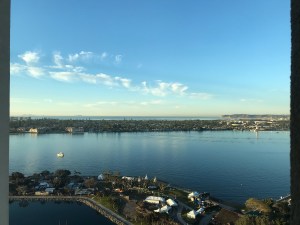
Those of you who read my daily reflections know that I’m glad to share publishing knowledge.  I encourage academic authors to learn a bit about the publishing industry.  It’s rapidly changing and when you have an inside track (here is the real added value) you need to look beyond your current book project to see what goes on behind the veil.  Widen the focus.  There’s a whole world out there!  My glimpses out the hotel window inform me that there’s an entire bay to be explored.  I watched seals or sea lions (it’s hard to tell from this distance) playing in the water as the sun rose.  Then a seagull flew up and landed inches from my face on the windowsill of my room.  It stayed for nearly a minute, looking me over as I looked it over.  Noticing the tiny white feathers that formed a W on the edges of its beak.  Its Silly Putty pink feet with small black nails.  The emerging red patch on the underside of its bill.  It took a step off the ledge, spread its wings and looked elsewhere for a snack.  I soon learned why.  A second later a larger gull landed in its place.  We too regarded one another curiously.  Had the glass not been there, we could’ve easily touched.  It also lept off to be replaced by an even larger, more mature gull.  None of the three were in any hurry to get away, but when they realized I couldn’t give them what they wanted, they left.
I’m a great fan of metaphor.  Academic writing, unfortunately, doesn’t encourage the craft of utilizing it (neither does it often encourage being coherent).  Later this morning—it will be early afternoon back home—I have to rush to the airport to catch a hopeful tailwind back east.  Someone else will check into my room.  If, perchance they sit by the window with the curtain drawn before dawn, the gulls will visit.  And maybe a lesson will be taken away.


Armed Forces

You ought to feel safe with the U.S. Navy so close by.  The naval base at San Diego is the second largest surface base in this particular branch of our sprawling military system.  From my hotel room I can watch the ships chugging through the harbor and from the Convention Center you can see quite a spread of naval real estate.  Still, all this hardware doesn’t make me feel safe.  Perhaps because I’m a child of the sixties, I can imagine a world at peace where military budgets don’t literally take food from the mouths of hungry citizens.  The last time I was in San Diego for AAR/SBL I toured the USS Midway aircraft carrier.  It’s clearly visible from my room.  I was amazed at both the technology and the obvious expenditure for such a craft.  It can’t be easy to set a city afloat.

Whenever I experience things like this I can’t help but wonder what we might accomplish if we loved each other as a species and put our heads together to try to solve our problems.  Lack of water—perhaps ironically in this naval city—is a serious global issue.  Poverty is the ghost of civilization.  The grasping of power by the driven but inept is clear worldwide.  We build great, complicated war machines.  The noise generated by the helicopters charging overhead bespeaks their weight and weaponry.  Down here in the southwest there are places civilians just can’t go because our military is busy keeping us too safe to allow us to wonder what they’re up to.  Black budgets must be nice.  I stand here among religion scholars and dream.

Ironically religion often leads to the fear that leads, in turn, to militarization.  We want to protect our “way of life.”  We’ll follow the prince of peace into war any day.  Just give the signal and release the missiles.  It doesn’t make me feel safe at all.  One time on a family visit, we drove through Norfolk, Virginia.  We stayed at a cheap hotel, because, well, we’re cheap.  The metal door was heavily reinforced with a stolid steel lock.  Navy men, we were informed, didn’t always behave well while ashore.  The locks were to keep us safe from those protecting us.  We stayed only one night and left early the next morning.  So I while the annual meeting away under the watchful eye of our largest line item on the budget.  They’re keeping our bodies safe, but who’s keeping track of our souls?


Focus on Religion

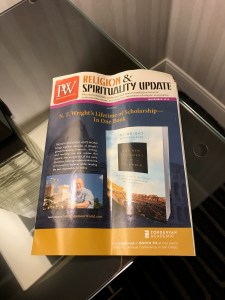
Publishers Weekly, or PW to those in the biz, is a great place to get information about, well, publishing.  I often spend AAR/SBL telling authors and prospective authors something that I wish I’d been told when teaching: time spent learning about publishing is never wasted.  PW every year has a “Religion and Spirituality Update” released in time for this meeting.  Despite the relatively small number of sales, religion is a discipline that loves its books.  I’ve only been quoted in PW’s special edition once, and it’s not been for a few years, nevertheless I always learn a thing or two from this free—yes, if you’re here in San Diego it’s free!—update.  It may seem odd to suggest that religion titles can be hot, but it is indeed possible.  Sexuality is hot.  I suppose that goes without saying.

A number of titles dealing with religion and sexuality appear every year.  What caught my attention, however was an observation from Jennifer Banks, from Yale University Press.  Noting the rancor that sexuality often introduces to discussions of religion, she observes that (and this is a quote from PW, not directly from Banks) “some Christians apparently need others to go to hell.”  (I can send the full citation, if you want to know.)  In an era when academics have been stressing inclusion, the retrenched religious world has been spinning in the opposite direction.  Instead of inviting everyone to Heaven, as might, say a Universalist, many conservative Christians consign fellow believes to Hell, and gleefully so.  It’s almost as if Christianity and capitalism have merged into a zero-sum game.  If some win, all the others have to lose.  They haven’t however, studied the history of Hell very well.

It’s kind of an insidious idea.  Given that we all want to justify ourselves, some go to the extremes of demonizing those who see things differently.  This form of religious thinking was original neither with Christianity nor the Judaism from which it grew.  There was no Hell in the Hebrew Bible.  The idea, when it did develop, wasn’t a place to torture your enemies, but rather a place demanded by justice.  Those who were utterly and unrepentantly wicked couldn’t hobnob in God’s country club with those who tried to be righteous.  In the modern evangelical narrative those who make certain medical decisions for basic human situations are among the utterly wicked.  Not surprisingly their sins are usually sexual.  If you want to see this in a wider context, pick up a PW when you pass by the stand.  “Anything free,” to quote another sage, “is worth saving up for.”  And who knows, it might keep you from Hell?


Wisdom of Trees

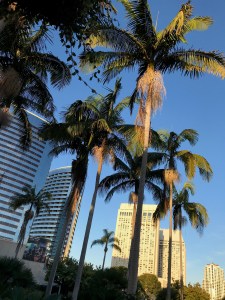
Stepping out of the airport the first thing I noticed was the palm trees.  I’ve traveled to this area enough times that I shouldn’t be surprised, but I always am.  And since we are creatures of the culture in which we’re raised, palm trees inevitably make me think of Gilligan’s Island.  We grasp for culture to help us make sense of this odd world of negotiating other people and, like many children born in the sixties, I was raised on television.  Gilligan’s Island (somehow appropriate training ground for attending AAR/SBL—it actually featured a professor) was as close to seeing a palm tree as I ever got, being raised in a very humble household.  To me, palm trees were as much creatures of fantasy as the monsters that populated the movies I watched on Saturday afternoon.

My first experience of a real palm tree was in Israel, 1987.  I’d signed on as a volunteer at Tel Dor, an archaeological dig near Haifa.  Then, as yesterday, I encountered palm trees—so alien and yet so natural—at the airport.  Welcome to Tel Aviv!  And so we think of palm trees as being part of paradise, a place where it’s always pleasantly warm and although well-watered it doesn’t rain too much.  Trees symbolize our culture.  Although back home in the northeast most of the leaves are down from the hardwoods, the region is also defined by its large plants.  Trees do that for us.  Spreading high over our heads, with dense cellular structure that makes them heavy, trees have always been attractive to our species.  And they can help us define, at a glance, where we are.  “Paradise” derives from a Persian word for “garden.”  Even in arid zones they value their trees.

Looking out my hotel window I see the bay.  In the bay stands a marina.  Back home most boats are shrink-wrapped by now and I’ve already seen smaller bodies of water start to freeze over.  Paradise has no ice.  For the castaways, being on the island was always a challenge, but never a terribly serious one.  Thurston Howell III used his money (useless where there’s nothing to buy) to try to assert his influence.  Everyone treated him with respect, always calling him “Mr. Howell.”  In that paradise, however, one of the two characters (who had names) referred to always by title, the professor—the skipper, of course, was the other one—was the person looked to for guidance.  If anyone would figure out a way to be rescued, it would be the academic.  I’ll be spending the next few days on an island with mostly professors.  And when it gets too intense I’ll look at the palm trees and remind myself that this is paradise.


Speedy Delivery (SD)

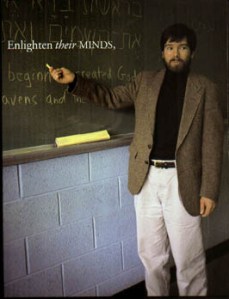
Ritual, no matter what scientists say, is deeply woven into the fabric of human psyches.  It may be either the warp or the weft, but it’s downright basic.  I was reminded of this on my hurried and slow trip to San Diego yesterday.  I always wear the same shirt when I fly to this conference.  This isn’t superstition, but rather it’s a case of sticking with something that works.  I don’t often wear turtlenecks, and one reason is that they seldom fit well.  More years ago than I care to admit (I’m wearing the shirt in the photo below, which was taken at Nashotah House nearly two decades in the past) I found a navy blue turtleneck from Land’s End (this is not a sponsored post, although it probably should be) that works perfectly.  Even today it fits snugly around the neck after hours of wear.  Maybe ten years back I bought a black turtleneck from the same company and after pulling it over my head, it gaps something awful.  I tend only to wear it around the house.  The original still does the job.

I was ready to drive myself to the airport yesterday and I grabbed a quick lunch at home.  Part of said lunch involved opening a ketchup bottle probably nearly as old as the shirt I was wearing.  (I’m sure you can see where this is going.)  I ended up looking like a murderer, which is not something you want to try to explain to a TSA agent.  I quick threw said ritual shirt into the washer and the drier buzzed at the same time as my phone did for when I had to leave for my two-hour-ahead check-in.  This remarkable shirt was dry and ready to serve.  Maybe you can see now why I’m so ritualistic about clothes.  I also opt-out of those Star Trek scanners at the airport.  This means I get lots of governmental pat-downs.  It feels more authentic when you have actual hands running down your body—at least it’s honest.

The TSA agent commented that you don’t see many turtlenecks these days.  I explained that it’s good for flying because I’m always cold on planes.  As this stranger’s hands were rubbing down my chest, I was wondering how many times this shirt has been felt up by the US government.  It has no pockets to pick, and besides, at airport screenings everything is stowed in my carry-on, including wallet.  At midnight San Diego time, I checked into my hotel.  East coast time said I’d been awake 24 hours because who can really sleep on a plane?  Once my patted-down body reaches 3 a.m., Eastern Time, it wakes up.  In these circumstances it’s good to know I can rely on that shirt in my drawer.  That’s what rituals are all about.


Daylight Saving Time Zone

One or two of you out there—you know who you are—put yourselves through reading my musings on a daily basis.  I haven’t missed a post in nearly a decade, but travel always complicates things.  Yes, it’s that time of year again—I’m on my way to AAR/SBL.  The American Academy of Religion and Society of Biblical Literature Annual Meeting is the trade show of the guild.  This year we’re meeting in San Diego, California.  The hope of many of us is that it’ll be sunny and warm.  Last year, of course, I missed the conference for the first time, exchanging the Denver Hilton for a night on the floor of Newark’s Liberty Airport.  This year I’m flying out of a different venue—one where egress is possible in the case of snow.

I always like to post a reminder to the faithful few that normal service on this blog may be interrupted.  One never knows what might happen when away from the regular routine.  And three time zones will surely wreak havoc with circadian rhythms that haven’t yet caught up with the end of Daylight Saving Time.  Or is it the beginning of Daylight Saving Time?  It makes no difference, because it lead to lack of normal sleep, no matter what we call it.  In any case, San Diego may make usual posting unusual.  At the very least it’ll be a few hours off.  I’ve become a creature of habit, posting my thoughts between six and seven on weekdays.  On weekends I’m up just as early, but I give the web a chance to sleep in.

These annual meetings are exhausting when you go on behalf of a publisher.  Unlike the leisurely experience of a paying customer, you don’t get to go back to your room for a nap, or even to sleep in.  Every year colleagues ask me to receptions but I decline because every day is a school day.  And I have appointments from 8:30 until 6:30 daily.  Sometimes even later.  You, my gentle reader, have been given advance notice.  I’ll try to continue my daily chronicle of life inside this particular head as thousands of scholars of religion mill about, wondering about the answers to the big questions.  Right now the big question is whether I’ve packed everything I’ll need.  I’ll gain three hours on the way out, but I have to leave them at the desk when I get back.  Along the way I’ll scatter posts like breadcrumbs to help me find my way home.


Sister Monsters

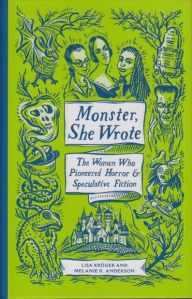
Every once in a while you read an inspirational book.  I’m hoping readers will keep in mind that inspiration comes from different locations for some of us.  Monster, She Wrote: The Women Who Pioneered Horror and Speculative Fiction, by Lisa Kröger and Melanie R. Anderson, is a source of inspiration.  With the usual Quirk Books touches, this isn’t a tome heavy on literary criticism, but it is a wonderful compendium of brief bios on women who walk(ed) on the dark side.  I find books like this encouraging in a number of respects.  First of all, these are women who did what they loved and were recognized for it.  Secondly, it gives the rest of us some hope that getting through the establishment to actual publication isn’t as impossible as presses would have us believe.  And third, it’s also a lot of fun.

It isn’t often pointed out that women played a major role in the development of the horror genre.  Some of the earliest Gothic novels were by Ann Radcliffe and Margaret Cavendish.  Probably the first fully fledged horror novel was Frankenstein, by Mary Shelley.  The real learning kicks in when the other names come out—many women found, and continue to find, the genre compelling.  Most of them, like most of us, are lost to history, but many of them have been rediscovered.  Here again is cause for hope; those of us who write, I think, have our eyes set on the far distant future.  We’re inscribing our “Kilroy was here” on paper—I still can’t think of ebooks as actually existing—in hopes that those down the road might know us a little better.  The fact that some of our sisters have been found suggests that we too may be resurrected some day.

There’s no plot here, and the point isn’t to present some great discovery.  This is a book that encourages women to be who they are through example.  The fact that it involves monsters and horror is simply a bonus.  As a non-female reading this it struck me time and again that women have long been informed of what they should or could do by men.  Men don’t like to see women knowing as much as they do about the shadow side of human existence, even as they relegated them to the shadows.  It’s my hope that this book will inspire women to be themselves.  And if they want to invite monsters along, so much the better.


What I Meant to Say

So I try to illustrate each of my posts. I do this because in the days when the internet was young I often found blogs during image searches. I’ve grown more cautious over the years, regarding copyright. I try to stick to the “fair use doctrine”—and that’s what it’s called, a doctrine—or images I “own.” In the latter case it often means searching WordPress for a picture I’ve posted before. Since nobody has time to name all their photos, I use the assigned DSCN or IMG nomenclatures. There aren’t so many that a search won’t turn up an image in my library. Thing is, WordPress likes to anticipate what I’m looking for. What’s more, it “autocorrects” after I’ve begun scrolling through everything. DSCN becomes “disc” in its addled electronic brain, and IMG becomes “OMG.” Naturally, the image you’re seeking can’t be found until you manually correct autocorrect.

OMG has become very common shorthand these days. Growing up evangelical, there was a debate whether “o my God” was swearing or not. Those who like to hedge their eternal bets argued that this was taking the Lord’s name in vain, thereby breaking one of the big ten. This was to be avoided at all costs. Those with a little less fear (or perhaps a bit more courage) argued that “God” wasn’t “the Lord’s name.” God is a generic word and can refer to any deity, except, of course, for the fact that there is only one God. This led straight back to the conundrum. Exegetes tell us that technically this commandment isn’t about saying the deity’s name, but rather it’s a prohibition against using said name when you don’t intend to do what you say you’ll do. In other words, lying.

It’s truly one of the signs that evangelicalism has evolved that the world’s best known liar is unstintingly supported by this camp. When I was a kid, saying, well, OMG, could get your mouth washed out with soap. Lying could lead to other forms of corporal punishment, such as being, in the biblical parlance, smitten. Now it gets you elected to the highest office in the land and supported by all those very people who won’t spell out OMG, even when they’re busy cutting you off in traffic with their Jesus fishes flashing in the sun. When I was a kid presidents would step down rather than go through the humiliation of being shown a liar in the face of the world. Times have changed. And I have no idea how to illustrate such a post as this. What comes up when I search OMG?


Geography Lesson

As someone who eschews easy labels, I’m always conflicted when someone asks what my doctorate is “in.”  Universities have departments, of course, and different academic fields have differing standards of what qualifies you as an expert.  My Ph.D. was mainly in the field of history of religions, but focused (all such project must be narrow) on what is best called ancient West Asian cultures.  Recently someone showed me a website with free geography quizzes on it.  (I post the link here with the caveat that this can be very addictive.)  This friend asked me how good my Asian geography was.  I knew that once I got east of Iran I was going to be in trouble.  Some countries, such as Russia, India, China, and Japan are hard to miss, but the others I was properly humbled over.

I tried the quiz again and again until I could point to any of the official Asian nations with a fair degree of accuracy.  Eurasia is a very large landmass, and when you consider that it is, apart from human-made canals, attached to Africa this is a lot of space to label.  Considering that many isolationist politicians can’t correctly find smaller countries on a map without an app, I started to realize just how lopsided the world is.  Many more people live in Asia than populate the “New World.”  They actually have more space than we do here, but much of it is too cold or too dry for comfortable living.  Still, I considered that if I’d had this quiz as a kid I might’ve known my geography much better than I do.

As I’m preparing to attend the American Academy of Religion and Society of Biblical Literature Annual Meeting in a few days, I recall priding myself at knowing all fifty states of my native country.  I’ve been to all but five of the lower 48—Alabama, Kansas, Oklahoma, New Mexico, and Nevada have eluded me (the conference never meets in them and I don’t have friends who’ll put me up for free in them).  But at least I know where I haven’t been.  

After trying my hand at Asia on the app, I attempted Africa.  Let’s just say I still have a lot left to learn.  And unlike when I was a kid, I look forward to taking quizzes.  Work interferes with web time, though, and learning modern countries isn’t the same as knowing where Hatti or Elam used to be.  Religion, after all, forms borders just as impermeable as mountains, oceans, or deserts.


Houses of Light

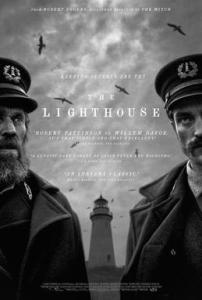
The Lighthouse is a movie we’ve been waiting a month to see.  Since its opening weekend my wife and I haven’t had two consecutive hours free during any weekend showtime.  Now that we finally managed it, I’ve been left in a reverie.  Robert Eggers, whose film The Witch opened to critical acclaim, has repeated the feat with this one.  His movies require a lot of historical homework and the end results have a verisimilitude that pays the viewer handsomely.  The details of the plot are ambiguous and the influence of King, Kubrick, Melville, Hitchcock, Poe, and Lovecraft are evident as two men in isolation grapple with insanity.  Also obvious is Greek mythology, with one reviewer suggesting Tom Wake is Proteus and Ephraim Winslow is Prometheus.  The end result is what happens when literate filmmakers take their talents behind a camera.

Naturally, the symbolism adds depth to the story.  The eponymous lighthouse is phallic enough, but the light itself—often a central metaphor of religions—is, like God, never explained.  Encountering the light changes a person, however, and the results can be dangerous, even as Rudolf Otto knew.  This light shines in the darkness so effectively that no ships approach the island.  The monkish existence of the keepers requires a certain comfort with the existential challenge of isolation, even if God is constantly watching.  The light never goes out, even when a reprieve would be appreciated.  Having reading Barbara Brown Taylor’s Learning to Walk in the Dark since the film opened, this makes some sense.  Horror movies lead the viewer into such territory when they’re thoughtfully made.

The concept of light is central to at least two similar forms of religion that have moved beyond doctrinal Christianity.  Both Quakerism and Unitarian Universalism emphasize the light as central to their outlooks.  Whether it be divine or symbolic, light is essential to spiritual growth.  In novels like Cormac McCarthy’s The Road the idea of an inner light keeps the father and son going.  In The Lighthouse the external light, when taken internally, leads to madness.  Since I watch horror with an eye toward religion—I do most things with an eye toward religion—I didn’t leave the theater disappointed.  I knew that, like The Witch, I would need to see it again but when it comes down to the price range of one ticket for repeated viewings.  Finding the time to get to the theater once was difficult enough, despite the payoff.  


Yeti Again Again

I wish I had more time for reading short stories.  I grew up on them since, like many young boys I lacked the attention span for entire novels.  Many collections of short stories sit on my shelves, but I’ve been drawn into the world of extended stories, perhaps because so much of reality bears escaping from these days.  In any case, I find myself neglecting short story collections.  I have a friend (and I tend not to name friends on this blog without their express permission—you might not want to be associated with Sects and Violence!) named Marvin who writes short stories.  This past week his tale called “Meh Teh” appeared in The Colored Lens.  Marvin often uses paranormal subjects for his speculative fiction.

“Meh-Teh” is a Himalayan term for “yeti.”  Since we jealously guard our positions as the biggest apes on this planet, science doesn’t admit yetis to the realm of zoology without the “crypto” qualifier in front.  Still, people from around the world are familiar with the concept of the abominable snowman.  Maybe because I grew up watching animated Christmas specials, I knew from early days that a mythical, white ape lived in the mountains, and that he needed a visit to the dentist.  The yeti has even become a pop culture export from Nepal, since those who know little else about that mountainous region know that strange footprints are found in the snow there.  Apes, however, like to dominate so we tend to drive other apes to extinction.  Still, they had to be there on the ark, along with all other cryptids.

I recall an episode of Leonard Nimoy’s In Search of that dealt with yetis.  Or was it a Sun Pictures presentation about Noah’s Ark?  I just remember the dramatic earthquake scene where either the skullcap of a yeti or a piece of the true ark was buried, lost forever under the rubble.  Yeti is also a brand name for an outdoor goods company based, ironically, in Austin.  This fantastical ape has become a spokesperson, or spokesape, for the great outdoors.  All of this is a long way from the story Marvin spins about the great ape.  As is typical of his fiction, religion plays a part.  I really should make more time for reading short stories.  In a world daily more demanding of time, that sounds like a solid investment.  And free time is more rare than most cryptid sightings these days.


Author Revise Thyself

Monster fans may have noticed that, despite the season I haven’t been writing much on the topic.  One of the reasons for this is that I’m in that dread stage known as “revision.”  As an editor I often see book proposals—or even entire books—that have never been revised.  You can tell.  I learned this while writing Holy Horror.  If you’re one of the people who took out a second mortgage to buy a copy, the book you purchased was based on a manuscript rewritten thoroughly at least five times.  The idea is that like rocks in a river, all that pouring over a text smooths the words like stones over the millennia.  Few rocks emerge from volcanic or sedimentary situations as smooth and round.  That takes revision.

My peer review report for Nightmares with the Bible came in a few weeks ago.  Nightmares had been revised a couple of times, at least, before I submitted it.  I understand the review process very well, as I deal with it daily.  Sometimes single blind (the writer doesn’t know the reviewer’s identity), other times double blind (neither reader nor writer know the other’s identity), the process is meant to provide feedback on a manuscript.  Having written many more manuscripts than have seen publication, I know just how useful peer review can be.  Like anything, however, it can also be treated legalistically, as if the reviewer knows more about a subject an author has just spent years researching.  No matter your impressions about this, once the reports come in, revision is in the cards.

Self editing is difficult.  And occasionally embarrassing.  You read again what seemed to make sense to you at the time, but even after you hit the “send” button you’ve continued reading.  New information comes to light.  Monographs are a very expensive form of dialogue.  Well, not so expensive as all that.  Many people are happy to pay out the cost of a monograph for a dinner out, which lasts an evening.  A book, mutatis mutandis, lasts much longer.  Like that meal, it’s taken internally and digested.  You can read the same book twice, however, without having to pay the second time around.  It’s a good idea, then, to revise before sending it to a patron’s table.  Ironically, revising a book on monsters takes time away from writing about monsters.  I also have essays awaiting revision, circling overhead like planes at Newark’s Liberty Airport.  And then there’s work, which has nothing to do with my own writing at all.  There’s a reason Nightmares occurs in the title.


Seventies

It’s pretty rare for me to be out on a week night.  Like a kid on a “school day” I’ve got to get up early the next morning.   And yawning a lot at work is bad form, even if nobody can see you.  I risked it recently, however, to meet with some colleagues from the Moravian orbit in Bethlehem.  As we talked, current projects came up, as they’ll do when doctorate-holders get together.  Demons are a conversation stopper, but I nevertheless asserted that our modern understanding of them derives directly from The Exorcist.  The insight isn’t mine—many people more knowledgable than yours truly have noted this.  One of my colleagues pointed out the parallel with The Godfather.  Before that movie the mafia was conceived by the public as a bunch of low-life thugs.  Afterward public perception shifted to classy, well-dressed connoisseurs who happen to be engaged in the business of violence and extortion.

The insight, should I ever claim as much, was that these films were both from the early seventies.  They both had a transformative cultural impact.  Movies since the seventies have, of course, influenced lots of things but the breadth of that influence has diminished.  I noticed the same thing about scholarship.  Anyone in ancient West Asian (or “Near Eastern”) studies knows the work of William Foxwell Albright.  Yes, he had prominent students but after Albright things began to fracture and it is no longer possible for one scholar to dominate the field in the same way he did.  Albright died in the early seventies.  Just as I was getting over the bewilderment of being born into a strange world, patterns were changing.  The era of individual influence was ending.  Has there been a true Star Wars moment since the seventies?  A new Apocalypse Now?

You see, I felt like I had to make the case that The Exorcist held influence unrivaled by other demon movies.  We’re still too close to the seventies (Watergate, anyone?) to analyze them properly.  Barbara Tuchman suggested at least a quarter-century has to go by for the fog to start clearing.  Today there are famous people who have immense internet fame.  Once you talk to people—some of them my age—who don’t surf the web you’ll see that internet fame stretches only so far.  It was true even in the eighties; the ability to be the influential voice was passing away into a miasma of partial attention.  The smaller the world gets, the more circumscribed our circles of influence.  And thus it was that an evening among some Moravians brought a bit of clarity to my muddled daily thinking.


Who Cares?

America’s all about money.  I read quite a bit about care-related exhaustion, and being in a situation where several family members are requiring care I’ve begun to notice that our government just doesn’t care.  Talking with a family member recently, his exhaustion was clearly evident.  Not affluent, he has to care for a spouse with Alzheimer’s and continue to work ten hour days because nobody pays you simply to help another human being in need.  Care can be monetized, of course.  Then Republicans sit up and take notice.  Until then, however, I try not to be overwhelmed by what is clearly a growing crisis.  Some call us the “sandwich generation”—we support our children longer as more and more jobs become obsolete, and we care for our parents longer as lifespans extend and extend.  For the working poor, the benefits do not keep pace with life expectancy.  And what child wants to see his or her parent suffer?  Why doesn’t our government care?

Instead of devising new ways to deal with a massive crisis (I know many people who are constantly running on empty from having both to caregive and to work), Washington tweets about how the wealthy are the objects of “witch hunts.”  Those with too much are so oppressed, but they just can’t see their way to share what they have.  Meanwhile even those of us with educations find ourselves not knowing what to do.  Politicians play their games forgetting that the pieces they move about the board are alive and sentient.  After all, there’s only one king on each side.  And who feels too bad if a pawn or two gets bumped off, as long as the monarch is kept safe?

There are solutions.  Not perfect, of course, but societies with a dash of socialism realize that if those on the bottom can’t do their jobs, those on the top will tumble too, when the foundation fails.  Any builder knows the importance of secure footings.  One guy, often cited by the GOP but never really listened to by them, said houses built on sand fall.  Giving care takes time, money, and energy.  Employers want those exact same things and should you fail to provide them, you will find yourself also requiring care.  Even if your reason was that you were caring for another.  Meanwhile policies will be made to favor those who line the pockets of the political.  Who cares?  Certainly not the officials we “elected” to “lead” us.


Frozen Streams

I was walking in Ithaca, with my feet not far from Sagan.  Winter had settled in prematurely, as it often does in upstate.  I was wearing a hoodie and old fleece combo and I suppose I looked a bit tatty.  My wife and daughter had gone to see Harriet, but movies about how badly people have mistreated others, strangely for a guy who watches horror, really depress me.  Ithaca, until recently, supported three independent bookstores, so I figured I could pass the time easily enough.  It was growing dark and breezy, and I visit bookstores only with a list, otherwise it’s too dangerous.  Autumn Leaves, a used vendor, I’ve visited many times.  Their religion section is disappointingly small, but I tend to find offerings in other areas when I blow in.

Buffalo Street Books is the last remaining indie that handles new books, but I stopped by The Bookery, now closing, on my way.  This was saddening.  Ithaca houses both the ivy league Cornell and the highly regarded Ithaca College.  I suspect many of the street sweepers hold doctorates.  Has book culture entirely bent the knee to Amazon?  At the end of the last millennium, Ithaca housed 25 independent bookstores.  Today it’s evident that Buffalo Street (formerly The Bookery II) struggles to keep its hold.  I feel ethically obligated to buy something there, to take one for the team.  I had a short list and the shelves in The Bookery had been nearly bare.  It was just too depressing to stay there.  I found an inside bench and sat to read until the movie was over.

Or so I thought.  I ventured back outside and now it was fully dark, being six p.m., and I wandered back to the familiar Ithaca Commons.  I went into a couple of shops, but they looked at me as if I were homeless.  (I suppose I was, in a sense.)  I haven’t had a haircut in a while, and my beard is scruffy and white.  My hoodie and fleece don’t speak to affluence.  I had unconcealed books—I routinely refuse bags—and I suppose I could come across as a touch eccentric.  (I don’t have enough money to be authentically eccentric.)  I wondered how street people do it.  Outside the east wind was decidedly sharp and windbreaks on the pedestrian zone are few.  I came to the monument to Martin Luther King Junior.  I was walking in Ithaca but I really felt that books could make that dream come true.