Self-Convinced

Like many people, I suppose that my own views are right.  All people think this, I suspect, otherwise they’d change their point of view.  Unless they’ve been brainwashed, of course.  Religion has a way of convincing people that they alone are right.  (And perhaps also those who believe just like them.)  I have plenty of experience with this.  Seemingly normal, friendly people suddenly turn on you when you’re not there to defend yourself.  All in the name of religion.  The place, unfortunately, that it’s most found is in “conservative” religions.  With preachers braying about righteousness and being washed in the blood of the lamb the human element is often sacrificed.  Anyone who dares to think differently is going to Hell, and, in most of these traditions, you wish them godspeed.  Then there are those who wish for true dialogue.

Dialogue means, however, that you have to admit you may be wrong.  That’s one of the features the self-convinced fear most.  Ironically, even those who think they’re right can admit that they could be wrong.  Otherwise what’s the point of discussing anything at all?  As Tom Nichols points out in The Death of Expertise, many are offended that someone has greater knowledge of any area than they.  Like it or not, some of us have studied religion, the Bible, and spirituality for our entire lives.  You might not agree with everything such a person says—we often disagree among ourselves—but at least one might admit that a mere Ph.D. counts for something.  Even if on the stock market it simply won’t trade.

Ironically, as a young man I too was self-convinced.  For some reason that I can’t fathom, I decided that if my beliefs were solid they would stand up to the challenge of higher education.  As an undergrad I majored in religion at a conservative college and graduated summa cum laude.  I chose a liberal seminary to challenge further what I believed and came away magna cum laude.  Then the doctorate.  (Edinburgh didn’t offer such trifles as honors; if you made it through the program you should be so thankful.)  Tolerance became a massive part of my outlook, even as I ended up on the faculty of a very conservative seminary.  I was willing to listen, but the same could not be said for those who saw things differently.  Many of whom were far less educated, I say with all due self-abasement, than yours truly, in such things.  As time goes on I can’t help but reflect on this.  Even as I do I know others are completely convinced I’m wrong.


Vapid

The smoke encircled his head like a thief.  And not in a saintly way.  I was going to have to rethink this.  You see, the culture of the early morning commute is one where you stand in line with strangers before dawn.  Having grown up a victim of second-hand smoke at home, I can’t stand it now.  Should I go wait in the line (which was growing) where the last guy was smoking, or sit in my car?  Work anxiety always wins out in such situations, so off I trudged.  I discovered, however, that the man in front of me wasn’t smoking after all.  He was vaping.  What was this chemical stew hanging in the air that had just come from his mouth?

I worry about second-hand vape.  How desperate must a person be to smoke a device?  You see, my trust in technology goes only so far.  People are slowly beginning to understand that electronics don’t solve every problem.  Vinyl records are starting to come back, even at Barnes and Noble.  Independent bookstores are returning, despite the rise of Kindle.  I’m still waiting for it, but film cameras may once again appear.  There’s something about the Ding an sich.  The tech of the stereo was invented for the analogue record.  Yes, the MP3 is faster and cheaper, and you can buy just the song you want with the click of a virtual button, but we still have our favorite LPs around.  This isn’t misplaced nostalgia, like those who long for the 1950s.  No, this is simply the recognition that faster isn’t always better.  Some things were meant to linger.

Vaping is, however, an example of how a bad habit becomes a vice with no point.  Initially meant to come to the succor of smokers who couldn’t do it indoors, vaping was also quickly relegated to the outside.  Many people, it seems, don’t want to breathe someone else’s smoke.  Do you develop artificial cancer from artificial nicotine?  Another commuter comes up to the guy in front of me.  Like a couple of kids on a 1970s schoolyard, they exchange vape flavors.  The first guy doubles up with a coughing fit.  Spits off the curb.  The second guy says, somewhat anticlimactically, that this one’s strong stuff.  I have to wonder what future generations, if there’ll be any, will think of our love affair with devices.  The bus pulls in.  I’m the only one on the whole thing who clicks on the over seat light.  I have a physical book to read.


Thunderers

“Storms are the embodiment of Mother Nature’s flair for the dramatic, and the words that we use to write about them are infused with that drama,”—the words aren’t mine, but they express something I often acknowledge.  The quote comes from a Verbomania post about the word “brontide”—a noun for things that sound like distant thunder.  Weather-related words are indeed part of the religious vocabulary as well.  I wasn’t quite daring enough to suggest it in Weathering the Psalms, but it seems that thunder may be behind most basic religious beliefs.  Well, that and bad luck.  Think about it—most cultures have a very powerful storm-deity.  That power is expressed in thunder.  Even in the twenty-first century a sudden clap can made the sophisticated duck and cover.  

We don’t know as much about ancient Mesopotamian culture as we’d like to, but it’s pretty clear that storm deities commanded major of respect.  Eventually in the city-state of Ugarit, in what is now northern Syria, a god named Hadad (aka “thunderer”) became the patron of the city and was known mainly by his title “lord” (Baal).  There may have been more than one lord, but the one in charge of day-to-day affairs was the one who controlled storms.  We’ve entered another rainy season around here (something you tend to notice when the roof leaks), and my thoughts often turn to how very much the weather controls us.  Interestingly, thunder hasn’t been much in the picture.  We’ve lived in our house coming up on a year and I have been awoken by thunder (something that still scares me as much as when I was a kid) only once.  Thunder is the approach of gods.

There’s drama about the weather.  In fact, fiction writers have long known that one of the most effective ways to suggest the mood of a story is the meteorological method.  Weather sets the scene.  The sound of distant thunder has a naturally ominous, almost predatory quality.  The growling, low and loud bursts from the sky sound so like human expressions of rage that it is only natural that they should be interpreted this way.  Since the sky is (or used to be) out of the reach of humans, the sounds from above were from the realm of the divine.  When gods approach the mood is threatening.  We dare not meet them.  That mythology has long informed our perceptions of meteorological phenomenon, acknowledged or not.  Brontide is an underused word that brings the drama of both nature and the divine together.  It could be a psalm word.


Sustain Chapel

It seems that holidays come thick and fast in the spring, especially when Earth Day follows directly on the heels of Easter.  Given the hard time mother earth has been having with too many Republicans waging war on her, it’s worth taking a few minutes to consider finity.  Our planet is not infinite.  The resources with which it came loaded out of the showroom are all of limited supply.  Somehow we’ve managed to convince ourselves, at least in this hemisphere, that there’s always more where that came from.  Unless, of course, you’re referring to the degrees that contribute to global warming.  Of those, the GOP narrative goes, there really aren’t any.  No credible scientist doubts climate change, although those who are already old and who are benefitting from it will claim otherwise.  Any story depends, of course, on the teller.

Over the holiday weekend I was out of town.  Driving home a few hours I was distraught at just how much litter lines our otherwise scenic highway system.  Stuff falls off of trucks and, despite advertising against it, out of car windows.  The few trash bags piled for pickup by the earth-conscious can’t keep up with the cast-offs of a throwaway culture.  We desperately need to take the narrative back from those with the loudest, and most incoherent mouths.  We all rely on this same planet and the power we cede to the wealthy is due to our complicity in their claims of ownership.  They’ve proven themselves, should I dare to be biblical, unfaithful stewards.

The earth, it is true, is a place of immense beauty.   It’s not aesthetics alone, however, that motivate us.  We simply cannot survive without this biosphere in which animals, plants, microorganisms, and minerals coexist.  We evolved in it.  The mythical narrative of special creation unwittingly played into the hands of those who will claim it all for themselves if the rest of us don’t deny that they had indeed “earned” the right to be considered the most prestigious.  Our societal sin of rewarding bad behavior has led us to this crisis.   We pollute far beyond our needs.  We “speculate,” hoping that “development” will lead to “growth.”  The wealthiest build rockets to escape our planet, but there’s nowhere to go.  Might it not be better to invest in this gift that we already have?  To learn the lessons of nature?  To become students in the classroom of Mrs. Earth?  There have been many holidays lately, but this may indeed may be the most important of them all.


Rise Again

Resurrection, as I argue elsewhere, is a scary thing.  Since today’s Easter, at least in the western Christian world, people are—or should be—thinking about resurrection.  In the case of Jesus, a young man who died “before his time,” resurrection seems only fair.  Indeed, in the earliest biblical hints of the concept it applied to people in precisely that category.  The story’s different for older folk who are beginning to wear out and are ready to go to a better place.  Christianity made the idea of resurrection more palatable by stating that you get a new and better body next time around.  The creeds say, after all, “the resurrection of the body.”  Heaven, it seems, is an embodied location.  Resurrection is necessary to get there.

Horror writers and film makers have used revenants to great effect.  When they do, pop culture latches on.  Think about the vampire craze of the early 2000s.  Or the ongoing fascination with zombies.  Even your basic garden-variety ghost.  They’re all revenants that attract and repel us.  We’re not quite sure what to make of life after death.  It’s okay if it’s played out beyond human senses, but as much as we want life to go on we don’t want to witness it here.  Horror films like to play on this ambiguity.  They’re closely related to religious ideas.  I’m occasionally asked why I watch horror; it’s essentially the same question as why I study religion.  Sometimes you just need to look closely enough to find the connection.  Resurrection, as I discuss in Holy Horror, is tied to some of humanity’s most basic fears.

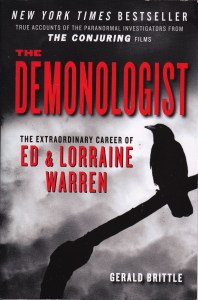
Just two days prior to Easter, Good Friday in fact, Lorraine Warren passed away.  A fervent believer in resurrection, she was half of the dynamic paranormal investigating couple of Ed and Lorraine, about whom I’ve posted from time to time.  This coincidental occurrence illustrates once again the connection between resurrection and horror.  The Warrens were fond of declaring that haunting spirits of the human kind were those that had not passed over into the next world.  Revenants were confused spirits (not to be mistaken as demons, which were something completely different).  Resurrection, presumably, awaits just the other side of the veil.  Clearly religion shares this roadmap with horror.  Just as the Warrens will be resurrected as characters in this summer’s forthcoming Annabelle Comes Home, such returns to life may take many forms.  It’s Easter for some of us, and it can integrate horror and hope, if viewed a particular, perhaps peculiar, way.


Look Out Below

Demons are seldom what you think they are.  Bernard J. Bamberger’s Fallen Angels: Soldiers of Satan’s Realm isn’t so much about demons as it is about, well, fallen angels.  A classic in the field, it was published in 1952 and has been periodically reissued when interest revives.  There are many aspects of this book that deserve development in a place like this blog, but I need to suffice with a few.  I won’t take much of your time, I promise.

First and foremost, Bamberger, who was a prominent rabbi, presents the seldom heard Jewish perspective on the topic.  The Devil really had more explanatory value for Christians than for Jews, and it is no surprise that he appears rather abruptly in the New Testament.  There are, of course, plenty of antecedents for him both in the Hebrew Bible and in Jewish apocrypha and pseudepigrapha, but the idea, and character, grabbed his main hoof-hold in Christianity.  This dualism has periodically been a source of embarrassment, but in general it has served the Christian narrative well.  We seldom see the Jewish outlook on it.

A second noteworthy feature of this book is its wide survey of these ideas in both what is now termed Second Temple Judaism and that of Late Antiquity.  The fallen angels seem to be there in the Good Book, but close reading of the texts suggests other meanings.  Judaism has never felt the compulsion that many Christians feel toward having the one, correct outlook.  Spend a little time with the Talmud and see how dialogical the search for the truth can be.  With no Pope or supreme human authority to declare the rightness of one outlook, the search must remain a process of discussion rather than an ex cathedra pronouncement.

A third, and for now final, observation is the sheer number of characters that pick up the baton of evil in both early Judaism and Christianity.  Even Islam.  A bewildering number of names for lead fallen angels and other demonically sourced characters populate these pages.  Since Judaism tended not to buy the fallen angel narrative, other sources for demons were considered.  Few doubted that they existed in the early days, but whence exactly they came was an open question.  Bamberger explores the options here and, beyond his book many others also exist.  That evil exists in the world seems patently obvious.  Religions of all stripes ask what’s to be done about it.  Some delve into its origin myths.  In the end, however, it is how we choose to respond that matters most. 


Discriminating Tests

That explains it.  That glow coming through the window as I got out of bed this morning is the full moon.  Since this is the first full moon after the vernal equinox, that means Sunday’s Easter.  If Sunday’s Easter this is Good Friday.  That brought to mind an article my wife sent me from The Atlantic, “Most American Christians Believe They’re Victims of Discrimination.”  In this piece Emma Green explains that Christians of a certain stripe believe they’re under threat.  Most people express surprise at this outlook, but having grown up in a Fundamentalist tradition I can say that this is hardly new.  The narrative of persecution among conservative Christians has been around for a long time.  They have a mandate, you see.  A mandate to make the entire world like themselves.

Hearing the many cries of legitimate oppression doesn’t help, of course.  In this linked world of instant communication and news 24/7, we’ve become perhaps too aware of just how widespread oppression is.  Christians have felt persecuted from the very beginning, and they don’t like now being cast in the role of oppressor.  Forcing other people to conform is no longer considered right or desirable, but Christians have a mandate.  What strikes me as odd here is that we have a means of learning about this—of arming ourselves with knowledge—but we’d rather be surprised at the polls and pay for it with years of actual oppression.  What is this mysterious means of knowing?  The Bible.  If read, this viewpoint can be understood.  And if handled carefully, disarmed.

The Roman Empire, after which, tellingly, American politics is modeled, oppressed Christians.  At least for a while.  Then the faith became establishment.  And it began oppressing.  An ocean away, Christians fled here because they wanted freedom of religion.  They didn’t always want to share that freedom with other groups experiencing discrimination.  Especially, of course, if they could be compelled to do heavy labor without pay.  Now these groups feel they’re being judged for saying “Merry Christmas,” or for declaring loudly that Sunday’s Easter.  They can’t point to behaviors that in their understanding of the Bible are bad and tell people not to do them.  They don’t understand that Allah is the same deity they worship, only in monotheistic form.  And they get all this news while the moon is still in the sky.  I look at the puddle of light on my bedroom floor and head for my writing nook.  It may be Good Friday, but I’ve got to work today, getting Bibles ready to sell.


Mystic Connections

Those of us who find rationalism a bit too constricting sometimes find solace in mysticism.  My reading of late, which is mostly research for Nightmares with the Bible, frequently touches on mystics of the past.  This isn’t a new fascination.  All the way back in college, as a religion major, I mentioned to one of my professors that I found it appealing.  A frown settled across his academic face.  “Mysticism is dangerous,” he said.  He went on to explain that churches (he was Presbyterian, and I Methodist) had belief systems into which mystics—those who experience the divine directly—didn’t fit.  A direct experience of the divine could cast doubt on church doctrine and nothing, as you might guess, is more important to true believers than dogma.

That discussion at such an impressionable age set me aback.  Here as we enter (for the non-orthodox) the Triduum, or “Great Three Days” the faithful are hoping for some kind of divine experience, I expect.  Many of us will spend two-thirds of it working.  In any case, if nothing mystical happens why do we bother?  Mysticism is equally deplored by science since it suggests something that doesn’t fit into rationalism’s toy box.  A universe where the unexplained—and oh so subjective!—direct experience with naked reality threatens to undo all the neat columns and tidy formulas that describe the entirety of existence.  Conventional churches tend to agree because you never know what God might do if you open that box.

There are religions that welcome mysticism.  They recognize that human-built systems are only approximations—Platonic shadows, if you will, cast upon the cave wall.  Mystics are those who, temporarily unchained, dare to turn around and face the fire directly.  Who knows?  They might even catch a glimpse of the sun itself.  More conventional religions are run like businesses.  You come to a certain building at a certain time.  You perform prescribed actions on cue.  You place your money in this specific receptacle at this specific time.  Leave and forget it all until next week.  Our younger generations don’t find this engaging, just as they see through the lie of the inherent fairness of capitalism.  I can still see the frown of my theology professor.  The old systems are falling apart even as those not too weary after work will head to Maundy Thursday services for a slip of bread and a sip of wine.  The mystic, however, doesn’t know what might happen next.


Aging Tech

When I get an idea my first impulse is to grab an envelope and pencil and start scribbling.  I run around with an older crowd.  Many of my generation don’t appreciate how much a single “share” can do for a blog post, or what a simple link to a page can do.  I have college friends who have no email addresses and who are invisible on the web.  I guess this is a young person’s playing field.  I suppose one of my reasons for writing about horror is that it keeps me in the younger demographic.  I don’t know too many people my age who are fans of “the genre.”  Sci fi is a little more acceptable, I suppose.  Still, I’ve been thinking quite a bit about why I find horror so fascinating.  There’s actually something redemptive about it, at least in my reading of the material.  It’s also a coping mechanism.

One reason that people tell stories (and read stories), according to psychologists, is to learn how to handle situations they might encounter.  This is on a subconscious level most of the time, otherwise speculative fiction simply wouldn’t apply.  I can’t recall having been in a crisis situation and stopping to think what a Stephen King character would have done in such circumstances, but I suppose that might be in the back of my mind somewhere, along with information about all the things I’ve mislaid over the years.  The older you get, in a technologically rapacious society, the more things there seem to be worthy of horror stories.  I haven’t even figured out the last round of devices before the new generation’s introduced.  No wonder so much of horror has to do with being attacked by monsters that look innocent.  Clinically engineered in a clean room.

Image credit: Pattymooney, via Wikimedia Commons

Some of the horror comes from the inherent instability of a constantly upgrading tech.  My laptop’s a few years old.  While a little younger than that, the device that sits on my laptop is also not fresh from the factory.  The last time I tried to back up the contents, the external hard drive (new from the factory) refused to do what I commanded.  While I did eventually figure it out, I wasted a good deal of my scarce free time working out how a device I couldn’t control was in fact controlling me.  Younger folks grew up with this kind of problem solving drilled into them from kindergarten on.  Now I find myself in a world of devices I can’t comprehend and which don’t even react the same way they did last time I bought the exact same one.  I ask my fellow quinquagenarians what to do and I watch as they grab an envelope and pencil.


Looking Back

Image credit: David Hunter McAlpin Fund, 1944, via Wikimedia Commons

Like many I’m shocked and saddened by the fire at Notre Dame cathedral.  At the same time a recurring theme of this blog has been that modern people are disinclined to pay for the past, and some analysts are saying that lack of funds for regular upkeep of the cathedral over many years are at least partially behind the tragedy.  Monuments that have stood for centuries require constant care, but it’s so easy to take them for granted.  Cathedrals aren’t just religious buildings.  They are humanistic in the sense that they stand for our natural tendency to create great markers of our time on earth.  So very human.  Many human acts we wish to erase, but some represent a loss to the very soul of our species when they’re gone.

Even in this secular age the great cathedrals of Europe are on the agenda of many a traveller.  My own recollections of Notre Dame have grown hazy with the years—I do recall the stolid towers and flying buttresses.  Even the doubtless inauthentic but still ancient crown of thorns.  The famously secular French stood in the streets and sang hymns as the fire raged. 

My single trip to Paris was followed by a stop in Germany where we saw towers of cathedrals left standing even when the remainders of the buildings were gone—bombed out during World War Two.  Asking a friend about it we learned that the Germans felt these skeletal churches were appropriate reminders of the horrors of war.  No masses could be said in them ever again, but they stood, in their ruined majesty, as their own kind of monument to human folly.

We live in a post-cathedral world.  Symbols of the unity of a nation, demanding resources beyond what could really be afforded, cathedrals served to unite.  Citizens of London, it is reported, shoved bombs off St. Paul’s Cathedral during the Blitz.  Religion today has been turned into a means of dividing and conquering people.  It builds border walls rather than cathedrals where those of any faith might be allowed in and invited to wonder.  Images of that famous spire helplessly falling amid the flames suggest the shock of the twin towers collapsing.  Although the structure survives, much has been lost forever.  And if people react like they are wont to do, there will be outpouring of resources to rebuild and restore, but only for a while.  We tend to think that looking at the past is frivolous.  Yet, my photos of Notre Dame remind me that a life spent looking back may well be the only kind worth living.


No Refuge

A convention in histories of the horror genre is to trace it to Gothic fiction.  Gothic fiction itself is traced to The Castle of Otranto, by Horace Walpole.  Having grown up reading Gothic stories along with religious texts, perhaps surprisingly I never came upon Walpole’s oeuvre.  Some weeks back I happened on a used bookstore, which, by convention, had its cheapest fare on sidewalk carts.  I was surprised to see a negligibly priced copy of The Castle of Otranto, which I took in to the counter.  The clerk looked puzzled a moment, then asked if it was from the carts.  “Oh,” he sniffed, “that explains it.  We don’t carry Dover editions; they’re too cheap.”  Perhaps that remark haunted me a bit, but I finally got around to reading the slim book and it left a kind of unanticipated horror in my mind.

Okay, so this was written in the eighteenth century, and set further back, in Medieval times.  A spooky castle, knights and knaves, and fainting damsels all populate its pages.  Religion, particularly in debased form, became a standard characteristic of the Gothic.  Here a monk, an erstwhile lord, holds a secret that leads to the downfall of a house of pretenders who have claimed ownership of the castle.  All pretty straightforward.  Even the ghosts and talking skeletons fail to raise fear.  One aspect, however, does hold horror.  The three princesses in the story are completely at the whim of the men.  They acknowledge as much and claim it against piety to declare any different.

It would be unfair to assert that such sexism was intentional—like most human behaviors it evolved over eons—but in this era to read it is to shudder.  We have moved beyond the horror fiction that men own women and that they have any right to determine their fate.  Especially in these days, it’s embarrassing to be reminded that such was ever the case.  Despite the word from on high we cannot hide from history.  The domination of men has been a testament to how poorly civilization has been run.  Some of its benefits can’t be denied, but on a whole we see a succession of aggression and wars, suffering and poverty, generally brought on my societies that have taken their cues from patriarchical ideals.  My reading of The Castle of Otranto brought this back with a force not unlike that of the giant ghost haunting its walls.  Is it too much to hope that some two-and-a-half centuries might show some evidence of progress?


Not-Quite-Normal Religion

I’ve been thinking about categories quite a lot lately.  In a world connected by the internet, it seems that traditional categories don’t stretch far enough.  For example, I recently read The Paranormal and Popular Culture: A Postmodern Religious Landscape, edited by Darryl Caterine and John W. Morehead.  Published by Routledge, this is an academic study.  It contains some things, however, that many academics would find challenging.  I can’t summarize the entire book here since there are twenty very different essays included, but I can say this is a book that makes you think about categories.  Even the word “paranormal” means different things to different people.  To my way of thinking it has to tip the hat to Rod Serling and that place where fiction and fact begin to overlap.

That’s appropriate for this book: there are articles about what people perceive as factual encounters with all kinds of creatures and events, as well as studies of the decidedly fictional beings like Batman and zombies.  Our categories, in the modern world, tend to be inviolable.  Even scientists who handle Heisenberg know, however, that we are now in the postmodern world (as the subtitle indicates) and true objectivity is beyond the reach of all.  None of us stands outside the box looking in.  We’re all in the middle of it, and we look around ourselves trying to figure out what is real.  Another problematic category that, reality.  We don’t even understand what consciousness is yet, and how can we hope to know what is really real?  We all have dreams and some take them more seriously than others.

Reading books like this with an open mind is a truly po-mo experience.  After finishing more than one piece I found myself having to put the book down for a while at least so I’d have a hand free to scratch my head.  You see, we’ve been taught to laugh at those who believe in the paranormal.  It has been the only acceptable way that rationalists can deal with that which flies in the face of the system.  The internet, however, has put those isolated, ridiculed individuals into a community and the advent of reality TV (and what can be more real than what we see on the tube?) erodes the laughter factor little by little.  Plumbers can find ghosts but scientists can’t.  The average person relates more to the plumber, I think.  It all comes down to categories.  Making sense of them can, and will, impact our views of reality.


Label Maker

Did you ever have one of those label makers?  The kind with a rotating wheel that embossed a plastic ribbon with letters that you could stick to things?  Labeling is so easy!  I often feel constrained, however, by the chosen labels of extremist groups.  Not all evangelicals are power-hungry or enemies of human welfare.  This is perhaps one of the keys to the success of extremists.  Camouflage has long been recognized by evolution as a most effective tactic.  I have many evangelical friends who do not protest cartoons, or ride around in Trump-laden vehicles, polluting the environment like there’s no tomorrow.  The problem is what to call them since the more radical wing has usurped their nomenclature.  I often think of this because I eschew labels in general, but people in a collective can do quite a bit more damage than a single disgruntled individual.  Perhaps “disgruntled” should be part of their name?

Religions generally begin as efforts to help make the world a better place.  The historian of religions sees, however, that over time many believers begin seeing the peripherals as the central tenets of the faith.  Since I’m familiar with evangelicalism, let me use that as an example.  As a form of Christianity, evangelicalism began with the Reformation.  Pietist groups, freed from Catholicism’s idea of communal salvation, began to worry about their individual souls and how  they might be saved.  Their belief structure eventually came to include the necessity of converting others because, if you read the Bible a certain way, that’s a requirement.  Over time this outlook  evolved into the idea that only one group (one’s own) has truly understood the Christian message.  Once numbers grow numerous, it becomes like the medieval Catholic Church—large enough to take political power.  Somewhere along the line the central message of helping make the world a better place morphs into making the world evangelical only.  Or whatever label we feel constrained to use.

labels are problematic

I’m not picking on the evangelicals here—this could apply to any extremists.  And it certainly doesn’t apply to all evangelicals.  Religion has been part of human culture from the very beginning.  A good case can be made that it is one of the basic components of consciousness itself.  A person has to learn how to become unreligious.  We are also political animals.  Who doesn’t want things their own way?  We can’t all win, however, and some religions have difficulty separating, say, a savior willing to die for others and the insistence on one’s own way no matter what others want.  Like most aspects of life this is a balancing act.  I grew up evangelical.  I have friends who are evangelical.  I don’t want to insult anybody, but what can you do when you feel disgruntled by the degradation of religion into an excuse for hate?  I lost my label maker long ago and I no longer know what to call things anyway.


If Onlyists

A special brand of Fundamentalism called King James Onlyism is a particularly odd variety of faith simply because of its required backing and filling.  In brief, this particular evangelical position claims that the only inspired translation of the Bible is the King James Version.  It’s best not to look too closely at the KJV, however, or the problems start.  Primary among them is that the version most Onlyists cite is not the original King James.  Published in 1611, this translation is immediately evident by its use of “I” for “J” and for the long s (the one that looks like an f).  Perhaps more troubling for Onlyists, it also includes the Apocrypha.  There was still some debate at the time concerning the status of these deuterocanonical books, and they were part of the actual KJV.

The typical King James used by Onlyists is a revised KJV.  In England, where the translation was done, revisions were made from time to time, leading to an Oxford version (Blayney text of 1769) and a Cambridge version (Scrivener text of 1873).  On these shores further adjustments were made leading to the rather strange situation where there is no single King James Version of the Bible.  There are many King James Versions.  Attempts to control Scripture often end up like that.  The underlying problem is the belief that there is a single version of Holy Writ.  Inerrantists are pledging their faith to something that doesn’t exist.  Defending this approach many would claim that the revisions are minor, but small changes can make huge differences.

The belief in one single version relies on the belief that God inspired not only the original writers, but the translators as well.  It denies that the better manuscripts that have come to light since the early seventeenth century (including the Dead Sea Scrolls) contain any authentic information of what the Good Book says.  Textual criticism, in the absence of any original manuscripts, is the best way we have of discovering what the original likely said.  Onlyists argue that the manuscripts from which King James’ translators worked were the divinely selected ones and their work was inspired—a position against which no empirical proof can be offered.  This faith trades in certainties that only bringing in direct heavenly control can achieve.  And it means that Catholics are wrong, despite King James’ inspired error to include the Apocrypha.  That’s the thing about a trump card like inspiration—once it’s played there’s no way to overcome it.


What’s Wrong with Heroes?

There can be no doubt that under Trump conservative Christians have been flexing their muscles.  Few things corrupt so readily as political power, and evangelicalism—already an unrealistic way of looking at things—is itching to throw punches.  A story on For Reading Addicts that my wife sent to me bear the title “DC Comics cancel latest comic after backlash from conservative Christians.”  The piece by Rowan Jones notes that Second Coming was cancelled due to pressure from evangelicals with the cultural sensitivity of the Kouachi treatment of Charlie Hebdo.  Cartoons, it seems, are a real threat to true believers in a way that reason is not.  Jones notes that the comic was actually largely supportive of Christian values, but like an evangelical Brexit the reaction was taken without understanding the issue.

The anger of conservative religions—it hardly matters whether they are Christian, Muslim, or Aum Shinrikyo—often plays itself out in displays of violence.  I wonder if part of this insecurity comes from the fact that the expectations of their faith don’t work out they way they’ve been led to believe they will.  The myth of the blessed existence of the true believer is given the lie by life in a secular world.  While the evangelicals support Trump, 45’s tax plan takes money from their pockets and hand it to the ultra-wealthy.  This raises no objections, but a cartoon showing Jesus helping the poor?—now that’s offensive!  And still no second coming takes place.  It’s difficult to retain a fantasy view in the face of cold reality.

Who doesn’t like a hero?

Religious beliefs are a deeply personal matter.  It is a dicey business to try to get someone to change their outlook when they’ve been convinced that the consequences are eternal.  Although vaguely aware of other religions all along, Christianity in the “new world” was taken quite by storm at the 1893 World’s Parliament of Religions in Chicago.  Suddenly it was clear that other moral, decent religions had developed similar ethics to what had largely been supposed to have been Christian innovations.  It’s difficult to feel superior when others in the same room seem just as intent on improving the lot of humankind as you do.  Even when a particular religion holds all the political power of a nation it’s overly sensitive to cartoons.  This is a curious situation indeed.  I’m not a comic book reader—I don’t even have time for internet articles unless someone sends them to me with the suggestion that they’re worth my time.  And I, for one, think a little more humor might just make the world a better place.  Either that or we need a hero.