Tweets from Heaven

What do the ultra-rich know about morals?  I read recently that now that Elon Musk has purchased Twitter for billions and billions of dollars, that he’s going to allow Trump back on because it’s “morally wrong” to prevent him.  Heaven help us when the plutocrats start dictating morals.  One of the odd things about my strange career is that I was an undecided major in college.  I settled eventually on religion, but my transcript shows a restless mind.  One subject that I came back to time and again was ethics.  I want to know what is right.  Shutting up a deranged narcissist who wants to run the country only to enhance his image of himself seems a moral no-brainer.  The case was different before he was elected the first time.  Now we know.  Now we have a responsibility.

Those who can afford to buy the moon shouldn’t make declarations on what is moral.  The church, however, has largely become irrelevant.  “It’s easier for a camel to pass through the eye of a needle,” a famous moralist, whose name is unfortunately forgotten, once said.  The moral compass of the uberwealthy is irrevocably squewed by a massive loadstone known as personal wealth.  Indeed, our very laws are made by the wealthy to protect the interests of the wealthy.  They do this by courting biblicists who seem to have forgotten—what is his name again?  You know, the one who seemed to have a problem with the rich?

Photo by Sharon McCutcheon on Unsplash

Morality has somehow become confused with concerns about other people’s genitalia.  We don’t ask what the wealthy do with theirs—it’s pretty clear what one tweeting resident of Mar-a-Lago has done with his.  Ironically Protestants broke away from the Catholic Church largely because of the sale of indulgences.  The idea that the rich could buy their way out of sins rankled sixteenth-century moralists into saying sola scriptura.  But now they have lost even their solaScriptura, for its part, is unequivocal about one thing—the problem of the rich.  The poor aren’t the problem.  In this new gospel, however, victims are blamed while the powerful rightly rule all.  The divine right of riches.  The wealthy, so misunderstood; the poor are the way they are because they’re lazy.  There’s no systemic cause for anyone not to have as much money as he wants (and it seems they’re generally he’s).  And they have a right to say whatever they want because their word comes down from heaven, echoing out from their private space rockets to the stars.


Consistency

Consistency.  Back in Wisconsin I belonged to a group of Hebrew Bible professors who read a book and got together to critique it.  We came from different schools—Marquette, Sacred Heart, Carroll College, and Nashotah House (me).  We took turns on different campuses and spent a pleasant Saturday afternoon discussing our selected title.  Soon one of our members, an Auxiliary Bishop for the Diocese of Milwaukee, began to look at me right off and ask if the author had been consistent—my most frequent criticism was inconsistency.  It’s the way I think.  If is an argument is being made, or a story is being told, it has to be consistent in order to be convincing.  Recently I realized that this has carried over into my writing on horror.

The dream of many authors and auteurs is to establish a successful series.  Publishers and studios like them too.  Follow one success with another just like it, so the thinking goes.  People like to see how the story ends.  The longer a series goes, however, the more difficult it is to maintain consistency.  I’ve been noticing this in the articles I’ve been writing lately.  I follow the stories closely and inconsistencies creep in.  I noted this in a recent post about Dark Shadows and I wrote about it when looking at The Conjuring and Paranormal Activity franchises in Nightmares with the Bible.  I realize, just as my Bishop friend pointed out, that consistency is my problem.  Sometimes it gets in the way of enjoying the tale.  Deft authors and auteurs will tease you with it.  It’s part of the literalist mindset.

Being raised as a literalist, from my youngest days I learned that the story goes only one way.  The world, however, is much more ambiguous than that.  Stories have multiple points of view and endless iterations.  Not only that, but not even the author or auteur has the final say in what “really happened.” When I first learned of reader-response theory I was suspicious of it.  Even with a doctorate and teaching experience I was still looking for consistency.  Get the story straight!  But stories are crooked and queer and untamed.  They follow the imagination and defy literary convention.  Those that succeed best are remembered as classics.  The rest are nevertheless expressions of fertile minds with tales to tell.  I doubt I’ll ever get over my watching out for consistency.  I should, however, pay attention to that gentle teasing my erstwhile colleagues gave.  Relax and enjoy learning how it goes this time.


Empty Chair

I’m not a Roman Catholic.  Nevertheless, I admire much about the tradition.  Its perceived unchanged continuity with the past is a big draw.  Still, one of the largest issues most religions face as they evolve is that things change.  No religion can stop it.  Edward Jarvis’ brilliant Sede Vacante: The Life and Legacy of Archbishop Thục explores the life and possible theological motivations for one of the most fascinating people in recent church history.  Ngô-dinh-Thục became a Roman Catholic Archbishop in his native Vietnam.  He was the brother of Ngô-dình-Diệm, the first president of South Vietnam, and likely one of the reasons behind the Vietnam War.  In fact, Thục had two other extremely prominent brothers and the four of them formed a junta that ruled the country with authoritarian vigor and utilized all the corruption for which authoritarianism is famed.  They became enormously wealthy, they used torture and extortion to get what they wanted, and Thục supported all of this.

Eventually excommunicated (twice), Thục had to leave Vietnam.  Two of his brothers were arrested and assassinated.  After his self-imposed exile Thục attended Vatican II, the papers of which he signed, but his prominence faded.  Without his holdings in Vietnam he was poor, and in fact lived in poverty.  Then he started consecrating bishops for breakaway Catholic groups, including the strange sect of the Palmarians.  This led to his first excommunication.  Later in life, after restored to the graces of the church, he again started consecrating bishops for the Sedevanctantists.  These were Catholics who believed the Pope was invalid and his chair (sede) was vacant (vacante).  He was excommunicated again and, after moving to the United States, died in poverty.

I keep these posts brief enough that I don’t have space to spell out all the amazing angles from which this life could be viewed (read the book for that).  In our authoritarian-loving times, however, the nature of those who reject “modernization” stood out.  Many Sedevanctantists insist on the restoration of the Latin mass.  They somehow believe the Popes since about Pius X have been liberals(!).  Like Trumpists, they believe it is possible to halt the movement of culture and go back to the way things were in the 1950s when outward conformity was all the rage.  Even Fonzie, after all, was really a nice guy instead of a dangerous biker.  Although there is some theological minutiae here, I recommend this book for anyone who has even the slightest interest in the history of Vietnam, the Roman Catholic Church, or the mindset of those who reject the modern world.


Heat Pump

We’re preparing our home to welcome a new resident.  It’s not human.  Those of you who are home owners know how you move from crisis to crisis, paying to repair this just in time to start paying for that.  Our current issue is a dead dryer.  We knew it wasn’t long for this world when we moved in.  The previous owners, as most working class folk do, let things go until a machine forces  the issue by dying.  Being concerned for the environment, we like to replace appliances with more environmentally friendly ones, if we can.  They are, of course, much more expensive.  With the dryer it was also a space issue.  Snuggled together like young lovers in bed, the washer and dryer leave less than an inch clearance total from either wall.  The first issue we faced—modern dryers are bigger.

Small and energy efficient is what we wanted.  I learned about heat-pump dryers.  They don’t require a vent and they’ve been used for decades in Europe because of both space issues and environmental friendliness.  Here they cost more and you’ll have to wait because they’re in demand.  We decided to side with the environment.  Then there’s the problem of the old vent.  I gingerly walked out the old dryer and was amazed at the detritus I found.  Now, I’m an archaeologist at heart, so instead of sweeping it all in the trash, I sorted through it.  I found a dollar bill.  And 32 cents—this helps defray the cost of the new dryer.  Three guitar picks and a heap of cosmetics.  A box of rubber bands for braces.  There was ancient history in this pile!  The lighting’s bad in that corner so I put on a headlamp like a phylactery.  Let there be light.

I had to use most of my tools to tug the old vent out.  You have to stuff the hole with insulation and put some furring strips in place to hold the new drywall.  Cut out the patch to fit the hole and mud the whole thing up.  Why bother painting where nobody will see?  By the end of the weekend we were ready for our new resident.  It still wouldn’t be here for at least a couple of weeks.  The clothesline is strung in the backyard where the even better method of using nature’s dryer is free.  For those days without sun and on which we have time to do a load, we’ll be glad for our heat-pump dryer.  Particularly when the weather starts growing cold again and global warming enacts its chaos.  Hopefully we’ll have a stop-gap solution by then.


Fight for Mom

The spring holidays come think and fast.  Depending on when you start spring we’ve got Valentine’s Day followed a month later by St. Pat’s.  On it’s roving schedule Easter hops along, with its precursor Mardi Gras.  There’s Earth Day, May Day, and Mother’s Day.  One thing they all have in common, apart from being holidays, is they’re not worthy enough to be days off work.  You have to wait for Memorial Day for that.  Today, in any case, is Mother’s Day.  We stop to think, as if we shouldn’t every day, about our mothers.  Women are pretty poorly represented in the holiday scheme, unless you’re Catholic (and even those aren’t days off).  Mother’s Day always comes on a Sunday so employers are eternally thankful.  A holiday with no consequences.  But should it be?

We’re only just beginning, after being “civilized” for five thousand years, to give women their due.  Only just beginning because capitalist systems are built on male fantasies of growing rich without the female humane element.  It’s not a system friendly to mothers unless we find a way to make people spend money.  Women remind us to look for cooperation and not just competition.  Working together we can make things better for everyone.  Men, left to their own devices, go to war.  Men take what they want and women act as our conscience.  Mothers sacrifice to keep us safe and alive.  Their self-denial resonates better with the Christianity suborned by men into a money-making venture.

It’s Mother’s Day.  It’s a day to put aside our acquisitive, war-like tendencies and think of someone else.  It’s a day to imagine what it might be like if we made a habit of good behaviors.  It’s like those grades they used to give in school for “deportment.”  It wasn’t all just about how well we learned our facts.  Mothers teach us what it means to set aside our own wants for the needs of another person.  Without that the human race simply wouldn’t survive.  Instead of politically stacked courts taking away women’s rights, today we recognize that without women none of us would be here.  The human experiment only succeeds when women are recognized for all that they contribute to life.  To civilization.  To society.  We may not have commodified it, so why not listen to our mothers’ wisdom?  Why not make it every day instead of just the second Sunday of May?  Don’t forget to thank your mother today.  Better yet, fight for her rights.


For Sale for Free

It’s one of the signs of spring.  Although it may be more appropriate for winter when we’re holed up inside for much of the time, the library book sale often takes place when it’s a bit more conducive to being outdoors.  When we travel, which isn’t frequently these days, we often spontaneously stop into an advertised library book sale.  Most of the fare is fairly pedestrian, but sometimes you find something you simply didn’t expect.  On one such recent outing, that’s just exactly what happened.  Back when we lived in New Jersey the Friends of the Hunterdon County Library book sale was a much-anticipated event.  It remains, in my experience, one of the largest of such sales.  (Believe it or not, there are websites dedicated to pointing inveterate readers to book sales and that’s how I found this one.)  That’s not the surprising part, however.

One year when I went, one of the library friends was working the pre-entry crowd, proclaiming some of the treasures inside.  One of them, he announced, was a Bible from the nineteenth century.  They were asking more than the usual one or two dollars for that one.  If I recall, it was $100.  No, I didn’t buy it.  I have dozens of Bibles right behind me at this moment and if I had a Franklin to spend I’d load up on books I don’t already own.  Many of the books mentioned on this blog came from just such sales as these.  That big Bible’s not the surprising thing either.  Here it is: on a recent library book sale day, I saw a shelf with Bibles.  They were free.  Library book sales are intended to raise money, but Bibles for free?  Unexpected, no?

America is the land of free Bibles.  They are printed in vast quantities and sold cheaply, without a thought to what this says in a capitalist world.  Some Christian rock groups were famous for throwing free Bibles from the stage—you’ve got to think those in attendance already had one—and any county fair will usually have at least free New Testaments for the taking.  Ironically, most of those who distribute free Good Books are also the staunchest supporters of capitalism, one of the most exploitative economies ever invented.  Attending library book sales entails more than just finding books that you perhaps didn’t know about.  It’s more than being tempted by something for which you’d rather not pay full-price.  It is, perhaps surprisingly, a learning experience in and of itself.


Highest Education

The average church-goer is often impressed with the idea of seminary.  The thought that someone could devote three years of their lives to theological minutiae in order to take a job with long hours and substandard pay, is mind-boggling.  Having been a seminary creature for so many years, however, makes me wonder if many church folk realize that seminaries are businesses.  Non-profits, yes, but businesses nonetheless.  This is a trait that they share with other institutions of higher learning.  Customers pay money for a good or a service (I’m not sure which) in the form of a degree.  If a student can’t cope academically, they’re often “grandfathered”through because, well, it costs a lot of money and you deserve to get what you paid for, right?

This business concept of higher education is dangerous and is primarily prevalent where governments do not support education.  Schools have to raise money and if alumni don’t give, well you have to raise tuition.  And the more somebody pays the better case they have for getting their degree.  Seminaries, however, also suffer from generally low-income alumni and sponsoring churches needing clergy.  (It’s not difficult to get accepted into most seminary programs.)  Only when a candidate is a serious problem will they tend to be weeded out.  And congregations get the results of such a system.  My level of cynicism probably results from having gone through seminary and then having taught at one for many years.  At no point have I been ordained.  In fact, even churches facing clergy shortages have shown no interest.  Call it sour grapes.

To me, however, the crisis in higher education is the result of business practices being applied to education.  The two don’t mix.  In a world where job options are limited for those too weak to dig and too proud to beg, ministry has some appeal.  You can be considered a community leader and an expert in the relatively innocuous arcane area of “theology.” And most of the people you serve will have no idea what seminary delivers, or doesn’t.  I attended events for seminary administrators offered by the Association of Theological Schools—the seminary accrediting body.  I learned that they too are under pressure to approve unless there’s a serious problem.  Even heads of accrediting bodies have to eat.  So we let the system churn on as it has since the earliest universities turned out educated clergy.  And we don’t stop to think what all of this means.

Tradition

Boone to Some

Folk heroes sometimes put us in compromising positions.  We appreciate their importance for where we are and yet we recognize that where we are came at a tremendous cost for those who lived here first.  Still, I was somewhat surprised to learn that Daniel Boone was born right here in Pennsylvania.  Like most people my age, I learned of Boone primarily through the television series that aired in the 1960s.  In other words, I learned the commercial Boone.  In reality he was a fascinating individual who preferred outdoors living to the comforts of home.  His prominence meant that he would meet and know such figures as George Washington and Thomas Jefferson.  He was largely responsible for US westward expansion, leading the first Europeans into the territory of Kentucky.  His association with the south is so pronounced that I was surprised to learn he was born in a homestead, that is today, less than an hour north of Philadelphia.

Of course, the land settled by the Boone family was stolen from American Indians.  The story might be somewhat easier to appreciate if we treated Indians better today, but our culture still insists on repressing them.  Racism runs deep, it seems.  Boone himself seems mainly to have gotten along with the Indians he knew.  The fact is his story is exciting to hear.  He was an able negotiator and both Indians and other settlers respected his position.  When tales of his adventures were written down he became famous, if not wealthy.  What seems to have really struck those who heard his story is that he continued his outdoor existence into his eighties.  At an age when many have become frail, he continued to spend months of the year living outdoors in the wilderness.

Being there where he was born felt like a revelation.  Of course the docent was a gifted storyteller, and she told his story with humor and an obvious pride in the man who’s responsible for her living.  I reflected how television once again had shaped my childhood.  Fess Parker’s portrayal of Boone was among the most popular prime-time shows of the mid-sixties to 1970.  I had no idea that I was consuming pop culture in such quantities as I watched it, along with other staples such as Dark Shadows, Gilligan’s Island, Scooby-Doo, and the Brady Bunch.  Some people worry that the rising generation “learns” its narratives from the internet, but my generation learned them from television.  Daniel Boone would have, and indeed did, learned from the outdoors.


Shadows of Childhood

Childhood, it seems to me, is where we define ourselves.  In the days when life expectancy wasn’t terribly long and people generally lived only long enough to reproduce, there was not much of a need to revisit childhood.  Now that we live several decades, however, childhood begins to loom large.  We have time to revisit and reassess.  This is one of the reasons I’ve been addressing Dark Shadows so much, and why my memories of it have been of such interest.  I recently watched the second feature film based on the series, Night of Dark Shadows.  This was aired after the original soap opera had been cancelled.  It focuses on Quentin Collins rather than Barnabas and it again caused me to reassess.

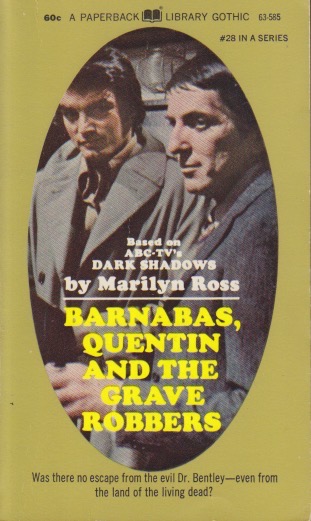
The story is complex—the soap opera was quite literary and intelligent to begin with—and it involves several characters from the series.  In my mind Quentin is a werewolf.  In the movie he’s not.  This made me realize that my image of Quentin is largely from the Marilyn Ross novels, not from memories of the television show.  I never did see the original series through.  Nor did I ever read all the novels.  Like most people my childhood was a pastiche of this and that as I sampled the somewhat small set of offerings made available in a modest family in a small town.  Fossil collecting and exploring within two or three blocks of home were about all the options.  And then there was television.  I watched a lot of it.  When the rigors of homework started to really hit in high school, I stopped watching so much.  I’d begun reading quite a bit by middle school, and many of those books are the ones I’ve been seeking out in recent years.  Not that middle school was that great, but it was formative.

Night of Dark Shadows, although set in Maine, lacks the Collinwood I remembered.  Yes, it’s a grand old house, but there’s no hint of being on the Atlantic coast.  No crashing waves.  No theremin.  Quentin is instead haunted by the ghost of Angelique and is apparently a reincarnation of an ancient ancestor whom she loved.  Angelique decides to kill off Quentin’s young bride so as to have him to herself.  It wasn’t bad, but I guess I was expecting a werewolf movie.  My view of Quentin was formed by the imagination of W. E. D. Ross, I’m coming to realize.  Sam Hall wrote many of the original episodes.  He also co-wrote this movie.  My childhood, however, remembers all of this differently.


Shopping Screed

Capitalism is insidious.  Those of us with modest incomes—and I’m quite aware that many, many people are poor—are constantly being bombarded with new schemes to get us to pay a little each time for something that used to be free.  Look, I realize the economy was hit by the pandemic.  We’re all paying for it.  Still, even basic stores you’ve used your whole life now want you to sign up for schemes that will only cost you a dollar each time and which never really pay anything back.  The one that’s got me thinking about this is a drug store.  Like it’s a surprise that you’ve decided to buy something at a drug store.  They get you to sign something you vaguely understand as you’re trying to rush out the door with your prescription and then they send you daily emails telling you how great it’s going to be.

And surveys—the endless surveys!  They sound more neurotic than I actually am.  Did we do this right, and could we have done it better?  It’ll only take a quarter hour of your time.  Each time you stop in.  And please do that daily.  The last time I did one of these surveys for the promise of a prize worth $90, I ordered their version of a fit-bit as my prize.  I’m curious how many steps I take in a day and no, I don’t carry my phone with me everywhere.  The “prize” arrived late and when I charged it up and turned it on (it came with no instructions readable in my native language) it worked for a total of literally 3 seconds before the screen died a pixelated death.  Now that same company wants me to answer surveys weekly and pay an extra dollar each time I come in.  It’s enough to make me want to use the other drug store, but they’ll probably do the same.

The thing is it’s not just pharmacies.  All the stores are doing it.  You shopped here once?  Look what else we’ve got!  Some of us shop for what we need.  We live on a budget.  If you’re going to start charging me for the privilege of shopping at your establishment I’ll have to start going somewhere else.  The items on offer for promotional plans are things I just don’t buy. If you want me to spend more, then reframe your economics and pay me more.   And I don’t have money to just give away.  Have you even taken a look at your last heating bill (thanks Mr. Putin)?  I’ll come to the store again as long as it’s free to shop there and it has something that I actually need.

Photo by Bruno Kelzer on Unsplash

Teaching Tradition

There’s a dilemma.  Many thinking religious conservatives end up arguing against “secular” education and yet wish to make themselves out as rational, and reasonable.  The truth is that underlying their position is the belief that the truth was revealed long ago and nothing has changed since then.  They want educated individuals to agree with this so quite often they establish their own institutions to turn out “experts” who haven’t been challenged in their positions.  This became clear to me yet again when reading Faith of Our Fathers by Stuart Chessman.  Subtitled A Brief History of Catholic Traditionalism in the United States from Triumph to Traditionis Custodes, I was expecting a history.  Instead it is more of a screed, or jeremiad, arguing that the Catholic Church is trying to destroy traditionalism.  What I was looking for, I guess, was a “secular” history.

I’m interested in traditionalism.  I taught, after all, for well over a decade at Nashotah House.  What I learned there I also sensed in this book.  There’s a certain naiveté associated with such theological thinking.  (Political conservatism is much more insidious.)  Small groups tend to think the larger organization has it in for them.  In reality, the larger church (in both these cases) has much more pragmatic things on its collective mind.  The narrow focus of traditionalists, however, interprets everything in the light of—in this case—rejecting the liturgical reforms of Vatican II.  Having the mass in Latin is more important (as is clear here) than coming up with an effective way of dealing with Covid-19.  Traditionalists are proud that they met more frequently during the height of the epidemic.

This kind of thinking is important to understand.  For Roman Catholicism, as a hierarchical organization, the projection of unity is very important.  Anyone involved in the upper levels of any administration knows that money—even for churches, especially for churches—is a major concern.  Reputation influences cash flow, so reputation has to be guarded at all costs.  No organization can appear to be caught up in medievalism in a capitalistic twenty-first century.  I had hoped this little book would contain an actual history of the movement, looking at socio-economic, political, and religious causes and their ramifications.  In other words, why people do things.  Believe me, I understand the draw of traditionalism.  Although it was in English my first Episcopal high mass threw me into a multi-year odyssey to a place (Nashotah House) where I learned what was really going on.  It’s not all about smells and bells.  Not by a long shot. 


Wicker Lessons

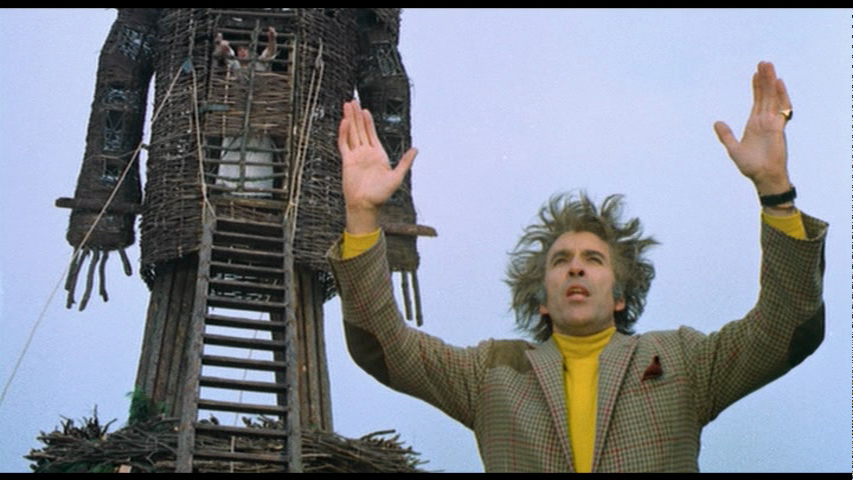
Beltane creeps up unnoticed.  Not an official holiday in these parts, it is, hopefully, a sign of slightly warmer weather than we’ve been having in April.  It’s also the day that I can’t help but think of The Wicker Man.  One of the early intelligent horror offerings, it came out 49 years ago.  My book on the movie, as far as I know, is still scheduled to come out next year, on its fiftieth anniversary.  Watch this space for further announcements.  In any case, today I have a piece on The Wicker Tree—the “spiritual sequel” to the movie, appearing on Horror Homeroom.  Societies in old Europe tended to celebrate this as the beginning of summer, which explains why Midsummer comes half-way through June.  The seasons aren’t always the same in all times and places.

In Germanic countries, Walpurgisnacht, which began last night, was a time of concern about witches.  Our modern calendar tries to concentrate our fears in late October, but they are appropriate any time of year.  These days Beltane’s more of a day when we expect warmer weather to start rolling in and perhaps, especially this year, hopes for peace.  May tends to be a hopeful time—it’s a transition.  The persistence of our fears suggests that learning to deal with them might well be a good idea.  Instead of hiding monsters away, why not face them?  The Wicker Tree isn’t a great horror movie, but something holds true for it—the monsters are us.  In that film capitalism is the real horror.

What makes The Wicker Man the classic that it is is religion.  More specifically, the clash between religions, neither of which is willing to yield.  This is largely behind religious violence throughout history, up to the present.  Religions convinced that they’re the only possible way to the truth can’t recognize that believers of other religions feel exactly the same way.  Yet May is about transitions—one season giving way to another.  It’s part of the inexorable change that marks life on this planet.  We may not fear witches in the mountains any more, but we still fear what’s out there.  Beltane is a hopeful holiday—a day of blessing animals and building fires to encourage the strengthening sun.  Instead of making it a day of clashing beliefs, perhaps we should look for our common humanity in it.  Perhaps we can learn a deeper lesson from The Wicker Man.


Ode to Books

There are fewer things more personal.  Each one has a story and it reveals quite a lot about you.  Really, it’s a brave thing, putting your books out on a shelf for others to see.  Seldom have I read a book more euphoric about a book than Alberto Manguel’s The Library at Night.  A deeply literate book collector unashamed, Manguel takes the reader on a pleasurable tour of many aspects of libraries, including his personal one.  Libraries may represent many things because books are so varied.  Many of us who are bibliophiles are used to trying to justify our libraries to those who don’t care to read or to complaining movers threatening to quit.  Or even to those who write books claiming other books are clutter.  Manguel understands.

Those of us with many books but little of anything else can tell you the story behind most individual books we have.  Where we bought them and why.  Why we’ve kept them even if we haven’t read them.  Manguel understands that not all books are reading books.  There are reference books.  There are episodic instructional books.  There are books laid up against retirement or incapacitation.  Books for work, books for play.  Books bought to help you prepare for that event that never took place but might, in some remote future, still happen.  Yes, books take up space, but so do pets, furniture, and children.  There’s a cheerfulness to rooms with books, unrivaled even by elegant spaces.

On a recent dentist visit the television was set to one of those shows where a couple is given their dream home.  I’ve watched those before in other waiting rooms and medical facilities and one thing I’ve never seen is a couple saying, “I want a home to fit my books.” And yet those homes with books occasionally make the news and garner thousands of clicks on the internet.  Those of us who are bibliophiles know we’re a minority.  Some of us actually enjoyed those high school reading assignments that so many of our classmates despised.  Our educational system, undervaluing teachers as we do, often fails to inspire the love of reading in the young.  Manguel’s book is for those who were inspired, who remain inspired by books.  Those of us who categorize and move them around.  Take them with us.  Who love them.  The Library at Night is a beautiful book full of wisdom.  It is a love letter to books. Happy National Independent Bookstore Day!


Words and Belief

Why do we care so little for the poor?   Part of the answer is surely the misguided idea of meritocracy—if you merit good you will be successful.  This kind of thinking emerges from the wrong end of a bull.  There may be poor people who are lazy but the vast majority of the poor are those for whom our systems make it impossible to thrive.  It’s very easy to put them out of mind as long as we can keep them out of sight and just let our prejudices do the thinking for us.  The poor are the victims of capitalism.  Loud voices proclaim them to be a drain on the system, despite the fact that many of them work—some multiple jobs—and remain unable to keep up.  Capitalism is kind only to the wealthy.

The Rev. Dr. William Barber is one of the organizers of the Poor People’s Campaign.  The full name is the Poor People’s Campaign: A National Call for Moral Revival.  The initial part is taken from an initiative that Martin Luther King, Jr. started before his assassination.  He was shifting towards a movement meant to address the entrenched unfairness deep in American society.  These nearly six decades on, we are just as deeply entrenched.  Barber is doing amazing work, organizing, speaking, and advocating.  He’s trying to give a voice to the people.  I do wonder, however, if using the word “Revival” doesn’t work against the goals of the movement.

Certain words have been poisoned by their abuse among various religious groups.  Especially among the young.  The word “revival” may fall into that category, calling to mind, as it may, repressed people working up to an emotional fever under the banner of Hellfire and brimstone.  Believing a bit too literally a message that was contained in a book viewed magically.  Names can be important.  Many of the younger generation are put off even by the word “church” since so much hypocrisy (something the Republican party has openly embraced) has come to light over recent decades.  I fully agree that we need a moral revival, we need people to wake up and demand that our government promote the justice it claims to seek.  I do wonder if religion, as previously packaged, has the credibility to do it.  No matter how we take on the task, it’s clear that the poor have been abandoned by the system, through no fault of their own.  And some in the church have begun to find their voice in the Poor People’s Campaign.

Photo by Katt Yukawa on Unsplash

The Network

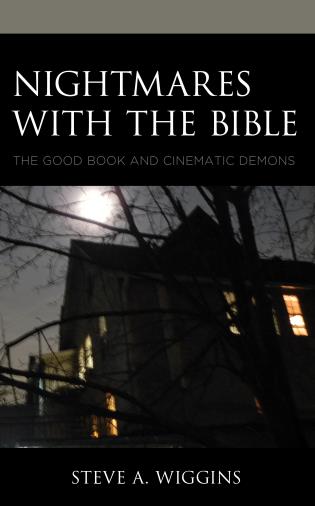
Although it’s not NBC, the New Books Network has quite a reach with academics.  That’s why I was glad they accepted my pitch for an interview about Nightmares with the Bible.  The interview is now live and can be heard here.  The experience of getting the interview made turned into quite a saga with my pitch going back to at least November, and acceptance coming early in January.  The actual interview was over a month ago and it was posted only yesterday.  I’m not naive enough to think it will boost the sales of a hundred-dollar book, but maybe a few more people will become aware of it.  Even in academia there are too many books published for all of them to get notice proportionate to the work that goes into writing them.

Some publishers are of the opinion that editors shouldn’t try to be authors.  Obviously I disagree on that particular point.  Author-editors share the ups and downs and know what it’s like to put in the work only to have a book disappear.  I haven’t received any royalties at all for Nightmares.  I have no idea how many copies have sold.  Many writers publishing into the teeth of a pandemic fall into the same category.  While trade books—including fiction—did remarkably well during the height of Covid-19, academic books languished.  Nightmares is, of course, its own kind of hybrid.  A monster, if you will.  Written for educated laity it’s packaged and priced for the academic monograph market.  That’s why I pitched it to NBN.  I’m glad to see the recording is now available.

Nobody writes this kind of book to get rich.  I’ve had friends ask me why I bother.  Believe me, that question occurs to me too.  Some of us have something to say but the auditorium’s empty.  The Bible’s at a low point outside a specific cross-section, and that cross-section generally doesn’t pay attention to horror.  Of course, that’s another reason I do this.  Bringing opposites together offers the world, even the staid academic world, something new.  Horror is at last being taken seriously by literary and cinematography scholars.  Some biblical scholars are realizing that apart from comforting words of love, and towering demands for justice, the Bible itself contains plenty of horror.  When unlike things mix, monsters are born.  I’m grateful to the NBN for taking a chance on my book.  If you’ve got some time, and the inclination, you can listen in here.