Who’s It For?

I suspect editors see this all the time.  I also suspect that I’ve unknowingly participated in it as well.  If you’re a book writer, you have to be clear of your readership.  As an academic editor I receive many proposals for books that either cry for popular treatment, but are too academic, or books that are written for laity on topics of interest only to academics.  A writing life is a struggle to find that correct balance.  Particularly for your typical academic.  You see, doctoral programs don’t generally include instruction on how publishing works.  Or in writing.  It’s assumed that any string of 100,000 words from a credentialed expert is worth publishing.  Worse, as Steven Pinker has pointed out, academics are rewarded for writing poorly.  No wonder people are confused!

Lately I’ve been on a kick about people not paying attention.  It is important to observe.  When writing a book it’s important to gauge who might want to read your potential book.  Indeed, this is something seldom asked early enough in the process.  Who is this book for?  Will they want to read it?  You see, we have this lone ranger attitude to book writing.  In actual fact, most books you see in bookstores are the clear result of teamwork.  Yes, authors do most of the writing.  In many books editors do quite a bit of the fixing of the writing.  Agents, marketers, publicists, sales reps—there are a host of people behind successful books.  It’s easy to think, while writing, that your book will be a bestseller, no matter how academic.  That you will see it in Barnes and Noble and point it out, ever so casually, to your friends.  That it will sell for less than $20.

It’s important to pay attention to what other people think.  We’re all busy, I know.  We have our own lives to live and plans to enact.  Who has time to bother thinking about who might read their book?  Obviously, other specialists such as themselves.  But how many people is that, really?  With the sheer number of books published each year, are there topics that will draw in thousands, instead of hundreds (or less) of buyers?  Writing a book naturally makes you think the topic is important—vital, even.  It’s easy to transfer your personal interest onto the masses.  My advice, for those few who ask or care, is to think carefully about who you wish to reach.  Be honest with yourself.  And try to think from the point of view of somebody else.


Cover Copy

If you’ve ever wondered why the same images appear on book covers over and over, there’s a fairly simple explanation.  (I should specify, by the way, that I mean academic press books.  The pockets of trade publishers are apparently bottomless.)  For many in the humanities the choices come to the same set of classical paintings that are out of copyright.  Now, in a capitalist system, copyright is a necessary idea.  It protects those who create intellectual property from being taken advantage of.  Their work is treated like a physical object, so an accurate image of a painting is the same as the painting itself.  But if you’ve ever been to an art gallery you know that’s not exactly true.  Art galleries show us that being in the presence of the real thing is different than seeing a reproduction.  But I digress.

Books are not only recognized by their covers, but sold by them.  It’s a strange industry and part of the reason why goes back to one of those eye-glazing-over court cases involving (yawn) taxes.  In 1979 the Supreme Court ruled that companies could no longer devalue old stock for tax purposes.  This was the Thor Power Tool Company v Commissioner case.  The court ruled old stock had to be assessed at value.  While this was about manufacturing, it deeply impacted books.  Publishers now had to destroy old stock (and books are printed in quantity) or face heavy tax consequences.  This led to books being pulped much more quickly than usual (they could then be written off as losses) and directly impacted the book cover.

Despite the old adage, every publisher knows people do judge books by their covers.  Since 1979, extra care has been given to covers to make books sell quickly, and in significant numbers.  Now granted, your nuts and bolts will still be useful in future power tools, but books sell differently.  A typical book has a three-year lifespan.  Sure, there will be those (like yours truly) who’ll buy a book that’s been out for a while, but most books are considered dead after year three.  That old stock is a liability and pulping is common.  It seems an inglorious end for such a noble product.  Not to mention wasteful.  Academic books have similar covers because copyright images are often too expensive to license for covers.  Constantly publishers have to guess as best they can how many copies will sell because old stock is too expensive too keep.  Print on demand has changed a lot of things as well, but that’s a different story.   Covers still do count.


Ephrata Cloister

Conrad Beissel isn’t exactly a household name.  I never heard of him until a visit to Ephrata Cloister during a Lancaster staycation.  My wife knew about the Ephrata Cloister due to a music course she took at the University of Michigan; he was influential in developing a distinctive musical style.  Since we were in the area we stopped in for the tour.  Beissel was banished from what would become Germany in the early eighteenth century.  He made his way to America where he established a kind of monastery in south central Pennsylvania in the early 1700s.  Not Catholic, he was inspired by German Pietists, the Anabaptists, and Christian Mysticism.  Not ordained, he established what became a Seventh-Day Baptist association because whenever he tried to settle as a hermit others came to him.

Celibacy has always been a hard sell for religions.  Once his Camp for the Solitary was established, it grew to about 300 members, with only some 80 celibates, or solitaries.  This 80 was half men and half women.  They built around 40 buildings in what was then the frontier and they couldn’t have survived without the 120 or so married people who joined the church but continued to live at home with their families.  Like many separatist groups, the Seventh-Day Baptists were expecting Jesus’ return at any day and lived their lives accordingly.  Not strict about others joining him in this, Beissel was an early vegetarian, eventually becoming primarily a vegan (although that name wouldn’t develop for a couple centuries).  They had midnight worship services since they believed Jesus would return in the middle of the night.  They were, with the supportive families, self-sufficient.  The group established a printing press, and at one time it was possibly the largest printing operation in the colonies.

After Beissel died, the community continued.  They realized that, like all celibate communities, it would be difficult to survive and the celibacy rule was dropped.  The last celibate member died in 1813.  The community by then had taken on the form of an independent church and it survived until the 1930s.  The remaining land—some of it had been sold off over the years as the community shrank—was bought in the early forties to be preserved by the state.  Theirs was never a very large group, but it was significant enough that their memory was felt to be important enough to preserve.  Beissel wasn’t alone in establishing such sects here in Pennsylvania.  The tradition is, interestingly, part of the American heritage and demonstrates how the religious, ordained or not, live in their own worlds.


Life Writing

It’s sometimes thought that a writer’s life is easy.  What’s so difficult about scribbling things that people will pay for?  I’m absolutely certain that, like most systems, this one may be gamed.  Amazon has made it quite easy to slap together words and covers and sell them alongside literary giants.  Only time will tell those that endure.  Most writers, apart from those who achieve early success (capitalism loves nothing so much as a repeat source of money), hold down other jobs.  Many of those jobs don’t involve writing, so those with literary ambitions must carve out time from their busy lives to write.  Not only that, but to write well you have to spend a lot of time reading.  Think about your daily life—how often do you have time to curl up with a good book?  Sure, you can read on the internet, but that’s not the same thing.

I love reading about writers.  Often they had struggles to overcome and many remained obscure as writers until after they’d died.  (At least that takes some of the pressure off.)  Someone saw there was money to be made in what they left behind.  Knowing quite a few writers, I suspect most of them really wouldn’t mind that.  Recognition during your lifetime must be nice, but writers tend to have a longer view.  That’s why things are written down, and, against hope, published.  Literary ambition can be a mean dog indeed.  Especially when the lawn requires mowing again and those invasive trees need constant trimming and gee, why didn’t we buy that house with no yard?  Many writers had even greater struggles to overcome.

Image credit: George G. Rockwood, via Wikimedia Commons

When reading, I’m constantly discovering new old writers that I missed.  I didn’t grow up in a literary family.  I find them by reading other writers and, perhaps more importantly, reading about other writers.  Who influenced whom.  Many remained obscure.  Although it’s only an estimate, 2.2 million new titles are published each year.  Readers are, and always have been, a minority.  Most people don’t read for pleasure.  That makes sense, given that we haven’t evolved for that.  Survival involves working for sustenance and mowing the lawn or shoveling the walk when you’re done with work.  A clueless professional once asked me “Why don’t you hire a service?”  With what?  My royalties?  Sacrifice is an inherent part of writing.  Whether it’s the neighbors thinking you’re a trashy yard-keeper, or you boss wanting you to spend more hours on the clock, or cheating sleep night after night, a writer’s life isn’t for the fainthearted.  That’s why they inspire me.


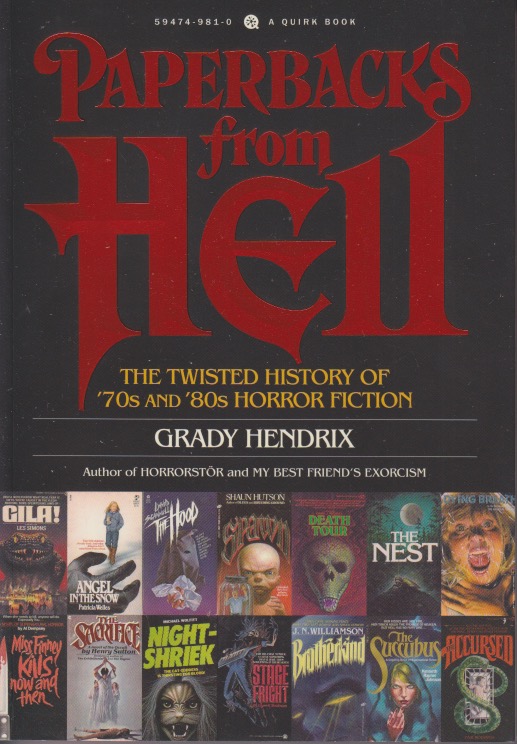
Paperback Nightmares

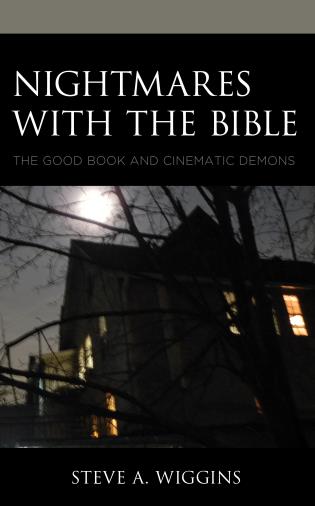
I’m not assertive.  My voice is not loud and even when I have strong opinions I like to let others have their say.  Those of us who’ve been beaten down too many times can be like that.  So it took a lot of courage to ask.  “Is it possible that Nightmares with the Bible might be issued in paperback?”  You see, I know that “academic” books almost always sell the copies they’re going to sell in the first year.  Some follow-up sales continue into years two and three, but beyond that it’s about done.  And I also know that when authors ask for a paperback it almost never sells as well (or even more poorly) than the hardcover.  I’m hoping the paperback of Nightmares will buck this trend because it published into the pandemic.  That was a game-changer.

When you’re worried about staying alive you might not feel like reading about demons.  Of course, what better time to do so is there?  Paperbacks are often produced, in academic settings, to appease authors.  I have long believed—and this flies counter to the orthodoxy of the publishing world—that if books were initially published in paperback and priced affordably they would sell better.  The fear is that the higher priced hardcovers wouldn’t be purchased by libraries.  Librarians would, oh tremble, purchase the reasonably priced paperbacks and rebind them for less expense than the stratospheric price put on a 208-page monograph.  Publishers are often afraid to try anything different.  Assured sales are a blessing that can be bankrolled.

I’m hoping, once the paperback comes out, to do some more promotional work on it.  This blog was started long before I had books to flog.  It’s free content for those who like the less sweet kinds of treats in the bowl.  I do appreciate the occasional free advertising I can do.  It’s my hope that there’s always something to learn offered with it.  Successful content providers can make a living doing it.  Others pay for the privilege.  I often ponder what will happen to this blog when I run up against the size limits of my WordPress account.  The next level up, commercial, is beyond my price range.  Perhaps, like a phoenix, it will be time to start all over again when that moment comes.  In the meantime I’ll reuse images as often as I can, because each new one takes a byte out of my account.  And when it’s all said and done, Nightmares will still be available in print. Hopefully in paperback next year.


Paper not Paper

I’m sure other people have this problem.  I read hardback books with the dust jacket off.  Lest anyone accuse me of being consistent, my wife reminds me that I debated the opposite side early in our marriage.  I guess I’m complex.  In any case, the problem I face is with things pretending to be what they’re not.  This particular book is “cloth-bound.”  I own quite a few cloth-bound volumes, but this one is so slick that I keep dropping it.  It slips right through my fingers.  The reason this happens is because “cloth-bound” seldom means “cloth”-bound.  Modern binderies offer a textured paper covering that looks like cloth but it’s not.  In other words, although this book is not a paperback, it has, in fact, a paper back.  This is more than just semantics.

When looking for a house one of my non-negotiables was that it couldn’t have vinyl siding.  Vinyl siding pretends to be wooden cladding, and I require authenticity.  I don’t want a substance saying it’s something that it’s not.  You see, I grew up in a plain-speaking, blue-collar environment.  The last time I visited my mother’s trailer to get something from her former neighbor who’d moved in, it was summer.  I stepped out of the car and although I’d said maybe less than two sentences to this man in our meetings over the years his first words to me were “What are you all dressed up for?”  A bespectacled, white-bearded veteran, he was wearing a tank-top tee-shirt.  I had on a button-down that had been recently laundered.  I loved his authentic approach.  It was hot out, so why was I “dressed up”?

Book-binding actually has a fascinating history.  Books were originally sold as sheaves of paper in a “book block.”  In the early days booksellers often did the binding themselves, or customers would buy a book block and take it to a bindery of their choice.  That’s why there’s no uniformity in old book covers.  Eventually, however, mechanization allowed for books to be bound before being shipped to book sellers.  Early binding tended to be leather, which is why many Bibles are still sold that way.  I found all of this out from reading various books.  Which ones they were have slipped my mind.  Probably they were bound in paper, pretending to be cloth.  Cloth binding is more expensive than paper-pretending-to-be-cloth binding.  That’s why publishers use it.  The same applies to vinyl siding, I suspect.  Only with human beings does pretend authenticity become more expensive.  


Slow Running

It’s extremely slow.  In fact, you might think nothing is happening at all.  I mean the book publishing process, of course.  It takes a long time to read 60,000+ words.  Even longer if you’ve had a few poor nights of sleep.  And many people have to read it before it gets anywhere near a printing press.  Everything about writing a book takes time.  While everything in the outside world happens at an unbelievable pace—last year at this time there was no war in Ukraine, for example—the slow process of organizing thoughts, putting them into words, sending them to a publisher who has many, many other proposals and manuscripts to consider, getting it rejected once or twice, finally finding a publisher, making the requested changes, getting it copyedited and typeset, getting the files sent to one of the few domestic printers left (who have tremendous backlogs), then to the bindery, and finally shipped out to the warehouse—it takes years.

Centuries of work

Current events publishers can rush things through and it often shows.  Meanwhile the authors of all other books learn to wait.  And wait.  Often the payoff isn’t great.  (I’ve received no royalties at all for Nightmares with the Bible.)  So why do we do it?  Those of us compelled to write have many motivations, I suppose.   One is to expand human knowledge.  We’ve discovered something and we want to share it.  We want to inform and entertain.  Those of us who write fiction also hope that our ideas may speak to others.  Having the fiction piece accepted is a validation of our outlook and experience.  Those who do so well may be inflicted on future literature classes.  I still remember The Loneliness of the Long-Distance Runner by Alan Sillitoe.  We had to read it in twelfth-grade English.

None of my friends liked it.  It was a collection of short stories by Sillitoe, titled after the one story that is still his only real claim to fame apart from his novel Saturday Night and Sunday Morning.  The tale of an English boy’s alienation didn’t speak to the rural western Pennsylvanians of the late seventies.  One of my classmates disliked it so much that he drove his pencil through the runner’s image on the front cover in a kind of uncouth performance art.  Now as I experience trying to get short stories published (with a little success here and there, but no royalties), I can feel for Sillitoe.  Still, “The Loneliness of the Long-Distance Runner” was made into a movie and has quite a few cultural references pointing its way.  Long-distance running, like publishing, is sometimes a slow process.  And at times you decide not to finish the race.  Or at least realize this race may last for years.


Masking the Devil

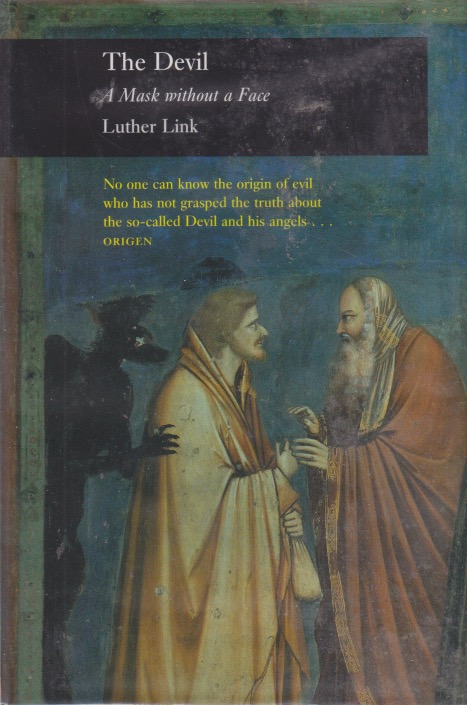
There are many books on the Devil.  In fact, entire horror movies such as The Ninth Gate are based on that fact.  Since writing a book on demons (Nightmares with the Bible), I read a few of the many.  I’ve continued to read some further since, and one of them is Luther Link’s The Devil: A Mask without a Face.  The first thing to note about this book is that it is the same as The Devil: The Archfiend in Art from the Sixth to the Sixteenth Century, as it was published simultaneously in the United States.  (The former was published in the United Kingdom.)  Many authors don’t realize that when you sign a publishing contract you’re selling the rights (the copyright) for your book.  Some publishers or agents will sell the rights in different territories to different publishers.  They don’t have to use the same title largely because, prior to Amazon it was difficult to buy UK published books in the US and vice-versa.  Now a lot of “buying around” happens so books published anywhere can be purchased anywhere.  (Except in authoritarian states.)

In any case, this book is a study of the Devil in art.  The UK subtitle, A Mask without a Face, focuses on the conclusions drawn, whereas the US subtitle is more descriptive of the contents.  There are a number of interesting points made by Link.  One of the most important is that of his conclusion—the Devil, in the biblical and theological worlds of the long Middle Ages, really isn’t so much a character or “person”as a representation of “the enemy.” His looks and actions depend on the circumstances.  As Link points out, to the Pope Luther was inspired by the Devil, to Luther the Pope was inspired by the Devil.  Both, Link concludes, were dealing with a mask without, well, a face. Further, since the Devil does God’s bidding, whether he can be considered evil or not must be questioned.

Another interesting point is the strange continuity and lack thereof that characterize the representations of the Devil.  Some of the continuities go back to an antiquity (such as ancient Mesopotamia) that had by lost by the Middle Ages.  There was no real avenue of transmission since who remembered Humbaba after the tablets of Gilgamesh had been buried for centuries?  This seems to point to what Jung would’ve considered archetypes.  Or it could be that the same things scare people across the ages.  The point of the book isn’t to be comprehensive, but it does make a good point.  Anyone accusing someone of being the Devil opens themselves to the exact same charge.


Leathers

It’s an occupational hazard for the vegan Bible editor.  Leather.  Leather Bibles, although expensive, are popular.  If you want free fetishistic deliveries of colored leather to arrive at your door, well, it’s part of a Bible editor’s life.  Morally I’m opposed to leather and I eagerly await the day when cactus leather is considered a suitable alternative.  Leather began being used in bookbinding early on, when books were treasured possessions.  It was readily available because animal slaughter was a part of everyday life.  It’s also extremely durable.  These days it’s just a status symbol.  When Bibles are produced there’s generally a market for whatever translation in leather.  In my time I’ve seen some well enough used to perhaps justify such extravagance, but not very often.  Usually it’s merely for show.

There’s an entire vocabulary associated with leather bookbinding.  Tooling, or engraving the smooth leather to look like something else, embossing, or pressing a design in the leather, gilding, or the use of gold paint on leather, and dentelle, or having a border run around the outside edge.  All of these were (and still are) signs of the artistry of the binder.  The practice dates back to before the nineteenth century when books were bound by booksellers, not publishers.  Perhaps this is why we shouldn’t judge a book by its cover.  In any case, apart from tradition there’s no need to kill animals to bind books any more.  Law books and Bibles are the major purveyors of leather binding.  It continues simply because it continues.

One term used for traditions unwilling to change is “hidebound.”  While this seems originally to have referred to emaciated cattle, it has come to be associated with codified, as in leather books.  Pigskin, or other cheaper hides, are often used.  Or “bonded leather,” which is as much plastic (if not more) than actual leather.  The Bible isn’t a terribly animal-friendly book.  Dogs are unclean and cats aren’t mentioned at all (except the large, wild kinds).  Yes, there are shepherds—both good and bad—but sheep were kept to be exploited.  And perhaps turned into leather.  There’s something strangely symbolic about this.  And not in a propitious way.  Where does obeying the rules get you?  Sheep are praised for their docility, their willingness to be thoughtlessly exploited, slaughtered, skinned, and eaten.  To do the job, a Bible editor must learn about leather.  Perhaps its a profession best left to carnivores.


Underestimated

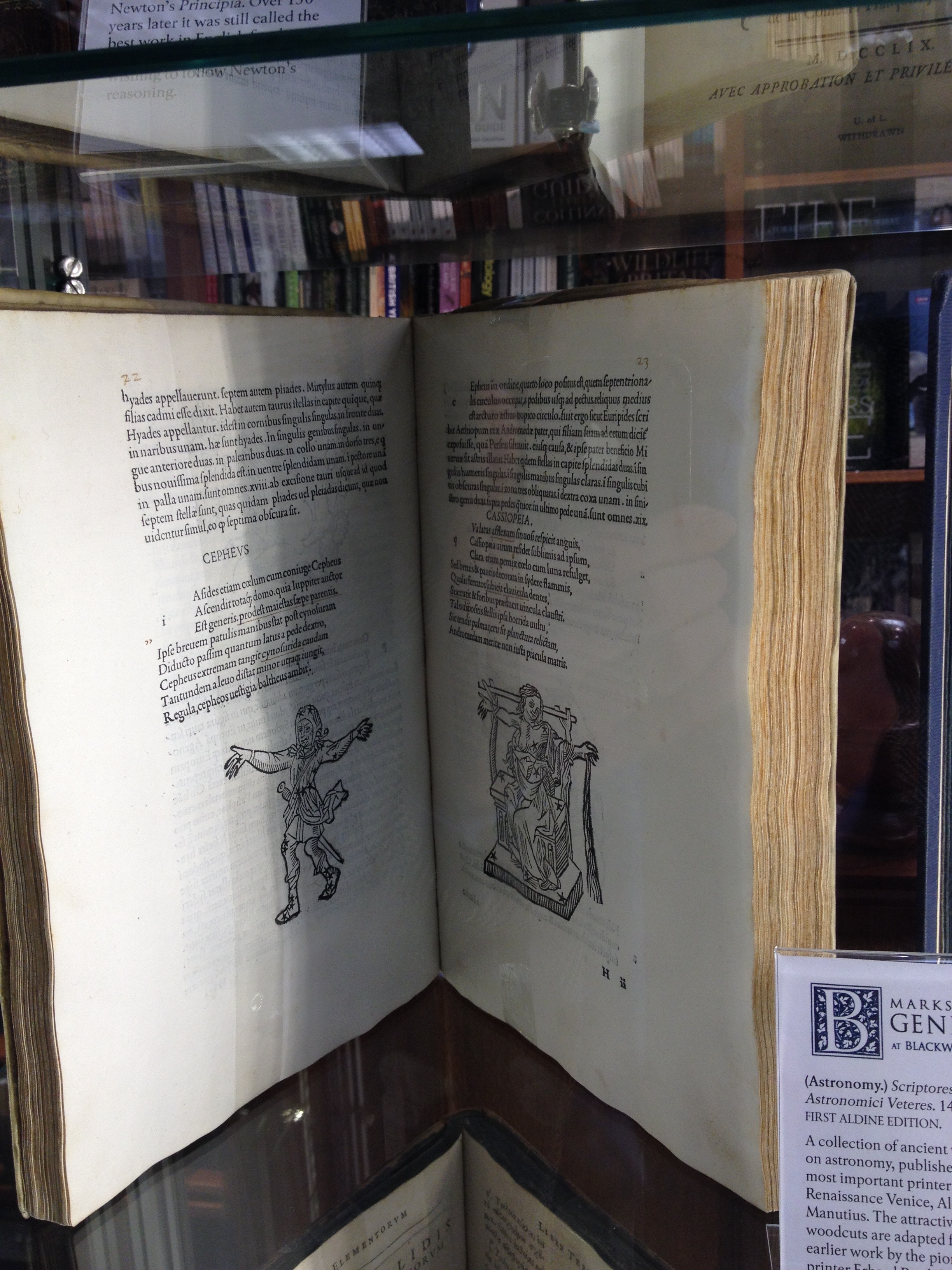
Under-printing, ironically, can create great demand.  Books are generally under-printed because publishers don’t see much of a market for them.  Back before the days of inexpensive print-on-demand (POD, in the lingo) books may not have even existed as electronic files.  Often a publisher won’t print a book unless it anticipates that it can make back its costs.  If they think it won’t sell that well, they’ll print just enough.  And they might even melt down the typeset plates to reuse them for other books.  I’m not sure if that happened in the case of a book I’ve been looking to consult, but something has made this under-printed book extremely rare.  It’s not on Internet Archive.  WorldCat shows it in only two libraries world-wide, the nearest one over 3,000 miles away.  Its price used (and there seems to be only one copy) is $46,000. I can’t tell you what it is because you might buy it before I can.

For the purposes of my research, this is actually the only book on this particular topic.  (The subject isn’t even that obscure.)  The book is cited everywhere this topic is mentioned, and at least one person on Goodreads has actually seen a copy of it.  I have to conclude that all those who cite it must live within driving distance of one of two libraries worldwide.  For the rest of us the book is simply inaccessible.  As an author this is one of the worst fates imaginable.  Even if some price-gouger is selling a copy for $46,000 the author gains nothing from it.  Royalties are null and void for used book sales.  The only profiteer is the person who happens to have found a rare book (from the 1990s!) and is determined to ensure only the most wealthy will be able to purchase it.

I’ve known people who sell used books online.  Those who want to move books try to undersell the unfortunate under-printed title by pricing a bit lower than the competition.  There is no regulation, however.  You can charge whatever you like.  The funny thing is, if someone eventually forks over $46,000 for this book, and then has it appraised (it is a paperback from the 1990s), its actual worth is probably at most in the hundreds of dollars.  Back when we watched the Antiques Roadshow we always knew that the poor person who brought in a book would be disappointed in the appraisal.  Last time I was in Oxford I saw rare books from the 1400s for sale for far, far less than $46,000.  I only hope that my books, as obscure as they are, are never deemed that expensive.  And I would encourage publishers to print a bit more generously, for the sake of knowledge.


Living Right

Horace Liveright had an outsized influence for his somewhat foreshortened years.  Initially a bond trader, he eventually moved into publishing where he founded the Modern Library as well as Boni and Liveright.  The Modern Library still exists, now as an imprint of Random House.  Liveright ceased publishing operations eventually, but the name was revived as an imprint of W. W. Norton.  There have been many publishing Wunderkindern, including Richard L. Simon, co-founder of Simon and Schuster (and father of Carly Simon), and the Scot William Collins whose name still appears in HarperCollins.  While reading about Liveright recently I learned that he also was responsible, in an unexpected way, for the development of the horror film.

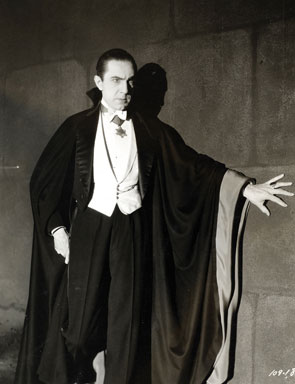
Liveright never worked in the film industry.  He did, however, work as a stage producer in New York in the 1920s.  Among his most successful works was a play titled Dracula.  It starred Bela Lugosi and Edward Van Sloan as Dracula and Abraham Van Helsing, respectively.  The success of the Broadway show caught the attention of Hollywood and Lugosi and Van Sloan were cast in the same roles in Tod Browning’s Dracula, widely considered to be the first horror film, released in 1931.  Van Sloan went on to appear in Frankenstein as well, and Lugosi reprised his Dracula character as well as several other monsters.  It’s possible, perhaps likely, that horror would’ve begun with some other entry into the genre, but as history stands Dracula, based on Liveright’s stage production, started the whole thing.

Unless we work in it, we tend not to think about publishing too much.  We don’t pay attention to the publisher of the book we’re reading, and who lingers over the copyright page?  Giving a thought to these details, however, often adds new stories to the ones between the covers.  A fellow editor is fond of saying that books are as much about the author’s story as they are about the story the author’s telling.  The press, for example, often focuses on the former.  Who is it that wrote this book and why?  The question may be extended further—what publisher took it on and how did they even get into the business of deciding what people will read?  The internet has democratized that quite a bit, of course, and some authors can become their own authorities by knowing how to handle it.  So I’m taking one such opportunity to highlight the work of a sometimes forgotten pioneer who nevertheless began a publishing venture from which we’ve all most likely read.  And he also helped created the horror movie.


Keeping Categories

Writing books about movies with a limited budget presents some challenges.  Our subscription to Disney Plus doesn’t really help with the horror genre, but my wife insightfully added Hulu to the package.  Now Hulu isn’t known as a horror streaming hub, but they do have some movies on my viewing list.  The other day I noticed one of their offerings with a title I didn’t recognize.  I  tried searching it on IMDb and came up with nothing.  A bit more research revealed it was an episode of an original Hulu series, mixed in with the horror movies.  The eroding of categories bothers me a bit.  It’s not just Netflix and Hulu and Amazon with movies, but it’s across the board.  I grew up when movie and television were easily distinguished.  Now we live with hybrids.

The same is happening in publishing.  When I sit down to write a book I have a specific end-goal in mind.  Everyone knows what a book is, right?  Well, the future of publishing is all about breaking that down.  Already years ago you could purchase aggregates for classroom use.  These were custom-selected chapters from certain books (electronic, of course) that an instructor could bundle into a “textbook.”  You could mix in articles, blog posts, anything to which you had the rights.  Such a textbook is not a book.  Nobody set out to write it in that form.  It looks like things are moving more and more in that direction.  You’ll be able to purchase just a chapter, or even a paragraph, to use.  Even if the book only makes sense when taken as a whole.

The electronic era is all about breaking down what civilization took centuries to build up.  Not everything about civilization has been good, of course.  It has been patriarchal, treating women unfairly.  It has been supremacist, treating those less technically developed in horrendous ways.  It has been classist, favoring the rich and their interests over those of the vast majority.  Still, it has left us some good legacies—the book, the symphony, the movie.  Such things have made us better people.  It may be fine to break such things down—who knows?  Maybe it will create more fairness for more people.  It won’t help me, however, when I’m trying to write a book about movies.  You still have to know what counts for each category, even if you have to do so on a budget.


Getting Used

Unknowing is a blessing in disguise sometimes.  There is so much to learn and, regrettably, little time outside work to do it.  Books are my life.  I work in publishing, so I know a passable amount about the book business.  I have much still to learn.  To support my research, which doesn’t include a university library, I often have to purchase academic books.  I know quite a bit about academic book pricing (hint: what the market will bear), and I know that it’s assumed academics have university professor-level salaries.  The “independent scholar” is as much a ghost as the next revenant.  So I buy books used.  The best clearinghouse I know of is Bookfinder.com.  They list other sellers who have the book and facilitate your buying of it.  I strongly suspect they take a small cut.

While looking for an obscure book (it pains me to say, for I met the author), I wondered if Amazon’s used copy had the lowest price.  So I went to Bookfinder.  The Amazon copy was there, along with seven comparably, slightly lower, priced other copies.  Reading the descriptions, I realized these were different vendors hawking the exact same copy of the book.  Some of the description wording was oddly specific and that led to this epiphany.  Down at the bottom was a lone seller some $4 to $5 dollars cheaper, selling the book directly.  Navigating to this page I discovered it was the self-same book—the same physical book being marked up by the other vendors.  Each reseller along the way, with wider reach, stopping at Amazon with the widest reach, was charging a finder’s fee for this same object.  It was available directly from the seller.

Used books are a thriving business.  Many publishers these days are focusing on “the electronic future,” scratching their heads that people are still reading paper.  What will happen to walking into that impressive library?  Have you ever walked into someone’s impressive iPad or Kindle?  It looks the same no matter how many electrons you add.  The internet has been taken with the photo of the late Johns Hopkins humanities professor Richard Macksey’s library.  Would it be possible to have walked in there and not been impressed with the obvious love of books?  As a Hopkins professor I doubt he had to resort to used books much, but I kind of think he probably did anyway.  Bibliophiles are like that.  A first edition is a thing of beauty forever.  And so I find myself on Bookfinder and I’m willing to give them a cut just for the privilege of holding a coveted book.

Richard Macksey’s home library. Credit: Will Kirk/Johns Hopkins University

Investigating Investigators

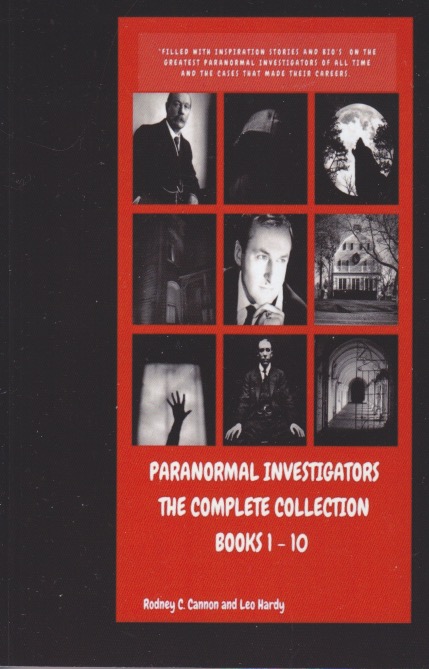
I firmly stand by my earlier assertion that you can learn a lot from reading badly written books.  It’s difficult not to attribute motives (particularly of the pecuniary kind) to a book apparently hastily written and self-published.  But still, but still.  Writing even a short book takes quite a bit of effort.  One thing that came through in my reading of Paranormal Investigators: The Complete Collection Books 1–10 is that Rodney C. Cannon and Leo Hardy have a legitimate interest in the topic.  Not everyone has the facility with wordsmithy that makes for pleasant reading.  Not everyone has years of research training.  Still, there were moments of eye-rolling and actual out loud snorting that accompanied reading this one.  It continues some useful information, but all of it will need to be double or triple-checked.

My reason for reading it is the dearth of good information on controversial figures.  This has bothered me for some time.  Academia tends to pretend figures such as Ed and Lorraine Warren, Hans Holtzer, and Montague Summers simply don’t matter.  The fact is they have very wide followings and they share the feature of being self-taught in the field of ghosts and/or monster studies.  I knew this book was self-published (itself a warning sign, but then many credible authors self publish because it’s nearly impossible to break into the commercial publishing world).  I had hopes that it was simply because publishers don’t like to take chances on authors without a platform, without household name recognition.

The book is, however, poorly organized and repetitive.  The grammar is bad enough to make an erstwhile teacher such as yours truly pull out his truly’s hair.  And yet there is information here.  I can’t accept anything as factual from a book loaded with grammatical errors, very very few citations, and factual mistakes.  That doesn’t mean there’s nothing of value to be found in it.  In fact, I learned a thing or two (that I’ll need to confirm) that may help me in my own research.  And besides, it’s a quick read.  Given the constraints in the publishing world, we can all be forgiven for not automatically dismissing those who have something to say but who need to sidestep the standard publishing world to do it.  Amazon and others have made self publishing as simple as clicking a few buttons.  Who can be blamed for taking advantage of what others have wrought?  I learned something and that is, after all, the point of reading.


Literary Thoughts

A book is a physical object.  It is printed on paper and has a cover.  It has a publisher who undertakes to have it printed and bound (and with any luck, marketed and publicized).  This, I would contend, it what most authors have in mind when they sit down to write a book.  It isn’t just “content,” of which you can find far too much on the internet.  It is an object of pride that you can slot onto your shelf with a great sense of personal achievement.  It has taken a lot of work, and headaches, to get to this point.  Several months or even years of your life.  An idea that can’t be addressed in a couple dozen pages.  A book is born!

Publishers are more and more pushing the ebook, however.  The ebook is not a book in the same sense as a printed object is.  In some sense it may be more durable.  It’s certainly easier to get quickly.  But how do you get excited over writing an ebook?  Whenever I’m writing a book, there’s clearly an object in mind, not a cloud of electrons.  Ebooks have their place, but as people start talking about a post-literate future I start seeing visions of my own tombstone.  It gives me a strange kind of comfort to know that all of my books so far reside in the Library of Congress.  Some university libraries even buy copies.  Would a carpenter take pride in an electronic table she built?  Can you set your book on it?  If you don’t carve your “Kilroy was here” in stone, how will you ever prove it?

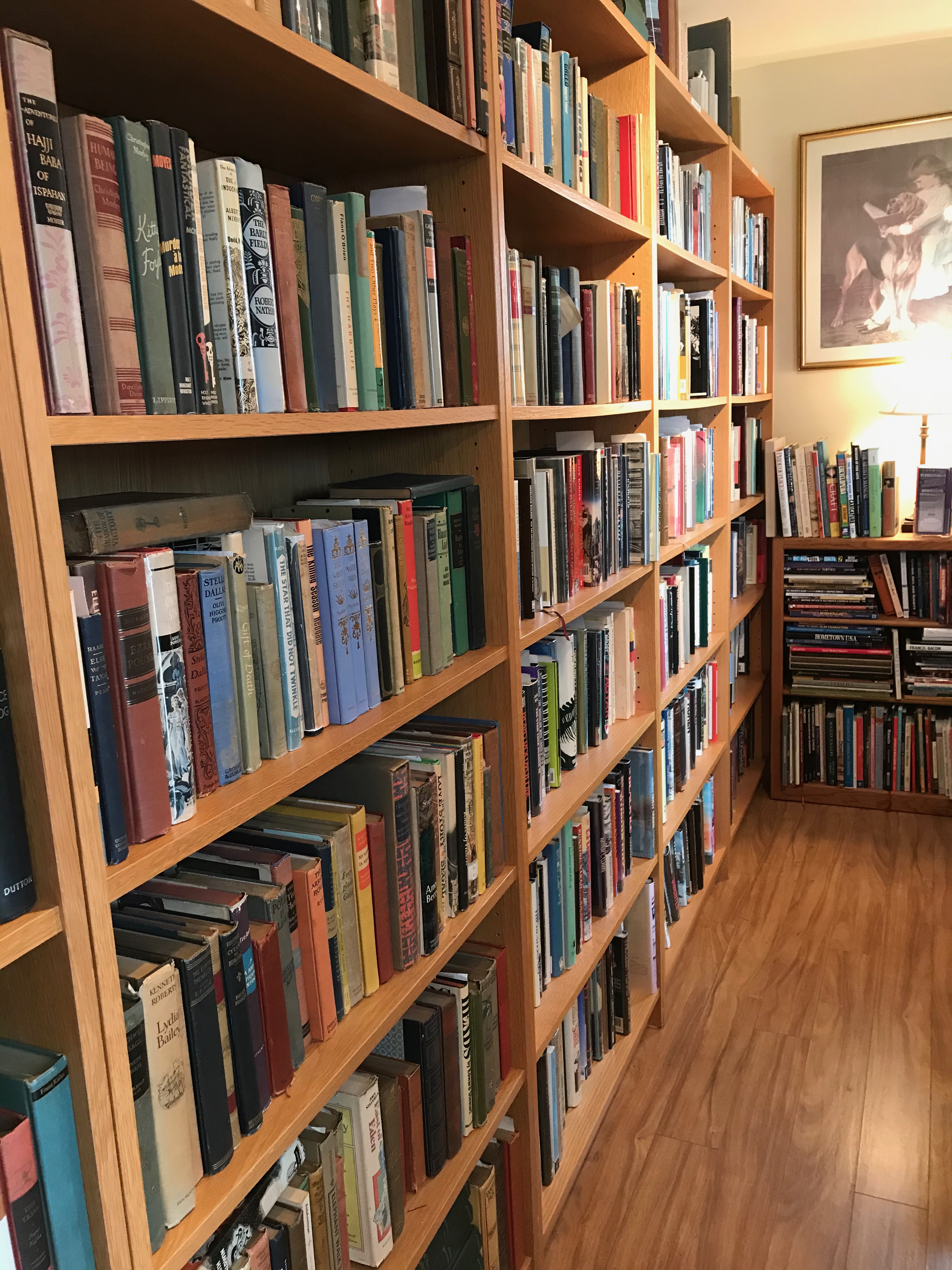
As handy as ebooks are, nothing matches the sensation of walking into a room full of books.  The sense of rapture is palpable.  Such rooms are monuments to our culture.  A screen with metaphorical tons of content may be a tribute to technology, but is any of it real without ink connecting with paper?  There’s nothing wrong with “content;” I produce some every day.  The thought process is different from book writing, however; just like the process of writing poetry differs yet again.  The publisher always looks at the bottom line.  (And I don’t mean the last line of a poem.)  And to keep “books” profitable the conversion to “content” seems attractive.  It breaks down, however, if writers no longer think in terms of books.  The book has a storied history and a long future, if we keep in mind that it’s something far more refined than mere content.