Mediating Reality

The brain is one troubling organ. The gateway to both our thinking and our physical experience—as well as our survival—it tends to explain things in terms of narrative. Human consciousness likes a good story. Experiment after experiment has shown that if the brain doesn’t know why you do something it will make up an answer. Consciousness is far from foolproof. Those who rely too heavily on rationalism don’t like to think about such things. Logically, if your brain can fool you then you can’t believe everything evidence seems to verify. Think about that. If you dare.

Psychology has sometimes received a bad rap among the sciences for not having empirical evidence to back up some of its assertions. “Freudian” is now used as much as a slur as it is a sign of the sudden insight that strange things constantly go on inside our heads. BBC Future recently ran a story by Melissa Hogenboom titled, “The woman whose tumour made her religion deadly.” The account regards a woman who came to the hospital with serious self-inflicted wounds. Although hackneyed, the voices in her head told her to do this to herself. Brain scans indicated a tumor at the point in her brain where auditory information and religious belief come together. Paging Dr. Jaynes! Now, I know this is over-simplified. I’ve read enough neurology to know that brain functions can switch from one part of the brain to another and that mapping this kilo-and-a-half universe is one of the the most vexing of scientific enterprises. Still, in this case, the implications were clear: the woman’s self-destructive behavior was connected, in her brain, to religious commands.

Many educated people in this post-Christian world rely staunchly on reason. I don’t disagree that reason is essential. I do wonder, however, what happens when such thinking is forced to confront the fact of the irrational brain. Ever since setting our clocks forward I’ve been awaking in the midst of dreams. My usual sleep cycle hasn’t yet adjusted. I know some pretty strange stuff is going on in my brain when rationality’s taking a snooze. The other day I awoke convinced I was in my boyhood home. Rationality tells me it was razed years ago. Yet this brain with doctoral-level education was convinced it was in another state at another time. And this isn’t the result of a tumor, but normal sleeping brain functioning. It does make one wonder if putting too much faith into rationality isn’t a form of minor neurosis. To find out you have to ask a troubling organ and hope for a rational answer.

Testamental Annihilation

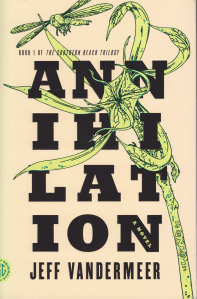
I’d be a hypocrite if I didn’t tell you there may be spoilers below. The book to which I alluded last week—the one made into a movie—was Jeff Vandermeer’s Annihilation. I first saw the book in a Green store in Ithaca, New York. I figured it must have a planet-friendly message if it were being sold at such a venue. I’ve finally had time to read it. There may be spoilers, so if you plan to see the movie, be warned.

Set in a kind of edenic dystopia not far from now, the novel gives none of its characters names. The narrator is the biologist of a four-member team sent into Area X—a region in the south from which no expedition has returned. Clearly intended to be part of a series, the novel does leave quite a few things hanging. Among the many unanswered questions is what has happened here. One of the problems with having Bible-radar is that you can’t overlook references to the Good Book. Without going into too much detail, the story has mysterious writing on the wall. That itself is a biblical trope, of course, but when the biologist discovers notebooks from previous expeditions, she considers that the writing is like something from the Old Testament. This description made me pause and ponder. The Hebrew Bible has, in the popular imagination, been cast in the role of a harbinger of doom and gloom. Granted, there are many passages that have earned that reputation, but on the whole it’s a very mixed bag. Still, in popular culture “Old Testament” means things are going wrong.

While not a horror novel, there are elements of horror here. People transforming into plants and animals, sloughing human skin. And resurrection—how New Testament! This made me think that maybe a penchant for horror isn’t such a strange thing for a guy who spent a decade and a half teaching the Hebrew Bible. My motivation for going in that direction had more to do with my interest in origins, but nevertheless, I also grew up watching monster movies. Maybe, unbeknownst to me, I was bringing the two together in this field of study. It’s difficult to tell at the end of book one what the overall message will be. But since I’m discussing the Hebrew Bible maybe I’ll take a stab at prophecy and predict that the second book of the series will be in my future. And I wouldn’t want to be a hypocrite.


Sky Mercies

While in a used bookstore recently, I was going over the science titles. I like to read accessible science since I often find it approaches religious ideas in secular terms. Once in a while even the terms of these disparate disciplines coalesce. I spied a volume on the top shelf titled The Mercy of the Sky. The spine showed a purplish cloud-bank, and the very concept set me wondering. We’d just been through a bomb cyclone the day before with wind bellowing through our apartment. Many trees were down and power was out for several people I’d overheard talking that day. I stared at the spine, thinking perhaps this would be a good follow-up to Weathering the Psalms, but as I already had books in my hands, and since I’m not the tallest guy around, it seemed beyond my reach. Of course, after I left I thought more about it.

The previous day’s nor’easter had revived that sense of a storm as divine anger. Strong winds, my wife commented, are generally disturbing. They make it difficult to sleep. It’s hard to feel secure when the heavens are anything but merciful. Although the wind is easily forgotten, it’s among the most easily anthropomorphized of natural phenomena. And it’s ubiquitous. Everything on the surface of the earth is subject to it. Indeed, the atmosphere is larger than the planet itself. Is it any wonder that God has always been conceptualized as in the sky? The quality of the mercy of the sky, we might say, is strained.

Danger comes from the earth below us, the world around us, and the realm above. Like our ancient ancestors staring wonderingly into the sky, it is the last of these that’s most to be feared. The wind can’t been seen, but it can be felt. It cuts us with icy chills, drenches us with dismal rain, even flings us violently about when its anger compresses it into a tight whirl. We can’t control it. Unlike other predators it requires neither sleep to refresh nor light to see. Its rage is blind and it takes no human goodness or evil into account. After a great windstorm, the calm indeed feels like a mercy. Elijah on Mount Sinai stood before a mighty wind, tearing the land apart. It was the still, small voice, however, that captures his imagination. There’s a calm before the storm, but it is the stillness in its wake that most feels like the mercy of the sky.


No Whine

Sneaking in a grocery run to Wegmans before church one Sunday awhile back, I was in line behind a distinguished looking gentleman. “I’m sorry,” the clerk told him, “we can’t sell alcohol before 11 a.m.” She set aside an expensive looking bottle of Glenlivet as he nodded solemnly. From behind me a woman called out, “Is that true, I can’t buy my wine?” Like Paul Masson, it seems, in New Jersey they will sell no wine before its time. Many, I suspect, have supposed that blue laws would’ve lapsed by now. What most people probably don’t realize is that this is yet another instance of how the Bible continually impacts our lives. Although the weekend has become enshrined as relief from jobs that most of us find tedious, blue laws were biblically based to keep us in line.

The Puritans did all within their power to enforce their views onto larger society. Sunday was not only “the sabbath,” it was a time for no fun—read Laura Ingalls Wilder for getting a sense of what this was like even on the frontier—and church attendance. Nothing potentially more attractive than church was to be on offer on Sunday morning. Here in over-populated, wonderfully diverse, secular New Jersey, those doing their weekly grocery shopping were learning the Bible has a very long reach indeed. Even if many people don’t realize that the Good Book’s behind it, they must abide by Puritan standards. I suspect many have no idea why blue laws remain in force. The Bible doesn’t loosen its grip easily.

As we pushed our cart past the ends of the other check-out lanes I noticed that several of them had bottles purloined at the point of egress. I suspect that most of the would-be buyers weren’t hurrying home to get ready for church. Instead, they were probably annoyed that they’d have to go out again later to continue their purchases. The Supreme Court has upheld blue laws on the basis of giving time off to those of certain professions that work by the hour. Those of us who don’t punch the clock are, according to the logic of such a decision, given exemption from the law of the land (but not to make immoral Sunday morning purchases. Indeed, in some professions attendance at church is part of the job expectation). It is perhaps bewildering for those raised in different religions. The idea of time off, although it probably wasn’t intended for humanitarian reasons, has also become one of the hidden blessings of the Bible. Without the sabbath, our weekends would also be an opportunity for others to make more money by the usufruct of our precious time. Holding off a few hours to buy alcohol seems like a small price to pay, in comparison. The Bible giveth, and the Bible taketh away.


After Darkness

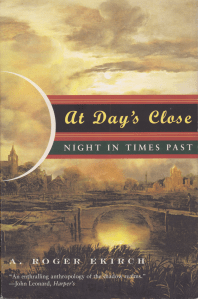
Some historians, I suspect, despair of the volumes already written on all periods, ancient and modern. History, however, can cover a variety of segments of time. A. Roger Ekirch, for example, thought to write a fascinating history of darkness. At Day’s Close: Night in Times Past is a thoughtful exploration of what night has historically meant. For those of us born in the era of constant light, the realities of what it was like after dark in the past are almost unimaginable. I’m sure Ekirch didn’t intend it to be so somber, but the reality of frequent crime in unlit regions made reading much of this book a sober experience. Confident of their ability to get away with it, many up until modern times took advantage of the night to commit all kinds of crimes. Makes you kind of want to check the door locks once again before turning in.

Much, but increasingly less, of our lives is spent in sleep. The advent of artificial light has led to changes in lifestyle that, according to biology, aren’t terribly healthy. The natural rhythms of sleep and wakefulness may be challenged by jobs or enticements to stay up late and surf the web or any number of other factors. Now that light has become so very portable in the form of smart phones and tablets, even less of darkness remains. Although it’s a bit repetitive and not laid out chronologically, At Day’s Close contains many provocative observations about the dark. There’s even a bit about monsters.

Night has always been symbolic. Death and fear were associated with night early on, and we still call the era of scientific progress the Enlightenment. Churchmen (for it was an age of such) tended to condemn night as evil, the Devil’s time. Not all agreed, for some considered the dark a creature of God and complained of the hubris of setting up lights at night. The religious symbolism of night is very rich and very ancient. Those of us used to artificial light have difficulty imagining what it took to navigate after dark in ages past. More than an annoyance, night could be a truly dangerous time. Dreams, once mainly the products of the night, also had religious significance before being rationally explained. The industry of banishing night also has, in some respects, the effect of banishing dreams. We should stop and think before we put night to flight. Half of our time is spent in darkness, and all of our time is highly symbolic.


Science of Unbelief

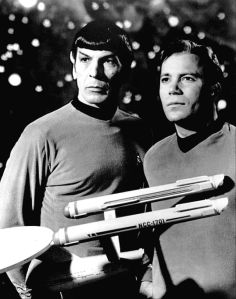
An article a friend sent me from Science Alert back in December recently came to mind. Titled “Thinking About God Might Make You Sweat, Even if You’re Not Religious,” the article by Brittany Cardwell and Jamin Halberstadt discusses how religious ideas are deeply engrained in human psychology. Like people who say they’re not afraid of spiders or snakes, people who don’t believe in the supernatural have made an effort to become this way. For reasons poorly understood, human beings are natural believers. As the article takes pains to state, that doesn’t mean a non-believer isn’t sincere. Thinking, however, doesn’t come only from rationality. Many people hold to the Mr. Spock fallacy—the belief that reasoning can solve anything. We all know from experience that it can’t. The big decisions in life—whom should I marry? What house should I buy? For whom shall I vote?—are often made with the emotions rather than rationally.

Which one’s the captain?

Reason has taught us to be expert deniers. We can learn to overcome our natural aversion to snakes and spiders and we can learn not to believe in God. Sometimes that belief can even be knocked out of us by the silly, unthinking behavior of “true believers.” But deep down it’s still there. Funnily, those who claim that reason alone answers all things are in denial about their own evolution. The human brain is a direct adaptation of the “reptilian brain” with its fight or flight impulses. That viper doesn’t plan to bite your ankle—it’s reacting to fear. Emotions are an integral part of thinking. Crimes of passion are committed by otherwise rational people sometimes. That thing you keep on bumping into in the room is, in fact an elephant. As irrational as that may seem.

The Science Alert article discusses the empirical proof that people fear to dis the Almighty. Were the brain a computer I’d say it was hardwired into us. We’re not wire and circuits, however. We’re messy, organic, evolving stuff that at one time lived beneath the waves. It took a certain amount of lungfish faith to believe we could survive on dry land. As mates approved of such irrational behavior, the trait multiplied and became more common. Today our smart phones and our cubicle window posters tell us there’s no such thing as a deity beyond our own scientific rules. The truth is, however, at some level we don’t really believe it. You can learn not to believe, but you’ll still sweat the big stuff, even in laboratory conditions.


Breakfast of Champions

In my efforts to become vegan, I’m finding dairy to be the hardest element to replace. I’m reminded of this every morning since the day begins with cereal. Most people don’t realize that cereal for breakfast is largely of religious motivation. The original Kelloggs were Seventh-Day Adventists, and therefore vegetarian. To promote both health and animal-free diets, they gave a big push to the idea the day should start with cereal. It’s a touch dry, however, and water on your flakes leads directly to paste. So I’ve been experimenting with alternate milks. Often I use soy milk, but it has to be the right brand. Some of the offerings on the market have that oily aftertaste characteristic of soy beans. Not sure of the legality of hemp milk these days, I recently tried oat. Oat milk should taste like oats, i.e., it shouldn’t have much taste at all.

The moral crisis came as I poured it into my oatmeal. You see, there’s a biblical injunction to cooking a calf in its mother’s milk. This is the reason meat and dairy can’t be mixed in kosher settings. Scholars debate the basic concept behind this regulation. Like eating a bird and its eggs, some suggest, this depletes nature and should be avoided. At least one generation should have a chance to avoid exploitation. At least until it grows up. But what of the oats and their oat milk? Have I gone too far? What hidden principle am I violating, however unintentional, here? This is the problem with any religious thinking—taken to extremes it begins to break down. Some of the earliest gods, after all, were agricultural deities.

Agribusiness is huge. People gotta eat, right? And it is one of the most massive environmental hazards humans have ever concocted. Industrial farming is the largest producer of methane and the largest user of potable water, by far. Keeping animals for our food is literally destroying our planet. Religions, interestingly, quite often concern themselves with eating habits. It’s strange how most of them in this country are silent regarding what is obviously an ethical issue. After all, we adapted to the cereal for breakfast lifestyle because of religious conviction. It’s difficult to change eating habits. That’s my current struggle. I could pour the oat milk over corn flakes, I suppose. But then again, the Bible forbids mixing fabrics from different plants. What’s an aspiring vegan to do?


Addicted to Heaven

I once wrote a scene—please don’t look for it; it’s never been published—in which a character awakes after attending a concert the night before. In my own life this kind of thing is very, very rare. Even when I had a full-time job in the relatively inexpensive Midwest, shows in Milwaukee were a bit out of our range for regular consumption. Here on the East Coast you have to scrimp and save to pull it off once in an every great while. In the scene I wrote, the character awoke wondering why the world looked so different the morning after. I’ve been pondering that because of my own recent Broadway experience, and a realization came to me. Such events involve an altered state of consciousness.

For all of science’s dowdy physicalism, there are very few practitioners who’d deny that altered states of consciousness exist. Nearly everyone experiences them. Perhaps the most common form is the dream. We know it’s not real, but most of us have had one or two that we just can’t shake. Upon awaking, going to work, dealing with the drudgery of everyday, we come home still feeling as if the preceding daylight hours were somehow less than real. Shows, some movies, and meaningful music can all induce alternate states of consciousness. Perhaps rare these days, but so can religious services. Such states continue after the event ends, and cushion our harsh reentry to “reality” with pleasant reminders that there’s something better somewhere else. Historically these moments have been highly valued. More so than even money. They’re addictive.

Attempts to induce such alternate brain chemistry through drugs are now a national crisis. One draw of opioids is their ability to bring on such altered states of consciousness. Our experience informs us that such things must exist, and they are likely behind the very idea of Heaven itself. The cost for altered states of consciousness is, of course, daily life. As physical beings we could not and cannot survive in a perpetual state of bliss. What is truly sad is that physicalism has convinced many that such alternative states are “not real.” Materialism leads, so often, to misery. The tendrils of altered states, however, interweave themselves among the synapses of our gray matter, sparking just often enough to make us realize that yes, those transcendent moments were just as real—if not more real—than this illusory world we daily inhabit. My character, awaking the morning after, was learning something she already knew to be true. Even if it was only fiction.


Jedi Bible

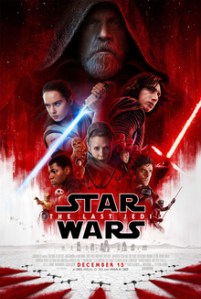
A long time ago in a galaxy far away there was no paper. This is something I didn’t realize until I read a book of essays by Ryan Britt a couple years back. George Lucas, although a limited visionary, saw a Star Wars universe without paper. When I thought back over the original trilogy, and the harsh prequel trilogy, that seemed to be true. Nobody picks up a piece of paper to read anything. Like many people I went to the theater to see The Force Awakens and left stunned. After being battered by episodes I through III, it was good to see the old form return. It was as if the force really had awakened. Then I went to see The Last Jedi.

Overly long and often plodding, I wondered, after it was over, what was so different this time. Not only was Luke Skywalker annoyingly noncommittal to the force, but backstory and counter-backstory made the truth hard to discern. There was a lot more talk of the Jedi religion as a religion. From my perspective, of course, this isn’t a bad thing. I would like to know more about this. There’s a secret tree on Luke’s island wherein are the sacred Jedi scriptures. Yoda shows up and calls down lightning like a little green Elijah and burns the Jedi library and its Keebler home. Then it hit me: not only is there paper in this universe, there are actual books. Scriptures.

We’re never shown the inside of any of the books, but if the fact that fans tend to fill in the blanks holds true we may well see future publications of the Jedi Bible. H. P. Lovecraft’s Necronomicon, a fictitious tome, now exists because his devotees couldn’t live in a world without it. And paper scriptures add an entirely new dynamic to any religion. Most world religions (at least on this planet) have some form of text. Books tell us what to believe and how to live our lives. Given enough time people will realize that they were written by other people and need to be interpreted by people. After all, if God could write the Bible, what would prevent him from writing the Qur’an, or the Book of Mormon? So stuck here in the middle of a trilogy the rules have changed. First paper has appeared in Star Wars. And although it’s a little too early to be sure, it looks like Jediism will never be the same.


Ancient Perspectives

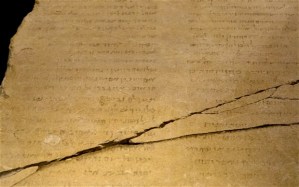
Around the holiday season, on social media, stories relating to the Bible tend to pop up. When my wife mentioned a New York Times story about “Gabriel’s Revelation” on the second day of Christmas, I was suspicious. The story, which was nearly a decade old—the internet keeps things in circulation far longer than those old library tomes consisting of physical newspapers bound together—describes the unprovenanced inscription as predicting a messiah will rise after being dead for three days. I assumed this meant evangelicals would be overjoyed, but it turns out that the artifact, if authentic, predates the New Testament. That means that it can’t be traditionally ascribed as a prophecy, since it’s not in the Bible, and therefore it becomes a threat because it suggests Jesus’ story isn’t unique.

Image credit: The Telegraph, from Wikimedia Commons

This is an interesting dynamic. A potentially important ancient artifact can only have value if it’s in the Bible or proves the Bible “true.” When that happens the faithful crow about how the evangelical position was right all along. If such a document implies that the gospels were borrowing from widespread cultural assumptions, however, it becomes just another unimportant bit of junk from days gone by. Confirmation bias, of course, is something in which we all indulge. Nobody likes being wrong. The difference is that the scholar is obliged to admit when the evidence overthrows his or her position. New options have to be considered.

Since I was between jobs in 2008 when the inscription was announced, it escaped my notice. Now that nine years have settled the dust a bit, there seems to be no sustained case for declaring Gabriel’s Revelation a forgery. Neither does it appear to have changed Christianity at all. The period known as that of Second Temple Judaism has shown itself to have been rich in messianic expectations. We know little, historically speaking, of Jesus of Nazareth. We know from the Dead Sea Scrolls that some were expecting a messiah along the lines of what Jesus was said to have been. But those documents aren’t part of the magical book that contains the truth, the whole truth, and nothing but the truth. In as far as they back the Bible up, they are celebrated. When they call the Good Book into question, they are rejected. I have no idea whether Gabriel’s Revelation is authentic or not. It seems pretty clear, however, that a faith that’s based on one unquestioned source might be more fragile than even other artifacts that have managed to survive, somehow, from ancient times.


All Is Calm

For those who prefer their solstice celebrations in Christian flavor, today’s Christmas Eve. As various denominations warn us to keep Christ in Christmas, secular NORAD provides a radar tracker to follow Santa through the skies. One hopes he’ll be cautious over North Korea this year. He may skip the White House altogether. And yet some will insist that there was no Christmas before Christ. But there was. Celebrations of the lengthening of the days began when humans reached temperate zones, at the very least. Prehistoric monuments throughout the British Isles were aligned with the sun’s position at solstices even before the Bible was scribbled on its first bit of parchment in warmer climes far away. We eagerly await the light.

Many religious traditions tell of that light within. Quakers, Unitarian Universalists, and some Asian religions focus on the divine spark, or secular light, within humankind. We are light-bearers, no matter what our religion. Back in my Nashotah House days, when Evening Prayer was a communal, daily expectation, the hymn Phos Hilaron, “gladsome light,” or, in the more liturgical mode, “O gracious light,” was the part that moved me most. We observe the coming of darkness with the hope that light might somehow continue. When days grow brief our hope grows fervent that the light will miraculously return. That it does so by the working of nature makes it no less of a wonder. We have been living in nighttime, and that light within us seems to flag at the persistent gloom. Then solstice. Christmas Eve captures that light in angelic voices.

Those who insist it’s all fake—the Tiny Tim crutch of feeble minds—need only look at NORAD today. The defense system built to keep the northern hemisphere safe from the endless winter of the nuclear species today shows a mythical object streaming across the stars with good will and cheer. Not just for Americans. Not just for Christians. Not just for true believers. No, Christmas Eve, the solstice, is for all people. Not just men. All people. Perhaps I’ve let my guard down just a little, and I’m letting my naiveté show just a bit much, but I do believe in that light. It may be that the tilt of the planet’s axis makes it inevitable, but a night when shepherds are startled and a woman brings hope to the entire world, we bask in what we deem a silent and holy night, knowing dawn will bring a longer day. And hopefully a world at peace.


Basic Catholic

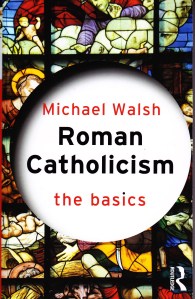
One thing upon which we all might agree is that we don’t have enough time. Publishers, eager to find an angle that will help them survive an age when we believe knowledge should be free, have shown a preference for short books. (An exception to this seems to be novels—consumers appear to like getting lost in a long story.) One result of this is the brief introduction format of book. That’s what Michael Walsh’s contribution to The Basics series is. Roman Catholicism is somewhat of a challenge to explain in less than 200 pages. You have to stick to, well, the basics. Having sojourned among the Episcopalians many a year, I felt that I had a fairly good grasp on Catholicism, but as I was reading it struck me that to really understand it, you have to be it.

One thing the Roman church has going for it is direct continuity. Making claims of having been there since the beginning, as an organization they have a leg up over other groups that boast more recent origins. We respect, or at least we tend to, organizations with such longevity. Tracing itself back to Saint Peter, the Catholics have continuity with spades. Or crosses. Of course, one of the things Walsh addresses is how change happens in such a long-lived group. Councils and synods, new scientific information and new Popes. Catholicism today isn’t the same as it was in Pete’s day. Walsh does a good job of guiding us through all that up to the time of Pope John Paul II, who, it turns out, raised global awareness of the papacy in the world as it existed then.

One thing we might agree upon is that Pope Francis has changed perceptions of what it means to be Catholic. The church remains mired in medieval thinking about matters such as gender and sexuality, but since this little book was published there have been steps forward. Even this popular pontiff, however, can’t change the decrees that went against the majority opinion regarding birth control, as Walsh somewhat guardedly notes. Or the ordination of women. He observes at the very beginning of his little book that Catholics know all about and deeply respect authority. This brief introduction helps to get a sense of how things ended up the way they are. We know that Pope Francis has started to speak out on such things, but men like to keep authority, as we all know. And even Popes have just so much time.


Not So Gnostic

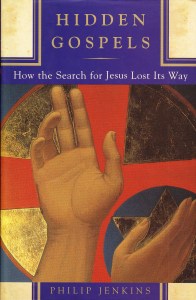
A certain, amorphous indignation comes over those of us trained in history when we encounter abuses of the same. In my case, some thought me conservative when I argued in my first book that Asherah as Yahweh’s wife wasn’t nearly the slam dunk some scholars were making it out to be. Don’t get me wrong, I wanted to see Yahweh as happily married as the next deity, but it was a matter of the evidence being weak and not thoughtfully examined. That is to say, I sympathize—maybe even empathize—with Philip Jenkins. His book, Hidden Gospels: How the Search for Jesus Lost Its Way, is an historical dressing down of many in the New Testament scholarly community who’ve perhaps let a bit of historical rigor slip in order to understand the world of early Christianity.

You see, once upon a time, scholars took the Gospels as, well, the gospel truth. Contradictions were simply harmonized or glossed over. When newer ancient material began to be discovered, however, adjustments had to be made. Perhaps the “orthodox” story of Christian origins wasn’t the only option available. In the twentieth century some spectacular manuscript finds were made, including the “library” of Nag Hammadi—largely Gnostic—and the Dead Sea Scrolls. New understandings of early Christianity were possible when these texts were considered. Some scholars engineered sweeping theories about revolutionary ideas concerning Jesus and his buds. Jenkins laments the lack of historical precision that many of these reconstructions demonstrate, and he comes across as somewhat annoyed.

Sensationalism, as we all know, sells publications and gets presidents elected. We all like a good story. In the case of Jesus, this means that the reconstructions of scholars often challenge traditional views, and popular publications love it. Jenkins finds it distasteful. Although this book is well written, as all of Jenkins’ material tends to be, it probably doesn’t do his arguments any favor to have retained the tired trope of heresy. Heresy means nothing without a supernatural bias, something that historians must avoid. Heresy, after all, assumes that one and only one version is correct (orthodox) and the four Gospels demonstrate that such a simple dichotomy is more difficult to sustain than it might appear to be. Yes, the Gnostic texts may not be as early as the traditional Gospels, but the ideas may have been circulating from near the beginning. We know surprisingly little about Jesus, so it’s not unexpected that rumors would’ve flown, even in antiquity. A solid source of information on some of the early “other gospels,” Jenkins’ book serves as a useful reminder that history is almost never as simple as it seems it should be.


More than Baptism

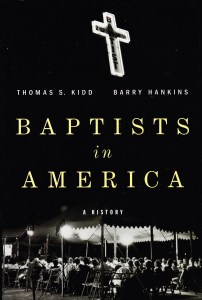
Few things distinguish American Christianity as much as its divisions. These aren’t precise, however, and often the borders are fuzzy and held more by cultural history than by theological outlook. One of the denominations—indeed, the umbrella for the single largest Protestant denomination in America—often faces the question of its identity. Who are the Baptists? Many Protestant groups can trace their histories to defining moments; consider Martin Luther and his hammer, according to the Lutheran origin myth. Baptists are a little tricker to pin down. Dissenters, yes, convinced that adult baptism should accompany conversation, yes, but beyond that widely divergent. Thomas S. Kidd and Barry Hankins have provided a service by writing Baptists in America: A History. Going back before America, they trace the origins of the sect and quickly bring it into the context in which it would thrive.

Persecuted early in American life, Baptists grew in numbers and recognition during the period commonly known as the Great Awakenings. Suited to frontier individualism, non-doctrinal, and advocating for freedom of conscience, the Baptists gained large sums of converts in this era. With their congregational polity, Baptist cultural influence really only took off when mass media gave its more aggressive preachers a venue not limited by church walls. As Kidd and Hankins point out, however, the denomination proved friable. Splitting apart over various issues, the number of Baptist denominations grew. Their political influence would also grow so that they would become a force with which to be reckoned even today. Few, however, really understand who the Baptists are.

The Southern Baptist Convention is the largest single Protestant denomination in the United States. It defines itself by a radical conservatism that masquerades as “orthodoxy.” Heavily biblical, many in the tradition have a strong preference for inerrancy. Social causes that appear outdated to most modern people are do-or-die issues for this sect within a sect. Baptists in America does a good job showing how contradictory Baptists can be. They were, after all, dissenters from the beginning. Their championing of religious freedom often doesn’t apply outside their own borders. The more political of the denomination know very well how to game a democratic system. Perhaps the lesson they’ve learned most acutely is that being unseen carries with it great advantages. They play the sport of legislative chess very well. In a culture that loudly and repeatedly claims that religion no longer matters, those with conviction have a natural hiding place. From there pieces are easily moved to positions of power.


Kings of Israel

Eating out is something that has become more of a habit than it should. Still, when we get together with friends it’s a cause for celebration, and a restaurant is usually somehow involved. You only live once. Well, maybe. In any case, while waiting for a seat at a new place I happened to glance over at the bar. Two huge bottles of wine stood there. I asked our friends if they knew what they were called. I can’t recall how I’d learned, but the proper name for them is “Jeroboams.” Jeroboam, in case your reading of 1 Kings is somewhat rusty, was the first king of Israel when the “United Monarchy” split into Israel v. Judah after Solomon’s reign. The curiosity of my friends led me to research the subject a bit. What I found was alcohol of biblical proportions.

Another name for the same size bottle as a large Jeroboam is Rehoboam. Rehoboam was Solomon’s son, the king of Judah while Jeroboam took over Israel. Moving up to a 6 litre bottle the name becomes Methuselah. Methuselah, of course, is the Bible’s oldest man. Symbolically, if you do the math, he drowned in the flood. Nine litres will be called a Salmanazar, also known as Shalmaneser, a king of Assyria who attacked Samaria. Twelve litres, and perhaps the namers were getting a bit tipsy here, is either Balthazar or Belshazzar. The former, while not biblical, is the name of one of the three Magi from the visit of the wise men. Belshazzar was, according to Daniel, king of Babylon and is somehow scripturally mixed up with Nebuchadnezzar. Nebuchadnezzar, by the way—famous for his madness in Daniel—denotes 15 litres. An 18 litre bottle, depending on which line you’re following (if you can) is either Melchior—another of the Magi—or Solomon, the father of Rehoboam and one time boss of Jeroboam. The 27 litre bottle is called Goliath, for obvious reasons. And if you’re still standing, the 30 litre bottle may either be Midas or Melchizedek. The latter is the mystical king of Salem, later to be called Jerusalem.

I’m personally no fan of wine, so much of this was news to me. Not all bottle sizes are biblical, but many of them are. Spirits, in all seriousness, were taken to be related to the spirit world in ancient times. And the Bible, a book most familiar to those engaged in the industry of wine, was a natural place to find often ironic names. According to John, Jesus’ first miracle was changing water to wine at the wedding at Cana. Prohibitionists shudder to read that the carpenter from Nazareth changed six jars, each holding between 20 and 30 gallons, into free spirits. Wine bottles, perhaps to society’s benefit, never grow so large. But it’s time to go, our food has arrived.