Cthulhu You Knew

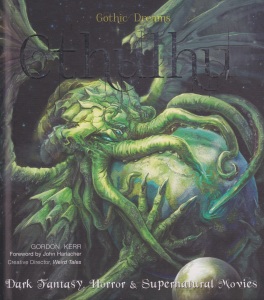
Humans tend to be visually oriented.  Arresting images stop us cold, causing us to focus on what we’re seeing.  As a tween I could be transported by large, lavishly illustrated, full-color books of other worlds.  While these went the way of Bradbury, I still sometimes recollect scenes that stopped me in my young tracks, making my juvenile mind wonder, what if…?  As an adult I realize “coffee table” books are heavy and a pain when you’re moving.  Printed on specialized paper, they have more heft than your mass-market paperback, or even most academic tomes.  Nevertheless, Gothic Dreams Cthulhu was a book that carried me, like a time-machine, back to my younger years.  Unlike in those days, however, I read the text as well as lingered over the images.  And I wondered about Cthulhu.

You see, I didn’t know about Lovecraft as a child.  The only reading regularly done in my family was Bible-oriented.  I discovered science fiction and gothic literature as a tween and, living in a small town, had no one to guide me in my choices.  Rouseville (the town pictured in the background on this website) had no public library.  My reading was left to my own, uninformed devices.  I discovered Cthulhu through my long fascination with Dagon.  I’d pitched Dagon as my dissertation topic, but settled on Asherah instead.  While teaching religion at the University of Wisconsin Oshkosh, I discovered Lovecraft, and Cthulhu, through Dagon.

Gordon Kerr, the author of Gothic Dreams Cthulhu, might be forgiven his hyperbole about H. P. Lovecraft.  Lovecraft was not a great writer—that’s not intended as any kind of slight, I hasten to add.  Classically, however, he didn’t have the level of literary finesse of Edgar Allan Poe, for example.  Still, Lovecraft created credible worlds.  His was a life of imagination—one might almost say divinity.  He was a creator.  Cthulhu has become a cultural icon.  With the magic of the internet bringing a writer still obscure to international attention, many people who never read horror fantasy nevertheless know who Cthulhu is.  Or they think they do.  As Kerr explains, the descriptions by Lovecraft himself are spare, thus the variety of ideas represented in the delicious artwork on every page of this book.  As Lovecraft earns more academic attention, surely others will notice the religious potential of the Great Old Ones that were, in their time, gods.  A guilty pleasure read, to be sure, Gothic Dreams Cthulhu fits well into this serious world of chaos we’ve created for ourselves.


Away and a Stranger

“And Joseph also went up from Galilee, out of the city of Nazareth, into Judaea, unto the city of David, which is called Bethlehem.”  Strangely enough, the great physician (although we know nothing of his medical practice) Luke was writing about a place an ocean and a sea away from here.  The place names of eastern Pennsylvania demonstrate the religious awareness of the early colonial Europeans who brought their Bibles and diseases to this nation.  Bethlehem, Pennsylvania was known more for being a house of steel than being a house of bread.  It’s just down the road from the little town of Nazareth, made famous by The Band’s classic hit, “The Weight.”  The road to Emmaus is nearby.  And the major medical facility is, you guessed it, St. Luke’s.

The Band had an influence somewhat surprising for those who may have trouble recalling their nondescript name.  “The Weight” is a story of a traveler coming to, of all places, Nazareth, Pennsylvania.  So taken by the song was a Scottish band that they adopted the name Nazareth before informing us that “Love Hurts.”  This is something the evangelist and purported doctor Luke presumably knew.  If you go down from Nazareth even unto Bethlehem, you’ll find the steel city recast as the Christmas city.  For those of us who grew up in the western part of the state, Pittsburgh was the real steel city anyway.  When I was growing up, Pittsburgh was the 16th largest city in the country.  It now sits at 65th, because, like Bethlehem it had trouble drawing people without the natural hardness that is Pennsylvania.  There’s a parable in a city transforming from a heavy metal to a holiday.  There’s no Pittsburgh in the Bible.

When Luke begins his Christmas narrative (think of this as one of those “Christmas in July,” or August things), quoted above, he ironically leaves Mary until the next verse.  Joseph, whom later tradition will say had nothing to do with the conception anyway, still gets first billing.  One wonders what might’ve been different had Mary led the way.  It was much later, after the gruesome crucifixion account, that Emmaus came into the picture.  Two unnamed disciples were walking along that road and didn’t recognize who Jesus was.  Had they kept walking, I wonder if they might’ve ended up in Pittsburgh, for the biblical names soon give way to places like Kutztown and Fleetwood, the latter of which, I have to admit, I never got into.  Had Mary taken a load off in Nazareth, this story would’ve been completely different.  Thus saith The Band.


Enoch Enough

For a person referenced so little in the Bible, Enoch captured popular imagination in a way difficult to comprehend.  Even in ancient times speculation about him was rampant.  The seventh generation from Adam, and great-grandfather of Noah, Enoch lived a remarkably short 365 years before “he was not, for God took him.”  Now, there are lots of obscure people in the Bible.  Many of them have very little afterlife in later tradition.  Enoch, however, became the putative author of a collection of booklets that goes by the name of 1 Enoch.  This book fed speculation in antiquity and became a vehicle for many esoteric traditions that continue even into the present day.  It might seem that there’s little information to go on for an entire book, but James C. VanderKam’s Enoch: A Man for All Generations finds plenty of material with which to work.

A careful scholar like VanderKam doesn’t delve much into speculation, and he rather cautiously examines many of the ancient texts that discuss Enoch and draws some basic conclusions.  There’s a lot of information in this book.  With my own fascination concerning the Bible and popular culture, what stood out to me was how Enoch went from the “mere” man who didn’t die to become, in some traditions, the Metatron, or “the lesser Yahweh.”  Having been a fan of Dogma since teaching at the perhaps too sanctimonious Nashotah House, I’d never researched the late, great Alan Rickman’s character.  I supposed the Metatron was a character like the Muse—some extra-biblical quasi-divine functionary thrown in for fun.  I didn’t doubt such a figure was known in early Jewish or Christian writings, but I had no idea that Enoch had been promoted to that level.

Since I’ve been researching demons lately, the book of 1 Enoch has been a major source of interest.  One of its sections, The Book of the Watchers, expands on that odd story from Genesis 6 where the sons of God lust after the “daughters of men.”  Ever coy, the biblical passage doesn’t directly say that their offspring were giants, but this idea was developed by sources like 1 Enoch.  And these fallen angels—the nephilim—in some traditions, become demons.  Studying Enoch is a fine introduction to a mythological world every bit as rich as Dogma.  These characters—Enoch, nephilim, watchers, and demons—populated the imagination of early readers of the Good Book as much as they do modern speculators’ worlds.  Not bad for a character barely mentioned at all in the Bible.


Animal Rains

We may have been to the moon—if not personally, collectively—but we still don’t control the weather down here.  It’s probably not news that the eastern part of the country has been getting a lot of rain lately.  One of the factors that led me to write Weathering the Psalms was the overwhelming tendency for humans to attribute weather to the divine.  It used to be that we couldn’t reach the sky, so placing deities there seemed a safe bet.  Now that we’ve shot through the thin membrane of atmosphere that swaddles our planet, we’ve discovered beyond a cold, dark space liberally sprinkled with stars and planets but mostly full of dark matter.  The deity we thought lived beyond the sky somehow wasn’t anywhere our probes flew and recorded.

Still, down here on the surface, we live with the realities of weather and still think of it in terms of punishment and pleasure.  When we don’t get enough rain, God is destroying us with drought.  Too much rain, and the Almighty is washing us away with flood.  The true variable in all of this is, obviously, human perception.  Sure, animals experience the weather too, and they sometimes look to be as disgusted as humans when it snows too early or too late, or when the rain just won’t stop.  I have to wonder if somewhere in their animals brains there’s the seed of an idea that the bird, or squirrel, or woodchuck in the sky is angry at them for some unspecified faunal sin.

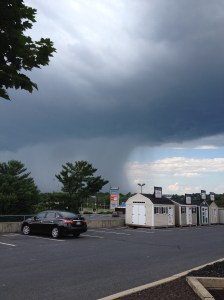
While heading to the store yesterday, after weather reports assured us the rain was finally over for the day, the skies told a different story.  The vistas around here are never what they were in the midwest—or what they are in Big Sky country—but the approaching storm was pretty obvious.  An opaque drapery of precipitation was coming our way and although a rainbow would cheekily show up afterward, knowing that we’d been caught away from home with our windows open felt like punishment for something.  Perhaps the hubris of buying a house when all I really require is a corner in which to write.  Somewhere in my reptilian brain I translated a natural event into a supernatural one.  When we got home to discover the storm had gone north of us, it felt like redemption.  I spied the birds sheltering in shadows from the sun’s heat.  Were they thinking it was some kind of divine avian displeasure, and hoping for some rain to cool things off for a bit?  If so, was our religion correct, or was theirs?


Hidden Origins

This blog was born at the very lake I’m about to leave.  Although it’s relaxing, there’s an element of chaos to a family vacation that stirs up creativity.  Tomorrow’s long day of travel back east, however, will mean another day without a post.  Flights leave so early that you barely have time to slither out of bed to the shuttle, and the airport hotspots want your money to connect.  I’d rather maintain radio silence for a day.  That doesn’t mean I won’t keep my eyes open for religion hidden in the interstices of American life.  Since religion and mythology share sleeping quarters, I’m reminded of something I saw up here in the northwest the other day.  While in a local grocery and souvenir shop (for all groceries in this area carry souvenirs) I saw sasquatch dolls.

Such cryptids are unknown to science, of course.  Even if they really exist, their liminal status now places them firmly in the realms of mythology.  Being in the wilderness can be an uncanny experience.  Long accustomed to dwelling in cities and towns, we feel vulnerable out in the open.  Taking walks in the woods might just put you in the path of black bears, grizzlies, or mountain lions.  Who knows what else might be hiding in these woods?  It’s easy to believe in our myths here.  Vacation, in addition to being the ultimate reality, counts as time borrowed against work and its punishing rationality.  Religion thrives in the quiet moments when you’re not sure what might be hiding just out of view.

Did ancient people devise belief in such circumstances as this?  (Well, without the wifi and indoor plumbing, of course.)  It’s not hard to feel the spirit of the lake.  Standing chest-deep in the water, being rolled by the waves, there’s a kind of secular baptism taking place.  In the quiet unearthly voices can be heard.  No television or newspaper tells you that it can’t be happening.  Listening is much easier with no distractions.  These woods are vast.  Human access to them is limited to marked and maintained trails.  Beyond these borders, who knows?  Science comforts us with the assurance that there are no monsters out there.  Standing isolated from any other human beings, surrounded by ancient trees, you might begin to wonder if such assurance is as certain as it sounds.  The sasquatches are children’s toys, and the sense of the numinous you feel can, like all extraordinary things, be explained away.


Fair Weather

“I just saw God up on your ridge.”  (Kudos to anyone who can name the source of that quote!)  Many years ago I read Stewart Guthrie’s remarkable Faces in the Clouds.  The idea that he presents is that pareidolia—seeing faces or people where they don’t actually exist—may account for the belief in God.  Early people, not knowing any way to interpret such obvious examples of humans writ everywhere thought they were gods or spirits.  Since reading this book, I’ve taken to trying to capture incidents of pareidolia where I can.  The other day as I was working away in my home office, I noticed a literal face in the clouds.  I thought “I just saw God outside my window.”

Now I know this isn’t really what I saw.  I know matrixing (mistaking noise for signal) when I experience it.  I hope.  Nevertheless, the resemblance was detailed—brow ridge, nose, distinct lips, chin.  The lighting in the fair weather cumulus will likely make this difficult for you to make out, and you might see a face other than the one I saw.  Not everyone thinks of the Almighty in the same way.  Looking at the picture I snapped I can see at least two faces stacked on top of one another—the council of the gods?  Who am I to tell deities what they can or can’t do?   Or to prevent imagination from going where it will?  Religion seems to be an evolved characteristic of our biological makeup—our eyes show us what to believe about the world around us.  The rest is hermeneutics.

Gods and the skies naturally go together.  We can’t reach the heavens nor can we control them.  We can increase greenhouse gases in them, though, threatening the very illusion we see in the clouds.  The glimpse of the divine we once saw there can easily dissolve into acid rain.  Heaven and Hell, according to the story of Dives and Lazarus, aren’t very far apart.  Even as we gaze into the cerulean sky seeking serenity, others are bending laws to allow them to destroy it for profit.  There’s a reason Dives is simply called “the rich man.”  Does Scripture defend the practice of environmental destruction?  Dives’ friends claim the planet was given to us to use and use up and Jesus will swoop out of those clouds we’re manipulating at the last minute and rescue us from the mess we’ve made.  Looking into God’s face in the clouds, I interpret this all as a mere excuse.  To destroy the environment is to side with Dives as he makes his flaming bed of nails in Hell. This is why windows in an office are divine.


Starting Something

Starting your own religion, I’m told, just takes patience.  You may have to die before it gets off the ground,  but if it’s a religion you’re starting you get to make the rules.  Well, until somebody else starts interpreting what you wrote.  I grew up thinking a religion had to be ancient to be real.  There’s a certain comfort in untestablity—you can’t verify the facts, so you accept them.  It took many years before it dawned on me that new religions rely on the same premises as old: someone has received the truth (at last!) and is willing to share it with the world.  Followers emerge—true believers.  And then they begin to change things.  “The founder meant this,” they argue, and really they’re starting their own sub-branch of the religion.

Not everyone is convinced by this ancient religion paradigm.  Zarathustra, for example, set out to create his own religion, according to tradition.  Jesus, it seems, was trying to reform Judaism.  The process never stops.  A couple of weeks ago in New York City I saw an adherent of a New Religious Movement.  This one had started in the 1930s.  The man appeared a little older than me, so his life may well have overlapped with that of the founder, or they might’ve missed each other by a decade or two.  Already, however, the religion had grown into its own entity, and it doesn’t seem to worry adherents that the truth was being revealed, for the first time, maybe in their lifetime.  You have to start somewhere.

So, if I were to start a new religion, what would it be?  For a variety of reasons I think I’d call it Moby.  The connection with Melville is palpable, but that wouldn’t be the reason for the name.  (Religions must have a sense of mystery, otherwise they can be analyzed until they look illogical.)  Like Unitarian Universalists, I think the religion would be more about what you value than what you believe.  Belief can be shifting sands.  New information can lead to new results—this is one of the weaknesses of religions developed when the earth was still the center of the universe.  Heaven is now outer space and Hell is earth’s iron core.  Moby would avoid such a doctrinal morass by not having doctrine.  It would need rituals and ceremonies, of course—no matter what Mr. Spock wannabes say, we need emotional engagement and ritual has the goods.  All of this requires patience, because who has the time to develop a new religion when there are only two days in a weekend?


Faithism

Religion, in general, has come upon hard times. Many proponents of science and secularism point disparagingly toward what is, in all likelihood, one of religion’s strengths: its utter diversity. The fact is all people are believers. No amount of denial will change that. Whether the belief is in science or magic, we all take things as true, based on our outlook. My wife recently forwarded me a story about Faithism from the New York Times. A religion built around the Oahspe Bible, written about the same time as the Book of Mormon, Faithism very nearly went extinct before undergoing a modest revival in the present day. Instead of casting aspersions on it, a far better approach is to consider the basic, underlying human element to the movement.

Faithism was based on a book written by a dentist, a one John Ballou Newbrough. Although I’d never hear of Newbrough before, I can make a safe assumption about him—he was struggling with trying to understand a supernatural that can’t be measured or tested. This same element applies to scientists. Measurables have to leave at least a physical trace. Millennia ago, religions were already claiming that outside this mortal coil there was an entire realm that we could experience with our feelings but which would never offer any physical confirmation. There’s a pretty obvious difference between the living and the dead (at least to most people). Since nothing measurable changes at human death, it must be something incorporeal. Scientists begin to shake their heads here, but even they must face it some day.

The other takeaway from Faithism is that spiritual writings, like tiny particulate matter in clouds, can lead to the coalescence of something larger. Orally based religions, such as Zoroastrianism, seldom survive long. (Zoroastrianism, however, had very compelling ideas.) Written texts, once believed to be inspired, will naturally grow like a pearl over a grit of sand. The factuality of the text doesn’t matter, as long as it is the object of belief. When it rains, it pours. Some architects of new religious movements, such as L. Ron Hubbard, perhaps implicitly know that. While his science fiction may not have been inspired, his religious texts were. Unlike Scientology, science requires objective measures of what it considers reality. The title of Faithism, however, makes a trenchant point—it is belief in faith, like fear of fear itself, that makes religion. While historically few have believed in Faithism, even atheists have faith in what they don’t believe.


Only Which King James?

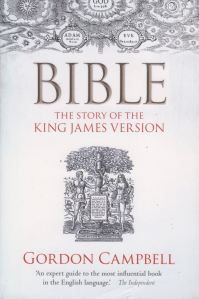
Nothing is as simple as it seems. Not that the Bible ever claims simplicity for itself. Among those who make up their minds before seeing all the evidence, there’s a strong preference for the “King James Version” of the Bible. Many with that preference will claim that they don’t interpret the Good Book, they just read it. Reading itself is an act of interpretation and stakes tend to be pretty high when the claim for divine authorship is on the table. So I figured I’d better interpret something about the King James Bible myself. Gordon Campbell’s Bible: The Story of the King James Version is an informative, authoritative, and often witty treatment of the topic. One of the immediate takeaways is that there is no single KJV.

Beginning in the beginning, Gordon tells the story of the Bible in English. There were translations before the King James, and its translation companies used these previous efforts and sometimes borrowed extensively from them. In other words, there’s nothing new under the sun. Once the King James was done in 1611 it had to be printed, and printing, being what it is, led to errors. Although these were of the secular, human kind, they nevertheless appear from the beginning and new typesettings led to corrections and other errors, some perhaps intentional. Then came the revisions. What readers buy—and some claim is an inspired translation—as the KJV is a revision of a revision. Of a revision. In other words, the inspiration seems to lie with the redactors rather than the translators themselves. There are many different “official” King James versions. Translations are never static.

King James Onlyists (a modern movement) may not realize that the New Revised Standard Version is the modern descendant of the King James. The Revised Version (RV), followed by the Revised Standard Version (RSV), and its more recent, feared progeny (the NRSV) are all based on the King James translation. That is the version “Revised” in each of these efforts. They consult improved versions of ancient texts that have been discovered since the Jacobean era, but where they earn the ire of conservatives is in the updating of the modern language. A Bible with no thees or thous hardly seems sacred at all. The line of continuity is there, however. Other Bible translations “start over” but still consult the KJV, such is its stature. The real problem comes in supposing that any one translation is the original. No original Hebrew or Greek biblical manuscripts survive, and no original King James Version exists. How uncomfortable these facts are, everyone will have to interpret for her or himself.


My Heavens

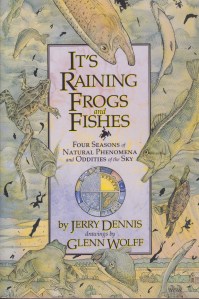
The details escape me. I was a student at Grove City College, working on a paper. In the library I ran across an article about a rain of fish. Always interested in the unusual, I was surprised to see such a piece in a reputable journal, and up until that time I’d never heard of Charles Fort or his gathering of such accounts from around the world. That paper was in my mind when I picked up It’s Raining Frogs and Fishes by Jerry Dennis and Glenn Wolff at a used bookstore. Subtitled Four Seasons of Natural Phenomena and Oddities of the Sky, it was published by the mainstream Harper, so I figured it wasn’t too far afield from reality. It turned out to be more the subtitle than the title, but an engaging read nevertheless.

There is a small section on rains of fish and other strange objects, but the book is really a tribute to the sky. Although I’m not an anthropologist, I have long been intrigued by the fact that people everywhere associate the sky with the divine. From the human perspective, it’s massive and all-encompassing. No matter where you stand on this planet, the sky extended over you, engulfing the horizon and implying even more beyond. It is responsible for our weather, and without the buffering of our atmosphere no life would’ve evolved on the earth at all (and that would be a pity because I enjoy writing this blog). Perhaps even before there were humans proper, our ancestors thought there was something divine about the sky.

While the firmament can’t be contained in a book, this one tries to consider just about everything you might find in the celestial realm. From extremes of weather to meteors to strange things falling from the sky, it tells of rain and snow and sunshine, insects, bats, and birds. The four seasons don’t really function as the best conceit for the book, since the sky is eternal and many of the aspects discussed are present all year long—the moon is with us always and the sun rises and sets even in winter. Nevertheless, this strange and alluring book demonstrates how the sky makes us what we are. Even though it was written in the last century it warns of global warming—then merely an idea—and shows how humans are capable of destroying that which gives them life. That article back in college suggested that the impossible happens, and that, given how the world is going, causes me to look upward with wonder.


Eternity, Technically

When the robot uprising comes, we have a factor in our favor, we biological beings. That is our parts, although they do break down, generally heal themselves. I write this as kind of a forecast, because I’m not at home due to the holiday weekend, and neither is the internet at my home. You see, our internet service (which is not cheap) has been going out from time to time. Our service provider thinks it may be old parts. The box was installed in our basement over a decade ago and when the technician sent me down amid the cobwebs before leaving town I had to report to her that all cables were hardwired into the box. No clip and slip here. She thinks the cable has gone bad.

The cable just sits there. It never gets moved or jostled. How it could fail I don’t know. But the consequences are two. There may not be posts on this blog for a while once I return home. I’ve posted every day, holiday and secular-day, for years now. Technology, however, is a jealous deity and will not permit humans taking it for granted. The second consequence is more optimistic; when the robots rise up against us, their parts will wear out and they won’t be able to regenerate them organically. They’ll need to order them and hope they can find a delivery system even more efficient than Amazon’s. Good luck with that! I ordered a book the other day and less than 24 hours later it was at my door. That’s service.

I decided to post this advance warning so there may be no weeping and gnashing of teeth (please—dental work is expensive!) on Monday or Tuesday when no new post appears on this blog. It’s not that I’m not thinking of you all, it’s just technical. Robots may run system tests, but can they feel it in their bones when something’s about to go? Do they indeed sing the body electric? Can they feel the poetry they write? To be human is to think with our emotions and to reason ourselves out of irrational angst. I see the slaves to technology putting on weight as they rely more and more on labor-saving devices to make their lives automated. I’m guilty too. As I sit here many miles from home, however, I worry about the internet back there. Is it sick? Is it dying? And if so, to which mechanical god should I pray to save its technical soul?


Holy or Not?

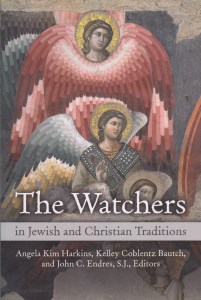
The ancient divine world was a slippery place. When you stop to think about it, this makes sense. The deities and demons of antiquity were invisible. Different opinions existed as to what they were. The idea of “the Bible” that contains infallible information didn’t exist. Apart from the books now accepted by Protestants, the “Apocrypha” and even more fun Pseudepigrapha contained many more traditions than the average reader might guess. I’ve been a student of that ancient divine world for decades now, and I learned quite a bit from The Watchers in Jewish and Christian Traditions, edited by Angela Kim Harkins, Kelley Coblentz Bautch, and John C. Endres, S.J. Appropriately divided into three parts (origins of fallen angels, Second Temple developments, and Jewish and Christian reception) these collected essays explore different dimensions of these mysterious beings.

Watchers are seldom mentioned in the Bible, in just a few verses of Daniel. In some traditions they are high angels—think the hymn that includes the word “ye Watchers and ye holy ones”—but mostly they are fallen angels. If you limit yourself to the Good Book you really get only four verses of Genesis 6 to explain them. Other ancient writers, some of whom likely influenced the New Testament, took up the subject. The book of 1 Enoch contains a section called The Book of the Watchers. Here the Watchers come down to earth with a couple of purposes—to share forbidden secrets with humanity, and to mate with human women. The offspring of these matings are giants, Nephilim, or demons. Perhaps all three. These events are retold in Jubilees and are taken up by early Christian writers especially.

Although this book isn’t a monograph with conclusions based on all the information it contains, it nevertheless gives a very good sense of the various traditions that developed around these Watchers. Even when reading through the Bible as a child, the Genesis 6 episode caught me off guard. The story isn’t highlighted in children’s Bibles, and the way it’s told in Hebrew leaves a lot of ambiguities in the adult reader’s mind. It’s almost as if this brief account is bing kept deliberately obscure. The Good Book drops this bomb then blithely goes on its way without mentioning it again. This episode reminds us just how little the Bible clarifies. It wasn’t written to be the “inerrant word of God,” and those heady days just after Eden were full of stories that it never bothered to tell. The Watchers, meanwhile, made their way into popular culture because the silence of Scripture allows readers to fill in the blanks with either angels or demons.


Wired for Good

I spend entirely too much time untangling wires. Recently I read a survey asking whether you’d rather face a robot uprising or a zombie apocalypse. There’s no question that the devices have already taken over. And they’re eager for your source of power. The work laptop, the home computer, the aging iPhone, the iPad—they all want feeding, like a nest of hungry chicks. And their cords get tangled. It’s up to the human servant to come along and try to introduce some order into this chaos. Then there are the devices that go the way of the iMac, and yet their cords somehow remain. We have boxes of cords that look like an octopus orgy—uncertain to what device they once belonged we’re afraid to send them to the recycling plant because you may have accidentally rid yourself of one you still need. If there was a robot uprising, they’d be tripping over their own umbilical cords.

We used to go camping. Completely unplugged. These days of state parks offering wifi, even a trip to the wilderness isn’t really wireless. I’m a little afraid of this new dependency. The joy of memorizing has been replaced with the internet in my pocket. Life has become much easier in some respects, no doubt, but it’s not a one way street. Technology has its price, as this tangle of cords I’m facing reminds me. There’s no cutting this gordian knot without going back to the Stone Age, it seems. What would I do if I couldn’t post on this blog daily? What would remain of me?

If electricians are the acolytes to this new religion, then programmers are the priests. Each keystroke produces a recognizable letter because of their prayers and supplications to the great god Internet. Without it my job would be impossible. It knows how much money I have and where. What I’ve spent it on. It even flatters me when I search for something I wrote. The robot uprising, you see, need not be violent. It’s subtle and gradual. When you can’t live without something—when you adore it and depend on it constantly—it’s become a deity. The god, however, depends on us for providing it the constant sacrifice of power that it demands. It hasn’t figured out how to extract electricity from the air, or suck it from our fingertips as we type. And for its needs it requires cables. Like a good servant, I’m going to sit down and sort them all out again.


Creating Afterlife

Once upon a time I wrote a book on commuting. It never got beyond my laptop, but I often wonder if it was simply premature. Some stories from public transit can be quite amusing. A few weeks ago I posted on how a woman spoke up after our bus missed it’s turn off the highway and made us all late for work that day. No matter what you think of developers and speculators, one thing we can say for certain is they lack imagination. If you’ve driven this stretch of highway 22 you know that the exits look very much alike. Early in my commuting days a young woman took the empty seat next to me on the way home and asked where we were. “I miss my stop because they all look alike to me,” she explained. She had a point.

So one morning last week I was in my usual seat, reading along, when the driver—new to our route—missed his turn off the highway. The same woman (for we are mostly regulars at this forsaken hour of the morning; if this doesn’t ring a bell search this blog for “commuting”) said, “No need to turn back, they have another bus coming.” I was pleasantly surprised at the learning that had taken place since the last time. I am, however, old enough to remember Greyhound commercials and their slogan, “Take the bus and leave the driving to us.” I also thought of those passengers waiting like evangelicals for the second coming for a bus that would never show up. Our gain in time was their loss. Such are the dynamics of life in a universe not built on the principle of fairness.

The bus can be a microcosm of the moral universe. Evangelists, for example, believe all people must have the opportunity to catch this express bus to Heaven. The bus that comes after the express makes more stops, somewhat like Catholic Purgatory, increasing the suffering for a while, but ultimately making the goal. Missing the bus completely are the Hell-bound for which some claim we must turn back while others insist we press on; there will be another bus. In this case, the same passenger insisted that we help those left behind just a few weeks ago. This led to lengthening of her own stay in Purgatory, so when it happened again she decided those waiting were simply too hard to reach. Or maybe she’d come to believe in predestination. Perhaps it was on some ancient bus that ideas of the afterlife emerged. Experience teaches that much depends on factors beyond your personal control.


Real Dreaming

I keep odd hours. Although we don’t live far from New York City, as the pigeon flies, public transit sets the schedule for my day. (I’m merely writing as a representative here, since I know others keep my hours as well.) Since I’m usually waking up around 3 a.m., I have to go to bed pretty early. One night recently I turned in around 8:00 p.m. and fell into a fitful sleep. When I awoke three hours later, it was as if my gray matter were a thunderhead. Ideas, worries, and memories flashing like lightning. Concerned, I watched the clock since I knew it was a work day. When three rolled around with no more sleep I hoped it would be like one of those rare days of interrupted rest when my conscious mind does just fine. Would it function that way on just three hours of sleep?

This incident brought home to me once again the mystery of consciousness. I had a meeting in New York I couldn’t miss that day, but by mid-morning (in real-people time) I was seeing things that weren’t there—an almost Trumpian dissociation from reality. Then I’d snap back to awareness and realize my mind was drifting off to steal some of the sleep it refused during the hours of darkness. Using the usual tricks I stayed awake for the workday and even for the bus ride home, with only brief momentary lapses where what had been reality had stopped making sense. Consciousness, it seems, functions best with a well-rested brain. A good night’s sleep put me back to normal the next day.

Reflecting back over that previous 24 hours, I thought how surreal they’d felt. Not to put too fine a point on it, but they were like an altered state of consciousness. Religions, some claim, began because of such altered states. They are strange and powerful. And fairly universal—almost everyone experiences them from time to time, whether by sleep deprivation, controlled substance use, or prayer and meditation. Even knowing the cause (going to bed with a lot on your mind when you have to wake early, for example) doesn’t change just how real the experience feels. This is one of the reasons that rationality doesn’t explain all of experience. In the same brain there are Jekyll and Hyde aspects to consciousness, interchanging with each other every few hours. As the movie Inception underscored, you don’t remember how you entered the dream. You’re just there. And when that world intrudes on the conscious, rationally ordered territory of wakefulness, the questions can become quite religious. Unless, of course, I’m still dreaming.