Trained Witnesses

The problem with lying is that it generally doesn’t hold up. Eventually people will figure out that a falsehood is exactly that and the liar will be scorned. In other words, truth is determined by witnesses. This is tested and confirmed every day in our legal system. The witness is invaluable (except in the hands of lawyers). Since no one person can see everything, we rely on others to help us fill in the blanks. Think of it; when you see something unusual don’t you ask whoever’s with you “did you see that?” We witness the world around us, and unless we’re untruthful that observation becomes part of the collective narrative of what the world is like.

A story from IFL Science! sent by a friend describes “Ancient Legends And Myths That Were Later Proven True By Science.” Apparently this is part of an annual series. What the article lays out are recorded myths later confirmed by science. Scientists are trained witnesses. Taught to silo information, they separate belief (so they say) and eschew non-natural causation. They peer into the mirror each morning with Occam’s razor firmly in hand. Then everybody seems to be surprised when non-scientists have actually observed something correctly. This is the ancient bickering between religion and science—you can’t have it both ways, the reasoning goes. This is a zero-sum game. The winner takes it all. Reality, we observe, is seldom so simple. Articles like this one express surprise that non-scientists can get it right once in a while. The fact is, we’re all witnesses to what happens on this planet. Some of us are just taken more seriously than others.

Don’t get me wrong—I’m not equating religion and science. Nor am I suggesting that all people are equally good observers. It’s just that sometimes things happen when there’s no scientist in the room. Or if there is there’s no time to wire everything up appropriately. The events in the IFL Science! piece are all like this. Observed by people before science was invented—some of them before civilization was invented—events were called myths until scientists came round with their notebooks and validated the long-departed witnesses. The problem with occasional phenomena is that they don’t come on cue. The universe isn’t here to please us or satisfy our curiosity. It’s just that sometimes we see things that don’t match up with the textbook. Whether you call an exorcist or a scientist depends entirely on your point of view.

Infinite but Expanding

What could be more humbling than living in an infinite but expanding universe? Since the days of Copernicus, Brahe, Kepler, Galileo, and Newton we’ve known that the apparent reality of both our own lives and that portrayed in Holy Writ is inaccurate. The earth doesn’t hold still, and the sun doesn’t rise or set. The universe isn’t a layer-cake with Heaven above and Hell beneath. Instead it’s mind-numbingly massive. The only appropriate response, it would seem, would be silent awe. Marcelo Gleiser, whose work I’ve mentioned before, is a rare scientist. Rather than continually slapping the rationalist card on the table and declaring science the trump suit, he brings an element of humility to his writing. So much so that he’s willing, almost eager, to engage religion. Not in debate, but in conversation.

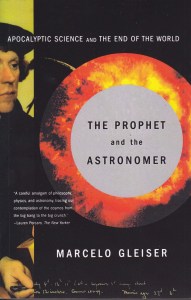
The Prophet and the Astronomer is a wide-ranging book that is tied together around the theme of the end of the world. A few weeks back we had yet another brush with a biblical literalist declaring the end of all things. Gleiser, although his book was published over a decade ago, was called in to comment in various places. This book opens by discussing ancient ideas of the end of the world. These are necessarily religious ideas. We don’t fully understand ancient concepts, but enough remains for us to see that apocalypses have their origins in Zoroastrian thought. Judaism encountered such thinking and the book of Daniel ran with it. Early Christians also had the world’s end on their minds, and the book of Revelation developed into a full-blown apocalypse. The world, or at least the western hemisphere, has never been the same since. Centuries of living under the threat of a cataclysm that could come at any second surely takes its toll.

Gleiser then shifts to the real harbingers of potential apocalypses. Comets and asteroids still exist and could theoretically deliver what the Bible implies might happen—a fiery end to the planet. This is sobering stuff. But the book doesn’t stop there. Bidding adieu to the dinosaurs, The Prophet and the Astronomer sweeps us into this great, expanding universe and how it may end, scientifically. Black holes and the heat death of the universe can be truly terrify. What is remarkable about the book, however, is that Gleiser openly acknowledges that science can’t give the comfort and meaning that religion can. Instead of saying, “be tough, face facts” he suggests that scientists might consider a narrative that adds value to a cold, dark universe. That’s not to say some of the story isn’t technical and some of the concepts aren’t difficult to grasp, but it is to suggest that science and religion should sit down and talk sometime. Hopefully before the end of the world.


The Deity Electric

The title set me back. “Deus ex machina: former Google engineer is developing an AI god.” The article in The Guardian is surprising in several ways. Firstly, technocrats tend to suggest that since there is no deity, worship of said non-entity is a waste of precious time. Is this, then, an acknowledgement that those of us who’ve spent our lives on religion may have had at least an inkling of the truth after all? Scientific studies have repeatedly shown that religion is an inherent, and perhaps unavoidable, aspect of being human. Whether you call it inspiration or superstition, we think in religious terms. It’s entirely natural. Perhaps it’s evolved behavior. It’s anything but absent.

Another aspect of the article that generates wonder is the idea that we can create God. Yes, analysts have long claimed that we humans made God in our own image. Traditionally, however, the very concept of God was based on the idea that there was something non-human about the deity. Artificial Intelligence, however, makes the hubristic assertion that human intelligence knows enough to create a god. We don’t even know enough to elect a sane person as president. Looking at the wider world—let alone the universe—there is so much we don’t know. Our five senses are limited. There are realities which we have no way to measure. Is is perhaps not dangerous to make a divinity when our own way of looking at the universe is so terribly limited? What if I don’t like the god you build? At least with the old fashioned one we can shrug our shoulders and sigh, “that’s just the God there is.”

Any fulfilled future humanist will need to find an outlet for this need to worship. Can we truly respect a deity whose transistors we’ve manufactured? This Godhead will be, at the end of the day, only 0s and 1s. And what’s more, we will know that. Traditional religions have given us gods from the outside. Some of them are flawed, some are perfect, but they all have this in common—we didn’t make them. The universe imposed them upon us. Throughout history people have attempted, in various ways, to build their own gods. It generally doesn’t end well. It’d be like designing your own parents. They made you what you are and what would you be if you could somehow reverse engineer them into more perfect versions of themselves? Can we invent gods? Oh yes. We do it all the time. But when we set about making one that our disembodied, downloaded consciousness can worship we might want to consider the history of such attempts.


Nicholas of Myra

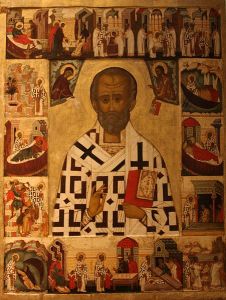
It may be a little early to start thinking about Christmas, but archaeologists don’t often worry about timing. A piece in the Washington Post announced something of potential interests to hagiographers everywhere—Saint Nicholas may still actually be in his tomb. According to the article by Cleve R. Wootson Jr., bandits broke in and stole the relics of the saint centuries ago. In fact, they took them to Bari where a thriving cult grew up around the giving bishop. It seems, however, that they got the wrong tomb. If the analysis is correct, Nicholas of Myra is right where they put him sixteen centuries ago.

Photo credit: Bjoertvedt, via Wikimedia Commons

None of this, however, impacts Christmas as we know it. The relationship between the historical Saint Nicholas and Santa Claus is a wide-ranging and fascinating one. Stories of generosity surrounded Nicholas during and after his earthly life. It took centuries of evolution to get from that to what we now accept as standard Christmas mythology. In the early—pre-rampant capitalist—United States Christmas wasn’t much observed. It was even illegal in some places. Too Popish to appeal to the dissenter sensibilities that made up the colonial majority, the holiday season simply did not exist. It was, in the words of C. S. Lewis, “winter without Christmas.” For those of us who grew up with warm memories of presents, special foods, and days off the obligations of school, such an existence is difficult to imagine.

The feast of Saint Nicholas falls on December 6. Because of its proximity to the revisionist birthday of Jesus on December 25, the gifts of the Magi and the storied presents of Nicholas to families in need eventually merged. The holy days eventually became spending days and the whole jumble of Yule and other solstice celebrations got mixed into a wonderfully tolerant holiday. And all this time we thought Saint Nicholas was missing. He was missing in his own grave.

Miracles are attributed to the relics of saints. I suspect they work even if the wrong bones are plundered. Belief is like that. Historically, little is actually known of Nicholas of Myra. Little is known of Jesus of Nazareth, for that matter. The holiday that grew up in the wake of those willing to give, and to give to those who were undeserving, is a lesson that seems to have been interred with their bones. “So let it be with Santa,” you can almost hear Mark Antony say, standing before Congress, itching to slash any safety nets so one-percenters can have the happiest holiday season ever. Yes, Saint Nicholas is well and truly dead.


More Conjuring

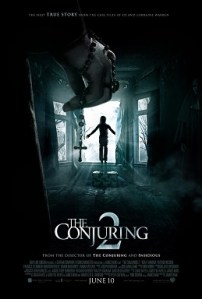
Among the most revered traditions of the horror film is the sequel. Originally a financially driven feature, sequels have now become an expectation among fans. And although in general we prefer to appeal to our higher cultural aspirations, many horror movies do remarkably well at the box office. I’m not much of a sequel-watcher, but sometimes in my effort to understand the close connection between religion and horror, I succumb. So it was I watched The Conjuring 2. As with the formula for the initial movie, cases actually investigated by Ed and Lorraine Warren are brought together with exaggerated special effects and demonic entities. Starting out in Amityville, the demon Valak is introduced. It later appears as the source of the Enfield poltergeist.

In real life controversy never strayed far from the Warrens and their investigations. Amityville and Enfield have both been implicated as hoaxes. The Hodgson girls, just like the Fox sisters in upstate New York, confessed to some faking, and, of course once that dam has been breeched, there’s no stopping the flood to follow. Nevertheless, such incidents make for good horror film fare. In the case of The Conjuring 2, bringing a named demon into the mix keeps the religious pot roiling. Ironically, the demon takes the form of a nun. This character is a complete departure from both the Amityville and Enfield of record, although demonic influences were posited for both cases. Valak appears to go back to The Lesser Key of Solomon, a grimoire familiar to watchers of the now departed Sleepy Hollow.

Even with the hoax light cast on the “based on a true story” tagline, The Conjuring is well on its way to spawning a cinematic universe. Annabelle was a spinoff, and Annabelle: Creation scored high marks this summer. The success of The Conjuring 2 has led to work on The Nun, scheduled out next year. There’s talk of a third Conjuring film as well. As religion becomes less obvious in the traditional forms of weekly worship gatherings, it crops up more in other areas of culture. Don’t get me wrong—there’s plenty of secular horror as well. What does stand out is that when religion knocks at that creaking door of horror, nobody’s especially surprised. The Conjuring 2’s climax is quickly resolved once the demon’s name is remembered. The fallen angel is banished, not so much back to Hell as to another sequel. Eternal life is, after all, a religious idea as well.


Voting Belief

No one knows the origins of religion. Before the advent of writing we can only guess, based on artifacts. Even in the era of scriveners, nobody jotted down the origin of belief until modern times, long, long after it began. Once writings about religious practice become reasonably clear, we find temples in the service of palaces, and vice-versa. Monarchs needed the validation of deities and priests required the support of the crown. Together they brought the two swords together and managed to keep the unruly masses in check. This isn’t cynical, not necessarily, since it reflects, the best we can reconstruct, how western organized religions began. Power was always part of the picture.

A recent Washington Post story, “The stark racial and religious divide between Democrats and Republicans, in one chart,” by Christopher Ingraham, shows the diametrically opposed pie-charts of self-identified white Christians (Republicans) versus non-white or non-Christian (Democrats) Americans. Such survey results tell us much about ourselves. We vote with our faith (or lack thereof) and not with our rationality. This has long been the piece of the political puzzle that Democrats have failed to comprehend. Not to take away from Barack Obama’s charisma, but people were afraid of Mormon Mitt Romney in 2012. Although conservative, white, and evangelical, Mormons have long been questioned as to their Christian identity by other evangelicals. It would seem, in the light of present circumstances, that understanding the “white Christian” mindset might be the only way out of the morass.

Typically self-defeating, academic institutions have shown little interest in understanding religion among hoi polloi. Long ago they bought into what Peter Berger admitted was his biggest blunder, the idea that religion was dying out. By the time he made that admission, academics had ceased to pay much attention to religion. It has, of course, come back as the ghost that haunts us. Or is it a zombie, once dead and now back to life? The fact is religion was never dying. It is as much of being a human as is driving a car or owning a cell phone. When times are uncertain, we turn to what is perceived as unchanging—religion. In truth, religion is constantly evolving to fit outlooks influenced by science, technology, and social progress. Worldviews change. Our culture is becoming more diverse. Republicans have a natural voting bloc that identifies itself by race and religion. Information about the former is readily available. You’ll need to look a bit harder to find quality information about the latter, no matter how important it may be.


The Name of the Game

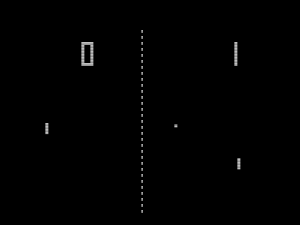
I have a confession to make. I’m not a gamer. Just like everyone old enough to be aware in the 1970s, I was amazed at Pong. Television, which had always only been a passive producer of entertainment, could now be interactive. Slower than real table tennis, the game nevertheless easily consumed hours of life otherwise productively spent. I went off to college and left the burgeoning video game market behind. Then in the late 1990s Myst appeared. The new Macs of those days came loaded with action games about dinosaurs stealing eggs. My daughter was fascinated and so I played. Then I lost interest again. That had been family bonding time, so it wasn’t completely wasted. Now we live in a world where, writers tell me, the real money lies not in movie rights to your novel, but game rights.

Kids, developmental psychologists assure us, need to play. It’s how they explore their world. As the human world becomes more and more electronic, games become more a part of virtual life. Some even have plots and genuine character development. A friend sent me a link to a story on Mashable, “Jesus battles the Buddha in fighting game hellbent on offending.” Victoria Ho describes Fight of Gods where deities of all denominations duke it out for dominion. After posting about god novels recently, it seems to me that we’ve begun to enter a time when the divine world hasn’t disappeared, but has transmuted. In this new world while all gods are not exactly created equal, they all have a shot at supremacy. It’s a matter of who can hit hardest.

No matter whether one finds this offensive or not, there is an element of profundity here. Historically religions have made gods of the things we fear. Storms, diseases, wars, and death—all of these have been, and continue to be, represented as deities. Human insecurity is deeply rooted in our psychology. We’re afraid of things we can’t control. In periods of governmental chaos, phobias naturally rise to the level of personal panic. What can we do in the face of such forces? Especially when prominent figures tell us all religious belief is for the weak-minded and feeble? Don’t we have to strap on our virtual armor and hope some powerful divinities are on our side? In such times as this we need our gods, no matter their tradition of origin. For me, I fear I won’t be able to spin this dial fast enough and that strangely square ping-pong ball is going to get past my virtual paddle.


Contemporary Scripture

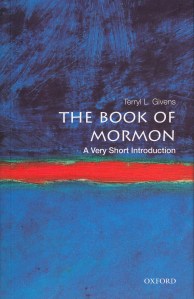
Being born into a religion makes all the difference. I say this as someone who was born into a family that would now be labeled Fundamentalist. That orientation stays firm unless a reason arises to question it. And that reason must be compelling. Many today wonder how, for example, Mormons can believe the narrative of golden plates told by Joseph Smith and that led to the Book of Mormon. Like many non-LDS members, I am curious. While this isn’t the main question in Terryl L. Givens’ The Book of Mormon: A Very Short Introduction, he does address it. The answer comes in the form of a community of belief. The idea is perhaps surprising in an age of individualism, but communal belief has been, historically, the mainstay of religion. A few individuals in any tradition dig deeply and ask questions. They rise into leadership roles, and steps along the way confirm their convictions. Most, however, are everyday believers.

The Book of Mormon is an interesting scripture. The idea of tribes from Israel colonizing the New World has its challenges. The Bible itself tends to go silent about what happened to the northern tribes (“Israel” proper) after the exile. This opens the door to all kinds of possibilities. Various cultures have claimed to be the remnant. Native Americans, of course, tend not to apply the idea to themselves. As Givens points out, the Book of Mormon states that the Israelites of the New World died out long ago. Probably when the Latter-Day Saints are few centuries older, it may happen that metaphorical views toward the Book of Mormon might become prevalent. It took over a millennium before “mainstream” Christians began to ask some pointed questions about their own Scriptures.

Scriptures are products of their own periods. No matter how sacred or inspired they are thought to be, they were written down in human time and human space. Hints are often left along the way regarding authorship, origin, bias, and perspective. The Book of Mormon is rare in having a known publication date, and that in the nineteenth century. Autographs—original texts—are available, even if the golden tablets are not. It’s a rare opportunity to watch a scripture come into being. We know who wrote the Book of Mormon, and when. Its printing history is known, as is its context in the Second Great Awakening. All that’s needed are a few more centuries for scholars to see how things develop. Those who study scriptures are inclined towards the long view anyway.


Hieroglyphs

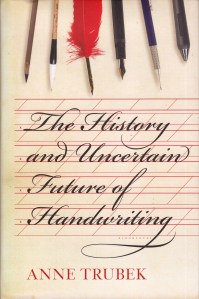
The word “hieroglyph” translates to “sacred writing.” If you’re like me, your first attempts to learn writing were probably not very sacred at all. Tongue pressed to the corner of my mouth, eyes staring fixedly at the paper flat in front of me, my hand going anywhere but where I wanted it to, writing was a burden. I soon grew to love it though, not realizing it was changing my brain even as I was assimilating how to do it. Anne Trubek introduces quite a few new angles to the story in The History and Uncertain Future of Handwriting. She begins at the beginning, cuneiform, not hieroglyphics, and offers a brief sketch of how handwriting developed into the phenomenon we know today. And how it is now becoming something very different than what it once was.

Trubek’s book is full of delightful surprises about the development of scripts and the technologies that attend them. Like most non-specialists in cuneiform suppose, she suggests handwriting is basically anonymous therein. In fact, it’s not. Molding clay into a smartphone-shaped tablet doesn’t seem like technology, but the process of writing took a leap forward when someone figured out how to do this. Those who work with cuneiform can learn to identify handwriting. In the Ugaritic corpus, the tablets “signed” by Ilimilku can be distinguished from those written by others, and not just by his name. Technology has been devised to measure depth and order of stylus strokes in the clay, the angle the stylus was held, and many other seemingly insignificant features. Handwriting was present from the very beginning.

Perhaps what is most striking about Trubek’s study is how religion enters the discussion at almost every stage. Very early on writing was identified as a sacred activity. This continued through the middle ages when monks were those who performed writing as part of their non-secular duties. Even those who piloted penmanship in the modern period often noted that a person’s moral, Christian disposition could be measured by how said person made their letters. Writing, as those who do it for a good while know, becomes a sacred activity. Most world religions have holy books. Many of those books were the reason for an interest in literacy in several cultures. Even a surprising number of secular writers have understood the activity to have spiritual dimensions. Trubek’s book gives bibliophiles plenty to ponder. She doesn’t see the rise of keyboarding as a threat to writing because even in the computer age, individuality comes through. And for those who truly understand hieroglyphs, all writing is sacred.


Not Devil’s Tower

The Sourlands, apart from being the setting of Joyce Carol Oates stories, are one of New Jersey’s characteristic features. Although the Garden State brings visions of heavy industrialization to many imaginations, there are also lots of outdoor options for getting back to nature. One is the Sourland Mountain Preserve. No one’s sure of the origin of the name—was it named after a person, or was the land poor for farming? Could it have come from another language? No matter what the source might be, these areas are today criss-crossed with hiking trails—some of them quite rugged. On a sunny September weekend my wife and I decided to take a walk. The sunshine and cool temperatures made the opportunity beguiling. Although it’s not far from where we live, we’d never been there before. Time to look at a map.

The most distinctive point listed was the Devil’s Half-Acre Boulders. Geonyms, or place names, can be quite evocative. New Jersey and Pennsylvania along the Delaware both lay claim to some impressive boulder fields. The Devil’s Half-Acre was clearly a place for rock climbing, as chalk dust on the trail indicated. It’s not territory that you can get through quickly. But why devilish? Across the Delaware may lie the origins of the name. Near another boulder field, Ringing Rocks, is the site of a tavern along the Pennsylvania Canal. Said to have been the locale of lawlessness, haunted by the ghosts of dead canal workers, the location earned the same diabolical sobriquet in the early nineteenth century. What we found on the Jersey side, however, was an impressive jumble of massive stone and a rather popular hiking path.

“The map is not the territory” Alfred Korzybski once famously wrote. His expression was borrowed and adapted by religionist Jonathan Z. Smith in a book that’s still required reading for those starting out in the field. The point of the saying is that a map is an abstraction. The experience down here on the ground is very different from that projected from a bird’s eye-view. We can easily adjust to the concept however, using maps to tell us what lies ahead. The difficult work of digging a canal, or the unyielding nature of boulders, may symbolically point to the devil. At several points on the trail we had to pull out our map to make sure of our bearings. Trails are hard to follow over rocks. There was no literal devil there, but territory might just help to explain the name on a map.


Church of Advent

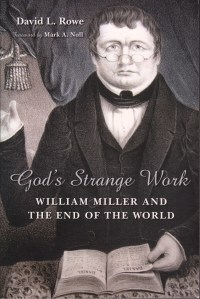
It’s a common name. You might know one yourself: William Miller. Indeed, for many years of my own life I borrowed that surname from my stepfather before returning to my birthright after seminary. But the ordinariness of the name alone doesn’t explain it. Joseph Smith, a fellow creator of a new religion, also bore an innocuous name, and he was a Junior. While many people might have trouble placing William Miller among religious founders, they would likely know of Seventh-Day Adventism, a religion that sprang from the root of his teaching. During his lifetime the preferred title was Millerite, but Adventist also worked. David L. Rowe presents a sympathetic, but not hagiographic account of this somewhat remarkable life in God’s Strange Work: William Miller and the End of the World. For Miller, you see, predicted the year Jesus would return.

A self-taught farmer, Miller became convinced that the Bible indicated 1843 would be the end. This idea was based on calculations derived from cryptic books such as Daniel and considering their days to be years. A touch of math and before you know it, it’s all gonna burn. During the intense period known as the Second Great Awakening upstate New York was perhaps the most religiously creative place on the planet. New ideas bumped into each other and, as if the bounds of Christianity were too constraining, flew out into new forms of belief. People grew convinced that the world might indeed end in 1843. When it didn’t, they called it the Great Disappointment and carried on. Adventism is still with us today.

Rowe also makes the point that for being such an obscure individual, Miller influenced the great religious movements that would give us modern day Fundamentalism as well as Jehovah’s Witnesses. These groups trace their spiritual ancestry to the convictions of a not-so-simple farmer who could fill an auditorium with his plain speaking and clear exposition of the scriptures. He devised his end times scenario with the use of only a Bible and concordance. No seminary or advanced theological reading was necessary. Millerites did not reach the numbers of Latter-Day Saints. They were disowned by the Baptist Church that gave them birth. They got the date of the end of the world wrong. Yet they persisted. It is a curious story with a long afterlife that still helps elect extremist presidents to this day. William Miller, ever unassuming, managed to change the very world that he was certain would end even before the midpoint of the nineteenth century.


Creative Religion

If you ignore common sense and read this blog, you know that I try to be creative in my approach to the world. It’s bold, in my way of thinking, to claim the mantle of creativity since there are so many people out there that the world has already decided are creative enough, thank you. Who has time to visit all the world’s museums, read all the world’s novels, or watch all the world’s films? Why contribute to the clutter? The answer—in as far as there is an answer—is that creativity is a way of being. My wife sent me a piece by Maria Popova from Brain Pickings. It is about the creative life. I’m reluctant to claim the title for myself, but the essay does match the description of what I’d like life to be.

Writing about religion daily requires a certain amount of creativity. If you think about it, it does make sense. Religion deals with intangibles. “Things not seen.” It also delves into that deep place called meaning and wrestles with issues we all have to face in our lives. It’s really a shame when religion becomes ossified into a system with no creativity or humor. One might make the case that it ceases to be religion then. The other day I was recalling just how powerful a high mass can be. Even now, if the mood is right, the memory of my first experience of it can bring tears to my eyes. It is a pageant of mystery and power. And creativity. The colors, the sounds, the scent of incense, the pressure of the kneeler on your knees, the sharp bite of flame tokay. It may not be the worship the way the disciples did it, but it sure has a creative genius.

When, however, worship became a daily requirement—when the majesty became mandatory—something was lost. Creativity means being willing to try something different. As much as we creative types cherish our friends, we need time alone with our Muses. And when we come back together with those friends, it is all the more pleasant for having been away. Creative people do not control their creativity. It clearly works the other way around. We can’t stop being creative, even if—and I can’t imagine why—we’d ever want not to be. Religion, on the other hand, tends to get stuck in some awkward places. If only it could be brought together with an open creativity without becoming trite it might find a place in a world too busy to take time simply to be.


New Religious—Bang!

Religion, no matter what the skeptics say, gives us something to believe in. Even those who claim no religion believe in their non-religion. We can’t escape belief. It’s no surprise, then, that new religions constantly emerge. As people find new things—or events—meaningful, and they come together around the phenomenon or episode, a religion eventually emerges. Take the example of the Chelyabinsk meteorite. On February 15, 2013 a resounding explosion rocked Chelyabinsk. What was likely a former asteroid had headed for Russia (which they seem to prefer almost as much as Donald Trump) and became a meteoroid (the name for meteors while they’re still in outer space). Once it entered the earth’s atmosphere and became a meteor proper, it superheated and exploded in the sky—a phenomenon known as a bolide. For those of us who’ve experience them, bolides are unforgettable. Once the pieces of the exploded meteor hit the earth they became meteorites.

Image credit: NASA/ESA, public domain

Meteors are an everyday occurrence. Any time you see a shooting star—which you can do any clear night—you’ve seen one. Large, exploding meteors are rare. Shortly after the Chelyabinsk meteorite fell, according to Astro Bob, the Church of the Chelyabinsk Meteorite formed. This group did not wish for the main body of the surviving meteorite to be raised from Lake Chebarkul, where it fell. Their protests became religious as they chanted, prayed, and sang. A new, if temporary, religion was born. Astro Bob goes on to say that religions and meteorites are no strangers. Indeed, up until the Middle Ages and even a little beyond, it was believed that rocks could not fall from the sky. A meteorite, then, was a sign from either God or, well, you know who. When the impossible happens religions are quick to follow. Astro Bob’s story was written in 2013, so he doesn’t declare the fate of the Church. The meteorite was raised from the bottom of the lake in October of that year.

New Year’s Day in 1987, while I was home from seminary on break, putting a puzzle together with my brother, our house shook. A loud boom accompanied the shock wave. We ran outside to find the neighbors staring at the sky, and a few casting a wary glance toward the petroleum refinery in town. The news later that day told us a bolide had exploded nowhere very near us. We were within the shock wave, and those fortunate enough to be outside that January saw a flaming meteor in the daytime sky. I remember it well thirty years later. I already had a religion at the time (Methodism, starting to tend toward Episcopalianism) so my plate was already full. It was nevertheless a dramatic event, and when your world is literally shaken, you will naturally look for something to believe.


On Jordan’s Stormy Bank

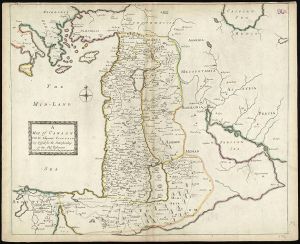
All you have to do is spit in the cup. Well, you have to do it quite a few times, but that’s the basic idea. Then you send the contents to a religiously motivated lab and your genetic ancestry will be emailed back to you. (There will be a fee involved, of course.) Genetics, a science of which Darwin didn’t have the benefit, is capable of mapping out where various “races” originated and ended up. Enter the Bible. One of the most disputed groups among scholars of the ancient Near East is the Canaanites. There was, as far as we can tell, no “nation” called “Canaan.” No people called themselves “Canaanites” but the term was used by others to designate them. Yahweh had a vendetta against them and ordered them wiped out. And, according to parts of the Bible, the Israelites acquiesced. So where are the Canaanites?

Image credit: http://maps.bpl.org, via Wikipedia Commons

According to a Washington Post article by Ben Guarino, DNA sequencing has revealed that they’re still there. This should come as no surprise to most anthropologists. Racial purity is always partially a myth, since “race” is no barrier to love. Or at least lust. And genetic traits don’t lie. Tracing ancient DNA from “Canaanite” (I’m getting myself scared using all these scare quotes) burials, scientists have discovered the biblical nemesis still survives in abundance, especially in Lebanon. Interestingly, on a cultural level, there is no distinction between Israelite and Canaanite. They are virtually identical. This creates one of the many embarrassments for biblical scholars, since the differences should be more than just skin deep. As with so many cases of racial distinction, the reality is mostly imagination.

Literalists, of course, have been in a rear-guard position for well over a century now, so the news should cause minimal shock. The problem will be keeping them from finding new excuses to carry out an extinct mandate. Biblical scholars, that heathenish race, long ago capitulated with the enemy. You’d expect no less from those who would dare use reason when approaching Holy Writ. It’s the real-world application that’s a problem. What do you do when the biblical enemy is found, hiding in plain sight like a purloined Lebanon? The solution might be as old as the story itself. Darwin didn’t have genetics, but he did have the Bible. The issue in the nineteenth century was what to reject when worldviews clashed. The answer was to jettison the godless science. We can only hope that this time-honored technique will prevent future crusades fomented by scientific discovery.


Big Shoes

Belief in the supernatural seems to be alive here in the northwest. At least if the culture at Sea-Tac Airport is anything to go by. I’d noticed, last year, that a sasquatch graces a restaurant in the N terminal, where jets from Newark tend to land. This year we had a bit of a layover, so we strolled through the C concourse. There I found sasquatch approved salmon in the somewhat anomalous Hudson News. Then, as I sat in one of the stylish, Seattle seats, a young woman came up next to us and sat down wearing a Sasquatch Volleyball shirt. I’m past the age when I can get away with innocently asking young ladies if I can take a photo of their shirts, so you’ll just have to use your imagination for the latter. The point is, bigfoot has been mainstreamed.

When I was growing up you got pretty mercilessly teased if you expressed any interest in such things. Now that I’ve got a respectable career others can get away with what captured my imagination as a young man. I’ve never thought of myself as being ahead of the curve. Or really ahead of anything, for that matter. Still, I trust my instincts. Maybe religion will come back into vogue some day. Or maybe it will simply be called something else. A tainted name is difficult to live down. The supernatural—or paranormal—often shares conceptual territory with religion, and although the pews aren’t getting any fuller, the number of those looking for some kind of meaning in the unusual seems to be holding steady. Physics can take us only so far in understanding what it is to be human.

Times change. Yesterday’s jokes are today’s orthodoxies. Those who spend a great deal of time peering back into history won’t be surprised by this. What is true today is true for today. New facts will be discovered and if we lived long enough we’d find that the future world will believe quite differently than we do. Not that the truth is relative. It is, however, temporary. Massive religious wars have been fought over trying to keep truths timeless. The sad irony is that the truths had already changed by the time such wars had been waged. The more rational we become, it seems, the more we open the door for the supernatural. I won’t presume to be one declaring such truth. That would take more weight than I have to offer. And anyone making such a claim would have some awfully big shoes to fill.