On Jordan’s Stormy Bank

All you have to do is spit in the cup. Well, you have to do it quite a few times, but that’s the basic idea. Then you send the contents to a religiously motivated lab and your genetic ancestry will be emailed back to you. (There will be a fee involved, of course.) Genetics, a science of which Darwin didn’t have the benefit, is capable of mapping out where various “races” originated and ended up. Enter the Bible. One of the most disputed groups among scholars of the ancient Near East is the Canaanites. There was, as far as we can tell, no “nation” called “Canaan.” No people called themselves “Canaanites” but the term was used by others to designate them. Yahweh had a vendetta against them and ordered them wiped out. And, according to parts of the Bible, the Israelites acquiesced. So where are the Canaanites?

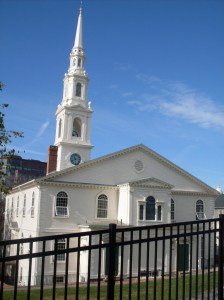
Image credit: http://maps.bpl.org, via Wikipedia Commons

According to a Washington Post article by Ben Guarino, DNA sequencing has revealed that they’re still there. This should come as no surprise to most anthropologists. Racial purity is always partially a myth, since “race” is no barrier to love. Or at least lust. And genetic traits don’t lie. Tracing ancient DNA from “Canaanite” (I’m getting myself scared using all these scare quotes) burials, scientists have discovered the biblical nemesis still survives in abundance, especially in Lebanon. Interestingly, on a cultural level, there is no distinction between Israelite and Canaanite. They are virtually identical. This creates one of the many embarrassments for biblical scholars, since the differences should be more than just skin deep. As with so many cases of racial distinction, the reality is mostly imagination.

Literalists, of course, have been in a rear-guard position for well over a century now, so the news should cause minimal shock. The problem will be keeping them from finding new excuses to carry out an extinct mandate. Biblical scholars, that heathenish race, long ago capitulated with the enemy. You’d expect no less from those who would dare use reason when approaching Holy Writ. It’s the real-world application that’s a problem. What do you do when the biblical enemy is found, hiding in plain sight like a purloined Lebanon? The solution might be as old as the story itself. Darwin didn’t have genetics, but he did have the Bible. The issue in the nineteenth century was what to reject when worldviews clashed. The answer was to jettison the godless science. We can only hope that this time-honored technique will prevent future crusades fomented by scientific discovery.


Big Shoes

Belief in the supernatural seems to be alive here in the northwest. At least if the culture at Sea-Tac Airport is anything to go by. I’d noticed, last year, that a sasquatch graces a restaurant in the N terminal, where jets from Newark tend to land. This year we had a bit of a layover, so we strolled through the C concourse. There I found sasquatch approved salmon in the somewhat anomalous Hudson News. Then, as I sat in one of the stylish, Seattle seats, a young woman came up next to us and sat down wearing a Sasquatch Volleyball shirt. I’m past the age when I can get away with innocently asking young ladies if I can take a photo of their shirts, so you’ll just have to use your imagination for the latter. The point is, bigfoot has been mainstreamed.

When I was growing up you got pretty mercilessly teased if you expressed any interest in such things. Now that I’ve got a respectable career others can get away with what captured my imagination as a young man. I’ve never thought of myself as being ahead of the curve. Or really ahead of anything, for that matter. Still, I trust my instincts. Maybe religion will come back into vogue some day. Or maybe it will simply be called something else. A tainted name is difficult to live down. The supernatural—or paranormal—often shares conceptual territory with religion, and although the pews aren’t getting any fuller, the number of those looking for some kind of meaning in the unusual seems to be holding steady. Physics can take us only so far in understanding what it is to be human.

Times change. Yesterday’s jokes are today’s orthodoxies. Those who spend a great deal of time peering back into history won’t be surprised by this. What is true today is true for today. New facts will be discovered and if we lived long enough we’d find that the future world will believe quite differently than we do. Not that the truth is relative. It is, however, temporary. Massive religious wars have been fought over trying to keep truths timeless. The sad irony is that the truths had already changed by the time such wars had been waged. The more rational we become, it seems, the more we open the door for the supernatural. I won’t presume to be one declaring such truth. That would take more weight than I have to offer. And anyone making such a claim would have some awfully big shoes to fill.


Sky Blue

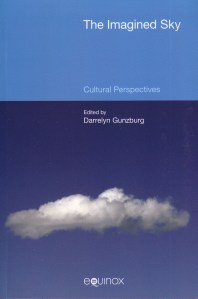
How do you capture a true and abiding fascination in words? That’s a thought that comes to me once in a while when I think about the sky. It’s so hard to define, yet it’s always there. To quote myself: “To understand the weather is somehow to glimpse the divine” (used with permission). I waited for The Imagined Sky: Cultural Perspectives, edited by Darrelyn Gunzburg, for years. I think I first saw an ad for the book two years in advance of publication (yes, scholarly presses can do stuff like that). I kept stopping by the Equinox booth at AAR/SBL to see if it was available. It was the same kind of drive that led me to write Weathering the Psalms. That hope of grasping the intangible. To hold the sky itself. One of my early creative writing club stories was about a boy who wanted the sky. I wanted this book.

Like all books of essays from different authors, it’s a mix of fruits and nuts. There’s some very interesting pieces in here while others seem to have been made to fit only with some difficulty. Still, the sky. I admit to being somewhat disappointed as I read along. This wasn’t for research—my book on the topic is already done—it was for pure intellectual curiosity, what passes for pleasure among academics. Many of the pieces were mired down in detail. Written bout the sky, they refused to soar. Then I came to Tim Ingold’s essay. Here’s what I’d been looking for. Someone who knew the sky could only be approached in terms that contradict themselves at every turn. There is something to say about the daytime sky. It has to do with the nature of light. And of the sky seeing us.

The sky, by definition, is larger than this rocky substrate we call home. It encompasses everything above us. I work in a cubicle with no access to outside windows. I wilt daily like a plant deprived of sun. (Although the wonderful article on light pollution by Tyler Nordgren gave me pause over even that.) I need to see the sky. When clouds block my view, my outlook begins to suffer. It’s that ethereal cerulean I crave. Without it I am but a troglodyte eking out a minimal survival on toadstools and lichen. The sky is our orientation. It is our timepiece. It is eternal. Of the things we do that are evil, polluting the sky is one of the most unforgivable. The key may be in the word “imagined,” but if we could only understand the sky we will have found true religion. They’re called “the heavens” for a reason.


No Explanation

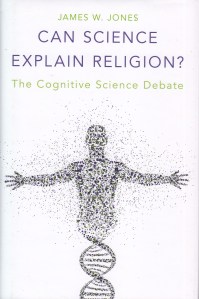
How do you explain that? Everything, I mean. The need to understand “life, the universe, and everything” is as old as our species, and perhaps even older than that. Up until modernity when the limits of physical explanations were reached, gods filled the gaps. Can Science Explain Religion: The Cognitive Science Debate, by James W. Jones, is not an easy book. It demands mental rigor on the part of the reader. It is also a very important book. Mainly addressing the religion debunkers—those who famously declare religion to be pointless and perhaps even evil—the book asks logically, step by step, whether their assertions are rational. Since Jones is, as I once was, a professor of religion, the reader will be forgiven for second-guessing him. Jones makes a very strong case not for the truth of religion, but for its rationality, not its believability.

Beginning with the basics, Jones considers explaining explaining. In other words, can religion be explained scientifically, and if it can what does that logically prove? You need to follow him pretty closely here, but it is worth the journey. Science, as a human enterprise, has its limits. Jones doesn’t disparage science—far from it—just its misuse. The mad passion for a single explanation for everything has led to reductionist thinking. It’s not uncommon for the debunkers to claim everything is physical. Nothing exists that science can’t explain. Jones demonstrates the logical flaws in this approach. Not apologetically, but rationally. Physicalism, like its ancestor logical positivism, runs into serious problems when it comes to explaining much of life. Especially consciousness.

Consciousness remains one of the great mysteries of existence. Nobody knows what it is or where it comes from. Jones isn’t appealing to the “God of the gaps” here, but he is simply taking his own experience as a clinical psychophysiologist and bringing it into the conversation. Mind is not easily explained as a byproduct of matter. The term that has been used in recent years is that consciousness is an emergent phenomenon. Something that is greater than the sum of its individual parts. Jones doesn’t declare science can’t explain this, but rather that when science addresses the question clearly and logically a plurality emerges. One single answer may not be enough to cover it all. I’ve posted many times on this blog about the misuse of Occam’s Razor. Jones here provides a sustained, and rational discussion of questions that have never been answered adequately. Religion doesn’t challenge science, but together they may have more explanatory power than either has separately. Any book that can establish that qualifies as very important.


Light and Dark

Prophets, mothers, messiahs. A new religion for a new world. While these may not be main themes of Robert Repino’s new novel D’Arc, they’re clearly there in the background offering verisimilitude to a world turned upside down. Continuing the diegesis created in his previous two novels Mort(e) and Culdesac, Repino again shows an uncommon awareness that when survival becomes difficult people (and animals) turn to religion. Many fiction writers create worlds under stress and pretend that characters simply forget the religious option. That may be realistic on an individual level, but as history shows, not on a societal one. People—and mutated animals—are meaning-seeking beings. D’Arc doesn’t shy away from this fact. In a wildly integrated world of different species coping with consciousness and opposable thumbs in various ways, religion naturally arises.

If you haven’t been initiated into Repino’s universe, it begins with a virus and/or a plot—themselves religious—which allow animals to become bipedal and to grow human hands. They can talk and reason and they show us a true reflection of who we are. D’Arc, the female companion of Mort(e), finds her way in a world under threat. Planning to speed up global warming in a dramatic way, the aquatic antagonists conspire to melt the ice caps to flood the entire world. Repino knows the value of the flood story and uses it to full advantage. Along the way we meet beavers who’ve developed a religion that functions between water and dry land. Indeed, as a species their religion defines them as much as their engineering skills. This is a world that’s just been through war and instead of reconciling all species, there remain those (most notably humans) who can only live with their own superiority. This is a complex universe.

The hero of this tale, D’Arc, is sympathetic to the religious sensibilities that have sprung up around her. She herself is a character prophesied in this world where Mort(e) is messianic. There’s a scripture in the background somewhere and theirs is a world without embarrassment about it. There’s also plenty of action and adventure—the war with no name is really not over—but there’s a subtlety to the narrative as well. When things go awry many people do assume they’re alone in the universe and try to find their own way. It’s equally true that many look for meaning in a structured form of belief where all of this has been foretold. Such worlds, to me, seem to be more honest to the human condition, even when the characters are cast as talking animals.


Ellis Island

A few years back we made a trip to Ellis Island. This is a common field trip here in New Jersey, although none of my immediate family passed through this portal. The most recent immigrants in my own heritage seem to have arrived by the early 1800s. In any case, Ellis Island is an impressive location. Now a museum, you can wander through the rooms and get an idea of what newcomers faced after a long and trying ocean voyage. What struck me the most was that large numbers of people were turned away for mental problems. I suspect mental illness of one sort or another is unnervingly common among human beings, and our current frenetic pace of life probably only exacerbates the situation. Still, I wonder if we really have a clear grasp on what is “normal.”

As humans become more adept at understanding their own brains, a need for more precise definitions asserts itself. A friend recently sent me an article suggesting “Neurologists Have Identified Brain Lesions That Could Be Linked to Religious Fundamentalism” on Science Alert. The article my Mike McRae ultimately doesn’t suggest that brain damage is the answer to Fundamentalism, but the story reminded me of an unscientific observation by one of my seminary professors decades ago. Harrell Beck once said something along the lines of Fundamentalism isn’t a theological position, it’s a psychological problem. Indeed, those who fall into the literalist camp have a preternatural urge to see things in black and white. Rules that can’t be violated, even if it means your deity’s an angry old God. With literally Hell to pay if you’re wrong, the right course of action is strikingly clear. Only life’s seldom so simple.

We study our brains but we don’t have a baseline for normal. I can’t believe that waking before dawn to catch a bus to work a job that pays less than a successful high school degree in other states is a good bet by anybody’s standard measure of normalcy. Those who read probing biographies find that even our brightest and best have quirks they didn’t wear in public. Surely the physicians on Ellis Island had some guidelines in mind when they were turning away those who didn’t measure up to the standard of what an ideal American mentality should be. Although Ellis Island shut its doors over half a century ago, it’s clear that even if we kept some unstable candidates out, we’ve done a stellar job of growing our own. And that can be taken as truth by faith alone.


Incident at the Wailing Wall

While reading about Jerusalem lately, I recalled my first visit to the Wailing Wall. The Wailing Wall is the only standing part left of the temple that Herod the Great refurbished on the site of the temple originally built during Solomon’s reign, destroyed by the Babylonians, and rebuilt under the Persians. This was called the “Second Temple” because the first had been razed and although Herod had basically rebuilt it, the second one had never been destroyed (that would happen a few decades down the road). Today the Wailing Wall, the western wall of that magnificent temple, is a sacred site to Jews, and to not a few Christians. My visit took place in 1987. I was volunteering on a dig at Tel Dor, and on a free weekend I’d taken the bus to Jerusalem with some friends to look around.

It was late Friday afternoon. I was on my first trip overseas, and, like most fresh-eyed youngsters, photo-documenting as much as I could. I raised my camera. A guard walked up to me. “No pictures on the Sabbath,” he said. He had a machine gun and I didn’t, so there was no arguing the point. Besides, I had just finished the roll. (Does anyone out there remember film cameras?) I stepped into the shade of an alcove to change the roll. A couple of Hasidic men stopped me. “No photos on the Sabbath,” they warned. I assured them I was just changing my film. It was clear, however, that no more pics would be snapped. I rejoined my party and took out a notebook—at least I could jot down a few impressions. Another guard approached, “No writing on the Sabbath,” he said.

This episode has stayed with me over the years. With Trump’s international tour, I’m reminded that I’ve always striven to avoid the “ugly American” syndrome. I respect the local rules. The incident at the Wailing Wall, however, was a case of religious rules, wasn’t it? Does the enforced rest of the Sabbath apply to Protestants? Indeed, I’d been warned that if I didn’t catch a bus before sundown I’d never make it to Jerusalem on a Friday evening at all. Conflicting theocracies have led to more than their share of international sorrow. Why not take the high road and simply absorb what is going on around me? There’s a profound wisdom in that. Travel should inform our worldview. Those who encounter walls should stop and consider all they might mean to all who will eventually face them.


One Size Fits All

The divide between religion and science is often artificially widened by one side or the other. Of course the divide’s artificial—both science and religion are human constructs, after all. This is illustrated well in the sense of wonder in an article titled “True Story Of Volcanic Eruption Told By Aboriginal People For 7,000 Years” by Robin Andrews on IFLScience!. The very concept that a scientifically verifiable event survived in oral tradition for thousands of years completely unbalances those accustomed to think that the ancients were superstitious dupes who looked to the gods to explain everything. What’s often not realized is that the gods were an early version of science. Think about it—ancient people observed their environment for cause and effect. They couldn’t use the empirical method because it hadn’t been invented yet. That didn’t mean they were unsophisticated.

We look at the pyramids and wonder. How could such archaic people construct such advanced monuments? The rudiments of science actually begin to appear in the human record very early. Our species is a curious lot. The explanations for the close observations tended to be mythological. Gods are great for filling gaps. What we don’t see is any conflict between knowledge acquired by reason and ideas conjured by imagination. They fit together nicely. Human brains evolved that way. Belief is a strange thing—it influences reality, at least on a quantum level, but somehow it must be denigrated when compared to “pure science.” A large part of the blame, of course, has to go to those who had learned to take the Bible literally, particularly beginning in the eighteenth century.

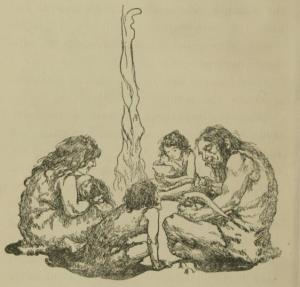
The Bible had a disproportionally influential role in the founding of European empires. From the regular Roman under Constantine to the Holy Roman under Charlemagne, what became Catholicism informed political structures. In the British Empire, ever vacillating between Catholic and Protestant, the Bible played a major intellectual role. Real problems developed, however, when the idea of science alone took over. This was after Newton, Galileo, and Darwin. None of these lights suggested religion had no place. The real issue isn’t vanquishing, but finding proper balance. No matter how well calibrated our instruments may become, until we learn to detect “spirit” we have to admit that science can’t replace religion. Such harmful ideas as eugenics and behaviorism indicate that we need a balance and not a slam dunk. Who knows? Some of even the Bible may be true. Unless we learn to admit we don’t know all, those sitting around the fireside telling stories should be given credibility regarding what they’ve seen.


Spiritual Spelunking

Looking at the headlines it’s sometimes difficult to believe we’ve evolved. I still trust evidence-based science, despite official government policy, however. So when a friend sent me a story about a new human cousin I knew it was worth a look. Homo naledi bones date from much more recent times than they should. At less than 400,000 years old (which means they might fit GOP ideology pretty well) they are almost contemporary with Homo sapiens. And, apparently, they buried their dead. Now much of this is still speculation. The bones were found in caves with openings so small that onlyfemale spelunkers could fit in, and the question of whether dropping bodies in a hole counts as burial has raised its head. Still, the human family tree is being redrawn, and in a way conservatives won’t like.

I became interested in evolution because of Genesis. My mother gave us a few science books as children even though we were Fundamentalists. One of them talked about evolution and I was intrigued. Clearly it didn’t fit with the creation story—I was young enough not to notice the contradictions between Genesis 1 and Genesis 2—and yet scientist believed it. They likely weren’t Christians, I reasoned. College gave the lie to that deductive thinking when I ran into Christians teaching the required “Science Key” who believed in, and yes, taught, evolution. I’d missed something, obviously. Once I discovered evolution could coexist with Scripture I was eager to learn as much as a non-biologist could. In my teaching days I focused on the early part of Genesis and even began to write a book on it.

Image credit: Margaret A. McIntyre, from Wikimedia Commons

It’s much more honest to admit that we’re related to the rest of life on this planet than to set ourselves aside as something special. Evolution has done something that the Bible never could—brought all living things together. There are too many towers of Babel and chosen people themes in Holy Writ to allow for real parity with our fellow humans, let alone other creatures. Yet the human family tree is wondrous in its diversity and complexity. We now know that Neanderthals were likely interbreeding with Homo sapiens and I wonder how that impacts myths of divine chosen species. Did Jesus die for the Neanderthals too, or just our own sapiens sapiens subspecies? You can see the problem. For a literalist it’s just easier to crawl into a cave. But only if the opening is large enough to admit males, since the Bible says they were created first, right?


Sideliners

Sidelines can be interesting places to sit. You’re close to the action, and you’re privileged with a close view that few others have. You can’t, however, play the game. Sidelines are familiar to biblical scholars. I can’t count the number of times and/or ways the input of those who spend their lives trying to comprehend the Good Book are, well, sidelined. In the publishing world those who work with Bibles are simply ignored by most others, despite the enormous revenue Bible sales generate. In the academy religion departments overall are fair game for any potential budget cuts. And since what religion study survives tends to be intercultural, the Bible faculty are deemed somewhat less necessary than other sub-disciplines. It’s easy to forget that Christianity is the largest organized religion in the world and that some 2.2 billion persons claim that name. The Bible’s their foundational book. It tells us what motivates them. And yet, it’s easier simply to ignore the whole thing. Then something insane like an Evangelical-fueled Trump election, and everyone continues to say, “we can safely ignore this.”

I recently saw an article by scientists which explored why people engage in dangerous behaviors. The main idea was that although we know certain things are bad for us individually or as a planet, we still do them. We do them with the full knowledge that they’re deadly and will likely hasten our demise. Ignoring religion (and in the case at hand, the Bible) is very much like that. A well-armed true believer can ruin your day pretty quickly. Religion, in recent years, has generated over $82 billion in revenue per year. At least those in the dismal science ought to sit up and take notice of that! Hey, for once, the numbers are with us! Statistically, religion is very important. Sounds like a good thing to pretend doesn’t exist.

Having grown up a Fundamentalist, I often ponder this state of affairs. The Bible, we all knew, was the most important thing. Studying it formally does tend to force new ways of considering it, but few Bible scholars would want to dismiss the Good Book out of hand. It still means too much to too many people simply to ignore. Far safer is the proper handling of Holy Writ. This is much easier to instill when institutions support it. It really is a necessary kind of education. Still, it gets sidelined for industries with lesser profits and lesser baggage. I grew into a career defined by the Bible, but even if I hadn’t I’d hope that I’d be able to recognize that some things just shouldn’t be ignored. Yet I’m on the sidelines cheering on those who consider such a career a tragic mistake.


Good Newsists

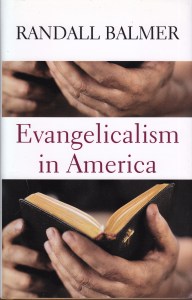
In the interest of avoiding conflict thereof, I cannot yet give a review of Randall Balmer’s Evangelicalism in America. Since I’m writing a review of it for Reading Religion, I’ll use it as a springboard into a topic that should concern all who believe in religious freedom. One of the resounding themes of Balmer’s treatment is that Evangelicalism, after it wedded to the Religious Right, lost its soul. Those are my words, not his, but the sentiment’s about right. For anyone who wasn’t politically aware in the 1980s, it may seem a surprise that religion didn’t enter into politics before that decade. With the exception of the fear of the Catholic in the case of John F. Kennedy, religion wasn’t used as a political wedge until the presidency of Jimmy Carter. The Religious Right, unhappy with the born again Southern Baptist in the White House, moved to solidify the Evangelical bloc.

Evangelicals had been an underground movement for half a century. Many had no idea what being “born again” meant when Carter first claimed the sobriquet. Balmer points out that it was the threat of the withdrawal of tax-exempt status to discriminating Christian schools that led to political action. Bob Jones University, fearful of racial intermarriage, didn’t admit African American students. Leaders of the Religious Right saw the loss of tax-exempt status as a move against their sacred segregated culture and a push that required a shove. Coopting the abortion issue (historically Evangelicals had supported women’s rights, including the right to abortion in many cases), they nailed together a platform for political activism which put women “back in their place,” kept racial “purity,” and romanced a total aberration in Christianity—the “prosperity gospel.” All of this is well documented. And well hidden.

Looking at Evangelical politics today, abortion—the control of women—has become THE issue. It’s hard to believe, as Balmer amply illustrates, that Evangelicalism used to be allied with the Social Gospel. It was a religious view with a conscience and it supported issues that are now polarized as “liberal” and leftist. This shift came about gradually, but not accidentally. There were political players—Balmer names names—who had one goal in mind, and that goal wasn’t Jesus or what he’d do. It was the sweet prize of political power. Evangelicals, you see, are born followers. A leader with a strong voice can lead them just about anywhere. Many Evangelicals today would deny their more liberal history, but it is right there for anyone who’s willing to learn something about who they once were.


To Whom?

The other day I heard someone use the phrase, “preaching to the converted.” I’ve read enough anthropology to know that regional variations on folk sayings exist, but I’ve always heard this as “preaching to the choir.” What’s the difference, you ask? Actually, these two statements imply very divergent things. It all comes down to preaching. Preaching is what clergy do. (I know I’m over-simplifying, but bear with me.) And where do ministers preach? That’s right, in the church. Aha, you might say, those in the church are both converted and some, anyway, are in the choir! What’s the difference? The difference is the choir has to be there. It’s an issue of volition.

Since this isn’t eighteenth-century New England (at least not yet, although the current administration is trying to make it so) there are no real consequences for not attending church. Many of the converted exercise their God-given right not to worship. The choir, however, has committed itself to being there. They’re more than converted. They’re the faithful. The minister, in other words, doesn’t really need to preach to them at all. Turn this around. Preaching isn’t necessarily to convert someone so much as to improve their lifestyle. Preaching to the unconverted is actually evangelizing. “Evangelizing the converted,” though, just doesn’t have the same ring to it now, does it? Preaching to the choir is applicable to the rest of the church goers who show up regularly. They’re not, however, in the same league with the choir.

I decided to research the history of the saying. It turns out that the original is “preaching to the converted.” The saying originated in England in the 1800s. “Preaching to the choir” appears in America in the 1970s. Perhaps the choir emerged as a new ecclesiastical force in twentieth-century America. Some of the clergy I know would certainly agree with this assessment. They’re really a smaller subset of the converted, after all. The committed converted. Of course, it’s a distinct possibility that I’m spouting nonsense here. If that’s the case, I’m probably preaching to the choir.


Dark Lite

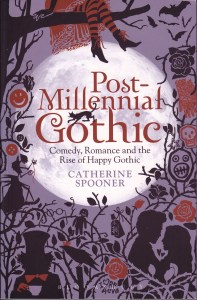
Maybe you’ve noticed it too. While certainly not universal, many forms of Gothic cultural expression (novels, movies, television, etc.) have a playfulness to them. As if taking the genre too seriously might be a misrepresentation. Even Edgar Allan Poe can be caught smirking from time to time. I’ve often wondered about this unusual combination of darkness and light. Catherine Spooner obviously has too. In Post-Millennial Gothic: Comedy, Romance, and the Rise of the Happy Goth she takes on a number of these cultural expressions—both Goth and Gothic—and tries to understand the lighter side that they often present. Sometimes it’s comedy and sometimes it’s irony, but those fascinated by darkness aren’t always as gloomy as they seem.

This book is a real hodgepodge of both British and American explorations of the smiling dismal. It’s a cultural contradiction, maybe, but it certainly feels authentic if you look closely enough. Although Spooner doesn’t discuss it directly, I couldn’t help but think of that great progenitor of the Gothic—the medieval church. Perhaps it was the very real fear of the plague and the nearly constant warfare of the time in Europe, but liturgy, when done right, has a palpable darkness to it. References to ourselves as “miserable sinners” begging God to “have mercy upon us” clearly call to mind some of the deeper elements of the Gothic sensibility. Having attended Anglo-Catholic services for years I came to know many who were compelled by this intensity. A Gothic chasuble is a thing of beauty forever.

Spooner, however, focuses on popular culture. Beginning with the Goth movement of the 1980s, a subculture formed that brought much of this darkness to light. She’s careful to point out that being Goth isn’t the same as being gloomy all the time. It is an expression of creativity, and, as Spooner notes, closely associated with Steampunk. Such things, however, require a recognition on the part of participants that in order to taken seriously, such expressions must become part of daily life. There are risks, however. Even in enlightened cultures we are not yet fully tolerant of those who are different. And really, much of the book is about this—accepting those who are not like ourselves. There is quite a bit going on here that’s beneath the surface. And depth is something the world could use a bit more of. There’s nothing wrong with having some fun while acquiring it, either.


Thick Skin

Religion and folklore encapsulate what folk believe. Human beings, despite rationality, are ritualistic creatures. Psychologists have their work cut out trying to explain why we do this or that odd thing, and historians sometimes dig deep into the backstory to find some hint of a tradition’s origins. Although I lived in Edinburgh for over three years, and drove through South Queensferry in the shadow of the great Forth Bridge a number of times, I never heard of the Burryman. In case you haven’t either, here’s a link a friend sent to a brief video about him. In it Andrew Taylor explains the tradition. Each year, going back to South Queensferry’s pagan past, a citizen dresses in a suit of burrs to ensure a good harvest and bring good luck. What’s fascinating here is that burrs are something people generally avoid, although they are an ingenious method of seed dispersal. They stick to clothes, and even skin and can be annoying even singly. Why anyone would submit to an entire outfit of burrs is something only folklore can answer.

Anthropologists are in short supply. Universities don’t like to fund the study of folklore since it doesn’t lead to jobs. The end result is that what we know of many strange traditions is anecdotal. A few years back I got soundly dressed down in an academic setting for referring to a popular publication of Scottish ghost stories. You see, I was writing an article for publication in an academic journal. I wanted to document a story I’d memorized by dint of the fact that a ghost tour guide would stand beneath our window every night in Mylne’s Court and recite his tale. (I traced it back to a potential Ancient Near Eastern origin.) The problem was, no academic would deign to write about such decidedly low brow tripe. In order to find a written source, I had to cite a popular book. Academic reviewers responded with scorn that I would never pass on to an author, speaking as an editor. This was, however, in the old school days.

So, how would we find the backstory to the Burryman? Great Big Story went straight to the source. Andrew Taylor, the incumbent Burryman, tells what he knows of the tradition. You can’t even see the Burryman from high in your ivory tower where pure thought is your only companion. I’ve always been a street academic, though. Growing up blue collar, I find it much more interesting to see what people are doing out here where the professionals don’t tell them how to behave. The pagan past is still alive. We don’t need a wicker man to prove the point. All it takes is a bunch of dried burdock and some very thick skin.


Crossing Beowulf

Beowulf, from Wikimedia Commons.

Slaying dragons is costly. In much of the western hemisphere the ultimate metaphor for the perils that await humanity in a world imperfectly understood, dragons were the bane of the medieval imagination. And earlier. Dragons are mentioned in the Bible and were stock creatures in the bestiaries of the Mesopotamian imagination. And, of course, it is a dragon that causes Beowulf’s fall. Almost a type of a latter-day Gilgamesh, Beowulf likewise holds an early, if non-negotiable place in the western canon. In this month’s Atlantic, James Parker discusses the dynamic of this pre-Christian poem in our post-Christian context. Specifically he addresses how modern renditions, perhaps inadvertently, Christianize the story. A popular subject for movies and graphic novels, Beowulf is a monster-hunting story that begs for baptism.

The story itself is familiar to most alumni of American high schools. Perhaps before we’re ready to be exposed to Old English, we find ourselves assigned a story of drinking, rage, and violence. Make no mistake—Beowulf is a hero. A deliverer like the judges of old. Grendel, after all, is the spawn of Cain, the evil seed that continues into a moody world of stygian nights and dismal swamps. Parker’s brief article demonstrates the reception history of the poem nicely. It also raises the question of what’s going on when heroes fight monsters. When the Christian imagery that’s deeply embedded in our culture comes to play Beowulf can’t help but become a Christian monster slayer just as Grendel becomes the enemy of God. All of this may be quite unintentional. What we see, however, isn’t imaginary. That’s the way reception history works.

Parker suggests that, although Beowulf is a pre-Christian poem, the cosmic order laid out in the tale is a Christian one. Even today in a post-Christian America it’s vital to understand how important religion remains. It’s not so much that churches are overflowing (unless they’re mega-churches stating that you can get rich by attending) as it is a recognition that centuries of Christian identity can’t help but leave their mark on culture. We see crosses in the handles of swords. Or even in the grid patterns laid out in city streets. Telephone poles. What’s so remarkable is that we see such things naturally and think nothing of it as we go on our secular way. There may be monsters out there. What may not be so obvious is that in slaying them we’re engaging in a religious activity as old as Gilgamesh, if not as obvious as a crucifix held up to a vampire in the present day.