Frightening Faith

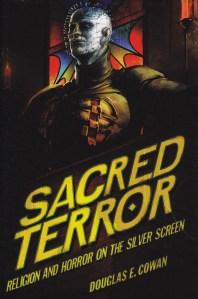
sacred-terrorBack when I first started this blog, I regretted that I had read Douglas E. Cowan’s Sacred Terror: Religion and Horror on the Silver Screen so long ago. You see, I try hard to post on a specific book only once—there’s really no rule about that, but I read a lot and don’t like to play favorites. Since it had been a year or two since I’d read it, my memory was a touch hazy about the details at the time. I did a post anyway. Now that we’re in the thick of fall, and my daily commute both begins and ends in darkness, I decided to read it again. This particular book is validating for a guy like me. Many scholars feel they need to apologize for such low brow peccadilloes as watching horror movies. I mean, don’t scholars read all the time? And when they’re not reading, surely they have better things to do with their time than watch cheesy exploitation films? My generation, however, has started to come to terms with this basic disconnect. A few of us have somehow made it past the bouncers.

Cowan’s book is the one I first read that dared make explicit what many of us feel—religion and horror are not so different. As a sociologist of religion Cowan brings a specific lens to the subject, and his book analyzes different societal fears (sociophobics) that these movies address. And even though he admits being a bit squeamish, he brings an impressive number of films to the table. The fears of hoi polloi, it turns out, are often the very same ones religion seeks to redress. After reading his book the first time, my list of must see DVDs grew. The same happened this time around.

It requires a certain maturity of character to both realize and admit that horror meets a deep need. We don’t like to feel vulnerable. More than once, armed with my Ph.D. and years of training my rational faculties, I’ve still ended up sleeping with the lights on. I can tell fact from fiction, but there’s an itch that horror scratches which other genres just can’t reach. As much as I enjoy science fiction on the screen, its debased little brother has fingernails just the right length. As Cowan points out, fear is one of the primal human emotions. The world we’ve constructed hasn’t eliminated fear—although I can’t recall the last time I saw a cougar or wolf in the wild—but has constructed it as more of our own making. In our own image, I might suggest. And since nobody likes to be alone during a scary movie, it gives me some comfort to know that Dr. Cowan is out there, somewhere, watching with me.

Ritual Rent

Rituals frequently outlive their purposes. Some skeptics may claim that rituals—particularly of the religious sort—really don’t mean anything at all, but in fact they do. Rituals have logical origins, or at least that seemed logical at the time. Atlas Obscura ran a piece by Sarah Laskow on “London Is Still Paying Rent to the Queen on a Property Leased in 1211.” Such a story invites commentary on many levels. One is that the items payed in rent—6 horseshoes, an axe, a knife, and 61 nails—don’t seem to be commodities her royal highness actually needs, or could even make use of. Still, it’s easy to see how this ritual rent has a logical origin. Axes, knives, nails, and shoes for six-legged horses were all quite practical in the Middle Ages, one assumes. They won’t help you get onto the internet any faster, though, so one wonders how they might be of use now.

Another question a story like this raises is that of government itself. Rulers both in monarchies and democracies have a habit of skimming off the top. It’s been some time since we’ve had a president who purchased his own loaf of bread or could even guess how much it costs the rest of us to do so. In Britain the question may be even more salient—the royal family is among the richest in the world and yet they still take an axe, a knife, horseshoes, and nails for a property that, as the article states, nobody even knows where is? I guess it’s the price we pay for feeling safe under the watchful eye of those who already have too much. The property itself may be a legal fiction, but the payment is real enough.

Wonder what the rent on this place is?

Wonder what the rent on this place is?

There are those who declare rituals empty, and therefore meaningless. To me that seems a hasty judgment. Our rituals reflect what we’ve historically believed. Those beliefs may have changed over the years, while the rituals continued in their own way. But they are reminders. Reminders of something once held to be significant enough to take time and resources in order to ensure the smooth running of—in the case of religious rituals—the universe itself. On the smaller scale, however, our secular rituals contribute to a system that always has favored the rich. It likely always will. You see, rituals are not easily broken. And even if all they can extract are items of little practical use, those who already have will be glad to accept even more. This is the reality behind rituals and rites.


Sects These Days

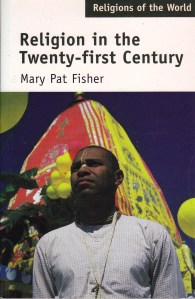
fisherreligionNew Religious Movements (NRMs) have long fascinated me. As a natural historian, looking back over where we’ve been has been my usual source of orientation. The idea that a new religious truth could emerge used to strike me as unlikely, especially in the western hemisphere. All major religions of ancient times have come from Asia. (I’m using “major” here only in terms of numbers, not importance.) I wasn’t sure if Mary Pat Fisher’s Religion in the Twenty-first Century was going to be about those traditional religions or NRMs. Both, it turns out. This little book, spun off of a bigger book, looks at very brief histories and contemporary expressions of traditional religions as well as some newer expressions of the spiritual quest. As such, it really doesn’t strive to reveal too much that’s new, but I found it interesting nevertheless.

To begin with Fisher reveals a bit of her own spiritual journey. This may be the first time I’ve ever read of a major textbook author (her larger world religions books are bestsellers) admit to having had a near death experience (NDE, as long as we’re using abbreviations). I know for a fact that Fisher is not the only academic to have experienced such, but trying to get anyone to admit as much requires, well, the confidence of a bestselling textbook, I guess. The fact is, human beings have a spiritual sense. Even academics. It can be effaced, sublimated, buried, or neglected, but it is there. There’s no other way to explain the persistence of religion. Even Nones, to update the discussion a little, often list themselves as spiritual, but not religious. It is part of the human condition, and it is well worth trying to understand.

This little spin-off text, at seventeen years old, does look a bit dated. Some of the predictions for the then coming new millennium were a touch optimistic. I suppose that’s the danger of any description of contemporary developments. Interfaith dialogues and initiatives, I suspect, still continue although we hear little of them. We continue to use religions as a way to divide between insiders and outsiders. Although our common yearning for spirituality has great potential to bring people together, historically it has wrenched them apart. I’m not sure that this particular book by Fisher is still available any more. Or it may have been updated. As one who tends to look back over history, however, I find the optimism refreshing. Perhaps as we continue to struggle with what it means to be human we will come to realize that religion is about what is inside, not out.


Tell It Straight

Apparently there is a burgeoning interest in swearing. Not necessarily in doing it, but in studying it. Over the past couple of years I’ve easily found a book every twelve months that devotes itself to the topic. After I finished reading the most recent one, my wife pointed me to a story on The Guardian that deals with the same topic. The story by Benjamin Bergen, “Well, I’ll be… There’s a real science to cussing and blaspheming but beware,” springs from his book on the subject, which I’ve not yet read. Interestingly, Bergen points out that there are four main classes of “bad words:” those that misuse religious concepts and names, those dealing with sex, words that denote various bodily effluvia, and finally, slurs. Today the final category, particularly when it comes to prejudicial slurs, is often considered the most offensive. Religious swears aren’t what they used to be.

800px-rembrandt_harmensz-_van_rijn_079

Why concern ourselves with such things? For me, I suspect, it is because of laws. Yes, laws. The religion in which I was raised was all about what you could or couldn’t do. One of those species of forbidden activities was swearing. Problem was, I didn’t know what all the words were. How could I not say them if I didn’t know them? And how could I know them if somebody didn’t say them? This vexed my young mind. I thought perhaps I should keep a written list, but this would be hard to explain if anyone ever found it. To make matters worse, some of the words were not swears sometimes and other times they were. “Hell,” referring to the fiery place, was not swearing unless you instructed someone to go there. Other uses beyond the literal were swearing. An ass was fine if it was an animal, but not if it was on an animal. And if you added one consonant that you couldn’t even hear onto a structure built to hold back water you were in hot water. Who made up these rules? The Bible didn’t say much about it.

In high school I heard there were seven words that you couldn’t say on television. Since we didn’t watch George Carlin I didn’t know what they were, but by this point I had collected more than seven. When I finally did hear his shtick (quite recently, at that) it contained some words I didn’t expect which, while rude, were never considered “swearing” on my canonical list. So it is we find ourselves with no definitive rules about what not to say. Professors are writing books about such things and even after having read some I’m no closer to my definitive list than when I started. It’s all a matter of laws, I suppose. Only the rules keep shifting. Best just to keep my mouth shut.


The Grammar of Evil

I stepped into a devil of a situation. Elevators are strange spaces. Given the choice, I’ll take the stairs any time. At work, however, as one of the many quirks of Manhattan, our elevators only stop on certain floors and we’re not able to use the stairs unless it’s an emergency. After a meeting on a floor where the only option was to elevate out, I stepped into a crowded elevator where a conversation was going. “You always capitalize Satan,” someone was saying. The usual questions among non-religion editorial staff ensued. Why is that? What about “devil”? “It’s never capitalized,” came the reply. My profile at work is about the same as it is on the streets of New York. Not many people know who I am or what I do. Although I’ve struggled with this very issue before, on a professional level, I kept silence and waited for my floor.

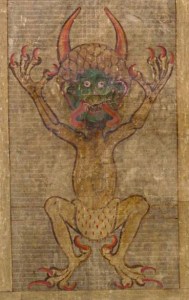
So, was the elevator authority right? “Satan” has become a name, rather along the lines of “Christ.” Both started out as titles. In the Hebrew Bible “satan” is “the satan.” The accuser, or the prosecuting attorney—something like that. As one of the council of gods, the satan’s job was to make sure the guilty were charged of their crimes. Diabolical work, but not evil. By the time of early Christianity, however, Satan had evolved into a name. It is therefore capitalized. It was specifically the name of another title, “the Devil.” Or is it “the devil?” Do we capitalize titles?

The Devil wears underpants.

The Devil wears underpants.

In seminary and college the received wisdom among those of my specialization was that there is only one Devil and the title should be capitalized. My elevator colleagues were discussing the number of devils when I stepped out. Traditional theology says there’s only one. Not that the Bible has much to say about the Devil—he’s surprisingly spare in sacred writ. Demons, however, are plentiful. Some people call demons devils, just as many believe that when good people die they become angels. The mythology behind demons seems to be pretty well developed in the biblical world, but again the Bible says little. Demons can be fallen angels or they can be malign spirits who cause illness. Either way they’re on the Devil’s side. But should we capitalize his title? The Oxford English Dictionary doesn’t help, giving examples of both minuscule and uncial. I suppose that’s the thing about the Devil; you never really know where you stand.


Only October

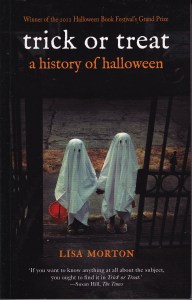
trickortreatComfort may be a strange word to describe Halloween, but it is accurate. I’m no specialist on the holiday, although I’ve read a few books on it—most recently Lisa Morton’s Trick or Treat: A History of Halloween. Growing up in what felt to me like an uncertain environment, holidays—and especially Halloween—have left me with positive impressions. Morton’s book explores this strange combination of fear and fun and suggests that many people of my generation do find comfort in its celebration. I grew up without a father in a conservatively religious home. Yet I loved the escape of putting on a mask and being someone else. Coming home with a bag of candy was a bit like that dream I still have of finding a penny on the ground and then realizing there are thousands of them just beneath the surface. There’s a security in that dream and I always find a tear in my eye when I awake from it.

Halloween is, appropriately, a chimera of holidays. It is solidly pagan. It is equally solidly Christian (specifically Catholic). Perhaps to placate those troublesome Celts, the Roman Church moved its commemoration of All Saints and All Souls to November 1 and 2, allowing for the Eve of what used to be called “All Hallows” as a holdover of Hibernian lore. Morton goes beyond the northern European fascination with the darkening of the year to explore other regions and how they mark the season. The southern hemisphere, obviously, doesn’t have the same pattern of autumn and spring, and the holiday has had less success there. The threat of the light never returning has to be real to make the fear stick. The warmest memories of my childhood seem to come from the days artificially lengthened by electric lights and the holidays they spawned: Halloween, Thanksgiving, Christmas. Comfort.

The air has begun to turn chilly around here. I’ve found myself shivering a morning or two while waiting for the bus. As I pull on my coat and step out into the pre-dawn dark, a stop sign creaks eerily on the deserted street. I’m headed to a long day in a city of stone and glass and warmth will be difficult to find. Halloween decorations get lost in the enormity of New York City and its constant quest for money. So I recall Halloweens of my small-town childhood. I tend not to go out at night, but I haven’t always been this way. When there was an unspoken comfort awaiting at home, no matter how frightening it could be at times, I would brave the dark and ask strangers for candy. Is it any wonder that Halloween still glows in a world somehow grown too cold?


Majority Report

In your mind’s eye, picture American 500 years ago. What do you see? Even those of us who’ve studied history have trouble envisioning the past with so different a set of parameters. At least if we’re honest with ourselves. 1516. The Salem Witch trials are almost two centuries in the future. The landscape is occupied by Native Americans. There are some European settlements. Protestantism is something new. In fact we’ll need to wait another year for Martin Luther to drag out his hammer and nails, theses in hand. The America we see then, not called “America,” let alone “United States,” is a diverse—some might say “wild”—world of decidedly non-European sensibilities. Global warming wasn’t an issue, and King James hadn’t even been born yet, let alone been commissioning the most famous Bible in English ever. So why am I asking you to look back?

luther_at_erfurt_-_justification_by_faith

This presidential campaign has largely been a waspish one. During the turmoil, books have been published proclaiming the end of “white, Christian America.” In an interview on PBS one of the authors of such a book, Robert Jones, talks about how America has changed. He notes that what he really means is that white Protestants are, statistically speaking, no longer the majority. Just a few centuries ago that was also the case. Think about Protestants a minute. They’re the ones who invented the Bible as we know it. Oh, the book had been around, in some form or other, for a couple of millennia (well, a millennium and a half, back then). Other than scholars in need of more fresh air, few spent much time with it. The church told Europeans what God demanded and the majority of people just got on with their daily lives not worrying about what some book they couldn’t even read might say. How things have changed!

We worry about the end of our majority. I like to look back and see that this world we’ve built is one based largely on a book that was mainly the invention of those who had some discussion points with the church. Not quite a hundred of them, even. They were largely Anglo-Saxons. If they knew about “the New World” their knowledge was hazy and imprecise. From that perspective it doesn’t seem like much is being lost in the changing religious demographics of this country. Back in the old world, if one wished to feel nostalgic for such things, they would’ve taken their complaints and found the nearest church door. Now we nominate candidates who think this country was ours in the first place, without ever even reading the Bible used to support that myth. What a difference a few centuries can make.


Finding Your Way

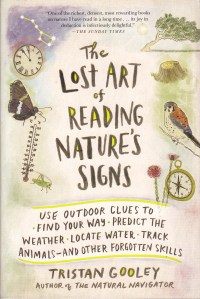
lost-artOnce while visiting the house of a friend, we took a walk in the woods. It was an area I didn’t know and after a few minutes it became clear that we were lost. There can be nearly no other feeling more frightening for a child. We wandered in the trees shouting for help for what seemed far longer than the maybe twenty minutes or so that my friend was disoriented. The message was clear: never go somewhere unless you know how to get where you’re going. I’ve been lost a few times since then and the gut-twisting fear is the same. Where am I? The Lost Art of Reading Nature’s Signs, by Tristan Gooley, is an amazing book for anyone who’s had that experience. We are residents of earth and we should know how to find our way around the place. Instead, most of us live in urban environments and never spend a lot of time outdoors learning that nature provides many, many clues to finding your way. You just have to know what to look for. I found myself wishing I could memorize large sections of this tome, assuring myself I’d never be lost again.

There is an irony about reading such a book during the commute to Manhattan. Apart from his small chapter on navigating in cities, Gooley spends most of his time offering advice on spotting hints in nature. I can’t believe the behavior of the mice, rats, pigeons, and cockroaches I’ve seen in the city is any less neurotic than that of the people. In nature trees, plants, land forms, weather, fungi, and the stars can all be used to guide a person home. There is a touch of quaint Britishness to the book, but the tips included quite often branch out to specifics in the United States, or even elsewhere. What all of this means is that in its own language the earth makes sense. We need to learn this language. Although Gooley doesn’t say it here, when we destroy our environment we’re increasing our ability to get lost.

One of the more interesting sections of the book used churches as a means of orienting oneself in unfamiliar country or a town. Church architecture, at least initially, followed a regular logic with an eastern orientation and opinions about the sacredness of the ground on the north-south axis as well. Knowing this holy geography, along with the ability to read lichens growing on the outside and finding the clues on tombstones, you can often find your way. There’s some poignancy here. There was a time when churches, synagogues, and mosques were natural means of showing people their cardinal points. We’ve come to rely on our devices to show us the way, and it’s a little early to know if that’s been a mistake. And if it weren’t for work today, I’d be outdoors, taking a walk and trying to learn to find my way through nature.


Scary Pictures

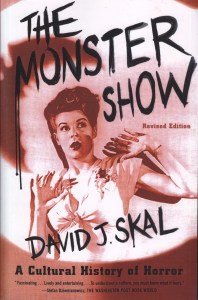
monstershowThroughout its history, until quite recently, one of the most serious natural enemies to the horror movie was the religious establishment. At times this antagonism seems well placed as horror films often take theological concepts and stand them on their heads. Within the last few years, however, thinkers of religious thoughts have come to an uneasy accord with some horror movies as vehicles for the kind of thinking promoted by traditional religions. The first half of this dynamic appears clearly in David J. Skal’s The Monster Show. Written before any kind of detente had been reached, his book chronicles skirmishes between the Production Code, religious groups, and even women’s collectives, against what was considered indecent and degrading. We have come to realize, however, that we are the monsters. We are the degraded. And seeing these films can lead to a strange sort of solidarity.

Most classic monsters, after all, have their origins in religions. Even the most recent of the lasting undead—Frankenstein’s monster and zombies—have origins in religious thought. Mary Shelley’s novel was subtitled The New Prometheus, a reference that anyone in the early nineteenth century would have understood. Zombies, on the other hand, are a product of vodou. Religion can’t get along very well without its monsters, and despite their less-than-stellar looks, their screen appeal is undeniable. Maybe it’s just we don’t like our dirty liturgical laundry being hung out where anyone might see it.

Skal’s treatment doesn’t stop at the cinema. He has a chapter on modern vampires, and Stephen King has earned his own chapter (or at least most of one) as the poet laureate of the novelistic form of the genre. More often than religion, Skal traces what’s happening in the monster world to the larger social issues of the day. Quite rightly so, as scary movies go nowhere without a receptive viewership. Looking around these days it’s easy to be scared. Even what was once a grand occasion of debate over higher principles as we ponder our next leader has become a farce in one of the parties that could make its own horror movie. Hitler, it is said, was a huge fan of King Kong. Large apes manhandling women never seem to go out of style. Some call it horror. Others try to get away with saying it’s politics. While the daily commute grows more and more dangerous, and the rhetoric grows even worse, is it any wonder we like to dim down the lights and watch monsters that we know really can’t get us at all?


Intelligent Life

arewesmartPerhaps the most pervasive trait of religion is its ability to construct worldviews. Even when the religion is eventually abandoned, the worldview remains. Most scientists would deny that religion lies behind their perspectives, but in the case of human exceptionalism it remains the most logical cause. I always eagerly await new books by Frans de Waal. Ever since I read his book on empathy and apes, I couldn’t wait for the next one. His latest book, Are We Smart Enough to Know How Smart Animals Are?, although the title is a mouthful, does not disappoint. As I’ve noted before about his works, de Waal is perhaps the most sensible person writing in science today. He considers the evidence and takes his own biases into account. In a competitive world where science money is often doled out to those who can exclude others, de Waal is willing to leave the door open when the evidence demands it.

What is really ironic is that evolution has become the line in the sand between biblical literalists and science. As de Waal points out, the idea that people are different from the animals from which they evolved—in some qualitative way—is an idea based on religion. Many scientists still hold to it in a way that can only be described as, well, religious. This is very strange when evolution works by gradual changes over long periods of time. When did humans gain whatever trait that separates them from “the animals”? When I was a child it was tool use. When that was disproved, it became language. When that was disproved it became consciousness. The latter is the safest since nobody really knows what it is. As de Waal amply demonstrates the Behaviorist school was clearly wrong about animals (including humans). What no Behaviorist wants to admit is that the idea that we alone are conscious comes from the cultural interpretation of the Bible.

Are We Smart Enough to Know How Smart Animals Are? is, like many of de Waal’s books, full of wonderful observations of the ways animals actually behave. They solve problems. They learn from experience. They anticipate the future. In some cases they have been shown to outperform humans on cognitive tasks. And yet we still insist that people are somehow different. Better. Interestingly this is one area where religions and science tend to agree. People are just more important than animals. I wonder if one of the underlying reasons—not addressed by de Waal—is that we have come to depend on a lifestyle that unfairly exploits animals. After all, we eat them, use them for work, and even experiment on them. If we admit that they are intelligent we would need to, yes, rethink all of this. Given what’s happening in the world today, it is perhaps time to admit what we don’t really know.


Viewpoints

WomanistI first heard of feminism in seminary. Growing up as a poor, uneducated fundie in a small town, where would I have learned about it? I came to it naturally, though. Being raised for several years by a single mother I knew that women were just as smart and resourceful as men. I guess I was surprised to learn that others didn’t see it that way. This was in the eighties and angry feminism was around—I was occasionally attacked in class for my naiveté. After all, I had attended Grove City College not because of its conservatism but simply because I didn’t know any better. This is a lengthy preamble for a book that would’ve helped me a lot as a youngster, although I wouldn’t likely have known to read it. Nyasha Junior’s An Introduction to Womanist Biblical Interpretation is a very useful guide to those who don’t really know what womanism is.

I’ve been in biblical studies long enough to know that I really don’t know much. There are critical approaches to the Bible I’ve never even heard of. Not too shabby for a field that has already been written off as moribund by the academy. In any case, the title “womanist” doesn’t really say much beyond an implication of gender. Junior’s book explains that. Womanism didn’t really grow out of academia as much as it did out of African American women’s experiences. I admit that it took this book to teach me that. What is really being addressed, however, is how womanism is becoming, or is starting to become, an interpretive school. The Bible is in the public domain. It’s anyone’s book. Indeed, it strikes me as odd that translators copyright their work, especially if they believe it is the word of God. The word of God comes with a price tag, I guess. African American women have long been readers of the Bible. What, though, characterizes this method?

That’s the question with which Junior wrestles in this informative book. Just as being female doesn’t make a scholar a feminist, she notes, being an African American woman doesn’t make one a womanist. And we all approach texts with a method, explicit or not. “Objectivity” doesn’t really exist and even literalism is an interpretive approach. Junior traces the history of both feminism and womanism, especially in regard to biblical interpretation. Her struggle should reflect that of any scholar—how do I regard the text regardless of my demographic? While many churches have slumbered in doctrinal dreams, progress in reading the Bible has marched forward. The real danger often comes in the form of labels. This book, written just as a method is starting to be formed, is a trustworthy guide to both the history and to the larger questions.


Mysterium Tremendum

HistoryHorrorFor those of us accustomed to ancient things, horror movies are remarkably new. That doesn’t mean, however, that they are scarce or even easy to understand. While it is beginning to erode, the academic derision of popular culture has long avoided the decidedly low brow genre of horror. It doesn’t know what it’s been missing. Wheeler Winston Dixon’s A History of Horror is an insightful attempt to make some order out of a century of monsters and mayhem. Beginning at the stage when “horror film” was still just a demonic gleam in some vampire’s eye, Dixon points out that from the very earliest experiments with movies “horror” was a popular trope. It seems only natural that the idea of a full-length scary movie would be the expected development. What happened in Universal Studios in the 1930s is that business began making money out of monsters. Where there’s money, there be monsters.

Dixon takes us through the early days into the tired era in the 1950s when life was, apparently just so darned good that people weren’t really thinking about monsters. (Dixon’s analysis is a bit more sophisticated than that.) Horror films matured in the 1960’s and spun out of control in the ‘80s. His book continues up to the first decade of our current century. There’s obviously a lot that can be said about this, but what caught my attention, naturally, was how quickly religion entered the discussion. Those of us who approach horror with an open mind know that religion is its next-door neighbor. Indeed, one of the nihilistic aspects of the proliferation of horror movies since the 1980’s has been the lessening of this getting to know the neighbors. Horror, as Dixon notes, seems to have devolved to brutality and cruelty with no real message.

I’ve never been a fan of gore. I’ve watched my share of slashers, I suppose, but they’re not my favorites. Horror can—in the best of its offerings—be very profound. Indeed, it can even inspire thoughts not so terribly far from those generally classed as religious. For what is worship if not carefully managed horror? The concept of the holy as mysterium tremendum underscores this dynamic. Part of this connection is the appeal to emotion. Horror movies make you feel something, and that is a large part of their appeal. They can be more, however. A smart horror movie will feed your brain rather than just having zombies eat it. Academics, eventually, will catch up with it. Dixon starts to show the way.


The Neighborhood

583px-Ptolemaicsystem-small

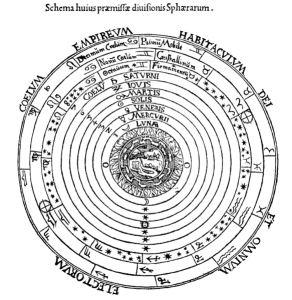
Let me send out a warm welcome to the neighborhood, I think. Not that I officially represent Earth—or anything for that matter. I’m just friendly, I guess. Now that astronomers have strong evidence that the nearest star to our own, Proxima Centauri, likely has a planet, it’s not premature to head over with a casserole. It’s not every day that a new solar system is discovered. We don’t know for sure that the planet’s there, but chances are pretty good. In reading about this discovery I learned that the orthodoxy has changed since I took astronomy in college. It seems now standard wisdom teaches that most stars likely have a least one planet. I can’t even count the stars—I usually start to trail off after I get to about ten—so I can’t imagine the number of potential planets out there. And where there are planets, there are gods.

Let me rephrase that. If there are billions and billions of planets it is very likely that there’s life out there. I know I’m racing ahead of the evidence here, but let me have my fun. If there’s life, there’s a chance, a glimmer of a chance at least, that given enough life we’ll find consciousness. I’ve always thought it was a touch arrogant on our part to assume we were the only ones out here. Perhaps it’s because the stakes are so, ahem, astronomically high we seem to be afraid to admit the possibility. We don’t really want to be alone in this cold, vast, universe after dark. Enter the gods. Conscious beings—even arrogant ones—have no trouble supposing that there is an even greater presence out there. I suspect this isn’t an earth-bound bias. I should hope that conscious life looks toward the stars with wonder, and even after they discover that there’s no lid on their planet they might still ponder what else might be out there.

Let’s suppose there are other creatures out there with other gods. When the meeting takes place we’ll need to have that discussion. You know the one I mean. We’ll need to ask whose deity is really real. Is it yours or is it ours? Hopefully we’ll enter into this with an open mind. I suspect it will depend on who’s in the White House, and all the other big houses, at the time. There are certainly those who claim their own almighty brooks no rivals. If it turns out that we can’t agree, I hope it doesn’t come to blows. There will always be other planets to explore, and maybe even new orthodoxies to accept. It’s an infinite universe, after all.


Imagining Monsters

WideSargassoSeaAll fiction writing, it is often said, is borrowing. I’m not exactly sure that’s literally true, but the basic idea is that writers often trade with one another. They also borrow against their own experience and observations that others have made. When a character, or set of characters, an author develops become(s) wildly popular, fan fiction can result. There are websites dedicated to “fan fic” where characters from one writer are personalized in another writer’s imagination. Another form of borrowing is the parody. Pride, Prejudice, and Zombies takes Jane Austen far beyond her original scenario while using her novel as the basis of something somewhat new. These borrowings, as the saying suggests, have been around for a long time. I recently read Jean Rhys’ Wide Sargasso Sea. The novel from the 1960s is a “prequel” of sorts to Charlotte Brontë’s Jane Eyre. Although spoiler alerts for literature nearly a couple centuries old might seem like overkill, I’ll give one here anyway. You’ve been warned.

Jane Eyre includes quite a lot of gothic mystery. Thornfield has a mad woman, Bertha, the first wife of Mr. Rochester, living in the attic. Bertha is from the Caribbean, and Rhys, although Welsh, was born in Dominica. Taking an interest in the point of view of the neglected, insane Bertha, she decided to tell her story in Wide Sargasso Sea. I won’t sum up the plot here since you may decide to read it. The reason I brought the whole subject up in the first place is the glimpses given of the religions of the Caribbean. Clearly this was not Rhys’ main objective. The Creole of the various races from the slave trade and colonialism, however, did produce fascinating religious amalgams. The zombie, a figure that plays a small part in the imaginative aspects of the novel, is only the most familiar of the creatures.

The soucriant, or soucouyant, is a blood-sucker. A figure that combines elements of witches and vampires, the soucriant takes the form of an old woman by day and a blood-sucker by night. (Before you get the wrong idea, there are no zombie or soucriant characters in Wide Sargasso Sea—they are merely mentioned briefly in conversation.) This concept, while derived independently, relates to the succubus but also to the more modern chupacabra. These are all creatures that suck the vital essence from another, be the victim human or animal. The ubiquity of the idea is striking. In the context of the novel, however, such creatures merely haunt fevered imaginations. Our minds, however, are what make monsters real. Although Rhys declines to diagnose “Bertha” completely, it is clear that human mistreatment of one another creates, in its own ways, monsters. That’s an idea, I suspect, that I’ve borrowed.


Not Quite Dead

Duria_Antiquior

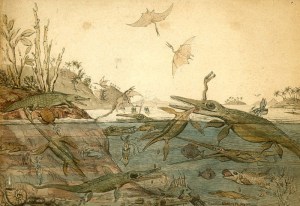
Extinction is a cause of fear. Having evolved a certain level of self-aware consciousness, we fear becoming the next tyrannosaurus-rex or spinosaurus, or whatever the next top predator turns out to have been. We’re here to stay. So we like to think. Data have been known to interfere with comfort zones, however. Take religion, for example. America has always been a religiously diverse “country,” but many people suppose it has a Christian beginning. Moreover, the historically uninformed suppose that generic Christianity to have been Protestantism (which is not really a single religion) and white (which isn’t really a race). Now, it seems, that white Protestantism is slowly going extinct. An article in the Washington Post by John Sides contains an interview with Robert P. Jones of the Public Religion Research Institute. Jones has written a book about the end of this particular hegemony.

Demographics tell the story. The powerful cultural force of the mainstream Protestant churches hasn’t disappeared, and really isn’t likely to become extinct. It has, however, diminished. As soon as we began to embrace technology this was a more or less inevitable trajectory for the human race. We made oceans smaller and came to see that we’d evolved different religions in different regions. And that Christianity wasn’t quite unique as we’d thought. “Orthodoxy” was actually a form of prejudice for a past that may never have been. We saw the writing on the wall and went on scribbling. Making claims the data don’t support.

One of the drivers—and this is a complex phenomenon—behind this shift has been the ossified positions of religions in the light of increased understanding. For example, most people see no problem with homosexuality. They believe shooting someone because of their race is wrong. Women, they radically suggest, should have the same rights as men. The hold-out positions on these issues have historically been religiously based. Just listen to the rhetoric of televangelists and see if it has changed. Meanwhile, the world moves on. Many religions are holding still. Or racing to see if their diminishing number of feet might make the world spin backwards after all.

Religion is a human invention. Many protect themselves by claiming direct revelation by a God who used to live in a glass ceiling above our heads. Trips to the moon, probes to Mars, and out of our solar system have proven that view false. If the view of something as basic as the universe was wrong, what else might’ve been a mistake? Jones’ new book will no doubt cause some panic. Extinction, at least not imminently, doesn’t seem to be in the cards. Protestantism seems to have reached a stasis. Religion still has an important function in society. When it takes the lead on issues of equality, we may begin to see a miracle.