Footprints in the Snow

A friend keenly aware of my interest in the unusual sent me a story about the “Devil’s Footprints” that sometimes occur in snow. The article focuses on an instance in England in 1855 but which was reprised in 2009. The prints, made by a bipedal, cloven-hoofed animal, surmount tall barriers and occur on rooftops as well as on the ground. Such a phenomena is not limited to England. Associated with the Jersey Devil, similar unusual trails were reported during the flap of sightings in the early part of the last century here in New Jersey. As the piece on Mental Floss states, this is most assuredly not diabolical work, but it does make me wonder why people associate the unknown with the Devil.

IMG_2654

As a character in world religions, the Devil can trace his (and, like God, he is almost always a male) origins to the Zoroastrians. Zoroastrian theology is a dualistic outlook: ultimate good versus ultimate evil, Good God versus Bad God. The idea synced particularly well with the burgeoning of apocalyptic thought that hovered in the air during the time that the people of ancient Judah came into contact with Persian thinking. The idea was toned down, of course, to a being with lesser powers than God, but still a real foe with which to contend. By the time of the New Testament, the Devil was ensconced and associated with the Persian accuser known by the title of “the Satan,” or the divine prosecuting attorney. How this character came to be associated with strange footprints in the snow traces an odd trail indeed. The key is the cloven hooves.

No description of the Devil exists in the Bible. The best evidence suggests that the horns, goatish bottom, and cloven hooves come from an association with the Greek demigod Pan. Why Pan was singled out as a particularly bad god is not known. He was popular in ancient Greece. It is certain that the Jews of Jesus’ time would not have recognized a cloven hoofed beast as devilish. The livelihood of too many relied on sheep and goats. Once the transformation took place in the imagination, unexplained cloven footprints appearing in the night suddenly became those of the Devil. As Stacy Conradt points out in her Mental Floss post, several suggestions have been made for creatures of the natural world and their snowy markers. We don’t know what makes the footprints, however, and winter is all the richer for it.


The Problem with Love

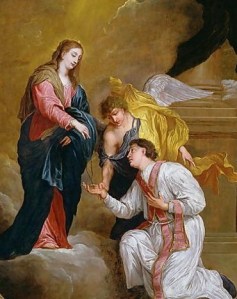
As far as we can tell, historically there is no Saint Valentine that is particularly connected to February 14. Even if there were, it is difficult to imagine a saint promoting what we know as love. Love is a slippery topic. The ancient Greeks (who did not marry for love) were so perplexed that they came up with three different words for it, and the nascent Christian community tended to prefer agape-type love. Love that expresses well-being for the community and has little to do with the physical attraction that people everywhere find so compelling. It is safe to say that Christianity has always been uncomfortable with the kind of love that Valentines Day celebrates. The holiday, because of its associations, has often been removed from the liturgical calendar a time or two. People are already prone to express their biological urges, so it is best not to give them an excuse, sanctioned by the church.

This is an odd situation, thinking love is wrong, or at best, tolerated. As far as we can tell, the earliest Christians had no particular concerns in this way. We can’t measure, of course, how people loved their spouses, but there was nothing inherent in the new religion to suggest physical attraction was bad. By the time Paul of Tarsus started writing his letters a couple of decades after Jesus’ life, at the earliest, some doubts had crept in. They seem to have been largely personal. We know little of Paul’s life, but we are aware that he saw the kind of love known as eros to be a problem. Concession had to be made to those who couldn’t control themselves, but otherwise, in good stoic fashion, love was to be ignored. By the time of Augustine of Hippo, some three centuries later, sex passed on original sin and love had become decidedly dark.

St-Valentine-Kneeling-In-Supplication

Attitudes change with time, of course. After two millennia a certain practicality sets in. We have moved through the troubadours and courtly love to psychology and deep human needs. Arranged marriages are, for the most part, considered like shackles from the past. And love, that feeling that we never completely outgrow, is believed to be a positive thing. Saint Valentine (and there were at least two of them) would likely have disagreed. While the Romans celebrated sexuality, they also believed in restraint most of the time. Valentines Day, however, still has something to teach us. Despite the commercialization of the holiday, in a world with a surplus of hatred, any kind of love is, as long as it’s mutual, is worth celebrating.


Commitment

Marriage is a human institution. As those who invented it, we should be able to define it. Biology may not help here, since animals become mating pairs in many different ways. Besides, we’re selective in our application of science to the question. Not only that, human views of marriage have changed quite a bit over time, and the practice of marriage is still not uniform today. Back in biblical times, for example, polygamy was more or less normal. Marriages were arranged for tactical and economic reasons, and bonding for love had, one can only guess, very little to do with it. It was practical, pragmatic, and of use to the state. Prior to that, if the evidence is to be believed, “marriage” was a communal practice among groups of maybe 150 individuals. The purpose was the same: social harmony and cooperation.

An article on The Wild Hunt has me thinking about this again. (And you thought I was going to be discussing gay marriage, didn’t you?) According to a recent piece by Christina Harrington, handfasting, the marriage among pagan communities, has now been legally recognized in England and Wales. As far as we can tell, again delving back to the Bible, marriage was not considered a religious matter in antiquity. Part of life, it was handled by families who were witnesses to the promises made. Over time, various religious bodies came to give their blessings to people pledged to each other. In fact, for some religions marriage is perhaps the most important sacrament. Once this happened, however, dominant religions became jealous of their right to declare a marriage binding or not. Even as a child I remember a stigma attached to a merely civil wedding. It is, however, the state the declares a marriage binding.

Photo credit: the ShahMai Network (from WikiMedia Commons)

Photo credit: the ShahMai Network (from WikiMedia Commons)

Marriage is a convenient method to sort out tax statuses among genders with earning disparities. A government has no interest in whether a couple marries for love or not. Even gender doesn’t really matter. Can you tick that “married” box on your tax form or not? So it is that recognizing handfasting is likely, on some level, politically expedient. Meanwhile, those who marry for love have the added benefit of being with someone they chose and having a friend at hand. Tax season is upon us. Valentines Day will soon be here. And in some parts of the world the government is catching up with the times and realizing that marriage is what people make it.


The Great Slumbering

Even in days of secular education—I am a product of public education throughout my childhood—Jonathan Edwards is a name that still retains recognition among many Americans. Perhaps best remembered for his sermon, “Sinners in the Hands of an Angry God,” Edwards thrived at a time when being a clergyman was a recognized path to success in this world as well as the next. Not that all ministers became famous, of course, but those with the inclination had access to books and time to study. They could write books and influence public policy. Indeed, Edwards was part of the “Great Awakening” that spread throughout the young United States, before its independence. George Whitefield had brought a showman’s sensibility to preaching, and people gathered to listen to roving reverends who brought their wisdom to new locations. In fact, revivals continue to this day—I had attended a few as a child—and they are largely responsible for the denominational map of American Protestantism even today. The “Second Great Awakening” brought Methodists and Baptists into the mainstream to stay.

The first major revivals, however, were fueled by a Calvinistic intensity. Having spent many of my educational years in schools established or supported by Presbyterians, I know their theology well. Judgment is important in the Reformed tradition. Indeed, without the element of threat, the heat is stolen from much of revivalism. Edwards’ sermon encapsulates so well the vital element of a theology that preached total depravity, unconditional election, limited atonement, irresistible grace, and perseverance of the saints. In other words, unless God has already selected you, you’re out of options. As Presbyterian teachers were eager to state, you should still try to live as if you were saved (“elect”), even if you were going to Hell because of, well, you know, an angry God. Campus rules at Grove City embodied that ethic in a real-time way.

Jonathan Edwards went on to become president of Princeton University (the College of New Jersey, at that time). He died at about my age, having been inoculated for small pox—he was a believer in science—to demonstrate the value of the practice to students. He contracted the disease and died merely weeks later. Ironically, Edwards felt he was past his prime and had to be persuaded to take an academic job—somewhat of an extreme rarity today—and largely because his son-in-law, Aaron Burr, Sr., had recently died as the incumbent. Today, starting on the path to ministry is often a fast-track to job insecurity, popular derision, and poor earnings. For all that, it is difficult to be accepted in the ordination track without jumping through many hoops. So Jonathan Edwards came to rest in Princeton, New Jersey, as a famous, published, and highly respected man. A more different world then his in such a short time in the same location, is hard to imagine.

DSCN6140


Illusions

While out driving one winter evening, the sun was setting below a distant horizon that I couldn’t see. Trees lined the sides of the road and, while creating not exactly a tunnel, they blocked the actual view of the orb itself. The day had been partly sunny with cloud forms shifting between layers of the atmosphere. Even though I had studied weather pretty intensely for a number of years, I couldn’t readily identify the cloud types. Thin, smooth lengths of cloud seemed to be suddenly rising up into cumulus banks, heavy with snow. Not far away, the sky was clear. As the sun was going down, these dramatic clouds were lit with the colors of fire: yellows, oranges, and reds. Further to the west, a high, broken bank of clouds glowed a rosy red against a twilight sky. Since the highway we were on was straight, I had a fairly consistent view of the warm tones of the sun highlighting the impressive clouds. My camera couldn’t hope to catch the intensity of the palette revealed to my eyes. When the sun finally fell beyond the range of the clouds, they appeared gray and prosaic against a darkening sky. They had been alight only moments ago, and now they were dull, and not even white.

IMG_2657

What I’d learned of physics reminded me that even these colors were not inherent to the clouds—colors are simply reflections of light rays and the range that we see depends on our eyes. An object’s color, in other words, is a kind of illusion. It’s an illusion we share, and although some people are color-blind, we make the conventions of color part of everyday life. Red means stop, and green mean go, for example. Objective reality is simply the fact that objects reflect different wavelengths of color. Depending on the light source, they appear a specific color to us. While we take colors for granted, they are actually a way of conveying meaning that isn’t entirely real.

Ancient people looking at the colors in the sky could only understand them as caused by the activity of the gods. Bright hues in the clouds suddenly diminished to gray could be the basis for a myth of heavenly conflict. A rainbow, according to Genesis, is a sign that such a conflict is finally over. I don’t know what the gods might have been doing overhead that night, but as the sun disappeared and a full moon rose, throwing soft, but pervasive light from the broken clouds that have only moments before had appeared red, another reality seemed to be taking over. I suspect that we have lost much by no longer watching the sky. My daily work generally involves sitting in a windowless room, and in Midtown the sky is occluded with human attempts to climb to heaven. When I can see the sky for an extended period of time, it seems that the gods are putting on a show, if only we’d watch.


Creating English

From Wikimedia Commons

From Wikimedia Commons

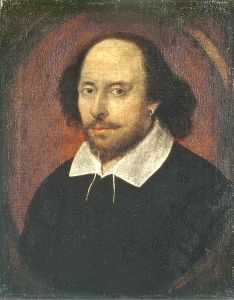
The seventeenth century was a portentous time for the English language. Well, I suppose every day is portentous in some way, but in the year 1611 the King James translation of the Bible was published, and it still has considerable staying power in the English-speaking world. Quotes from it show up regularly among the modern media with many readers (and likely a few writers) having no idea of the origins of the phrases they use. Just five years after the King James Version made its debut, William Shakespeare died. Many languages can point to formative individuals or literatures that codified their forms of expression. In English the honor is shared by the forty-seven translators of the KJV and William Shakespeare. This four-hundredth anniversary of Shakespeare’s death is set to be a year of celebration among Anglophiles worldwide. We will gladly acknowledge that the words we write and speak owe much to the Bard and his lasting influence that still has high school students griping all the way through English class their senior year. I have read a Shakespeare play or two that I was never assigned in school, as many come to do. This year, among my reading goals, is at least one more of the works I’ve never read.

As with the text of the Bible, there is doubt about some of Shakespeare’s plays. Scholars scrutinize. (That’s what we’re supposed to do.) And scrutiny raises doubts. The seventeenth century was a time of generally acknowledged authorship. Some great English epics, such as Beowulf, have no author we can cite by name. Over time, however, quality came to be associated with the person who produced the literature. Even today a name often sells a book far more readily than the contents do. Some of Shakespeare’s plays may not go back to William himself, but the English language wouldn’t be the same without them, in any case. We are heirs to this legacy. Spelling began to be standardized. Grammatical expressions were codified. Classic stories predating Shakespeare became endlessly replicated and copied by those who know there’s no replacing an original.

A story on NPR notes that the First Folio—the first bound copy of all of Shakespeare’s plays—is being sent around the country this year by the Folger Shakespeare Library. Each state will host the first edition during the course of the year. The article by Susan Stamberg notes that this folio is the literary equivalent of the Holy Grail. Shakespeare is nearly as canonical as the biblical canon itself. Even if the Bard’s authorship is in doubt, it is still holy writ. Those of us who’ve spent considerable time with religious texts recognize the hagiography readily. No, these aren’t signed editions. Some of the work may have been done by someone else. Nevertheless, four centuries ago, through a combination of Bible and what we would today call “fiction,” the English language as we know it, was itself becoming canonical.


First Stronghold

FIRST Robotics has a way of getting into your blood. Like many people of my generation, I learned about FIRST Robotics through my daughter. Our local high school has a robotics team and, as we quickly learned, the decision to join FIRST is a four-year family commitment. My wife and I were both involved at some level, despite being the world’s least likely engineers. I even served a term as the president of the foundation (responsible for funding the team). We made lasting friendships and grew in the lingo and odd humor that is FIRST. The founder and chief promoter of FIRST, Dean Kamen, is an unapologetic geek and has helped develop what some journalists are calling “the new cool.” Yesterday was launch. If you are a FIRST follower, I don’t have to explain that. In case you’re not, “launch” is the revelation of this year’s game. Teams now have six weeks to plan, design, and build their robots.

IMG_3125

Launch is a big deal. We haven’t been part of the competition for three years now and we still watch the live web-broadcast. The major players (Kamen, and Woodie Flowers) get in character and meet kids from various teams. They give inspirational talks. Dean Kamen told the kids “Don’t get stuck into today.” Technology changes too fast. What you learn in school are tools, because facts are available instantaneously on the internet. Those of us who retain facts are so yesterday that we’ve become the trivial pursuit generation. Any computer, let alone robot, could beat us. Woodie Flowers told the young audience thinking about careers that they must do what machines cannot do, otherwise their jobs will become obsolete. What could be more human than religion? What’s religion got to do with it? This is science and technology!

This year’s competition is FIRST Stronghold. The entire buildup of yesterday’s launch was a takeoff on Monty Python and the Holy Grail. What is this I see before me? History? The Middle Ages were nothing if not religion run wild. This was a world ruled by bishops, popes and nobility. It was a world where no matter who you were, God trumped all. Technology meant that a trebuchet was a pretty sexy device and long distance communication traveled at the speed of a horse or human runner. (Or, I suppose, a trebuchet missile.) Now that the humanities have fallen victim to science, we look back to them for inspiration. It reminds me of John Keating in Dead Poets Society: “And medicine, law, business, engineering, these are noble pursuits and necessary to sustain life. But poetry, beauty, romance, love, these are what we stay alive for.” This hasn’t changed since 1989. Or even 932 for that matter.


Feasting

In addition to music, Christmas has also been associated with seasonal foods. Unlike today, when we think of foods primarily in terms of either fast food or culinary sophistication, Christmas dishes of yesteryear often had religious symbolism. While singing an English carol, for instance, you might hear of figgy pudding. I tried my first when living in the United Kingdom and it was nothing like the images its name conjures. It is more like a dense cake made of raisins and dried fruit, set aflame to burn off the brandy. Sometimes it is topped with holly. According to an interview on NPR, the Christmas dessert, in addition to taking weeks to make, contains thirteen ingredients, to symbolize Christ and the apostles. The holly is to represent the crown of thorns, and the flames the passion. That’s a lot of theology to stomach. (In seminary I had friends who used food analogies for theological purposes, but I suspect they didn’t know it was such an ancient tradition.)

Christmas cheer, I would’ve been shocked to learn as a child, generally involved spirits. For example in A Christmas Carol, Charles Dickens reverses his entrepreneurial relationship with Bob Crachit over a bowl of smoking bishop. I had always supposed this was a kind of soup or stew, but, again NPR comes to the rescue with a piece about Christmas drinks. Smoking bishop was made of port, and, according to the NPR story by Anne Bramley, is of the class of Protestant drinks called “ecclesiastics.” These were various alcoholic drinks named after Catholic church offices that Protestants used to poke fun at the ecclesiastical hierarchy of the Catholic tradition.

Christmas

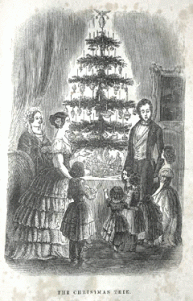
A Christmas Tree primer

It is difficult to conceive of anything more basic than food and drink. All living things require nourishment. It stands to reason that when religious sensibilities began to appear that they would certainly be associated with the necessities of life. Holidays, as necessary breaks from the mundane, offer opportunities for bringing theology to the table. The most basic of ingredients, as any observer of biblical holidays knows, can contain more than just nutrients and roughage. There is a symbolism in what we eat. In these days when it is fashionable to declare religion nothing but stuff and nonsense, it can’t hurt to stop and look at what might be on our plate or in our cup before declaring it to be mere animal nourishment.


Christmas Music

While reading about holidays recently, I came across the idea of Christmas as a cultural holiday as well as a religious holiday. Now that it’s here, it feels like a little of both. My wife grew up in a musical family and Christmas music was a large part of her experience of the holiday. Although I grew up in a family where the religious aspect of the holiday was as preeminent as it could be with young boys, I don’t recall music being much a part of it. Perhaps we had enough of Christmas carols in church and on every shopping excursion. I don’t recall having a record player beyond maybe a close-and-play for our few 45’s. Now a large part of our holiday experience is the music. We listen to contemporary secular and classical religious and, to borrow an expression from popular parlance, it’s all good. Music spans the sacred and secular and suggests that we might all get along if only we were willing to try.

IMG_2649

Scanning our shelves we have a wide variety of Christmas music. It begins with Medieval carols and spans to a Very Metal Christmas and the most recent Pentatonix album. Even Amy Grant has a place in there from my college days. Like a kid I awake early on Christmas, from the long habit of getting up around 3:30. The house is quiet and, rare for New Jersey even the street outside is silent. In the hush I can still hear a kind of music. The music of peace, of a dream, of an ardent hope, of Christmas.

Christmas is all about sharing. We know Jesus of Nazareth was unlikely born this time of year, but we take it as a symbol. The peace of a silent night is best enjoyed in mixed company. With the political rancor of exclusion burning in our ears other days of the year, maybe we could think about sharing today. Sharing our land. Sharing our sense of hope. Sharing our music. The world could be such a wonderful place if we would only listen for Christmas.


Imagine the World

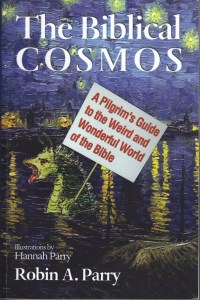
Biblical CosmosRobin A. Parry’s, The Biblical Cosmos: A Pilgrim’s Guide to the Weird and Wonderful World of the Bible is a fun trip through territory already familiar. Familiar, that is, to anyone who has studied the biblical world on its own terms. Fundamentalists, I think, would benefit from taking this guided tour seriously. The fact is, most people have no real sense of how mythology might inform a scientifically inclined world. Not that Parry will convince everyone, but the dangers of literalism are best disarmed by a believer. This little book endeavors to demonstrate just how odd a world produced the Bible we still use today.

Although the point of the book may not be what I took away from it, I would suggest that the most important aspect is that times change.  A biblical worldview, unless one is mentally able to hold two realities simultaneously in mind, is simply not possible today.  I told generations of students that the world described by the Bible does not exist.  It is a flat world, held up by pillars and with a solid bowl inverted over it for a sky.  At the same time, those who lived in the biblical world were not simpletons.  The basics of science were well understood and their engineering capacity easily bypassed that of the current writer.  It was a world based on different assumptions than ours.  The problem occurs when people who know better (i.e., anyone born since about the time of Copernicus) try to pretend that the Bible can be taken literally.  It is disingenuous to say so.  The Bible, regardless of divine status, is a document of its time.  No dinosaurs had been discovered.  The processes of geology were understood only in the most rudimentary of ways.  Stars were not millions of light years away.
 
So what are we supposed to do with this information?  Parry concludes his book by describing ways in which the biblical view of the cosmos might fit, conceptually, into a modern theology.  For many of those starting out in the academic study of the Bible such a demonstration can be quite valuable.  Those who’ve been at it a while will surely have come up with their own systems.  When books become sacred, in the minds of the believing community, the “truth” attributed to the book is the truth of that era.  As any scientist or historian will attest, truth is contingent.  We haven’t learned everything yet.  Given the limitations of the human mind, we likely never will.  We should accept our universe with a little mystery.  Humility can be a good thing, and it is more effective not having to make excuses for what will surely become outdated information sooner than we think.


Who the Devil?

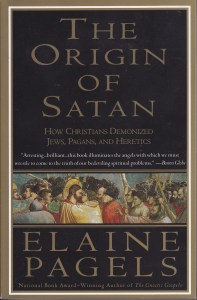
OriginSatanThose who’ve studied the history of ancient West Asian religions know that the concept of a devil, as a character, derives from Zoroastrian origins. In Zarathustra’s dualistic worldview, the forces of evil were concentrated in an “anti-God,” who, upon contact with the emerging monotheism of ancient Israel, became the satan. While scholars still argue about exactly what the role of the satan was, it is clear that it was a role, and not a name. The job of the satan was in some way to bring to accounting wicked deeds. By the time of the New Testament, “the Devil” had developed into an embodiment of evil more along classic Zoroastrian lines. What Elaine Pagels explores in The Origin of Satan is encapsulated in her subtitle: How Christians Demonized Jews, Pagans, and Heretics.

This is not a book about the historical development of the figure of Satan, but rather a study of how early Christians (and to an extent, Jews) viewed “the other.” Naturally she does discuss Satan, who developed along the lines suggested above, but more specifically she addresses how the accusation of being “of Satan” was used. Interestingly, it was generally utilized by those of ancient times to describe those of their own religion, but who held different viewpoints. Sects of Christianity and Judaism generally accused other sects in their own religious tradition of being “satanic.” Foreigners and pagans, well, what would you expect of them anyway? Those closest, ironically, are those most despised. Even early converts to Christianity from Roman polytheism tended to view their former religion as satanic. Satan, in other words, is “the other.” But not the far other. The near other.

While the book is full of Pagels’ usual erudition, it is also disappointing. Not as a book, but as a fact. Religions that claim God only wants us to love one another and treat each other well rely too readily on the figure of personified evil to castigate their enemies. As Pagels demonstrates, even as early as Augustine of Hippo there were those who realized Satan was not a “physical” being, but a symbol for evil. Yet on through the Middle Ages Satan would continue to be evoked to murder women and men thought to be witches or heretics. Satan, it seems, is simply a word for our darkest urges to harm those different from ourselves. We know that religions often have noble intentions. Perhaps the most noble could be to rid the world of Satan, and I don’t mean the mythological figure we all recognize without a hint.


Holiday Fervor

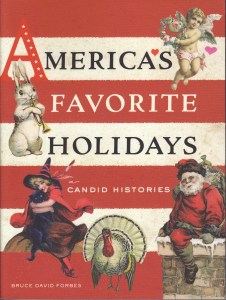
AmericaFavHoliTime comes in different varieties. In temperate regions where the changing seasons keep the time of year for us, we tend to have seasonal holidays. Christmas and other December holidays mark the shortest days of the year with the hope that light will soon become more abundant. Spring rituals, near the time of the vernal equinox, encourage the return of fertility to the earth. Autumnal holidays mark the approach of darkness once again as the world twirls endlessly on. Summer, bright and warm, doesn’t really lend itself to so many holidays. These thoughts came back to me as I read Bruce David Forbes’s America’s Favorite Holidays: Candid Histories. Forbes doesn’t cover all the special days, but focuses on Christmas, Valentine’s Day, Easter, Halloween, and Thanksgiving. These are five holidays marked, in some sense, by spending. They are often, although Forbes doesn’t really spend too much time on it, the focal point of cultural wars where various Christian groups wish to reclaim a certain day for its “rightful heritage.”

One of the real values of books like America’s Favorite Holidays is that it is clear that these claims of “keeping Christ in Christmas” and its kin are samples of collective amnesia. Many “Christmas” traditions predated Christianity. Others developed concurrent with it, but in “pagan” contexts. Christmas trees, for example, didn’t originate in the latitudes of Bethlehem. The same may be said for just about any holiday. Valentine’s Day and Thanksgiving, of the five explored, are the lone exceptions. These are fairly recent holidays and neither one marks a solstice or equinox. They celebrate aspects of life we value, making them sacred time. Don’t expect to get Valentine’s Day off of work, however. Capitalism never makes room for love.

Christmas, of course, is the holiday most under dispute. All holidays may be commercialized, but for Christmas spending is central. Forbes insightfully shows that Christmas is, and may always have been, both a cultural holiday and a religious holiday. The cultural aspect of the season is the one that most people celebrate. The birth of Jesus—which we are fairly certain was not in December—was a latter add-on. A baptism, if you will, of a pre-existing holiday. The winter solstice holiday is a staple of cultures in climes where the difference in available light and warmth is appreciable. It marks the point of the year when things start getting better. Yes, the real cold of winter has not yet set in, and there will be months of snow and ice. Still, once the solstice is passed, there is more light to help us cope. Celebrating sacred time, whether secular or not, is the natural reaction of people who crave light over darkness.


Musical Mind

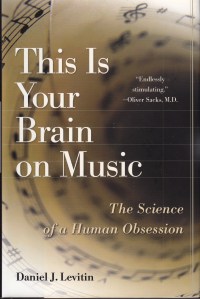
BrainOnMusicMusic is perhaps the most natural of human arts.  We are all, as Daniel J. Levitin says, expert listeners from an early age.  This Is Your Brain on Music: The Science of a Human Obsession is a fascinating study of neuroscience and music.  I began exploring this connection about a decade ago when studies on religion and neuroscience were only just beginning to appear.  Music, although closely related to religion in many ways, does not bear the stigma of “belief” and although music programs are often tragically cut from school budgets, we all value music because not to do so makes us less-than-human.  Levitin shows clearly how music accompanies the most important parts of our lives and how it forms and develops the brain.
 
Music is somewhat easier to define than religion.  Those who decry the humanities, I suggest, should be locked away with no access to music for a few years to see if they change their tune.  I suspect they would.  We need music, and music’s impact on the brain is an analog to that of religion.  More studies of religion and the brain have begun to appear, and one gets the sense that materialists are a little bit angry and disappointed that religion hasn’t disappeared the way that it was predicted to have done by now.  That’s because being human is more than being molecules and chemical reactions. It involves what we call the humanities.
 
Our brains are our gateways to all of human experience.  They are complex in ways that computer designers emulate, but there’s a messy something about biology that straightforward mechanics seems to have trouble replicating.  Our brains are part of one large, organic whole that encompasses life on this little planet.  While studying the brain to understand it is indeed a good idea, calling it a meat computer is not.  While software may be coded to compose music, of one thing we can be sure. Computers can’t enjoy music.  It takes a brain to appreciate music, and the brain that appreciates music is mere synaptic connections away from seeing why religion is still important.


Deserted Village

Hands up, anyone who’s heard of David Felt. Until just recently my hand would’ve remained down too. In his day, however, Felt was famous enough to have a town named after him (Feltville, New Jersey) and wealthy enough to leave it when it failed. Today the Deserted Village is a small tourist attraction, a wooded site on the National Register of Historic Places, and the residence of a few locals who prefer the quiet life. David Felt settled in Union County back in the days when it was rural, and established an industry around a mill. The available literature is frustratingly silent on what kind of a mill it was, but it was important enough for him to build housing to accommodate his workers out in the middle of nowhere. While many of the houses no longer stand, including that of Felt himself, the property has a few remaining buildings and a sense of history.

2015-11-06 22.16.35Upon walking into the park, part of the Watchung Reservation, the first building you meet, after a private residence, is the Union Church. Felt was a Unitarian. He nevertheless insisted that residents—his employees, remember—attend services weekly. The church, which is one of the few buildings open to the public, was a center of communal life. The timeframe here is the mid 1800s. Today employers are more likely to try hard to distance themselves from any religious activities, renaming any holiday gatherings with more neutral titles and hoping, rather than praying, that they won’t offend anybody. Of course, Felt’s business venture failed. Others that followed, sans church, didn’t fare much better.

The man that employees knew as “King David” went on to other ventures and has largely faded from history. Incredibly in this age of internet fame he doesn’t even have his own Wikipedia page. Symbolically, the only building that remains accessible to the public in the church—now a museum with a few artifacts from a century-and-a-half ago. Having lived not far from Feltville for nearly a decade now, I had no idea of its presence until a chance meeting held there brought it to my wife’s attention. We can build our own little kingdoms, it seems, and call them after our own names. They are no guarantee, however, that what we leave behind will not become a ghost-town as the interests of civilization move in directions we had never anticipated.


Seeing Red

Not being commercially minded, it took many years for me to understand why it is called Black Friday. To many people “black” indicates negativity, sort of the opposite of Good Friday which, when you think about it, doesn’t seem so good. After I was forced into jobs in the money-making business, I came to realize that budgets were written in black and deficits were written in red. Since my lifetime, with a few exceptions, has been a series of economic disasters following one another (the implications should be obvious) and businesses operate in the red while projecting budgets ever higher the next year. This model is, in a world of limited resources, the very definition of unsustainable, and yet we keep raising our sights and getting disappointed. Nobody knows for sure where the term Black Friday originated, but it is a modern term. A holiday for those who measure celebration in terms of dollars and cents. (Mostly dollars.)

As I was pondering this phenomenon, my thoughts turned to red letter days. Red here is a positive thing—special days on the calendar that let us step outside the usual routine of pushing ourselves to make this year’s budget and allow us to relax with family and friends. The black and the red have switched places here. In fact, red letters, apart from the dismal science, have historically been considered good. Think of the red letter editions of the Bible. These Bibles had the putative words of Jesus printed in red so that they would stand out. The concept dates back to the change of the twentieth century. Red letter Bibles caught on among Evangelical readers. Red letters, however, go back even further in history.

Who said what now?

The book that Catholic priests used to set on the altar was a missal. Missals contained the instructions for saying mass, and during certain parts of the ceremony priests were supposed to make specific gestures. The places at which these actions were to be made were printed in red to draw the priests’ attention. They were called “rubrics” since they were written in red. Missals date back to the Medieval Period and they give us perhaps the first positive use of red writing that we know. Even further back in history when inks were organic, red writing was found. Epigraphers of antiquity know of red inscriptions but the meaning at that time remains speculative. We call this Black Friday because the one percent hope to get a bit richer. Those of us further down are supposed to enjoy the trickle. For me, in principle I don’t go shopping on Black Friday. I see it as a red letter day.