Time To Meet

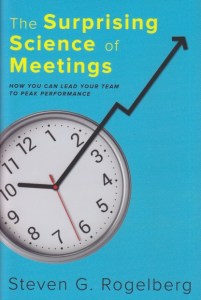
I feel compelled to state up front that this wasn’t the mind-blowing book I was writing about in yesterday’s post.  One of the perks of working in publishing is the occasional offer of a free book.  (It’s not as generous as you might think, so when one is offered I always say “thank you.”)  The Surprising Science of Meetings, by Steven G. Regelberg, isn’t exactly “mind-blowing.”  The realization that some people make a living studying meetings was certainly, well, surprising, but the corporate world is all about returns on investments and boring stuff like that.  We all hear of companies that value innovative and exciting ideas, but most of us know the feeling of being desk drones parked behind a soulless monitor all day.  At least I’m no longer confined to a cubicle.

The academic world I once knew was the stimulating environment of learning for its own sake.  The academy has followed the business world to its own form of perdition and as Rogelberg points out, there are millions of meetings any given day.  Many of them are poorly run.  This book is for those who want meetings to flow more effectively, to better the bottom line.  Still, I found the chapter on servant leadership particularly hopeful.  I couldn’t help but wonder if Rogelberg was aware that servant leadership was something that developed in the church, out of the effort to imitate the way Jesus was said to have led his flock of disciples.  The point was not to aggrandize himself (this is a chapter 45 and his ilk should read) but to help others to be their best.  This is the kind of leadership—rare, to be sure—that the church has always, at least vocally, promoted.

It didn’t take long for ecclesiastical organizations to start running like businesses, however.  The bishop became a boss rather than someone who reluctantly had the crozier forced into his (or her) hand.  I’ve always believed you should have to take a pay cut to become a bishop.  That would immediately weed out most of the climbers.  In fact, if servant leadership is really the ideal, and the good of the company is really the goal, pay cuts should be expected as you climb the corporate ladder.  Can you imagine a business world where workers were well compensated, and those who really had vision sought promotion because their motivation wasn’t their own bottom line?  It’s an intriguing idea, to be sure.  I’d like ponder it more, but I’ve got a meeting to get to.


Scrolls Not Living

Of the many ancient finds in Western Asia, none captured the imagination like the Dead Sea Scrolls.  The timing and romance of the find itself, the scandals that almost immediately broke out, and the subsequent “secrecy” over the contents made the secular news.  I’m convinced that a large part of the mystique has to do with the somewhat spooky name—Qumran scrolls never caught on, even though it is more accurate for many of the documents.  Their discovery came after the Second World War when people were wanting good news, and, perhaps, an indication that all of this stuff was somehow predicted.  Enter the scrolls.  No doubt, these documents gave us quite a lot of information on the Second Temple Period—the time from the rebuilding of the Jerusalem temple in the sixth century BCE until its destruction under the Romans in the first century CE.  Now the scrolls are back in the news.

A story by Nicola Davis in The Guardian announces that the origin of the scrolls is once again open to interpretation.  The reason is somewhat technical—scrolls that were written on vellum (animal skins) had to be prepared for writing.  One of the steps involved chemically treating the writing surface with a fine powder (the details are beyond me) so that it could be written upon.  We’ve reached the point where the salts left behind can be tested for place of origin.  The Guardian story notes that the Temple Scroll—one of the important non-biblical texts—was not prepared at Qumran (the site where most of the scrolls were found).  That means that the scroll itself came from elsewhere, depending upon with whom you speak.  The scrolls gather controversy like the Ugaritic tablets gather dust.  

Part of the charm here is that there are many unanswered questions about these ancient texts.  Who exactly wrote them is debated.  Their find-spot suggests they were hidden away by the quasi-monastics who lived in nearby Qumran, but this doesn’t mean they necessarily wrote them.  It’s still debated whether the Qumran community was made up of Essenes or not.  One thing we do know about them is that they were able librarians.  The scrolls themselves are symbolic of the strife in the region, having been discovered just as Israel was declared a nation.  The scrolls were quickly politicized.  They were kept under the auspices of a small group of academics and priests for many decades.  And they still have a way of catching headlines.  Even when its a matter of who powdered their faces.


Permanent Change

Maybe you’ve experienced it too.  The sense of change in a large city like New York is palpable.  Although I don’t commute in much any more, I noticed it when I made daily treks to the city—change is constant.  If the skyline’s forever evolving, on street level things are more than keeping pace.  In the seven years of my daily commuting I saw buildings built and razed in the same location.  Scaffolding is a constant hazard.  Public art pieces are placed and then replaced.  Change.  I was reading about Yijing, better known as I Ching, the other day.  One of the spiritual classics of China, this “Book of Changes” reflects a worldview common in eastern Asia that is quite at odds with that that developed in ancient Greece.  Many Greeks believed permanence was reality, those in China who read the spiritual masters believed that change was reality.  The older I get the more I think the author(s) of Yijing got it right.

I’m not an expert on the religions of southern or eastern Asia, but I have studied the major ones.  To those outside the field of religious studies, it may be surprising that the field is as large as it is.  In the United States alone there are an estimated 40,000 denominations, and that’s just within Christianity.  To be an expert in any one takes years of study.  Add in the many religions of other locations, such as Africa and Asia, and you’ve got more than one lifetime’s worth of work lined up.  A common—the most common, in fact—course in collegiate religion curricula is “World Religions.”  I’ve taught it myself.  The problem is nobody’s an expert in all of them.  Still, I found reading about what used to be called “eastern religions” (with that poisonous cultural bias that the unchanging west is the correct vantage point) full of surprises.

Scientists well into last century liked the idea of a steady-state universe.  Permanence.  When Edwin Hubble noticed other galaxies were moving away from ours (and, by the way, first noticed that there were other galaxies), the Big Bang theory developed to explain this motion.   Change, it turns out, is constant.  It may be slow at times, and at others it’s like the skyline of a major city like New York, shifting several times in a single lifespan.  I’ve read some of the spiritual classics (in translation) and I always come away with a new sense of wonder about the many ways of understanding the world.  And I ponder what it will take to change the attitude that religions aren’t worth studying.


Pointing to the Moon

The failure of India’s  Chandrayaan 2 to maintain contact, intended to make India the fourth nation to successfully conduct a lunar landing, sent me reading about the moon.  I remember the first manned landing, which happened when I was six, so the idea that we could make it that far seemed less impressive than it really is, I suppose.  I was fascinated by early space travel, and part of this may have been because of the moment of silence announced in school the day Apollo 13 safely returned to earth after the oxygen tank explosion that made its landing impossible.  As I was reading about the many moon missions that took place before I was born, I was surprised to learn how many nations are still attempting to reach our nearest neighbor.  This year alone China, Israel, and India have all attempted to land up there.

Israel’s mission called its lunar lander Beresheet.  It was the first attempt to land the Bible on the moon.  Beresheet is the Hebrew title of Genesis.  The US missions were named Pioneer, Ranger, Surveyor, and Apollo.  Ironically for the persistently religious nation, our only supernatural title was the name of a Greek deity.  Israel was true to its roots with its naming convention, but there is kind of a paradox involved.  In the world of the Bible the earth is the center of the universe and the moon is a quasi-living being circling about our stationary fix in this fictional view of the cosmos.  That’s not to say our own views may not some day be regarded as fictional as well, but simply that we now know the view in Genesis is incorrect.

Of course, the word “genesis” can mean a purely secular beginning as well.  It is a compound word that is often translated as “in the beginning.”  As such, it is appropriate for the first attempt at a moon landing, or any other great venture.  Still, it is instantly recognizable as the first word in the Bible, indicating a kind of strange juxtaposition where the biblical moon—which is not the same as the astronomical moon—are brought together.  Unlike the book of Genesis, the moon has been reached many times by others before.  The old and the new meet in this attempt to reach into space.  Meanwhile our problems continue down here.  Maybe that’s why we continue to attempt to reach the heavens.  And in that sense, no better title applies than that of the book that somehow defies rational explanation.


Masked Reality

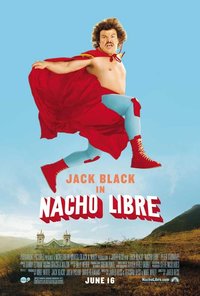
Before I make my confession you need to consider that I spent much of my professional life as a seminary professor.   Never ordained, I nevertheless donned the cassock and taught future priests what they’d be assumed to know (the Bible) while trying to earn an academic reputation through my publications.  It was a double life in which one half involved the church.  Shortly after that job ended I saw trailers for Nacho Libre, a movie in which Jack Black plays a monk who moonlights as a luchador, a Mexican professional wrestler.  I never saw the film, but I had been raised on a white trash diet of World Wrestling Federation fandom, back in the day when that involved gathering around the television to watch grown men posturing and preening while knowing that none of it was really real.  I secretly wanted to see Nacho Libre.

Recently I visited friends who had the movie.  They warned me that it was corny, but I had already supposed that.  What I didn’t realize until after it was over (for movie viewing is now followed by internet viewing) is that it is based on a true story.  “Based on a true story” doesn’t mean, of course, that a movie accurately portrays events, but I had no idea that a Mexican priest had actually supported an orphanage for over two decades as a masked wrestler under the name of Fray Tormenta.  I followed up the movie with a little web research because the film was remarkably respectful of the church.  The character of Ignacio never criticizes Catholicism, and he clearly cares for the orphans for whom he serves as the cook.  His wrestling winnings go toward purchasing better food for them.

Earlier in the day we watched the movie I’d talked to one of my friends about how religious life, no matter how seriously it’s taken, involves acting.  People generally put on masks before going to church (or any other function in which they interact with others).  Religion requires a level of piety impossible to sustain in the real world.  Early in the history of Christianities it became clear that the church would hire some religious specialists to try to take on the lifestyle toward which all faithful should aspire.  I’ve trained many priests.  I’ve seen them when they’re in mufti.  I know that in the vestibule, at the altar, or in the pulpit they’re wearing masks.  Many of them have the heart of Nacho Libre, but outside the church doors they still have bills to pay and family and friends who know them as they really are.  As we slipped the DVD in I didn’t know what the movie might be like, but it was based on a true story in more ways than one.


The Holy

It’s perfectly natural.  Trying to make sense of things, I mean.  It’s been a little difficult in America for the past three years or so, given that nothing seems to add up beyond greed and narcissism supported by a senate majority.  Still, as I retreat into my horror films I realize that there’s a logic to it.  Over the past several months I’ve been attempting to articulate it.  You see, I have a couple of presentations to give on Holy Horror in October and one of the questions likely to arise is why.  Why bring together the sacred and the scary?  Those who’ve studied religion formally—and many who’ve not—are aware of Rudolf Otto’s classic The Idea of the Holy.  It’s outdated and I’ve been waiting for someone to write its replacement, but we’re past the era when one scholar corners the market.  Has nothing new emerged this past century?  Nevertheless, Otto’s main ideas still make sense, before he lapses into a Christocentric view.

Mysterium tremendum et fascinans isn’t an incantation, but with a little imagination the Latin makes sense.  The holy, according to Otto is a mystery that is both terrifying (tremendum) and fascinating.  To the laity in the pews this may be strange, but chances are pretty good that your minister has read this book.  In the monotheistic west, the divine is terrifying.  It’s not splitting hairs to suggest terror and horror differ, nor is it unreasonable to suggest they have much in common.  Horror seems more embodied—a working-class variety of terror.  Still, both have that element of fascinans.  We fear but we can’t look away.  I don’t have the time to sit and ponder that a Gilded Age academic had.  Otto didn’t have to keep up with Facebook and Twitter.

Although academia required far more than eight hour days, the time during those days wasn’t spent “on the clock.”  As one intellectual I admire once quipped, staring out the window is work.  Not as far as HR is concerned, however.  Productivity in an industry under stress is its own kind of mysterium tremendum, I guess.  It doesn’t really allow for unstructured hours to read, take notes, close your eyes, and read some more.  Work measures inspiration in terms of currency, which is one of the problems that stretches past beyond these last three years.  Struggling hard with an idea is like wrestling an angel until dawn.  You can’t win, and you can’t lose.  But when the sun clears the horizon it will be time to be at your desk and ideas will have to wait another day.


Building on Water

I try to keep up.  Really, I do.  Although my specialization is in ancient religions, at heart I’m an historian of ideas and I try to keep up with the origins of the many Christian denominations.  You see, with so many competing versions of the one correct way to please God it pays to hedge your bets.  Thing is, there’s so many options and some seem to spring out of nowhere, like toadstools after the rain.  The other day I attended a local community event.  One of those kinds of affairs where local organizations set up tents and sometimes sell food.  Many of the tents were for churches.  As supporters of community values (mostly) this isn’t unusual, even with the declining numbers in the mainstream.  Then I heard a voice.

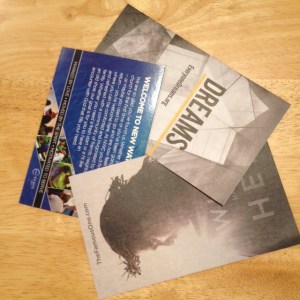
“Do you read?” the man asked.  I confess to having a bookish look, so I admitted I do.  “We want you to have a free book,” he said, handing me a plastic bag (warning sign one) containing a small paperback and several fliers.  Now, I was here to look around and maybe get a bite to eat, so I thanked him, tucked the bag under my arm and walked on.  Only on the way home did my wife look at the contents.  The church—for it had to be a church giving such things away—was one of which I’d never heard.  This would’ve been disorienting if it weren’t for the fact that ever since college—where I learned quite a lot about denominations—I’ve been noticing new varieties of Christianities, cropping up somewhat frequently.  Each seems to believe it has found the answers, despite the threadbare denominations that have been around for centuries.

I make fun on nobody’s search for meaning, or the truth.  It is, after all, a lifelong quest.  I am suspicious of those who claim to have already gotten there, however.  For those traditions that declare they’ve found the answer centuries ago, the passing years with their constant changes have worn on them.  Especially if they’re awaiting a divine cataclysmic ending to it all that’s been delayed for a couple of millennia now.  Others are, apparently, wanting to pump some fresh air into these tired lungs.  This group featured a website “the famous one [all one word].com.”  I was surprised and a touch saddened to see Jesus relegated to the role of a media celebrity.  But then again, I can’t keep up like I used to.


Turin Turnabout

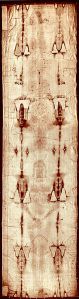
Turn about, they say, is fair play.  Turin, on the other hand, is a city in Italy.  Its claim to fame is a shroud housed there that is believed by many to be Jesus’ burial cloth.  Tests have been done over the years, most authoritatively a carbon-dating done by three independent laboratories, with the results suggesting a medieval origin to the cloth itself.  In case your chronology is a little hazy, the medieval period comes centuries after the time Jesus lived.  Now, some thirty years after the definitive study, some scientists are questioning the results.  They’re being skeptical of the skeptics.  Turn about.  According to a story in The Catholic Register, a Freedom of Information Act request, honored only by one of the three labs (the one at Oxford University) has revealed that the bits of the shroud subjected to analysis were the worst possible parts of the cloth to test.  Herein lies the rub: scientists like to poke holes in credulousness—what do you do when your science is itself the subject of skepticism?

The Shroud of Turin, like Donald Trump, is one of those utterly arcane artifacts that unites Catholics and Evangelicals.  When I was growing up these two groups were the cats and dogs of the theological world.  They united under the umbrella of conservative social causes during the Bush years and have been sleeping together ever since (while both convinced that the other is going straight to Hell when it’s all over).  You see, the Shroud is a Catholic possession and allegedly bears wounds that support the Catholic narrative.  (The Vatican has never declared it an authentic relic, however.)  Evangelicals see it as proof positive that Jesus was resurrected, and so they tend to go further than the Catholics in citing it as proof.  We live in odd times when believers successfully out-skeptic the skeptics.

Since the other two laboratories (the University of Arizona and the Swiss Federal Institute of Technology) haven’t released the raw data, the grounds for a conspiracy theory grow fertile.  When information is kept secret, that’s a natural enough response.  The conspiracy-prone mind asks why the data isn’t being made public.  They do have a point.  The claims of religion are often hoisted on the petard of “no evidence” and when evidence (such as the lab results) exists but isn’t shown, that suggests somebody’s hiding something.  I have no vested interest in the authenticity of the shroud, but we all should have such an interest in getting at the truth.  The turnabout in this case, however, was completely unexpected.


Good Monster

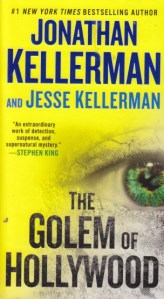
The little free library is a great idea.  Just after our move last year we contributed to our local many times as we discovered duplicates in the process of packing.  On one such venture, I discovered a book I wanted to read.  Not that I’d heard of it before, but any book with “golem” in the title catches my eye.  For the first (and so far only) time, I took a book.  Jonathan and Jesse Kellerman’s The Golem of Hollywood proved a fairly quick read for being over 600 pages.  I believe the industry term is “potboiler,” but it’s also a page-turner.  Nevertheless, it made me think.  The story follows a hard-bitten Jewish detective in Los Angeles.  Struggling with personal issues, he gets assigned to a bizarre homicide case that eventually takes him to Prague and Oxford, and then back to LA to clinch it.  And the killer is a golem.  (That’s not a spoiler, since it’s right there in the title.)

Parallel to the modern-day crime drama is the retelling of the biblical tale of the first days of humanity outside the Garden of Eden.  One of Adam and Eve’s daughters is headstrong and beautiful and when the tragedy between her brothers plays out she eventually takes her revenge on Cain.  Although not explicit about it, for violating the mark of Cain she witnesses the horrors that people will visit upon one another and her redemption is to become the soul that animates the golem of Prague.  Not your garden variety golem, she can transform into different shapes, and she stays loyal to the family of Rabbi Judah Loew ben Bezalel, the legendary first creator of the golem of Prague.

One of the frequent topics raised on this blog is how the Bible appears in everyday life, often unnoticed.  This novel is an example of that.  A further point, which is what stands behind my book Holy Horror, is that the Good Book is understood as mediated by popular culture.  Even those few biblical scholars who make it into the limelight can’t compete with the myriad representations of Scripture in the entertainment media.  Like The Golem of Hollywood, Holy Horror sees the Bible in the context of monsters.  Horror is an outsider genre.  Despite the many intelligent, thought-provoking exemplars extant, the default among the more refined is to see horror as something base and low.  It can also be a lot of fun.  Perhaps not great literature, The Golem of Hollywood is entertaining even as it underscores the continuing influence of the Good Book. 


Monsters and Gods

Nothing makes you feel quite as old as seeing a documentary where the names of the experts are unfamiliar to you because they’re too young.  So it was when I watched PBS’s Ancient Skies episode “Gods and Monsters.”  They had me at “Monsters” although I know that when paired with gods the term generally refers to Greek mythology.  This documentary had a pretty cool rendition of Marduk battling Tiamat that would’ve left many a Babylonian quaking in his or her sandals.  Ranging across the world, it showed the earliest efforts to understand astronomy, and then went on to contrast it with how the ancients nevertheless still believed in gods.  It was a striking kind of condescension, I thought.  Many scientists today still believe in a deity, although it’s no longer the fashion.

That sharp dichotomy, that either/or, bothers me a bit.  It’s not that I have a problem with science—I’ve always supported the scientific method.  No, it’s the idea that everything is explained that bothers me.  We understand so little about the universe.  Yes, we’ve made great strides over the past millennia, but we’ve not even been out of the cosmic neighborhood yet.  And I wish we could acknowledge that even on earth life is still a mystery that can only be solved with poetry as well as reason.  “Gods and Monsters” made the point that the ancients realized the explanatory value of stories.  Myths weren’t just idle constructs to pass the time.  They were ways of understanding how this universe works.  Some people take their mythology too seriously, of course, but that doesn’t mean that no stories are required to make sense of it all.

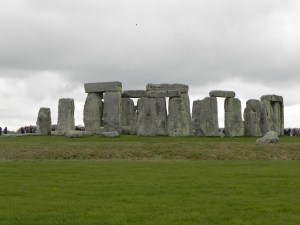
It was the inherent conflict implied between science and religion, I think, that bothered me the most.  Not everything in life comes down to an equation.  That doesn’t mean that equations are wrong, just that they’re not everything.  One of the points Ancient Skies makes is that people of bygone eras had a very sophisticated understanding of the sky.  It featured the builders of the great pyramid of Khufu, those who constructed Stonehenge, the Maya, and the Babylonians.  They all knew much of the math that would only be formulated in Europe much later.  And they all assuredly believed in gods.  It didn’t prevent them from complex thought in either architecture or astronomy.  Our modern dilemma is the razor burn left by standing before the mirror too long with Occam.  You don’t have to shave to support science.


Funny Business

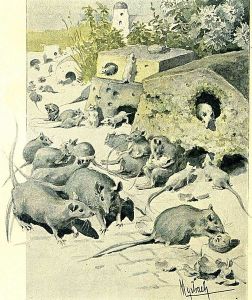
Do animals laugh?  The question sounds innocuous enough, and when my wife played me a RadioLab episode on that very question, the conclusion, although cautious, was that at least rats and chimpanzees do.  This is an instance in which the very question strikes me as terribly speciesist.  Despite the fact that evolution suggests otherwise, Homo sapiens are constantly seeking that fabled northwest passage that will separate us from animals once and for all.  One by one, over the decades, the defining traits have fallen aside.  Animals make and use tools, they build dwellings with ornaments, they solve puzzles, they communicate, and they laugh.  Were we not so obsessed with our own greatness (and consider whom we’ve elected over the past few years!) we might easily recognize that we have evolved to be what we are.

Perhaps it’s because we wish to retain our right to exploit animals.  After all, eating animals is big business and it’s harder to eat someone who’s not so very different from you.  In our culture certain animals are taboo for fodder: dogs, cats, and horses, for example.  This isn’t universally the case, and knowing that animals laugh might just make it a little worse.  We like to think animals “react” using “instinct” rather than respond with genuine emotion.  Until we fuss and fawn over Rover, and accept his affection as genuine.  Consciousness can be quite a burden to bear.  Funny, isn’t it?

We accept evolution up to a point.  Is it any wonder then that creationists still are a force with which to contend?  Often we fail to recognize that science, as it has developed in the western hemisphere, gestated in a largely Christian context.  The reason for drawing a hard line between animals and humans is ultimately, in this setting, biblical.  We’ve moved beyond the idea of God creating each separate species one-by-one, but we haven’t gotten beyond the literal truth of Adam naming and dominating them.  If we don’t consider the biblical origins of these ideas they continue unchallenged, even into the laboratories and sterile rooms of today.  It makes us a bit uncomfortable to consider just how influenced we still are by the Good Book.  At the same time we consider its meta view on the biological world, even as the evidence continues to pile up that little, if anything, really separates us from our faunal kin.  Try explaining that to the rats.  That sound you can’t hear without special equipment, by the way, is their laughing.


Tumblin’ Down

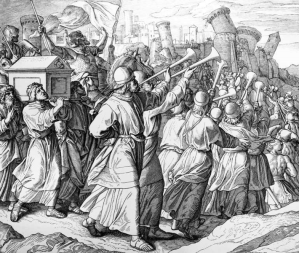
RadioLab (not to be confused with Radiohead) is an NPR program to which my wife likes to listen.  She’s introduced me to a few episodes since, as a person who does a lot of writing, I don’t normally gravitate toward programs with a lot of talk.  It’s part of the writer’s curse.  In any case, she recently played a segment on acoustic warfare.  I’ve known for some time that acoustic warfare is a thing, and that militaries use sound to disrupt enemies’ machinery and human operators.  I didn’t really know how it worked.  The interesting thing about this RadioLab spot was that they took the story of the walls of Jericho as a starting-off point.  Also of interest is that one of the hosts had never heard the story—something that would have been somewhat impossible for many growing up in my generation.  In case that’s you, however, the story goes like this—

God commanded Joshua to take on Jericho, a major, walled city, with a ritual procession and the blowing of trumpets.  After marching around the city several times, the priests blew their trumpets and the walls collapsed.  The story’s told in the book of Joshua.  The question discussed on RadioLab was whether it was possible to knock down walls with noise.  It is, they concluded, but at a noise level beyond the abilities of shofars.  This very discussion, however, raised any number of issues.  One is that the collapse of Jericho’s walls isn’t attributed to the rams’ horn sound, but rather a miracle.  Another is that biblical scholars and archaeologists have long known that Jericho wasn’t even occupied at the time of Joshua, and so the story isn’t historical.

Those who produce educational materials on various media generally don’t consider scholars of religion as interesting or noteworthy speakers.  TED talks don’t feature a category for religion, and, as this RadioLab episode demonstrated, those who understand acoustics have more interesting things to say than biblical scholars.  It’s not so much a rude awakening as it is a confirmation that what has long seemed obvious is indeed true—biblical scholarship isn’t really of general interest.  The Bible, however, retains a certain mystique.  I struggle with this disconnect constantly.  While the Good Book remains an iconic symbol—divine, even—those who know it well have less to say than others who have scientific methods to apply.  Not once was it mentioned on RadioLab that pretty much no biblical scholar would argue that the story is historical, but then, what fun would that be to pick apart?


A Decade

Please pardon my being sentimental, but today marks one decade of blogging on Sects and Violence in the Ancient World.  I realized, thinking this over, that I used to make some interesting, perhaps even quotable statements back then.  Why not, I thought, farm those older posts to celebrate what I was thinking when I was a tenth-of-a-century younger?  So for today’s post, I’m presenting some quotable quotes from July 2009, starting with one of the zingers from my very first post.  For convenience, I’ve even provided the links to the posts so you can see them in context, if your July has somehow not filled itself up already.

Sects and Violence in the Ancient World, by the way, was the name given when one of my nieces thrust a recorder in my face and asked me what I would call a blog, if I had one.  She subsequently set this site up for me.  One aspect of the title may not have been evident: it’s a quasi-anagram for my initials.  It has been, from the beginning, mostly metaphorical.  Without further ado, then, a few of my favorite lines from a decade long gone:

“He had a sidekick called Cypher (sold separately), and arch-enemies with such names as Primordious Drool and Wacky Protestor. I marveled at the missed opportunity here — they could have called them Text Critic and Doctor Mentary Hypothesis!” First post: Bible Guy, July 12, 2009. <https://steveawiggins.com/2009/07/12/bible-guy/>

“Technology has outstripped reality.” Asherah Begins, July 13, 2009 <https://steveawiggins.com/2009/07/13/asherah-begins/>

“Black and white are not in the palette of serious religious studies.”  God is Great (not)?, July 14, 2009 <https://steveawiggins.com/2009/07/14/god-is-great-not/>

“When he [Aqhat] refuses to release it to the goddess he is unfortunately pecked to death in a hitchcockian demise by a swarm of buzzards with attitudes.” Sects and Violence, July 15, 2009 <https://steveawiggins.com/2009/07/15/sects-and-violence/>

“Indeed, one may think of them [religion and monsters] as fellow ventricles in the anatomy of fear.” Vampires, Mummies and the Holy Ghost, July 16, 2009 <https://steveawiggins.com/2009/07/16/vampires-mummies-and-the-holy-ghost/>

“Better to consider it [weather] human than to face unfeeling nature.” Changing Faces of the Divine, July 18, 2009 <https://steveawiggins.com/2009/07/18/changing-faces-of-the-divine/>

“As the gods are drinking themselves senseless (how else can the latest Bush administration be explained?)…” Drunken Moonshine, July 20, 2009 <https://steveawiggins.com/2009/07/20/drunken-moonshine/>

“As usual, we kill off what we don’t comprehend.” Not Lion, July 22, 2009 <https://steveawiggins.com/2009/07/22/not-lion/>

“A bonobo was recently documented as uttering the word ‘yes’ to a keeper’s question, officially making her more articulate than some clergy I’ve known. Even today there are churches that still call their leaders Primates!” Religious Origins, July 23, 2009 <https://steveawiggins.com/2009/07/23/religious-origins/>

“I never used a computer regularly until I began my Ph.D., and then it was only a glorified typewriter, qwerty on steroids.” Who We Were, July 27, 2009 <https://steveawiggins.com/2009/07/27/who-we-were/>

“I grew up in a blue-collar household where paying ladies for favors was itself considered a sin.” Yes, Mammon, July 28, 2009 <https://steveawiggins.com/2009/07/28/yes-mammon/>

Where do you suppose we’ll be a decade from now?


Waiting for a Miracle

A friend recently sent me a New York Times story about Marianne Williamson’s spiritual background.  Before I say anything more about this I have a confession to make.  I didn’t know who Marianne Williamson was and, consequently, I’ve never read any of her books.  I also didn’t know about her presidential bid, although she seems much more grounded than whatever it is that sits in the Oval Office these days.  In any case, it’s the spiritual background part on which I’d like to focus.  Williamson is apparently a devotee of A Course in Miracles, a book written by Helen Schucman in the 1970s.  According to the NYT article, Schucman penned the book by the dictation of a divine voice.  This aspect seems worthy of further exploration, regardless of politics.

You see, sacred books have a long history of divine dictation.  The Bible makes such claims only obliquely, but clearly there were some who believed that Moses was the recipient of narration from on high.  Mohammed heard a voice saying “Write.”  Centuries later the Book of Mormon was written out at the dictation of Joseph Smith.  The point is that such texts are often believed to have had sacred origins.  I find Schucman’s reluctance to put herself down as the author of A Course in Miracles instructive.  She didn’t believe she wrote it.  Not to devalue any of these sacred texts mentioned, I would nevertheless note that authors often feel that their words come to them.  Maybe academic books don’t count, but when I’m writing fiction, it’s like somebody’s hands are on the wheel, but I’m not sure I’m the one driving (with apologies to Jeff Daniels).

A Course in Miracles has been translated into double-digits languages, something quite rare even among many bestsellers.  What this says to me is that people still crave answers from an authoritative text.  The written word has a power that electronic publication lacks.  Who wants to point to a screen and say, “this is divinely revealed truth”?  Hefting a heavy book, printed on actual paper, has a symbolic power that outweighs that of ebooks.  Probably it’s because the Bible paved the way.  We’re already primed for a sacred text, in physical form.  The longer I study holy books the clearer it becomes that they will unlikely ever cease to be written.  Helen Schucman didn’t have the last word.  As long as people write it’s doubtful anyone ever will.


Weathering the Sun

I may have given up on Weathering the Psalms a bit prematurely.  Those who know me know that the weather impacts my mood.  Now that I have a yard to mow that feeling has grown exponentially since perpetually wet grass is happy grass and is impossible to cut with a reel mower.  Today, while those of pagan inclinations celebrate the sun, there’s more rain in the forecast.  As there has been since Sunday.  If Yahweh’s the God of the sun, then Baal’s had the upper hand for some time now.  As an article on Gizmodo has pointed out, this has been the rainiest twelve months on record for the United States.  And we’re largely to blame.  We’ve known we’ve been warming the globe since the 1980s, at least.  Yet we do nothing about it.  You can’t stop the rain. 

Our species occupies that odd role of predator and prey.  Most predators, actually, are prey to somebody else.  Not being nocturnal by nature, we fear the dark when we feel more like prey.  Since we’re visually oriented, we crave the light.  Today, when the conditions are right, we have it abundantly.  Ironically, of the seasonal celebrations, the summer solstice is the only one with no notable holidays.  Easter and a host of May Day-like holidays welcome spring and Halloween and Thanksgiving settle us into fall.  December holidays around the other solstice are the most intense, but summer, with its abundant light and warmth, is perhaps celebration enough.  Or maybe we know that marking the longest day is a transition point, since now we’ve reached a natural turning point.

So, it’s the solstice.  From here on out the days start getting shorter and we slowly move toward the time of year when horror becomes fashionable again.  The light that we crave now ebbs slowly to the dark we fear.  There should be a holiday around here somewhere, for those of us outside academia continuing working right on through.  The problem is western religions, especially Christianity, place no especially memorable events here.  Resurrection’s a hard act to follow.  Calendars, apart from telling us when to plant and harvest, are primarily religious tools in origin.  When things are their darkest, six months from now, the church moved the likely spring birthday of Jesus to counteract pagan festivals encouraging the return of the light.  I, for one, would like to see a day to commemorate it, even if it’s raining again.