Creation of Horror

I recently read the article “The Christian Worldview of Annabelle: Creation” by Neil Gravino on Horror Homeroom.  I’m pleased to see that the complex world of religion and horror is being addressed by other scholars.  (I know that many actually work in this area, but if you don’t have access to an academic library finding their articles can be impossible.  Also, did I ever think I would miss Religion Index One and Two so much?)  Since I have a piece that is scheduled to appear on Horror Homeroom concerning the 1976 movie Burnt Offerings, I’m glad for the company.  As in my article, Gravino makes the case that the relationship between horror and religion (the Christianity of Annabelle: Creation and its need to be a horror film) is fraught.  This is something I describe in some detail in Nightmares with the Bible.

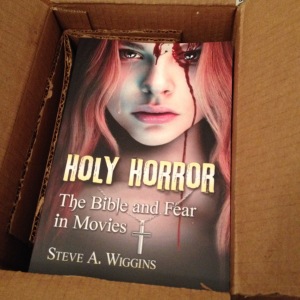
Back when I was writing Holy Horror I realized that putting individual horror films into a series creates continuity issues.  Annabelle: Creation is part of the wildly successful Conjuring franchise, the latest installment of which has been delayed by the pandemic.  Depending on how you count it, there are already seven films in that particular universe and the shifting of the story is the focus of an entire chapter in Nightmares.  The reason it requires such sustained attention is that, apart from being the most successful horror franchise after Godzilla, these movies are squarely based on Christianity.  Lacking the unrelenting gravitas of The Exorcist, they feature (in the main branch of the diegesis) the Catholics Ed and Lorraine Warren.  In an almost Dantesque view of Heaven and Hell, the characters struggle with monsters that hover between ghosts and demons.  They’re closer to the latter.

Many horror films—but by no means all—are based on fears associated with religion.  That religion isn’t always Christianity, as both The Wicker Man and Midsommar show, but the warnings against extremism apply equally to belief systems across the board.  Another thing I miss, being outside the academy, is the funding to do some in-depth research on this.  It’s good to know that others are seeing what I’m seeing as well, as is appropriate when you encounter something unexpected.  Our religion haunts us.  The reasons we believe are often tied to the self-same fear that the religions themselves generate.  And like religions, horror movies hold the possibility of earning quite a lot of money.  The parallels should not, I believe, be overlooked.


Mummy’s Daddy

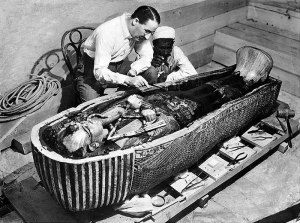
Now that I’ve broached the subject of the Agade listserv, I’m bound to find some interesting stories therein.  The title of this blog “Sects and Violence in the Ancient World” is an artifact that demonstrates eleven years ago I was still keeping up with Ancient Near Eastern studies.  I was calling it “Ancient West Asian studies” then, but I’ve been in publishing long enough to know that shifts in terminology are frowned upon by those in an industry that moves at a glacial pace.  (Just remember that the tortoise wins in the end.)  In any case, one of the recent articles on Agade had to do with the “curse” of Tutankhamen’s tomb.  This is an idea that goes back to the 1920s and was in some respects expressed in the Universal monster film The Mummy.  In pop culture the idea lives on.

Photo credit: The New York Times (public domain)

It seems that some, but not all, of those involved in opening Tut’s tomb died in unusual ways shortly thereafter.  The deaths were not concentrated within a day, let alone a week or a month, and some of them were natural but premature.  The ideas of curses, however, fit the spiritual economy of the human psyche so well that they suggest themselves in such circumstances.  A run of bad luck may last for years, causing the sufferer to think they might be living under a curse.  It is, in many ways, the pinnacle of magical thinking.  No matter how scientific we become the idea never goes completely away.  Just when Mr. Spock seems in control of the Enterprise Harry Potter beams aboard.  Our minds are funny that way.

The particular article I saw was one that had clearly followed on an earlier piece that I had missed.  It mentions “the documentary” but doesn’t say which one.  I suppose there are many such filmed attempts to make sense of memes such as the Pharaoh’s curse.  From my teaching days I have documentaries about a number of weird things that the History or Discovery channel, and maybe A&E, spun out back in the Dark Ages.  I’m not convinced that scientific thinking is really under any threat from such journeys down the paths of speculation.  I’m also not sure that there really is any connection to the various deaths surrounding the Carter expedition in 1922.  In just two years’ time we’ll be at the centenary of the discovery of the tomb and I’m sure there will be plenty of information on offer then.  As long as the curse doesn’t get us all first.


Enough

Stories of the wealthy never interest me unless they have a mysterious, ageless cousin who’s really a vampire.  Unfortunately fantasy can’t save us from the reality of a once great nation that’s now crumbling.  As I wrote earlier on this particular book, we already know, at some level, what it says.  Mary L. Trump, who alone has courage among her family, exposes quite a lot in Too Much and Never Enough: How My Family Created the World’s Most Dangerous Man.  There’s no point in ascribing blame for deeds done.  I also fear there’s no hope that justice will ever be served in this case.  Dysfunctional families are all too real and all too common.  Some of the traits (but none of the money) from Fred Trump’s cruelty were as familiar to me as my own childhood.  A powerful, overbearing stepfather riddled with a sense of his own inadequacy, taking it out in his own empire within the walls of his house.  The damaged children it leaves behind, each struggling to cope in their own way.

The family Fred Trump raised was bound to become damaged goods.  It is to the everlasting shame of the Republican Party that it could come up with no other viable candidate for the highest office in the land.  Not so long ago I would’ve written “world,” by that day’s gone past us.  Not only did “the party” accept his nomination, it has enabled him, as Mary Trump shows, every step of the way.  Knowing that something is deeply wrong—that more people will have to die in this country of Covid-19 than anywhere else, just to stoke one man’s ego—and refusing to act should be a sin in anybody’s book.  Who still emerges as his defender?  The Evangelical.  This mess is so convoluted that it will take historians (presuming anyone survives it) decades to try to unravel it.  That’s because nobody in the GOP has any empathy for those already born.  Strange form of “Christianity,” that.

This book is a depressing read.  Still, I’m glad I did it.  Not that it will change much.  Those who are psychologically like Trump, incapable of distinguishing truth from fiction, will say it’s all lies.  You can always play that card.  There are facts, however, and they are recorded.  Those who are able to weigh evidence know (and already knew) that a dangerous man had been coddled by a dangerous party that puts self-interest over nation.  You know, I think there may be a vampire in this story after all, but I just don’t have the heart to look any further.


Hurricane Isaias

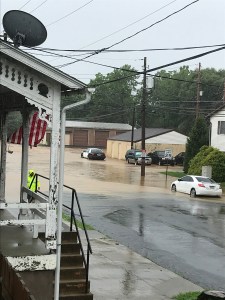
People have been debating how to pronounce Hurricane “Isaias,” an hispanic name based on Isaiah.  Pennsylvania, which has few distinguishing features, is generally well enough inland not to have too much hurricane damage.  Isaias, however you pronounce it, dumped over five inches of rain in the small town in which we live.  Multiple roof leaks sprang up in our house and a small part of the ceiling in one room came down.  Not exactly wrath of God level treatment, but unwelcome nevertheless.  The real problem was the short amount of time in which the rain fell.  Averaging about an inch per hour, the water simply overwhelmed the devices put in place to keep it outside.  Being of my particular disposition I can’t help but think of the prophet Isaiah.

Not a classical prophet of doom per se, Isaiah is the most quoted prophet in the New Testament.  He is remembered for “predictions” and soaring rhetoric that promises deliverance.  He’s also a prophet known for his woe declarations, as reflected in the Hebrew Bible.  This storm, I suspect, has delivered more of the woe than of the hope.  Streets were flooded as the local creek burst its banks.  Our own street was closed as I called our roofer who, I’m sure, had more than wanted popularity in one day.  Being a homeowner, I quickly discovered, is largely a matter of trying to keep the water out.  Our sump pump was working overtime and still the rain came.

My book Weathering the Psalms was intended to be the first in a series of volumes exploring meteorotheology in several books of the Bible.  The weather, you see, is a popular topic of discussion since in ancient times their meteorology was theology.  After the Psalms my exploration was intended to move toward the prophets.  There are dramatic events where these saintly folk were able to bring down rain, or withhold it.  Israel never experienced hurricanes because they don’t form in the Mediterranean.  Meteorological terms, however, shift over time just as by the time Isaias reached us it was a tropical storm.  The wind buffeted us a bit, but it was mainly a rain event.  I thought at first that I would look at weather terminology in Isaiah and see what I could find there.  I don’t know what my conclusions would have been since I was cut off before I could get that far.  Like those who cast their bread upon the waters, after many days it came back, ironically in the form of Isaias.


Bonded

It happened this way.  When my daughter was young she was interested in dinosaurs.  Most kids are.  In fact, my wife and I went to a public lecture by a paleontologist in Edinburgh where he pointed out that the real experts on the subject in the audience were generally twelve or younger.  I took an interest in what my daughter found fascinating, and you can’t study dinosaurs without knowing a bit of geology.  Now, the professor’s lifestyle is a thing of wonder.  You may have a heavy teaching and publication load, but the freedom to spend your unstructured summer time pure learning was (still is) a huge draw.  I began studying geology.  I joined the Wisconsin Geological Society.  I was even made an officer.  My, a biblical studies professor.

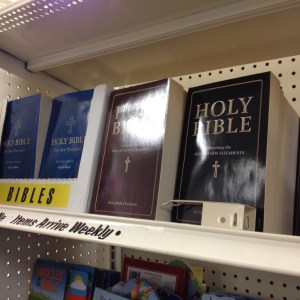
At one point I bought a jeweler’s loupe.  Many geologists have them.  To get down to the level of the crystalline structure of most rocks you’ll need something more powerful, but for fieldwork (and I’ve got a garage full of rocks to prove it) your average loupe will do.  When Nashotah House decided I should no longer be a professor (and the rest of academe acquiesced) I seriously considered going back to school to study geology.  Time was against me, however.  I had to find a job with a family needing support, and so here I am in publishing instead.  And not only that, but I’m a Bibles editor.  Most people have no idea what that means.  Some days even I don’t.  But one thing I have learned is that you’ve got to know your leather.

This is a bit uncomfortable to me as a vegan, but I have learned that many people want their Bibles wrapped up in animal sacrifice.  I’ve also learned there are many different kinds of leather.  The typical leather Bible is pigskin.  Yes, that’s right.  In the trade you can call a Bible with any animal hide leather.  Bonded leather means that it’s pieces glued together.  The most expensive Good Books are “genuine leather.”  Cut from whole cloth, as it were.  I keep my jeweler’s loupe in my work desk.  Sometimes I need to look at something closely, off screen.  My loupe came in a leather case.  One of the sides peeled off during our move and I could see clearly what bonded leather means.  In fact, the “nded” part of “bonded” is clearly visible like a secret Bible code on the underlayer of my case.  Nothing, it seems, is ever wasted.


Who Watches You

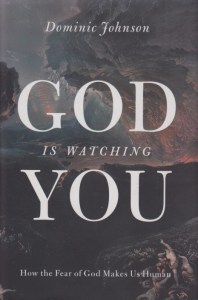
When my wife saw Dominic Johnson’s God Is Watching You on the top of my pile she said “Are you sure you want to be reading that?”  Her question was justified, of course.  I was raised in a religion where the punishment of God was very much on the surface.  Heaven’s carrot was nothing next to Hell’s stick.  I still suffer from that religious outlook in innumerable ways.  Johnson’s subtitle, however, is How the Fear of God Makes Us Human.  Johnson, who holds doctorates in evolutionary biology and political science, is well placed to try to untangle what those of us with just one doctorate in religious studies deal with constantly: what is religion?  The main idea of the book is deceptively simple—we have evolved the way we have because we feared (and continue to fear) supernatural punishment.

Johnson establishes that sociological and anthropological studies have shown that humans respond much more readily to punishment than reward.  Reward is like icing—you can eat a cake without it and still enjoy it—while punishment is like the threat of all food being removed.  You see the difference?  One has a far greater motivating factor than the other.  This idea spins out into many aspects of religion, and even perhaps hints at the origins of religion itself.  I have often written on this blog that animals exhibit religious behavior.  We don’t speak their language so we can’t know for sure, but some of what various animals do seems very much like what we do in church, synagogue, mosque, or gurdwara.  Accusations of anthropomorphism fall flat, to me.  We evolved, did we not?  Then why do we resist pointing out in animals where that behavior sticks out like a sore opposable thumb?

Human societies worldwide share the fear of divine punishment.  Interestingly, even a significant portion of atheists admit fearing it too.  Often those who know me ask about my preoccupation with fear.  It sometimes shows in my writing about horror, but I think Johnson may well have the key in his pocket.  Religion is about fear.  It’s not just about fear, but it clearly is about avoiding divine (however defined) wrath.  Lose a job or two broadly defined as religious and disagree with me.  Am I sure that I should be reading this book?  Now that I’ve finished it I can definitively say “yes.”  While I don’t agree with everything in it Johnson has clearly hit on something that all people who study religion should know.


Virtual Bible Study

Like just about everybody else, I spend my days online during the pandemic.  Well, actually, I spent my days online before that since I’m a remote worker.  Even before that, when spending a considerable part of each day commuting to and from New York City, once I got there I’d sit in a cubicle and work online all day anyway.  To borrow a tagline, the truth is out there.  Somewhere on the internet, I think.  Probably on the deep web, but I understand that’s a scary place.  I’m not sure why it is that I started receiving email ads for something called Virtual Bible Study.  I suppose I spend enough time, and my computer eats enough cookies on Bible Gateway that the Virtual Bible Study people think I’m the typical customer.  

Having led many Bible studies in my life, and having taught biblical studies professionally, I’m aware that you can never learn it all.  Indeed, biblical study is the original never-ending story.  Stay with it long enough and you’ll earn plenty of enemies.  Recently my mother was telling me that she’s doing a Bible Study where you follow a schedule and read the “liner notes” that come with a particular curriculum.  She mentioned to me that she was having trouble with Deuteronomy 28.  It’s a chapter with which I’m quite familiar.  I remember reading it as a young person and being terror-struck by it (those who wonder what horror might have to do with the Good Book ought to read it.  Go ahead, I’ll wait.  You can find it on Bible Gateway.).  This is one of those places where God spells out the blessings (somewhat limited) for obedience and the curses (very many) for failure.  The list is long and terrible.  I’m not a chapter-and-verse citer, but from my very first read-through of the Bible I could tell you what was in Deuteronomy 28.  It was burned into my memory.

I do have to wonder about the efficacy of online Bible Study.  I sure do appreciate not having to look everything up in a print concordance any more.  That was quite a time-consuming activity and you needed to be very familiar with the particular version you were using to make it work.  I know I grouse a bit about technology on this blog, but given my vocation, and avocation, I sure like having Google on my side when I need to look up a verse that I can only partially recall.  I do have to wonder, however, since the truth is out there, whether anybody’s found a good way to comfort their elders who get stuck on the curses that essentially wrap up the covenant in good old Deuteronomy.

Virtually the Bible


Like an Egyptian

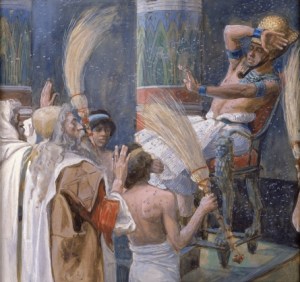
“And Pharaoh’s servants said unto him, How long shall this man be a snare unto us? let the men go, that they may serve the Lord their God: knowest thou not yet that Egypt is destroyed?”  The words are from the Good Book.  Specifically Exodus 10.7.  They’ve been on my mind as the coronavirus is beginning to yield in all developed nations but our own.  Let me set the scene: the Israelites have become slaves in Egypt.  Moses was sent to set them free, but a Trumpian Pharaoh stood in the way.  Plague after plague was sent, but the president, er, I mean Pharaoh, refused to acknowledge what the evidence indicated.  Moses would appear before the senate and declare the coming disaster.  In the mythical world of the Bible, though, the senate actually saw reason.

“Knows thou not yet that Egypt is destroyed?”  Instead of addressing the Covid-19 crisis the White House has decided to turn a blind eye.  Nearly one-fourth of the worldwide cases of the disease are recorded in the United States.  In the past week several record-setting days of new case numbers were set even as the administration was insisting that schools be opened without any plans, or even ideas about how to help.  “Have them make bricks without straw,” you could almost hear echoing around the Oval Office.  Ah, indeed, this is the most biblical of administrations.  Our economy has been tanked for years to come.  The environment has been degraded to the point of disaster.  And yet Moses is ignored.  The real plague was the Pharaoh.

“This is the finger of science!”

Exodus is a story of liberation.  What’s more, according to the Good Book, God himself wanted Israel to be set free.  The Pharaoh, it seems, was not personally afflicted with the plagues until the darkness fell.  Prior to that, if it didn’t affect him personally he simply didn’t care.  Too many self-aggrandizing monuments to be built to his own name.  Ancient Egypt was like that.  Meanwhile plagues brought the mightiest nation of the time to its knees.  Beyond that.  It brought them prone.  Most of us, I expect, are ready to get on with life.  We’ve been self-isolating for over three months and yet the number of cases continues to increase.  We could use a word or two of guidance from a sympathetic leader.  Instead we’re entering hurricane season.  I can’t speak for anyone else, but I’ve got my Bible all ready.  And right now it’s open to Exodus.  


Something Burning?

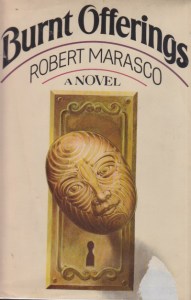
It’s all Amazon’s fault, really.  Several years ago—I can’t recall how many—they were running a horror movie DVD sale (that’s how long ago!).  I hadn’t yet watched enough movies to write a book on the subject, and most of the movies on offer I hadn’t heard of.  One of them was called Burnt Offerings.  Well, burnt offerings, by definition, come from religious settings.  The DVD was very inexpensive, and so, well.  The movie wasn’t that scary, but it was moody, which is often what I’m really after.  I did wonder, however, at the title.  In one sense it fit the plot, but in other ways it was almost as if something were missing.  A vital clue.  For one thing, the movie was completely secular, nothing I could include in Holy Horror.  

I’ve watched the movie a few times over the years.  There’s something compelling about the story, even though missing something.  A little research revealed that the movie was based on a novel by the same title by Robert Marasco.  Now, when I learn a novel was written in the 1970s, my thoughts turn to used bookstores.  Although the days of getting books there for less than a dollar seems long gone, the fun of browsing makes up for it. I don’t know how many years I looked for it in shops throughout the tri-state area.  Now with the virus, I finally broke down and ordered it from Bookfinder.

My main reason for wanting to read the novel was to find what I’d been missing.  The movie, it turns out, follows the original story very closely, for the most part.  The ending is different, however, and that makes all the difference.  (If you haven’t seen the movie or read the book, there will be spoilers here.)  The Rolfe family decides to move to an estate for the summer to get away from the noise of New York City.  There’s something odd in the house they’re renting, which they sensed even before moving in.  Marian Rolfe, the mother of the family, clearly becomes possessed by the house.  In a diabolical sense.  As her family dies off the house renews itself.  In a scene not in the movie, the regular caretaker stops in for a visit and tells Marian that she has to give her all to keep the house.  Finally, resigned to the death of her loved ones, she asks to have any remaining doubt burned out of her.  Her family will be the burnt offering.  So at last, it makes sense.  And yes, there’s a more religious theme in the book than there is in the movie.


Layers of Brick

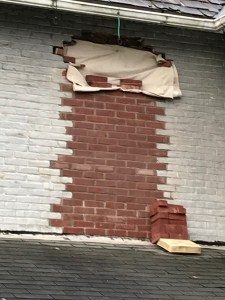
If, like me, you can’t see a neighbor’s brickwork without thinking of “A Cask of Amontillado,” then I need not explain why I watch horror films.  I know that as of late some literary scholars have challenged the idea that Edgar Allan Poe wrote horror.  There is now, and always has been, a bias against the genre.  In fact, many would point out that Rod Serling’s Twilight Zone wasn’t really horror, no matter how creepy some of the episodes were.  Some would cast Ray Bradbury into that lot as well, and others would not.  I spend a lot of time pondering this because those of us who enjoy some of what’s called horror are often cast as misfits.  And misfits have a lot in common with monsters.

The connection with religion is a palpable, yet intangible one.  It does seem that religion has its origins in fear and as it branched out it came to have different emphases.  Jesus, for example, apparently stressed love, at least according to the gospel of John.  That religion of love came, eventually, back around to fear.  Calvinism, especially, is suffused with it.  There’s a reason that it is the religion expressed in particularly effective horror.  Apparently they meet similar needs, but psychology is not an exact science, and our tastes in it differ.  Even our interpretations do so.  As the bricklayer puts down row after row of masonry, the thoughts get walled up in days where work prevents serious consideration of the deeper questions.

It’s been years since I’ve read “A Cask of Amontillado.”  The story has stayed with me, however, whether it’s horror or not.  Stories about imprisonment are like that.  The other day a police car stopped outside our house.  We live in a working-class, but descent neighborhood.  From the bits and pieces glimpses out the window revealed, there was a problem with a car that had been parked on the street for quite a while, and that didn’t belong to any of the local residents.  The natural response to seeing that car just outside was fear.  We fear criminals and we fear the police.  We fear what Covid-19 is doing to us, even to those of us who’ve managed not to contract it.  Traditional religion would tell us punishment comes from the Almighty.  These things are all related.  And across the way the bricklayer keeps up his work, row after row.


Independence Day Wishing

It’s Independence Day and what we most need independence from is our own government.  History is full of ironies.  Federal holidays falling on a Saturday, for instance.  In any case, here we are on the Fourth of July and still stuck under a repressive government that a small portion of people like.  Republican groups supporting Biden are starting to arise, but we can only dream on Independence Day.  Many of us would like to be independent of the coronavirus, and not a few people are acting like we are.  Cases are spiking, so the rest of us are staying indoors.  Fireworks are okay, but I have trouble staying awake until dark these days and more often than not they just keep me awake as I’m starting to doze.

Maybe for Independence Day I’ll take leave of reality.  Maybe I’ll imagine a government that isn’t so utterly corrupt that some people might have some faith in it.  Maybe I’ll dream that black lives matter and that our leaders would believe it.  Maybe I’ll think what it would have been like if caring officials addressed the Covid-19 crisis directly instead of brushing it off, so that like all well-run nations cases would be going down here instead of back up.  There’s so many possibilities and the one thing they all have in common is that they point to independence from the Trump Administration, if that’s what it can be called.  Maybe it’s time to light a sparkler of hope.

Independence Day can be a day of looking forward instead of looking back.  If we can look ahead we might see a country where anyone will be allowed to exist and not be condemned by “Christianity.”  We can come to see that privileging any one “class” or “race” or “sexual orientation” is a form of bigotry from which we can and should be independent.  We can try to think what it must be like to experience life from somebody else’s skin.  We can try to understand instead of standing ready to condemn that which is “different.”  Fact is, everyone is different from everyone else, it’s only a matter of degree.  And difference can unite rather than divide.  The whole idea behind uniting different states was that those who were different could support one another and figure out how to make room for everyone to fit.  It won’t be easy to do, but we might use today to envision a country where we can work together, and figure out that leaders who bring people together are the only hope we have for the future.


WWW

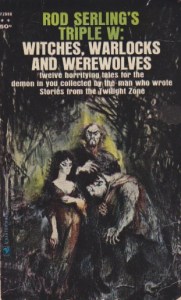
With a few exceptions I think we’ve lived beyond the time when a single name could spawn an industry.  I used to watch re-runs (itself an arcane concept) of The Twilight Zone when I was a kid.  These weird stories drew me in, and, it seems clear, not only me.  Rod Serling’s brainchild led to an industry and “twilight zone” became a household concept.  Lots of little books were written bearing Serling’s name in some way.  One of those paperbacks was Rod Serling’s Triple W: Witches, Warlocks and Werewolves.  I can’t remember where I picked it up, but it was a used book and it had Rod Serling’s name right there on the cover.  Going over my books to find unread gems, I picked up Triple W and sat down to find out what it was like.

None of the stories are by Serling himself.  He’s listed as the editor and he wrote a very nice little introduction.  The tales here reflect, as the subtitle indicates, witches, warlocks, and werewolves.  Some are old stories and some are fairly recent for a book published early in the 1960s.  Descriptive writing does tend to evoke a scene, but I’m often amazed at just how dated it can make a story seem.  What struck writers from the 1940s and ’50s as huge sums of money are likely less than we pay for our monthly internet bill.  Men all try to act tough and the ladies prepare dinner.  Stereotypes.  That’s somehow appropriate for this collection since most of the stories have to do with witches.  Serling was well aware of the tragedies of history, and these tales are told mostly for fun.  The scariest characters are the witch hunters (generally men).

Serling’s famed conscience shows in the choice of the final piece.  Not a story, not even fiction, Charles Mackay’s “Witch Trials and the Law” is an essay about the horrors of witch hunting.  It’s a rather sober piece with which to end a book of speculative fiction, but then Serling was always known for his impatience with injustice.  Also included is Nathaniel Hawthorne’s “Young Goodman Brown,” which I’ve been wanting to read for some time.  Given his shame at the Salem trials and his own ancestor’s part in them, it was mildly surprising that Hawthorne’s story seems to presuppose the reality of witches.  Of course, it condemns the respectable folk who, in reality, all participate in the ills of the society in which they find themselves.  In all, this collection made me think.  Not bad for an impulse purchase on what was probably a rainy afternoon. 


Just the Beginning

It occurs to me that my post on Sunday may have been a touch cryptic.  (I can be naughty at times.)  Horror Homeroom was good enough to publish a piece I’d written about the movie Midsommar, a film that got its hooks into me earlier this year.  Here’s the link in case you’d like to read it (it’s free): http://www.horrorhomeroom.com/midsommar-and-cross-quarter-day-horror/.  It’s not an article using the Bible and horror as in yesterday’s post, but rather it is an exploration of the broader relationship between horror and religion.  The origin of religion has long been a fascination, and the more I look into the connection with what makes us afraid, the more I find in common.  But why midsummer when summer’s only just beginning?

Ancient peoples in temperate zones, according to the records they left behind, carefully observed the change of seasons.  Without a tilted, spinning globe as a model the science of the time (which was likely their religion) suggested that the heavenly bodies were migratory.  If you use raw observation that’s what seems to be the case.  Now that I sit in the same office every day with a south and a west window, it becomes very clear how the sun shifts over the course of the year.  In the winter it seems to be on a journey far to the south.  Religions of such science would want to know, of course, when it would start coming back.  The years were divided into segments—we still recognize four of them in our seasons although, in truth, they are merely gradual changes that take place in the weather as the earth’s tilt moves our hemisphere toward or away from the sun.

Midsummer was a northern European festival to celebrate the longest day.  Whether this is the start of summer or the middle of summer is merely a matter of interpretation.  The film Midsommar plays on the disorienting long span of daylight in northern Sweden.  Without the dark to guide us, sleep and the regular rhythms of daily life can become difficult.  When the people believe the old religion, well, let your imagination run wild.  Horror films often lurk in these transitional times of the year.  We tend to associate them with Halloween, but there’s enough to be afraid of right now.  Not all horror has religious components, of course.  Nevertheless it has been there from the beginning, from when van Helsing pulled out a crucifix to frighten off Dracula.  And it continues, in perhaps more sophisticated ways, even in the broad daylight.


Bible Horror

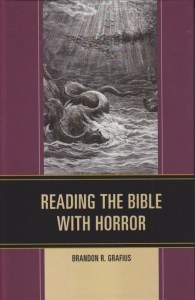
The combination may seem odd, but it is definitely a valid one.  The Bible and horror, I mean.  My colleague in this venture, Brandon R. Grafius, has published the first book in the Horror and Scripture series, Reading the Bible with Horror.  This is a fascinating little volume that explores the productive use of horror films when it comes to interpreting the Bible.  The Bible isn’t all horror, of course, but a good deal of it is.  That’s one of the keys of biblical interpretation—no one method covers it all.  At least when I was teaching I used eclectic methods both because some methods work better than others in some places and because no one method is the correct one.  Using horror to interpret the Good Book is one of the newest methods out there.

The methodology involves looking at horror films (mostly) and finding biblical parallels.  Both the Bible and the movies interpret one another.  This can be a kind of reception history—the idea that to understand Scripture we must look at how it has been “received.”  The way that people read Holy Writ after it was written is as important as the way biblical specialists read it.  We all know what literalism is, and biblical scholars are well aware of its shortcomings as a method.  There are tons of other methods that seek to show the relevance of the Good Book, and one of them is to see how horror makes it so.  To get to this point the reader must get beyond our social bias about horror as a degraded, evil genre.  Some of it is quite bad, of course, but much of it has redeeming value.  Redeeming value so obvious that it can be used to interpret the Bible.

Grafius studies only limited examples here, for instance, the book of Job with its human suffering and superhuman Leviathan.  He also looks at hauntings and biblical ghosts, as well as haunted locations.  His chapter on haunted houses made me stop and think quite a bit.  He concludes with what will be the most challenging concept for many—the idea that God can be monstrous in the Bible.  He clearly can.  Apart from theodicy, one of the major reasons critics attack Christianity is the character of God as portrayed in the Bible.  Grafius isn’t attacking Christianity but rather he’s trying to show how a most unlikely source can shed genuine light onto it.  Reading the Bible with Horror is an insightful step in that direction, even if it’s a step into a rather haunted house.


Too Much Light?

The summer solstice comes whether we want it to or not.  Today is the longest day in the northern hemisphere although, as I write this the sun has not yet risen.  It was a sleepless night, making this day seem even longer than it already is.  Over on Horror Homeroom, where they understand sleepless nights, my piece on the movie Midsommar will appear.  I won’t say here what I say there, or you might not go and read it.  I will say that for a horror film Midsommar boldly sets itself in a sun-bathed atmosphere, making it all the more unsettling.  To see more you’ll need to visit the Homeroom.

There are implications for the longest day.  One of the most obvious is that from here on out days will be getting shorter.  That’s the thing about anticipation—we crave the light when it’s in such short supply in December and January.  This year of Covid, the spring blended into a long stretch of social distancing and isolation, even as the days were growing longer and the weather warmer.  It was like some spokes were missing from the wheel of the year.  Now that summer’s here many people are acting as if the need for caution is gone.  Midsommar may help with that, since it shows that the daylight sometimes shows us what we don’t really wish to see.

Ancient peoples kept an eye on the seasonal changes long before they learned to write.  Etched into the landscape markers like Stonehenge and Avebury and countless others were oriented toward celestial points on the solstices.  Equinoxes were also observed, as well as the half-way points between.  This altering of the earth to commemorate the progressing of the year took great effort, so we must assume it had great importance.  You don’t move boulders unless you feel strongly compelled to do so.  Such compulsion strikes us all as religious.

So it’s the longest day of the year.  What will we do with it?  When we look back at it, will we see what we wished we might have done with all that light on our side?  Will we treat it just like any other day?  The beauty of holidays (of which capitalism recognizes far too few) is that they teach us to stop and reflect for a few moments on the messages our planet sends us.  Our longest day is also a message.  What we do with that information is up to us.