Unusual Autopsy

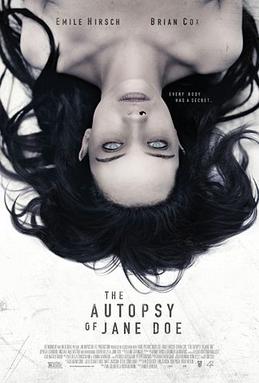
I avoided The Autopsy of Jane Doe for some time because, well, autopsy movies just aren’t my thing.  Besides, I thought it might be a “true crime” sort of movie and those aren’t my favs either.  That didn’t stop the recommendations, so I gave in.  I’m glad I did.  It’s a cut above a lot of what’s out there, and although it does rely on a few more jump-scares than I like, it isn’t all about them.  And it turns out that it’s Holy Sequel material.  Here’s how the story goes: a father and son mortician team, who have the morgue in their basement, specialize in determining cause of death for the local sheriff.  When four bodies are found in one house and none of it makes sense, the sheriff brings the most suspicious body, Jane Doe, to the morticians for their assessment.  Externally the body has no marks, so what killed her?

The majority of the movie is the attempt to solve this mystery.  The father and son find impossible things—evidence that the woman had been tortured, but there were markings on internal organs without any damage to the skin.  They soon determine this is bad juju and when lights begin shattering and corpses get up and walk around they know they were right.  They’re trapped, however, in their basement.  It’s clear that this Jane Doe isn’t quite through with them.  I’ll try not to spoil the ending here, but I did mention that the Bible comes into it.  How so?  Well, it turns out that one of the impossible things in the body is a charm that has Leviticus 20.27 written on it (the passage about not allowing witches to live).  And although it invokes Salem, it does so in a way that suggests the witch hunters were to blame.

This movie was actually out before Holy Horror was finished, but as I point out in that book, there is no website or repository listing horror films that use the Bible.  To write a book like that, you have to do a lot of watching.  I love watching movies, but it takes both time and money, items in constant short supply in my life.  When I do watch, I try to make connections.  It would also be interesting to write a book on how Salem is portrayed in horror movies.  What with the work-a-day world in which I live, I’m not sure how many more books I can crank out.  Especially when they don’t sell.  The important thing is not to let the title of a movie put you off, for autopsies can reveal much.


Dark Smile

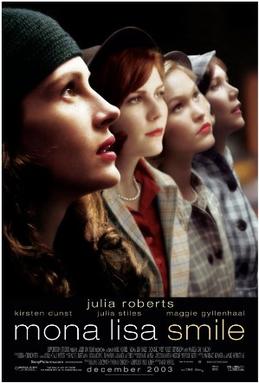
Romance.  It’s not the same thing as Romanticism, but it’s often part of drama.  It can, and often does, feature in horror.  Tender feelings toward someone we really love seem to be a human universal, even if social structures don’t always support such feelings.  Maybe I’m trying to make excuses for why I watched Mona Lisa Smile, but there is an underlying reason.  More than one expert considers it an example of dark academia.  I was curious, and honestly, it’s easier to get my wife to watch dark academia than it is horror (for that I’m on my own).  This was a film I’d heard about many times, but hadn’t watched any trailers for, so I wondered what it was all about.  In short, Wellesley.  One of the seven sisters.  But more than that—women struggling for equality in the 1950s.

A fictional Katherine Ann Watson takes up a post teaching art history at Wellesley, back in the day when a doctorate wasn’t required.  In order to demonstrate her expertise to her very well prepared students (I never, in nearly 20 years teaching, had students show that level of eagerness for any subject) she introduces them to modern art.  Traditional Wellesley isn’t prepared for that.  Moreover, she encourages them to develop careers of their own in a period when the MRS degree was still a main reason for women to attend college.  Watson’s own life isn’t without romance; a boyfriend back home in California and another professor at Wellesley both vie for her affections.  Some powerful students, however, make her life difficult and despite her popularity as a teacher, the administration allows her to remain, but with severely clipped wings.  She decides to fly instead.

Amid all the social commentary, a darkness remains.  A large part of it is patriarchy, but academic politics—driven by money—is the main culprit.  As Watson is essentially forced out, her students see her off with a display of camaraderie, making this, in some ways, quite similar to Dead Poets Society.  There were a few triggers for me.  Years ago I was indeed called into the Dean’s office and handed a letter to read.  While not nearly as dramatic as either Dead Poets Society or Mona Lisa Smile, I had students demonstrate their support for me as I was forced out.  Katherine Ann Watson seems to have had better prospects than John Keating, but both movies remind us that academic politics are dark indeed.  Even if it’s couched in the genre of romance.


Special Delivery

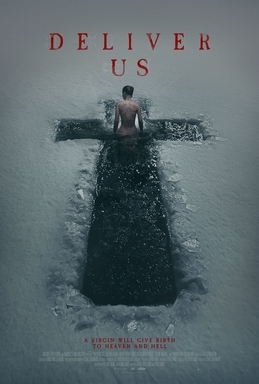
Deliver Us is a horror movie intentionally built around religion.  It hasn’t been discussed much on the sites I frequent, but I suspect that it should be more.  Yes, it gets aspects of religion wrong, but then most religious horror does.  And it leaves a lot unexplained.   Again, most religious horror also does.  The cinematography is bleak and beautiful, evoking a winter chill.  The story is built around a made up prophecy, but do I really need to say it a third time?  Fr. Fox is a Catholic priest in Russia and a former exorcist.  Like Fr. Karras, he doesn’t believe in demons, but his bishop really wants him to go to a convent to check out a possible genuine miracle.  Fr. Fox is about to become Mr. so he can marry his pregnant girlfriend.  Since she has to go to Estonia for a while, she encourages him to do this one last thing for the church.

Meanwhile, signs are occurring that the end times are arriving.  In the convent a secret society called Vox Dei is harvesting prophecies from people’s backs.  What sways Fox to go is that a renowned cuneiformist, Cardinal Russo, is there.  Fox wrote his dissertation on “alphabetic cuneiform”—that’d be Ugaritic, folks.  Not explaining where they got the human-skin scrolls, Russo needs Fox’s help in figuring out the language (it turns out to be cuneiform Zoroastrian).  The miracle is a weeping Madonna statue, but there’s also an immaculately pregnant nun.  She has twins in her, one the Messiah and the other the Antichrist.  Fox doesn’t believe any of this but when he learns that the Cardinal is going to kill the babies to prevent the end of the world, Fox convinces him to give up the wicked plan and they escape with the nun.

This is enough to give you a flavor of the movie.  I won’t give up the resolution but I will say it ends up revolving around the end of the world.  In general this is a pretty intelligent movie.  It borrows quite a lot from other films, including The Omen and The Shining, but it is fun to watch (if you don’t mind a bit of gore).  The tension mounts as Vox Dei tries to find the escaped priest, Cardinal, and nun and there are some legitimately scary scenes.  It was written and directed by Lee Roy Kunz, who also plays Fox.  I do think this deserves more in-depth consideration and had it been out in time, and had I known of it, I would’ve included it in Holy Horror.


Indigenous Gods

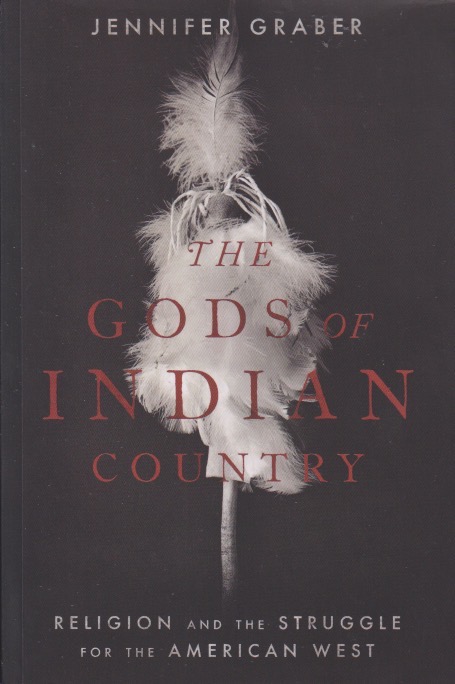
Engulfed by capitalism, it is too easy to ignore the indigenous population of this country.  I grew up thinking, in some way, that American Indians were extinct (this was small town America, after all).  Then we visited a place—in upstate New York, I think, but the recollection’s hazy—where there were real Indians.  This was before exoticism was a bad word, and I thought them quite exotic.  Maybe it was the way I was raised, but I’ve never thought of myself as better than anybody else.  Certainly not on the basis of race or gender, or even personal worth.  In any case, there were still Indians.  I’ve always been an admirer of their culture.  Jennifer Graber’s The Gods of Indian Country is an informative monograph on, as the subtitle says, Religion and the Struggle for the American West.

My interest in American history is relatively recent.  Growing up, I always found European history of greater interest, and then, for many years, the ancient history of the states along the eastern coast of the Mediterranean.  It was the antiquity of it all.  History feels safer when it’s at a great distance.  American history is not old.  When hearing that some of the events discussed by Graber took place in the 1910s, I kept thinking, “were we really that naive just over a century ago?”  Or was our nation willfully blind to the plight of the people who lived here before the Europeans arrived?  The narrative has changed.  And if it hasn’t, it must.  How would we like it if, say, aliens landed and assumed the right to take over capitalistic America?  It’s only our arrogance that prevents us from treating Indians better.

Religion, particularly Christianity, fueled many interactions with the Indians, as Graber ably demonstrates.  The assumption was that Indians had to assimilate to capitalistically-fueled Christianity.  Private ownership.  Free trade.  Otherwise the cultures could not share the land.  Treaties were broken because the “Christian” rules of the new overlords demanded it.  Graber also explores some Native American religious practices as well, chiefly among the Kiowa.  Since the book is fairly brief, it doesn’t include any kind of comprehensive coverage of Indian religion, nor, of course, of early American settler religion.  What happened is that religion and politics joined forces to justify stealing what belonged to someone else.  Those who study the history of religion recognize this pattern.  It isn’t a rarity, unfortunately.  Although my interest in American history is recent, it is growing.  What happened in your own backyard determines so much of how we’ve become who we are.


Getting By

There are some books, such as Trina Paulus’s Hope for the Flowers, or Charlie Mackesy’s The Boy,  the Mole, the Fox and the Horse, that are inherently hopeful and that you like to have around.  Especially in the coming four years full of hate-filled rhetoric.  My wife asked for Regina Linke’s The Oxherd Boy: Parables of Love, Compassion, and Community, for Christmas.  Of course, I read it too.  It is yet another to add to this hopeful shelf.  The thing about these three books is that you could easily read them all in an unrushed afternoon.  All three are profoundly hopeful outlooks on life.  I would recommend having them at hand.  The Oxherd Boy is a combination of beautiful artwork with bits of wisdom drawn from Taoism, Buddhism, and Confucianism that can keep you centered in difficult times.

There’s no real storyline here, but rather reflections.  “Eastern wisdom” is kind of a tired trope, but the “religions” of that part of the world can infuse a bit of sanity into many of the facades western religions throw up.  I’m not anti-Christian; I fear our society is.  It has taken one of these facades and claimed the name “Christian” so that it can get its hate on and feel righteous doing so.  There are seldom positive benefits when politics finds religion.  If any.  The Oxherd Boy reminds us to look for the good in simple things.  A life with friends and one in which love is the primary outlook.  I believe Christianity began that way, but it became politicized in under four centuries and politics tend to engender hatred.  A truly Christian state, through and through, has never, ever existed.  And it’s not coming here.

We know hate mongering will take the norm.  In fact, while out driving recently I noticed an increase in rude and angry behavior on the part of not a few drivers.  There was a noticeable uptick in such behavior shortly after Trump’s first election.  In a nation of people that imitate what they see on the media, I suggest staying inside and reading a book.  I would recommend The Oxherd Boy among them.  As long as you’re stocking up, don’t forget Hope for the Flowers and The Boy, the Mole, the Fox and the Horse as well.  Books don’t need to be written by academics to try to make the world a better place.  In fact, sometimes I wonder about the choices I’ve made.  So I’ll pull down the books that give me hope, and reflect.


Vampire or Not?

I’d heard that Martin was a depressing movie but I felt I should watch a Romero film that wasn’t about zombies.  I’d read bits and snatches of what happens, but I didn’t know the storyline in total.  Now that I’ve seen it, I’m still not sure what to make of it.  Martin is a young man who believes himself to be a vampire.  He does drink blood, murdering his victims, but there are no fangs, no “magic stuff” as Martin himself calls it.  It seems pretty clear that he’s mentally unbalanced, but he’s brought into his older cousin’s house in Braddock, Pennsylvania.  Cuda, his cousin, believes him to be a vampire, calling him “Nosferatu.”  He has protected his house with garlic and crucifixes, but Martin demonstrates that such things (magic stuff) doesn’t work.  

Daylight and eating regular food don’t bother him.  His cousin gives him a job at the grocery store he runs, while constantly warning Martin about looking for victims in Braddock.  Shy around women, he only has sex with his victims, after he has drugged them.  (This is a pretty violent movie, and the tone is downbeat throughout.)  Since he has no friends, he calls into a radio talk show to discuss the problems of being a vampire, and people love listening to him.  Meanwhile, Cuda arranges for an exorcism on Martin, which doesn’t work.  There are black-and-white sequences that aren’t really explained—either as fantasies or as past memories for a real vampire.  After his cousin becomes too suspicious, he stakes Martin to death and buries him in his back yard.

There are many unanswered questions about this movie.  If Martin is a vampire just about everything in traditions about them is wrong, apart from needing to drink human blood.  When Martin begins an affair with a troubled housewife, his bloodlust lessens, but he still gets “shaky” and has to find victims.  For those of us who tend to find ambiguity both beguiling and confusing, this is a vexing movie.  It makes you wonder what a vampire really is, and, as with most of Romero’s work, there’s a fair bit of social commentary—intentional or not.  Life itself has its fair share, perhaps more than its fair share, of ambiguity.  The only real certainty that Martin gives is that his victims die and he himself dies in the end.  Is his cousin correct?  Is Martin himself correct?  He may be mentally ill, but society is too.  And the working-class people of Braddock should know who the real vampires are.


Haunted Space

A haunted house film set in space.  That’s what I thought and then read the same words in a published description of what the writer and director were going for.  In that way it was a clear success, but in others it struggles.  The premise is good, if jarring.  Space travel, which is the most scientific of scientific enterprises (there’s a reason the rest of us say, “I’m not a rocket scientist”) collides with the traditional supernatural.  The results are worth pondering.  Event Horizon has become a cult classic, and like many older films, has been more positively reevaluated in recent years.  So the crew of Lewis and Clark is on a rescue mission to the ship Event Horizon, in a decaying orbit around Neptune.  Neptune’s atmosphere provides lightning for this haunted house.  The crew learns that Event Horizon has been through a black hole and has returned sentient.  Its crew has no survivors and it won’t allow Lewis and Clark to either escape or to destroy it.

Those of us who watch horror looking for religion—and even general viewers—can’t help but notice that Event Horizon ended up in Hell and returned.  It plagues the rescue crew with hallucinations of their regrets and failures.  Weir, the scientist who designed Event Horizon, is more or less possessed and stops at nothing to save the ship, which has brought Hell back to this dimension.  Again, it’s a bit jarring, like vampires in space.  (Yes, I know it’s been done.)  There’s even a point where Weir informs one of the crew that the crewman doesn’t believe in Hell.  Heck, they’re in outer space on a ship technology built.  But what if there is a spiritual reality—“dimension,” in the film’s lingo—out there?  What if some traditional religions are right?

The movie’s not apologetic, but it’s offering a reminder that to be human is to be spiritual.  No matter how much science “proves,” there’s always potentially more “outside.”  Hell in Event Horizon is beyond the bounds of the universe.  It is another place but a place it is.  It costs some of the crew their lives, but does it claim their souls?  Event Horizon is one of those movies that the studio ordered severely edited, and for which the edited footage was lost.  Movies ever only show us what directors, producers, and studio execs want us to see.  People crave stories.  And when a movie, like Event Horizon, raises more questions than it answers, viewers want to know—what really does happen in a haunted house in space?


Borrowed Land

The thing about local attractions is that residents seldom have time to visit them.  Weekends are busy with the tasks you can’t accomplish otherwise with a 9-2-5 and being a “homeowner” is more like being owned.  Nevertheless, one Sunday afternoon we ventured to The Museum of Indian Culture, just south of Allentown.  I’d known about it for a few years, but wasn’t sure what to expect.  Occupying the house built by the Bieber family (not the singer, but the local bus-owning company that died during the pandemic) way back, the museum is small, but intimate.    The docents are unstinting with their time.  This is Lenape tribal land and the museum houses some local, and some national, pieces.  It also has a very extensive library.  

Often it’s difficult to feel proud of being of European extraction.  So many crimes were committed during the period of colonialism (and are still being perpetrated) that you just want to apologize over and over when you meet an American Indian.  The thing is, every native American I’ve met has been gracious and kind.  They still feel connected to the land in a way that seems foreign to Europeans.  Colonialists (and present-day capitalists) saw (see) the land as for exploitation.  We are slowly, hopefully, coming to realize that the indigenous way of living with the land is far more sustainable than the conquering attitude that metal smelting and gunpowder gave.  I kept thinking, what would it be like if people we didn’t even know existed showed up and just started taking everything for their own?  And claiming an all-powerful deity had given it to them?  Wouldn’t we fight back, just as the first Americans did?

I was especially hit by the hypocrisy of it all.  The code talkers helped win the Second World War.  As our docent said, at the Carlisle Indian School Indians were severely punished for speaking their native language.  They were being Christianized, of course.  Then, during the War the military realized we have a treasure-trove of languages that nobody else in the world speaks.  Suddenly their languages were an asset to be exploited.  Native Americans proudly served (and serve) in the military.  It is actually their land they’re defending.  We spent an educational hour in the small museum not far from property we “own,” according to a law code of “right behavior” drafted by others.  You might be able to leave places like this small museum, but they don’t leave you.


From God’s Mouth

If book banners would actually read the book they claim to protect, the Bible, they would run across the account of Jehoiakim and Jeremiah.  It’s in Jeremiah 36, if you care to follow along.  Jeremiah was not a popular prophet.  In fact, he was often in trouble for speaking what God told him to say.  He wasn’t wearing a “Make Israel Great Again” cap.  In fact, his message was that the kingdom of Judah had to fall in order to be restored.  So in chapter 36 he dictates his message, straight from God, to Baruch, his secretary.  Baruch reads the words in the temple and this comes to the notice of the royal staff.  They arrange for a private reading and it scares them like a good horror novel.  One of them reads the scroll to the king, Jehoiakim, who cuts off a few columns at a time and burns them in the fire.

My favorite part of this story has always been the coda: “Then took Jeremiah another roll, and gave it to Baruch the scribe, the son of Neriah; who wrote therein from the mouth of Jeremiah all the words of the book which Jehoiakim king of Judah had burned in the fire: and there were added besides unto them many like words.”  Many like words.  So we have book banners around the nation trying to stop children from reading.  The hope is they will become unreading adults because reading expands your mind.  Jehoiakim was a book banner—a book burner, in fact.  But the response from God himself is to write the whole thing over and add many similar words.  

The Bible has been, and still is, fairly constantly abused.  What it seems to be is unread, at least by those who use it to stop other books from being read.  I came to believe, while majoring in religion in a conservative college, that if literalism was truly from God there would be no way to stop it.  I took a route unlike my classmates, who tended to go to the most conservative seminary they could find to have their minds further closed.  I figured that if it was true then testing it by reason couldn’t hurt it.  It’s pretty obvious the way that turned out.  I don’t stand with book banners.  This is Banned Book Week.  Read a banned book.  Stand up to those who do the banning.  And if you need something to convince them that their tactics don’t meet with divine approval, point them to Jeremiah 36.


In Sheep’s Clothing

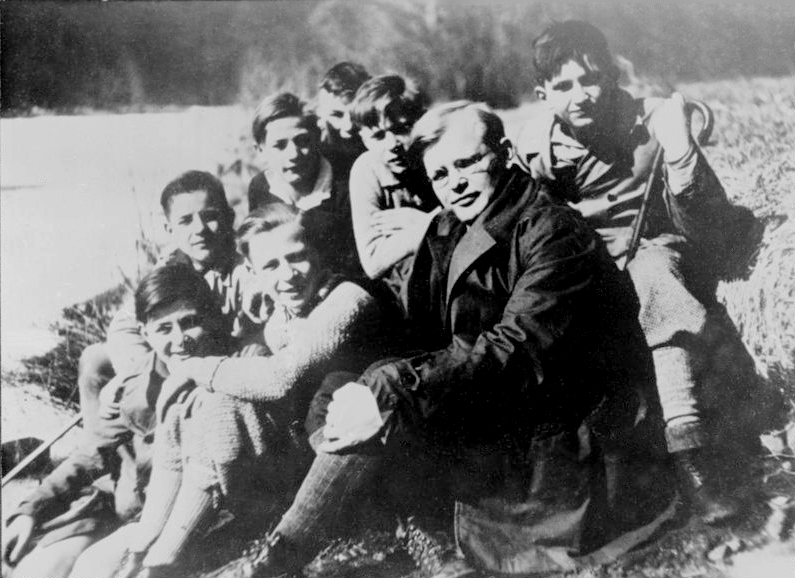
Evangelicals supporting Trump must experience some cognitive dissonance when they read Dietrich Bonhoeffer, one of their heroes.  Bonhoeffer, who could easily have remained in comfort in the United States, went back to his native Germany because he was deeply troubled by the fascist regime of Hitler.  Involved in Operation Valkyrie, the attempt to assassinate Hitler, Bonhoeffer was hanged for his faith.  He wrote, “If I sit next to a madman as he drives a car into a group of innocent bystanders, I can’t, as a Christian, simply wait for the catastrophe, then comfort the wounded and bury the dead. I must try to wrestle the steering wheel out of the hands of the driver.”  How far we have fallen!  Now evangelicals support someone with all the signs of being a madman.  A man who has said he intends to dismantle democracy itself, if elected.  How quickly Bonhoeffer and his important work is trampled underfoot by his own.

Some people express surprise that I still appreciate evangelicals such as C. S. Lewis and Dietrich Bonhoeffer.  They were believers who stood by their convictions, but who used reason to do so.  And yes, Hitler had messianic delusions as well.  A poor carpenter once warned of wolves in sheep’s clothing, but then, what did he know?  And can we compare Trump to Nazism?  Have you read the Project 2025 agenda?  An agenda so explosive that the publisher for the book on it (HarperCollins, with a foreword written by J. D. Vance) has put off publication until after the election.  You don’t want people to know what they’re voting for, now do you?  Wolves dressed up like what?  You can’t pull the wool over our eyes.

Photo by Tanner Yould on Unsplash

I have no problems with Evangelicals.  Faith is exceptionally important in people’s lives.  My concern is the weaponizing of religion by political cynics.  They select issues that they know will rile up religious conservatives and use them to glean votes.  One of the oldest tricks in the book—known by every stage magician who’s ever stood before an audience—is misdirection.  Get people to look over there so you can pull a trick over here.  I spent my formative years reading Bonhoeffer, and his reasoned evangelicalism made a lot of sense to me.  Of course, this was when the biggest threat we faced was characters like Richard Nixon and Ronald Reagan.  Now even they are trampled under the iron claws of what has become “conservatism.”  Even Dick Cheney has said he’ll vote for Harris.  If Hitler hadn’t had Bonhoeffer hanged, modern evangelicals, it seems, would’ve done the job.


Opposites?

Not having the money to subscribe, I limit myself to the daily headlines of Publishers Weekly.  When physically in the office in New York City, it circulated among editors in print form.  I do miss that.  The weekly is a great place to stay informed of what’s going on in the book world.  Interestingly, the headlines—which are often linked together newsletter-style—noted that the annual preview of religion books was on the way.  This was followed by “On the exact opposite side of the publishing spectrum, Orbit has launched its fourth imprint, Run for It, capitalizing on the horror boom.”  So there it was staring me in the face.  Religion and horror are exact opposites.  Now, I can’t expect even experts in publishing to be aware of all the trends, but the religion-horror connection has been alive and growing for a few years now and those of us who publish books in it might dispute the “exact opposite side” designation.

Photo by Thomas Park on Unsplash

Horror and religion are closely related.  Many in the religion camp would want to deny that, but those who know horror know that religion quite often wanders in.  More than that, religion often drives the horror.  They’re not so much exact opposites as they are playmates.  Rather like the Bible depicts God being the chum of Leviathan.  (Who is, after all, a perfectly good monster.)  While my own humble efforts are frequently overlooked, the last four books I’ve written explore different aspects of religion and horror.  This includes my forthcoming Sleepy Hollow book.

Even if you’re not a fan of horror movies, if you pay close attention religion is not the opposite of horror.  We have this mental image of religion as a pure and holy thing in and of itself.  We don’t often stop to think that religions are invented by humans.  Yes, they are often in response to what believers see as divine stimuli, but the way that they are conducted is part of our human ingenuity.  They are considered good because of their emphasis on love and positive virtues.  If you watch enough horror you’ll notice that the menace is often a threat to love.  In other words, horror too emphasizes the value of love.  It’s a perception problem that sees horror as the opposite of religion.  Simplistic categories are often necessary to get through life—that’s why we stereotype.  Those of us who like to stop and think through things can gum up the works.  Even a headline in a magazine we like can lead us to wonder about the deeper implications and the biases they perpetuate.


The Teenth of June

It’s only really when they have no choice.  The Wednesday holiday, that is.  No convenient weekend a day away.  So Juneteenth is actually celebrated on Juneteenth.  I believe in holidays.  I think they’re more than just time off work, and Juneteenth celebrates freedom.  And it reminds us that our African-American siblings aren’t yet truly free.  We still have much to learn and having a holiday to underscore that is important.  Capitalism does a good job of disguising freedom, of course.  Your worth is weighed by how much value you add to the company.  Taking a day off from that is an opportunity to reflect on how daily living could be improved for all.  Juneteenth is a necessary holiday.  We need constant reminding.

I don’t see many African-Americans flying flags on their houses declaring themselves “not woke.”  We prefer to believe we’ve reached perfection already.  Capitalism is great at spreading myths like that.  The basic premise behind it is greed, and people are easily divided into groups because of skin tone.  It’s a dangerous combination.  Somewhere along the way, “justice” came to be a swear word.  Particularly among one political party that has decided power, at any cost, is the sine qua non of human existence.  If that means oppressing others systemically, or if it means invading a neighboring sovereign state because you have nukes with which to threaten the rest of the world, it’s all the same.  Power is far more addictive than any opiate, but we  don’t have any laws preventing those unsuited to holding it from doing so.  Juneteenth uncovers a host of problems still to address. 

Slavery was hard to let go because it cut into profits.  Human beings love wealth more than each other.  Ironically, without others to compare with, wealth means nothing.  If money makes someone happy I have no problem with that, but it has to come with responsibility.  One way to handle it responsibly is to insist that only so much can be had before the surplus goes to insure that all people have enough.  Of course, where Supreme Court justices openly accept bribes we can’t wonder that there are legal loopholes to help the wealthy circumvent their civic duty.  We need constant reminders.  We need holidays like Juneteenth.  We need to give our African-American siblings the same rights and privileges all people should have.  It’s appropriate to celebrate small steps in that direction.  Even if it means giving a Wednesday off of work.


Horror History

Trying to make sense of life has perhaps been my only real vocation.  As I continue to work on horror-themed books, reasonable people ask why I keep doing this.  It’s a question I ask myself.  The other day, while working on one of these projects, I had a realization.  The narrative I’d been playing in my head is that I grew up watching monster movies and then, apart from a few slip-ups, fell off the wagon again after my career malfunction.  That’s largely true but I suddenly remembered that seminary was actually another period of my life when I watched a lot of horror.  Regular readers know that I’m intrigued by the connection between religion and horror, but I’d forgotten how early this started with me.

A friend, nameless here, was a fellow seminarian and a total cinephile.  He and I would watch movies together quite a lot.  As I was recollecting which ones, it suddenly struck me that many of them were horror films.  And it wasn’t just this unnamed friend.  Another anonymous comrade frequently talked me into theatrical horror.  He’d go with his girlfriend (something I lacked at the time) but he liked to chat about the movies with me and often invited me along.  So it was that I was watching horror into the mid-to-late eighties.  I stopped, pretty much cold turkey, when I married.  It seemed that the therapy horror was offering was no longer needed.  Life settled into a happy, if weird existence stretching several years into Nashotah House.  This was the locus of said malfunction.

Losing my only full-time teaching post led directly to watching horror again.  My wife had to take a job out of state.  We crammed ourselves into an apartment after having a four-bedroom house.  Jobs were not coming my way, no matter how low I aimed.  Horror was cheap therapy.  What’s more, it’s remained a hobby ever since.  (Read into that what you will.)  People who know me personally (but who don’t frequent this blog) are often surprised to learn that I watch horror.  I don’t act like someone who does.  At least according to this usual, prejudiced image of the horror fan.  What’s more, the friends who share this fascination are nice people.  I was recently asked to speak about Holy Horror to a senior seminar at Transylvania University (it’s in Kentucky).  The students all seemed to be upstanding, bright young people.  They, however, like horror.  I don’t know their stories, but I’m guessing that they’re probably quite interesting.  They’re just beginning to try to make sense of life.


More Omens

Brushing up on my eschatology, I watched The Omen again.  The original, that is.  One of the underrated aspects of cinema is that people learn their theology from it.  Movies tend to be more memorable than sermons.  It is opined among some that The Omen is responsible for the prevalence of dispensationalism among many Americans.  I’d put a bit of a finer point on it in that The Late Great Planet Earth was being raptured off the shelves all the way through the seventies (I personally bought two copies) and it caused a feedback loop with The Omen.  Many mainstream ministers, without benefit of a Fundamentalist upbringing, were caught unawares, I expect.  Scholars of religion have noted how several aspects of the narrative—the character of “the Antichrist,” the rapture, indeed, the Apocalypse—have been read back into the Bible by credulous believers.

What I found interesting in this viewing is the debt owed to The Exorcist.  Of the two there’s no doubt as to which is the superior film.  The name Damien in The Omen, I read somewhere once upon a time, was taken from Fr. Damien Karras.  During the late seventies and early eighties, unruly boys were routinely called “Damien” by frustrated camp counselors and others.  Apart from this nod, if true, is the fact that the abruptly introduced character Karl/Carl Bugenhagen is an archaeologist exorcist.  (He’s the guy who gives Robert Thorn the knives, if you haven’t seen it for a while.)  The scene shot in Jerusalem (said to be Megiddo) underscores that Fr. Merrin is also being channeled here.  I suspect that the film was getting a bit long in the tooth and some explanatory material on Bugenhagen was left out.

It has also been suggested that the number 666 entered popular culture because of The Omen.  I would temper that a bit with the fact that a lot of people were reading Hal Lindsey’s new apocalypse as well and the two of them got the job done.  There’s no doubt that after the film the evil number took off in a direction that would’ve left John of Patmos scratching his head.  This brings me back to the point that belief is influenced—sometimes constructed—by movies.  The Omen was a huge success at the time, despite the fact that many critics (also not raised Fundie) thought the premise was silly.  Most people aren’t film critics.  The Bible can be pretty impenetrable as well.  Preachers may not be inspiring.  Movies, however, wrap it up neatly and tell you what to believe.  Perhaps it’s some kind of sign.


Squeaky Clean?

A New York Times story, apart from the expected misunderstanding of actual Evangelicals, made me sad.  The article points out that, especially since 2016, “Evangelicals” have taken to soft-core porn, cussing, drinking, and premarital sex.  In other words, Trump has given them license to behave like secular folks while still claiming the name “Evangelical.”  Why should this make me sad?  I lament the loss of place for those who grew up, like me, striving for clean living.  It’s an image—a mirage—rather than a reality, of course.  But still, if conviction holds, you can get pretty close to the ideal.  That vision of life has been occluded by a guy who runs for President because he cares only for himself.  Jesus, on the other hand, was all about caring for others.  Going as far as, if the Gospels are to be believed, sacrificing his own life.

Like fiscal conservatives, such legitimate Evangelicals now have no public voice.  One of only two political parties has become identified with an individual rather than ideals—what used to be called a platform.  I have Republican friends.  I grew up identifying as a Republican.  I also grew up as an Evangelical.  I studiously avoided things like bad language, sex, tobacco, and alcohol.  Even at Evangelical Grove City College I was a bit of an outlier for how seriously I took all these things.  Of course, studying history can be dangerous, particularly for ideologues.  Still, “clean living” had its own virtues.  Those who continue to try to live that way are swimming into a rip tide, it seems.  For some Trump seems like the Second Coming, sans the white horse.  And this, above all, is sad.

There are those who claim, often loudly, that religion is bad.  I agree that when a religion tries to force others to obey its standards it can quickly become evil.  Still, the baby should be left behind when the bathwater’s discarded.  Religion has led to much good in the world.  Hospitals, charities, and yes, “clean living.”  These things, along with retirement homes and affordable apartments for low-earners in their autumn years, are necessary to pick up the slack that the government leaves.  It is cause for sadness that the clean living camp has succumbed to Trump-style hypocrisy.  Heck, religion gave us the word “hypocrisy.”  The standards of classical Evangelicalism are often impossibly high.  If we look at current Evangelical leaders we find many, many skeletons in a house with many closets.  And a wagging finger warning the young, “Do as I say, not as I do.”