Calculating Christians

I know some calculating Christians.  I use “Christian” as religion scholars do—it is the way people identify themselves, not necessarily what they are.  For example, I grew up learning that Christianity was God’s excuse for throwing a bunch of unknowing people into Hell.  Laughter all around!  Then I did something radical.  I started reading the Bible.  Spoiler alert: as you start to get near the end, you learn that Jesus and his early followers (except maybe Paul) promoted the idea that God is love and the only correct response to that is to love other people.  Of course, a religious founder, deity or not, can’t control what his/her followers will do.  Christianity quickly became judgmental.  “I’m going to Heaven and you’re not!”  Laughter all around!  In my life I’ve been the recipient of calculating Christians more than once.

Calculating Christians are those who, like ein U-boat Kapitän, try to figure out the best way to do the most damage to those they don’t like.  They will destroy your career—torpedoes away!—and then get on their knees to thank their vengeful god for sinking a satanic vessel.  And all the lives of Christians onboard are counted as collateral damage.  God’s good at sorting things out.  Laughter all around!  I’ve also known “Christians” who will target a family member when he’s down, and stressed out to the max, only to tell him he’s going to Hell and they’re just fine with it.  Laughter all around!  They do this without ever asking about the two seriously ill people in a family of three, or how you’re doing with that therapy you’ve had to start.  Jesus would do no less than kick a confessing sinner when he’s down.

There’s a reason Christianity is developing a bad name.  With the first compassionate Pope in centuries we find doctrinaire Catholics condemning his compassion.  Among the Fundamentalist camp we find those who would gladly die for the most hate-filled politician ever elected on these shores.  Calculating the end of the world is, after all, a tiring activity.  No matter that you’re wrong (you never consider the possibility and you never, ever try to weigh the facts), you calculate how to blow it up for everybody.  Laughter all around!  The only thing that keeps me sane, I believe, is knowing that many actual Christians out there know that such actions are taking God’s name in vain.  And that, they know, is against the commandments so prominently placed on courthouse lawns.

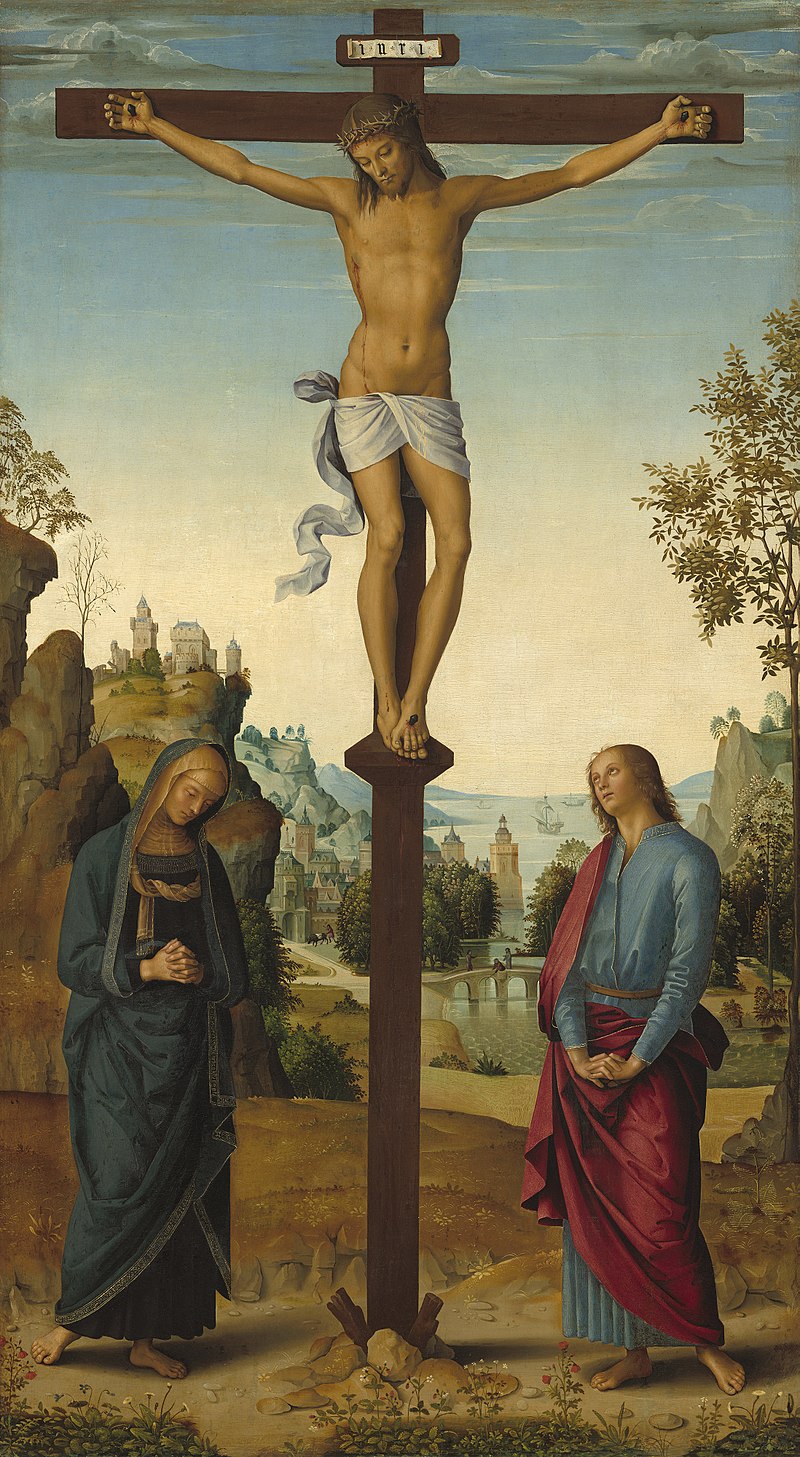
Pietro Perugino, The Crucifixion with the Virgin, Saint John, Saint Jerome, and Saint Mary Magdalene [middle panel], public domain, via Wikimedia Commons

Banned Monk

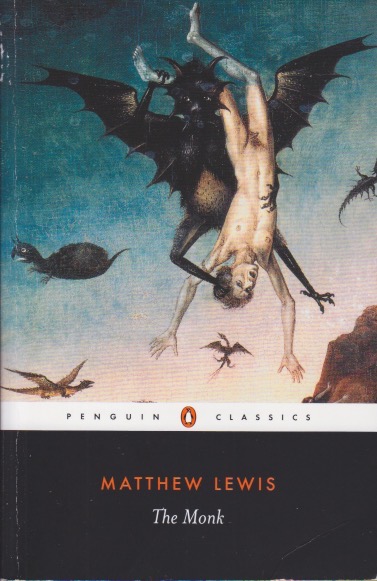
One of the strange things about gothic fiction is that, although often set on the continent, the early practitioners—inventors, if you will—were English.  Three names among them stand out in many treatments of the genre: Horace Walpole, Ann Radcliffe, and Matthew Lewis.  I’ve read the former two and have long supposed I should read the latter’s The Monk.  This 1796 novel made the author famous, but it is long.  And written in the often florid style of the age.  Still, there are plenty of swoons and thunder-plagued nights.  Set in Madrid with a cast of closely related characters, the novel has a twist ending that I did not see coming, which is pretty amazing considering that the book has been out for over two centuries.  (I may have read about the ending before, but had forgotten, if that was the case.)

The novel intertwines two stories that revolve around Antonio, the eponymous monk.  A paragon of righteousness, he heads an abbey in Spain and all are in awe of his piety.  Until sex breaks through his vanity (so we are told; his piety was based on too high a self-regard).  Once seduced, he can no longer maintain his status as chaste, and this sets in motion a tragedy that will leave innocent people dead and lives ruined.  Lewis, it’s famously known, used the novel to critique excesses of the church.  Its power, the novel demonstrates, corrupts.  Still, at the end I was left feeling sorry for Antonio.  He was set up by the Devil and his chances of winning were quite slim from the beginning.

Although PG-13 by today’s standards, the novel scandalized English society when it came out.  The sex scenes were too explicit for the day, especially since they involved the clergy.  The story has quite a leisurely layout, and only after 200 pages (in the edition I read) does the supernatural enter the picture.  Once it does the pace begins to pick up.  The weird thing is, despite its length, this story works.  It’s considered a classic—although often dismissed because gothic literature generally is—it nevertheless delivers.  Antonio is shown to be subject to weakness, and while vain, not inherently evil.  He’s a victim of human vulnerability.  Readers in the late eighteenth century couldn’t see beyond the sex, but there is a tragic human story here.  Castles, abbeys, ghosts, and subterranean passages, murder and torture, it’s gothic through and through.  Although it took most of September to get through it, it feels like I accomplished something worthwhile.  And I finished just in time for Banned Book Week.


Rocks and Philosophs

Porphyry is, apart from being a cool word, a kind of purplish stone that was prized for statue-making in antiquity.  It is also the name a Syrian philosopher gave himself in the third century of the Common Era.  Now, if you read widely about antiquity, as some of us have done, you’ll encounter the name Porphyry from time to time, but those of us who focused on older materials don’t pay him much mind.  I was reading about Porphyry recently, however, and did a little poking around to discover that he’d written a book called, in translation, Against the Christians.  Some historians speculate that Porphyry may have once been a Christian himself, but whether or not that’s true, he developed an antipathy to the sect.  I was curious about what his beef may have been only to discover that this book is lost.

Now lost works in antiquity are the rule rather than the exception.  Literacy may not have been widespread, but those who could write did write, and often prolifically.  Human history was very well documented.  But tonnes of it went missing.  Wars have been part of that history and wars are notorious for destroying written records.  Also, much writing was on perishable materials that, well, perished.  That wasn’t the case with Against the Christians, however.  Porphyry’s work was purposefully destroyed.  By this point Christianity had taken over the Roman Empire.  Rather than accepting the challenge of a philosopher, officials censored and destroyed his work.  Ironically, all that survives are quotes from books of theologians who were trying to refute him.

This made me reflect on the book bans that are currently all the rage among some “Christian” politicians.  Such rearguard actions belie the confidence that imperial religions showcase.  A religion that’s afraid others might see the holes raises many questions, does it not?  It seems to come down to the idea that nothing has changed in two millennia, even though Jesus didn’t have a cellphone—not even one of those old flip-open kind—and much of what we know of nature was still many centuries in the future.  The fact is that we only try to silence those who disagree when we fear them.  Book bans pretend that they can hold the hands of the clock still and that all will remain as it was decades ago.  Learning, however, is a genie let out of the bottle.  Back in Porphyry’s day powerful bishops and emperors ordered his book banned and destroyed.  And we are all the poorer for it.


When Will We?

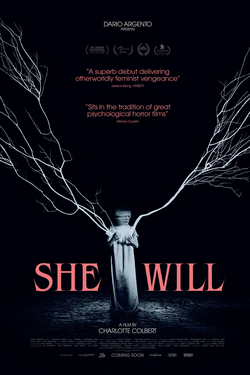
She Will is a creepy art house film from a couple years back.  Sometimes cited as a #MeToo film, it was directed and co-written by Charlotte Colbert and it follows an aging child actress recovering from traumatic surgery.  Veronica Ghent has decided to go to Scotland, to a remote retreat, to heal.  She takes her nurse with her and is chagrined to find that the retreat she booked is being shared by an art therapy retreat.  She insists on private accommodations and is put up in an even more remote cabin.  While there, it’s made abundantly clear that this was a place where witches were burnt and their ashes mingled with the soil and the very earth therefore has healing properties.  Veronica gains an ability to exact revenge from her dreams.

The target for Veronica’s revenge is a famous director who seduced her as a child while working on her first starring role.  Famous and powerful, nobody was able to touch him.  With her new-found abilities Veronica is able to exact justice through supernatural means.  Not only that, but when a local man—the retreat’s handyman—tries to rape her nurse, Veronica is able to prevent that too.  This is a moody, sad film that addresses issues that are all too real for many women in a system designed by and intended to profit men.  Either unaware of, or uncaring about women’s experiences as participants in the system, they dismiss their trauma in a way they wouldn’t for other men.  

Although the film doesn’t have tons of action and doesn’t rely on jump startles, it is an effective gothic horror movie.  The Scottish scenery is bleak and evocative and the message is important.  Horror films directed by women are starting to gain some notice.  Those familiar with Suspiria, however, will note the influence of executive producer Dario Argento.  That film also featured the difficulties women can face, and it also concerns witchcraft.  She Will is more mature in these areas, however.  Female directors—and writers—know the unique struggles women have in a society that refuses to give female leadership a chance.  It’s a simplistic world where men are in charge (because the church says so, or, more brutally, because physical strength can be used to get one’s way) and aren’t willing to consider that half the world sees things in a different way.  Movies like this force us to take the perspective of another.  And for that the world is better.


Cabin Stories

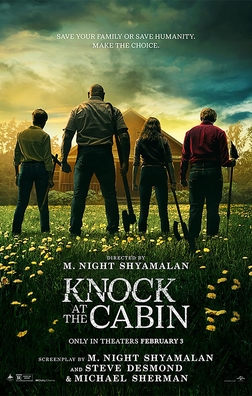
Almost always I come out on the same side of the debate.  The book is better than the movie.  The book allows things to be explained more fully and is the way the story is “supposed to go.”  Maybe it’s because I found the novel open-ended and I like closure, but M. Night Shyamalan’s Knock at the Cabin, in my humble opinion, is better than The Cabin at the End of the World by Paul Tremblay.  Now, the author’s title is better, but Shyamalan’s explanation is clearer.  In short, I think the movie works better.  If you’re not familiar with the story, four apocalypticists, responding to visions they’ve had, break into an isolated cabin occupied by a vacationing family of two daddies and an adopted daughter.  Shyamalan characteristically shifts the cabin’s location to Pennsylvania and, yes, before you think it’s all Philadelphia, there are some very isolated places in my home state.

These weaponized apocalypticists subdue the family and inform them that unless they decide which one will be sacrificed, and then carry out the deed, the world will end the next day.  The adult couple tries to explain rationally how crazy this all is.  How could four people be given this hidden knowledge and be tasked with saving the entire world?  It seems more likely that they’ve targeted a gay couple and are trying to break up their family.  One of the things the movie makes explicit that the book doesn’t is that the intruders are correct.  This is the end of the world.  In order to achieve this, Shyamalan had to rewrite the ending to remove the ambiguity.  For some of us, that really helps.

The movie, in a way that a brief blog post can’t replicate, includes quite a bit of dialogue about religion.  Religion and horror are often bedfellows, and this is one of those movies that relies on religion to fuel the fear.  Interestingly, the cabin invaders aren’t stereotypical conservative Christians.  In fact, they appear to be mostly secular everyday people who have come together around a vision that they all had in common.  In the novel there’s always some question whether this is an elaborate hoax whereas the movie makes it clear that the death of each individual apocalypticist unleashes a plague.  Indeed, they are, as the couple finally realizes, the four horsemen of the apocalypse.  Since I’m still here to tell you about it, the end of the world has obviously been avoided.  This movie is worth seeing, even if the novel has a better title.


America the Religious

One of the truths that doctoral work teaches you is that if you look closely at something, minute differences appear.  Those interested in historical subjects write up syntheses that cover over many of these minute differences until somewhat of a false impression might occur.  Consider Puritan New England.  The image is a familiar one to the American imagination.  Rigid, pious, fearful church-goers predominated.  Stern, often acerbic, ministers were voices of authority.  But in actual fact, maybe a third of those eligible to be so in Puritan New England were church members.  Many lived in remote locations and used folk traditions (what the church would condemn as “witchcraft”) to meet their spiritual needs.  This was DIY religion.  And yet, the overall picture is of an uptight, strict, Calvinistic world.  That’s only part of the story.

Controlling the narrative is a powerful thing.  For example, the religious right has often flouted the idea that America was very religious from the beginning.  The “falling away” from the church is only the result of modernism.  Before that, they claim, pretty much everybody was religious.  This is patently untrue.  But if the narrative is believed, it becomes powerful.  Historians face a dilemma here.  Not every single little detail can be written about anything.  If you read a history of, say, the United States, do you think everything is in those thousand pages?  No, not by a long shot.  Entire books written about a single individual don’t cover everything.  The temptation is to present an approximation that covers the general trends.  Those of us who study religious history have an extra hurdle—what people say they believe and what they actually believe might be quite different.

Demographic studies that show only a third of New Englanders were church members indicates that two-thirds of the story remained untold.  The city on a hill may have been an ideal, but most of the people lived in the valley.  People prefer a happy story, of course.  That’s natural enough.  When we look for facts sometimes the story can grow a little confused.  Shrink that history of the US down to a single state and it’s still unwieldy.  Even a single city.  Choices have to be made and approaches have to be decided.  What really happened?  You can bet your bottom dollar that it was a lot more complex than any history book indicates.  People prefer mythological national narratives to naturalistic ones.  When we buy into simple materialism we often mistake our mythic past for a factual one.


Striving for

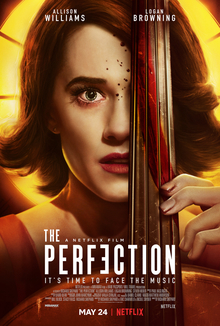
Get Out! was Allison Williams’ first feature film starring role.  Playing the unsuspected villain, she was incredibly believable.  Then I saw M3GAN where her role was again not exactly that of protagonist.  Curious, I decided to watch The Perfection, the horror film between the two in which she also stars.  As always, she starts out looking innocent enough, but this film has so many twists that you might be left feeling a bit dizzy when it’s over.  Williams plays Charlotte, a gifted cellist at the prestigious Bachoff Academy.  Forced to leave by her mother’s stroke, Charlotte became a full-time caregiver, leaving her promising career behind.  She’s superseded by Lizzie, whom she meets in Shanghai as the two are judging a scholarship contest for a new Bachoff student competition.  Lizzie and Charlotte hit it off and travel across China together.  Lizzie, however, falls ill and has to have her hand amputated.

A flashback reveals Charlotte tricked Lizzie into that situation so that the Bachoff star cellist would no longer be useful to the academy.  Another flashback shows why: Anton Bachoff has devised a horrid punishment for making mistakes while playing.  While this is disturbing enough, it takes place in “the chapel”—a room designed with perfect acoustics—and is done to please “God.”  This set-up has been operating for years and Charlotte was rescuing Lizzie from it, albeit in a rather extreme way.  The two cellists team up to bring Anton down.  There are quite a few holes in the plot and rape revenge films are one of the kinds I tend to avoid.  Still, the integration of religion with the horror is intriguing here.  One of the opening establishing shots is a close-up of a crucifix.  Sacrifice is indeed a theme of the film.

Critical opinion was mixed, but mostly positive.  The plot twists get you thinking that Williams is again playing the unexpected villain, and in a way she is.  Still, the real villain is a man who manipulates religious rhetoric (God demands perfection) in order to supply him with access to talented young women.  When they achieve international stardom, they’re not inclined to join #MeToo and lose everything because Anton is not only wealthy, but highly respected in classical music circles.  This is an odd sort of horror thriller that works on some levels but that leaves you feeling violated on another.  It doesn’t play out the religion element in any detail, which would’ve been helpful.  At least it would to a certain kind of viewer, who’s trying to figure out how this all fits together.


Pagan Fear

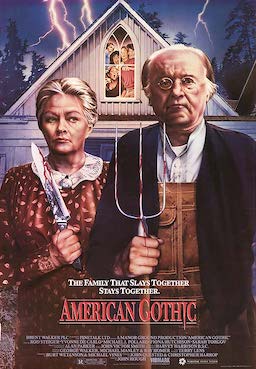
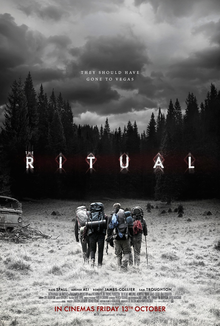
We still fear pagans.  Religion and horror are often tied up together, but when it comes to monsters we trust Catholics and fear pagans.  Of course, when Startefacts recommended The Ritual it was in the context of five pagan horror movies you should see.  I’d seen three of the others, so The Ritual seemed the next logical step.  Four friends are hiking through Sweden to honor the wishes of a fifth friend killed during a robbery.  When one of the them injures his knee, they decide to take a shortcut through the forest where a combination of the Blair Witch Project and Midsommar and Antlers takes place.  After finding a freshly gutted elk in a tree, they take shelter in an abandoned cabin surrounded by runic signs on the trees.  Soon they’re being hunted by a huge creature they can’t see clearly.

The final two are captured by a pagan group that worships one of the Jötnar—the monster that’s been hunting them.  The final boy escapes by getting out of the forest, where the Jötunn can’t go.  The choice of a Germanic monster is a bit different, and the creature design is fascinating.  Jötnar apparently straddle the line between gods and monsters, being a kind of frost giant.  The pagan group sees it as a deity that keeps them safe in return for sacrifices.  Given the number of bodies in the trees, other hikers had decided the shortcut was worth taking in the past.  But still, the pagans are cast as the bad guys.  This is in spite of the fact that the friend whose death started the whole thing was killed in England.

The religious convictions of the English robbers aren’t made clear, but they were raised in a Christian context and are every bit as brutal as the pagans.  In fact, the pagans, although they sacrifice strangers, do try to talk kindly to them (at least if they have the mark of the Jötunn on them).  Not just the pagans are savages.  At least they have a moral reason for what they’re doing, in their own minds.  The criminals are in it only for themselves.  We still fear those of other religions, although they’ve come to their beliefs in a way similar to how we’ve come to ours.  Whether born into it or converted, believers generally come to their conclusions honestly.  In the world of the film, this Jötunn is real.  And, until the end, it protects those who worship it.  So yes, this is a pagan horror film, but it makes the viewer wonder whence the horror really comes.


Baptist to the Future

Setting aside their smartphones and MAGA hats for a moment, the Southern Baptist Convention voted to exclude women pastors this week.  The photos seem to show a rather dour delegate pool that seems ready to head to the apothecary for some leeches to take care of this headache.  The conservative mind is a curious place.  I can understand wanting to slow change down—it is moving at a scary pace, leaving many of us concerned and confused.  Yet the idea that nothing has changed in two millennia isn’t only demonstrably wrong, it’s something that history demonstrates is a relatively recent, and reactionary, idea.  The fundamentalist brand of religion that elevates the Bible to godhood has only been around for about a century.  It’s a reaction to a hundred-year-old modernism that, in spite of all the evidence, closes its eyes.

Fear is natural enough.  Some of us actually watch horror movies voluntarily, after all.  But when fear overtly drives your religion isn’t it time to stop and ask what you’re doing?  The Southern Baptist Convention ejected its largest church, Saddleback, which had achieved national influence under Rick Warren.  According to the New York Times, Warren himself addressed the Convention citing none other than Billy Graham in his defense of women pastors.  The convention overwhelmingly voted to excise its most successful church for fear of that dreaded slippery slope of liberalism.  We’re fixated at some sexual level, it seems, and afraid of what might happen if we admit that even as AI is taking over our world, things may have changed.  At least a little.

The Bible is a sacred document with a context.  That context was patriarchal and it held considerable sway for about two millennia.  Power is difficult to relinquish.  When you get to call all the shots you don’t want to be reminded that those shots are wounding and killing innocent people.  “It was just better that way,” people think, ignoring the very Bible they worship.  It’s a point of view I understand, having grown up in it.  I remember reading with the juvenile furrowed brow of some tender twenty years how C. S. Lewis simply couldn’t see how women could be priests.  And then noticed how Baptists and other Protestants embraced Lewis although they condemned his idolatrous Anglicanism.  Sometimes it’s difficult to believe we’re actually in the twenty-first century with AI knocking at the door.  And we still can’t get over women wanting to be in the pulpit.

What would Roger Williams say?

A Tumble

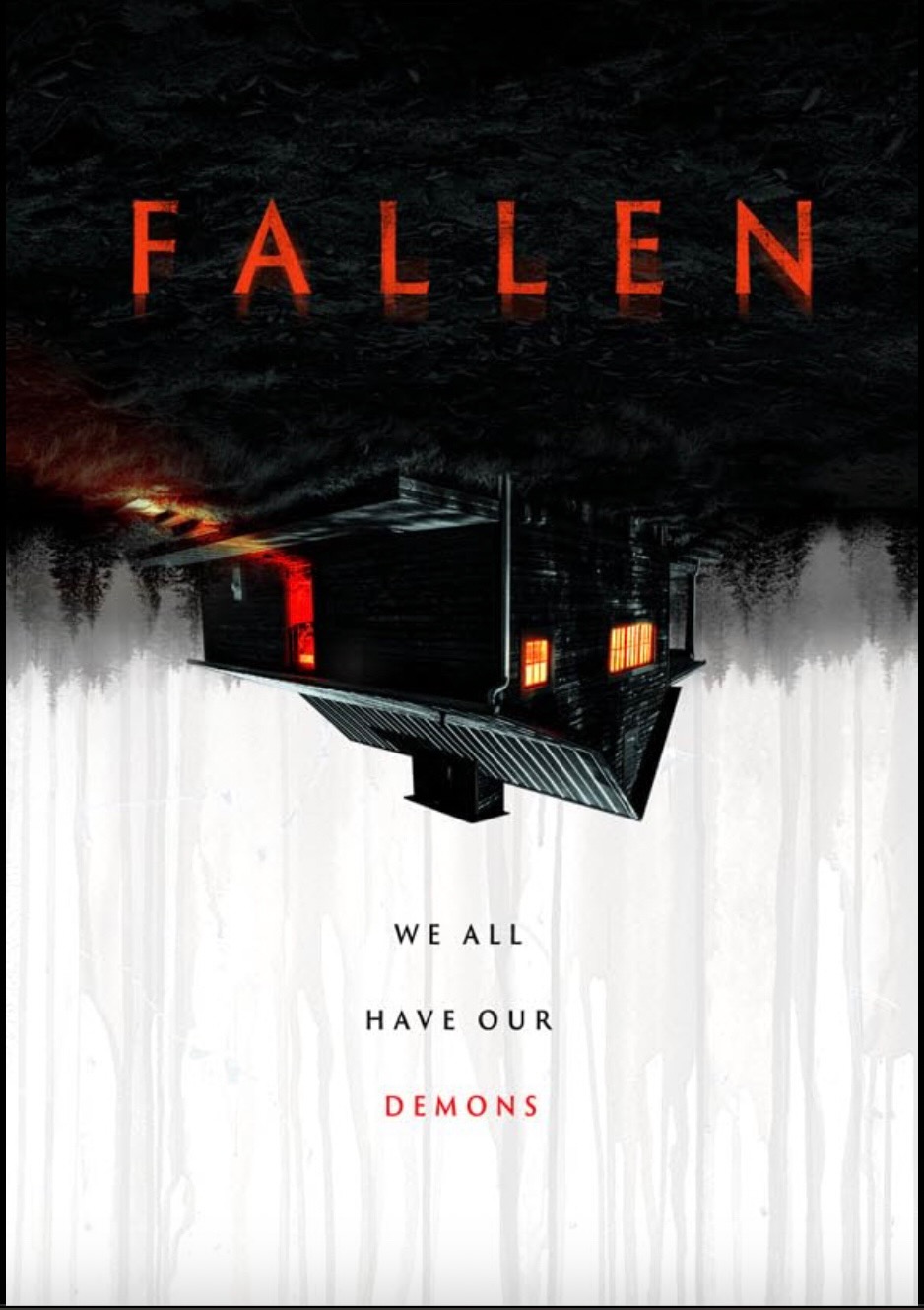
So beautifully shot, Fallen is a movie worth watching despite its disjointed plot.  Worth watching for horror fans, that is.  Apart from the night scenes, this is art house cinematography, and that may be because it’s an independent movie.  What’s it about?  That’s difficult to say, definitively.  The night scenes are so dark that you can’t tell what’s happening and the plot seems to have been intentionally obscure.  (That’s hard to substantiate because the 2022 film hasn’t generated too much discussion.)  This may have been another case of mistaken identity, like The Entity, because my notes only had the title down.  There are at least three movies with this title.  I’m learning my lesson to jot down the year when I add a movie to my “to see” list.  In any case, here goes…

A young priest (?) is warned by an older priest that it is time to take up violence because the darkness has started.  The younger priest is called “Father Abraham,” but he wears a tie in church services, and a small pectoral cross, making identification of the denomination difficult.  Since this is religion-based horror you’d think that that much, at least, ought to have been sorted out.  The heavily accented dialogue is often delivered so low that it’s difficult to follow.  In any case, this minister, after fighting “darkness” for many years, is in an isolated farmhouse with his disabled daughter.  He hunts and traps for their needs and a local boy delivers groceries, and is secretly in love with the daughter.  The minister, who seems to be presented as a tortured soul, isn’t really likable.  At night the house is attacked by physical demons.  There will be spoilers in the next paragraph.

It’s finally revealed that Fr. Fallen (apparently that’s his surname) had killed his wife for being a witch.  His daughter is also a witch, out for revenge for her mother’s death.  She summoned the demons and eventually kills her father and leaves the farm.  Religious imagery is everywhere in this film and begs for interpretation.  The lack of coherence, however, makes that very problematic.  The disabled daughter is the only survivor at the farmhouse, and is healed at the end.  By the demons?  Or because she’s a witch?  The influence of M. Night Shyamalan is evident, but his clean plotting is absent.  Online discussion is minimal, but there could be something of substance here.  If only it were better put together.  If only it were more discussed.


World’s End?

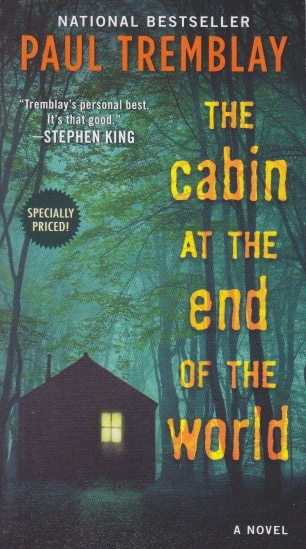
I’ve been writing on religion and horror for quite a few years now.  Sometimes you come across a horror movie, or novel, which addresses this directly.  Paul Tremblay’s The Cabin at the End of the World is one such novel.  A friend strongly recommended this, and indeed, the first half went impossibly fast.  This despite my dislike of home invasion stories.  It nevertheless kept me on the edge of my seat.  I should probably say there will be spoilers here (there will), in case you haven’t read this but intend to.  I’ll hold off on them until the next paragraph, though, so if you’re a faster reader than I am a writer you won’t accidentally run upon them.  So, a family consisting of two fathers and an adopted daughter find the cabin, where they’re vacationing, invaded by four people who believe the world is going to end.  Spoilers follow!

The world is going to end unless the family agree to sacrifice one of themselves to stop the apocalypse.  The strangers are armed while the vacationers are not.  And, as usually happens when those with weapons confront the innocent, the armed prevail.  But.  But the family refuses to sacrifice anyone.  Then the brainwashed four do something unexpected—they kill one of their own.  They continue to do this, attempting to convince the men that if the invaders all die, and neither of the men is sacrificed, the world will end.  Quite a bit of the novel then becomes a theological discussion regarding what kind of god would make such a demand.  Of course, if you read Genesis you’ll already know the answer, right Isaac?

Tremblay knows not to tip his authorial hand as to what’s really happening.  As the cabin becomes a mess of blood and gore, the television seems to be showing predicted apocalyptic events.  The invaders can’t reveal their source of secret knowledge because they receive visions telling them what to do.  The whole thing raises that most troubling of questions: who is really in charge?  Is there a bloodthirsty deity who requires a willing death or are the invaders simply good at acting out their paranoia and interpreting events to meet their expectations?  So it is that Cabin becomes a disturbing story—nearly a theodicy—asking age-old questions of what happens when religious belief conflicts with rational materialism.  There are enough hints of supernatural happenings to make the reader wonder.  And when it ends it affirms something many of us are exploring these days—religion and horror have much in common but neither is clearly understood.


The Idea of Scripture

Although the academic field of biblical studies is slowly dying—this is something I wrote about a long while back on this blog—the Bible and its kin nevertheless continue to shape and control society.  I was recently reading that Islam takes quite a different view of the Qur’an than Christianity does of the Bible.  It’s also clear that Judaism has yet another way of looking at Scripture.  What underlies these Abrahamic faiths is, however, the idea of sacred texts.  They don’t have to be understood, let alone read, in order to alter perceptions of reality.  The idea that God wrote a book, combined with the idea that God doesn’t show Godself or intervene in the world for good in any obvious way, has transferred a kind of godhood onto sacred scripture.

People desire the second coming because of a deep-seated need for God to part the clouds and demonstrate that their way of looking at things is the correct way.  It may be influenced by Scripture or politics or a favorite news channel, but the result is the same—they want divine intervention and since it’s not forthcoming, their sacred texts become the rallying point around which they gather.  Like many people I’m puzzled how a man like Trump, known for his proud womanizing and lack of care for anyone other than himself, came to be seen as a messiah.  Perhaps the key is that moment he gassed American citizens for a photo op holding up a Bible he never reads.  How this comes to be interpreted as a kind of divine moment only makes sense when we realize it’s the idea of Scripture that becomes the reality of many.

I’ve read through the Bible many times.  I have to confess that trying to get through the Qur’an is a struggle for me, but I suspect quite a lot of that is cultural.  I’ve read a few other sacred texts over the years, and have found some wisdom in all of them.  It’s when they become divinities in their own rights that society begins to pay the price.  If a non-interventionist God remains invisible, that identity will be transferred to the divine surrogate—Scripture.  People will coalesce around the idol they can see rather than the invisible one they can’t, right Elijah?  These sacred books have survived partially because they contain old wisdom, and old wisdom is often better than new knowledge.  But they also survive because they have become, in some sense, gods.


Kenyan Mourning

We ignore religion at our peril.  I may be a voice crying in the wilderness here, but just because church numbers are declining it doesn’t mean religion still can’t motivate.  And in large numbers.  A New York Times story tells how 179 Kenyans starved themselves to death because their preacher told them they’d meet Jesus that way.  It’s amazing how many demons pose as angels of light, even if well-meaning.  All it takes is to hold up a Bible.  People are religious by nature and they tend to believe what they’re told.  Jonestown and Waco taught us nothing about religion.  Universities continue to hack away at its study, declaring it no longer of importance.  Meanwhile useless deaths still occur because of something that “doesn’t matter.”  Religion is so easily weaponized you’d think the Pentagon might want to get in on the action.

How am I to read without an interpreter?

Our world is increasingly secular but that may not mean what it seems to.  Belief, whether in traditional religions or not, is still belief.  We may believe we know certain things, but knowledge is a lot rarer than we often suppose.  Religion evolved—co-evolved, more accurately—with our species.  We need it, even if its gods have lost their divine luster.  And if we don’t have people who can teach us about it without resorting to mere metrics we may be on our way to perdition.  You see, here in America we tend to be a pretty literalist bunch.  I don’t know what it is about our culture, but we’re uncomfortable with metaphor.  Even so we believe in all kinds of things and then deny that we do.

My mind keeps going back to those Kenyans who, trustfully believing, starved themselves to death.  No doubt the introduction of the Bible, without proper instruction, into their culture, meant that such interpretations would eventually arise.  Perhaps inevitably.  Religious thinking isn’t a bad thing, but taking sacred texts from thousands of years ago as roadmaps for today is.  We so want answers in black and white—we want someone to tell us that life isn’t this complex and that “it’s all really quite simple.”  But it’s not.  Religion does help us get through this complex world.  Even though he was a Transcendentalist, Henry David Thoreau tried the monastic approach.  It works for a while, but if we all did it there’d be untold suffering in the world.  In other words, there’s no easy answer.  There never likely will be.  Until such a time as that, we should be studying religion more, not less.  And trying to make lives better, not worse.


More Water Monsters

Monster from the Ocean Floor, one gets the sense, wouldn’t have merited a Wikipedia article were it not for the fact that it was the first film Roger Corman produced.  Despite its B-movie quality, there’s quite a lot to like about it.  First of all it has a strong female lead.  Julie Blair is the only gringo in Mexico to believe the locals that there’s a monster just off shore.  Steve Dunning, the scientist, is an avowed skeptic.  The plot is cheesy—the monster is an overgrown amoeba irradiated by the Bikini Island underwater nuclear tests, and it’s killed by getting a submarine in the eye—but there are some very effective cinematographic moments.  When the young boy talking to Julie in the opening turns to stare at the ocean where his father disappeared, the framing and emotion are perfect.

The theme music for the approach of the shark, and then the amoeba, anticipate Jaws by a couple of decades, and I have to wonder if John Williams hadn’t watched Monster from the Ocean Floor.  (I’m sure even cultured people watch the occasional B-movie.)  There’s also an unexpected religion angle.  A series of episodes in the film have a couple of locals trying to kill Julie as a sacrifice to the monster.  Despite the holes in the plot, it’s remarkable that in 1954 there could be dialogue suggesting that the Christian God (“the other god” according to a local woman) isn’t the God that Quetzalcoatl is.  All the same, the sacrifice is based on the folklore that the sacrifice of the “fairest” (Julie is, naturally, blonde) will appease the monster.  Maybe not the most solid theological basis, but still, not bad for a bad movie.

I’ve recently published a piece on Horror Homeroom about women and water monsters.  Having a strong woman in a 1954 film is especially remarkable.  Julie, despite the skepticism of the scientists, takes the initiative to dive right down and see the monster for herself.  It’s only when she comes up with physical proof that the men consider that she may be right (and in danger).  Of course, the men do have to rescue her—you can’t have it all.  Yes, it’s a cheaply made movie with a paper-thin plot but it was beginning to show that a woman could take the reins and with good motives (if nobody else will do something about the monster, she will).  Although she’s the love object of the movie, she’s so much more.  And a submarine in the eye—that’s gotta smart.


Wrong Entity

In one of those weird synchronicities the universe likes to play, the very next day after I watched The Entity (2015) and wrote a blog post on it, this happened.  In yesterday’s post I noted that I couldn’t remember where I’d read about the movie, or who had recommended it to me.  I couldn’t even be sure which The Entity it was, since I didn’t write down the movie’s date.  The next morning I had the privilege of watching Claire Donner, of the Miskatonic Institute, talking about The Entity and it immediately came to mind that it was she who’d suggested I might like it (or might not).  Also, that I got the wrong one.  I haven’t had the opportunity to watch the one actually recommended yet, but it brings back to mind just how the Miskatonic Institute contributes to understanding horror.

The Institute has asked me to present a course this coming October and I will be posting more on that closer to the time.  It got me to thinking about a couple of things.  One is that I missed some major horror films growing up.  When I “got religion” in high school (I always had it, of course, and saw no problem with enjoying monsters too) I began to steer away from horror.  In college I had a dating occasion or two to watch horror, but it really only started again in earnest after being booted out of academia.  I was interviewed in seminary by a sociology grad student interested in why people watch horror, but my watching was (and still is) circumscribed by lack of cash flow.  The Entity made quite a splash in the early eighties, but it took someone in the 2020s telling me about it before I realized I probably should watch it.

The other thing Donner’s talk brought to mind is how religion and horror relate.  Such films are scary because of an existential threat—THE existential threat.  There’s nothing more powerful than God, but in such movies God can do nothing.  I haven’t seen the movie yet, but I suspect that’s true.  It’s certainly true of The Exorcist, with which it’s sometimes compared.  God doesn’t deliver Regan McNeil, no, Fr. Karras does.  And only by sacrificing himself to do so.  The existential threat has to involve a universe entirely out of kilter.  What is a God that’s powerless (it’s implied) to drive out evil?  The exorcism in The Exorcist doesn’t work, does it?  Yet there’s some benevolent force in the universe that gives us synchronicities and, it seems, is looking out for goodness in an often cruel world.