Friend of Jonah

Last year a gray whale was spotted off the coast of Herzliya in Israel. As in the days of Jonah. Actually, we need to turn the clock back a little further. According to Arthur Max of the Associated Press, the gray whale was hunted to extinction in the Atlantic already in the eighteenth century. This whale, therefore, had to travel north of Canada from the Pacific Ocean through channels that are normally frozen. Global warming has opened these passageways and plankton last seen in the north Atlantic 800,000 years ago have begun to reappear. If Jonah was smart, he’d have stayed in that whale and would’ve just kept going.

Big business stands to lose the most from cleaning up the environment. It cuts into the bottom line. Happily, if brainlessly, joining the laissez-faire coven are many of the “Religious Right” who see destruction of the environment as part of God’s plan. So much for “and behold, it was very good.” When free market economists first met the conservative evangelicals it seemed that they had little in common beyond similar haircuts and a desire to turn time back to the 1950s. Since then they’ve joined to become a very powerful force in American politics, preventing any headway to improving the globe for others, even if it isn’t a personal concern of theirs. So much for “do unto others as you would have them do unto you.”

Each year in my Prophets class I have students that are far more concerned that a literal Jonah was swallowed by a literal whale rather than hearing the message Jonah proclaimed: repent or face destruction. If we turn the thermostat up a few degrees more each year maybe Jesus will finally jump on that white stallion and split the Mount of Olives. You can’t quite see the Mediterranean from there, but if you could you might spot a lonely gray whale. You don’t need to look for the little man inside. That whale is the sign of Jonah.

Wave to Jonah for me!

Reverend Sanders?

According to the Associated Press yesterday, Yenitza Colichon was sentenced to 18 months’ probation for child neglect and cruelty. The charges stemmed from a 2007 religious ceremony in which her seven-year-old daughter was made to watch a chicken sacrifice in New Jersey, and the girl was fed the animal’s heart. The practice is part of the Palo Mayombe religion of central Africa. This whole incident highlights the vital question of when religion crosses the line into child neglect. Many of us bear scars—some psychological, some physical—from our religious upbringings. It has been concluded by psychologists that children do not possess the level of abstraction necessary to deal with religious concepts until they are about the age of twelve. Parents, often fearful of eternal consequences should their children depart the one, true faith (whatever that is), begin religious instruction early, often passing their children off to others who are in no real sense an expert in the religion itself.

The United States embraces, on paper, the concept of freedom of religion. Rightly, it seems, the strong arm of the state will step in when a child is endangered or neglected. The unanswered question is at what point does this neglect or endangerment occur? Authorities turn a blind eye if the faith is time-honored, and, especially, if it is of European/American extraction. Typically of the monotheistic variety. What is standard practice for other religions, as this case demonstrates, may be called into question. Sacrifice is also at the heart of the Judeo-Christian tradition. Sublimated into different forms for both political and theological reasons, those of us in that tradition have abstracted sacrifice to bloodless words on a page. When we see red, child neglect and cruelty are cited.

Religions frequently make extreme claims over the lives of their adherents. Most religions relax such claims for children, but others continue ancient practice that is tacitly condoned. Sometimes those permissible rites cause real physical pain and scars. If under the hand of a moyel, okay; if scarification in African tradition, not okay. Religions denigrating personal achievements of the young, setting them onto a path of failure, okay; religions ritually killing animals, as even the Bible demands, not okay. Without making any judgment on specific religious outlooks, the reality of lingering effects remains. Are the terrors of Christian nightmares inspired by tales of Hell any less cruel than watching a domesticated animal die? Is eating a chicken heart any less unusual that fish on Fridays? Is being unfamiliar with a religion grounds for dismissing its authenticity or claim for equality? Some of us find animal sacrifice distasteful, but if we proclaim a tidy sacrifice each Sunday, and share it with our children, that particular rite/right is protected by law.

What would (wiki-commons) chickens do?


Contriving the Rapture

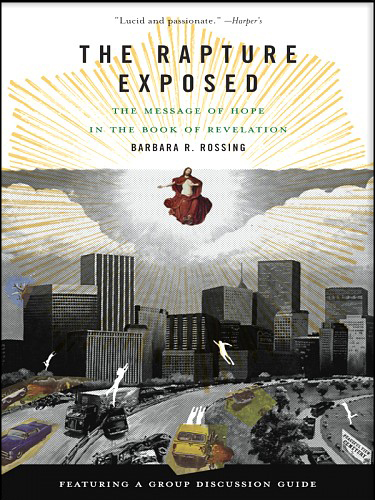
In the light of last month’s failed rapture attempt, I decided to read a book that I picked up some years ago that had been written in the wake of the millennial scare. Having grown up with nightmares of the rapture, I learned during my first college class on the book of Revelation that it was relatively modern meme, invented in the nineteenth century. Barbara Rossing’s The Rapture Exposed seemed a good way to refresh my memory without having to go through all those boxes of books in the attic to find my original textbooks. Rossing, a Lutheran minister and New Testament professor, brings to light some very important facts beyond the historical roots of this theological fabrication—facts that should concern religious and secular alike. The rapture was invented by John Nelson Darby, a founder of the Plymouth Brethren and convoluted biblical scholar. Basing his roadmap of the future singularly on Daniel 9, he concocted the rapture to make sense of his apocalyptic epiphany. Drawing diverse sections of Paul’s letters to the Thessalonians, the Gospel of Matthew, and the book of Revelation together, he mixed thoroughly, half-baked it, and pulled the rapture out of the oven.

The idea caught like wildfire. Today young people who’ve never read the Bible and who’ve seldom attended religious services know what the rapture is. What they do not realize is that nearly all of the Christian tradition rejects it, seeing it for what it is—a Johnny-come-lately of amateur theology that sees the Bible through the lenses of dilettante-sensibilities like those of Michael Drosnin (The Bible Code man). Instead of seriously reading the Bible and trying to understand it, society prefers to see it as a little bit of magic in the midst of our scientific and technical world view. It is a safe place where bits of the supernatural are preserved and that defies rational explanation. Rossing’s book does a good job of exposing the wrong-headedness of LaHaye’s Left Behind conclave, but she overlooks an important feature of this coterie: they have an unconfessed agenda.

The unspoken agenda is best summed up by Lt. Frank Drebin of Police Squad when he says, “blowing away a fleeing suspect with my 44 magnum used to mean everything to me. I enjoyed it, well who wouldn’t?” Rossing misunderstands Fundamentalism when she expresses surprise at the bloodlust present in the Left Behind novels. What she doesn’t take into account is that, as a collective, Fundamentalists thrive on self-righteousness. Feeling the same violent urges that others do—all humans experience violent emotions—they sublimate that aggression and save it for the unrighteous—God’s enemies. When the gloves come off in the apocalypse, that hatred bursts out in good, old-fashioned bloodletting—albeit with combat helicopters and high-tech weaponry. Of the Christians I know who own guns, the Fundamentalists are most avid in their rights to do so. In college I met my first Christian survivalists and I learned that the rapture was a ruse. It is a deadly mix, especially when this warped theology makes it into politics. Although Rossing’s vision of a new earth in the second half of her book may not appeal to everyone, Americans should read at least the first few chapters to learn why the rapture will never occur.


Bread Alone

The sad story of the death of an eight-year old girl from Irvington, New Jersey bears uncanny echoes to a case a year and a half ago of a mother who starved her children believing God would provide. The current case of Christiana Glenn’s death is heart-wrenching and the outlook is not improved when it appears that the girl’s mother had religious motivation to abuse her child. Christiana died from untreated physical wounds and malnutrition, prompting columnist Kathleen O’Brien to write about how food and religion often come together in unusual ways. As O’Brien points out, religions generally safeguard children from food privations, but less scrupulous leaders of what are frequently termed “cults” do not have the same strictures. The only real difference between a religion and a cult is society’s attitude toward it—religions tend to be larger and with finer pedigrees, but beliefs are beliefs. When religions seek control over believers’ lives, they often delve into the practice of deprivations, generally mild. More extreme groups take the idea to fatal limits.

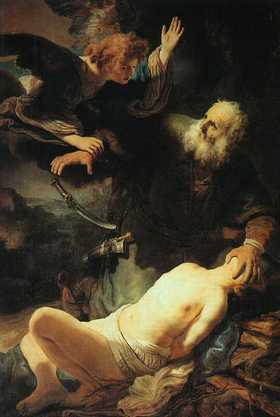
Even the Bible records from near the very beginning that deprivations are part of the religious expectation. One of the most complex and frightening stories from Genesis is that of Abraham’s near sacrifice of Isaac. No matter how theologians wash it, this story retains its stain of an adult—whether directed by God or not is a mute point—attempting to harm a child in the name of faith. The story, many centuries later, still sent Søren Kierkegaard into a tailspin that came out as Fear and Trembling. What kind of deity asks for a child to be harmed, even in jest? For Christiana Glenn, there’s no taking it back. The Bible tells us nothing of how the interior life of Isaac responded to this episode.

Food and religion are among the most common elements abused in American society. For our bifurcated (if not bipolar) outlook, one sustains body and the other sustains soul. While science still lacks evidence for the soul, the body remains the only basis upon which we have to base our ethics. Even biology dictates that care of one’s own young is an evolutionary imperative. It is tragic indeed when a religion overrides what all cultures respect as the ultimate “should” —take care of your children. In a world overpopulated by religious experts the street value of the soul will never face a recession. Believers, characterized my many religions as sheep, will go wherever their leaders tell them to go. As a culture suspicious of funding the study of religion, it may not be food that is reaped at the end of this harvest.

Thou shalt not...


Blood Lust

They emerge at night. They take your life-essence. They are very difficult to remove. In a particular political party their ruthless ways are highly praised. Yesterday I had occasion to watch the History Channel’s Vampire Secrets. Frequent readers of this blog know of my contention that horror films generally convey religious fears and certainly the vampire is prominent among such hosts of fear. Although superstition has held that actual creatures drew actual bodily fluids from their victims as far back as the Sumerians, today’s perception of the vampire has gone through several transformations. This particular documentary attempts to trace the origins of the modern vampire fascination through its major stages, beginning in ancient times. The writers and editors seem to favor a Far East origin of the concept, but linger for several minutes on the character of Lilith in Jewish folklore. Although Lilith does not really fit the profile of a classic vampire, she does contain a key to understanding the transformations: they are religious in nature.

People have believed in blood-suckers long before the GOP took on its recent transformation; there is no doubt, however, that the blood-lust of the vampire developed in the light of Christian ideas about the crucifixion. The regular imbibing of “blood” was an aspect of early Christianity that led to problems with the Roman authorities supposing this was some sort of precursor to Vampire: the Masquerade. By the time stories began to circulate about Elizabeth Bathory (ironically, at the same time the King James Version of the Bible was being translated) and her famous blood-lust, and after Bram Stoker later selected Vlad Tepes as a fictional model for his Dracula, blood-ingestion had become the singular hallmark of the vampire. In both cases, despite their historical facts, religious elements had entered in.

One of the most disturbing transformations, however, is that whereby religion itself becomes vampiristic. Originally established as a means of propitiating angry deities, religion very early assumed the aspect of blood-letting as a means of accomplishing that propitiation. With the development of religious abstractions, however, literal bloodshed has become distasteful and less common, but the deities still demand sacrifice. Even in the twenty-first century many accepting people are informed of the pecuniary sacrifice desired, commanded even, by the gods. While the occasional poverty-stricken cleric may occasionally appear, many far surpass the status quo in their crystal cathedrals while many of the faithful suffer want. The History Channel found vampire subcultures in the streets of New York City. They might also have found them in just about any town in any country of the world.

Saint or sinner?


Robopocalypse


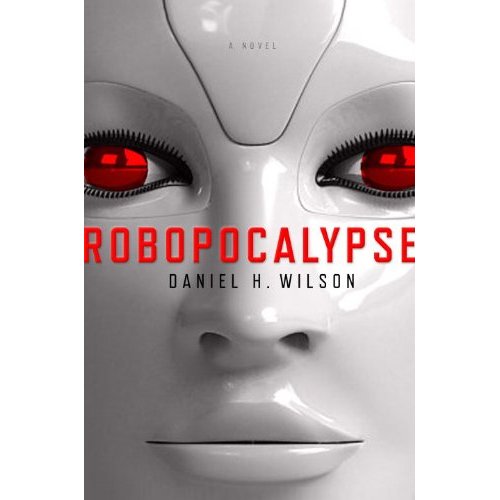
Yesterday the long anticipated novel Robopocalypse was released. Although I seldom indulge in hardcover fiction, I headed to my local Borders to purchase a copy. Sadly, it seems, my local is cutting back on first-day releases because I walked out of the store empty handed but with a robotic Armageddon in my head. Last summer I became acquainted with Daniel H. Wilson’s How to Survive a Robot Uprising, but word on the street is that this novel is serious. Steven Spielberg purchased the movie rights even before the book was released. And the concept owes its existence to religion.

If it were not for human religious sensibilities, would the concept of an apocalyptic end have ever arisen? Probing into the ancient psychology that lead Zoroastrians to suppose an ultimate conflict was just down the theological road, it is clear that even a strong moral sense alone does not dictate ultimate dissolution. By personifying evil in the form of Angra Mainyu, Zarathustra gave a (divine) human face to wickedness, and thus opened the possibility of battling against it. Evil as an abstract, non-personified force might simply be accepted as part of the universe we inherited. By providing it with will and intention, however, Zoroastrians allowed for a natural human response. Fight or flight is hardwired into our brains, but would we have dared fight a foe that is immaterial, amorphous, and completely abstract?

The nature of the enemy has transformed itself many times over the ages. Wilson, a scientist working with robotics during his education, has taken a religious theme and placed it in the context of a godless world of cybernetics. I must use caution here, since I haven’t yet acquired a copy of the book, but it remains clear that it is the humanization of non-human entities that gives force and pathos to a final conflict. Jesus charging his white horse into a foul-smelling cloud lacks the same impact. Thus mythologies are born. Mythologies that people live by and for which they frequently die. I do hope it all holds off until I can get a copy of Robopocalypse to read. Better yet, the end won’t come until after the movie is released.


Ouch!

Now in a dentist office near you!

Sitting in the dentist’s office may not be the best place to be reading about pain. Nevertheless, as I was anticipating my fillings (worn enamel at this stage, not cavities) I picked up the June edition of Discover magazine and noticed a story on the brain. Since pain and brain rhyme, I took it as a kind of omen. I actually subscribed to Discover for many years as a teenager, but with the vicissitudes of the job market as an adult, and the perpetual lack of storage space in apartments, I have let my magazine subscriptions lapse. The article, which I did not have time to finish, suggested that neurologists are on the cusp of being able to pin down whence chronic pain is experienced in the brain. If a chemical inhibitor can be found for this specific region it will be like turning off a light switch. There will be no more pain (rather like John’s vision of the New Jerusalem).

As I was called back to the dentist’s chair to the accompaniment of the whine of a dental drill, I reflected on the loss of pain. Being the sensitive sort, and probably more empathetic to others than may be healthy, I never wish pain on anyone. Life is difficult as it is, and even those who wish me harm do not deserve suffering. Nevertheless, I wonder if we could thrive in a world without pain. This is all the more relevant with the growing whispers among the AI community that brains can be simulated by computers. If they are programmed not to experience pain (as seems only sensible) then what becomes of humanity when pain is abolished? Some of us identify with the pains of mental agony even if the physical does not directly impinge on our lives. It is what makes us human. When I see another person in pain, my immediate reaction is to want to help. Being a religionist, however, my options are often limited in this regard.

After a very painful termination a few years ago, I had to give in to anti-depressants for a while. The very idea depressed me. My life, including its full array of mental anguish, defined who I was. Take that away, and what was left? Funny thing was, those in the church who initiated this particular pain showed no empathy whatsoever in the face of it. I weaned myself of the medication after a few years and occasionally the pain returns—particularly acutely when yet another religious employer let me go—but it is part, a very deep part, of the human experience. Could we thrive in a world without adversity? We are often at our best when we are helping each other. That to me seems to be what true religion is all about.


Vulcan’s Anvil

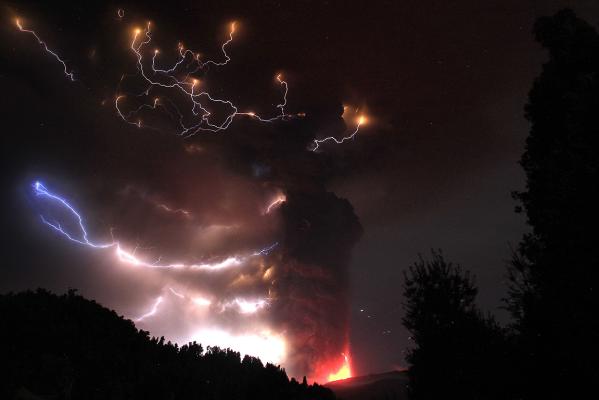
Volcanoes have long been the prerogative of the gods. Saturday’s eruption in the Puyehue-Cordon Caulle volcanic complex in southern Chile joins last month’s outburst from Grimsvotn in Iceland for divine fire-storms. In the days before geology, the only explanation for these impressive explosions was the gods. The concept of Hell was fairly late in the development of ancient Near Eastern religions, otherwise volcanoes might have been labeled as Hell breaking loose, literally. Many historic eruptions have influenced the course of history, most notably Thera and Vesuvius. Ancients would have been hard pressed to see such spectacular—and obviously divine—displays as “natural.” Indeed, the concept of “natural” events was itself slow in evolving since the gods were always lurking in the dark corners of the evolving human psyche.

Fortunately, beyond disrupting some air travel, these two latest outbursts have been fairly benign from a human point of view. This too is an evolved perspective since we tend to see ourselves as the overlords of the natural world. Watching industrialists poke new orifices in the planet’s crust for personal gain even in rare and delicately balanced ecosystems, who can doubt that we are masters of our own domain? Much of the misdirected sense of such entitlement comes from interpreting the Bible as declaring the planet ours from the days of mythical Eden. Some of the more perverse applications of this principle include those who try to force the hand of God into sending the Second Coming due to their creating conditions appropriate to an apocalypse. Others declare that since said Second Coming is nigh, why not trash the environment? We won’t be needing it much longer.

Apart from the obviously failure of logic here, the anthropocentric view is also misguided. The earth was not created for us—we simply evolved on it. The corollary also stands true: long after any human intelligence is here to read these words, our planet will continue on its weary track around the sun until it blossoms into a red giant and consumes our final cinders. There are no horsemen in the clouds, but this planet is all that we have (even the space station depends upon it) and when we grow too arrogant, the planet unconsciously gives us a spectacular display to remind us that we are mere guests upon this globe. We need to treat it with respect.


Not So White

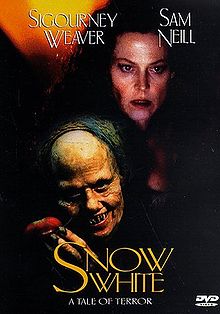
Over the past two decades, an interest in presenting fairy tales more akin to the spirit of the brothers Grimm has blossomed into its own industry. For those of us who were reared on Fractured Fairy Tales, this is a welcome development. Among the more creative approaches to this genre is the 1997 movie, Snow White: A Tale of Terror. Hampered by lack of theatrical release in the United States, this gothic attempt at telling the story in its original, dark form has gone largely unnoticed. I recently viewed the movie for the first time myself, and although the basic storyline is somewhat trite the Grimmesque features redeem it at many points. (Who doesn’t secretly want to see the pretty-boy prince charming thrown out of a castle tower window?) Perhaps the most unexpected addition to the Disneyfied tale we all know is the religious component to the movie.

“Snow White”—never named so in the movie—has been raised by a pious father who wears a cross and insists that she say her prayers and read her Scriptures. Being a local lord, he suppresses ruffians who populate the woods, including a band of not-so-merry men who incorporate some that were tortured for refusing to go on crusade. When the not entirely wicked step-mother needs Lord Hoffman’s blood to raise their stillborn son to life, she lashes him to a crucifix, saying to the corpus that occupies the other side, “now you shall have company.” (Did I mention this is a horror film?) Along with the unexpected twists that those conditioned to happy endings find so disturbing, the film actually contains a subtlety on matters of religion that is frequently missed. It also resists corny dialogue that so often plagues films where the storyline cannot bear any substantial weight.

While it will never be my favorite movie, this particular film was an effective adult retelling of a familiar tale with more depth than the common story might suggest. The Germanic folklore collected by the Grimm brothers often reveals a depth of insight into humanity that is bleached out by Disney’s bright colors and cheerful smiles. It is more true to the human experience. The scene that remains seared in my mind is where one of the seven miners (only one is a dwarf—another is actually a friar) is revealed to have been disfigured by crusaders off to liberate the Holy Land. Refusing to participate, he had to watch his family burned at the stake and had a red-hot iron cross pressed to one side of his face. (Did I mention this is a horror film?) As in the days of Grimm and continuing into our own, the church continues to scar many even as it attempts to heal others.


Crossing Over

The periodic reforms that have swept through the church like so many Massachusetts tornadoes have often whirled around the matter of ceremony. Certainly there have been disputes over obtuse points of esoteric doctrine for which there is no final arbiter, but frequently the rancor involves what the faithful do when they meet together. In keeping with ancient templates, religion is generally a matter of what people do more than of what they believe. I personally had my love of ceremony beaten out of me by its plangent and perpetual repetition at an institution so enamored of it that humans and their needs were viewed as mere obstacles to sacerdotal perfection. Nevertheless, as the school year winds down, ceremony is all around us: graduations, awards dinners, rites of social passage. Last night I attended a Girl Scout bridging ceremony. Bridging is the symbolic crossing of a bridge to indicate a new level of commitment and integration into the larger Girl Scout community.

It's just a bridge.

As I sat staring at the bridge, waiting for the celebration to begin, it occurred to me that this was very much like a religious service. A group of spectators had gathered to watch a ritual unfold—a ritual that involved everyday objects invested with a new significance by the context. The bridge is just a small arch bridge over artificial water; before the ceremony kids run and jump over it with no fear of divine reprisal. Once the correct words are spoken, however, crossing the bridge becomes a solemn act. The ceremony opened with a kind of invocation, a creed (the Girl Scout law), a kind of Scripture reading—complete with exegesis of what that “Scripture” means and a reference to God as creator of all—a sacramental act of transformation, and even a hymn or two. The main difference I felt between this ceremony and most religious events was that the Girl Scouts are far more accepting and affirming than most religious conglomerations. Of course, there is the matter of gender distinction, but what is a church without any exclusivity?

I have great admiration for the Girl Scouts. In the face of a community that continues to act out male supremacy as a matter of God-given right, the Girl Scouts (and other similar organizations) offer a place for young women to assert their sense of belonging. Religion has just as often been used to suppress aspirations as it has been to uplift them. Life is difficult enough without God breathing down our necks. Human institutions that encourage thoughtful regard for those who are different, or underprivileged, or simply overlooked, often fill the gaps that religions callously leave behind. Yes, some religious institutions still display a social conscience, but if we wait for the religious to solve the suffering of the world, it is good to have groups like the Girl Scouts around who actually put their beliefs behind their ceremonies into action.


A Tribute

Judith Mills Gray, 2009

The death of a friend always covers life with a hazy gauze of disbelief for some time. In my fitful career I’ve taught several hundred students, and of those several hundred a handful have become friends. When the painful debacle of Nashotah House took place and I was reduced to a weeping mound of incoherent impulses, those who were friends tried to console me. Some had fortunately moved on by that point. Judith Mills Gray was one of those who had become a friend although she had made it to safety before me. Readers of this blog will likely not recognize her name—she never earned lots of money, the measure we use assess a person’s importance these days—but she was an artist, a deeply spiritual woman, and one of the kindest people I have ever known. In a day when the seminary actively discriminated against women, she managed to hang onto a place among the boys and did so with good humor. After my short stint as Registrar, she came along to lift that burden from my shoulders. When she left the seminary, my tiny family sat in her tiny house and wished her the joy that Nashotah could never offer.

Just two years ago we went to visit her in her native West Virginia. She was proof to me at that point that recovery from institutional abuse is possible, but I could see there were still scars. Many of those who suffered through years at the seminary left very bitter—I count myself among them—but Judith rose above it all. She was not perfect—none of us are—but she was a person determined to leave this world a better place than she found it. That is a tall order when the church, the putative bastion of good, turns all its guns on you. As Judith and I shared what would become our final reminiscences together, I sensed that ultimately she had come out the winner.

We are all born into a life with far more questions than answers. Jesus seemed to have had the idea that it was good to console those in difficulty, heal wounds, and try to make your fellow sojourners happy. Judith followed that path without the benefit of having the answers. Along the way we shared many laughs and quite a few tears. We both had experienced the face that the church carefully hides from the wider public, the face that finds Jesus a little too idealistic and hate and revenge a simpler and more effective option. Judith never returned hate for hate. She continued trying to find a path where, although not ordained, she could still minister to others. For those few of us fortunate enough to know her, she was an example of how to make gold out of lead. In my case, I know that there will be lead in my life for quite some time now that she is gone. I also know that lead can, and sometimes does, turn to gold.


Malleus Practice

Misfortune takes a quiet seat in the back of the bus for many people, but it is always there riding behind you. My recent trip to Salem is now over, but it has left me with that haunted feeling that sometimes tragedy just won’t let go. Reading up on the history of witches and the belief therein, it is pretty clear that the whole idea began as a form of theodicy. Misfortune happens. When a one-to-one correspondence attends it, people don’t worry too much. (John has a stomachache. We know that John slapped Bob, and Bob punched John in the stomach so there’s no supernatural agent at work here.) When the adversity comes out of nowhere, to all appearances, we naturally look for a cause. As long ago as ancient Sumer, and probably before, the answer was sometimes the baleful influence of enemies with supernatural powers. The witch was born.

This idea has remarkable longevity. Even as the eighteenth century dawned, just a few short years after the tragedy at Salem, Puritans and politicians embarrassingly looked at their feet and admitted this mockery of justice had been an unfortunate error. Yet they still believed witches existed. The concept is alive even today in parts of the world minimally influenced by schooling in science and logic. (I taught at a seminary where various witch hunts still took place; books were even burned.) Who doesn’t know the feeling that a totally natural disaster was in some way targeting them? Whether tornadoes, tsunamis, or rain on your Memorial Day picnic, the normal human response is one of a minor (or major) persecution complex.

To solve the riddle of witches, horseshoes and witch bottles are not necessary, but education is. Witchcraft was not considered Satanic until the late Middle Ages when apocalyptic fever raged through Europe with the Black Death. Not understanding microbes, the populace supposed a great war presaging the end of times was escalating between God and Satan. The minions of the Dark Lord were spawned by witches and demons. (Add Tim LaHaye and you’ve pretty much got Left Behind.) To solve the problems of the righteous, sacrifice a few innocent victims. If we call them witches—actually any undesirable name will do, eh, Senator McCarthy?—we will feel justified in doing so. The real solution, namely, working together to overcome natural and human-made afflictions, is really just too hard.


Witch Kitsch

Salem is a town with a conflicted identity. The true history of the death of innocent women and men for a fictional crime is sobering. In a day when few take witches seriously—certainly not many believe that supernatural, green-faced hags fly the unfriendly skies—it is difficult to sense the utter terror the idea once comprised. We are still afraid, but our fears take more current forms. So with its lugubrious history, Salem now demonstrates itself as a model of tolerance. One local source cited the fact that eight or nine hundred modern witches live in the city. Modern Wicca, while taken very seriously by its practitioners, is laughingly appreciated by those who find release in the caricature of fictional, idealized witches. The police cars in the city of Salem even have witches riding broomsticks on them.

In this day of triteness and easy entertainment, it is easier to project the fictional image of the pointy-hatted witch and laugh at our past mistakes. Salem bills itself as “Witch Town” and hosts several witch museums, varying in historical accuracy. Shops throughout the town exploit this image of the harmless witch. It is difficult for the visitor to know which witch believes his or her establishment to be authentic and which is just out for a quick buck.

Places have a feel to them, as any pilgrim knows. The National Park Service, in its visitor center for Salem has a question-board that asks, “How Many Witches were Executed in Salem?” The answer underneath is “None.” Instead, twenty regular people were murdered for a crime they didn’t commit. The witch hysteria happened so early in the history of the town that it appears foundational for all its later developments. Who would go out of their way to visit yet another thriving mercantile port of the eighteenth century, were it not for the tragedy underlying it all? Like children laughing while making guilty eyes at their parents, those who prosper over Salem’s sad history realize that whether modern witches live there or not, religious intolerance is never a heritage to wear proudly. Exploiting a tragedy to make a profit is a time-honored American practice, and the real witch to fear is the one who says, “cash or credit?”


Lesson of Salem

I married a witch. I suppose I ought to clarify that a bit. My wife is descended from Rebecca Nurse’s brother Jacob. Rebecca Nurse was one of those unfortunately hanged as a witch in Salem, Massachusetts in 1692. My family has been spending the last couple of days touring Salem, seeking to get in touch with our heritage. Yesterday we had the rare opportunity to tour the home of Rebecca Nurse which, remarkably, still stands over 300 years after the tortured events of the late seventeenth century. Our tour guide was impressively knowledgeable about the witch hysteria. She noted that in the Puritan (Reformed) mindset, with no science to speak of, evil could only be explained by the Devil. If misfortune came, the Devil was to blame. Even after the “witches” were exonerated (too late to save 20 lives), it was understood that the Devil incited the girls to make their false claims against their ultimately and penultimately righteous neighbors. Without the Devil none of this made sense.

The Rebecca Nurse homestead

Salem was founded as a utopian community free to live out its Puritan religion. It was named after Jerusalem, a city of peace (!). As our guide noted, religious freedom was not the same as tolerance; the Puritans wanted the freedom to celebrate their own religion, but were extremely suspicious of all others. One of those hanged as a witch, George Jacobs, had nearly beaten a neighbor to death simply because he was a Quaker. Rebecca Nurse, however, at 72 years old, was no threat to anybody. She was a member of a Christian community that turned on her. Condemned for charges the nearly deaf woman could not even hear properly, she was hanged for consorting with a mythical Devil.

Rev. Parris's house, where the witch hysteria began

No doubt the religion of the Puritans was a harsh religion with a God nearly as unforgiving as that of Sweeny Todd. The problems occurred, however, when the law came into the hands of religious leaders. There is an allegory and a moral to this story. Today many of the tourist attractions in Salem focus on the need for true tolerance. They no doubt come closer to the spirit of the founder of Christianity than the Puritans ever did. As I stood looking over the hole in the ground that is all that remains of Rev. Parris’ parsonage—the very location the witch hysteria began as his daughter Betty started to act odd after hearing the stories of the slave Tituba—a profound sadness afflicted me. Twenty people died and many lost all their worldly possessions because of an uncontrolled mythology of a church convinced of its own righteousness. An allegory and moral for the twenty-first century indeed. Have we yet learned the lesson of Salem?


God’s Guards

That past informs the present in an oblique way. As religions continue to evolve they often depart from their original purposes. In preparation for my one surviving summer course, Ancient Near Eastern religions, I’ve been reviewing textbook choices. The procedure has reminded me of the unusual nature of ancient Egyptian religion. I have long contended that the environmental and social circumstances of a people determine the character of their religion. In Mesopotamia and the Levant, where rain is not always cooperative and impressive storms roll in, the gods often represent the awesome power of the atmosphere and the unpredictable will of the divine. In Egypt the fertility of the soil is assured by the regular flooding of the Nile. Rain does not play the same role in agriculture in such a system. Whereas the gods of the Mesopotamians are often stormy and violent, those of Egypt are generally peaceful and serene.

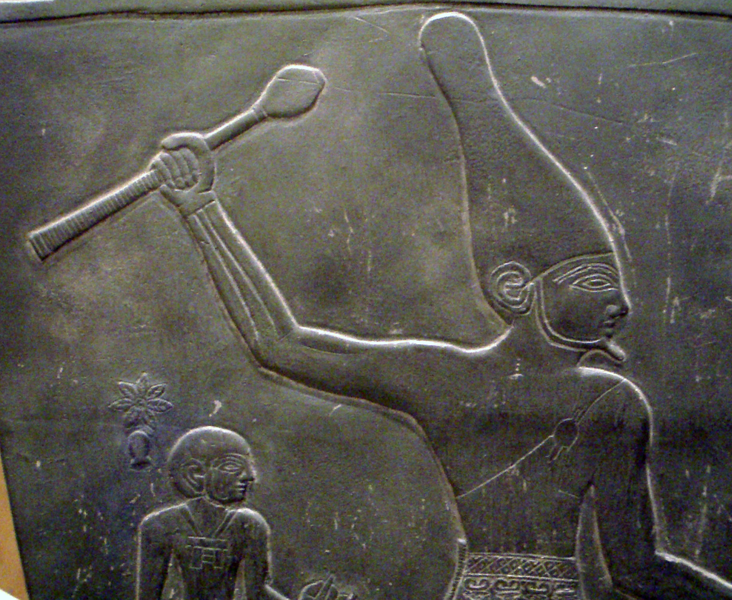
Egyptian religion developed independently of ancient Asia. Relatively isolated in the narrow strip of rich soil along the Nile and in the wave-dominated fan of the delta, Egypt reached an early cultural apex. Their religion emphasized the balance and continuity of life. Of course, it helps when your king is a god. This religion was based on the premise of an afterlife, the very fire-insurance that lends urgency to many Bible-thumpers today. Instead of believing the short, and often harsh life experienced by earth-bound mortals was the full picture, those placid eyes of stone pharaohs stare off toward a continued existence beyond that of life in the desert.

This tranquil religion did contain violent elements as well, but overall stability was valued and change unwelcome. Now as we see violence erupting in Egypt as the great ethical monotheistic religions clash for superiority, it is legitimate to wonder what has gone wrong. When did benevolent Ra become subject to the combating ideologies of Yahweh and Allah (who are, in terms of pedigree, the same deity)? Religion has become a tool in the utility belt of political power players. Since no one steps down willingly, the gods must duke it out. Even within Christianity, as is evident in America, multiple gods claim the title of creator and master. Perhaps it is the price of democracy. Otherwise we might experience the fact that even those pharaonic eyes did not always smile.

You wouldn't like me when I'm angry.