Your Brain on Plastic

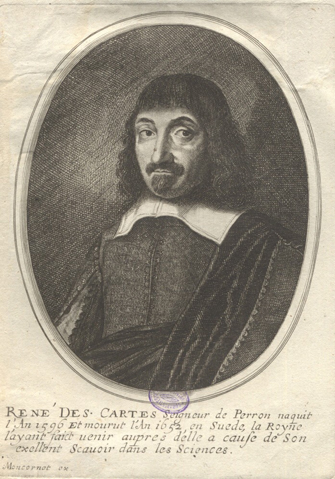
“Cogito ergo sum,” Descartes famously, and apparently erroneously, wrote. As technology races wildly ahead, those of us of biological origin are left feeling somewhat insignificant. An article in Monday’s Chronicle of Higher Education on “The Strange Neuroscience of Immortality” touches on many of the issues that are the very pulse of religion. Revolving around the theory of Dr. Ken Hayworth that a preserved brain, sealed in plastic instants before death, may in the future be thoroughly mapped and resurrected, Evan R. Goldstein explores the idea of immortality. Hayworth’s belief is that a thoroughly mapped brain, reconstructed artificially, would be the ego of cogito. The self. Despite all our advances in science, we don’t know what it is.

As Goldstein makes clear in his article, this transfer of consciousness and possibility of immortality is not mainstream science. In fact, most scientists rapidly distance themselves from it. Many cite the unscientific nature of the very enterprise, but I wonder if it might not have a more religious basis. Immortality is the ultimate of religious ideals. Christians generally recognize it as resurrection, and other monotheistic traditions offer a heaven after death (sometimes, to some people). Is that not all at stake here? If we manage to assure some kind of human immortality, have we not just robbed ourselves of heaven? Quite apart from the technological hurdles and uncertainties about what the self/mind/soul is, is not immortality what separates gods from humans?

The problem with gods is that they don’t get to go home at the end of the day. Would Heaven be so great if you just left another tough day in the universe full of sadness, violence, and pain? Hayworth suggests that a reconstructed brain placed in a mechanical body (robotic, probably) would have the potential of lasting forever. It will, however, be expensive. That means that only the very wealthy will be able to afford the procedure, if it ever works. Imagine that world: a planet full of immortal, wealthy entrepreneurs who can spend eons without sleep, trying to acquire yet more for themselves while knocking the competition on its metal rump. It really doesn’t sound like Heaven to me. But then, what would I know? To me cogito sounds like a snack food.


Enoch’s Dilemma

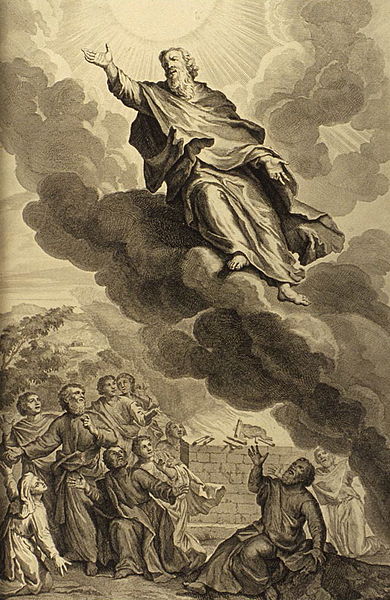
“And all the days of Enoch were three hundred sixty and five years: And Enoch walked with God: and he was not; for God took him.” These two verses from Genesis 5 convey just about all we know of Enoch. That, and he was the father of the oldest man ever, Methuselah. With this intriguing introduction, however, the religious mind insists on a backstory. Over the centuries of antiquity, books grew about this mysterious character as he became the prototype of the person who never died. The Bible doesn’t state that Enoch didn’t die. Nor does it state that he did. Plenty of wiggle room for the mythic imagination. In what appears to be an unrelated story, the Chronicle of Higher Education this past week reported on technology that builds on the strange but natural idea of phantom limbs.

When a person loses a limb, sometimes they report still feeling it. Their brains grew in a body that possessed the limb, and once it is gone the brain still has memory of it. The term used for this is a phantom limb. Knowing that mind does control matter to some extent, robotics experts have figured out ways to wire a robotic limb to the brain of a paralyzed person that responds to brain signals sent to the phantom limb. As much like science fiction as it sounds, this is already happening. The robotic limb responds just like a biological limb. This technology is just developing, of course, and is very expensive. It also implies that cyborgs, once the fodder of futuristic fiction, are becoming reality. Some theorists, such as Raymond Kurzweil, suggest that the brain itself can be converted to electronic signal and transferred into mechanical storage. Once that is achieved, we will have Enoch without any God to take him.

The world that we’ve been engineering bears a strange resemblance to the world of the Bible. For the people of ancient Israel death was the final word, and with rare exception (the only unquestioned case of the undying man was Elijah) people simply accepted the inevitable with no concept of an afterlife. Contact with the Zoroastrians convinced some Jews of the possibility of life beyond death and the quest for immortality was on. It has been a desideratum of human aspirations ever since. We invented machines to help us do what nature has not equipped us to attain. Finer and finer lines have been drawn between the biological and the mechanical. While it make look like immortality to some, to others it seems that we have been kidnapped—taken, if you will—by technology. What really happened to Enoch? The Bible doesn’t say, but it seems that we are getting very close to finding out on our own.


Fighting God

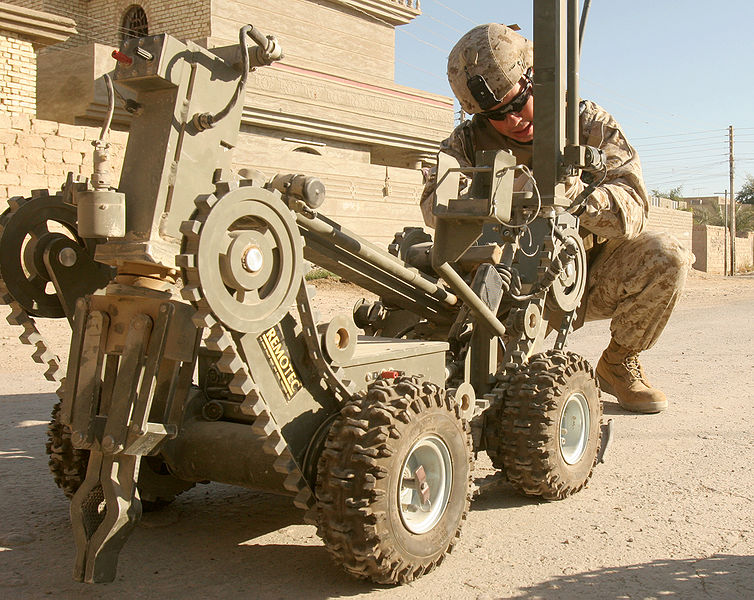
Quoting Orson Scott Card, P. W. Singer notes in Wired for War that two of humanity’s “primary occupations” are war and religion. These two aspects of life are simultaneously very distant while abutting each other. While analysts cite many causes of war, there is no agreement concerning why we seem to be constantly belligerent. As a species we are keenly aware of small differences, perhaps like ants, and use those minor points to excuse the exercise of violence. Yet we are also a profoundly religious species as well, believing in supernatural powers that sometimes deliver us from, sometimes into, war. The Bible, just by way of example, contains many accounts of war. Often they are undertaken at the behest of deity. Religion and war coexist a little too comfortably.

Although Singer’s purpose in this book is to analyze the impact of robotic technology on the practice of war, he also finds indications about the origins of war itself. In today’s affluent world, dominated by technology, we should expect that armed conflict would be on the decline. Instead, it would be difficult to find any historic era when unfair distribution of basic goods has been more pronounced. As Singer notes, social disruption today tends to begin in cities, places where those in squalor daily see the opulence of their neighbors’ lifestyles. Our culture awards the aggressive—those with bigger houses, bigger cars, bigger payrolls. To these we defer. At the same time, the vast majority have difficulty finding enough to survive, let alone thrive. Still, we offer tax breaks to those who don’t need them and remind the poorest of their social obligations. This is often done in the name of religion. God is the ultimate capitalist.

The sum result, it seems, is not to lessen human hopes for religious deliverance. The belief in fairness, biologists inform us, is deeply embedded in primate evolution. We believe in fairness, and when it is elusive we thrust it toward the heavens, trusting in divine justice. Millions have died awaiting that justice that isn’t forthcoming. Again, another quote from one of Singer’s sources, “Amid galaxies of shining technologies there is a struggle to redefine human meaning… Half the world is looking for God anew, and the other half is behaving as though no god exists” in the words of Ralph Peters. Although the reference here is to technology, it could just as easily be to money or war. It appears as though we have an actual trinity of casus belli that are inseparable: technology, money, and God.

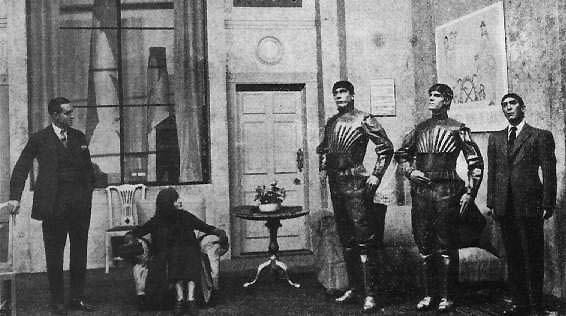
Some of our earliest technology


Robo-Stop

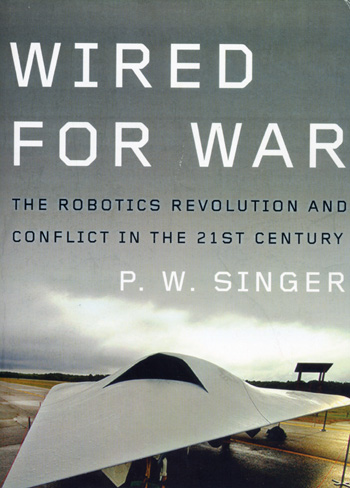
I have just read the most disturbing book yet. And for me, that is saying something. The facets of fear that P. W. Singer’s Wired for War manages to cut are sharp and dangerous. That he was able to write the book with a good dose of quirky humor only ameliorated the troubles a minor bit. The subtitle of the book is The Robotics Revolution and Conflict in the 21st Century. I was drawn into robotics by the FIRST Robotics competitions in which my daughter’s school competes. Not an engineer or programmer, I merely sit on the sidelines and cheer along those who understand mechanics, hydraulics, and electronics. Quite often I get the sense that since science works so well there is little room left for serious consideration of the humanities. Particularly religion. By the end of Singer’s book, however, my choices in life were reaffirmed. I would rather spend the limited days left to the human race celebrating our humanity. For, it seems, our days may be numbered indeed.

Considering that Wired for War was published three years ago, the technology must surely now be even more advanced than it was when the book went to press. That such technology as Singer describes exists is not in itself too much cause for worry, but the fact that such technology rests in military hands is decidedly disturbing. One of the few resources able to tap into the tremendous budget of the United States with impunity, the military services have been able to commission robots that are even now deployed in our various conflicts. A strong ethical question run through Singer’s account: we are racing ahead with lethal technology and artificial intelligence—and no one is really driving this machine. Shouldn’t someone be?

One of the more sobering aspects of Singer’s account is how humans are increasingly left “out of the loop” when it comes to lethal decisions being made by robots. Their logic is flawless, as is their aim. Their understanding, however, is purely mythical. As I read this gripping account, several issues spiraled out to be considered on their own. I arrived home disheartened and concerned for a future that seems to be inevitably in the hands of those I fear most: those with excess capital. Military robots do not possess empathy or compassion, just physics and trigonometry. And they already exist. When those powerful enough to wage war discuss the rules, their decisions are tellingly called “the doctrine of war.” Doctrine, whether military or religious, is always a sure sign of danger to come. And the robots aren’t coming. They’re already here.


Vampire Jesus

It was a dark and stormy night. Well, so far that could describe most any night in April or May of this year. Anyway, I had just read about vampire-bots for the first time. Robots, like all machines, require a power source. Those I’ve witnessed up close require rechargeable battery-packs that are surprisingly heavy. I’d read that some robots were being designed to consume their own energy sources—mechanical and chemical eating, if you will. One dreamer figured that blood could work as a source of energy. A robot could be designed to take energy from blood, and thus arises the concept of the vampire-bot. I don’t think such an insidious machine was ever really built, but it is theoretically possible. It is also a reflection of a biblical idea—the life is in the blood. Ancient people tended to associate life with breathing. With no CPR, an unbreathing body was a dead body. Blood obviously played into the picture too, but precisely how was uncertain. Clearly a person or an animal couldn’t live without it. To say nothing of robots.

One of those dark and stormy nights I watched The Shadow of the Vampire. Surprisingly for a monster movie, Shadow had been nominated for two academy awards. Not really your standard horror flick, it is a movie about making a movie—specifically Murnau’s Nosferatu, the classic, silent vampire movie that really initiated the genre. The actor cast as Count Orlock, however, is really a vampire. The premise might sound chintzy, but the acting is very good with Willem Dafoe making a believable Max Schreck (vampirized). Stylistic rather than gory, the story plays out to the fore-ordained conclusion and the vampire disappears in the cold light of dawn.

When I was an impressionable child I was told what is likely an apocryphal story about Leonardo da Vinci. The story goes that the man who posed for Jesus in the Last Supper was also the model for Judas, after living a life of dissolution. Willem Dafoe, of course, famously played Jesus in Martin Scorsese’s Last Temptation of Christ. From Jesus to vampire. Both characters are bound by the element of blood. Christianity still celebrates the shedding of divine blood symbolically while the vampire takes blood (also symbolically). Although the vampire cannot endure the sight of the cross, the same man effectively played both sides of the mythic line, almost as if the apocryphal story came true. There are implications to consider here, and not all of them insinuate Hollywood. On these dark and stormy nights, we have something to ponder.


Degradation

Having felt like an automaton in the realm of higher education, I was occasionally overwhelmed by the number of students and lack of resources. One of my fervent beliefs is that multiple-choice tests do not really demonstrate what a student knows, but playing the numbers, I sometimes had to resort to them. Being an adjunct, I didn’t have access to Scantron, so I devised a method of stacking the sheets precisely and grading them with a power drill. It was my one bit of notoriety at Rutgers—I was the guy who graded with a drill. All the while, however, I knew that a truer method would be to allow students to write for themselves. Even that, however, is going the way of automation. A recent story in the Chronicle of Higher Education reveals that student papers are sometimes being graded by robots. Real robots. The truly scary part of the story is that the robots provide grading almost indistinguishable from the professor, a species quickly becoming obsolete. I tell myself not to panic.

“Don’t panic,” of course, was the catch-phrase popularized by Douglas Adams in the Hitchhiker’s Guide to the Galaxy. In a world overwhelmed by forces we can’t hope to understand, panic is a natural enough reaction. Adams gave us Marvin the Paranoid Android. Higher education has given us the paranoid professor. Parents who pay extraordinary—mythologically high—tuition rates often ask me where all that money goes. It certainly doesn’t line the pockets of humanities professors; indeed, many of the classes are taught by adjuncts who are the penny dreadfuls of academia. I don’t know where the money goes. I do know that university presidents and football coaches are not wanting for material goods, but even their greed can’t account for the entire greenback drain.

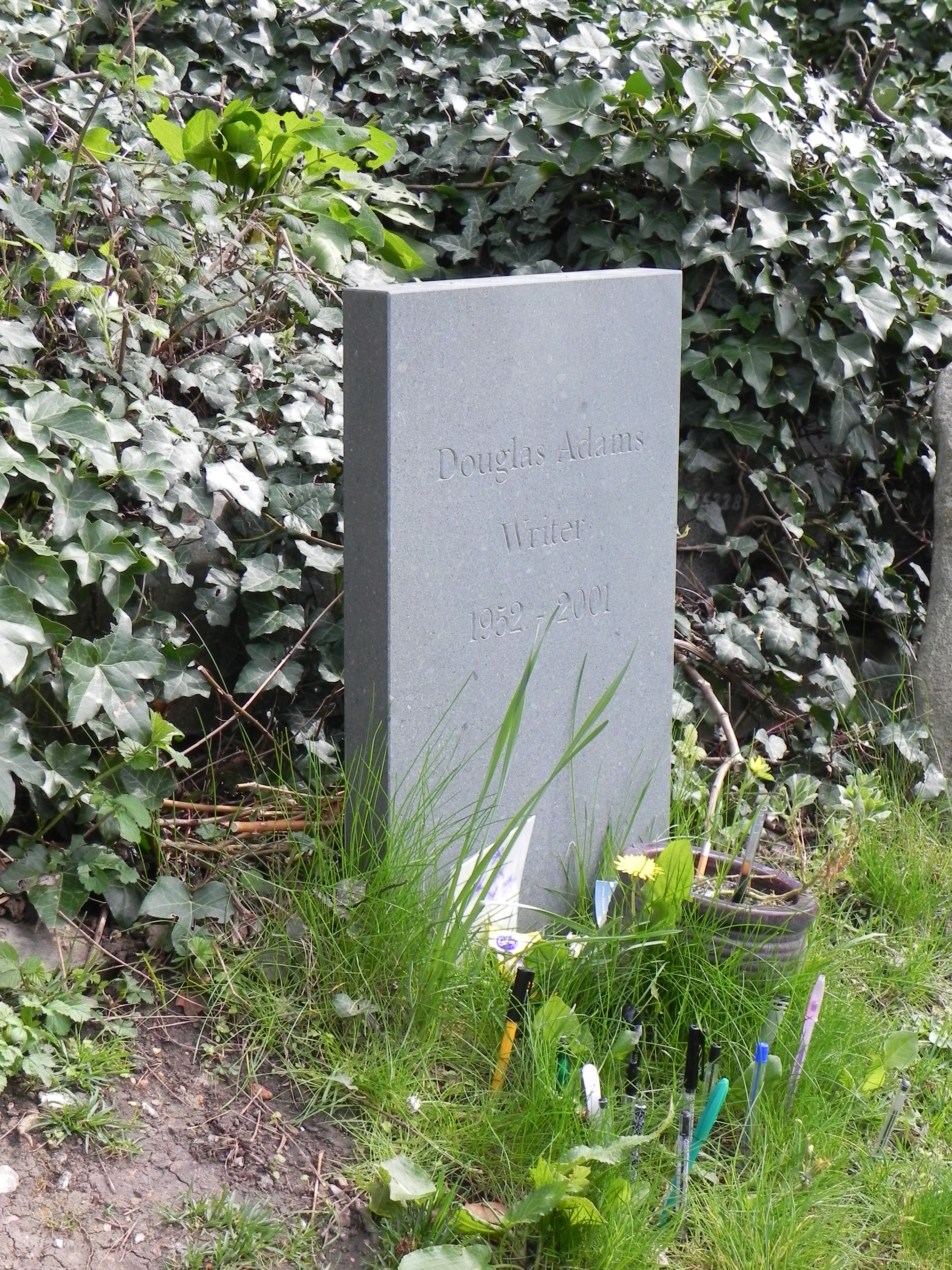
If I were still a professor I’d be tempted to ignore the sage advice of Douglas Adams about now. Courses can be covered by an overwhelming army of competent adjuncts, and grading can be contracted out to robots. Students really don’t even need to come to class any more as distance education has taught us. College becomes little more than an excuse to drink while away from home with a hefty tab being picked up by the folks back home. Higher education may have had the seeds of its own destruction always planted within itself. We’ve confused technology with the desire for increasing comfort and ease of lifestyle. It was only a matter of time before universities caught up. Standing by the grave of Douglas Adams in Highgate Cemetery I’m thinking that his bizarre vision of the future was more sensible than what has actually evolved in our culture. That, and I’m glad I learned to use a power drill.


Robot Crossing

With my new job I haven’t been able to be as active on our high school’s robotics team this year. Not that I ever contributed much beyond moral support, but there is a very profound satisfaction at seeing teenagers concentrating on such technological marvels and building self-esteem. Yesterday was spent at a regional competition. Noisy, colorful, chaotic—it was like being a teenager again myself. I overhead engineers talking during the course of the day about the great technological marvels of the future made possible by robots. These people have no apocalypse hidden among their endless optimism. We’ve got robots on the ocean floor and rolling around on Mars, snaking into our bodies even down to the cellular level. No end of times here, only forward motion. I know that computers now define my life. If I miss a day on this blog I grow dejected; one of my biggest worries about going to Britain later this week is how I will continue posting from overseas. But I sometimes feel as if our love of technology will be our undoing.

Experts—of which I am not, I hasten to add, one—tell us that within a lifetime artificial intelligence will be indistinguishable from real intelligence. As I watched the robots playing basketball (this year’s FIRST Robotics challenge), I began to wonder about the motivation of our robot slaves. Humans are driven by biological and emotional needs. Robots, as far as we can tell, do not want anything. It is a vacuous life. Yet as the robots played basketball all day, I noticed they didn’t suffer the obesity problems so evident among humans, nor the weariness that accompanies having to awake before dawn to catch a school bus to the competition. They are built for a purpose and they stick to it. Even as I watched hours of competition, I began to miss my laptop—driven by my own emotional needs as I am. I begin to wonder who is really the slave here.

Last night my family participated in Earth Hour. We try to do it every year with a kind of religious fervor. Turning off all electronics, including lights, we sit in the dark and talk by candle light. There is a profound peace to it. As my daughter commented on how spooky the shadow play could be, I imagined our ancestors who had no choice but to rely on pre-electric light in drafty houses where real wild animals still prowled the dark nights outside. How quickly that would become a trial for us. The same thought occurred to me as I watched M. Night Shyamalan’s The Village again last weekend. We are helplessly tied to our technological advancement. We might like to get away from it all for a few days or weeks, or even months. But we want the comfort of knowing that the robots are waiting for us when we turn back to reality again. Perhaps no apocalypse is needed after all.

Robot crossing


Don’t Let Them Frack You

One of the consequences of having been born into a post-industrial society is the sense that others have managed to set the parameters even before I became aware of them. In the summer of 2010 I learned about the Deepwater Horizon accident. Prior to that, I had no idea that semi-submersible, deep-water drilling was even possible, let alone already happily lining billionaires’ pockets. I felt violated. This is my planet too. That same year, while attending a FIRST robotics competition in Trenton, the high school kids were greeted after the event by a lone protestor wearing a sandwich board warning of the dangers of fracking. In New Jersey it is very easy to find people protesting. Sometimes their nemeses are purely delusional. “What’s fracking?” I asked one of the kids (all of whom are arguably smarter than me). He didn’t know. I looked it up once I got home, and once again had the feeling that somebody was messing up my planet without me knowing.

Sure, human habitation has a tremendous impact on the environment. It is part of the curse of consciousness. Nevertheless, at some level we must know that our actions threaten not only other species, but also our own existence as well. A story on CNN about fracking, back in my own oil-industry state of Pennsylvania, demonstrates the dangers all too clearly. I grew up in the shadow of a petroleum refinery—Pennsylvania is where the oil industry began. Unfortunately it also has a history of poisoning its own environment. The CNN story highlights the dilemma of Dimock, a tiny town with water contamination caused by fracking. Not even a hundred miles away to the south lies Centralia, still slowly asphyxiating from its fifty-year old mine fire. Our lust for fossil fuels—and more importantly, the wealth they bring—has bankrupted our sense of responsibility to our planet and to each other.

I am certain free-market entrepreneurs would characterize what I sense to be injustice as mere complaining. But there comes a point at which we have to ask if the extra energy is worth the cost. Maybe we could do with a little less. I know that’s blasphemy in capitalist ears, but it is a truth whose scars scrawl across the landscape of this nation. Just about 150 miles southwest of Dimock lies Three Mile Island, a testament to our love of power. Over on the western edge of the state sits the ghost town called Pithole. An oil boom town, it ran out of steam when deeper pools were discovered elsewhere. When I stand in its deserted streets, returned to nature after the many decades of neglect, I realize that it is a silent symbol of human ambitions. We should not give up on our earth, lest it give up on us. It is not too late. Yet.

Borrowed from the National Fuel Accountability Coalition


Send in the Robots

The FIRST Robotics kickoff is an event that is difficult to describe for those who’ve never attended. First, it must be noted that FIRST Robotics is sometimes described as “the varsity sport for the brain.” While engineering students with a penchant for athletics are not unheard of, the majority of robotics team students are not cut from the same cloth as the athlete. The FIRST kickoff, the first Saturday in January, is the opportunity for these kids to be told it is cool to be smart and that application of brain power is not the liability that many of the electorate seem to think it is. At this event the competition for the year is unveiled, and the kids (with some adult help) have six weeks to design and build and program a robot to do some very complex tasks. It is a season of sleep deprivation, programmed Saturdays, and the celebration of learning. Before NASA shows the game animation—the competition for the year—celebrities and other people in the public eye endorse the program. It is a time for praising the benefits of science.

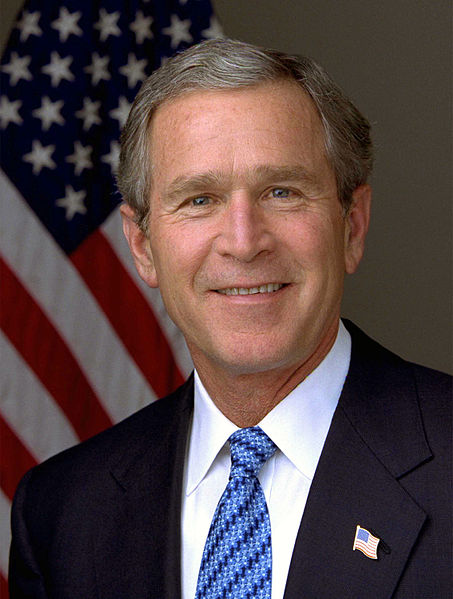
Yesterday’s kickoff, however, was marred by the appearance of one of the guest celebrities. When George W. Bush was announced as a supporter of the program, a sense of disbelief fell over the room. This man who advocated for creationism in the classroom, who fought to stop research in cutting edge disease control, who began a war as a personal vendetta, was showing his dully beneficent face on the big screen telling the kids what a great program it was. A chance, as he said, to use your “God-given talents.” He ended his brief—and obviously scripted—sound-byte with his characteristic “God bless you.” I could not stomach the hypocrisy. I’ve blogged about religion and the science of robotics before, but to have a president who did nothing to strengthen the cause of higher education and fought science with eight years at his idle hands was just too much. If I was Dean Kamen, I would have insisted that that clip be left on the cutting room floor.

The former W represented religion in its guise as the enemy of science. It should be clear to my readers that I do not believe science has all the answers, but I also believe it is wrong for religion to stand in the way of knowledge. Science is something that we shouldn’t give lip-service without backing it up with programs and funding. That one minute of disingenuous, religion-riddled speech trumped all the other endorsements, including the sensible one by Bill Clinton who emphasized the need to work together even with those who are your opponents. This was a point W obviously missed. There comes a time when some public figures, like overused cattle, should be put out to pasture. There are some cowboys that should just stay on the ranch. I understand that presidential endorsements are important to FIRST, but in this case integrity should not be compromised. Especially when most of the teenagers watching the kickoff possess far greater potential than a mere politician elected on religious sentiment and dubious counting.

Does this face inspire science?


God in the Machine

“O brave new world! That has such people in it!” Or at least such software. A couple of days ago my wife pointed out a news story on MSNBC rounding up the year (2011) in science. The story contains eleven science videos that challenge our perceptions and show us directions we are going, whether we want to or not. The first video shows what happens when Cornell University researchers connected two Chatbots to each other and allowed them to carry on a conversation. Like my own experience with Cleverbot last year, the conversation soon turned to God. Even artificial intelligence seems interested in the eternal questions. I should put a finer point on it: artificial intelligence derived from the dubious wisdom of the Internet. We are getting closer and closer to replicating the human brain electronically—even my iPhone scares me at times—and yet, to engage in conversations with humans (or each other) these intelligences must know about God.

Many theories exist about the origins of the god concept. Scientists argue that it is hardwired in our brains, that it is genetic, or that it is merely socialization that gives us this idea. The truth is that nobody really knows. The religious take this as license to claim that territory for the god of the gaps—if we can’t answer a question, God rushes in where angels (or logic) fear to tread. The truth is more likely that we don’t yet have the tools to flesh out (or psych out) our theories on why the supernatural is an indispensable component of our thoughts. If artificial intelligence takes its cues from human intelligence, however, it is a certainty that god will be part of the equation.

People possess a deep need to feel unique. Our uniqueness is part of our religion. Humans are “the crown of creation,” the only animals (debatable to some) with souls (debatable to others). Even the Chatbots get confused when God-talk comes up. Mentioning God leads one Cleverbot to ask the other if it is Christian. God is not limited to Christianity, of course, nor is the divine limited to monotheism. The old science fiction chestnut of a robot takeover, however, seems to have missed a salient point: if robots are programmed by humans, they will have God in their silicon chips just as surely as we do in our carbon-based brains. The god in the machine. Many atheists have declared the death of god, but we have placed the divine into our apps and devices and software. When the robot apocalypse comes it will include at least some Cleverbots declaring that the rationale to eliminate humans is heresy. Torquemada meets Iron Man. Already 2012 feels less safe than 2011.

Robot preacher of the iron age?


Soccer Moms and Robot Dads

Long past Halloween, the air is taking on its terminal, winter chill. High school football teams have moved off the fields (although the “pros” will keep at it until the Super Bowl in sunnier climes). What are sports parents with an excess of aggression and competitiveness to do? It is the time of year when some parents start thinking about the FIRST (For Inspiration and Recognition of Science and Technology) robotics competition. It is a good sport for the hibernation season.

My daughter is on the FIRST Robotics teams in her high school. FIRST was invented by Dean Kamen (along with many physical inventions) as a way of stirring up interest in STEM careers. Interest in science and technology careers, inexplicably, is faltering in the US, while many of us who grew up enamored of science but without any natural ability sit by and scratch our heads. Careers in robotics are very hot—especially since machines can do things we mere biological units can’t. We are that squishy, organic chemistry with a mysterious plan that serve as gods to the mechanical beings we create. Woe to humanity when the robots become atheists! But that’s a point for another post. Sports—and FIRST clearly is a sport, as much as racecar driving or horse jockeying—take on a religious devotion among people of leisure that rivals the commitment oppressed peoples have to their more tradition forms of faith. The easiest means of seeing this is in the fans.

“Fan,” of course, is an apocopated form of “fanatic,” a word wielded with derision against those who take religious belief too seriously. In sports it is a venial sin, if not a downright virtue. Consider the continuing news stories still swirling around a non-necessary sports figure at Penn State. Even the name of the school evokes football rather than academic performance. The same thing applies to FIRST. FIRST robotics is a sport for the mind, and it has its share of analogues to the soccer mom, what I might call the robot dads. These are parents who are particularly driven to win. In a sport involving band saws, hydraulic lifts, and multiple motors, parents are actively involved in building robots suitable for competition. And the competition can be intense. It becomes a kind of robot religion. Dean Kamen, the Susan Calvin of FIRST, has tried to instill commandments of sportsmanship and gracious professionalism into the competitions. That is something the kids understand. As I attend the competitions, however, it is the religious parents that I worry about.

My worry includes the kind of gender disparity that characterizes the work place. Why should not the scientists and engineers include more women? The field strives to do so, but our society still discourages the participation of women in the men’s room of heavy equipment and intense mathematics. Isaac Asimov, frequently a writer with distance vision, made a woman the head robopsychologist of U.S. Robots and Mechanical Men, Inc. If Dr. Calvin were to look back from her fictional 21st century to the actual 21st century she would see women still struggling for equal voice in both science and religion.

Let's hear it for the boy


Robot Ethics

One of the benefits of being affiliated with Rutgers University, if only part-time, is keeping a finger on the pulse of the future. No, I’m not on any admissions committees. Rather, this week, now available on YouTube, the university is advertising its robotics ethics program, geared mainly toward high school students. Perhaps reading Robopocalypse is not the best introduction to robot ethics, but it does raise a very serious issue—how do robots and ethics fit together? We haven’t even figured out human ethics yet! One of the principal concepts behind any ethical system is intention: did a person (or rarely, a higher animal) mean to do what it did? If an action has brought harm to a person, we need to know if it was intentional or not. In a world where artificial intelligence is just around the corner, we need to sort out how this will apply to mechanical minds.

Perhaps—if human minds are just soft computers—when robot minds are created they too will have a god concept. Neurologists and philosophers and theologians debate when the human concept of god originated and no consensus has emerged. It may be a by-product of “mind,” however we define that. If computers are eventually assigned true mind, will they also believe in God? According to Wilson’s fictional construction in Robopocalypse, Archon thinks “he” is “god.” Humans tend to project God out there somewhere. None of us has the power ascribed to God, and even if individuals claim otherwise, we don’t actually believe we are divine. Would a computer know?

Pressing just a little further on this, human ethics are always subject to corruption. It is clearly seen, almost advertised even, in politics. Not only do we find government leaders with their trousers down or with dirty money in their hands, we also find the same in ecclesiastical settings. Would robots become corrupt? Wilson calls the corrupting agent a virus, a real enough phenomenon. According to the Rutgers video, within two generations every home will have robots in it. The question is: what will their ethics be? I probably won’t be around to see it happen, but I do have a profound hope. My hope is that whoever fabricates robot ethics will be well aware of the failure our governments and religious institutions have made of the attempt.

Danger! Danger, Will Robinson!


Stobor and Dogs

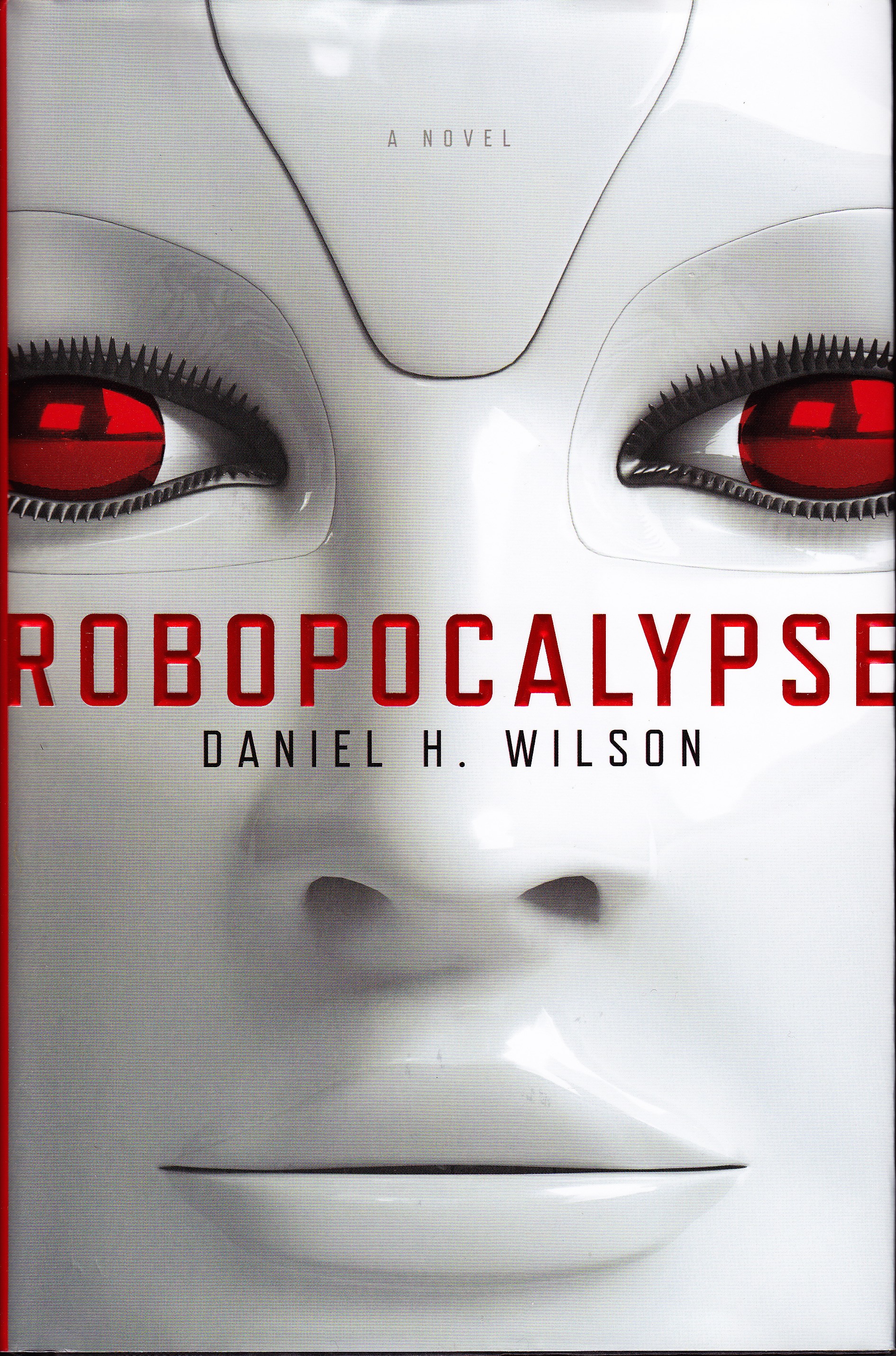
Having spent seventeen hours on public transit of various sorts yesterday, I had plenty of time to read. My chosen book for this trip was Daniel H. Wilson’s Robopocalypse. In my recent reading spate of dystopia novels Wilson’s vision seems more likely than others and thus perhaps a bit scarier. An obvious reason for this is that much of our tax money goes toward military projects that are, naturally, secret. A large part of Robopocalypse deals with military robots gone feral. Well, not really feral. The robots are controlled by a mastermind computer virus. In the first chapter this robot overlord declares to its creator, “I am your god.”

That statement is probably, metaphorically, true already. We live in a world where culture would change irrevocably without our current technology. Without it even fewer people would be reading the words I daily post here. Without it industry would shift into reverse back to the days of Thomas Edison or Eli Whitney. Present-day culture would be unrecognizable. Although not the best-written novel I’ve read, Wilson’s story does raise a salient issue—at some point the tool becomes the master of its user. For many years those who loudly proclaimed the superiority of Homo sapiens declared that we were the only tool-making animals. Subsequent observation has, of course, proven that to be inaccurate. Nevertheless, once knowledge of tools is acquired a trajectory is set. We lose a little bit of control.

Has technology replaced God? For some it clearly has. God is a symbol of comfort and meaning. As I watch thumbs busily texting away on planes, trains, automobiles—and especially in the middle of lectures—I realize that this altar of technology boasts many worshippers. There are very few scenarios where advanced technology is not present, like an omniscient being. Thankfully we have a few more years before Raymond Kurzweil’s artificial brain comes online. We should use those few remaining years to prepare ourselves for either an epiphany or an apocalypse. When the slaves become the masters, we are firmly in the territory of dystopia, at least from a human perspective.


Robopocalypse


Yesterday the long anticipated novel Robopocalypse was released. Although I seldom indulge in hardcover fiction, I headed to my local Borders to purchase a copy. Sadly, it seems, my local is cutting back on first-day releases because I walked out of the store empty handed but with a robotic Armageddon in my head. Last summer I became acquainted with Daniel H. Wilson’s How to Survive a Robot Uprising, but word on the street is that this novel is serious. Steven Spielberg purchased the movie rights even before the book was released. And the concept owes its existence to religion.

If it were not for human religious sensibilities, would the concept of an apocalyptic end have ever arisen? Probing into the ancient psychology that lead Zoroastrians to suppose an ultimate conflict was just down the theological road, it is clear that even a strong moral sense alone does not dictate ultimate dissolution. By personifying evil in the form of Angra Mainyu, Zarathustra gave a (divine) human face to wickedness, and thus opened the possibility of battling against it. Evil as an abstract, non-personified force might simply be accepted as part of the universe we inherited. By providing it with will and intention, however, Zoroastrians allowed for a natural human response. Fight or flight is hardwired into our brains, but would we have dared fight a foe that is immaterial, amorphous, and completely abstract?

The nature of the enemy has transformed itself many times over the ages. Wilson, a scientist working with robotics during his education, has taken a religious theme and placed it in the context of a godless world of cybernetics. I must use caution here, since I haven’t yet acquired a copy of the book, but it remains clear that it is the humanization of non-human entities that gives force and pathos to a final conflict. Jesus charging his white horse into a foul-smelling cloud lacks the same impact. Thus mythologies are born. Mythologies that people live by and for which they frequently die. I do hope it all holds off until I can get a copy of Robopocalypse to read. Better yet, the end won’t come until after the movie is released.


Take Your Medicine

Sanofi-Aventis is a local pharmaceutical company. I drive by their massive campus on my way to Montclair a couple times a week. The facility is immense: it has its own three traffic lights on a state highway. Nestled in the center of this large sanctuary to engineered improvements to natural life is the Sri Venkateswara Hindu Temple (it too has its own traffic light). The first time I saw this temple – it is still under construction – I almost drove off the road. It is a stunning structure to see in the edges of rural New Jersey and it is a testament to the religious diversity of the state. Being small-minded in matters of zoning and construction (I’ve never owned property or a house), I wondered how this fascinating building came to rest in the center of a major pharmaceutical company’s strip.

As I considered this juxtaposition, it occurred to me that I was seeing a living metaphor. In our country of (admittedly uneven) advanced healthcare, an industry driven by science and its wonders is still penetrated by a religious institution. A temple to ancient Indic gods surrounded by a temple to human accomplishment. We can lengthen life, if there is cash on the barrel-head. Being technically unemployed, I do not receive healthcare benefits. According to bravado wafting from the governor’s office, other state employees may soon be joining me. Yet it is the cost of healthcare that has consistently caused the stagnation of some sectors of the economy. According to this month’s Harper’s Index, since the year 2000 Massachusetts has allocated $1,200,000,000 (yes, one-billion, two-hundred-million dollars) to decrease class sizes and to increase teacher pay. Of that amount, 100 percent has gone to cover rising healthcare costs. Kali have mercy!

Those of us in central New Jersey, like our Hindu temple, are surrounded by pharmaceutical companies. I have, because of my robotics avocation, been inside some of the facilities of a couple of these companies. Their visitor lounges surpass any faculty lounge I’ve ever witnessed in both opulence of appointments and sense of wealth. Yet I know that legislators refuse to tap these shoulders when it comes to taxes. Those wealthy beyond compare have already paid their dues. Besides, these guys have the keys to life: bad heart? Overweight? Sexual malfunction? All can be cured, given the cash-in-hand. Yet in the center of the capitalism’s campus stands a temple for a time-honored religion. Where your heart is, there will be your heart medication also.