Zombies, Golems, and Robots – Oh My!

A truly great metaphor is hard to kill. Despite detractors and naysayers, the zombie has clawed its way into the modern psyche as a denizen of the living death of a world we’ve created for ourselves. Joblessness, environmental disasters, tea parties – just when you thought it couldn’t get any worse, the dead refuse to stay dead. Elsewhere on this blog I’ve written about the origin of zombies in Voodoo, and I mentioned in passing the connection with the golem. The golem is a mythical Jewish creature that serves the role of protector of the oppressed (one can’t help but think of the Democratic Party). It is strong, dedicated to its task, brainless and soulless (one can’t help but think of the Religious Right). Like the zombie, the golem has no inherent ability to think for itself, and it must be animated by a magical word written on its forehead.

Golem around the corner

One of the most famous golem stories involves the Golem of Prague, defender of the oppressed Jews in that city in the Middle Ages. The Prague connection also forever ties the golem together with robots in Karel Capek’s 1921 play, R.U.R. (Rossum’s Universal Robots), the very origin of the word “robot.” Like the golem the robot putatively has no soul. It too is controlled by a code written precisely for it. Unfortunately on my one trip to Prague back in 1991, I didn’t know to look for the golem – I did find the statue of Jan Hus, however. Right around the corner the golem lurked, standing guard over the oppressed. It is a powerful image when the world is in such a state.

We need a hero

With the recent release of George Romero’s Survival of the Dead, the zombie has been given renewed life. Watching the Republican Party gearing up for a major thrust at the very soul of America, lining up the local BP station to support big oil, spouting false rhetoric about what the Bible says, I think I’d rather take my chances with the zombies. Does anyone out there happen to have a golem for sale, just in case?


Aye, Robot

Being a “biblical scholar,” having an interest in robots might seem counter-intuitive. I was intrigued by the topic as a youngster, but convinced that if what the Bible said was true it deserved nothing less than full attention, I let my formal study of science lapse (although I kept an active reading life on it). Now, through the interest of my daughter, I have found myself mentoring budding young engineers, mostly by helping put things away and correcting grammar. Yesterday we took our robots outside for the local street fair. Almost always the response we get from local people is “Robots? Our school has robots?” Well, partly correct. The schools house the robots, but our robotics club is largely self-funded, so the robots might be said to belong to the team rather than the school. In any case, yesterday the robots played soccer in the street for the amusement of festive fair-goers.

People often fear “soulless machines.” They run by predetermined rules, set down explicitly in computer code, and do only what they are programmed to do. Some fear artificial intelligence for this very reason: what if robots or computers are programmed to think? Does this make them something more than physical machines? The standard, religiously biased, answer is that the soul, or even mind, is a uniquely human possession. Animals may act on instinct, some may qualify as having a limited mind, but definitely not souls. That would simply cross too many boundaries. When asked to produce a human soul for scientific scrutiny all religions come up blank. We don’t actually know what a soul might be – an everliving component that God might throw into Hell or spoil in Heaven seems to be the general gist. And it makes our moral choices for us.

In the Bible if any animal (say a bull) gores a person to death, and that bull had a prior reputation, not only beast but master could be put to death. It seems that the bull has a bad moral intention. If robots hurt people, in violation of Asimov’s first law of robotics, they are treated as acting with moral intention. We project souls onto them for the convenience of condemnation. If an animal, such as a zoo gorilla, saves a human child, that animal receives the treatment of a souled being for a while, until the act is forgotten. It seems that souls are immaterial components of a closed system used to reward or punish an individual. How much of themselves do humans have to put into their robots before they can have souls as well?

Robots among the people


Mystical Aquariums

This is the dawning of the age of aquariums. With the Gulf oil spill still gushing out of control, there is a current awareness of the plight of the seas due to unnatural (i.e. human) interference. Perhaps that is why so many people flocked to the Mystic Aquarium yesterday. That, and the fact that it was a beautiful day on the northeast coast. Having grown up in land-locked western Pennsylvania, I have always appreciated the oceans and their microcosms, designed for human visitation. My first actual aquarium experience was the New England Aquarium in Boston, a facility that sets a very high standard for all others. Trips to the Seattle Aquarium, the Norwalk Aquarium, the Camden Aquarium, and a variety of smaller facilities (I unfortunately missed out when my family visited the San Francisco and Shedd (Chicago) Aquariums) always leave me with a sense of connectedness to our planet. Life emerged from the seas, and, as Rachel Carson observed, we always long to go back to our ancestral home.

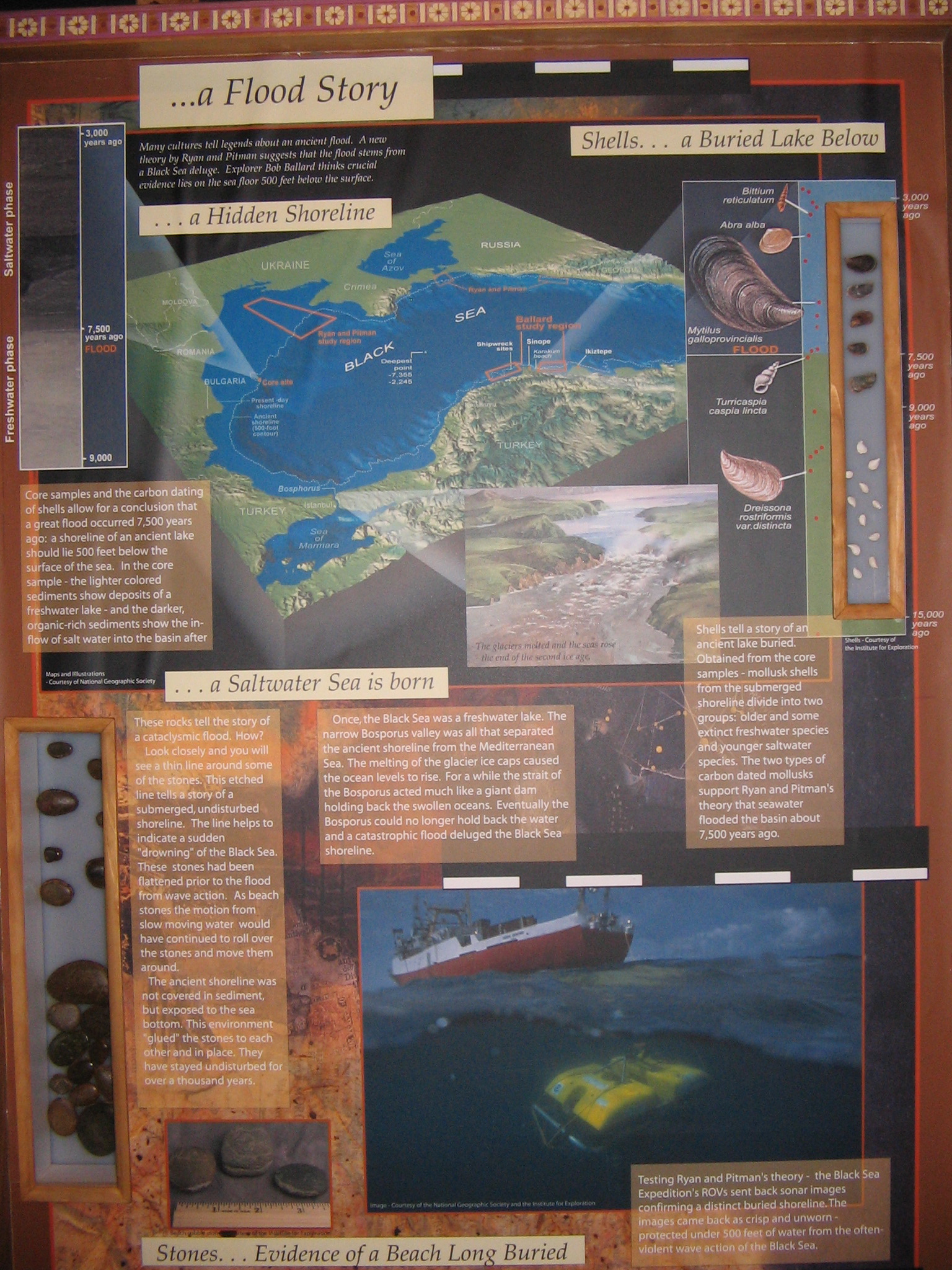
It is easy to spend an entire day at the Mystic Aquarium. Beluga whales are impressive close-up, and the sea lions show more intelligence that your average Republican. Jellyfish, with no brain at all, are capable of doing tricks humans can’t – a tank of bioluminescent jellies was captivating. The penguins had a fascination all their own. It had been a few years since I’d been able to pet a shark or ray. In a separate exhibit on Deep Sea exploration, largely featuring Robert Ballard, the man who discovered the Titanic, the aquarium houses several robots used for entering regions uninhabitable by humans. Since my intense association with FIRST Robotics is never far from mind this was an unexpected bonus. The biblical aspect of the journey, however, came at the end.

Exhausted from a day of wandering, hot and lethargic, we came across the final exhibit: Noah’s Ark! I had begun to wonder if I’d managed to spend a day in an entirely secular venue when the Bible showed up. The display was about the Black Sea. William Ryan and Walter Pittman’s theory of the origin of Noah’s flood in the Black Sea deluge was showcased, along with a video of Ballard, Ryan and Pittman discussing their ideas. As I tell my students, I don’t find this theory particularly convincing – the flood story first emerged, it seems, in southern Mesopotamia – but it is an excellent example of the hold the Bible has on the western imagination. The Black Sea did flood, shifting from fresh to salt water; that discovery is fascinating in itself. In the western world, however, it somehow just feels incomplete without giving old Noah his own Nantucket sleigh ride. To find the origin of the story of Noah, a trip to any vantage-point along the ocean where the power of the sea is evident is all that is required.


Robots and Religion

One of the constant duties I have as a “Robot Dad” (Soccer Mom just doesn’t apply here) is seeking funding for my daughter’s high school FIRST Robotics team. Always a supportive layman in the scientific venture to understand our world, I have encouraged this interest although I am pretty hopeless when it comes to understanding how it all works. So last night I found myself at a fund-raising, public-awareness event at the local minor league stadium. The Somerset Patriots stadium is just down the road, but I’d never been to a game before. I really don’t feel comfortable participating in crowd dynamics; I’d rather sit back and analyze than participate. And I have no real interest in sports. I wondered how I was going to survive being in such a foreign environment for several hours. Then my wife pointed out a, as it were, godsend.

Last night was “Faith Night” at the Somerset County Ballpark. The event was sponsored by Somerset Christian College, “the ONLY licensed and accredited Christ-centered, evangelical, undergraduate college in New Jersey.” Located in the appropriately denominated Zarephath, New Jersey, the small, extremely doctrinal college bought the privilege of a pre-game sermonette. Not too often does a public sporting event begin with references to “our Lord Jesus Christ;” I looked around for him but then remembered he’d been hit by a car just under two weeks ago. One of the administrators addressed the crowd and, trying to capture the elated, anticipatory feel of the moment, compared his college to a baseball game. I was busy handing out fliers and missed the early stages of his rhetoric, but when I heard him say, “third base is love,” my mind shifted to a more familiar baseball analogy I’d learned in high school. I imagined the prospective students’ interest when he went on to declare, “home base is Heaven!”

As two Christian motorcycle clubs solemnly rode their hogs around the field and local Catholic schools hawked their own fliers in competition, the sound system belted out any pop songs that had the word “faith” in them, no matter what the context. It was a circus-like atmosphere. I was surrounded by techies deeply immersed in science and human learning. We, in turn, were surrounded by an aggressive Christianity eager to claim as much territory as possible. Above it all wafted scents of searing flesh and deep-fried snacks. It seemed to me that a microcosm of American life was indeed evident at the stadium last night. Perhaps there is nothing as American as baseball after all.

Lead us not...


Soulless Robots?

Robots have taken over my life. At least in the short term. As my friend Burke commented on Easter: “Alleluia! The robots have risen… up against us?!” Actually, the robots I encounter are benign and all follow Asimov’s rules. I have mentioned before the phenomenal First Robotics program, a venue to encourage high school students to consider careers in engineering. Team 102, Somerville High School’s robotics team, recently won a regional competition in Hartford, Connecticut. My role has mostly been to watch other people design and construct the robot while occasionally correcting the grammar on written documents. The joke my friend made, however, has at its roots a deep-seated human concern: how do people deal with soulless machines?

Stephen Asma, in his book On Monsters, has a chapter concerning the human fear of a robotic future. Electronic gadgets with uncompromising metal bodies and no consciousness that we recognize present a frightening combination. The question that concerns me more, however, is the concept of the soul itself. The Hebrew Bible has no concept of the soul as it would later be adopted by the Judeo-Christian tradition. In the Hebrew Bible a body is a soul; when the soul dies the body dies – people are a monistic unit, not a dualistic entity with a part that hangs around the spirosphere after the biological part rots away. Of course, in Christianity the soul has become an essential aspect of church doctrine and we fear other creatures that lack them. Souls have never been observed in a laboratory and we have yet to prove their existence.

Reading the news and seeing how biological, soul-fueled humans treat each other is a sobering task. Each day I lay the newspaper down with a new kind of dread. Perhaps souls are only mythical beings concocted to shore up a theology that can’t survive without them. Or maybe all living beings have souls. Perhaps even mechanical ones. As Team 102 heads to the national competition in Atlanta in the days ahead, I know that I’ll be rooting for a soulless machine that may be a bold step towards humanity’s continuing evolution.

Sorry for the blur, the robot just wouldn't stop shaking me!


Clash of the Titans

Over the weekend I joined the thousands flocking to theaters to see Clash of the Titans. I first met Perseus in fifth grade and have been intrigued by classical mythology ever since. I tried not to believe that it was nearly three decades ago that I sat in the single screen theater back in Oil City, Pennsylvania watching a film with the same title and Ray Harryhausen’s famous stop-motion animated creatures. I was anticipating great things. While the new Clash is visually stunning at several points, the post-modern story line primarily demanded my attention. While there are gods galore in the film, the message is maybe not atheistic, but, to coin a word, anolatric – denying worship to the gods. Time and again Perseus refuses the help of the gods and when he finally meets Zeus, his absentee father, he shows him anything but respect.

Who let the trogs out?

The Greeks, like all ancient peoples, primarily feared the gods. Not offending deities was a societal expectation since an infraction on the part of any citizen might lead to divine repercussions. Dictys, Perseus’ adopted father, rails against the gods for allowing the degeneration of society, a trait that Perseus takes to extremes in the movie. In battling the monsters, Perseus is storming Olympus itself. In a nod to the Easter weekend crowds, Perseus defeats death himself by banishing Hades to an incongruously fiery underworld. I left the theater slightly stunned; here had been a hero standing before the very gods but refusing to worship. Clash of the Titans indeed.

While my family was off winning the Connecticut Regional First Robotics competition in Hartford (go Team 102!), I had consoled myself the night before seeing Clash by watching the cheesy 1968 Japanese giant monster classic, Wrath of Daimajin (also known as Return of the Giant Majin). I had seen the original Giant Majin some time ago, but here was a “monster” movie where the destructive colossus was himself a god. The Giant Majin is a protective mountain deity who, when injustice grows unchecked, breaks free of his rocky home and destroys the wicked. The Wrath of Daimajin included startling biblical imagery: as the Majin stomps through the sea the waters part as if Moses were on the god’s shoulder. The faithful female protagonist is being executed on a cross (burned at the stake, but tied to a cross), and the Majin breaks the gibbet and holds her aloft, the very tableau of the evil-banishing crucifix. As always, the Giant Majin vanishes at the end, leaving the oppressed to build their own, better future.

I dream of Majin with a dark green face

Such movies are benchmarks of public theology. Made by laypersons trying to express their ideas about the divine world, I find them a crucial measure for any teacher of religion to watch, mark and inwardly digest. In just 24 hours I saw a Shinto god go Christian and a Greek polytheist lose his faith. The world just can’t figure out if the gods are for us or against us.


Emasculating Science Education

American lags behind. Tough words to read, n’est-ce pas? America lags behind in science education. Even nations as “conservative” as Tajikistan teach evolution in their classrooms without question while the United States just can’t seem to accept the facts. The fault, with no question whatsoever, lies with a very narrow Christian interpretation of the irreconcilably contradictory creation stories that open the book of Genesis. This fact has once again come to an ugly head in New Jersey, among the bluest of states. Our, gulp, Republican governor has recently nominated Bret Schundler, a supporter of school’s rights to teach intelligent design, as state commissioner of education. I shudder.

As I teach classroom after classroom of Rutgers students, there is neither biblical nor scientific basis for Creationism. Creationism is a neo-Christian chimera forged together by political pundits who believe that if evolution is stopped in its factual tracks, America will revert automatically to the pre-hippie days of the 1950s where authoritarian dads with conservative haircuts barked out the family marching orders and saw everyone to gospel-hymn-singing churches each and every Sunday. It is a myth, they assert, that is worth believing.

The problem is that facts don’t evaporate simply because nabobs don’t like them. At the FIRST Robotics competition I attended this weekend, facts were presented. The facts are that America has fallen far behind in science education. Decades of fighting the pointless battle of Creationism at the highest political level in this country have weakened us. Those who study the Bible seriously do not question evolution. Those who study science at all cannot seriously question it. Those who do dig trenches of doubt in the minds of generations of Americans with an already inadequate understanding of science and suggest that maybe there is reason to find an atheistic plot behind evolution. There is no plot, only facts. And if New Jersey is about to join the Kansases, Arkansases, and Texases that see big cars, big oil, and big daddies as the solution to our social ills, it may be time to move to New Hampshire.


Robo-god

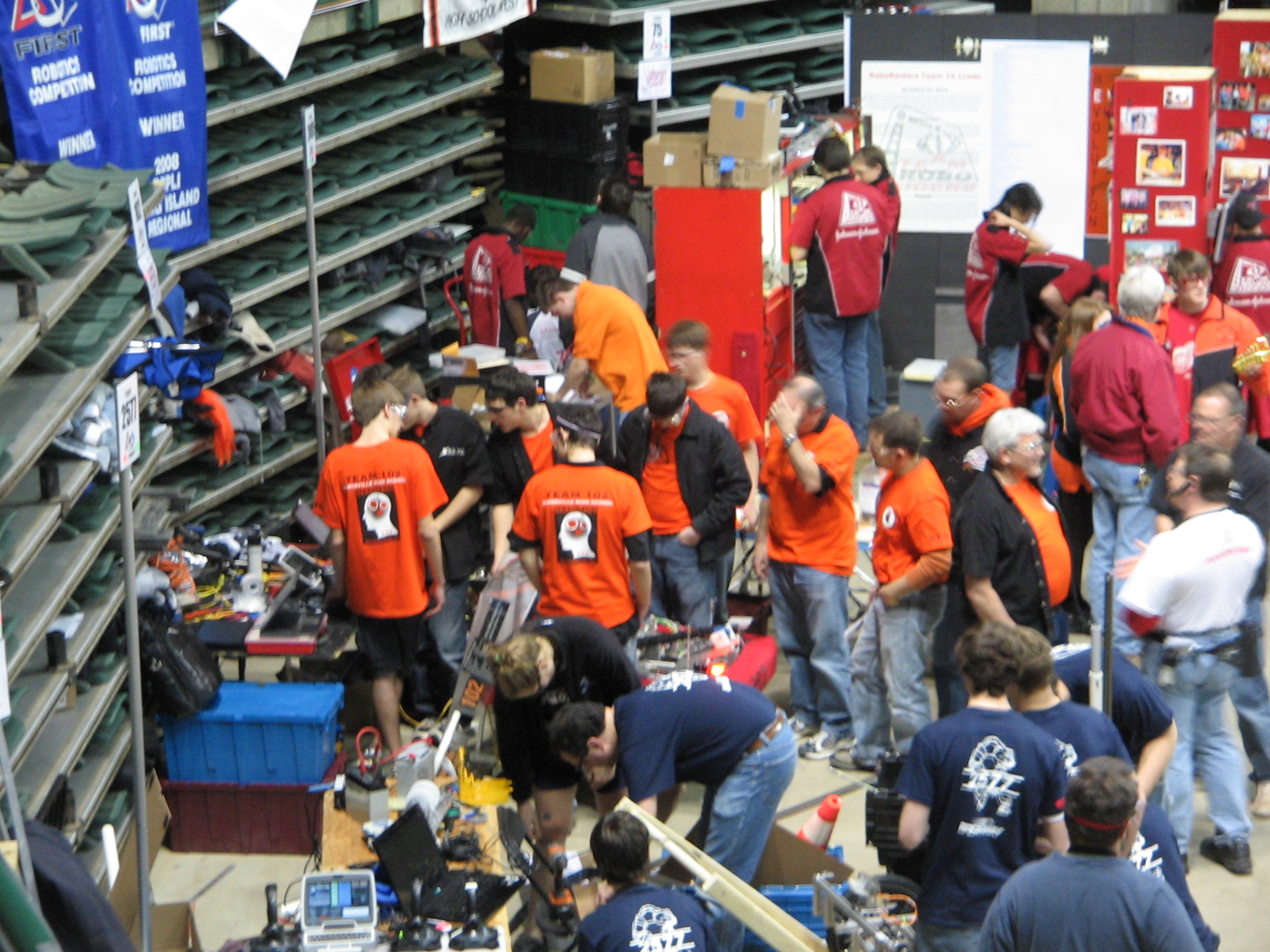
Yesterday I again found myself among the robots. After an early-morning school-bus ride to the New Jersey regional competition in Trenton, a mentor to a team known as the Gearheads, I felt a little out of my league. Soon, however, I fell into the spirit of the competition and watched with increasing interest as individuals highly regarded in the world of robotics lamented the lack of science education in the United States. Having just completed the nightmare of two terms with a creationist president, is it any wonder? In any case, the competition, a modified soccer match for robots – with two teams from Brazil, no less! – soon became as emotional as any sporting event. Well, for the human participants, anyway. I’m not qualified to assess robotic emotions. As the event wound down, a respected (human) member of FIRST Robotics, during a recognition ceremony, overcome with emotion, called out “God bless you!” to the adult volunteers.

Many scientists I know are personally religious people. There is no fortified gateway between scientific reasoning and the childhood teaching of religious belief. Nevertheless, an irony became apparent that has been bothering me all night long. I joined Team 102 as a mentor because of my daughter’s interest in robotics and engineering. My role is to help with editing, since I am a “humanities” type. The irony that leaves me sleepless is that Ph.D.s in the sciences are highly coveted and have an assurance for jobs. Ph.D.s in the “humanities,” however, are a sure way to block you from career success. Since I began this blog I have been officially unemployed (I pick up a course or two here and there, but no full-time offers have been presented). The people who have been most empathetic and helpful in this time of difficulty have been the robotics team. People there have tried to hook me up with people who might be able to help, but I am like an alien on the autopsy table among scientists – where do you begin? How do you help an overly qualified “humanities” ex-professor find a job? Meanwhile my co-“humanities” colleagues helplessly wring their hands and do nothing. Worse, they interview me and decide not to make a hire, based on “religious” reasons.

The past several years, as the recipient of calculated cruelty from many religious folks, stumbling along trying to find a means of reasonable support, I have come to trust the robots. The robotics team has demonstrated the most humanitarian attitude to a fellow human who has been suffering for several months. The religious tell me that God will work it out and go their righteous way. Yesterday, being blessed by a “high priest” of the robotics world, I felt that I finally found a place I belonged. Now it might be time to go back to school and find the real pulse of humanity in the sciences.

Kids building robots


Klaatu Barada Nikto

I grew up with robots. Of course they were on the television screen and I was far away in rural-ish western Pennsylvania. They were exotic creatures built by guys much more intelligent than I could ever hope to be, and they were powerful, completely rational, and scary. Now I find myself involved with the FIRST Robotics team in my daughter’s high school where kids a third my age are building a robot. It is a humbling experience.

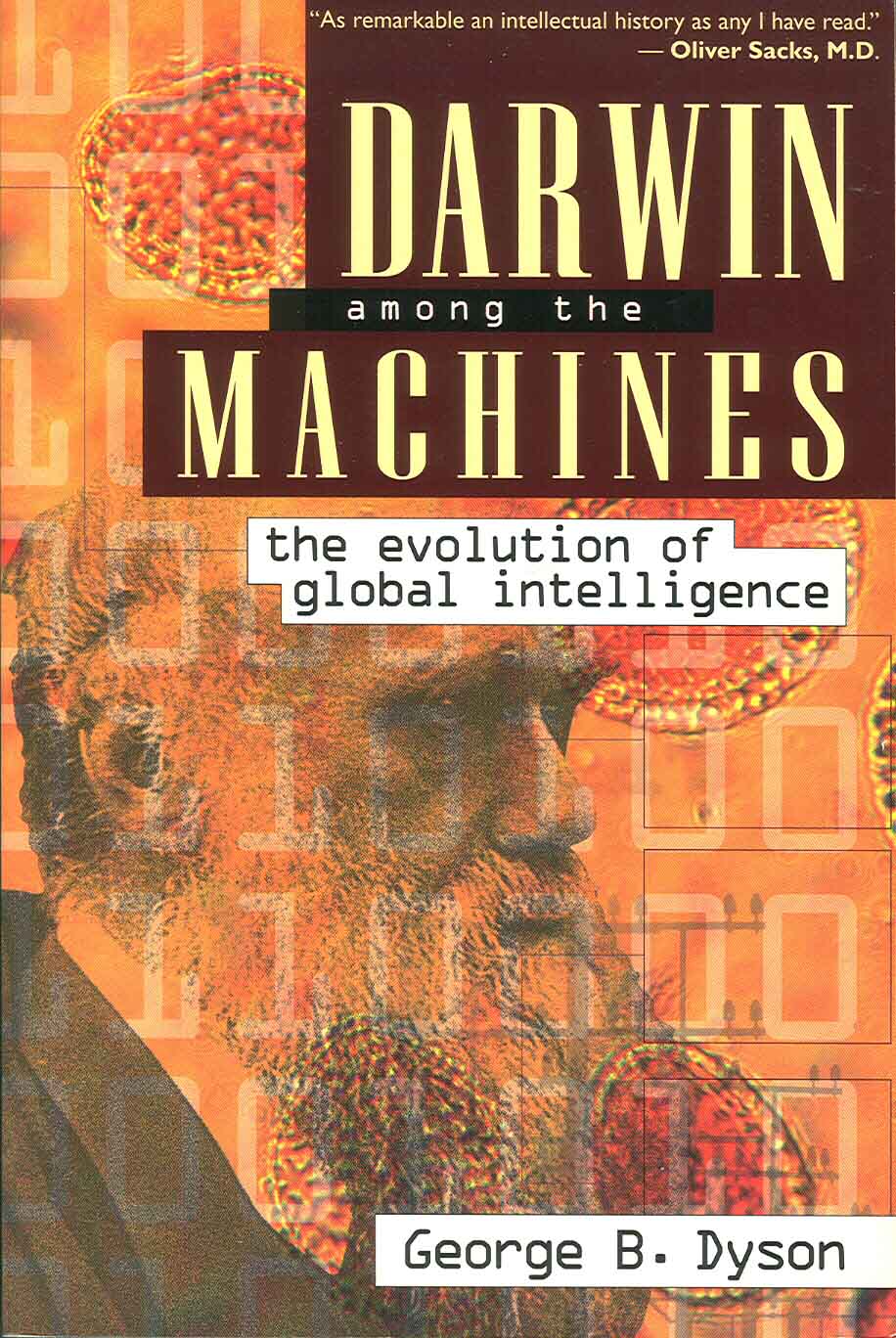
The more I ponder my small support role in the construction of a robotic creature, the more my thoughts turn to George Dyson’s masterful science writing in one of my favorite books — Darwin Among the Machines: the Evolution of Global Intelligence. I would not have known of this brilliant book had I not met George and a group of his friends several years back while they were discussing some of the ideas raised in his work. The main one that captured my attention was the premise that when we build machines we may be constructing an unrecognized form of consciousness. The greatest minds in neuroscience today cannot agree on what consciousness really is or how far it extends beyond this “three-pound universe” in our heads. Although most would decline to comment on the overtly religious term “soul,” we still know that any difference between consciousness, mind, psyche, and soul is very slim indeed.

Read this book!

Our lifestyle is made possible by robots. We drive cars largely constructed by them, use their chips to communicate over vast distances, and even take a stroll on the surface of Mars with them. My question from Monday’s post may have been whimsical, but it was serious. Where is it that the essence of a creature resides? Does it require carbon-based biology, or do we, unwittingly, create a race of slaves just like the gods of old?


Robots vs. Ancient Deities

NasaRob

Yesterday I found myself at my first ever robotics competition. As a scholar more familiar with the offering recipes for long extinct mythological deities than with the practical application of computer technology, I felt a little out of my league. I had gone to support the local high school robotics team, and, well, robots and Halloween seemed a natural combination.

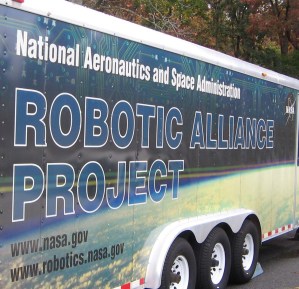
The first thing that stood out was the large NASA van parked in front of the school. Fidgeting over finding a job at the moment, I realized that the money is far more forthcoming for practical enterprises than reading ancient history. It is, literally, for rocket science. So I was crammed into high school gym bleachers with other aging parents, surrounded by kids smarter than I’ll ever hope to be, watching robots compete in exercises too complex for the average Republican. There was rock music blaring and yes, nerdy people dressed like science fiction movie/television characters. I was really feeling lost when I spied the character below.

DrJim

I had no idea that Dr. Jim of the Thinking Shop had relatives in the robotics field! As I saw the bearded Norseman approaching me, I was strangely reassured that there might be a place for me here after all. Religion and NASA do share an interest in celestial realms, and if my generation has been capable of producing kids this smart, there may be hope for the future yet.