Comet Tales

Göbekli Tepe, apart from being impossible to pronounce correctly, is a site of embarrassment to historians. First of all, this archaeological site in Turkey is too old. Abandoned around 9000 BCE—some 5000 years before the Sumerians show up with their writing—Göbekli Tepe had already gone through several phases of elaborate building and willful destruction. A large “temple” has been unearthed there with elaborately carved plinths that suggest a mythology at which we can only guess. Conventional wisdom states that the state came first, then organized religion. Göbekli Tepe suggest that it was the other way around—religion came first. We have no writing to go by here, however, just towering monoliths that make us scratch our heads in wonder. We are the apes.

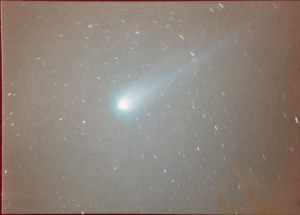
Hyakutake, 1996. My first comet.

A friend pointed me to an article in New Scientist that suggests one of the Göbekli Tepe “carvings show comet hit Earth and triggered mini ice age.” That’s a lot of ice. And eisegesis. Part of the problem here is that old scientists tend to sweep anomalous evidence off the table. It’s an admitted part of the empirical method. If a single anomaly stands against a host of conventionally expected results, the anomaly goes into the bin as an outlier. Göbekli Tepe, as real as it is, is an anomaly. Reputable books on it written in English by archaeologists and historians do not exist. Embarrassed turning away and staring at shoes ensues. The site is just too old, too sophisticated, and too far outside convention to be dealt with rationally. You can read a lot into an isolated carving, especially when accurate information is lacking.

To give you some perspective: the great pyramids of Egypt date from the Old Kingdom of Egypt, after 3000 BCE (remember, we’re counting backwards here). Stonehenge’s main phase (the famous blue stones) was a couple of centuries later than the Great Pyramid of Khufu (Cheops). Göbekli Tepe had closed up shop some 6000 years prior. By comparison, more time had passed between Göbekli Tepe and the Great Pyramid than between the Great Pyramid and us. We, with the internet in our pockets and humans walking on the moon, preparing to go to Mars, are only less than 5000 years from jolly old Khufu. Göbekli Tepe, with its inscrutable carvings, shouldn’t be there. And yet it is. Standard procedure suggests it be ignored. So far, conventional historians have done just that. And in my opinion that’s worse than an ice age brought on by comets written on a stone that nobody can read.


Trusting Truth

How do we know what’s true? For many the answer is what your experience reveals. If that experience involves being raised as a Bible-believer, that complicates things. A friend recently sent me a New York Times piece entitled “The Evangelical Roots of Our Post-Truth Society,” by Molly Worthen. For those of us raised in Fundamentalist conditions, this isn’t news. Then again, those raised Fundamentalist assume that everyone knows the truth but others have blatantly decided to reject it. It’s a strange idea, inerrancy. It’s clearly a form of idolatry and its roots can be traced if anyone wishes to take the time to do it. Inerrancy is the belief that the Bible is correct, tout court. It’s right about everything. If it contains one error, so the thinking goes, it topples like a house of cards. (Cards are sinful by the way, so get your hands off that deck!) If that’s your starting point, then the rest of the facts have to fall into place.

As much as I wish I could say that this simplistic outlook may be corrected by education, that’s not always the case. Many children of inerrantists are raised to question what they learn in school. Worse, many are home schooled so that they never have to be exposed to the sinful machinations of others until they try to enter the job market and are utterly perplexed by the fact that they don’t even speak a common language with the rest of society. Key code words don’t mean the same things outside that safe, withdrawn community where everyone knows the Bible and understands that to know it is to love it. Science doesn’t love the Bible, they’re taught. So science is wrong. It’s quite simple really. You already have all the information you need in one book. If science disagrees, then, well, you already have all the information you need.

There’s an internal logic to all of this, and dismissing the heartfelt beliefs of Fundamentalists only gets their backs up. It’s not about logic, but the emotion of belief. Some neuroscientists have been suggesting that we reason not only by logic but also with emotion. That complicates things, for sure, but it also explains a lot. For example, in a world where religion drives nearly all the major issues facing society, logic would dictate that universities would build up religion departments to try to understand this very real danger. Instead we find the exact opposite. Withdrawing into your own little world occurs on both ends of the spectrum. Dr. Worthen is to be applauded for bringing this out into the light. If society wants to benefit from this knowledge, it will need to stop and think about what it really means to be human. Fundamentalists, for all their foibles, illustrate that nicely.


Occam’s Beard

Skeptics can be so much fun. We really do need them, otherwise we’d likely still be living with notions of medical science being attributed to four humors, none of which were that funny. Still, sometimes it gets tiresome to read endless references that take Occam out of context. You see, one of the foundations, if not the very keystone, of modern scientific method is that of parsimony, aka Occam’s razor. The idea is simplicity itself. If there are multiple possible explanations for a phenomenon, then the simplest is most likely correct. But only if it supports your biases. The reason I raise this question is the materialistic dismissal of “consciousness” as merely a by-product of having a brain. The reasoning goes like this—nothing exists that can’t be measured by science. Since that which isn’t material can’t be measured, the most parsimonious explanation is that it doesn’t exist. QED.

This way of looking at the world has become so common that those of us who question it are given a condescending smile and a paternalistic pat on the head. But my thinking about this goes back to Occam himself. William of Occam (or Ockham) was a late medieval churchman and thinker. As a scholar he possessed a sharp mind. As a friar he also possessed a soul. There was no disconnect in those days. His observations of the natural world led him to the reasonable conclusion that if a simpler solution sufficed, a more complicated one need not be posited. So far, so good. This is not, however, to suggest that more complex things may not be going on. Quantum physics, for example, suggests that things aren’t quite so easy to explain. And what about poor Occam’s soul? This very component that made William William has been dismissed as mere illusion. Did it therefore not exist?

Is it more parsimonious to suggest that “mind” (or soul, or consciousness, whichever you prefer) is mere illusion, electro-chemical signals flitting between highly specialized cells just happen to give off a fiction of consciousness, or would the simpler answer be, as Occam himself believed, we have souls? We have no way to measure such things, but to claim they don’t exist is to rob a great thinker of his very mind. Any of us who experience consciousness know that it’s no illusion. We feel the pains and joys of this same body day after day and, if we’re honest, we believe that we’ll continue even after this fleshy substrate wears out. There’s a profound logic here. Science doesn’t know how mind affects matter—how I can decide to type and my fingers move. The most parsimonious answer, they claim, is that it only seems to be so. A far more honest answer would be that mind is real. And I’m sure Occam himself would agree, even if he preferred to call it a soul.


Frankly Frankenstein

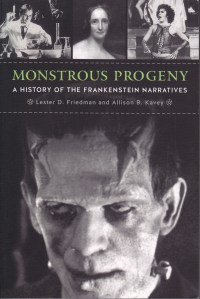
As a novel, like its monster, Frankenstein trespasses all kinds of boundaries. Is it science fiction or horror? Is it Gothic or presciently modern? Is it feminist or conventional? One thing about it is certain: it has been immensely influential. Lester D. Friedman and Allison B. Kavey have created for the world a truly wondrous treatment of this meme. Monstrous Progeny: A History of the Frankenstein Narratives is perhaps the most engaging monster book I’ve ever read (and there have been many). One of the main reasons for this is that Friedman and Kavey are keenly aware that binaries don’t necessarily exclude their opposites. Frankenstein is about both science and religion, and it treats both profoundly. Considering that Mary Shelley was only 21 when the novel was published bespeaks a rare genius in blurring boundaries and making those on each side think.

Monstrous Progeny considers multiple issues associated with Frankenstein. Should science be approached alone, or should peer review be involved at every stage? Is religion eschewed by this woman so strongly influenced by atheism, or is it the very crux of the matter? And what about the incredible and continuing afterlife of Shelley’s story? Friedman and Kavey survey not only the novel but several movies associated with, or based on ideas from, the book. Modern science, if we’re to be honest, also owes much to the fictional musings of a 19-year-old girl on a dark and stormy night. The tale of the tale is nearly as fantastic as its progeny. Challenged to write a ghost story, Shelley produced an undying Zeitgeist feature instead. Monstrous Progeny delves deeply into this unexpectedly profound idea, showing how it grips the heart of many contemporary nightmares.

Genres can be deceiving. Shelley wrote her tale as a “ghost story.” It received literary acclaim, becoming one of the best selling books in England in the nineteenth century. Only when Universal found success with Dracula in 1931 and followed it up with Frankenstein the same year did film critics want something to call movies like this. The term “horror film” was invented. There is certainly horror in Frankenstein, but there’s much more to it than that. The relationship between religion and science, and the very real ethical issue of making something because we can, are never far from the reader’s mind. Giving life to the creature only underscores the conflicts and contradictions of life in a world where to be gods risks destroying any possibility of heaven. Monstrous Progeny is a thought-provoking book that will, in its own way, brings our present fears to life.


Science Marches On

A few thoughts about the March for Science in Manhattan over the weekend seem to be in order. To get to the rally in time, from our little corner of New Jersey, we found ourselves on an early train. We arrived at 62nd Street and Central Park West to discover the march was beginning just outside of one of Trump’s unimpressive towers. The area for marchers was clearly marked off by barricades, but a woman walking her dogs, a resident of Trump’s tower, wandered in among the crowd. Like most Trump followers, she seemed clueless that there was an obvious way around the obstacles and had to be helped by the police. Seems to be a theme with 45—police are everywhere watching his assets. Meanwhile the hotel doormen from next door were asking for “Resist” paraphernalia and reminiscing about their shock when the boy next door received the nomination. The mood was jovial despite the spitting rain.

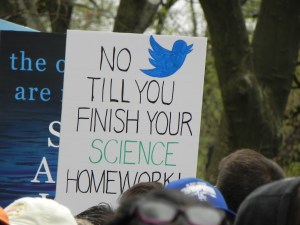
The speeches at the rally were mostly given by children ten and younger. The future teaching the past. As might be expected, the signs were clever, and some took considerable thought to figure out. A few, it seems, felt religion was to blame. Well, they’re probably right about that. One gets the sense that science and religion are like cats and dogs, and nobody has to guess which one’s identified with the cats. Still, the majority of the signs pointed out the benefits of science. Even scholars of religion use the scientific method, believe it or not. Like science, religion (as revealed by science) may be good for people. Who brings religion to a science rally?

I’ve always been a fan of science. Throughout school I learned a lot and did well in physics and chemistry, biology not so much (dissection was never my thing). I still read science and incorporate it into my thinking. Balance, however, suggests perhaps religion also be treated as not evil in and of itself. After all, it is evolved behavior. As the march progressed down Broadway, we passed a church that had a prominent banner reading “Prayer really does work,” or something along those lines. I’d seen enough clever signs already that morning to notice this contrarian voice. Then I wondered, why can’t science and religion seem to get along? Both can (but need not) make exclusive truth claims. What’s wrong with admitting that we just don’t know? Belief is involved in either case. No doubt science is important. I’ve always supported its study and always will. Is it, however, too much to believe that maybe religion can also enlighten, if understood for what it is—a human way of coping with an uncertain world? As science marches on, hopefully it will help us comprehend even the unmeasurable.


Earth vs. the GOP

They used to call her “Mother Earth.” Now she’s simply a commodity to be liquidated into cash at the country club where rich white men play. That’s why I’m spending Earth Day on my third protest march of the year. Of all the things the Republican Party has done to show its true colors the clearest has been to participate in the destruction of the world we all share. There’s only one word that answers the question “why,” and it used to be considered one of the seven deadly sins. Greed. These acts of planetary terrorism are carried out by men who believe lining their own pockets is the highest possible good. Even moderate Republicans have locked in their goose step to keep in the good graces of madmen who want to cram as much lucre into their coffers as they can before they die. When the planet’s a smoldering ruin their grandchildren will surely thank them.

Son, behold thy mother.

Don’t knock tree-hugging unless you’ve tried it. Trees tend to be much better company than Republicans anyway. Never have I had the feeling that I’ve had to celebrate Earth Day with such a blend of angst and anger. That one that your teacher always warned you about—the one who ruins it for everyone—now has control of the country. Immediately he insisted we start dumping coal waste into our streams and rivers. Burn more coal so he can play a few more holes with what passes for a clean conscience in a filthy soul. I march because I must. We can’t sit silently and let the darkness fall. If you can see through the coal dust you’ll understand that the planet weeps. It’s her that we celebrate today.

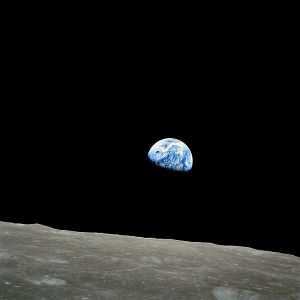
Matricide used to be considered a heinous crime. Now it’s just good business. If we were an honest species we’d admit it’s been bad business from the beginning. We’d never elect a businessman with inherently conflicting interests to the White House. The goods of the few outweighs the good of the many. The commodification of nature is the worst kind of unnatural selection. Here science and common sense agree—in order to survive we must preserve our planet. I confess that I’m unapologetic in this regard. So, although I’ll be spending this Earth Day in the artificial environment of Manhattan, marching in the cause of science, and if push comes to shove I’ll be the one hugging a tree.


Who Knows What?

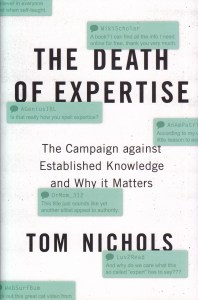
Nobody likes to have their shortcomings pointed out. I suspect that’s why many people might find Tom Nichols’ The Death of Expertise: The Campaign against Established Knowledge and Why it Matters a little uncomfortable. Nichols doesn’t pull any punches. Nor does he claim to be an expert on everything. What he does claim, however, is very important. He shows how America has taken a distinctly hostile attitude toward experts and specialists. Somewhere along the line hoi polloi began to mistake everyone has a right to their opinions for “everyone has the right to be an expert on what they express in those opinions.” This isn’t a new problem, but there’s no doubt that the Internet has exacerbated it. We’ve got people arrogant of their lack of training claiming alternative facts that are “just as good as” established facts. One of them resides in the White House. There’s no arrogance in claiming you have extensive, highly specialized training if you do. It’s a simple, non-alternative, fact.

A perfect book for our times, The Death of Expertise should be—must be—widely read. It’s not likely to change the minds of those who’ve already decided that with the Internet giving them a voice they’ve become the gurus of a new generation of the “Know Nothing Party.” The rest of us, however, should read and ponder. Nichols doesn’t shield himself in his ivory tower—he admits there’s plenty that he doesn’t know. He’s not shy, however, in saying he’s an expert on what he does know. I remember when facts used to stand for something. Winning at Trivial Pursuit was a matter of pride. Now everyone’s a contestant on Jeopardy and Alex Trebek has taken the express train home. All answers are right, for all people are experts. Seems like we have a surplus economy in arrogance these days. And that surplus just keeps growing.

An area where Nichols isn’t an expert is religious studies. He wouldn’t claim he is. I did find it interesting, however, that when he wants to make some of his strongest points he quotes C. S. Lewis. Any evangelicals out there should read The Screwtape Letters again and check what Nichols says. Lewis would not have been a Trump supporter. Not by a long shot. And he uses the word “ass” in his books, even when he’s not referring to literal donkeys. He may have been onto something. We have an anti-expert president who has appointed anti-experts at the head of major government agencies. He anti-expertly launches missiles at Syria illegally. C. S. Lewis was an expert Anglican. 45 may be an expert of the sort Lewis wasn’t afraid to name. We need to be educated. Read Nichols and give our nation a fighting chance. There’s always more to learn.


Universal Growth

Maybe the universe isn’t expanding, maybe it’s growing. Always tinged with a healthy dose of pantheism, I’ve often opined to those who will listen that life might be more than animals and plants and microorganisms. But then again, I don’t have the numbers to back me up. These aren’t just the ravings of a guy who wanted to be a scientist but whose religion prevented him, they’re also pretty close to those of a scientist who became a religious guy. When more than one person sends me the same article I figure I’d better comment on it. Those who used to be professors can’t help but professing, after all. So I read Meghan Walsh’s Ozy story, “Jeremy England, the Man Who May One-up Darwin.”

England spent his education on science only to turn to religion along the way. That’s pretty unusual, according to the standard social discourse, but I suspect it’s more common than we’d like to let on. There’s no clause in science that says you can’t believe in anything. Even Richard Dawkins has beliefs. Many scientists have been suggesting, of late, that perhaps physics and religion are converging. (Some of us from the other side of the equation have been saying so for years, but who believes a religionist?) Before I’m misunderstood, I’d hasten to add that I don’t mean religion as in literal trumpets sounding as a white horse and rider descend through the atmosphere. Nor do I mean in the sense of the minutiae of the Talmud. What I mean is the symbol systems that religion has long used may have been in some sense in line with what science has been trying to tell us.

According to the story, England thinks that matter may be self-organizing. That means life occurs where matter exists. Before I become too close a friend with my sofa I have to remind myself that this doesn’t mean everything’s conscious. Although my reading of Thomas Nagel does have me wondering even about that. You see, religion has historically been one of those disciplines where imagination has had a valued role to play. Those who accuse it of being doctrinaire and evil need to talk to a few more people. Religion has always claimed there’s more to life than what the senses reveal. Science professionally limits itself to the inferences of those senses. And you can get away with paying religion specialists a lot less. What’s not to like about this situation? If the universe is growing, there’s room for us all.


Alt Bible

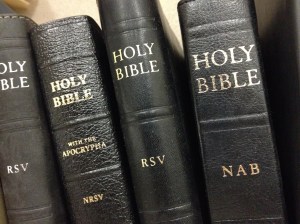
A friend recently sent me a story from Anonymous titled “Why Did The Vatican Remove 14 Books From The Bible in 1684?” This piece reminded me of just how rampant biblical illiteracy is in this Bible-worshiping culture. To begin with the obvious, Roman Catholics are the ones who kept the Apocrypha in their Bibles—it was Protestants who removed the books. No doubt, retaining the Deuterocanonicals was a rear-guard action of the Counter-Reformation, but still, if you’re going to complain about the Papists it’s best to get your biblical facts straight. The story is headed with a picture of The Key to Solomon’s Key. Ironically, Solomon’s Key is actually an early modern grimoire that the author seems to think is the same as the Wisdom of Solomon, one of the books of the Apocrypha. Reading through the post it was clear that we have an Alt Bible on our hands.

(For those of you who are interested in the Key of Solomon, my recent article in the Journal of Religion and Popular Culture on Sleepy Hollow discusses the Lesser Key of Solomon, a famous magic book. It features in one of the episodes of the first season of the Fox series and, I argue, acts as a stand-in for the iconic Bible. One of my main theses (don’t worry, there aren’t 95 of them) is that most people have a hard time discerning what’s in the Bible and what’s not. But I obviously digress.)

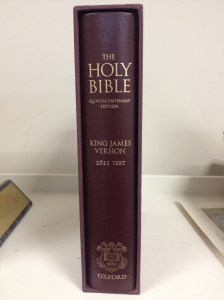
The post on Anonymous states that the Bible was translated from Latin to English in 1611. The year is partially right, but the facts are wrong. The translators of the King James Bible worked from some Greek and Hebrew sources, but their base translation was the Coverdale Bible which had been translated into English and published some eight decades before the King James. Myles Coverdale relied quite a bit on German translations, but the King James crowd went back to the original languages where they could. The KJV was published in 1611, but the translation from Latin was actually something the Catholics preferred, not Protestants. The Vulgate, attributed to and partially translated by Jerome, has always been the favored Roman base text. Ironically, and unbeknownst to most Protestants, the King James translation did include the Apocrypha. I like a good conspiracy theory as much as the next guy, but they certainly make a lot more sense when the known facts align without the Alt Bible unduly influencing the discussion.


All There Is To Know

I’m sorry, I didn’t mean to be rude but I just had to laugh. A friend sent me an article from Science Alert titled “A Physicist Just Explained Why the Large Hadron Collider Disproves the Existence of Ghosts.” Intrigued, I read, “there’s no room in the Standard Model of Physics for a substance or medium that can carry on our information after death, and yet go undetected in the Large Hadron Collider.” One of the reasons, I believe, science has trouble among hoi polloi is such arrogant statements as this. I don’t know about ghosts, and for a very good reason. There is no experimental way to test for that which doesn’t exist in the material world. The LHC may tell us all we can know about the world that we perceive (although I doubt it) but it can’t tell us about that for which there is no measure (e.g., consciousness). I don’t mean to get all complex here, but let’s stop and think about this for a moment.

What we know of the universe is what we can perceive and extrapolate from that perception by reason. We, however, don’t perceive everything. Our five senses evolved for one purpose and one purpose only—to survive in this particular environment. That’s a trait, hate to admit it as much as we might, that we share with other animals. It helps to be able to see, hear, touch, taste, and smell things clearly. These traits give us valuable information about the world around us—is that plant poisonous? Is this heat going to kill me? Should I avoid approaching that large, angry-looking bear? Things like that. What our senses don’t tell us is the aspects we didn’t evolve to perceive. We understand everything about nothing. Put another way there is nothing that we understand completely. Entire books can be written about the concept of zero and that’s just an abstract. We only experience a small piece of this universe.

That’s the problem with being in the backwater of the galaxy. I grew up in a backwater so I know what I’m talking about. Things might be different if we lived near the galactic hub, where beings with different senses may well exist. We know, for example, that even on our planet some animals perceive magnetic fields. Who knows what kinds of abilities might have evolved on worlds that posed different challenges to survival than our own? Who are we to say that here in our basement on earth we have a machine that can uncover every possible permutation of anything in the known universe? I don’t know about ghosts, but, I suspect, they’re laughing too.


Excarnation

To those raised in the Christian tradition incarnation is a familiar concept. The idea, more complex than it sounds, is that God becomes human. In a world of DNA and general disbelief in anything non-physical, it boggles the mind how disincarnate “matter” (for lack of a better word) might bond with the double-helix in order to create something new. Since science can’t explain such things spiritual, believers have long hung the cloak of mystery here and passed on to more practical matters. But what about excarnation? It’s actually not the opposite of theological incarnation, but it does involve spiritual practice. A friend sent me an article on Vintage News (much better than fake news, in my humble opinion) titled “The Towers of Silence: Ancient reminders of an eerie Zoroastrian burial ritual.” This was a nice find because I’ve been reading about the Zoroastrians again recently, and if ever there’s been a case of an important religion going underground, their’s is it.

I don’t mean to sound patronizing about it, but Zoroastrianism has been one influential religion. Having roots in the world between Vedic and Semitic religions, it had an impact on both. In my teaching days when I covered Zoroastrianism my Hindu students remarked on how similar the concepts were to their tradition. More reluctant were those of the Judeo-Christo-Islamic side to see that key concepts such as Heaven, Hell, the Devil, and Armageddon have their ultimate roots in the dualism that Zoroastrianism put on offer. Thus spake Zarathustra. We know very little about this founder of the religion. We do know that he set out to create a “systematic theology” that explained the world he saw. The result has changed the world many times over.

Those of you drawn in by catchy titles may be wondering what excarnation has to do with it. Believing dead bodies to be inherently corrupt, burial wasn’t the best Zoroastrian option since it only polluted the ground. The response was the ultimate in up-cycling—expose dead bodies until the vultures eat all the polluting flesh and then handle the dry bones afterward. This practice is arguably the most natural way of disposing of human remains, but it’s distasteful to many people. Who wants to be eaten? Unless, of course, you’re a believer in incarnation. For in that tradition God incarnate told his followers to eat his body and drink his blood. The more squeamish have done what religions have always excelled at—they turned earthy reality into a metaphor. Even vultures have to eat.

Image credit: John Gould, HC Richter, Wikimedia Commons

Image credit: John Gould, HC Richter, Wikimedia Commons


Seeing Thinks

Look, up in the sky! It’s a bird! It’s a dude! What what is it? It’s actually a cloud. I enjoy the entries on Mysterious Universe, but sometimes a cigar is just a cigar. It seems like decades since I laid down on the ground and looked at the clouds, seeking shapes. The sky is nature’s cerulean canvas and although they’re just water vapor, clouds take on endlessly fascinating shapes. Since religion has historically been projected onto the sky, many people take signs in the sky as somehow divine. The photo on Mysterious Universe is of a cloud that some thought was Jesus and others thought was Mary. Herein lies the rub of pareidolia. You see what you want to see.

There is, in traditional Christian thought, a world of difference between Jesus and Mary. You really don’t want to mix the two up. I mean one is divine and the other is only venerated. Don’t want to cross that line into worship because idolatry leads to all kinds of trouble. So who’s in the sky? Someone that we should perhaps think sacred: water. In a world quickly running out of fresh water (of course since now, officially, there is no global warming we’ll have to find another way of explaining our disappearing ice caps) we should all perhaps worship our clouds. The harbingers of fresh water. It won’t last forever.

I, for one, complain when it rains too much. I suppose that’s because I’ve lived most of my life in the rainy climates of the eastern United States and Scotland. Days can pass without a glimmer of sunshine. I get depressed and truculent. Yet the freshwater falls. Water tables are replenished. In much of the world—indeed, in much of the United States—it is not so. Water shortages are bad and are growing worse. We use far too much and when the ice caps are gone, the largest reserves of freshwater on the planet will be empty. Then again, capitalists have never been too keen on saving up for the future. Most of us alive today, at least in the rainy climes, will have our lifetime supply. The future, however, looks pretty hot and thirsty. So who is it in the sky? Could be either gender—wearing robes makes it hard to tell at this level of detail—but whoever it is, let’s hope they’ve brought plenty of friends with them.

Look like anybody you know?

Look like anybody you know?


Come Forth

the_lazarus_effect_2015_film_posterHorror movies provide a strange consolation at times such as this. When evil has overtaken democracy, it’s almost like strategy, watching how fictional characters deal with things that are wrong, things that are too close to real life. The Lazarus Effect has been on my watch list since the last sane presidential administration, but need finally dictated that I watch it. The premise is clear from the title—Lazarus is universally known as the dead man who came back to life. A group of medical researchers at a university in California find a way, through direct stimulation of the brain, to bring dead animals back to life. The idea is that they will give surgeons more time to resuscitate critical patients if they can get the formula right so that it works on people. An evil corporation steals their discovery and they have just a few hours to replicate the experiment to prove they are the ones who perfected it. Predictably one of them (Zoe) dies and her fiancé brings her back to life. Mayhem ensues.

Those who’ve seen Pet Sematary will find many similar ideas covered here. Those who come back from the dead are somehow distorted versions of their former selves. Those who do the resurrecting end up dead at the hands of the modern-day Lazaruses. There’s not much unexpected here except that Zoe, a Catholic, ends up in Hell. There’s quite a bit of talk about religion versus science—what really happens when you die. Zoe, despite being a practicing Catholic, has never been forgiven for her childhood sin of setting a fire that killed some neighbors in the apartment building. Religion and horror sharing the screen is something fairly common, but it is seldom as forthright as it is here.

Resurrection—necessarily a religious concept—is a frightening prospect. Horror films have shown many times that this is a miracle that just shouldn’t happen. At least not on this plane. (Those who’ve watched Re-animator know how bad the consequences could be.) Scientists, generally unbelievers in the cinematic world, just can’t accept either an afterlife or death. Using technology to challenge a godless fate, they inevitably end up losing. So it is in The Lazarus Effect. Some biblical scholars have suggested John’s rendition of the story is a kind of biblical horror tale. I mean, Lazarus had been dead four days in the warm climes of the Holy Land. His resurrection seems to have ended up well, however. Then again, there is an inherent difference between science and religion. Neither one, however, is now really in charge.


Theoretically Speaking

lit-theory-vsiI’ve been brushing up on my literary theory. All writing tends to get classified as fact or fiction, and we don’t stop to think, generally, about what “literature” is. Those of us who write fiction and non know that a well-placed hyperbole might throw us from one camp into the other. Such is the power of rhetoric. So it was that I found myself reading Jonathan Culler’s Literary Theory: A Very Short Introduction. Witty and insightful, Culler acknowledges the elephant in the room for many of us—theory, in a literary context, is often impenetrable. I’ve often wondered what one had to do to be considered a theorist, and this little book actually addresses that. Nobody has time to read all the theorists, though, and come up with their own creative things to say. Chose your poison.

The Bible, of course, is literature. That’s one reason I was reading Culler. I found one of his assertions immediately applicable: people in nineteenth-century England saw literature as a unifying principle. The British Empire encompassed the world, and to make diverse peoples a part of it, literature might be used, they thought, to do the trick. Culler suggests that it might have been a substitute for religion, which, he notes, was no longer holding society together. This gave me pause. Religion—at least official religion—began as social glue. The earliest recorded religions were state sponsored and served to cast the monarch in the role of the special appointee of the gods. There’s no arguing with that, right? Elaborate, expensive temples were erected. Financed by tax-payers’ dollars. This worked fine since priests declared the rule of the king as sanctioned by the gods. Nations warring against each other were thought of as rival gods fighting.

When science began to take the universe literally, religion lost its stickiness. How do you hold a society together when the gods no longer exist? You see, scientists didn’t think out the whole picture in advance. Scientists, like most academics, work in silos (that’s a metaphor). The discovery of a scientific truth can dissolve a social epoxy quite efficiently. Recognizing the slippage in the British Empire, theorists (I suppose that’s who noted such things) considered literature the great uniting force of a diverse people. We’re kind of facing that same dilemma today as literature is becoming, for many, as irrelevant as religion was a century-and-a-half ago. At the same time, people don’t understand science well enough to assess it for themselves. What are we supposed to do? Is there a theorist in the house?


Saint Charles

Honestly, I’m not sure where the idea of votive candles started. An educated guess—which will have to do in my state of limited research time—is that candles, like oil lamps, began as a practical necessity in places of worship. Temples, churches, synagogues, mosques—these tended to be large rooms and sometimes featured stained glass in their windows. Even if they didn’t, sometimes people want to pray after dark. Especially after dark. In the days before electricity, a lamp or candle was an obvious choice. Over time the practice of lighting votive candles developed. Lighting a candle for someone, living or dead, symbolized saying a prayer for them. The idea is much more common in liturgical branches of Christianity than it is in strongly reformed ones. Still, it’s a comforting idea. The few times that I’ve lit a candle for someone I’ve always felt better for having done so.

img_3125

Whenever a practice becomes sacred, parody is shortly to follow. As human beings we seem to be inherently aware that we take ourselves far too seriously far too much of the time. When I go to the grocery store—usually in the aisle with the more “Catholic” ethnic foods—I glance at the large, painted votives for sale. Secretly I’m hoping I might spot one for Santa Muerte, but this far north and east of the border that’s unlikely. Our own version of Saint Death is about to take office anyway. I was pleasantly surprised, therefore, to find a Charles Darwin votive candle in my stocking this past month. Intended, of course, as a novelty, there’s nevertheless something a bit profound here. What we’re praying for is the continuity of life. Evolution itself is under threat of post-truth science which is soon to receive official sponsorship. Time to light a candle and hope for the best.

I plan to keep my Darwin candle for emergencies. The idea isn’t that the figure on the candle is a deity. Those painted on the candle are the saints who have some influence in the divine hierarchy of this cold universe. When you light a candle you ask that saint to witness your prayer. I sense that many among my own political party have recently rediscovered how to pray. The beauty of a Darwin votive is that it’s non-denominational. We all evolve, whether we admit it or not. So if you can’t get yourself to a church, synagogue, or mosque on the traditional day of worship, Darwin can shed light at any time. And maybe even support a prayer for light in the coming darkness.