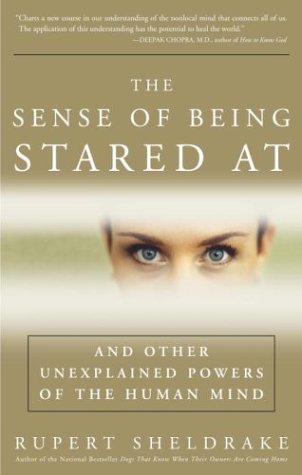
Sacred Gaze

SenseofBeingStaredAt Rupert Sheldrake raises the ire of some of his fellow scientists. Science has increasingly allied itself with a strict kind of materialism, although, as Sheldrake repeatedly points out, evidence for such absolute materialism is lacking. This is not to challenge science, but simply to note that we may not yet have all of the data. The Sense of Being Stared At considers possible scientific explanations for unconventional situations we all experience from time to time. Who hasn’t felt eyes on them and turned around to find somebody looking? A number of other “impossible” scenarios also find their way into this intriguing book. Sheldrake suggests that such phenomena can start to be explained scientifically if we allow that the mind is not the same thing as the brain. Sure beats a Christmas party with B. F. Skinner, where every present is inevitable.

Materialism feels threatened when spooky action at a distance occurs. As Sheldrake points out, however, we are willing enough to accept it if an invisible “field,” one that we can’t even feel, is posited. Take magnetism, for example. Few people doubt that magnetism is a real force. We’ve never actually seen it, but its effects are clearly visible. Taking this as a starting point, Sheldrake suggests that various psi phenomena involve such fields. The scientific studies that have been undertaken on many of these “spooky” scenarios show statistically that chance may be safely ruled out. And, if the experience of many ordinary people counts for anything, even our pets and other animals may possess minds.

Ironically, the mind (with its taint of being associated with religious concepts such as the soul) is one of the most contentious phenomena in science. Many materialists deny its existence, suggesting it is merely some epiphenomenon of our brains’ electro-chemical processes. Yet these scientists still, one presumes, insist on being treated with respect and being paid for their work, although these mere trifles are just odds and sods clinging to the edges of a materialistic abyss. To me, work like that of Rupert Sheldrake is crucial for an honest assessment of the evidence. Maybe not everyone accepts that dogs know when their “owners” are coming home, and maybe Sheldrake’s morphic fields have yet to be confirmed, be it is clear, when all the evidence is considered, these phenomena do actually happen on occasion. Instead of simply dismissing something because it shouldn’t be, or can’t be, according to materialism, why do we find accepting the evidence so frightening? Is it perhaps the fear of being watched?


First World Religion

H. P. Lovecraft’s contemporary, and sometimes inspiration, Algernon Blackwood has recently come to my attention. Like Lovecraft, Blackwood was an early twentieth-century writer of supernatural tales. Raised with a father of “appallingly narrow religious ideas” Blackwood came to write stories involving strange religious characters and occult themes. I recently read his famous story, “The Willows,” for the first time. The entire premise is built around a sacrifice required by strange gods on an isolated island in the Danube River. Much of Lovecraft’s literature, as is readily apparent, builds on the Old Gods. Lovecraft was an unflinching atheist, but he knew that the divine had the ability to frighten in a way that the purely material often does not.

The early twentieth century exerted an enormous influence on the religious landscape of the modern world. Although my historical specialization is much earlier, it is clear that the events of the First World War forever changed the way that religion was viewed. Historically, those not involved in the fighting of wars had often been insulated from them. With the advent of technology that allowed military devastations to be photographed and swiftly disseminated, people around the world realized what an atrocity war actually is. Not glorious. Not triumphant. And despite the abundance of piety in foxholes, no deities evident anywhere. It is well known that horror of war at least partly led William Jennings Bryan to advocate a more fundamental brand of Christianity to counterbalance the “evils” of evolution that led to such nasty ideas as eugenics and social Darwinism. It is no accident that the Fundamentalist movement began to take hold with the revelations of the First World War.

GermanInfantry1914

Ironically, today many use creationism as the excuse to challenge all religion as a misguided set of antiquated principles that have no place in an enlightened world. The sad truth is that those who immediately dismiss religion out of hand don’t realize that the creationist concern arose precisely for the same reason: the horrors that science was unleashing upon regular, simple religious believers. The two viewpoints, however, can live together. Although many of the writers of the early twentieth century had no room for faith in their accounting of reality, they did believe in its effectiveness in creating fiction that had to be taken seriously. Atheists, perhaps, but not angry ones. Perhaps the angry ought to spend some time amid the willows to evaluate more fairly the ambiguous role that religion play has played and continues to play in an uncertain world.


Continental Religion

In the course of my duties as an editor of religious studies, I was pondering the origins of the world’s major religions. Now, agreeing on what the major religions are is an exercise fraught with political incorrectness. What does “major” mean, after all? In any case, when we count in terms of numbers, there are more Christians, at the moment, than any other single religion. They are followed by Muslims and Hindus. So far there is little upon which to disagree, at least according to self-professed affiliations. Buddhists are usually counted as the next largest group, followed by Sikhs. When religionists mention “the big five,” however, they usually mean Judaism, Christianity, Islam, Hinduism and Buddhism. There are likely far more followers of traditional Chinese folk religion, perhaps mixed with Confucianism and Taoism, than most accountings record—such beliefs aren’t neatly categorized. Jains make up a sizable population, and Shinto is often classed in with all those religions of the far east. Many of the more modern religions, such as Mormonism and Jehovah’s Witnesses, sprang from Christianity, and so can safely be classed as a form of that faith.

What occurred to me that day was that all the major religions of the present world began in Asia. Judaism and Christianity, with all their numerous progeny, started in Israel or Palestine. Islam, as we all know, began in Arabia. Hinduism, Buddhism, Sikhism, and Jainism all have their origins in India, the big winner for the seed-bed of religions. Traditional Chinese religions and Shinto trace themselves to the far east. Yes, there are indigenous religions throughout the world. Native American and African religions are not to be discounted, yet they never quite attain the level of public awareness to be qualified as “major” religions. In this spiritual accounting, “major” has nothing to do with importance. For the religions with the largest followings we must turn our eyes to the one-stop continent, Asia.

Where major religions begin

Where major religions begin

Considering this, the obvious question is why. Why Asia? Civilization itself began in Asia, and one of the marks of a civilized society, at least until the day of the New Atheists, has been religion. Religion may be abused, as might any human innovation, but it has also been a harbinger of a more civil world. Not only fear of the divine, but also a sense of gratitude toward whatever forces might be greater than humanity, allowing us to survive for another season, or through another storm. Even in the world of science, religion has been a motivator. Gregor Mendel, the scientist who gave us genetics, was a monk experimenting in a monastery. Sir Isaac Newton was an occultist. Francis Collins is an evangelical Christian. Religion is at least as old as civilization. Its forms may be morphing, but, I suspect something our Asian forebears knew: religion will never truly go away.


Curing Fundamentally

Despite the many problems with Richard Dawkins’ religious reasoning, he correctly notes that children are religious because they are taught to be. (That’s actually further than Dawkins is willing to go, since in The God Delusion he states that children are not religious at all, but are only claimed to be so by parents.) Belief is something that we are only beginning to understand, but it is clear that children are taught their religion, generally, by those who raise them. By the time most of us finish high school or college, however, we have learned that religion is limited to a relatively brief segment of our otherwise busy, secular lives. Over the years I have met many people whose religion I have studied in more depth than they, mainly because it was of little interest to them. God made no sudden appearances in their lives, the miraculous never occurred, and so life is business as usual. Religion was for Sunday morning (or whenever).

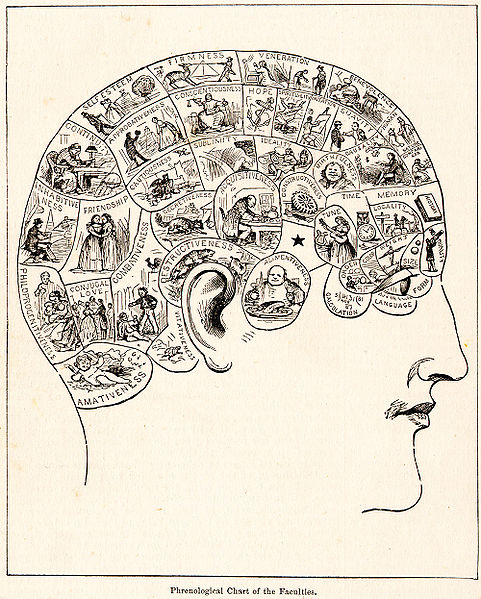
481px-PhrenologyPix

I was raised as a Fundamentalist. Although my readers may clearly see that I am no longer one, I do know that this bundle of neurons in my head has been made what it is, at least in part, because of that early training. Now a neuroscientist is suggesting that such thinking might be a curable mental illness. In an article in the Huffington Post, Kathleen Taylor, a neuroscientist at Oxford University, suggests fundamentalism may be a treatable disease. Looking over the secular headlines, there is no doubt that much of the misery in the world is caused by religious literalists acting out their fantasies in deadly ways. The suggestion that they might be treated for mental illness, however, raises profound—exceptionally profound—questions. Since I work in a city of millionaires and billionaires, I ponder how it is that extreme selfishness is not counted a mental illness. The desire of an individual to acquire far more wealth than one person can ever use seems to be an illness. Aesop might call it being a dog in the manger. No one is suggesting their brains be reprogrammed.

The even larger issue is who has the right to decide “the new normal.” Richard Dawkins may be correct that children reflect the religion of their parents, but as soon as adults declare what religion is acceptable we find other adults colonizing new continents, with the attendant misery that such migration entails. Where do we draw the line? If Fundamentalism programmed out, will Baptist neurons be allowed to remain? Methodist? Presbyterian? Mormon? The issue raised by Dawkins must be placed in context; if parents decide on a child’s beliefs do other adults have the right to decide on what is the correct belief? (Orthodoxy means precisely that.) Is a strict rationalist mentality what we want? A life without Hayden, Picasso, or Charlotte Brontë? What would Mr. Spock do? Will the real Randle Patrick McMurphy please stand up? Our rich fantasy lives are what make us human. If we are going to program out religious freedom perhaps the brave, new world is already here.


Super Stition

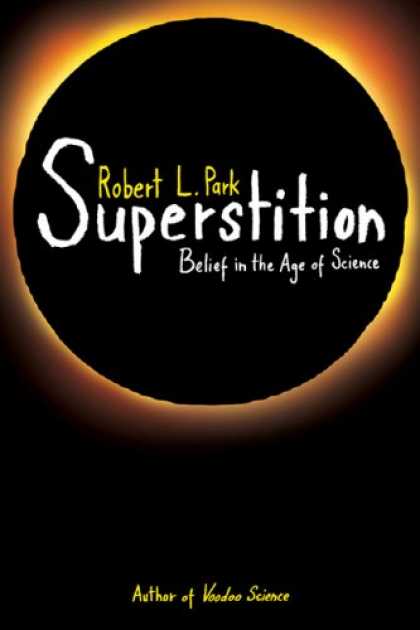
SuperstitionElijah is a folkloric character. Despite the common misperception, most of us who study religion know the difference between myth and reality. There are, nevertheless, lots of engaging traditions about Elijah. Even in our secular culture we joke about leaving a door open or an empty chair available for the disappearing prophet.

It is difficult not to like Robert L. Park. Reading his Superstition: Belief in the Age of Science was often a pleasure. I read Park’s Voodoo Science a few months back, and I enjoyed his supreme rationality very much. Many of the weird beliefs he decries clearly deserve his denunciatory treatment. Like many among the New Atheist movement, he believes that rationality, scientific thinking, will eventually displace religion completely. The final line of his book, “Science is the only way of knowing—everything else is just superstition,” however, maybe overlooking some vital information. In the first instance, scientists are humans too.

There’s no question that much of what Park writes makes perfectly good sense. The God of the gaps is gasping, indeed, dying. Double-blind prayer experiments just can’t work. Evolution does work. Quantum mechanics are abused by many New Agers. This all makes sense. There are, however, some gaps that rationality misses as well.

It has always bothered me that reality is much more than human senses reveal. Rationality is based on the premise that we have, or can discover, all the facts. There is an unseemly arrogance to it. We know, rationally, that “lower” animals experience sensory input unavailable to us. In many ways, Spot is more intelligent than his human “owner.” We use bloodhounds to find people for precisely that reason. We know that “bird brains” navigate in ways impossible for humans to emulate. Even a bee drunk with nectar can buzz its way home. And these are only the life forms that evolved on earth. Our rational knowledge is only a tiny fraction of all possible knowledge. And I’m not convinced that science is really the only way of knowing it. I just feel it in my gut. It’s a big universe out there, full of possibilities we haven’t yet encountered. Is the evolved human brain, limited as it is, the sole arbiter of reality? Is there some form of thought we have not yet reached? I will continue to enjoy reading books like Superstition. I will also, however, continue to leave the door open just a crack, in case Elijah does show up after all.


The Science of G-d

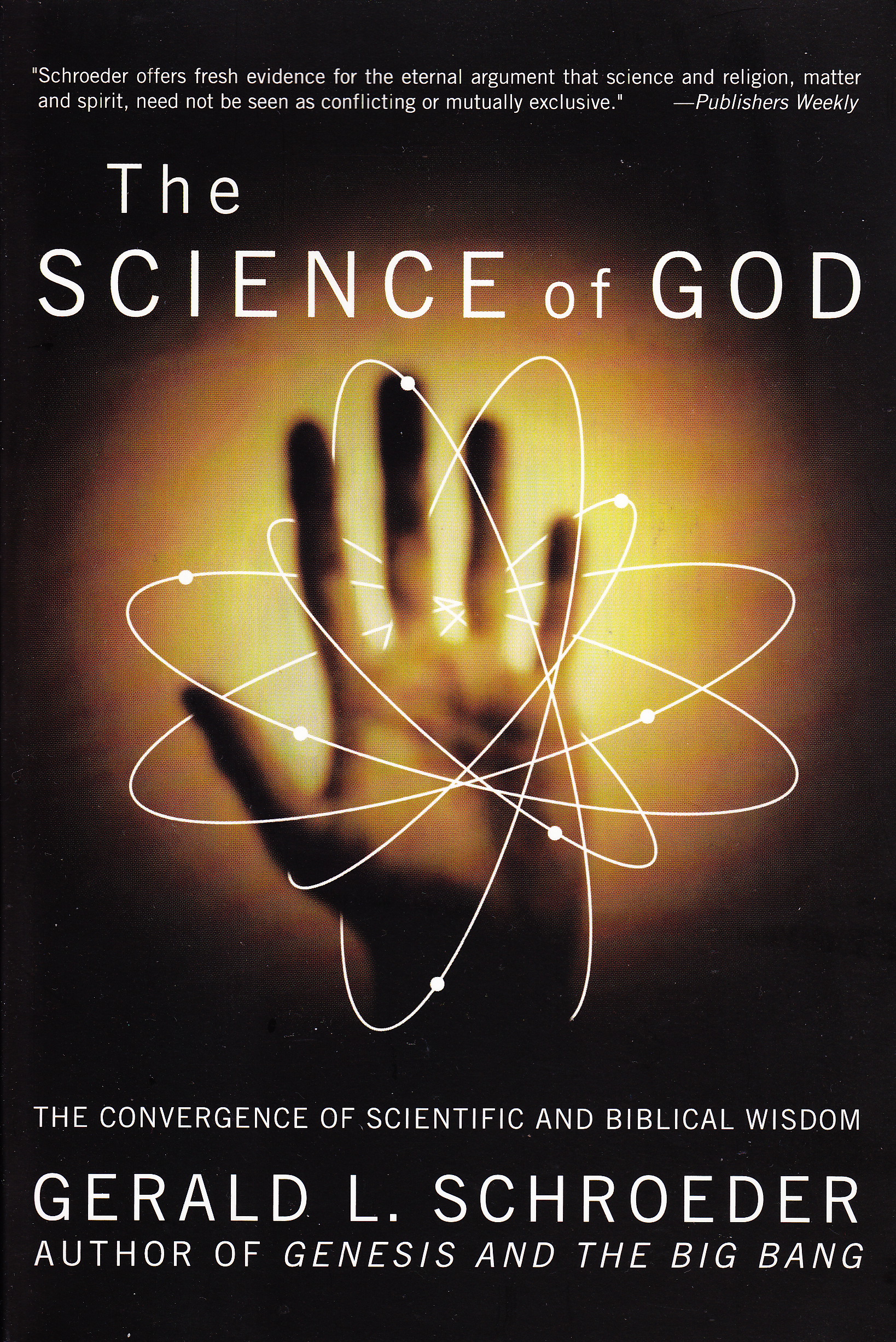
ScienceGodWhere, exactly, do science and religion come together? Since both are human mental enterprises, they must at some point at least glance off one another. Both religion and science attempt to make sense of human experience in the world, and, given the limitations of human time, being a true expert in both may be impossible. The John Templeton Foundation, as any religion scholar knows, supports research and awards handsomely those perceived to have succeeded, at least somewhat, in bringing the two together. A single lifetime, however, is not long enough for either, let alone both. Gerald L. Schroeder’s The Science of God illustrates this point. Subtitled The Convergence of Scientific and Biblical Wisdom, and produced by a major publishing house, the pitfalls of applying the Bible to a scientific worldview become apparent almost from page one.

Somewhat unusual in the field, Schroeder is an Orthodox Jew addressing the questions that the Bible raises for science. He is also a credentialed physicist. Most attempts to force religion and science into bed together come from Christian researchers—secular scientists usually have a headache—and a hidden agenda is often not too difficult to discern. I read The Science of God knowing nothing of Schroeder’s religious sensibilities. By narrowing the focus from science and religion to science and Bible, however, I knew the enterprise was doomed without even opening the cover. The Bible is one of the least scientific of all human writings. That’s not to say it has no value, but it is an honest observation by a lifelong reader of the Bible who believes science has a proven track record for making some sense of the world. Schroeder begins with that most specious of arguments, the anthropic principle. Few ideas raise such ire in my limited scientific understanding. The suggestion that the universe is fine-tuned for life is a moot point in principio. Who are we to say that life wouldn’t have emerged if the Big Bang were one degree cooler or hotter? It might have been life with different parameters, but the anthropic principle seems to point to nothing more than the tenacity of life.

While Schroeder does raise some valid points, it is clear from his challenging of the fossil record that the Bible will only ever sleep uneasily with science. For a physicist, Schroeder spends an awfully long time using God-of-the-gaps reasoning to fill in biology. In a disguised day-age “hypothesis” he gives us the creation order of Genesis 1, while skirting around Genesis 2 where humans are created before animals. And, I’m sorry, but the Bible does not mention dinosaurs anywhere. It’s a pity really. Schroeder’s book addresses some important issues, but using the Bible as a measure of scientific credibility fails every time. The science of God, it seems, is more a concluding unscientific postscript, but without the philosophical sublimity.


Inhumane Society

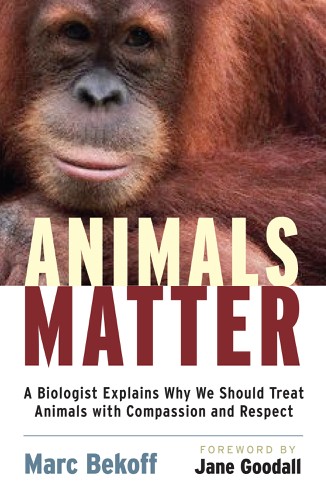
AnimalsMatter“I’m a member of PETA,” I’ve had more than one wag say, quoting bumper sticker wisdom as if it were profound, upon learning I’m a vegetarian. “People Eating Tasty Animals,” they then spell out with a smirk. I stopped eating animals at about the turn of the millennium, and since then I’ve discovered more and more reasons that it was the correct decision. I’ve just read Marc Bekoff’s Animals Matter: A Biologist Explains Why We Should Treat Animals with Compassion and Respect. It saddens me that in our world where nothing escapes being posted on Facebook, people still tend not to notice the suffering we impose upon animals as a matter of course. I’ve always been inclined to look closely at things, including animals. Watching them, it is clear that humans are indeed animals only differently evolved. Our mannerisms, our emotions, even our expressions, can be found among our animated kin. We share a planet on which we all evolved together, so why do we find it so easy to exploit other creatures?

One of the reasons Bekoff notes, without being judgmental, is that some religions inform us that people alone are special because we bear the image of God. Although God is supposed to be altruistic, we don’t wish to share that exalted status with any other species, apparently. Even in the twenty-first century many otherwise intelligent people still claim that animals feel no pain. Can’t reason. Are mere machines. We’ve been taught to distrust common sense that informs us that if an animal in distress acts like a human in distress that it experiences the same anxiety. The more we study animals the more human they become. The theology of Genesis has much for which it will be called to answer.

It seems, however, that the Bible is used as a mere excuse here. We exploit other animals because we can. We have taught bovines and ovines to trust us so that we may more easily slaughter them. Perhaps this is an exercise in divine image bearing, but somehow I doubt it. Reading Animals Matter in many ways felt like listening to a scientist who has taken the message of the Lorax to heart. We treat animals the way we do because we don’t understand their language, but we are morally obligated to speak for those who have no tongues. Although accessible to younger readers, Animals Matter is nevertheless a profoundly disturbing book. What does it say about the highly evolved when they exploit their relatives who’ve not learned the language of humans? Or, more accurately, who’ve not learned to vocalize like humans. Other animals speak, just like people sometimes, if we would only translate their actions into words.


Evolving Morals

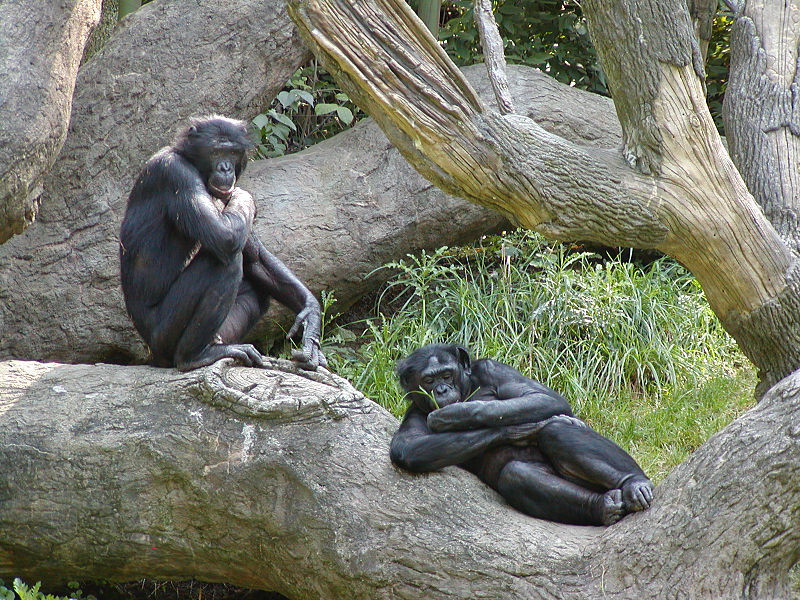
CNN recently interviewed Frans de Waal about his new book, The Bonobo and the Atheist: In Search of Humanism among the Primates. Of course the book immediately went on my “to read” list. I’ve followed de Waal’s non-technical work for years and I have come to trust his judgment. As director of part of Yerkes Primate Research Center, de Waal knows apes better than most of us know our neighbors. He has been exploring the origins of altruism and empathy in the great apes and has come to some amazing conclusions. His past work has shown that much of what we have attributed to special revelation has actually arisen in people through regular evolution. The apes, particularly the bonobos, but also chimpanzees, show startlingly human reactions to moral situations. In the interview, de Waal notes the implications for religion. In his opinion, morality predates religion since the former is seen in other primates while the latter is not.

As much as I trust de Waal’s judgment, the unanswered question remains: what exactly is religion? Animals display rudimentary religious behaviors, but in human-speak religion is often intertwined with belief. In watching a recent episode of Morgan Freeman’s Through the Wormhole—“Is There Life After Death?”—it was clear that while scientists tend to stand on the “no” side of this divide, in the end it comes down to a matter of belief. Not all religions, however, are tied to belief. Some religions assert that what you believe is not important, but rather, what you do. In such religions morality is much more like our primate kin’s version of religion. As Freeman points out, you really can’t know what another person believes. You can ask, but if you believe their response is always an open question. Here is the dilemma of religion as a matter of belief. Even Jesus putatively said, “by their fruits you will know them.” Morality here sounds like religion.

Frans de Waal suggests in his interview that morality differs from religion by being earlier in the evolutionary scale. If, however, religion evolved—which it surely did, as we can continue to observe its evolution today—it may be of a piece with morality. We object to suggesting animals have religion; this suggestion would knock humanity off its pedestal as the only species to which an incredibly human-like god revealed (as it is said) himself. What de Waal has gone beyond proving in his previous books is that much of what qualifies as religion is found among the great apes. De Waal doesn’t put it in those words, but as a lifelong student of religion I have observed the connections first-hand. A scientist may not feel qualified to define religion, just as a religionist is not qualified to correct a scientist. I eagerly await the chance to read The Bonobo and the Atheist, but I already know that I will find much of what de Waal writes to be beyond question, and we may all be much closer to the origins of religion than we realize. Even our great ape kin.

Michelangelo's muse? (Photo by Greg Hume)

Michelangelo’s muse? (Photo by Greg Hume)


More Witches

WitchHuntAronson It’s been some time since I’ve been to Salem. It’s been even longer since I’ve read Arthur Miller’s The Crucible. The events of 1692, however, continue to haunt me. I recently read Marc Aronson’s Witch-Hunt: Mysteries of the Salem Witch Trials. Intended for a young adult readership, Aronson’s book really isn’t proposing any new theories about why religious violence was perpetrated against the vulnerable, mostly female, pool of those living in a very superstitious society. It does, however, show some of the issues in sharp relief—more academic books sometimes cloud the issues with erudition. Historians will continue to debate what happened in Massachusetts at the end of the seventeenth century when the Enlightenment was getting underway and the explanatory value of science was overcoming the world of miracle and magic. Even with science on our side, however, adequate explanations of the sad social madness of Salem are still lacking.

As Aronson points out, there seems to have been a certain amount of greed involved as laws allowed the property of “witches” to be confiscated. Equally culpable are the learned clergy of the day, some of whom overrode their disinclination towards belief in witchcraft to hang a few women (and fewer men) for an imaginary crime. Lack of full historical documentation and the unrecorded lives of women often combine to raise many questions about Salem. It remains clear, however, that the outlook of the clergy influenced perceptions on the ground. Aronson suggests that Cotton Mather’s earlier accounts of Goodwife Glover of Boston—a woman executed as a witch without even her first name having been recorded—may have “inspired” similar violence among the population of Salem. When devils are suspected, the clergy are never far.

When the mania died down after a lethal year, the clergy, both Increase and Cotton Mather among them, recanted the easy execution of a few expendable women, and fewer, less expendable men, in Salem. Since we lack documentation, we will never know fully what was behind the witch-hunts, apart from misogyny and misperception.

Aronson ends his little book by asking us to consider modern terrorist hunts and the eerie similarities to the mindset of Salem. Listening to some media interviews, particularly on Fox, after the Boston Marathon bombings, we haven’t traveled so very far from Salem. In a world of high technology, where Satan is said to once again stroll the streets of Massachusetts, we have to wonder if the witch-hunts will ever truly end.


Shaman Shifting

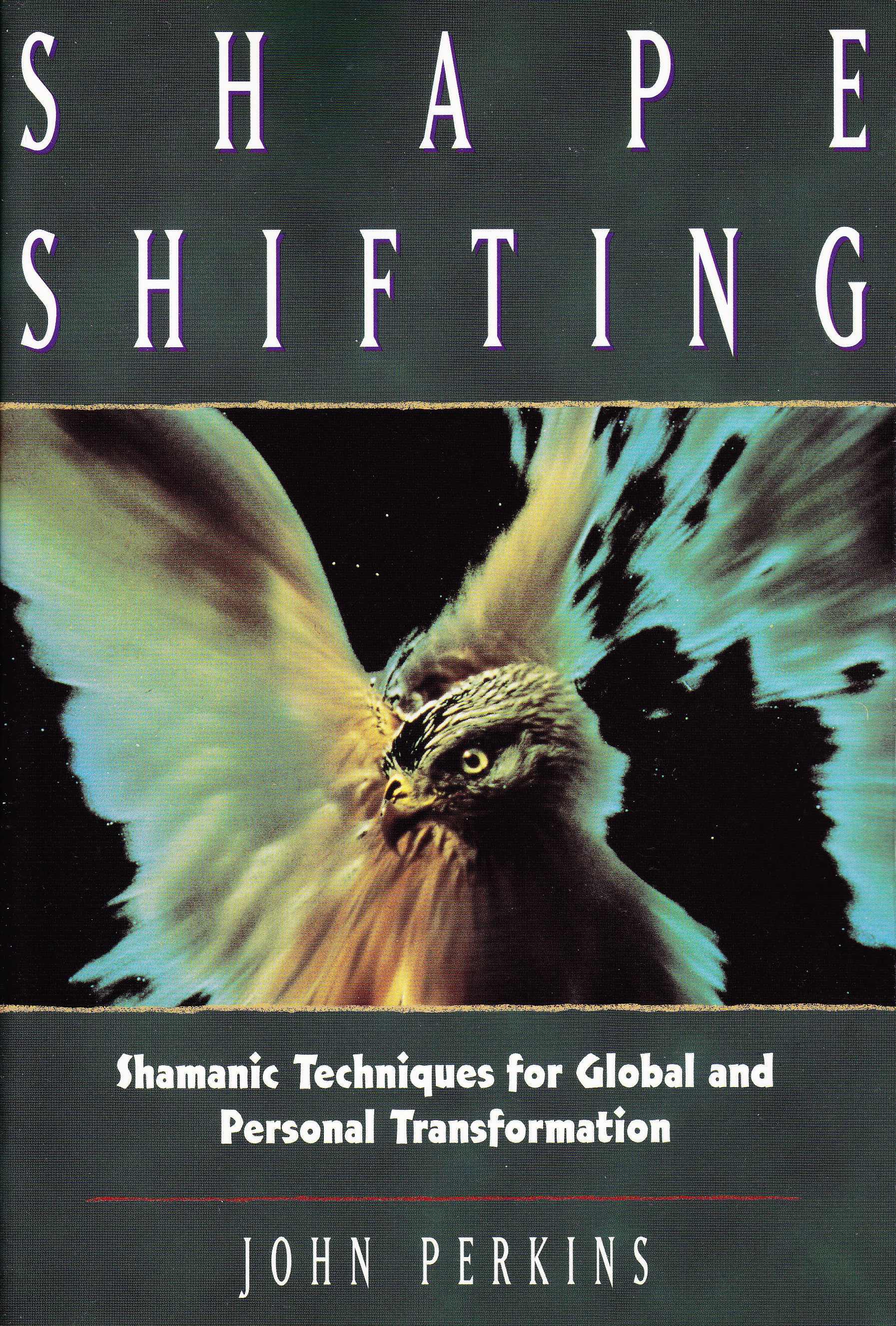
Shapeshifting I confess that I haven’t read Confessions of an Economic Hitman. Being incurably drawn to the weird, however, I picked up a copy of John Perkins’ earlier book, Shape Shifting: Shamanic Techniques for Global and Personal Transformation at the recent Hunterdon County Library Book Sale. I also confess that I fear being classed as one of those irrational sorts who’ll believe anything. It’s pretty obvious to anyone who’s been to college or university that a Ph.D. is no protection from the strange ideas that waft through human gray matter. Many years of teaching convinced, I hope, at least a few of my students that I approach the study of religion in a reasonable—dare I suggest?—rational, way. Despite appearances to the contrary on this blog, I weigh evidence carefully. Sometimes the evidence suggests we don’t yet have all the data. So it was with an open mind, but also a dose of skepticism, that I read through Perkins’ book. And yes, he does suggest that cellular-level transformation is possible.

Before breaking out your hooey-meters, however, consider that John Perkins is a successful businessman. Money speaks, n’est-ce pas? So I’m reminded every rational working day. The human mind, however, plumbs realms on which empirical method sheds little light, even to this day. Psychologists still debate whether there is a subconscious mind at all. And then there’s that troubling question of what exactly reality is. Historically, people have answered such questions with religion. And religion quite often permits entry where science declares “no gods allowed.” So did John Perkins really transform into a ball of energy and float across both time and space and see such disturbing sights as he describes? Did Richard Bach really astro-project with his partner, as recounted in The Bridge Across Forever? Are we really rooted to this mundane world where politicians and entrepreneurs make all the rules?

Perkins recounts his experiences with shamans of the Amazon, and like Jeremy Narby, his experiences with ayahuasca, a consciousness-altering plant. He even recounts transforming into an “inanimate object” so that his wife could not see him. Is it real? Can science measure such events? Does anything escape the penetrating stare of the electron microscope? We will have our Richard Dawkinses on one hand declaring an unequivocal “No!” The other hand, however, may be generating the sound of clapping for those who have ears to hear. Or at least for those who have eyes to read. At the end of this book, truth comes down to a matter of belief.


Paging Dr. Asimov

Who remembers Rock ’em Sock ’em Robots? Plastic “robots” in the boxing ring trying to knock each other’s block’s off was a form of entertainment for kids of the ‘60s before such things as humanoid robots actually existed. So when Boston University’s alumni magazine had an article about dancing robots, I had to see what was up. As regular readers will know, I’ve been exploring some of the problems with reductionism lately. This idea, that humans and animals are just fleshy machines, breaks down when we try to design robots that can do some of the most basic of human activities. Sometimes we dance and we don’t know why. Apart from Wall-e’s dance with Eve, robots have trouble getting the concept. Graduate student John Baillieul notes that this isn’t about “some high school guy who had trouble getting a date, so you get a robot. The ultimate goal is to understand human reaction to gestures and how machines may react to gestures.” Having actually been a high school guy who never even got to the prom, I’m wondering how depressed our robots get when the fem-bots all look the other way.

Rockem Sockem

The reductionistic outlook suggests that we can eventually program robots to respond as humans would, responding fluidly to situations, allowing them to over-ride their “instinct,” which, the article implies, equals programming. We have no idea what instinct is. It is something all biological creatures have, from the heliotrope following the sun to the human dancing her heart out. Do we want machines to replicate our most intimate emotions? Even our most reliable chip-driven devices sometimes freeze up or rebel. My car has recently got the idea in its mechanistic brain that the right-hand side rearview mirror should be rotated as far to the right as possible. We bicker about this all the time when I get in to drive. Well, machines know best. They, after all, are the shape of the future.

So programming robots so that they can react in real time to non-verbal cues, like all sentient beings do, is a desideratum of our mechanistic Weltanschauung. Notes Rich Barlow, the article’s author, “bats, for example, camouflage their motions so that they can sneak up on insect prey, a fake-out familiar to anyone who’s tried to swat a pesky fly.” My question is who is the pesky fly in this robot-human scenario? Who acts irrationally and unpredictably? Isn’t our instinct to smash the fly a result of our annoyance at it landing, yet again, on our sandwich with its dirty feet? And what is that stupid dance that it does when it’s all over our food? Reductionism must, by definition, reduce instinct to the level of a kind of genetic programming. Even this aging blogger, however, knows what it is to dance without knowing why. He also knows what it feels like when your date goes home with somebody else, something to which he’s not convinced that we want robots calculating an “instinctual” response.


God, Particle, Reduce

Reductionism is beguiling because of the exalted status it gives to the human intellect. It is presumed that rational thought can explain everything. Still, reason sometimes leads to paradoxes—we’ve all heard the (admittedly theistic) one asking if God can create a rock so heavy s/he can’t lift it. Given the premise, two strands of logic conflict. A similar sort of phenomenon, it appears, accompanies quantum physics. In a story from last year on Big Questions Online (a website supported by the Templeton Foundation), Stephen M. Barr submitted a piece entitled “Does Quantum Physics Make it Easier to Believe in God?” The article requires some concentration, but the basic premise is simple enough to explain: quantum physics does not sit well with reductionism. There seems to be will in nature. It may not be God in the machine; it may not even be a machine at all.

I have always been fascinated by science, and I am not one to castigate it. Its string of successes stretches all the way from atoms and their explosive tendencies to the moon and Mars and beyond. At the same time, most of us have experienced something that “should work,” in which no fault can be discovered. Reductionism would declare the fault is indeed there, just undetected. If, however, at the sub-atomic level, particles sometimes act uncannily, don’t those effects climb the ladder into the visible world in some way? Logic would seem to demand it. The problem with putting will into the equation is that will can’t be quantified. There have been many documented cases of an instance of superhuman strength coursing through a person when they have to rescue a loved one. We raise our eyebrows, mumble about adrenaline and pretend that will hasn’t affected nature in this reductionistic, strictly material world.

Denigrating human brain power is not something I undertake lightly. Logic works most of the time. A thinking creature who has evolved to be a thinking creature, however, must realize that its own intellect is limited. Simply because we are limited doesn‘t mean we shouldn’t strive to improve, but it does mean that ex cathedra statements, whether from pontiffs or physicists, should be suspect. One would be hard-pressed to label Einstein a believer. Yet even he made the occasional remark that left the door open for, well, maybe not God, but maybe not reductionism either. I was once told, and I believe it to be true, that you can tell a truly educated person not by how much he or she claims to know, but rather by how much she or he claims not to know. It may not seem logical, but down there among the particles of the quantum world, I suspect those willful quarks agree.

Erwinrossen's image of atoms, the sight eyes can't see

Erwinrossen’s image of atoms, the sight eyes can’t see


Dog-gone Belief

A recent book I read, I can’t remember precisely which one, suggested that one reason the average citizen has trouble with science is the fault of evolution. We evolved, at least some of us have, to rely on common sense. We trust appearances to intimate reality, and act accordingly. The problem is that science, almost in principio, informs us that things do not operate according to common sense, but according to laws that are inscrutable to most of us and involving math way beyond our limited ability. Even with a calculator. For example, the earth is spinning really, really fast and hurtling around the sun so quickly that I think I’m going to be sick. Really? Common sense tells me that I’m stationary, and my inner ear only gives me true peace when that is the case. QED, as my high school pre-calc teacher used to say. But it’s not the truth. We are spinning and jetting through space.

IMG

An article in Time magazine recently brought this disconnect home on a very poignant level. “The Mystery of Animal Grief,” by Jeffrey Kluger, explores the animal grieving process. Many species have been observed to react to the death of one of there own very much like humans do. Physical attitudes of bowed heads, actions that signal depression, and even rudimentary burials are all documented among animals. Some scientists disagree: reductionism declares that this is all appearance (like common sense), and if the professor on Gilligan’s Island taught us anything beyond building with coconuts and bamboo, it is that there is a rational explanation for everything. Animals grieving? It takes a human to do that. Well, actually, it takes a human to declare with such certainty that our animal cousins can’t feel like we do. Although our only current pet is a hermit crab—and perhaps many uninvited spiders—I grew up with dogs, cats, guinea pigs, and assorted other creatures. They express real affection. If they didn’t, I can’t think people would keep them.

I wondered, as I read Kluger’s article, when religion was going to come into the discussion. It wasn’t a long wait. Religion, he notes, is a human mechanism for coping with the finality of death. Dead is dead, after all. Animals can’t be religious, so they can’t experience the emotions we do. Or so science would mostly declare. I struggle with reality on a daily basis. My experience has taught me that things are not often what they seem, but sometimes my path lies in a direction diametrically opposed to that of Dr. Heisenberg. We are animals. Animals are part of our family. I’ve experienced people who show no emotion when their close associates are suffering. I’ve also experienced a dog that would cuddle up next to me and lick my face when I was sad, an encouraging look in his canine eyes. Animals are smart and empathetic. They have some understanding of death—it’s just common sense. I write this as I’m hurtling through space at 660,000 m.p.h. while spinning at a thousand miles an hour. If my reasoning seems suspect to you, consider the circumstances.


Paranormal Academy

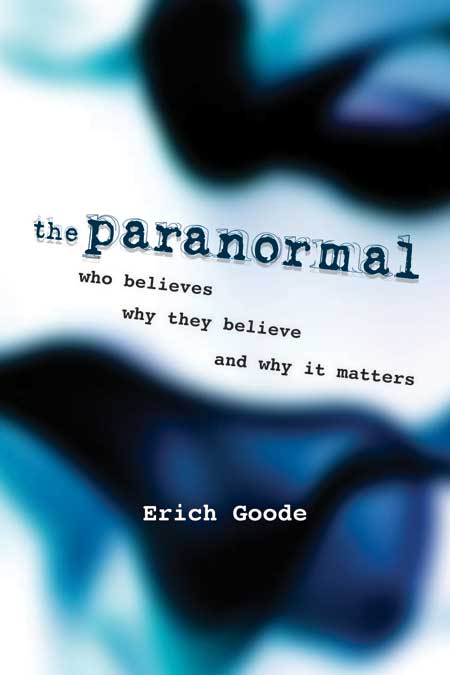
ParanormalA recurrent theme on this blog (as my faithful few will doubtless know) is that religion draws from the same stream of cultural energies as do other phenomena such as horror movies and the paranormal. Religion and fear and curiosity seem to share some common parameters, and every now and again serious academics tackle these connections as well. Erich Goode, a sociologist, has taken on unconventional beliefs in his The Paranormal: Who Believes, Why They Believe, and Why it Matters. Unlike many academic writers on the topic, Goode does not attempt to debunk, but it is also clear that he does not ascribe to the unconventional viewpoints he examines either. In what must be an important realization among sociologists, Goode, like some of his colleagues who also consider the paranormal, finds that belief is widespread. Large segments of the US population allow for some validity toward ghosts, psychics, aliens, and yes, even creationism.

That last one stopped me for a second. Several seconds, actually. Creationism paranormal? When Goode’s delineations are considered, this is not completely inappropriate, but creationism is pure-blood religion. Not that it is necessary for religion, but its birth and considerable growth has been among the conventicle of true Bible believers. It is clear that in Goode’s line of reasoning there is only a fuzzy line between religion and the paranormal. I’ve asserted that same fuzzy line, but I’d never considered biblical literalism as paranormal. Maybe because I was raised in that environment it seemed normal and natural to me. Maybe because it is in the Bible it feels weird to hear it classed as paranormal. Maybe because believers in ghosts, aliens, and undiscovered forces have at least some viable evidence to indicate their beliefs are valid; the creationist distortion appears not to belong in the same camp.

Creationism is a complex psychological phenomenon, to be sure. How people who know the obvious practicalities of science (such as television and the internet, where creationism can be expounded) have demonstrated that its overall methodology is sound, how such people can accept a fairy tale beginning to a Grimm tales world is difficult to fathom. And creationists, in general, would reject belief in what most of society considers paranormal. Can these coexist in the same category? While Goode constructs his paradigm as those who accept and reject empirical reductionism, I’m not convinced that religious belief is the same as paranormal belief. The parsing is a bit too coarse here. Creationism, which began life as a religious belief, has become a political agenda all about domination. It is not so much naiveté as it is need to rule. Somehow I doubt the ghost hunter with her or his night vision camera and digital voice recorder has any real designs on textbook distortion or having women keep silent on Sunday morning.


Bridge over Troubled

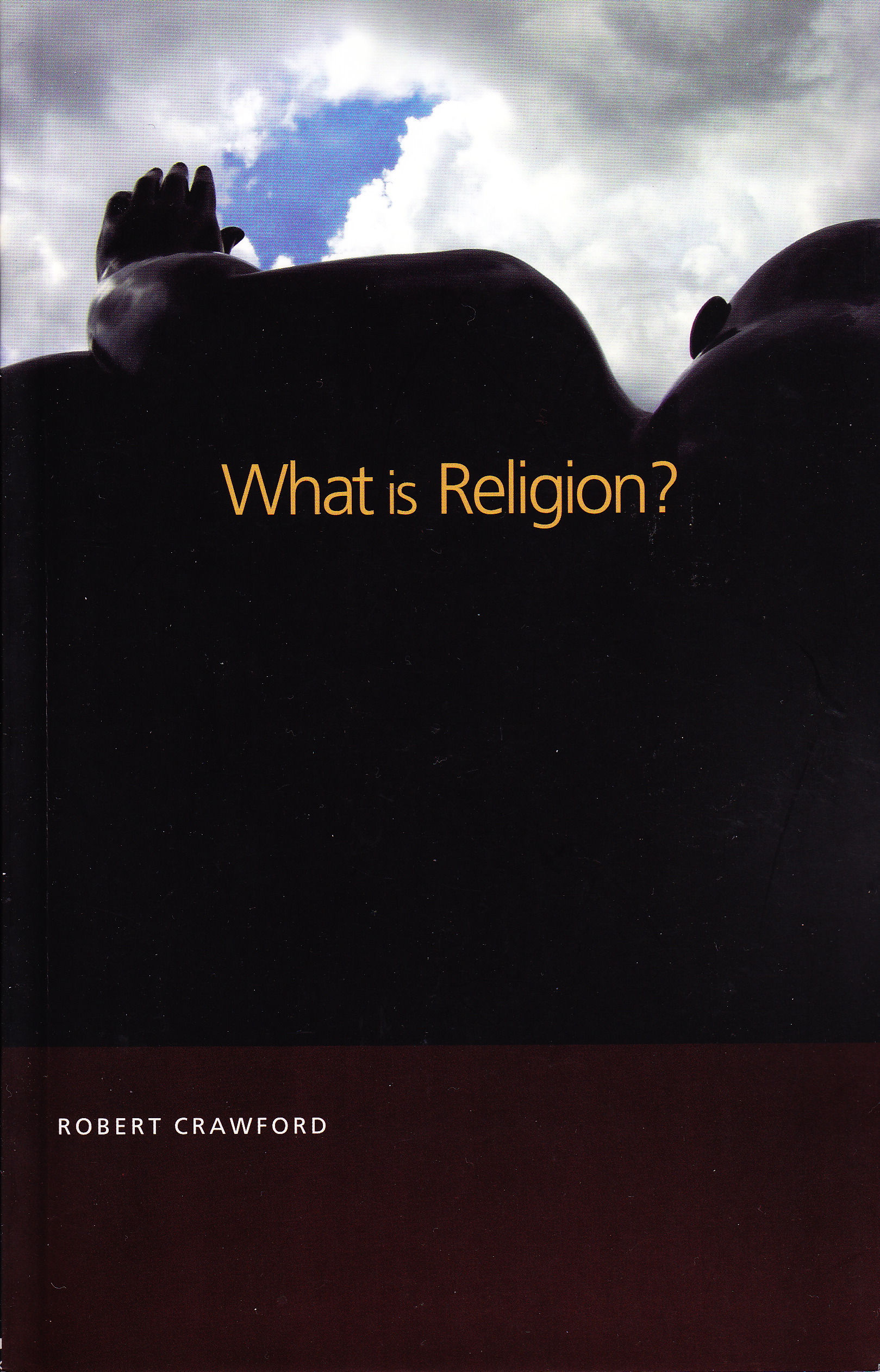
ReligionThe fundamental question of what counts as religion remains elusive. I read Robert Crawford’s What is Religion? hoping to find out. Crawford begins with the admirable assertion that in a pluralistic world all religions must learn to get along. Unfortunately, learning hasn’t always been one of religion’s strong suits. And we still don’t even know what religion is. As becomes clear within minutes of starting the book, consensus will be a stranger in this room. Nevertheless Crawford plows on, hoping against hope that comparison will reveal conformity. Religions aren’t really team players in that way.

Crawford keeps his focus on the “big six”: Judaism, Christianity, Islam, Hinduism, Buddhism, and Sikhism. Although these faiths contain the lion’s share of numbers, they in no way corner the market on religion. I wonder if Crawford’s net is really large enough. When trying to define religion, cutting corners gets you into trouble every time. No matter how we count it, religion is more than a matter of belief and broader than prescribed rituals. It must take seriously the attempts of even small knots of seekers in its preternatural accounting. Crawford sometimes gets bogged down in the details. Science plays a key role in his discussion but then the scope shifts to Christianity, a religion with more than its share of scientific troubles. Islam, for a while anyway, led the world in scientific thinking. What of Sikhs and science?

The more I read of What is Religion?, the more I got the feeling that all of these pieces don’t go to the same puzzle. Religions develop out of historical circumstances and needs. They, with a few exceptions, are not consciously devised by a bunch of eggheads shut up in ivory towers. Religions develop from people in difficult situations, whether physical or psychological. Think about it. If the Bible is to be believed Judaism grew out of slavery in Egypt (either that or Abraham’s childlessness). Christianity out of Roman oppression. Islam from Muhammad’s conviction that polytheism didn’t add up. Hinduism’s old enough to have lost its origins in deep antiquity, but Buddhism is clearly a reaction to pervasive suffering. Sikhism tried to steer between the clashes of Hinduism and Islam. We could go on, but I don’t wish to try your patience. I’m not suggesting I’ve finally done the impossible and defined religion. In fact, I may be suggesting the opposite. Religion encompasses many ways of being in the world. Crawford maybe got a start on the discussion, but it will go on as long as people have troubles.