Shaman Shifting

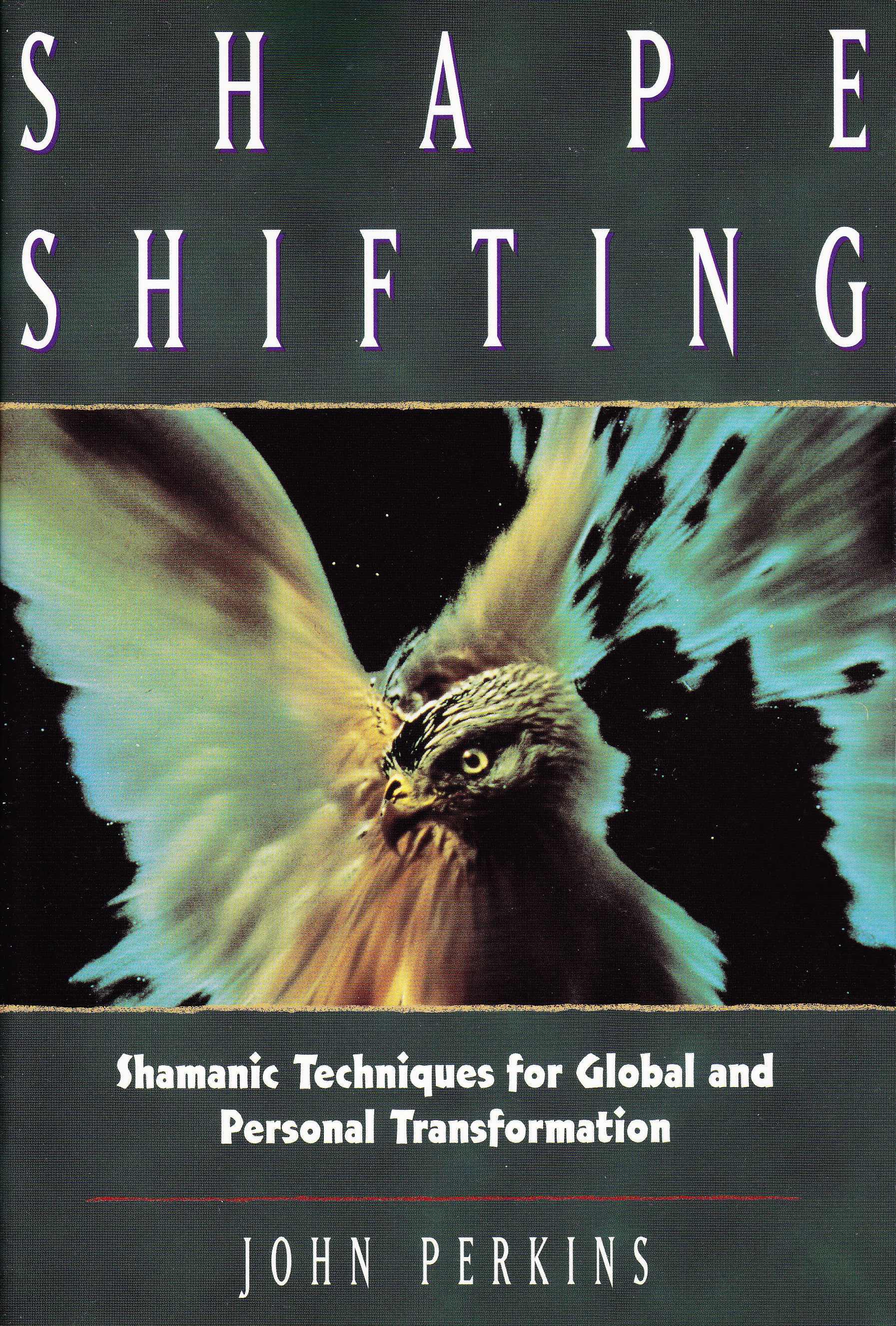
Shapeshifting I confess that I haven’t read Confessions of an Economic Hitman. Being incurably drawn to the weird, however, I picked up a copy of John Perkins’ earlier book, Shape Shifting: Shamanic Techniques for Global and Personal Transformation at the recent Hunterdon County Library Book Sale. I also confess that I fear being classed as one of those irrational sorts who’ll believe anything. It’s pretty obvious to anyone who’s been to college or university that a Ph.D. is no protection from the strange ideas that waft through human gray matter. Many years of teaching convinced, I hope, at least a few of my students that I approach the study of religion in a reasonable—dare I suggest?—rational, way. Despite appearances to the contrary on this blog, I weigh evidence carefully. Sometimes the evidence suggests we don’t yet have all the data. So it was with an open mind, but also a dose of skepticism, that I read through Perkins’ book. And yes, he does suggest that cellular-level transformation is possible.

Before breaking out your hooey-meters, however, consider that John Perkins is a successful businessman. Money speaks, n’est-ce pas? So I’m reminded every rational working day. The human mind, however, plumbs realms on which empirical method sheds little light, even to this day. Psychologists still debate whether there is a subconscious mind at all. And then there’s that troubling question of what exactly reality is. Historically, people have answered such questions with religion. And religion quite often permits entry where science declares “no gods allowed.” So did John Perkins really transform into a ball of energy and float across both time and space and see such disturbing sights as he describes? Did Richard Bach really astro-project with his partner, as recounted in The Bridge Across Forever? Are we really rooted to this mundane world where politicians and entrepreneurs make all the rules?

Perkins recounts his experiences with shamans of the Amazon, and like Jeremy Narby, his experiences with ayahuasca, a consciousness-altering plant. He even recounts transforming into an “inanimate object” so that his wife could not see him. Is it real? Can science measure such events? Does anything escape the penetrating stare of the electron microscope? We will have our Richard Dawkinses on one hand declaring an unequivocal “No!” The other hand, however, may be generating the sound of clapping for those who have ears to hear. Or at least for those who have eyes to read. At the end of this book, truth comes down to a matter of belief.

Paging Dr. Asimov

Who remembers Rock ’em Sock ’em Robots? Plastic “robots” in the boxing ring trying to knock each other’s block’s off was a form of entertainment for kids of the ‘60s before such things as humanoid robots actually existed. So when Boston University’s alumni magazine had an article about dancing robots, I had to see what was up. As regular readers will know, I’ve been exploring some of the problems with reductionism lately. This idea, that humans and animals are just fleshy machines, breaks down when we try to design robots that can do some of the most basic of human activities. Sometimes we dance and we don’t know why. Apart from Wall-e’s dance with Eve, robots have trouble getting the concept. Graduate student John Baillieul notes that this isn’t about “some high school guy who had trouble getting a date, so you get a robot. The ultimate goal is to understand human reaction to gestures and how machines may react to gestures.” Having actually been a high school guy who never even got to the prom, I’m wondering how depressed our robots get when the fem-bots all look the other way.

Rockem Sockem

The reductionistic outlook suggests that we can eventually program robots to respond as humans would, responding fluidly to situations, allowing them to over-ride their “instinct,” which, the article implies, equals programming. We have no idea what instinct is. It is something all biological creatures have, from the heliotrope following the sun to the human dancing her heart out. Do we want machines to replicate our most intimate emotions? Even our most reliable chip-driven devices sometimes freeze up or rebel. My car has recently got the idea in its mechanistic brain that the right-hand side rearview mirror should be rotated as far to the right as possible. We bicker about this all the time when I get in to drive. Well, machines know best. They, after all, are the shape of the future.

So programming robots so that they can react in real time to non-verbal cues, like all sentient beings do, is a desideratum of our mechanistic Weltanschauung. Notes Rich Barlow, the article’s author, “bats, for example, camouflage their motions so that they can sneak up on insect prey, a fake-out familiar to anyone who’s tried to swat a pesky fly.” My question is who is the pesky fly in this robot-human scenario? Who acts irrationally and unpredictably? Isn’t our instinct to smash the fly a result of our annoyance at it landing, yet again, on our sandwich with its dirty feet? And what is that stupid dance that it does when it’s all over our food? Reductionism must, by definition, reduce instinct to the level of a kind of genetic programming. Even this aging blogger, however, knows what it is to dance without knowing why. He also knows what it feels like when your date goes home with somebody else, something to which he’s not convinced that we want robots calculating an “instinctual” response.


God, Particle, Reduce

Reductionism is beguiling because of the exalted status it gives to the human intellect. It is presumed that rational thought can explain everything. Still, reason sometimes leads to paradoxes—we’ve all heard the (admittedly theistic) one asking if God can create a rock so heavy s/he can’t lift it. Given the premise, two strands of logic conflict. A similar sort of phenomenon, it appears, accompanies quantum physics. In a story from last year on Big Questions Online (a website supported by the Templeton Foundation), Stephen M. Barr submitted a piece entitled “Does Quantum Physics Make it Easier to Believe in God?” The article requires some concentration, but the basic premise is simple enough to explain: quantum physics does not sit well with reductionism. There seems to be will in nature. It may not be God in the machine; it may not even be a machine at all.

I have always been fascinated by science, and I am not one to castigate it. Its string of successes stretches all the way from atoms and their explosive tendencies to the moon and Mars and beyond. At the same time, most of us have experienced something that “should work,” in which no fault can be discovered. Reductionism would declare the fault is indeed there, just undetected. If, however, at the sub-atomic level, particles sometimes act uncannily, don’t those effects climb the ladder into the visible world in some way? Logic would seem to demand it. The problem with putting will into the equation is that will can’t be quantified. There have been many documented cases of an instance of superhuman strength coursing through a person when they have to rescue a loved one. We raise our eyebrows, mumble about adrenaline and pretend that will hasn’t affected nature in this reductionistic, strictly material world.

Denigrating human brain power is not something I undertake lightly. Logic works most of the time. A thinking creature who has evolved to be a thinking creature, however, must realize that its own intellect is limited. Simply because we are limited doesn‘t mean we shouldn’t strive to improve, but it does mean that ex cathedra statements, whether from pontiffs or physicists, should be suspect. One would be hard-pressed to label Einstein a believer. Yet even he made the occasional remark that left the door open for, well, maybe not God, but maybe not reductionism either. I was once told, and I believe it to be true, that you can tell a truly educated person not by how much he or she claims to know, but rather by how much she or he claims not to know. It may not seem logical, but down there among the particles of the quantum world, I suspect those willful quarks agree.

Erwinrossen's image of atoms, the sight eyes can't see

Erwinrossen’s image of atoms, the sight eyes can’t see


Dog-gone Belief

A recent book I read, I can’t remember precisely which one, suggested that one reason the average citizen has trouble with science is the fault of evolution. We evolved, at least some of us have, to rely on common sense. We trust appearances to intimate reality, and act accordingly. The problem is that science, almost in principio, informs us that things do not operate according to common sense, but according to laws that are inscrutable to most of us and involving math way beyond our limited ability. Even with a calculator. For example, the earth is spinning really, really fast and hurtling around the sun so quickly that I think I’m going to be sick. Really? Common sense tells me that I’m stationary, and my inner ear only gives me true peace when that is the case. QED, as my high school pre-calc teacher used to say. But it’s not the truth. We are spinning and jetting through space.

IMG

An article in Time magazine recently brought this disconnect home on a very poignant level. “The Mystery of Animal Grief,” by Jeffrey Kluger, explores the animal grieving process. Many species have been observed to react to the death of one of there own very much like humans do. Physical attitudes of bowed heads, actions that signal depression, and even rudimentary burials are all documented among animals. Some scientists disagree: reductionism declares that this is all appearance (like common sense), and if the professor on Gilligan’s Island taught us anything beyond building with coconuts and bamboo, it is that there is a rational explanation for everything. Animals grieving? It takes a human to do that. Well, actually, it takes a human to declare with such certainty that our animal cousins can’t feel like we do. Although our only current pet is a hermit crab—and perhaps many uninvited spiders—I grew up with dogs, cats, guinea pigs, and assorted other creatures. They express real affection. If they didn’t, I can’t think people would keep them.

I wondered, as I read Kluger’s article, when religion was going to come into the discussion. It wasn’t a long wait. Religion, he notes, is a human mechanism for coping with the finality of death. Dead is dead, after all. Animals can’t be religious, so they can’t experience the emotions we do. Or so science would mostly declare. I struggle with reality on a daily basis. My experience has taught me that things are not often what they seem, but sometimes my path lies in a direction diametrically opposed to that of Dr. Heisenberg. We are animals. Animals are part of our family. I’ve experienced people who show no emotion when their close associates are suffering. I’ve also experienced a dog that would cuddle up next to me and lick my face when I was sad, an encouraging look in his canine eyes. Animals are smart and empathetic. They have some understanding of death—it’s just common sense. I write this as I’m hurtling through space at 660,000 m.p.h. while spinning at a thousand miles an hour. If my reasoning seems suspect to you, consider the circumstances.


Paranormal Academy

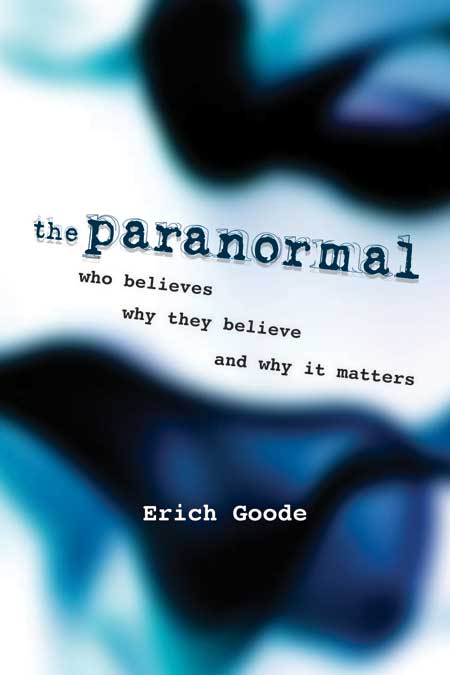
ParanormalA recurrent theme on this blog (as my faithful few will doubtless know) is that religion draws from the same stream of cultural energies as do other phenomena such as horror movies and the paranormal. Religion and fear and curiosity seem to share some common parameters, and every now and again serious academics tackle these connections as well. Erich Goode, a sociologist, has taken on unconventional beliefs in his The Paranormal: Who Believes, Why They Believe, and Why it Matters. Unlike many academic writers on the topic, Goode does not attempt to debunk, but it is also clear that he does not ascribe to the unconventional viewpoints he examines either. In what must be an important realization among sociologists, Goode, like some of his colleagues who also consider the paranormal, finds that belief is widespread. Large segments of the US population allow for some validity toward ghosts, psychics, aliens, and yes, even creationism.

That last one stopped me for a second. Several seconds, actually. Creationism paranormal? When Goode’s delineations are considered, this is not completely inappropriate, but creationism is pure-blood religion. Not that it is necessary for religion, but its birth and considerable growth has been among the conventicle of true Bible believers. It is clear that in Goode’s line of reasoning there is only a fuzzy line between religion and the paranormal. I’ve asserted that same fuzzy line, but I’d never considered biblical literalism as paranormal. Maybe because I was raised in that environment it seemed normal and natural to me. Maybe because it is in the Bible it feels weird to hear it classed as paranormal. Maybe because believers in ghosts, aliens, and undiscovered forces have at least some viable evidence to indicate their beliefs are valid; the creationist distortion appears not to belong in the same camp.

Creationism is a complex psychological phenomenon, to be sure. How people who know the obvious practicalities of science (such as television and the internet, where creationism can be expounded) have demonstrated that its overall methodology is sound, how such people can accept a fairy tale beginning to a Grimm tales world is difficult to fathom. And creationists, in general, would reject belief in what most of society considers paranormal. Can these coexist in the same category? While Goode constructs his paradigm as those who accept and reject empirical reductionism, I’m not convinced that religious belief is the same as paranormal belief. The parsing is a bit too coarse here. Creationism, which began life as a religious belief, has become a political agenda all about domination. It is not so much naiveté as it is need to rule. Somehow I doubt the ghost hunter with her or his night vision camera and digital voice recorder has any real designs on textbook distortion or having women keep silent on Sunday morning.


Bridge over Troubled

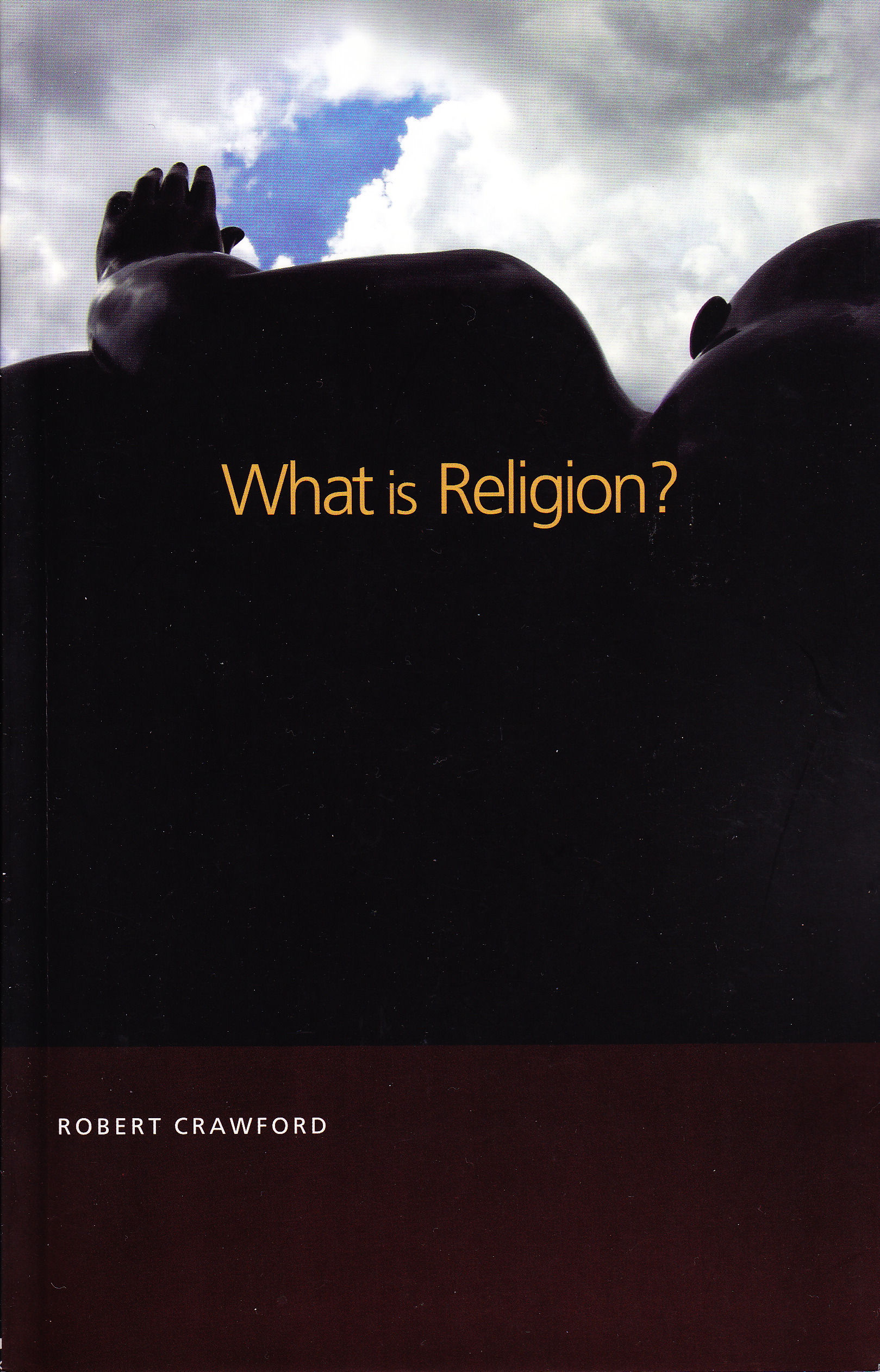
ReligionThe fundamental question of what counts as religion remains elusive. I read Robert Crawford’s What is Religion? hoping to find out. Crawford begins with the admirable assertion that in a pluralistic world all religions must learn to get along. Unfortunately, learning hasn’t always been one of religion’s strong suits. And we still don’t even know what religion is. As becomes clear within minutes of starting the book, consensus will be a stranger in this room. Nevertheless Crawford plows on, hoping against hope that comparison will reveal conformity. Religions aren’t really team players in that way.

Crawford keeps his focus on the “big six”: Judaism, Christianity, Islam, Hinduism, Buddhism, and Sikhism. Although these faiths contain the lion’s share of numbers, they in no way corner the market on religion. I wonder if Crawford’s net is really large enough. When trying to define religion, cutting corners gets you into trouble every time. No matter how we count it, religion is more than a matter of belief and broader than prescribed rituals. It must take seriously the attempts of even small knots of seekers in its preternatural accounting. Crawford sometimes gets bogged down in the details. Science plays a key role in his discussion but then the scope shifts to Christianity, a religion with more than its share of scientific troubles. Islam, for a while anyway, led the world in scientific thinking. What of Sikhs and science?

The more I read of What is Religion?, the more I got the feeling that all of these pieces don’t go to the same puzzle. Religions develop out of historical circumstances and needs. They, with a few exceptions, are not consciously devised by a bunch of eggheads shut up in ivory towers. Religions develop from people in difficult situations, whether physical or psychological. Think about it. If the Bible is to be believed Judaism grew out of slavery in Egypt (either that or Abraham’s childlessness). Christianity out of Roman oppression. Islam from Muhammad’s conviction that polytheism didn’t add up. Hinduism’s old enough to have lost its origins in deep antiquity, but Buddhism is clearly a reaction to pervasive suffering. Sikhism tried to steer between the clashes of Hinduism and Islam. We could go on, but I don’t wish to try your patience. I’m not suggesting I’ve finally done the impossible and defined religion. In fact, I may be suggesting the opposite. Religion encompasses many ways of being in the world. Crawford maybe got a start on the discussion, but it will go on as long as people have troubles.


Sea Wonders

There’s a hole in the bottom of the sea, if we are to believe childhood songs. News reports this past week, however, have suggested that just the opposite applies to the Sea of Galilee. According to Science on NBC, a huge stone structure, larger than Stonehenge, rests at the bottom of the lake over which Jesus reputedly walked at the height of a storm. To the untrained eye, this stone pile looks like just that—a stone pile. The problem is that there is no natural source for the mound, and it seems highly unlikely that it was built under the water. This astonishing find is only one of the many underwater structures known that seem to defy conventional chronologies and logical behaviors. If this gigantic cairn was built on land, the means remain a problem. It is one thing to climb a conventional pyramid, complete with ramps and sledges, and quite another to mount a mound of apparently random stones to drop another on top. Perhaps it was built under water after all, like one of those tantalizing toys where you try to land your penny in the cup at the bottom of a tank of water.

Pacman's Sea of Galilee from Wikimedia

Pacman’s Sea of Galilee from Wikimedia

Ancient monuments are one of the great fascinations of antiquity. When no rational explanation is forthcoming, a religious one will be declared. Without written records, we know nothing of the real purpose of Stonehenge or Avebury, let alone Galilee-henge. With the pyramids of Egypt we have a better set of data, and we can feel justified calling them religious structures. But why were ancient people building massive rock mounds in what was to become the Sea of Galilee? The place has irrevocable religious associations to the modern mind. Did it possess such connections in the deep pre-Israelite period as well? The false mountain of Silbury Hill, not far from Stonehenge, comes to mind. People are mountain makers.

Cairns have been among the most persistent of human monuments, but what makes this new finding of interest is its location. Baptized in the very lake that holds the headwaters of River Jordan, the mysterious mound has already claimed its sanctity. Who built it, why and when, will take backseat to the fact of its holy location. Archaeologists will eventually dive and probe and will declare an anthropologically sound explanation for this newly found, artificial, miniature mountain. Mountains and gods go together, however, as readily as offering plates and churches. Whatever this newly discovered structure may turn out to be, it will always be a religious site for those who believe.


Intelligence, Evolved

intelligenceinnatureAnyone who has looked into the eyes of a cat or dog can have little doubt that they think. What exactly they think is, of course, a matter of conjecture. I had been meaning to read Jeremy Narby’s Intelligence in Nature for a few years now. We are taught at a young age to eschew anthropomorphism—although our eschewers don’t use that word—as the childish way of perceiving the world. Animals don’t think because that’s reserved for people. We sit in the finest spots in the poshest corners of the animal kingdom and the sign says “No Dogs Allowed.” I never really outgrew this child-like belief because the minimal scientific evidence I’ve been able to infer supports the idea that like us, other animals think. Narby, an anthropologist, agrees. At least to a point. I don’t wish to make claims for Dr. Narby that he wouldn’t support, but he provides fascinating empirical evidence, “down” to the level of amebas and plants, that indicates intentionality. Nature is alive with thought.

As an anthropologist, Narby begins his consideration with the insights of shamans. Although scientists rarely countenance shamans, they are among the earliest of human religious specialists and they have long promoted the idea that humans are fully integrated into nature. We are not separate and above. From our brains to our bones, we are one with the natural world. If we think, should not animals think? Interestingly, this idea brings Narby into some of the same territory as Thomas Nagel; intelligence may be a cumulative process. Our brains’ ability to think may be the result of collecting together the thought processes of our fellow creatures to a point where our thinking becomes abstract. We’re told that dolphins and whales don’t think like us—they don’t build cities, do they? Maybe it’s because they didn’t evolve opposable thumbs. Maybe it’s because they’re smarter than we are.

There are, it seems, many thinkers on the outside of the hallowed confines of hard science that are chipping away at the strict materialist edifice. There can be no serious question that the empirical method explains much of what we experience in the universe. It has always amazed me, however, that we assume that humans are able to find the outer limits of existence with our limited senses. We know animals can see, hear, smell, taste, and maybe even feel in ways beyond our capabilities. Who’s to say that there isn’t other input well beyond our limited senses that we use to survive in this environment? After all, we didn’t evolve to know everything—we evolved to be able to thrive in our ecosystems. For that you don’t need all the answers—just enough to get by. If you doubt my reasoning here, I suggest you ask your dog or cat.


The Triumph of Lovecraft

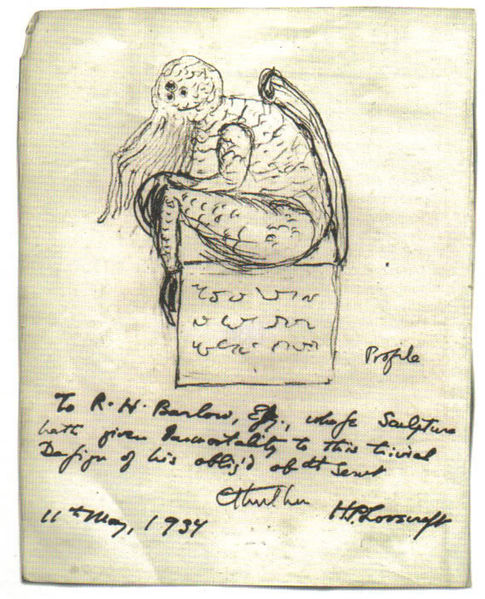
The deeper you peer into the mouth of nature, the more Lovecraftian the world becomes. Just days after I had posted a little meditation on Cthulhu, the great old god of H. P. Lovecraft’s unholy pantheon broke into the mainstream news. No less a source than NBC ran the headline “Tiny Cthulhu ‘monsters’ discovered in termite guts” only a few days ago. The microbe with the scientific name Cthulhu macrofasciculumque lives in the digestive system of termites, helping them in their destructive work. True, Lovecraft described Cthulhu as a bit bigger than that, but the first appearance of the microbes, according to Megan Gannon, reminded the discoverers of the eponymous terror of the Cthulhu mythos.

From microbes to the major football leagues such as the Baltimore Ravens, writers of the macabre have left their mark on our culture. The darkness they describe so richly is something we all feel at some level, but that we sublimate most of the time so that we can get on with our lives. Cthulhu macrofasciculumque may be very, very small, but the super-viruses and bacteria that we are encountering have the ability to destroy us just as surely as the chimerical colossus of Lovecraft’s nightmares. When we look for a way to describe these terrors, we have brave literary heroes from whom we might draw. We would be lost without them. They make it safe for us to venture into that darkened room, for they have been there before us. Lovecraft gave the world its first scientific description of Cthulhu, and although that description defies adequate reconstruction, we recognize it when we see it.

As Lovecraft saw him.

As Lovecraft saw him.

Science has brought us so very far. We can now see to almost the brink of an infinite universe and delve into the guts of termites. We have the ability to prolong life and increase physical comfort for those who can afford it, and we can annihilate entire nations at the press of a button. Drones can fly overhead and do the dirty work, and we don’t even have to step outdoors. Yet when we meet something that shivers our scientific spines, we turn back to the old gods to name it. Yes, religion may be the bête noire of science, but the dark night of the soul is not illuminated by LED’s or lasers. To see in this dark you need to have the night vision of literary perception. And those lenses, according to Lovecraft, reveal that the old gods are dead but still dreaming.


They, Robots

Somehow I knew robots would continue to be part of my life. After all, they are a staple of science fiction and they are indeed also a staple of science fact. As my association with FIRST Robotics taught me, robots are everywhere. (And they can play frisbee better than I can.) So when I saw an article in the Chronicle of Higher Education entitled “Robots Aren’t the Problem: It’s Us,” I knew I was in for a scolding. It’s not so much the robots that worry me, it’s what they say about us. People thrive in environments of complexity. Even a simple robot has me standing next to a bunch of teenagers scratching my head. I don’t know what half the parts are and have no idea what the other half do. Even the components can be complex. A good case can be made that the natural world is equally, if not more, complex. I can imagine how, for instance, being confronted by a tiger in the wild would offer a bewildering variety of complex implications. And yet, robots are the world we’ve constructed for our selves.

Not every job is immediately threatened by mechanical replacement, but we know that in the industrialized world some jobs have disappeared. Our choices of how to find meaningful vocation are being conscripted by the machines we make. Like God we make them in our own image. Unlike God, we make them more powerful than ourselves. Richard Florida, in his Chronicle article, notes that some claim the robots will free us to become more human. Only if the economic barons will allow it. Even today, at the very beginnings of the robotics revolution, it is awfully hard to find a satisfying job. Even with very extensive education. I know this from experience. At the end of the day you end up working to make money for somebody else. Robots didn’t steal my vocation, business did.

Al-jazari_robots

I appreciate Florida’s point, but I wonder if we can’t point a finer point on it. All people are greedy, to a point. In most of us a human, all too human, conscience starts to bother us when we realize that we are unfairly advantaged. Some people even actually do something about it. Those who run the business, however, didn’t get to the top by obeying the dictates of conscience. The apotheosizing of money demands that humans be treated like, well, robots. We are all servants to those who aren’t shackled with quibbles and moral qualms. Robots, on one end, are reducing the number of jobs. On the other end entrepreneurs are seeking whom they may devour. The mass of humanity is caught in the middle. When it is time to beg for mercy, from what I’ve seen, the far safer bet is with the robots.


Mind Your Cosmos

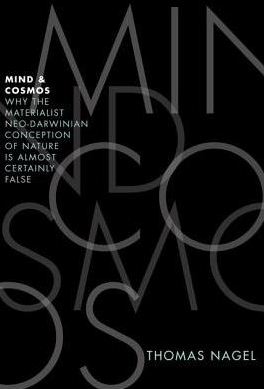
MindandCosmosSomething on your mind? How often do we bother to think clearly about our minds? One of the most dispiriting concepts ever invented is the idea that even our minds are merely part of a reductionistic, mechanistic universe. All those beautiful, frightening, sublime, and mundane thoughts are just noise, clutter. An inevitable side-effect of all that electro-chemical activity in the gray matter. Nothing more. It is an idea to which it is very difficult to warm. Philosopher Thomas Nagel, however, doesn’t use a soft approach to the concept of mind in his Mind and Cosmos: Why the Materialist Neo-Darwinian Conception of Nature is Almost Certainly False. This is not an easy read, but it rewards the reader well.

Some, I suspect, will accuse Nagel of being a closet creationist, but he addresses that concern up front. Nagel is an atheist, but he recognizes that the creationists have raised some valid points about the explanatory value of a materialistic, reductionistic view of the universe. Nagel, like all careful thinkers, realizes that the fact of evolution is not to be disputed. The mechanism driving mutations, however, is open to some speculation. I’ve read many books that suggest we are but (in a more than angst-ridden Kansas) dust in the wind. Particles and reactions and nothing more. That love you feel when your heart is thumping wildly over that special someone? Mere chemistry. And not the kind that implies a transcendent state. Just lab-coat chemistry. I read Nagel because this kind of reductionism just doesn’t fit reality as I’ve experienced it. I’m no physicist, but I’m all I’ve got. And my reason tells me that there’s something more too it.

Nagel approaches the issue by examining the origins of mind. Whence does consciousness emerge? Using precise, carefully selected reasoning, he demonstrates that there is a chance that consciousness is inherent in this universe we inhabit. Just as bodies are built of cells, and cells are built of proteins built of molecules built of atoms, the mind could be constructed of components as well. I can’t replicate Nagel’s elegance of expression, but his suggestion that we may be part of a universe beginning to awake is as much poetry as it is logic. And that, more than anything else, is a reflection on the complexity of being human. We are meaning-seeking creatures. Being told that we’re mechanistic automatons is like slamming a door in a two-year old’s face. If I am merely particles and tiny jolts of electricity, I’m going to take the particles that make Nagel’s book with me as I try to reconcile myself to a universe where nothing is really what it seems.


Infinite and Expanding

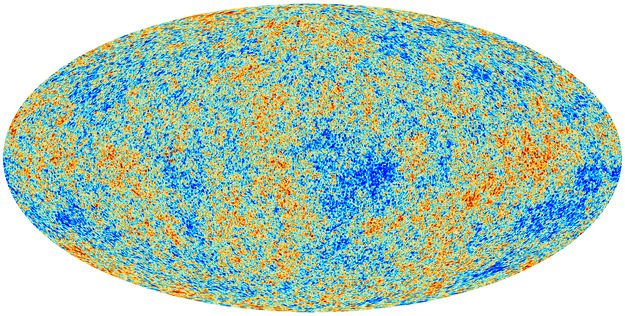
Show me the birth certificate. Whoa! It seems the universe padded the figures by about 80 million years. To you and me that’s 80 million years. To old universe, it’s merely the blink of a cosmic eye. The news has been humming with the results of the European Space Agency’s Planck Space Telescope picture of the microwave background radiation of the universe. From what I can see, the universe forgot to say cheese. Unless, of course, it’s swiss cheese. Further and further science confirms our big bang of a beginning, and, quite literally, it has been downhill from there.

PLANCK

Cosmology is the most theological of the sciences. I’m sure many cosmologists would demand to differ on that point, but the inexorable draw to find out how it all began had its humble origins in religious thought. The mythologies of the Sumerians, Babylonians, Egyptians, Israelites, among many, many others, explored options for how the universe (as they knew it) might have begun. The curiosity is deeply embedded in the human psyche—we want to know our origins. Physicists, of course, play by the rules. Astrophysicists use incredibly complex formulas that all point to a big bang that nobody has ever heard. The inevitable question is, however, what happened before that? Could it be there was no before? A time before time? It seems to me a religious question.

The Planck telescope tells us that our middle-aged universe also has more girth than it admitted previously. No surprises there, after all the theory of the universe’s growth is called “inflation.” I sympathize. All of this information is wonderful news on an intergalactic scale, but it hasn’t solved many of our problems out here in this corner of the cosmos. Reading the rest of the news headlines, after I wipe away the tears, I see that our universe really is showing its age. We are older than we thought, but are we wiser? Scientists are examining fossilized light with glee, but we still can’t figure out that if a guy loves another guy (or girl another girl) that it’s just another instance of what happens after the big bang. We can’t accept that our industrial greed has messed up the weather—has anybody been outside lately? We know that one percent control almost all the wealth and yet we buy lottery tickets and hope for the best. And these are only a few in a long series of echoes that can’t seem to allow some people to think clearly in this girth-challenged, more-than-ancient universe. It must be a religious issue after all.


RoboStop

Although few objects are as soulless and mechanistic as robots, I still feel strangely emotional about them. Had my daughter not been interested in them, I would never have become involved with FIRST Robotics, even serving for a year as an officer in the Team 102 foundation to help raise the thousands of dollars needed to run such a club. Like most people with a background deep in the humanities, I would’ve not pondered too deeply how much of ourselves we put into our machines. Right now I’m reevaluating that hypothesis.

No one doubts that an artist or musician puts her- or himself into her or his work. Those who do it best are most highly valued (after we let the artist die off, usually, after having lived a difficult life). We admire those who are able to catch the human spirit in such forms of expression while many scientists inform us that there really is no spirit at all—it is just chemical reactions and electrical circuits in the soft tissue of our brains. When we see the Mona Lisa, or hear Beethoven’s Seventh, however, we know they must be wrong. What we make becomes part of us. And I’m thinking that may apply to robots too.

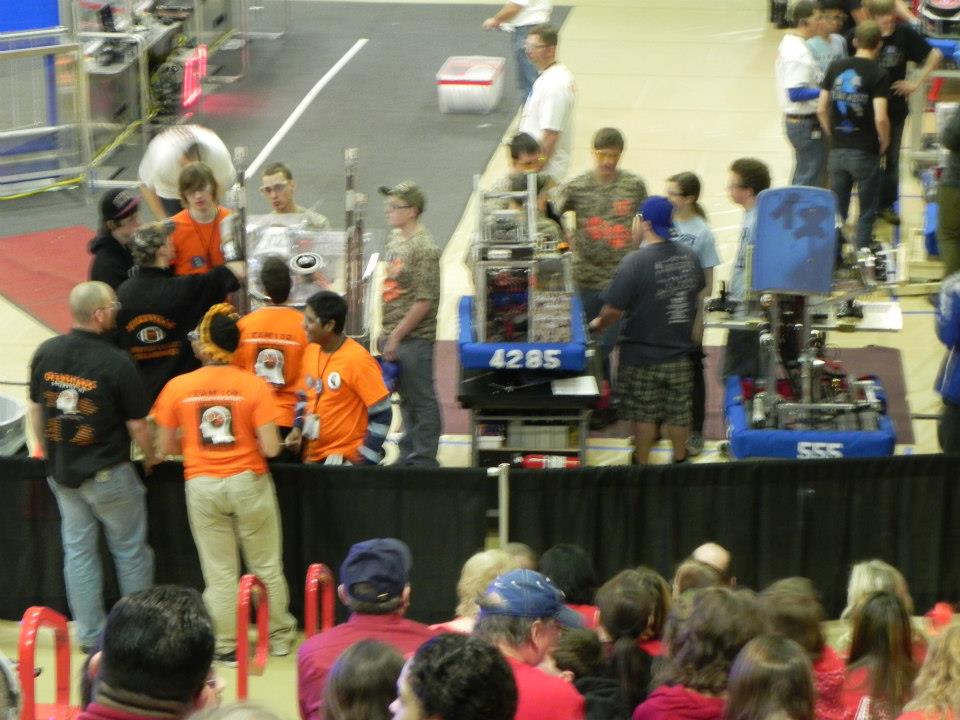
I’ve just attended my last FIRST Robotics competition. It is difficult to convey, if you’ve never been, what such an event is like. Hundreds of screaming high school students excited about engineering and the thrill of competition. A playing field is constructed to exacting specifications and six teams in two alliances facing off their creations to emulate human—sometimes superhuman—behavior. All the while the thumping rock beat of loud music and the play of colored lights give the event the emotional charge of a football game and homecoming dance rolled into one. Only you really don’t have to move very much at all.

I’m not a robot designer or builder. It is difficult to imagine anything further from my training (except perhaps accounting). Still, I’m a little let down after my last FIRST competition. Four years ago it seemed so novel, and there have been some difficult moments along the way. I’ve seen kids build robots that play soccer, hang inflatable tubes, play basketball, shoot frisbees, climb towers, climb poles, and do many other seemingly impossible tasks. I’ve been up before dawn to ride a chilly school bus across the state to compete, coming home in time to fall in bed to get up early for work the next morning. But most of all, I’ve seen kids putting themselves into more than machines. I’ve seen them putting themselves into a team. Although we didn’t win this year, and next year I probably will be consumed with other concerns, I am proud to have been, in my small way, a part of Team 102. Way to go, Gearheads! Maybe robots do have souls after all.

Team102FinalAlliance


AP Physics

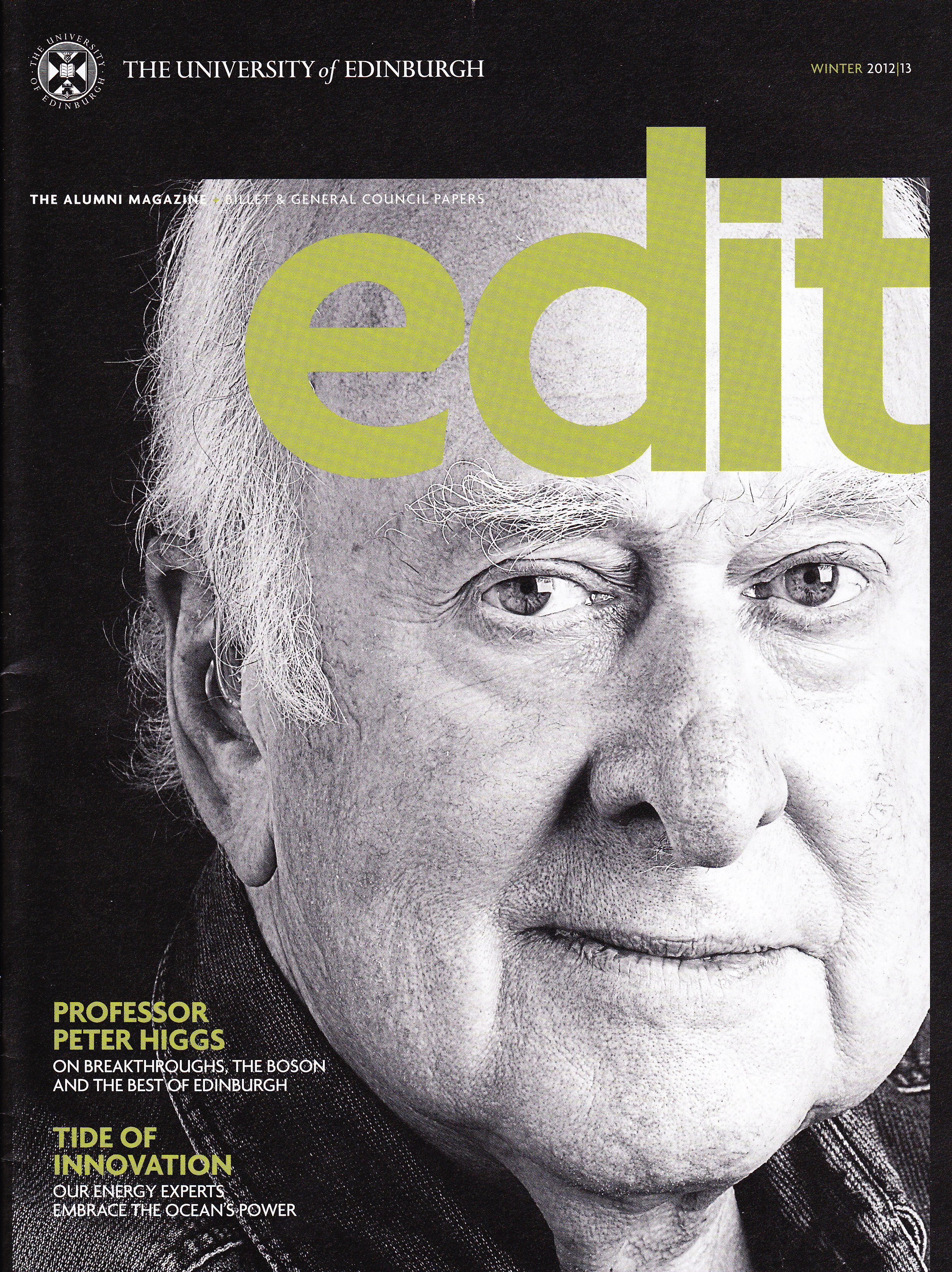
AP Physics. Few words strike terror into high school students like these initials and scientific surname. As a student I didn’t really comprehend AP, and never took any Advanced Placement courses, but I enjoyed physics. It was by far my favorite science class. Even as a Fundamentalist, I saw that here was the explanation for the entire universe, as we knew it. Laws deduced by people far smarter than I could even dream of being could explain everything. But then Heisenberg. And Schrödinger. And quantum mechanics. I remember being taught that nothing was smaller than an atom. (Primarily school teachers in the early ‘60s can easily be forgiven the generality.) Still, on my own I read about protons and neutrons and electrons with wonder. When physics and chemistry brought these to the level of reality, it was like we really understood that each atom was like a solar system and boy didn’t it look intelligently designed! But then we looked closer. Quarks, in a Life-Saver array of juicy flavors, string theory, and the God particle itself, the Higgs boson, coyly showed their elusive faces and physics got weirder and weirder.

Edinburgh does physics (and God) proud

Edinburgh does physics (and God) proud

When my daughter told me about AP Physics recently, I was reacquainted with this world where apparently conscious beings have their choice about reality. The observer bends the results of the quantum experiment. And yes, particles can be two places simultaneously. When a friend pointed me to an article on Quantum Reality in The Waking Times, I was ready to throw open the doors of perception and celebrate life in a universe so strange that the very concept of reality itself is up for grabs. Some physicists now believe the entire physical universe is constructed of energy and that it flashes into and out of existence at a staggering speed that makes me feel a little perpetual-motion sick. Reality is, literally, what we make it.

I have to admit just a little bit of pride on the part of having chosen to study religion here. The more we learn about the quantum world, the more religious it becomes. There will be hard-core reductionists who dispute this, I know. Those who’ve spent any time among the mystics, however, will know what I mean. Back beyond the singularity the laws of physics are so stretched and protracted that even Stephen Hawking can’t sort them all out. And we find ourselves daily living in a world that we help create, on a sub-atomic level. Reality may not be what it seems. I learned this in high school physics. Now that my brain has ossified into patterns that don’t admit much of calculus or accounting any more, I’m beginning to realize that physics is suggesting that reality may be consciously constructed after all. Only this time we’re the gods. And that’s a really weird concept.


Blob Blog

Those who actually know something about movies occasionally complain that Hollywood seems to provide us with diminishing returns. How many movies have been remade? Can anyone even count all the sequels, prequels, and just plan quels? A similar trend is evident in publishing. A teen-vampire novel takes off and every publisher faces a twilight of the profits if it doesn’t spin off its own version. Sometimes I end up becoming familiar with a movie through its remake before ever viewing the original. The Blob is one example of this. I’ve seen the thirty-year remake 1988 version a few times. Just this weekend I saw the original 1958 version for the first time. It seems to me that teen movies of the late fifties and early sixties tried a little too hard to get the snappy, sassing dialogue of teens on the brink of the incredible cultural changes that were about to take effect after the extreme conservatism of the McCarthy Era. At times it is so hip that I can hardly stand it.

The_Blob_posterThe Blob falls into that category. A young Steve McQueen trades ripostes with his chums who think a drag race and a Bela Lugosi movie with your gal are pretty daring behaviors. Buried in all that innocence, however, I found a hidden warning tone. When I watch scary movies, I always keep an eye out for religious themes. Sometimes they fail to materialize. The Blob is about as secular as they come. I didn’t even spot a church or a priest (unlike the 1988 remake) in the typical American town. Just a bunch of kids that, Archie-like, try to convince the adults that they’re serious. A blob from space really is loose in town, and nobody has an idea how to stop it. All the adult men wear ties and the ladies all wear dresses. It is a world that follows the rules.

What of this warning tone I mentioned? Well, the blob itself is, apart from its disruptive raison-d’être, hardly more threatening than the stifling culture it attacks. It can’t be shot or burned, and nobody has any other ideas. It is unstoppable. Except for cold. And here’s the chilling part. As the carbon-dioxide drenched blob is airlifted to the Arctic by the military, Lieutenant Dave declares the world safe once more. Steve (Andrews, i.e., McQueen) chimes in with, “Yeah, as long as the Arctic stays cold.” The film ends with a trademark horror question-mark (this one literal) as the blob is parachuted onto a snow-covered landscape. Global warming was a future monster in 1958. The optimistic world could see nowhere but forward. Now, over 50 years later, our future looks a lot less cold. With politicians and some religious leaders decrying global warming as just another liberal myth, we might do well to remember The Blob. Something up there on our melting ice caps is waiting for us to return to the 1950s to begin its sequel of terror.