Holy Hypothesis

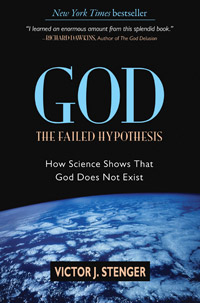
The angry atheists have been center stage in the God debates over the last few years. Many of them have become household names. Often giving sweeping generalizations about what God is, they tear apart this highly improbable image with aplomb. Not that I like to get in the way of somebody’s innocent fun, but their approach to the question only antagonizes the opposition without converting them. I just finished Victor J. Stenger’s God: The Failed Hypothesis. Like many who argue for atheism, Stenger is a highly regarded scientist. Unlike many, he offers a systematic, even-keeled account of his reasons for rejecting the divine. Indeed, the sub-title is straightforward—prosaic even—How Science Shows That God Does Not Exist. As befits a physicist, Stenger is careful to define his terms and is cordial enough to state that his book doesn’t cover the non-existence of deities per se, but the interventionist God of yore in particular.

Although I can’t agree on every single point Stenger makes, he does a compelling job of laying out logically how, if God is taken as an hypothesis (theory is a little too strong a category, implying substantial scientific concurrence), there should be some measurable result in the universe that God created. Choosing to differ from many theologians and scientists, Stenger argues that science can say something about God, given that God reputedly acts in a physical world. Outside these parameters something one may choose to call God may exist, but that kind of God does not answer prayers or oversee evolution.

Like many scientists, Stenger feels compelled to undertake this argumentation at least partially because of the weary insistence that evolution is “just a theory.” Creationists have tried to distort science for nearly a century now and have been successful really only in the United States. As Stenger shows, their method is often science, but wrong science. Just because an idea is scientific does not made it valid science. Stenger also points out that the premises of creationism, no matter how measured, are just plain wrong. Throughout, however, there is no belittling of those who believe in God. What is offered in this little volume is a rational, non-hysterical account of why a physicist who follows the law of the kingdom finds there is no God above it. And like a true scientist, Stenger leaves open the possibility that new evidence could overturn his verdict. Nevertheless, if his work is taken seriously, such a turn of events appears highly improbable.

Gods Will Be Gods

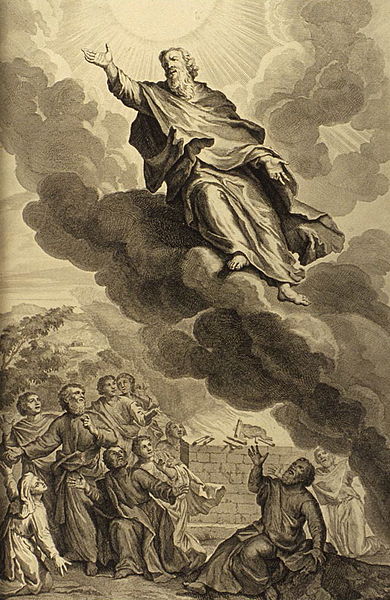
“And it came to pass, when men began to multiply on the face of the earth, and daughters were born unto them, That the sons of God saw the daughters of men that they were fair; and they took them wives of all which they chose.” Genesis 6 begins with one of the most unusual stories in the entire Bible. And that’s saying something! The sons of God mating with the daughters of men? A couple verses on we hear about giants roaming the earth in those days, presumably the children of this divine-human miscegenation. What is this stuff straight from pagan mythology doing in the pages of Holy Writ? Over the centuries, translators have tried to tidy up the boldly direct language of the King James here, making the sons of God into angels or some lesser beings. It is too hard to accept that sacred scripture admits of polytheism.

Monotheism, it is clear, came to the Israelites somewhat late in their history. The Bible is full of bold clues that other gods exist, and, worse yet, they are sometimes as powerful as Yahweh. In the light of later theological development, translators often bow to popular pressure and clean up the Bible’s language a bit. Fact is, Israelites, like most ancients, lived in a world populated with mythical creatures. Gods galore, monsters, demons, angels, witches, giants—they all haunt the pages of the western world’s sacred book. But that’s not what we expect the Good Book to say. The Hebrew text here is unequivocal, these are the “sons of God” we are talking about. Either that, or worse, “the sons of the gods.” More and more deities.

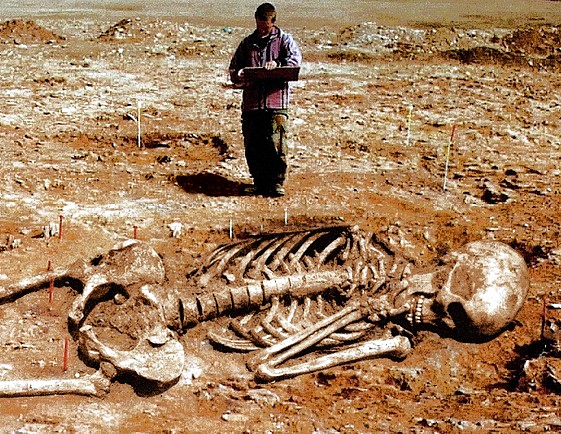
We can’t be sure why the ancient believed in monsters and giants, but it seems likely that such creatures had explanatory value for their world. Lacking science—paleontology was millennia in the future—they had to explain the huge bones found in the earth. We do know that dinosaur bones had been discovered in the Mediterranean basin in antiquity. These big bones often look human to a non-specialist. Heads are frequently missing. It has been suggested that these give rise to our biblical giants. Yet another response has been the recent trend of fundamentalists with Photoshop skills to post photos of archaeologists actually discovering giants on the Internet. Some of these doctored images are very impressive. It is an effort to save the Bible from the truth. A Bible that requires saving, however, should give even the most fervent believer pause for thought. Isn’t it just easier to suggest the sons of God were typical guys and that little has changed since the world was young?


After Before the Dawn

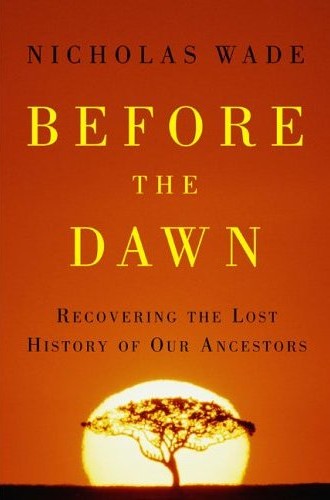
Apropos of reading Nicholas Wade’s Before the Dawn, as a sometime scholar of religion a number of points struck me. According to both material artifacts and DNA, several changes took place among human beings some 50,000 years ago. Having just read P. W. Singer’s Wired for War as well, the early coalescence of war and religion in human history was unavoidable. Wade ties the emergence of both with the development of language. It is only when we can speak that we can begin to express our theological speculations and, as history continues to teach us, despise those who disagree with us. It becomes clear quite early in the tome that Wade has an interest in explaining religion. Like many science writers he struggles with the issue of why religion persists, despite the explanatory value of science. We know how multiple aspects of our world work, yet we still defer to a divine that no one has ever seen or registered in any empirically verifiable way.

Not only does this tendency stretch back to our distant, distant relatives. The Natufians, about whom I generally lectured my students (itself ancient history), are marked as well by the dual achievements of religion and war. Wade is one of the few scholars I’ve discovered who concurs with my assessment that religion was among the earliest of human behaviors. In my mind, it is tied to consciousness and its evolution. Once we begin to realize that we are not in control of our destiny, we start to seek explanations from above, and hope that God loves us. Otherwise the picture isn’t so pretty. Indeed, Wade suggests that religion evolved as a socially cohesive force. Tying the concept to ethics and trust, he suggests early people had to learn to get along with strangers and religion cemented that bond.

I’m not a scientist, so I cannot assess whether this explains religion or not. It does seem clear, however, that if Wade is right religion itself has evolved into a more aggressive beast. Sure, religions still serve to bind people together—but only so far. As populations separated, their various religions evolved and led them to distrust one another. Instead of bonding humans together, religion began to put them into competition for the truth. Here, Wade’s analysis is sadly true—religion and war evolve together. Our small planet is yet too big for everyone to get along, to know and trust the stranger. Religion had helped us at the critical stage when we needed social bonding, and now it has naturally evolved into the opposite—a socially divisive force of orthodoxy and heresy. If Wade is correct, we all need religion to take on its most ancient role and bring people together instead of giving us excuses for war.

Waiting for the dawn


Enoch’s Dilemma

“And all the days of Enoch were three hundred sixty and five years: And Enoch walked with God: and he was not; for God took him.” These two verses from Genesis 5 convey just about all we know of Enoch. That, and he was the father of the oldest man ever, Methuselah. With this intriguing introduction, however, the religious mind insists on a backstory. Over the centuries of antiquity, books grew about this mysterious character as he became the prototype of the person who never died. The Bible doesn’t state that Enoch didn’t die. Nor does it state that he did. Plenty of wiggle room for the mythic imagination. In what appears to be an unrelated story, the Chronicle of Higher Education this past week reported on technology that builds on the strange but natural idea of phantom limbs.

When a person loses a limb, sometimes they report still feeling it. Their brains grew in a body that possessed the limb, and once it is gone the brain still has memory of it. The term used for this is a phantom limb. Knowing that mind does control matter to some extent, robotics experts have figured out ways to wire a robotic limb to the brain of a paralyzed person that responds to brain signals sent to the phantom limb. As much like science fiction as it sounds, this is already happening. The robotic limb responds just like a biological limb. This technology is just developing, of course, and is very expensive. It also implies that cyborgs, once the fodder of futuristic fiction, are becoming reality. Some theorists, such as Raymond Kurzweil, suggest that the brain itself can be converted to electronic signal and transferred into mechanical storage. Once that is achieved, we will have Enoch without any God to take him.

The world that we’ve been engineering bears a strange resemblance to the world of the Bible. For the people of ancient Israel death was the final word, and with rare exception (the only unquestioned case of the undying man was Elijah) people simply accepted the inevitable with no concept of an afterlife. Contact with the Zoroastrians convinced some Jews of the possibility of life beyond death and the quest for immortality was on. It has been a desideratum of human aspirations ever since. We invented machines to help us do what nature has not equipped us to attain. Finer and finer lines have been drawn between the biological and the mechanical. While it make look like immortality to some, to others it seems that we have been kidnapped—taken, if you will—by technology. What really happened to Enoch? The Bible doesn’t say, but it seems that we are getting very close to finding out on our own.


Convergent Evolution

Back when my opinion mattered—in higher education, you must realize, a scholar’s outlook only matters when s/he has a teaching post, no matter how abysmal the school. Once that post is gone you just become another guy with an opinion—I was invited to a conference. This is quite an honor for someone consigned to the bargain basement of academia, and for my paper I read from a burgeoning book that died a sudden death along with my academic career. In that stillborn tome I argued that many aspects of ancient mythology—including some in the Bible—made better sense in the light of science. I suggested that some of the infelicities in ancient texts might be the signs of continuing evolution of the human brain. Ancient people were able to believe what we find troubling. By the end of the conference many respectable scholars were looking askance at me when I stepped into the room. Honestly. I heard the word “Wiggins” uttered as if it were an archaic curse. Shortly after that I found myself working out of some guy’s basement for a salary fit for a knave.

Imagine my delight, then, at finding a reputable scholar who argued that the human brain indeed continues to evolve. In fact, it has speeded up the pace as new challenges have emerged. Before the Dawn: Recovering the Lost History of Our Ancestors by Nicholas Wade was recommended to me by my brother-in-law. As I was updating myself this week on how we became human, I was surprised to see Wade suggesting what I had suggested in my paper—the patterns of human behavior (we both have an interest in religion, it seems) are tied to the evolutionary state of our brains. Sitting on a bus next to many other drones commuting like ants to New York City, I felt strangely vindicated. I had an idea scorned by my colleagues that is being suggested by science. Not that everyone will accept Wade’s conclusions. Many scholars of ancient religions will never even read them. When I explained my thesis to a colleague after losing my academic status, he said, “I don’t give much credibility to science.”

Convergence is the phenomenon of two species evolving an adaptation independently. Often it is difficult for people to believe that a trait shared by two populations is simply nature’s way of trial and error that happened to work twice, in different situations. Nicholas Wade and I experienced convergence on this point. He, of course, is a famous writer and I am nobody. Nevertheless, my unpublished idea was presented at a conference the year his book must have been in production. We had both been reading about evolution and wondering what its effect on religion might have been. I will comment more on Wade’s specific ideas about religion in the book in another post. He, of course, went on to write The Faith Instinct, which was widely acclaimed. At that time I was struggling to find work and it seemed that natural selection hadn’t selected me at all. I am glad, however, that my idea made it into print, even if it was evolved by someone else who is far more fit for survival.


Stormy Weather

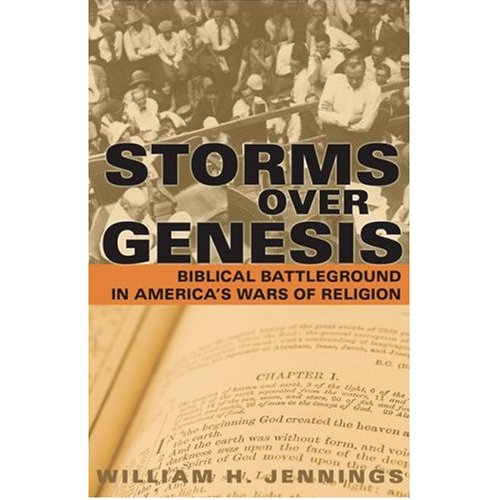
The privileging of one literature over others is problematic. Of course, the entire industry of biblical studies is built around such preferential treatment. And so is a large share of Christianity. I’ve just finished reading William H. Jennings’ Storms over Genesis: Biblical Battleground in America’s Wars of Religion. For someone who has taught Genesis before there wasn’t too much new material in here, but it strikes me as a very good primer for those who wonder about why the issues of gender inequality, global warming, and evolution remain firmly entrenched in evangelical minds, and therefore, our society. Just the first three chapters of Genesis, as Jennings points out, have led to the much of the irrational, at times inane, arguments that just won’t go away. Tea Party kinds of issues.

At the base of it all is the concept that Genesis somehow represents the way the world is supposed to be (rather than the way it actually is). As if seconding my choice of bus reading, The Economist recently published an article on Glen Rose, Texas. I’ve known about Glen Rose since I was a child. There, in a bizarre twist on the Flintstones, locals claim human and dinosaur footprints intermingle in a nearby creek bed. As the article points out, some locals see this as evidence of young earth creationism—seems Fred and Wilma missed the ark along with Dino. For decades paleontologists have tried to explain that the “human” tracks are actually dinosaur tracks as well. Given their size and stride, if they were human Adam must’ve been a giant. Despite the science, the myth persists. Even the article in The Economist doesn’t give the scientific answer.

It would be difficult to find a book more influential than Genesis. It would also be difficult to find one that is less scientific. Anyone who has studied ancient societies knows that they delighted in telling outlandish stories to explain the origin of the world. After all, there were no eyewitnesses. No channel 11 helicopters hovering overhead to bring you the story live. It all comes from mistaking a good story for a good book. In an era when evidence of evolution literally abounds, we still have nearly half the population of this technological nation trying to make room for the Valley of the Gwangi. Jennings may not hold the answers to all the problems Genesis raises, but if people would read Storms over Genesis, we might be able to afford a little more energy to solving global warming rather than running from dinosaurs in Texas.


Robo-Stop

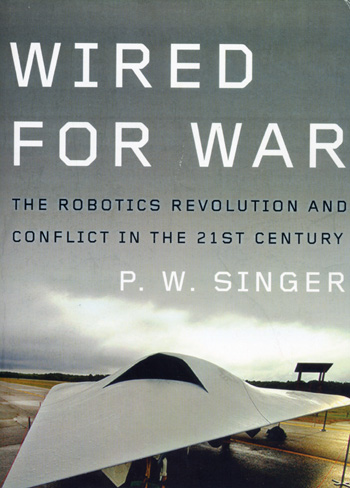
I have just read the most disturbing book yet. And for me, that is saying something. The facets of fear that P. W. Singer’s Wired for War manages to cut are sharp and dangerous. That he was able to write the book with a good dose of quirky humor only ameliorated the troubles a minor bit. The subtitle of the book is The Robotics Revolution and Conflict in the 21st Century. I was drawn into robotics by the FIRST Robotics competitions in which my daughter’s school competes. Not an engineer or programmer, I merely sit on the sidelines and cheer along those who understand mechanics, hydraulics, and electronics. Quite often I get the sense that since science works so well there is little room left for serious consideration of the humanities. Particularly religion. By the end of Singer’s book, however, my choices in life were reaffirmed. I would rather spend the limited days left to the human race celebrating our humanity. For, it seems, our days may be numbered indeed.

Considering that Wired for War was published three years ago, the technology must surely now be even more advanced than it was when the book went to press. That such technology as Singer describes exists is not in itself too much cause for worry, but the fact that such technology rests in military hands is decidedly disturbing. One of the few resources able to tap into the tremendous budget of the United States with impunity, the military services have been able to commission robots that are even now deployed in our various conflicts. A strong ethical question run through Singer’s account: we are racing ahead with lethal technology and artificial intelligence—and no one is really driving this machine. Shouldn’t someone be?

One of the more sobering aspects of Singer’s account is how humans are increasingly left “out of the loop” when it comes to lethal decisions being made by robots. Their logic is flawless, as is their aim. Their understanding, however, is purely mythical. As I read this gripping account, several issues spiraled out to be considered on their own. I arrived home disheartened and concerned for a future that seems to be inevitably in the hands of those I fear most: those with excess capital. Military robots do not possess empathy or compassion, just physics and trigonometry. And they already exist. When those powerful enough to wage war discuss the rules, their decisions are tellingly called “the doctrine of war.” Doctrine, whether military or religious, is always a sure sign of danger to come. And the robots aren’t coming. They’re already here.


Supernatural or Supernormal?

For anyone who’s honest, a person has to confess to doing weird things every now and again. Often we don’t even know why we do them. Those who write about our animal cousins after observing them closely offer a storehouse of explanations. Much of our behavior derives from our evolutionary heritage. In Supernormal Stimuli: How Primal Urges Overran Their Evolutionary Purpose Deirdre Barrett presents a most cogent case for why humans take things to the extreme. Everything from sex to overeating to television to our attraction to the young to why we kill each other in conflicts may be explained by the incredible attraction of supernormal stimuli. Beginning with the bird and bee studies of Niko Tinbergen, Barrett explains how we are often simply acting out eons’ old patterns that sometime prove to be destructive when left unchecked. The way to escape from them, she notes, is to become aware of them.

A bird will often favor an exaggeratedly large and crudely patterned egg over her own. Leopards will sometimes attempt to raise baby monkeys after eating their parents, because the babies are so cute. Thousands of citizens will prefer to watch athletes on television while eating unhealthy food rather than exercising themselves. Why? Supernormal stimuli have an immeasurable biological draw, and humans are in no way exempt. Tinbergen, the eventual teacher of Richard Dawkins, saw this as one of the dangers of Christianity. By separating humans radically from animals, religion presents us with false reasoning as to why we act the way we do. Science explains, religion makes up excuses.

The most poignant aspect of Barrett’s fascinating study has to do with war. Territorial animals make frequent displays of force that, in humans, translates to war. There does seem to be a biological basis for the male predilection for aggression. As Barrett notes, “Women throughout history have said—as do contemporary ones in Israel and Palestine—that a group of mothers could sit down and hash out in one afternoon an agreement that has eluded male rulers for years.” If men could lay down their posturing and be willing to let others have a fair share of the goods, life might be more amenable to all. It’s not all bad news, however. Nature endows us with endless curiosity as well. Is that not what brought you to this blog? I hope that curiosity extends to Deirdre Barrett’s Supernormal Stimuli and we will all learn to overcome the baser parts of natural selection.


Secret Life of Clouds

As April showers linger into May, I am reminded of April’s issue of Discover magazine. I picked up a copy on my way to Santa Barbara, and although much of it is beyond me, the article about microbes causing rain seems apt on days like today. Although I move in small circles, I hear many people commenting on how weird the weather has been this year. Mornings cold enough as to require a winter jacket, and evenings where a light sweater is almost too much. And the rain. Now, I realize that weather is always a decidedly local phenomenon, but apart from the rare reader in Antarctica or the Atacama Desert, we all know rain. In the biblical world the rain, as with so many inexplicable things before the birth of science, was in the provenance of providence. God sent the rain as a kind of blessing to a parched land. Thunder and hail, however, we sure signs of his displeasure. Discover suggests that maybe the answer lies in some being that is tiny rather than astronomically large.

The question that has frequently eluded answer among meteorologists is why some rain clouds rain while others don’t. No one really knows what the trigger might be—thus cloud seeding has often been a hit-or-miss proposition. Douglas Fox explores the possibility that, in his words, “The Clouds Are Alive.” Scientists can now measure the microbial life that survives in the sub-frigid temperatures high in the atmosphere above us. Amazingly we continue to discover that where we once thought conditions were too hostile, life manages to thrive. When I was a child scientific orthodoxy declared deep ocean trenches near volcanic vents far too acidic for anything to survive. Now we look at the clouds and see life. Not exactly the angels some theologians expected to find hovering above, but life nonetheless. And if the microbes are there, they might survive on a world as chilly as Mars (which, I hear, is even chillier than our apartment in winter).

One of the favorite gaps for the famous God-of-the, is the weather. As a symbol of what is beyond human control, indeed, the largest perceptible environment in inner space, the sky remains aloof from our tampering. Even so we’ve found ways to pollute our firmament. And now we’re discovering we’re not alone up there. The idea that the clouds are full of microbes sounds more like a Stephen King plot than an intelligent design. Actually, it is good old evolution in action. Life is surprising in its ubiquity. We’d once convinced ourselves that it was rare and could only thrive in environments similar to ours. Now we know that even on a terrestrial scale of survival, we are wimps. Every cloud, they say, has a silver lining. Little did they suspect that the light might be shining off of microscopic life.

The life from above


Random Science

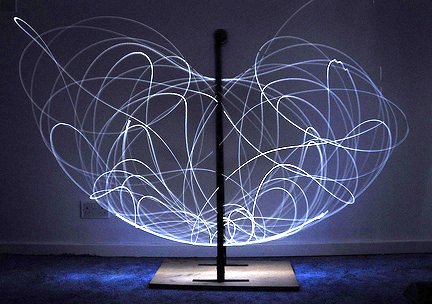
Our world is defined by science. Empirical method demonstrates again and again and again that physical properties follow the same tired pattern without any divine intervention. Saturday was Rutgers Day. Instead of our usual visit to College Avenue to sample French cheeses, we went to the Busch Campus of science and engineering. There we were treated to a 90-minute physics lesson that consisted mostly of demonstrations for the kids with things blowing up, glowing, and being broken after being dipped in liquid nitrogen. Outside the building we watched a chaos pendulum which a grad student explained never followed a predictable pattern. Back in the day when I was subjected to religious rules stricter than any laws of physics at Nashotah House, I used to read about chaos theory. It is the most biblical of scientific ideas. As anyone who’s watched Jurassic Park knows, it means that ultimate predictability is futile. Well, there’s more to it than that, but I’m merely an amateur.

Returning home, I read an interview with Matthew Hutson, about his new book The 7 Laws of Magical Thinking: How Irrational Beliefs Keep Us Happy, Healthy, and Sane. It is now on my wish-list, but I haven’t read it yet. Despite the fact that Hutson is an atheist, he recognizes that magical thinking is both healthy and unavoidable. A door creeps open for the scholar of religion here. We are able to see that non-rational thought is human, so very human. We don’t often think about how driven we are by our emotions. When we see a friend we ask, “what do you feel like doing today?”, not, “what do you think like doing?”. Visiting someone recovering from hard times we ask how s/he is feeling, not thinking. Emotion is, after all, built on the root of “motion”—it is our motivating factor. Seldom is it scientific.

Not to demean science. I have read science books and magazines on my own since I was a teenager. The truths that have been revealed through science are endlessly fascinating and pragmatic. They work in a way religions seldom do. Nevertheless, I became a scholar of ancient religions, studying them scientifically. In the Middle Ages it was said that philosophy was the handmaid to theology. Truth was revealed, not discovered. Reason, thankfully, began to show the way forward. The epithet Dark Ages gained currency for a reason. Science is our means of comprehending our universe, and yet, superstition is hardwired into our brains. I am glad for the scientific worldview even when the chaos pendulum still swings crazily, unpredictably before me. Seldom do those in my field get to consider themselves Renaissance women and men. The pendulum swings where it will.

George Ioannidis' chaos pendulum


Darwin’s Descendents

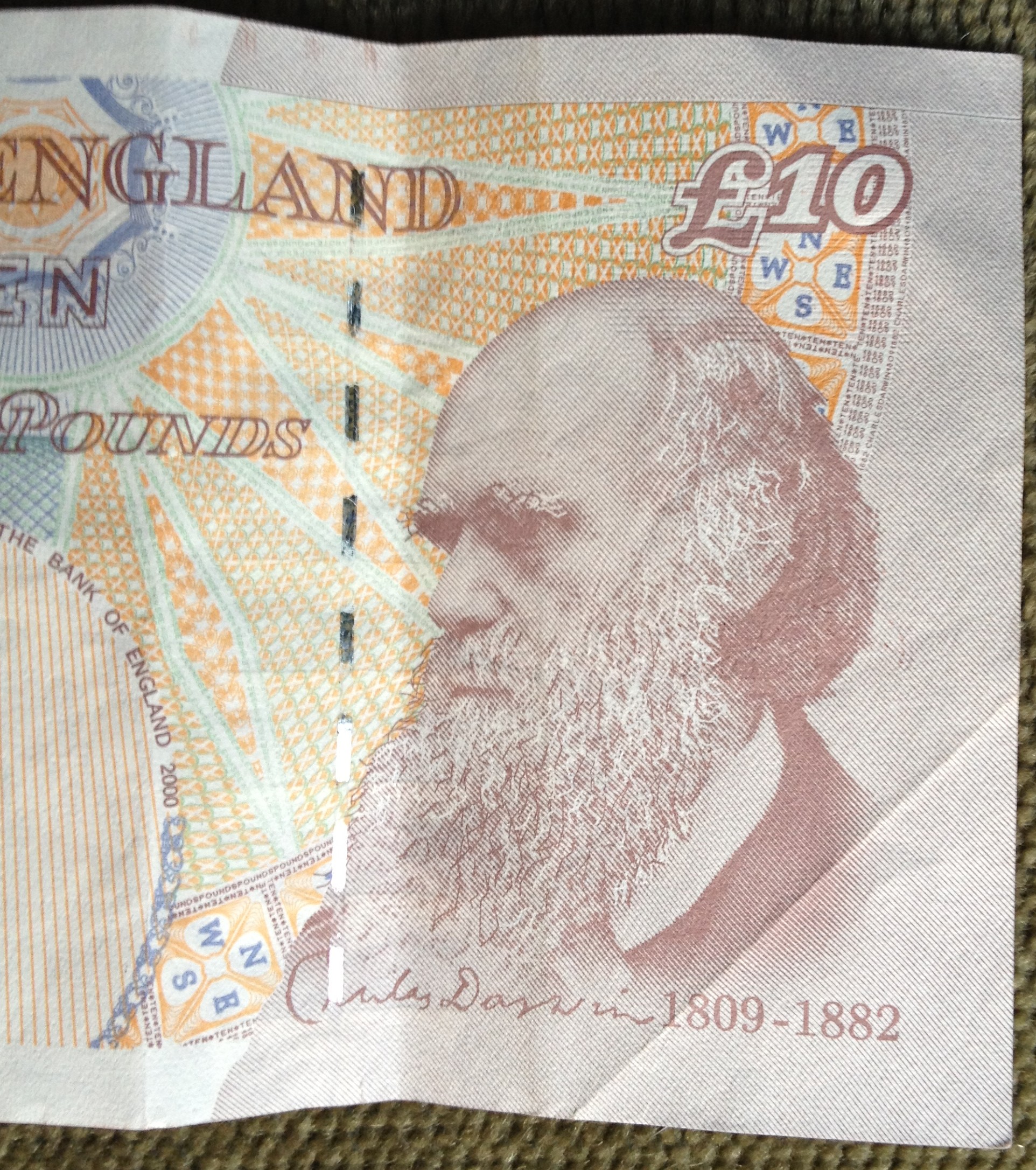
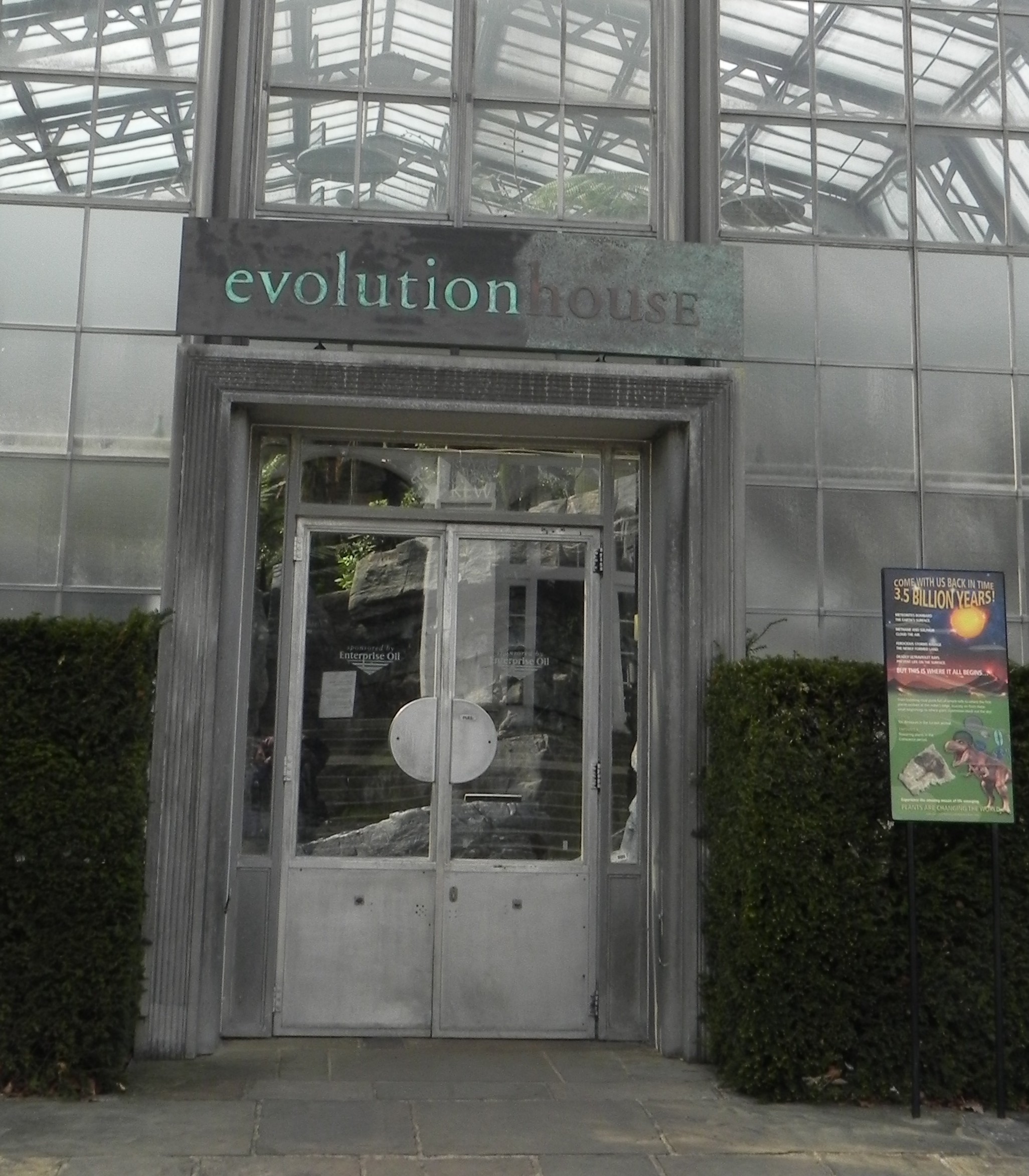
The plague that goes by the name of Creationism has been attempting to spread its reach to the shores of Britain. Proponents of a biblical literalism, whether overt or covert, have championed the idea that the world is terribly young—a mere cosmic toddler, in fact—compared to the vast geological ages of actual fact. When I unfolded my first ten-pound note and found Charles Darwin on the back, I smiled. England may claim a lion’s share of the heritage of one of the great unifying theories of science. In my brief jaunts between bouts of work I came across the tombstone of Herbert Spencer, the man who coined the phrase “survival of the fittest.” On a visit to Kew Gardens I strolled through the Evolution House. When I paid for my lunch, Darwin passed hands as the common currency of the realm.

Ten pound note

A school of thinking exists among many religious believers that insists that if science makes its claims justly then God cannot condemn them. Evolution runs as close to fact as does atomic theory. Those who doubt the latter should visit Hiroshima. Or Three Mile Island. Our literalist companions certainly don’t doubt nukes, but then, the Bible is mum on the subject of what things are really made of. Well, almost. According to Genesis 1, everything is made of chaos and divine words. The Bible doesn’t describe the origin of chaos—it is the natural state of things. God’s word, when it generates uranium, can be very deadly indeed.

Evolution House

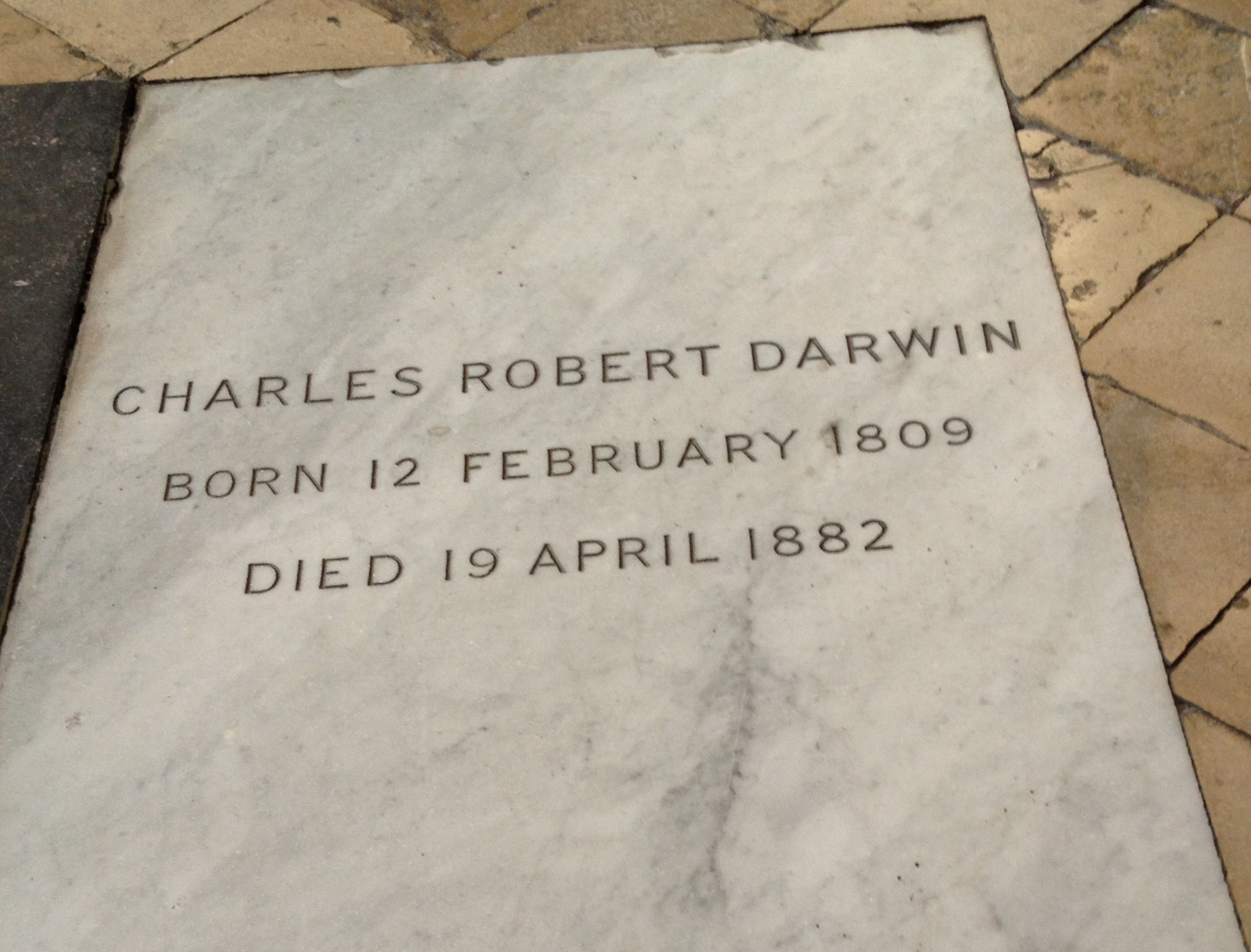
Creationists selectively choose which science to believe and which to reject. Fundamentalism can trace its origins to Britain, but the culture rather quickly outgrew these childish fantasies. In America literalism sank deep roots, roots deep enough to withstand the hurricanes of reason that would otherwise clear the air. Can an American imagine Darwin sharing the money which reads “in God we trust”? And yet, Darwin lies scarcely two meters from Isaac Newton in England’s holiest shrine of Westminster Abbey. Science and religion have here embraced one another. Perhaps when we put all the monkey business aside, we will come to realize that we may still have a thing or two to learn from the nation of our founders. Literally.

Darwin at rest


Abbey Rood

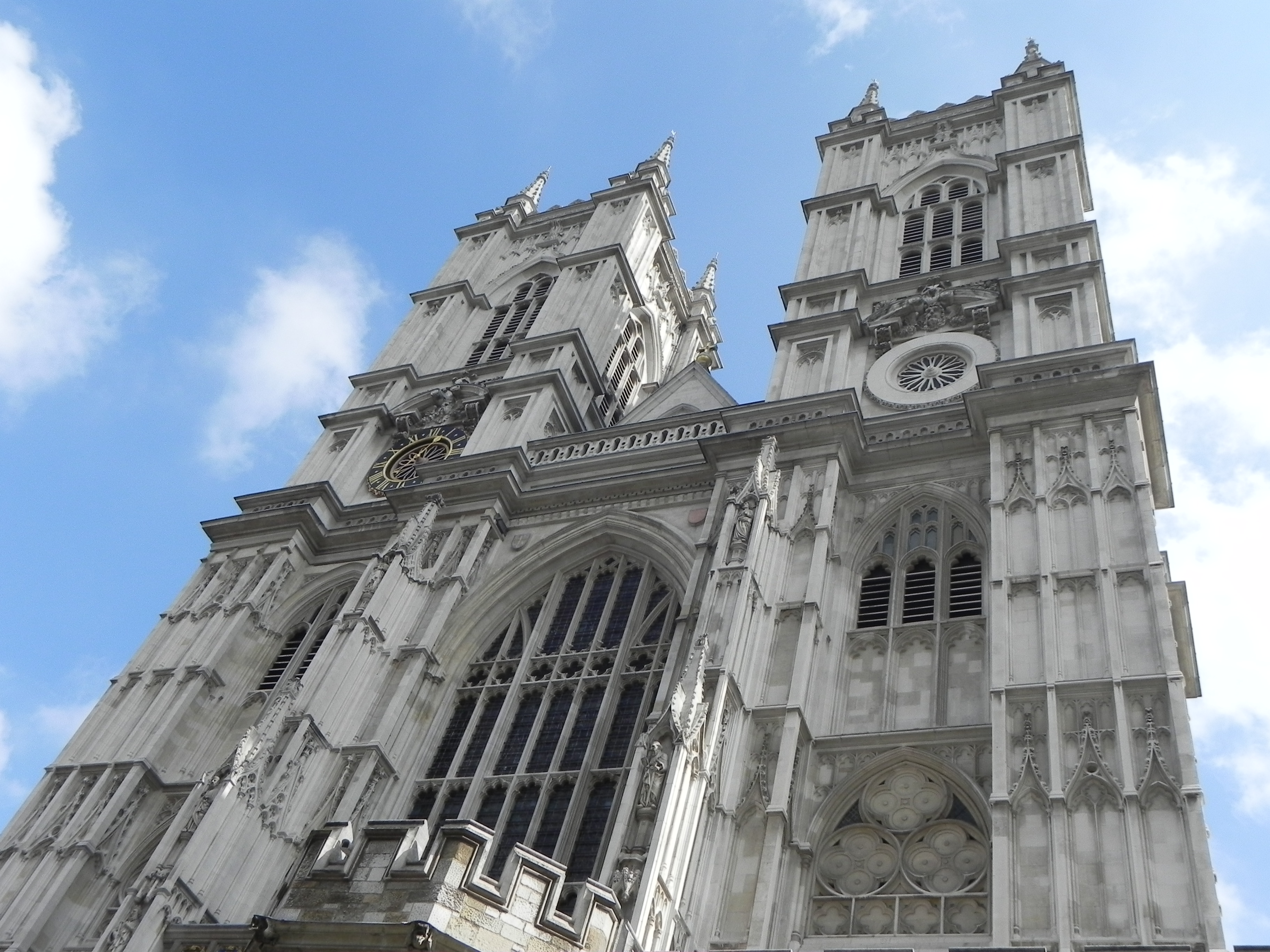
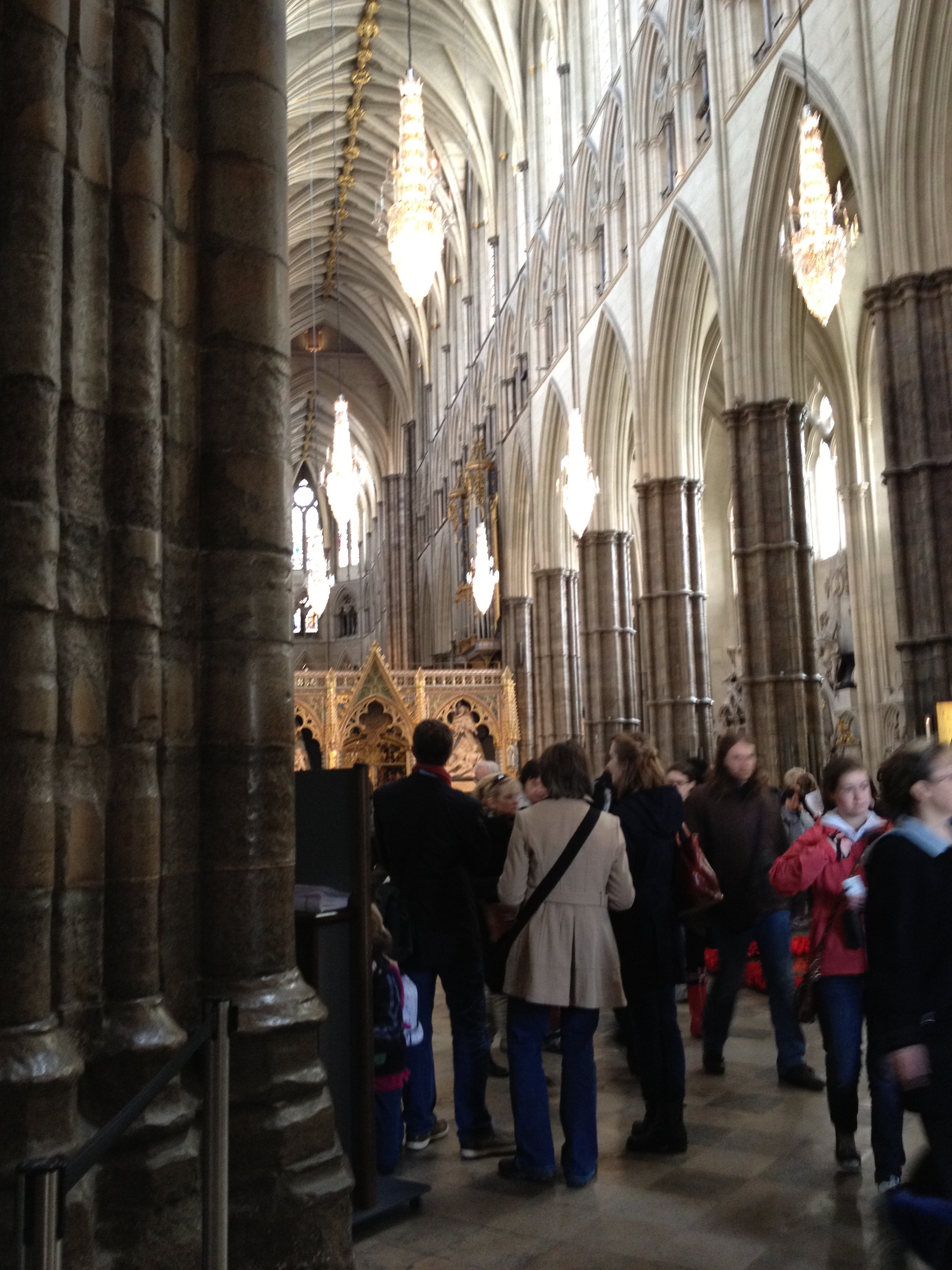
On the long flight home from London, experiences during my brief free time play back in my head in a continuous loop. One monument to civilization I wanted my daughter to experience was Westminster Abbey. I would liked to have taken her to St. Paul’s as well, but churches are just too expensive to visit. I’ve written before about our drive to visit places of significance, the urge toward pilgrimage that is as old as humanity itself. (Perhaps even earlier.) Because of the reach of the British Empire, events that have taken place in Westminster have affected people all over the world. The cream of the British crop is buried there. To see them, however, you need to pay an unhealthy sum of money. “Money changers in the temple,” as my wife aptly observed. And once inside photography is prohibited. How easy simply to become a slab of marble hazily remembered in the mind of an overstimulated tourist. There is no way to absorb it all.

The church has fallen on hard times in much of Europe. Speaking to several Brits the real interest seems to be in Islam, a religion clearly on the rise in the United Kingdom. During a brief respite from work, during which I ducked into the British Museum, the queues were out the door for an exhibit on the hajj. Tickets for the exhibit were sold out. Meanwhile, across town, the Church of England charges a visitor 16 pounds even to enter the great minster with roots in the eleventh century. Christianity and capitalism have become inextricably intertwined. A building as massive as Westminster, let alone St. Paul’s, must be costly indeed to maintain. These have become, however, icons to culture rather than religion. Their value in that regard cannot be questioned.

Standing beside Isaac Newton, Charles Darwin, Charles Dickens, and T. S. Eliot, it is noteworthy how few clerics buried in the Abbey maintain such a draw. Kings, queens, knaves and aces of many suits may abound, but apart from the eponymous Archbishop of Canterbury, few men and women of the cloth stand to gain our attention. The nave soars high overhead and the crowds of sightseers jostle one another to get a view of the sarcophagus that now houses the dusty bones of those whose names endlessly referenced from our childhoods vie for admiration. The sign says “no photography,” and the docents throughout the building cast a suspicious eye on anyone holding a camera. How jealous Christendom has become in a land of secular advance. I stand next to Sir Isaac Newton and contemplate how the seeds of destruction are often planted within the very soil that surrounds the foundations of mighty edifices of yore.


Unholy Brides

Hollywood is seldom accused of being a religious venue. Indeed, carrying on from an earlier distrust of theater as idle entertainment, some Christian groups early on deemed movies as tools of the devil. (Some relaxed that harsh assessment when Cecil B. DeMille came on the scene and started offering biblically based epics.) Many directors and writers, to judge from recent vapid box office successes, consider action or titillation sufficient to draw in the dollars. Yet, movies have often proven to be an outlet for the intellect as well, with profound, intricate, and important themes unfolding against the silver screen. The movies we watch reveal much about who we are. A surprising number of them, despite early evangelical concerns, have decidedly religious themes or messages. My regular readers know of my confession to being one of the monster kid generation, and as an adult I re-watch those movies with senses attuned to their religiosity.

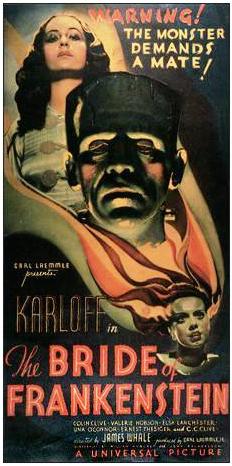
Last night, as I watched The Bride of Frankenstein, I was repeatedly reminded of the role religion plays throughout the film. From the opening lines of Lord Byron through to the monster’s moral judgment on humanity as he is about to pull the switch, religious language, symbols, and implications practically tumble over each other to get to the audience. The concept of life—the divine prerogative—being absconded by human scientists forms the skeleton of this story based on Mary Wollstonecraft Shelley’s original work. While Shelley can hardly be considered the poster-girl for religious scruples, her work, and its adaptation into this movie, bristle with the implications of usurping the divine. In the words of Dr. Pretorius, “To a new world of gods and monsters!”

The Bride of Frankenstein is not alone in this aspect of mixing religion and monstrosity. Hollywood of the 1930s was a money-hungry haven, but the classic monster tales that began to shape movie-watchers’ sensibilities often included religious themes. Dracula has his resurrection and aversion to crucifixes. The Mummy arises from ancient Egyptian ritual magic. The Wolfman suffers a gypsy curse. Frankenstein is the power of God incarnate. When the final reel is placed on the projector, we discover that God has rejected all these human attempts to ascend to the heavens. Hollywood gives us conventional religious endings. More recent and daring approaches have emerged, but seldom have they captured the American imagination like the creature features of the 1930s. The religious veneer may have been thicker in those days, but the underlying message could have chilled the blood of the finger-waving evangelists. Even the Bible, from the beginning, has its monsters.


Battle Billboards

Perhaps the oddest intangible accompanying democracy is the concept that all things are negotiable. Add to that a capitalist sensibility that everything has its price and even truth itself feels like a matter of debate. We see this all the time with Creationists so desperately wanting the Bible to the “true” that they twist science into a fairy tale noose from which to hang their literalist god. The tendency, however, does not stop with them.

Surely one of the most tense stretches of pavement in the country is NJ 495 leading into the Lincoln Tunnel. The aorta pumping countless metallic cells into the heart of Manhattan, drivers and passengers often sit motionless in it for seemingly endless periods to crawl forward like an inchworm entering the Olympics. It is there that Battle Billboards takes place.

I have followed the Atheist billboard development with some interest. In my limited experience with the Lincoln Tunnel, I have noted the digital billboard on the Jersey side bears the message of atheist.org near the major Christian holidays, so as Easter approaches the newest one reads “Celebrate Living Without God” to promote a rally on the Mall in DC. Both religion and science make claims of how to know the truth. Truth with a capital T should be non-negotiable by definition. The problem is that nobody has the Truth. We’re still trying to figure it out. Atheist.org holds a firm conviction that life would be better without religion. Clearly not everyone agrees. Clarity, it seems, is the chimera of debates over Truth.

A few seconds after the atheist.org ad flashes off the big screen, an ad for Wrath of the Titans (coming soon to theaters) flashes on. Irony can be sweeter than honey and as bitter as the Dead Sea. The most recent Clash of the Titans (2010) borrowed little from classical mythology beyond the names and large plot lines. An atheistic Perseus just doesn’t fit the classical taste. In the new film, Zeus—surely one of the prototypes for modern conceptions of God—is captured by Hades and has to be rescued by his unbelieving son. Could any movie be a more thinly disguised Easter story? Atheists? Wrath of the Titans? Which way to jump? Fortunately for me, traffic going into the Lincoln Tunnel in these lanes is one way. That’s the kind of certainty we all can live with.

Light from above or hopeless ambiguity?


Map is Territory

Far be it from me to challenge the established certitudes of the experts in academia, but I’ve been beginning to think maybe map is territory. This insight came to me from an unorthodox source (of course). I was watching War of the Colossal Beast over the weekend—among the corniest of corny 1950’s sci fi flicks. If you were born around the middle of the last century you already know the premise: a nuclear device has converted a man into a towering giant who resists all attempts to stop him or keep him under control. The reason that map and territory came to mind was that this 60-foot tall man (an apt companion for the 50-foot woman) could not be found by the authorities although he was terrorizing Los Angeles. Just as I was climbing on my high horse I realized that the problem they faced was communication. (And maybe they needed glasses.)

From the perspective of the twenty-first century and the vast network of instant communication (you can tweet your latest observation while on public transit, deep under the Hudson), map has become territory. There is nowhere left for the sixty-foot giant to hide. I am not the only one to speculate on the effect this shift will have on religion, but when we have become so intricately inter-connected, we seem to have squeezed the mystery out of life. Every trail has been blazed, every path has been trod. Old Ecclesiastes is laughing up his wizard’s sleeve. If a giant escapes among us its location will be texted across the territory second by nano-second. There is nowhere for us to hide either.

Our dependence on electronic media has changed part of the human race. It is easy to forget that in places not too distant, some of them even in the developed nations, there are human beings untouched by the revolution that has compressed map and territory. I have to wonder if their lives are better or worse for the ease that pervades our culture of flying fingers and ultra-dexterous thumbs. Avoiding the concept of the noble savage, I sense of kind of purity in the life free from the constant buzzing of 3G and 4G networks, wi-fi hotspots, and microwave towers disguised as trees. Theirs is a life where map is not territory, where being unplugged is natural and normal. It is a world where giants might hide in the night, and those who fear them may be all the more human for doing so.