Hope for the Flowers

Resurrection can become a tired trope, but it is the stuff of both religion and science. Last week it was reported that Russian scientists revivified a plant frozen on the tundra 30,000 years ago. Quite apart from proving that Siberia was already in place 24,000 years before God got around to creating the planet, this amazing feat teaches us lessons about life and its resilience, and also of the possibilities beyond the great pale. The scientists regrew the plant without the benefit of using seeds, making this a kind of virgin birth of the florid kind. Using plant versions of stem cells (the kind of science forbidden in the USA: “won’t somebody think of the seedlings!”), the dead plant was rejuvenated and is alive and healthy in a world vastly different than the mammoth-infested, frosty plains of northern Russia where it first saw daylight. Still, that environment was less hostile to science than the Religious Right. This resurrection shows that we don’t need miracles to bring inert matter back from the dead. No doubt there are covert Creationists trying to sneak into Russia with travel-sized bottles of Roundup in their carry-on bags.

Science has brought us to incredible places by its continued, self-critical process. Religion, preferring no critique, has given us characters like Rush Limbaugh, Glenn Beck, and Rick Santorum. And a really big book. Looking at the religious scene today it is difficult to believe that religions began as exercises in optimism—the world could be better if only we’d progress. Regress now characterizes the religion in the public eye—men (occasionally women) claiming that things were better when we were tilting with mammoths than they are now with people advocating equality for people of other genders, races, and sexual orientations. Science represents our progress, and the vocal theocrats claim we should be going backward. Back to when men were measured by the size of their spears.
Back when I was a teenager I discovered the book Hope for the Flowers, by Trina Paulus. Not really a graphic novel, and not really a children’s book, it tells the story of two caterpillars with the courage to reject the constant, heartless climbing so often required by the world. In the end, of course, they become butterflies. The story has a religious subtext, naturally, but it was for a religion that believed butterflies should be valued rather than smashed between the pages of a heavy Bible. Butterflies bring the pollen that allows flowers to thrive. We live in a world where butterflies have become soft and defenseless while religion is aggressive and offensive. Science has shown us the way to bring flowers back from the grave, but old-time religion is waiting in the shadows with its rusty scythe.

Walking Monsters

It was a moment of weakness, or at least tawdry cheapness, that made me watch The Monster Walks. Just the day before the Cable Vision guy had stopped by, detailing how much money we could save by switching. We haven’t had television service since 2004, and even then it was only with a cheap aerial. Back in the days of Borders, I sometimes caved in and purchased the “Classic Features” movie boxes with 50 B, C, or D movies for what seemed a steal at less then 25 dollars. Maybe five or six of the movies from each set were actually worth the time spent watching them, but many of them proved an education. So it was with The Monster Walks.

Now, I readily confess to having a weakness for B movies. Made by people who were really trying, but who seemed to lack talent, I often identify with their efforts. So when I popped The Monster Walks into my DVD player, I had no idea what I might learn. The first revelation occurred in the opening credits where a character named “Exodus” was introduced. Since this was 1932, the character had to be African American. And comic relief. To spare you the pain of watching the movie, the plot is rather simple: rich man dies, helpless daughter inherits all to the chagrin of surviving brother and domestics, who plot to kill her by pretending to be a murderous ape. There also happens to be a murderous ape locked in the cellar. You get the picture. Aptly named Exodus is purely there as a foil for the educated, privileged white family. He was played by the talented but underappreciated Willie Best. As might (nay, should) be predicted, the scheme of killing the girl backfires and the ape kills the killer. Okay, so I can confess an hour wasted and get on with my reading. But the final scene arrested me.

Exodus wonders to the lawyer (who is there to read the will) why the rich man even had an ape. The lawyer, metaphorically transformed into a judgmental William Jennings Bryan, states that it was because he believed in Darwin’s theory of evolution. Exodus responds by noting some family resemblance to the ape. The blatant racism was hard to take, but in Black History Month the painfully obvious collective sins of our society should be laid bare. In 1932 Fundamentalism, often implicitly allied with racist causes, castigated Darwin’s theory for bringing all of humanity down to the same level. As long as a white god is creating the universe, the Anglo-Saxon can claim superiority. Never mind that Genesis was written by a Jewish writer living in Asia. Self-righteousness comes in many forms, but it always involves bringing others down to a rung below where the blessed stand. Has not the great Rick Santorum told us that even the Crusades were merely misunderstood?


Hidden in Plain Sight

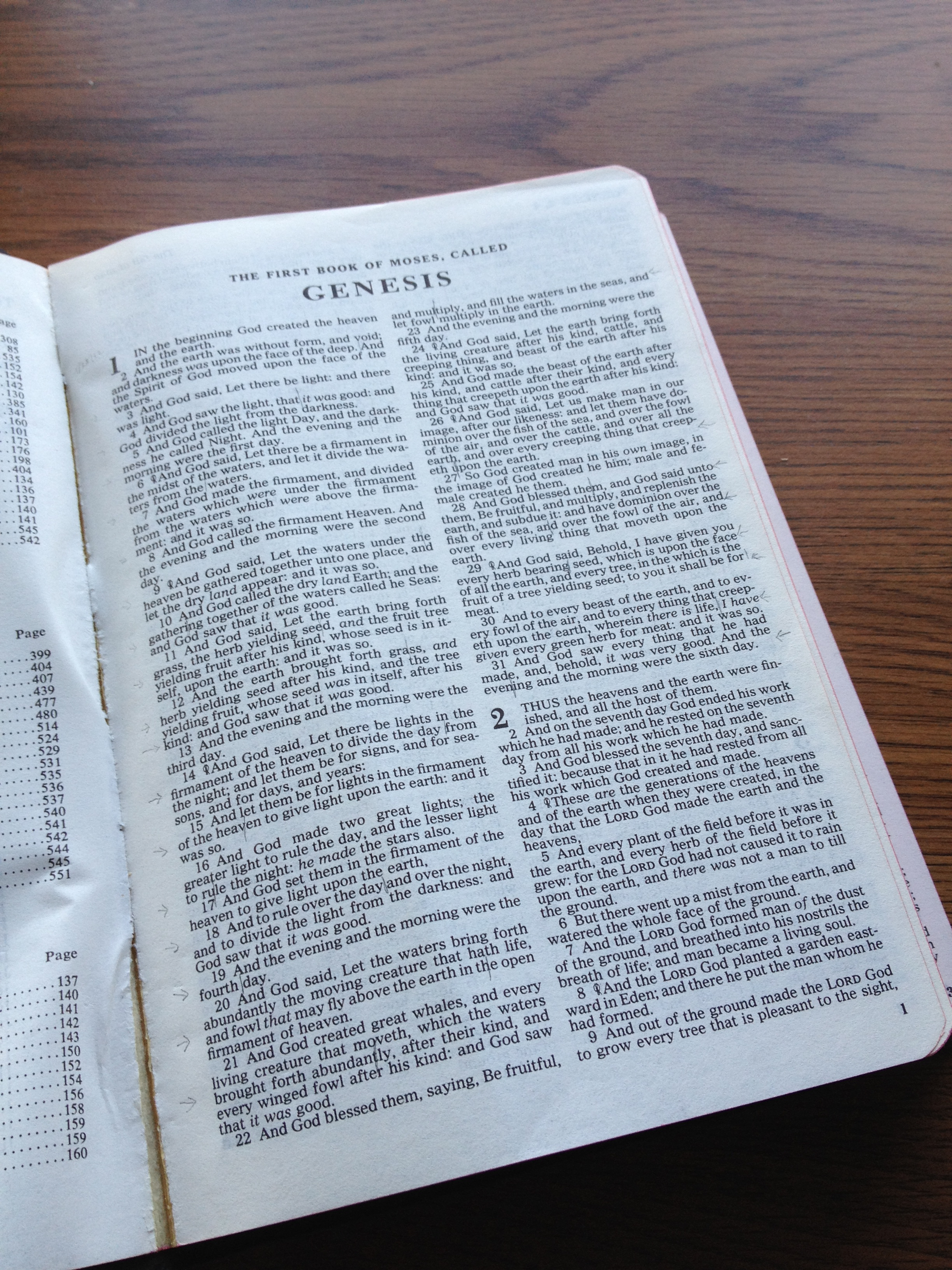
I have been tweeting the Bible for nearly a month now, and tomorrow—the thirtieth tweet—will see the end of Genesis 1 and the first words of Genesis 2. One of the occupational hazards of having been a biblical scholar for many years is the constant rereading of the same text over and over. I couldn’t even guess how many times I’ve read Genesis 1, in numerous languages, trying to find a key to unlock what is going on there. It is definitely not science—for that it would have had to have been written after science had been invented. Religion and science share that feature: they are human endeavors to understand the matrix in which we find ourselves. Anyone who is truly honest will admit to not being able to trust her- or himself all the time. We have all been betrayed by our convictions now and again. In this day of arrogant religious leaders and arrogant scientists we have little hope of coming to an armistice. Those who claim a special position for the Bible really couldn’t handle the truth in any case.

My twitter verse for today reads, “I have given every green herb for meat: and it was so. And God saw every thing that he had made, and, behold, it was very good. And the even”. Sense units in any text are where we, the readers, draw the limits. Taking this bit as a cue (indeed, the whole of Genesis 1 supports this), God intends humans to be vegetarians. The predatory gleam in the eyes of our religious politicians and televangelists belie their convictions given in public forums. The first rule God instates, after informing our primordial couple to have lots and lots of sex, is not to harm other creatures. At least the sex part seems to have gotten through, although many branches of Christianity repudiate it. The harm part we have received with ambivalence.

In a related development, an op-ed piece in yesterday’s newspaper gives instructions for properly disposing a worn-out Quran. While Christianity has no uniform opinion about where an old Bible goes to die, I find in this question a snapshot of the contradictions inherent in holy writ. We treat certain texts as sacred, and yet, is not the human expression in written form itself some kind of sacred act? Book-burning, no matter the book, strikes deeply at a visceral level those who’ve ever tried to reduce their ideas to what might be replicated on a page. It is our highest human achievement. All texts are sacred. Some may be misguided, and others are blatantly wrong—perhaps even evil—but they are the essence of a human endeavor. Perhaps this is the key I have been seeking all along.

Let there be light


Denying Truth, For Profit

Sometimes I’m questioned about why I bother with creationism. Everyone who’s intelligent knows it is religious ideology masquerading as science and people will eventually figure it out. But will there be time? An editorial in yesterday’s New Jersey Star-Ledger pulls the curtain back on creationism’s incestuous cousin, climate-change denial. As the editorial notes, key documents of the Heartland Institute—one of the major propagators of climate change as “just a theory”—have been leaked and show that they have learned their lesson from creationist tactics. They want “debate the question” instilled in science classes in lieu of facts. And much of their money comes from big oil. It is the hope of such institutes that an American public already woefully pathetic at understanding science will be led to believe “just a theory” equals “likely not true.” The data are stacked completely against them and the entire rest of the developed world knows that.

While the issue may seem less religious than creationism—which is based on getting Genesis 1 in the classroom as science, no matter what you call it—it has deep roots in that same insidious cocktail of politics, religion, and dirty money. Biblical literalists tend to believe the world is about to end. The belief has been around for at least two millennia. It is a damning and damaging belief that declares the world was made for raping because it is about to end. This deranged thinking is fueled, literally, by unrestrained economic interests. Sometimes the groups can’t see beyond the Bible to realize that they too are being screwed. Science is objective, and it is science that has been challenged by various religious and political groups since the 1920s. Today, when there is far too much information for anyone to stay on top of it all, and in an American society deeply distrustful of higher education, I smell an explosive amount of methane in the air.

Climate change is real. The “theory” is so well supported by evidence as to be fact. Is anyone really surprised that supporters of the Heartland Institute have also backed Newt Gingrich’s campaign? We have placed ourselves in a very dangerous position as the last remaining “superpower.” I tried to read a book on environmental issues that Routledge published, but was so scared after the first three pages that I had to put it down. What is the lesson here, class? Is it not that money is the root of evil? And that, my dear literalists, is biblical.

The future of human economic evolution


Being Human

Within the first three pages, if you’re not mortally offended or inexplicably happy, you’re probably not an American.

Growing up with pets, I had a hard time understanding the hard and fast line drawn between animals and people. The failsafe fact used back then is that only people used tools. When we looked closer at animals we found that wasn’t quite true. Well then, only people have language. A large question mark has grown from that assertion too. The final fallback, the sine qua non was souls: only people have souls. It is also the safest of assertions, since it can be tested for neither people nor animals.

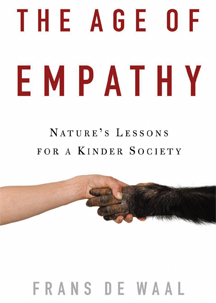
This way of thinking, according to Frans de Waal’s The Age of Empathy, arises from the western religious tradition—a religious tradition that grew up in relative isolation from other primates. Many world religions do not feel the necessity of making people absolutely different from our animal cousins. In Christianity at least, heaven itself rides on it. What are we so afraid of?

I posted, a couple years back, on Frans de Waal’s Our Inner Ape. Having just finished The Age of Empathy, I have reaffirmed my earlier accolades—he is one of the most sensible and important writers alive. Step by slow, evolutionary, cautious step, de Waal illustrates that one of the taboos of science—that animals don’t have emotion—is patently wrong. Not only do they experience emotion, but apes, cetaceans, and dogs at least, know empathy. Even scientists don’t like to admit this because science grew up in the shadow of the Judeo-Christian-Muslim worldview of human superiority.

But there’s even more at stake. As de Waal makes perfectly clear, the unbridled capitalism of the United States goes against nature. The unlimited acquisition of the vast majority of the resources by the few sets our primate sensibilities on end. Empathy, the ability to feel for another and take their perspective, is not only part of animals’ experience of the world, it is also a mandate of our religions. In order for society to survive, we must come to know this truth. Falsely applying Social Darwinism as factual, biological Darwinism, the few have taken more than either biology or religion permits.

The Age of Empathy should be on every school’s mandatory reading list and corporate climbers should learn that even selfishness has a very steep price tag. Not only for themselves, but for all of us.


Fall of the Planet of the Apes

Perhaps it is being under the influence of a head-cold that just won’t go away, or perhaps something deeper, I decided to watch Rise of the Planet of the Apes. Raised in a fundamentalist household, I was enamored of Planet of the Apes (the original one) and watched it and all its sequels repeatedly back before VCRs made owning such chestnuts possible. Perhaps it was that taste of forbidden fruit—evolution—that left such an exotic buzz in my head, or perhaps it was the unforgettable climax. The message that we’ve done this to ourselves. I once even missed seeing a high school friend after several years’ absence on a visit home because an all-day Planet of the Apes marathon was airing on TV. Perhaps it was the subtlety, the Rod Serling feel to it, or the deep level of empathy it evoked, for whatever reason, that original movie remains one of my personal favorites. In Rupert Wyatt’s slick new backstory, something was missing.

The CGI of Rise of the Planet of the Apes is pretty remarkable, except for the occasional jerkiness of violent scenes intended to pump up the testosterone. The subtle emotions visible in Caesar’s every glance conveyed the sense that animals share rights to this planet with us. I’ve been reading about animal intelligence again, and it saddens me that we’ve reached this far in our development only to continue the fiction that homo sapiens are unique among the tree of life. It’s not much of a tree when one of the branches is not and never has been attached. Our animal cousins have much to teach us, and perhaps that’s why I keep returning to Planet of the Apes, despite Charlton Heston. Even the new movie makes several nods to the original with naming the main family Rodman, Caesar building a three-dimensional puzzle of the statue of liberty only halfway complete, calling his mother “Bright Eyes,” spraying Caesar with a hose in his cage and calling the primate center a madhouse, and the cheesy repetition of “Take your stinking paws off me you damn dirty ape!” It simply can’t rise to the level set by the writing of Rod Serling and Michael Wilson.

The box-office success of the film tells us something about ourselves. Ironically, and perhaps intentionally, Wyatt’s version neuters the evolution. The apes don’t rise from an unspeakably long evolutionary track from us, but we create them with the nemesis of twenty-first century humans, the virus. Caesar and his friends are genetically engineered by humans, and God has nothing to do with it. In the original, a theological subtlety lingered as a religious court of orangutans condemned Taylor for religious reasons. His claim of human primacy was heresy to primate sensibilities. The new version takes itself too seriously for that. We can’t jangle the evolution keys anymore because of our own national schizophrenia concerning the raw power of nature. Just when we think we’ve evolved beyond petty superstition masquerading as righteousness, yet another state attempts to guillotine the entire scientific enterprise. It’s a sure thing that if the apes don’t get us, we’ll take care of it ourselves. That was the message already in 1968.


A Strange Confirmation

I’ve been tweeting the Bible. Many years ago I lost track of how many times I had read it, but tweeting seems to be a way to examine the text carefully, 140 characters at a time. As a college student who’d recently learned about textual criticism (many years ago), I approached my local pastor and asked him if we could try something at church. I had a big, old, black leather Bible set up in the vestibule and made announcements—and even had it printed in the bulletin—that we were going to copy the Bible. I placed a three-ring binder and a pen next to the Bible, and I asked the parishioners to write down a verse in the notebook on their way in or out of church. I wanted to see how long it would take, and to give the laity an idea of how difficult it was to copy accurately. (Hey, I was young and idealistic!) The Bible sat there many months, perhaps a couple of years. I would occasionally check on progress, and was surprised to see we were still in Genesis. We hadn’t even reached the flood yet. And mistakes? Ye gods! It was like the Bible had been written on another planet. I now see the many problems with the way the experiment was set up, but copying the Bible is a revealing exercise nonetheless.

My tweets are with the King James Version of the Bible, and over the weekend I discovered something. According to the KJV, seed-bearing plants are male. Note Genesis 1.11 “Let the earth bring forth grass, the herb yielding seed, and the fruit tree yielding fruit after his kind, whose seed is in itself.” This corresponds to a post I wrote late last year about the notion of distorted masculinity in the biblical worldview. The operating assumption seems to be that male and seediness go together. Since the Bible is literally right, somebody better get out there and explain the facts of life to the female plants that constitute roughly half the flora on this planet. Herein lies the rub: ancient assumptions no longer hold sway. Trees are not all “hes,” and yet many treat the surrounding context of a literal seven days (only one day in Genesis 2) as worthy to take down science itself.

Once in a while I have my own gripe with science—or at least its cousin technology. I was looking forward, many years down the road, to putting all my Bible tweets together into a seamless whole. The tweet I twittered on Sunday, however, never appeared. I can’t go back and add the missing 140 characters now, because that would throw the order off. And those ancient scribes thought they had it hard! Maybe there is an object lesson at play here. Maybe the utter devotion to a text has the potential to lead the righteous astray. As a society we’ve built a tremendous world of luxury around ourselves (well, most of us), and isolated ourselves from the wild animals and masculine fruits of biblical times. And yet, when we look at the text up close, we often find things we might not expect. Or even support. I will dutifully carry on my Bible tweeting, but like any human venture, my Bible will never be perfect.


Wired for God

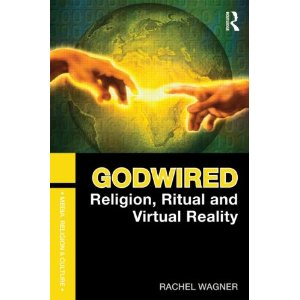
I am not now, nor have I ever been, a techie. When my fascination with the newest technological marvel borders on the rhapsodic, I suddenly realize it’s all electrons and immediately the fascination dissipates. It feels like an illusion. I am a guy who likes the sensation of a paper book in his hands and prefers conversation accompanied by all the subtle biological clues of being in the same room with somebody. Maybe it is lack of imagination on my part, but I will often get bored on the Internet and pick up a book instead. One book I recently picked up, and one that challenged my perception of reality, was Rachel Wagner’s Godwired: Religion, Ritual and Virtual Reality (Routledge, 2011). Wagner is one of that generation of younger scholars who is asking what the implications of electronic culture are for religion. If concepts such as online prayer walls, chat-bot salvation, and storing sacred texts on the same device as secular ones intrigue you, do yourself a favor and read this book.

As Wagner ably points out, religious individuals are tapping into the vast communications’ potential of the Internet to spread their faith abroad. There are apps to help you pray online, there are electronic games to prepare you for the fictitious rapture, and there are virtual churches. We have indeed sealed God in an Xbox, and we have beamed the divine across wireless networks and learned to confess our sins in cyberspace. And physicists are starting to confirm that, at our most basic level, we are energy rather than matter after all. Maybe we are tapping into ultimate reality here. Wagner explores how the level of engagement with virtual worlds constructed by software engineers (the new gods) becomes so intense as to provide an alternate reality. It all depends on how you define what is real. And it is clear that for many people, life without the Internet is now unimaginable. Those of us born before the supercomputer scratch our physical heads with amazement. How did Nebuchadrezzar or Alexander ever conquer the known world without GPS technology? Does my iPhone have a secret life about which I know nothing?

Within our culture live many older people who have never touched a computer. They exist alongside grandchildren practically born with some iDevice in their grasp (may be a choking hazard for children under three). I have lived long enough already to have witnessed keyboarding being replaced by thumbing, and research having shifted from long treks to the library in the snow to a few taps on a glass screen that can feel the electricity from my chilly fingers. From the comfort of my lonely room sings my soul, how great thou art! Perhaps Terminator didn’t go far enough, perhaps Skynet really is god. Maybe this matrix of blood, muscle, bone, fat, and spit is really just an illusion and the Internet is true revelation. Wagner pries open some very important questions in her book. And none of us should be surprised if, when we approach the pearly gates, we find a touchpad next to the electronic lock inscribed with this legend: “Welcome to Heaven. Please enter username and password. Type in the letters you see in the box below.”


Frozen Falls

Some weather we’ve been having! New Jersey has just completed its mildest January on record. Weather has always been a favorite mode of resort to the divine since it is one of those things we people just haven’t been able to control yet. And it makes perfect sense. The atmosphere is, by definition, bigger than the planet’s surface itself, and we people are pretty tiny, all things considered. I’ve stood next to some trees in the northwest that give me a flea’s eye view of the world.

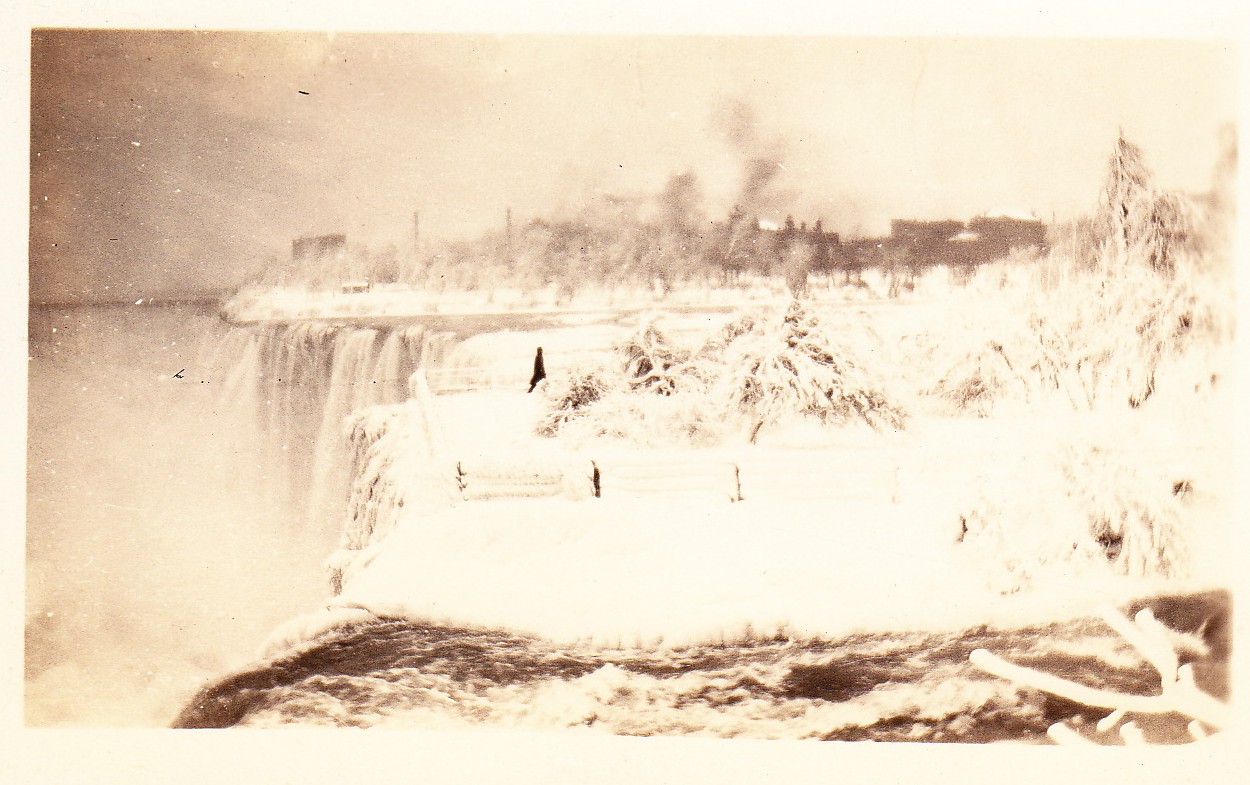
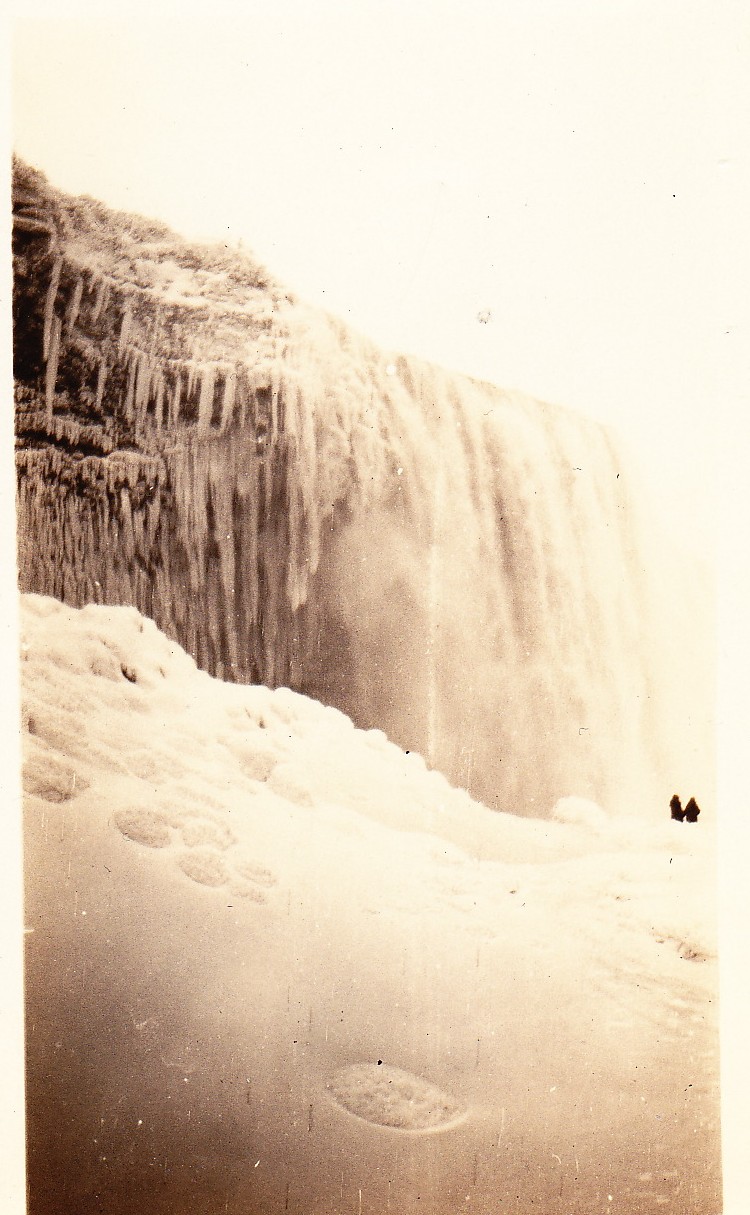
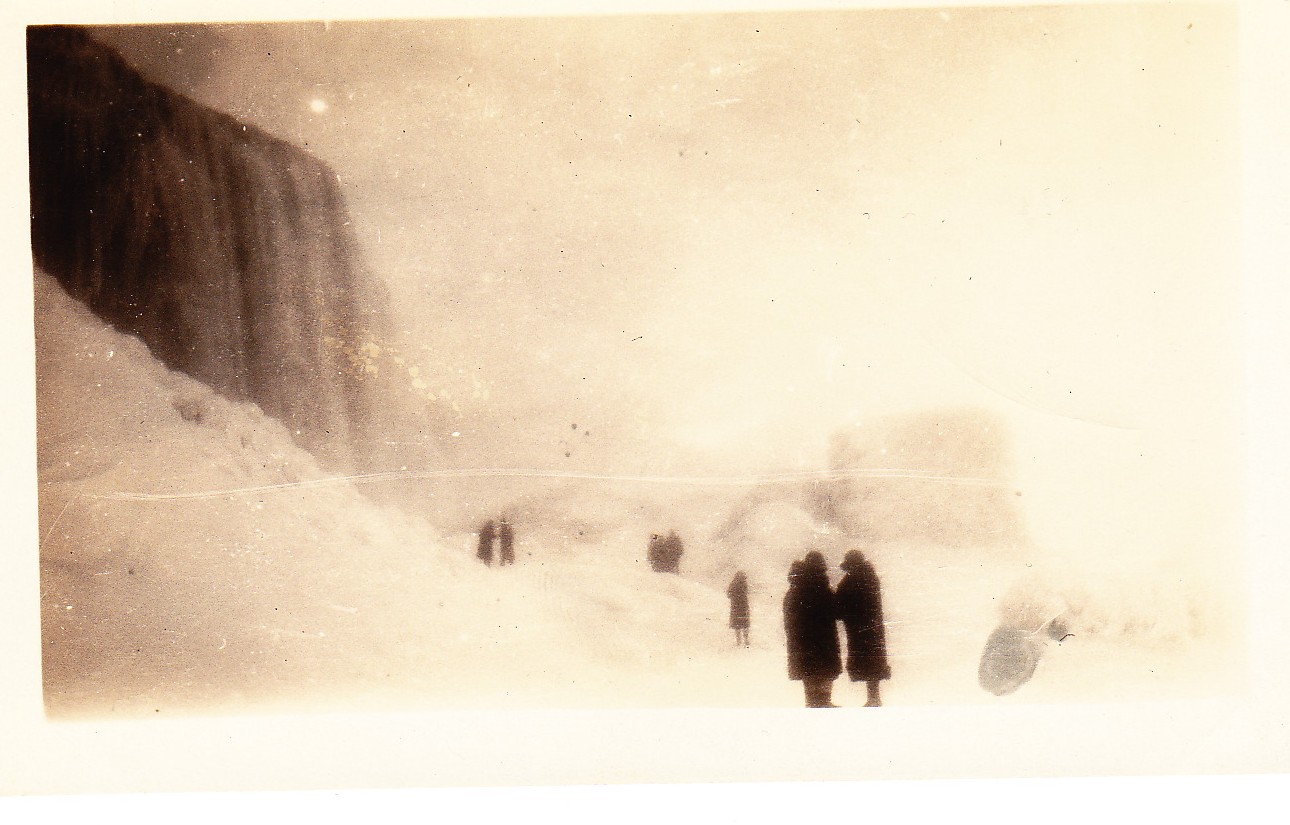
I remember one of my teachers telling us that Niagara Falls doesn’t freeze over. When I told my mother this, her response was to pull out these photos and send them to school with me. Someone in the family back in my grandfather’s younger days owned a photography business. The photos are unfortunately not dated, but they have been iconic images for me ever since that day in grade school. Yes, even Niagara Falls can freeze over. My best guess for the dates here must be sometime around 1920.

Back when we still had television, I was an avid fan of the PBS Naked Planet series. One of the episodes was on Niagara Falls. In the late 1950s and early 60’s the hydro-electric potential of the falls had been tapped to such an extent that now between 50 and 75 percent of the water flow of the thundering falls is diverted upriver. I first visited Niagara Falls as a child, but I have never experienced the falls with the full force that nature intended. Likely no one ever will again, at least as long as we are in charge of planet.

These pictures remind me of the awe of nature. They were taken when the falls were pretty much at full flow, and yet they are frozen solid and people are walking around on a river that boasts class 6 rapids, the highest the whitewater scale goes. Sometimes when people assert too much control on their planet, it is nice to be reminded that our tired orthodoxies aren’t always what they seem to be. It may be an unseasonably mild winter this year, but nature may still have a few tricks up her sleeves.


Trouble with Triffids

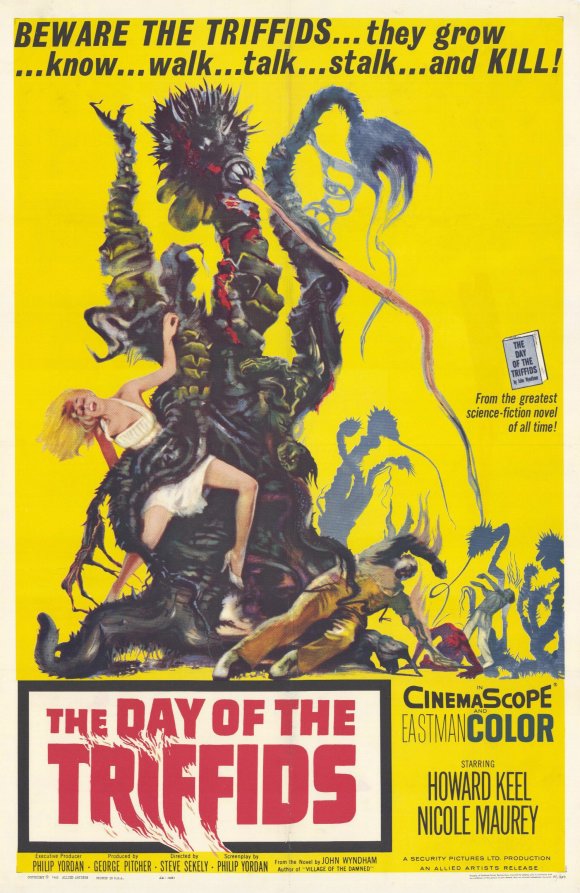
Some time ago, I posted about the John Wyndham novel, The Day of the Triffids. In playing on the loss of humanity’s primary sense of sight, the story creates a truly eerie scenario in which people are harvested by plants. Not just any plants, but alien plants! Of course, such an idea demanded a movie rendition. The film was released the year I was born, but I only just got around to watching it. Compared to the psychologically thrilling novel, the movie doesn’t ever reach the intended level of terror. Nevertheless, religion, as usual, plays a role in the movie. As Bill Masen, the protagonist, makes his way from London to Paris, attempting to find other people who retain their sight after a devastating meteor shower blinded most of the world, he comes upon a mansion where the wealthy owners are caring for the disabled. (Hard to imagine that these days, but it was the 60’s, and idealism was kicking in.) While discussing their rather hopeless options, Bill suggests there is little reason for optimism. His new-found love interest, Christine, says “We must keep faith,” to which Bill replies, “It’s going to take more than that to get through this.”

Indeed, God is no help against the triffids. These intelligent, moving plants are soon everywhere, consuming humans and intent on taking over the planet. Bill and Christine, along with their adopted daughter Susan, make their way to Spain in hope of finding a military solution. They stop at a mission, topped with a cross and inhabited with a helplessly blind, and expecting, couple. The message is clear—there is no god to help those left to their own devices. Even those who live in god’s real estate have been abandoned. Those who survive are those who help themselves. Eventually our hapless heroes are rescued by the navy and a submarine moves them safely away from triffid-infested Europe. Then, in the final scene, our blended family is seen walking into a church while a voiceover declares that the triffids did not defeat humanity after all, and “Mankind survived and once again have reason to give thanks.”

Exegeting this film, however, leads to some uncomfortable conclusions. Those who had no divine aid give thanks to an impotent deity after it is all over. The solution for destroying triffids—salt water (you might want to store that away for future use)—is discovered by scientists and is applied at their personal peril. Even the heavenly-based origin of the menace has divine overtones: colorful portents in the sky are the provenance of God. In 1962 science had not yet even reached the moon. The default fallback, based on decades of evangelical sculpting of culture, is to give thanks to the Lord, despite the devastation. Indeed, a new Garden of Eden might be said to have resulted from the triffid assault. In this garden parasitic plants teach humans to give thanks, but the vast majority of humanity remains blind.


Paranormal Activity

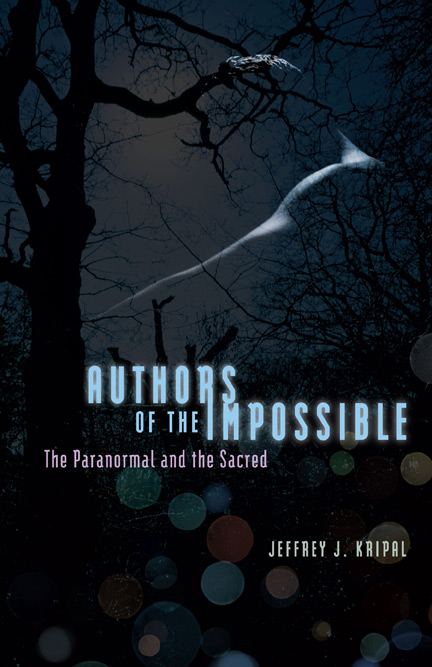
Once in a great while books with the potential to shift paradigms come along. These rare books often deal with taboo subjects, those areas of inquiry forbidden even to the most educated sectors of society. One of those books is Jeffrey Kripal’s Authors of the Impossible. I bought this book because of its subtitle: The Paranormal and the Sacred. I have argued before that paranormal subjects are very closely related to religion, but it is so unusual to find another scholar who openly takes on this question that I was shocked at finding Authors of the Impossible. Kripal is an academic who is willing to consider what is, as he admits, impossible. Those who’ve read deeply in the record of human experience, however, know that weirdness has accompanied us from the time we could write it down. It stands to reason that the uncanny stretches back before even that singular hallmark of human development. I have suggested elsewhere that it might even be the origin of religion itself.

Universities are establishment institutions. Free inquiry is not free, as I’m sure advocates of the National Security Act are glad to know. Most university professors who’ve seen a ghost or some unidentified object in the sky or an anomalous creature will never admit it. The easy equation of such things with mental instability keeps establishment people in line. It also cuts off honest inquiry into things people have experienced for centuries. Kripal is unafraid. In this book he considers the works of explorers most academics refuse to take seriously, despite their obvious intellectual ability: Frederic Meyrs, Charles Fort, Jacques Vallee, and Bertrand Méheust. Let’s have a show of hands: who has heard of any of them, except maybe Charles Fort? Each of these explorers was/is very educated. Each takes an aspect of the paranormal seriously. As Kripal points out, we will accept a physicist from CERN telling us that the impossible happens at the quantum level, but if you see a UFO you belong in an asylum. Is it because the paranormal violates not only the laws of physics, but also the laws of religion?

Life is too large to take it all in. We don’t even know what consciousness is. This is a question to which Kripal returns to conclude his book. His suggestion is that the paranormal is a literary hermeneutic—we are written by forces and powers outside our knowledge. Without denying science, indeed, while advocating it, Kripal suggests that it is not the whole picture. We are animals with two brains fused into one, and even scientists and materialists feel the sting and caress of emotion. Kripal is brave enough to assert that the emotive, imaginary side is just as real as the rational, materialist side. Noone can seriously doubt science and step onto a jet, Kripal shows that one need not doubt science to step onto a UFO either. If we are willing to participate in the reality our minds generate, the potential for human evolution really explodes. The only problem with Authors of the Impossible is that it is too short. An extremely deft writer, Kripal makes you laugh and think at the same time. And when you’re done, you’ll realize just how weird the world really is.


Send in the Robots

The FIRST Robotics kickoff is an event that is difficult to describe for those who’ve never attended. First, it must be noted that FIRST Robotics is sometimes described as “the varsity sport for the brain.” While engineering students with a penchant for athletics are not unheard of, the majority of robotics team students are not cut from the same cloth as the athlete. The FIRST kickoff, the first Saturday in January, is the opportunity for these kids to be told it is cool to be smart and that application of brain power is not the liability that many of the electorate seem to think it is. At this event the competition for the year is unveiled, and the kids (with some adult help) have six weeks to design and build and program a robot to do some very complex tasks. It is a season of sleep deprivation, programmed Saturdays, and the celebration of learning. Before NASA shows the game animation—the competition for the year—celebrities and other people in the public eye endorse the program. It is a time for praising the benefits of science.

Yesterday’s kickoff, however, was marred by the appearance of one of the guest celebrities. When George W. Bush was announced as a supporter of the program, a sense of disbelief fell over the room. This man who advocated for creationism in the classroom, who fought to stop research in cutting edge disease control, who began a war as a personal vendetta, was showing his dully beneficent face on the big screen telling the kids what a great program it was. A chance, as he said, to use your “God-given talents.” He ended his brief—and obviously scripted—sound-byte with his characteristic “God bless you.” I could not stomach the hypocrisy. I’ve blogged about religion and the science of robotics before, but to have a president who did nothing to strengthen the cause of higher education and fought science with eight years at his idle hands was just too much. If I was Dean Kamen, I would have insisted that that clip be left on the cutting room floor.

The former W represented religion in its guise as the enemy of science. It should be clear to my readers that I do not believe science has all the answers, but I also believe it is wrong for religion to stand in the way of knowledge. Science is something that we shouldn’t give lip-service without backing it up with programs and funding. That one minute of disingenuous, religion-riddled speech trumped all the other endorsements, including the sensible one by Bill Clinton who emphasized the need to work together even with those who are your opponents. This was a point W obviously missed. There comes a time when some public figures, like overused cattle, should be put out to pasture. There are some cowboys that should just stay on the ranch. I understand that presidential endorsements are important to FIRST, but in this case integrity should not be compromised. Especially when most of the teenagers watching the kickoff possess far greater potential than a mere politician elected on religious sentiment and dubious counting.

Does this face inspire science?


God in the Machine

“O brave new world! That has such people in it!” Or at least such software. A couple of days ago my wife pointed out a news story on MSNBC rounding up the year (2011) in science. The story contains eleven science videos that challenge our perceptions and show us directions we are going, whether we want to or not. The first video shows what happens when Cornell University researchers connected two Chatbots to each other and allowed them to carry on a conversation. Like my own experience with Cleverbot last year, the conversation soon turned to God. Even artificial intelligence seems interested in the eternal questions. I should put a finer point on it: artificial intelligence derived from the dubious wisdom of the Internet. We are getting closer and closer to replicating the human brain electronically—even my iPhone scares me at times—and yet, to engage in conversations with humans (or each other) these intelligences must know about God.

Many theories exist about the origins of the god concept. Scientists argue that it is hardwired in our brains, that it is genetic, or that it is merely socialization that gives us this idea. The truth is that nobody really knows. The religious take this as license to claim that territory for the god of the gaps—if we can’t answer a question, God rushes in where angels (or logic) fear to tread. The truth is more likely that we don’t yet have the tools to flesh out (or psych out) our theories on why the supernatural is an indispensable component of our thoughts. If artificial intelligence takes its cues from human intelligence, however, it is a certainty that god will be part of the equation.

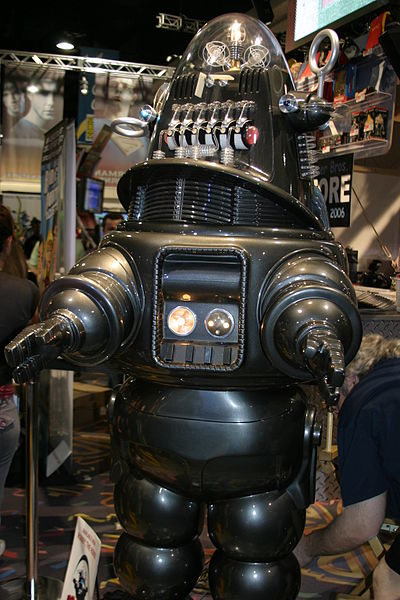
People possess a deep need to feel unique. Our uniqueness is part of our religion. Humans are “the crown of creation,” the only animals (debatable to some) with souls (debatable to others). Even the Chatbots get confused when God-talk comes up. Mentioning God leads one Cleverbot to ask the other if it is Christian. God is not limited to Christianity, of course, nor is the divine limited to monotheism. The old science fiction chestnut of a robot takeover, however, seems to have missed a salient point: if robots are programmed by humans, they will have God in their silicon chips just as surely as we do in our carbon-based brains. The god in the machine. Many atheists have declared the death of god, but we have placed the divine into our apps and devices and software. When the robot apocalypse comes it will include at least some Cleverbots declaring that the rationale to eliminate humans is heresy. Torquemada meets Iron Man. Already 2012 feels less safe than 2011.

Robot preacher of the iron age?


Legislating Reality

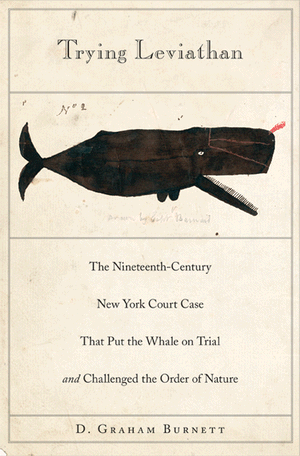
The follies that plague humankind come in an almost cyclical form. As old Ecclesiastes wrote, “there is nothing new under the sun.” I just finished D. Graham Burnett’s Trying Leviathan: The Nineteen-Century New York Court Case That Put the Whale on Trial and Challenged the Order of Nature. Other than the fact that the subtitle accounts for a good portion of the book, this account shows just how little we’ve progressed. At the heart of the book is Maurice v. Judd, a New York case of 1818 in which a whale merchant contested an assessor’s fee on “fish oil” by claiming a whale was not a fish. In “trial of the century” style, star witnesses were called in, bringing science to the docket. It was known, even in these pre-Origin of Species days, that a whale was a mammal, but what soon became clear as Burnett laid out the facts of the case was that the Bible held sway. Genesis divides the classes of nature into beasts, birds, and fish. This simplistic taxonomy was held by many in the nineteenth century to be a sacred statement of fact. If whales lived in the water, they were fish. The fact that they nurse their young, who are born live, and that they share the skeletal template of land creatures and have warm blood, and breathe through lungs, simply did not matter. If Genesis says fish, fish it is.

My mind immediately jumped ahead just over a century to the Scopes Trial. Once again, science was bent over the knee of Genesis and poised for a paddlin’. And the challenges still have not stopped. Call it Intelligent Design, or Answers in Genesis—anything but mythology—and it will keep coming back for more. Already, in 1818, lawyers were arguing that science could be decided in the courtroom. Facts only muddy the issue. If Genesis weren’t enough, Jonah’s “great fish” was called a “whale” in the Gospels, so, QED. There is no debating Bible science. Just to prove the case, we’ll bring it to trial so that twelve people with no science training can decide the issue based on rhetoric. Disciples of dogma. No surprise that the jury found the whale to be a fish. There’s no stopping a true believer.

My wife gave me this book because of my enormous fondness for Moby Dick. In both books the discussion of killing and butchering whales bothers me immensely, but I know that Melville is running after a beast of a metaphor and that whale-boat skimming across the surface of the ocean has lanced a far greater prey than a white whale. The creationists, however, fail to see the beauty of mythic images. Anyone who’s even watched a court drama on television knows that the truth is not what courts seek. Courts seek to convince a jury, whether a person is guilty or not. No matter if it’s a while whale or a white bronco involved. Truth is much more subtle and fragile. Truth can be discerned by facts. But the Bible is a heavy book, and when dropped from a great enough height, can fracture even the laws of nature. Like Ahab, the creationists are never truly gone forever.


Paradise Re-Lost

It is through the astute eye of my colleague Deane Galbraith that I came to know of my most recent reading project, Paradise Lust: Searching for the Garden of Eden by Brook Wilensky-Lanford. BWL (since the author’s name is a mouthful and since it took me four hours to get home tonight (at a distance of less than 30 miles) I’ll abbreviate her title. Being a fellow New Jerseyan, I’m sure BWL will understand) surveys various attempts that have been made over the past century-and-change to try to locate the Garden of Eden. Spurred on by the discovery that her own educated, rational great-uncle had also wondered about the mythical location of our mythical ancestors, she sketches various attempts to find Eden. Tracing a course that often crosses paths with my own academic background, BWL notes the pervasive—one might say undying—belief that once upon a time in a land far away there was a garden paradise.

Quite apart from the obviously folkloristic, and Mesopotamian, origin of the creation story, BWL demonstrates that the unifying factor behind the search for Eden is the four rivers mentioned in Genesis. The Tigris and Euphrates should be no-brainers, and no-brainer is a word that frequently comes to mind when otherwise intelligent people sincerely suggest Eden lies beneath the North Pole, or in Ohio, or Florida. Clearly this story left only psychological traces on the impressionable. Far more mysterious are the Pishon and the Gihon. The fact that these rivers have never been found (never existed) has fueled the economy of adventurers and bibliophiles for well over a century. The fact that people buy BWL’s book underscores the point. The end result is that any confluence of four rivers could potentially be Eden. What is lost is the biblical worldview.

The four rivers of Genesis 2 flow to the four points of the compass to water the entire earth since all ancient people seemed to have believed they lived in the middle of everything. The Genesis writer takes for granted that we’ve heard of them, and who, among the sophisticated, wants to admit otherwise? Since the story never happened, no physical evidence should be expected. And that’s what all of BWL’s explorers find. Nothing. Of course, if you want to run for President you’d better claim to believe in Eden, for plenty of Americans, despite our educational system, do. Many an ape is wiser. So if you want to find Eden, locate the center of the world. Given the traffic tonight, it surely must be New York City. If you’re going to look for it, you’ll want to take a book to read while the rivers of cars stop flowing. I’d suggest Brook Wilensky-Lanford’s Paradise Lust.