Naming Easter

Today, for some, it’s Easter.  Others call the day Pascha, after the Hebrew word pasach, or “Passover.”  At its deepest roots it is a spring celebration timed around the vernal equinox.  The name “Easter,” however, has an interesting story.  All the more so for having missing parts.  There was apparently an Anglo-Saxon goddess named Eostre.  Since these Teutonic peoples didn’t have their own archives we only learn about the April festival dedicated to this dawn goddess from the Venerable Bede.  Being venerable, we tend to trust him.  He tells us that what is called Pascha used to be called Easter because of the goddess and her celebrations.  We’re often left, however, with not enough information about the deities of old Europe because, ironically, literacy had not come to them.

As we move into what publishers are calling post-literary culture, I have to wonder at the losses that will mean for the future.  We all know, deep down, that electronic media are ephemeral.  We just hope our bank accounts stay viable until we die so we don’t run out of money.  In any case, Easter is a good illustration of what historians and those interested in the development of ideas have to do when few written records exist.  We look at artifacts and images and make our best guess.  This is clearly evident in the field of studies of another goddess—Asherah—upon whom I lavished my dissertation.  We do have some written records, but for many scholars they aren’t enough.  We guess that this or that image might be of her, although they’re not labelled.  A similar problem applies to Eostre.

There is little doubt that a goddess named Eostre existed.  It makes perfect sense that she would be celebrated in April.  Before Daylight Saving Time was invented, it was light around 5 a.m. this time of year.  For early birds (historically we were in the majority) it would’ve been obvious.  The goddess of the dawn is coming back to us.  Shining in our eyes as we try to pry a little more slumber from a shortening night.  Early Christians tended to adapt rather than to reject  non-Christian celebrations.  The name of Easter is yet another of those conveniences.  Although it snowed a little around here on what some call Maundy Thursday, today Easter is here to remind us of resurrection.  Life does return and our daffodils, although they may be shivering, have bravely broken through the sod to greet the dawn.


Whose Holiday?

I write a lot about holidays.  One of the reasons is that even long before capitalism, societies took breaks right in the middle of things.  One of the major seasons of celebration was the vernal equinox.  Easter is tied to Passover, of course, but since nobody knows the year of Jesus’ crucifixion the actual date can’t be determined.  Passover is a moveable feast and since the lunar calendar is essential in setting Passover’s date, Easter is calculated as being the first Sunday after the first full moon after the vernal equinox.  There has been talk of the three major branches of Christianity—Catholic, Orthodox, and Protestant—agreeing on a set date for Easter but even if that happened there would be splinter groups who liked it the old way and the confusion would only grow.

Since astronomical observation has grown so mathematical, the date of Easter can be calculated far into the future.  We know just when the vernal equinox will occur, and we know when the full moon will come around.  All that’s needed is some calendars and a whole lot of patience (and maybe a calculator).  Despite society’s obvious preference for Christmas, Easter has its own array of attendant holidays for some Christians.  (Not all Christians celebrate Easter.)  For instance, for some today is Maundy Thursday.  Tomorrow most will recognize as Good Friday.  Nobody’s quite sure what to call Saturday, and many Christians will begin to celebrate Easter at midnight even before Sunday wakes up.  Easter does last more than a single day, in some traditions, but it’s not quite as developed as the twelve days of Christmas.

Lately I’ve been considering that how these holy days are sacred for some and secular for others.  One of the realizations that globalization has wrought is that not everybody shares the same concepts of how universal events—such as the vernal equinox—should be commemorated.  Although on the equator every day’s not quite an equinox due to the earth’s tilt, it isn’t as dramatic as the changes that occur in temperate zones.  Christianity was custom-built for European holidays, which is what it tends to keep.  The history of the holidays is more complex than it might seem at first.  Add to that widespread disagreement around the world as to both religion and to when certain events should be calculated and you’ll need more than a slide-rule to figure it out.  So as we begin the Catholic and Protestant Easter season (Orthodox Easter is about a month away yet), it may be helpful to remind ourselves that what day it is might just be a matter of perspective.

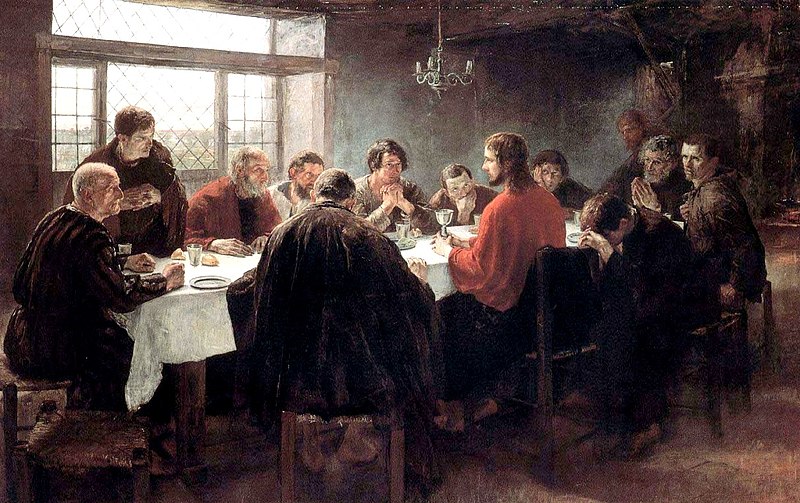
Stiftung Gertrud Schnürle 1975, Fritz von Uhde, The Last Supper, via Wikimedia Commons


one of many

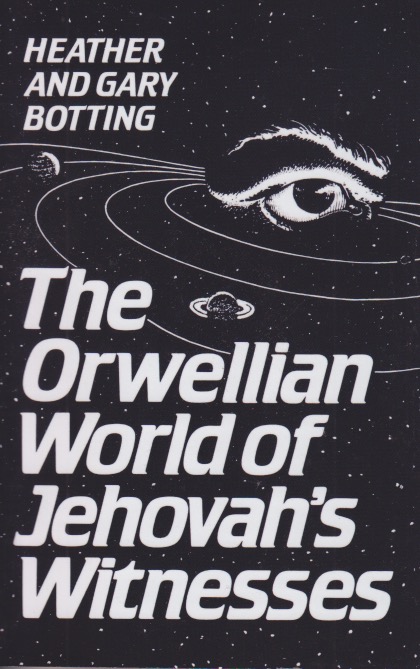
It’s been some time since I’ve read about the Jehovah’s Witnesses.  There are so many religions that I need to refresh my study on them periodically.  So it was that I received a mailing from the local Kingdom Hall.  You see, the very last people at my front door before the pandemic was declared were bearing the Watchtower and telling me the end is nigh.  We knew about Covid-19 at that point and were being urged to keep social distance, although the authorities were still dithering about masks.  They knocked nevertheless and we stood several feet apart on the porch as they tried in vain to convince me of their truth.  So now, a year later, they’ve reached out by mail.

You’ve got to have a soft spot for a religion that has its origins in Pittsburgh.  Well, maybe that’s the case for those who grew up where it was the nearest big city.  And I do admire that pioneering spirit that says “established religions just aren’t doing it for me.”  The great swath of NRM—New Religious Movements—shows that you shouldn’t feel lonely if this applies to you.  Even today’s Christianities bear little resemblance to the teachings of the carpenter of Nazareth.  He who said even to look upon a woman lustfully was to commit adultery, but whose followers support a president who recommends grabbing them by the, well, where the originator said not to look….  Religions evolve.  The literalism many associate with Christian belief is really only about a century old.  We have no business castigating religions just because they’re recent.

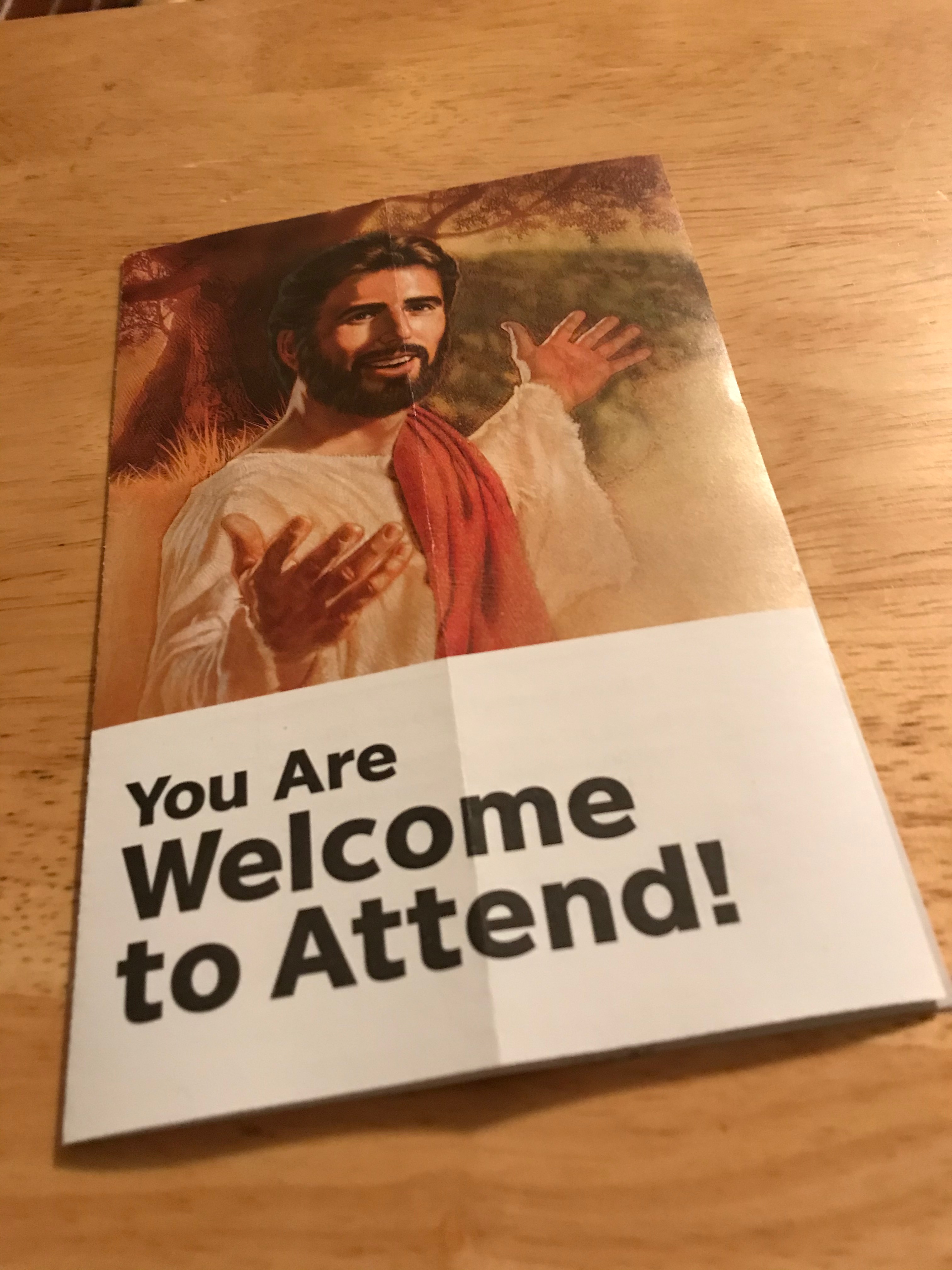
My mailing from the Witnesses included a personalized (somewhat) letter inviting me to a virtual commemoration of Jesus’ death.  Due to the pandemic it’ll be held on Zoom, of course.  The expected flyer with its Anglo-Jesus contains the details.  I did attend a Witness service back when I was in college.  Those days of heady explorations never really ended for me.  You have to settle into a tradition to get to know people, of course, but there’s a world full of ways of looking at our spiritual side and there’s more being propagated just about every year—even Jehovah’s Witnesses have splinter groups.  I suppose missionaries are something we’ll always have to put up with as long as people are convinced that their way is The Only Way.  Trust that others have perhaps quietly, perhaps deliberately, perhaps with a great deal of thought and reflection, have found their own way seems never to be good enough.  Still, an invitation is an invitation and those have been rare during a pandemic.


Clearly Conspiracy

What an odd place to find ourselves in.  Some evangelical Christians, who used to be guardians of decency and moral human behavior, now have to have their clergy explain to them why Trump wasn’t the messiah he’d been touted as for the last four years.  A piece in the Los Angeles Times recently described the struggles of one such minister with his congregation that had fully bought into the conspiracy theories Trump promulgated in order to mask his own lack of care for his country and its citizens.  Conspiracy theories have become big business in academia with faculty from many departments exploring them.  I haven’t seen much in the way of religion departments participating in the discussion, but I think they should.  Why?  Religions are all about getting people to believe and act in prescribed ways.

Image credit: Johann Lund, Wikimedia Commons

Not that religions alone can explain this.  Psychologists and sociologists must have some important insights as well.  I used to tell my students that not all religions are about beliefs.  Some have to do with behaviors—acting in a certain way, regardless of belief, is to be part of it.  Certainly that explains part of the membership in the cult of Trump.  Many who follow it must know in their consciences that a man who defrauds the government he “governs,” who actively womanizes, and who displays overt racism can’t be the ideal evangelical.  Ah, but the conspiracy theories explain it!  Pay no attention to the man behind the curtain, right?  You can sure get away with a lot that way.

Religions have a lot to teach us about both strange behaviors and strange actions.  Many years ago someone pointed out to me as I was enumerating what I considered odd beliefs of a New Religious Movement just how odd Christianity looks from the outside.  When I stopped to think about it, this made sense.  The unconventional aspects of the faith had become naturalized because I’d been taught all my life that they were true—unlike all other religious beliefs.  Not only that, but I had been taught that accepting them without question was the only way to avoid Hell.  Over the years the strangeness became normal.  Trump and his conspiracy theories had their way smoothed by an evangelical narrative of unquestioning belief instead of an examined faith.  Now many ministers, awaking sober, are having to try to convince their flocks that they’d accepted lies for truths.  It’s an uphill battle, unfortunately.  Religions, after all, have been about getting followers to believe without questioning, or, apparently, considering the source.


J-Horror

J-Horror better move over.  There’s a new kid on the block.

For many years those of us strange fans of horror have used “J-Horror” as shorthand for Japanese Horror.  With two highly successful films (eventually series) of the mid-nineties (Ju-On and Ringu) the Japanese contribution stormed back into American consciousness.  Those of us who grew up on Godzilla knew that J-Horror had been around for decades already, but these new movies were distinctly creepy.  So much so that English-language versions were remade for both original films (The Grudge and The Ring, respectively—rather like Let the Right One In and Let Me In).  So far, so good.  So why does J-Horror need to move over?

At least three separate friends have pointed me to another emerging J-Horror trend: Jewish horror movies.  These used to be rare.  With cases of early antisemitic themes in horror, and the real life horror of the Holocaust, this is certainly understandable.  “Christian” producers or directors delving into Jewish themes would seem to be in bad taste.  Still, some notable Jewish-themed horror has begun to emerge.  (I addressed one such film in my recent Horror Homeroom piece.)  The Possession (discussed in both of my most recent books) centers around the need for a Jewish exorcist in the case of a dybbuk problem.  For more information, you know where to look!  It seemed to me that the dybbuk box contents were reminiscent of the Holocaust, but that may not have been intentional.

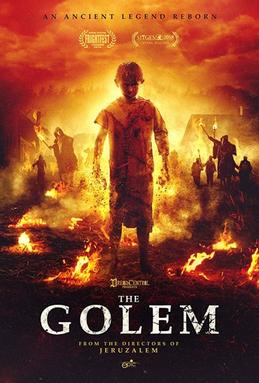
I recently wrote a post about The Golem.  This is a recent Israeli movie that builds on the traditional Jewish monster.  Although set before the Holocaust, the fact that there’s a pogrom in the film shows that the concept is not far off.  The movie that people have recently been pointing me toward is The Vigil.  I’ve not had an opportunity to see it yet, but the press it’s received suggests it too will be another classic based on lived experience in Judaism.  I’m not sure if Jewish horror will eventually rival the numbers of Japanese horror films, but the offerings thus far have been noteworthy.  Horror often addresses the problem of human suffering.  With all the oppressions in “white” society, it’s no wonder that, along with Black horror, Jewish horror is beginning to garner attention.  Although it’s clearly not to everyone’s taste, horror is often a genre with a conscience.  It becomes a screen on which we can see our worst behaviors projected.  And if we’re wise, we’ll take steps to make such suffering become merely an unfortunate memory.


Knowing Everything

Of all the jobs I’ve held, being an editor is the only one where strangers send random emails trying to convince me of God’s reality.  Granted, part of that may be because email is now so common as to be passé among the younger crowd.  When I myself was younger it was still just catching on.  Still, part of these strange emails is likely based on the evangelical compulsion to make others see things their way.  Someone who edits biblical studies books might seem like a good target.  I got another such email just last week, and as always, I wondered over it.  What kinds of assumptions must random strangers make about biblical studies specialists?  One of these assumptions, it’s clear, is that they suppose we are atheists.  They know this without even asking.

Technology has made such blindsiding communication easier.  It didn’t invent it, though.  It took a lot more effort to write up a letter, address it, buy a stamp, and mail it than it does to sit down at a keyboard, click, and they start proselytizing away.  In my earlier days, in other incarnations of a career, I received unexpected missives from time-to-time.  And certainly as a seminary professor you had students who had already figured everything out by the time they’d gotten to matriculation.  Many of them were coming to seminary to teach rather than to learn.  Such can be the arrogance of faith.  I fear that many of them graduated with their biases intact.  Education, perhaps, doesn’t work for everyone.

Photo credit: NASA

Having it all figured out is something many of us strive for.  We want things to make sense.  We want our spirituality to fit into this increasingly materialistic world.  Some of us go to seminary and/or graduate school to help us make sense of things.  We encounter minds further along the journey than our own, and, if we’re open, we learn from them.  For me, it’s difficult to understand how education isn’t always a humbling experience.  Oh, I get emails from academics who think they’ve figured it all out as well.  Such communications always make me sad.  The human enterprise, such as it is, has spanned millennia and true progress has only been made when people were humble enough to admit that they didn’t know everything.  They would eventually invent the internet and email.  Then those who already knew all the answers could send them to strangers to convince them of their own great learning.


One Day or Another

Although normally a time for celebration, Mardi Gras, I’m told, was subdued this year.  Today is Ash Wednesday but many of us feel like we’ve been living a year of Lent already.  I once told a fellow office worker on Ash Wednesday, “I think about death every day, I don’t need a yearly reminder.”  Looking out at the old snow, melting, freezing, refreshed with occasional flurries, I’m reminded of the cycles of nature.  I’ve been watching the turn of the year’s wheel.  Over the solstice I looked into Yule, and just a few days ago considered Imbolc.  The wheel of the year is a symbol for modern earth-based religions seeking to be kept in sync with nature.  It is a cycle, slowly turning.  Death, in this way of thinking, is part of a larger system.  It seems appropriate to consider it this Ash Wednesday.

I say it’s Ash Wednesday but it would be more correct to say “for many Christians it’s Ash Wednesday.”  Cultural imperialism is difficult to shake.  With the pandemic still embracing us tight we haven’t had much reprieve from thoughts of death these many months.  Thinking of the wheel of the year, however, may bring hope.  A wheel in motion spins around to a new beginning that, in the nature of circles, is equally at every point.  New beginnings are offered every day.  While we’ve never been in a year of isolation before, there is nothing that hasn’t been before.  Self-aggrandizing dictators, world-wide pandemics, calls for social justice and fairness, have all come around before this.  They may come around again.  The main thing is to keep it moving.

It moves, in fact, without us.  One of our human foibles is being species-centric.  When we discuss, in a pique of teenage angst, of “destroying life on earth” we really mean destroying humankind and perhaps many other species as well.  Not all.  With a kind of collective insanity we go about warring against our own kind, exploiting all other species we deem valuable, and talk as if that’s all that matters.  Today, for some, it is Ash Wednesday.  For others it is World Human Spirit Day.  For many of us it’s just another workday among many very similar, cut from the fabric of a year that has no even spokes to keep it rolling.  Beneath our feet this orb spins on, regardless.  The cycles continue, with or without us.  How wonderful it would be if we could actively contribute to their progress.

Photo by Ameen Fahmy on Unsplash


Leadership

After four years it finally feels safe again.  We can celebrate Presidents’ Day, although now and forever with some trepidation.  Even as Republicans still protect the insurrectionist Trump, democracy has survived his tenure of horror.  Many Americans don’t realize just how close to Nazi Germany we came.  There are many who hold party above the good of the nation, something our founders, one of whom we celebrate today, feared.  The outdated safeguards of democracy, such as the electoral college, have been used more than once to “elect” presidents the American people did not want.  One guess as to which party this has only favored.  Democracy, we’re now being told, is fragile.  It shouldn’t be.  Only the designs of a party scheming for personal enrichment makes it so.

Today we can at least take a breather and be glad that we no longer have a bigoted, sexist, classist, racist incumbent.  We have a female Vice President of color.  We are on the long, slow road to recovery.  The senate, clearly recognizing Trump’s danger to the nation, voted to acquit him because Republicans fear not being reelected if they stand up to him.  Our democracy’s not out of the woods, even this Presidents’ Day.  Until the GOP learns to grow a backbone we’ll be in constant danger of collapsing.  Anyone with back trouble knows how it can stop you in your tracks.  Of course, once you’ve made a deal with the Devil, there’s no getting out of it.  Most Republicans could benefit from just a touch of folk wisdom.

When one party sides with armed thugs who’d have happily killed them if they’d been found just a little over a month ago, our grounds for celebrating today remain on thin ice.  The GOP, which has no moral compass left, has decided that bullies and armed bandits are the way of the future they’d like to see.  Although Trump lost both popular elections they’d still vote for him a third time and support him again if he incited another insurrection.  It’s Presidents’ Day but we’re still on the edge of a precipice.  When a political party refuses to learn from its mistakes, and indeed, tries to build upon them, our celebration of democracy must, by definition, be subdued.  We do have grounds for hope.  Efforts to get the coronavirus under control are starting to take effect.  We have a sane human being in the Oval Office.  Until the GOP disavows evil, however, we’ll continue to live in fear.


Love or Saints?

One of the many oddities of life at Nashotah House was that we never celebrated St. Valentine.  I wouldn’t expect a mostly male and neurotically homophobic community to mark Valentine’s Day as for lovers (most of the faculty and many students were married, however), but the saint’s name wasn’t uttered in my years there.  Of course, commercialization of holidays does taint them somewhat.  It’s difficult to take a day seriously when you’re being told that how much you spend will be the sign of how special it will be.  With St. Valentine’s Day, however, I believe the topic was much too close to something the church had long feared—sexuality.  I’ve often pondered how this strange obsession evolved.  Judaism, from which Christianity sprung, isn’t the origin of this antipathy to being fully human.

The trouble likely starts in the Bible.  The New Testament, in particular.  No mention is made of Jesus having been married.  Paul, in his usual way, made it an issue but fell short of outright condemning it.  His words would help convince the Roman Catholic Church that mandated celibacy was a good idea.  Clearly, however, Augustine of Hippo, who lived after Valentine (depending on which one you elect to follow) saw the whole enterprise as flawed.  Making up the concept of original sin and tying it in with sexuality was a certain means of creating a problem.  Not that Christianity is the only religion that promotes celibacy, of course.  But when it came to Nashotah House there was really no concern about what other religions taught.  Even on February 14 no collects were recited mentioning the saint who must not be named.

The history of saints’ days is a fascinating one.  A few of them made it into pop culture—after Presidents’ Day there’s no national holiday until Memorial Day in May, so who can blame people for looking for reasons to celebrate while still waiting for spring?  Saint Patrick wasn’t similarly given the cold shoulder at Nashotah in my years there.  And although it moved around quite a bit, you could usually count on April for delivering Easter.  We didn’t celebrate Presidents’ Day.  Nor Martin Luther King Day—not being Catholic his canonization process was a non-starter.  The long, cold stretch between Epiphany (now Insurrection Day) and Lent was one devoid of popular holidays.  I suspect that despite the number of saints (and there are lots of them) the singling out of Valentine was considered to be asking for trouble.  That was many years ago.  Oddities, however, have a way of remaining in long-term memory.


Meanness

There’s often a meanness to literalist religions.  A sense that if they can keep their particular interpretation of God’s will, then anybody can.  No compassion.  No forgiveness.  Considering the base messages of nearly all those religions that harbor fundamentalists, that attitude is quite surprising.  Indeed, it ceases to be religion at all and becomes merely a facade of one.  The recovery of the body of Khaled al-Asaad is what brought this to mind.  Back in 2015 al-Asaad, an 82-year old archaeologist, was beheaded by the extremist Islamic State group in Syria.  Al-Asaad had spent his life excavating and attempting to understand the site of Palmyra.  The Islamic State was determined to destroy what they considered “idols” or offensive images.  When the octogenarian refused to tell them where they could find further antiquities to destroy, they beheaded him.

This isn’t finger-pointing at Islam.  Islam is a highly moral religion that values peace.  What it has in common with Christianity, apart from some shared history and theology, is that it fosters extremists.  Extremism may be fueled by religion but it’s not religious.  The adherents are often mean, hard-line individuals who have trouble distinguishing the shades of gray that make up so much of life.  As a result of the Islamic State movement, many antiquities that had survived for thousands of years were destroyed forever.  There were heroes like Khaled al-Asaad (we might even call them saints) who tried to protect these irreplaceable artifacts.  Religion has no feud with the past.  In fact, religions consciously build on their pasts.  Continuity is important to them.

Extremism of this kind is a fairly new blending of religion and politics.  As recently as the sixties it was felt that religion and politics should be compartmentalized.  Kept separate.  When the Republican Party realized in the seventies that evangelicals could be made into a voting bloc, religion became politicized.  This happened elsewhere around the world.  “True believers”—the very term suggests the rest of us believers aren’t true—tasting political power, realized they could use their meanness to make the rest of the world in their own unforgiving image.  We’ve been living with the consequences ever since.  Even now Republican lawmakers fear reprisals of Trump supporters if they dare accept the truth.  In other words, extremist religion has pitched its battle against the truth itself.  That would be ironic if it weren’t so terrifying.  No religion that I know has meanness among its central tenets.  It takes literalism to make it one.


Religions and Horrors

My latest piece on The Golem has just appeared on Horror Homeroom.  It’s free—check it out.  In it I briefly discuss Jewish horror.  I mainly write about Christian horror because that’s my immediate context.  That’s not to say other religions don’t participate in the genre too.  While I worked for Routledge I acquired the book Buddhism Goes to the Movies, by Ronald Green.  Like the title suggests, it’s about movies focused on, or made by, Buddhists.  What sold me on the project was the chapter on horror films.  Much of what’s being called “J-Horror,” or Japanese Horror these days, occurs in a Buddhist or Shinto contexts.  I’m not expert enough in these traditions, however, to spot them with the detail that I do in my own native religion. 

All religious traditions have certain commonalities.  As I’ve frequently discussed on this blog, sex and death are two of them.  Given the powerful ideas that religion trades in, it seems natural that it would appear frequently in the horror genre.  It’s just that modern viewers tend to be somewhat divorced from religion and can’t see it.  Religion is that way—it fills the cracks.  How often do we pay attention to the caulking or grout?  We tend to focus on the tile or woodwork instead.  Religion holds thought systems together, including those of the horror genre.  I just discussed no-go subjects yesterday, but even science shows religion in some of the cracks.  Learning to see it involves learning to shift your focus.

I blogged about The Golem just after I watched it, back in December.  The golem is an original Jewish monster, and Judaism is both a culture and a religion.  It’s difficult to tease them apart sometimes.  The same can be said of many traditions outside Christianity.  In fact, many cultures had no word for religion—the idea of a separate realm of life where you try to please the gods because what you do otherwise is inherently sinful.  (There’s probably a reason that capitalism grew in a Christian context.)  That means that horror particularly welcomes Christianity.  Many of the bases of fear are premised on a religion that, as culturally bound as it is, has always claimed that joining it is a choice.  If you can choose you can choose wrongly.  This is fertile ground for horror, especially when the consequences are eternal.   My Horror Homeroom piece takes a different approach than this, but religion and horror nevertheless find themselves together, often in the same room.


How Clean Is Your Brain?

First it was in.  Then it was out.  Now nobody seems to be sure.  “Brainwashing” isn’t really a scientific term, but human suggestibility is very well in evidence.  Advertisers count on it.  Did I really need that phone case when I never go out?  And so on.  The real question is can people be compelled to do what they normally wouldn’t want to.  Think Jonestown.  Heaven’s Gate.  Waco.  Do people really want to die en masse?  Are we but higher lemmings?  I’ve seen hypnotists do their shows.  The human mind is manipulable.  We can be shut off from reason.  A recent article from The Middletown Press my wife shared with me raises the question whether conspiracy theories, such as those sported by QAnon, are something like brainwashing.  Clearly they are.  As are many Fundamentalist forms of religion.

You can recognize this when a conversation becomes such that the true believer simply won’t listen to evidence.  They’ll say they want to discuss an issue when all they really want to do is have someone state their side so they can tell them they’re wrong.  Reason has nothing to do with it.  When that part of their gray matter that handles things rationally feels backed against a wall they resort to ad hominem attacks.  I’ve been observing this since I was a child raised in such a paranoid religious tradition.  It works for politics, too.  For many QAnon sorts, Trump’s word was God’s word.  Once uttered it could not be refuted, not with all the evidence in the world.  It’s very much like Fundamentalist views of the Bible which can’t take context, translation, and reason into account.  When contradictions are blatantly pointed out they respond with “there are no contradictions.”  Is there brainwashing?

Conspiracy theories can seem real because there are actually some conspiracies.  There are government secrets.  Only the naive deny that.  Still, once you start throwing in the ridiculous—that a devil-worshipping cabal of pedophiles is running a secret government—you’re in water over your head.  Not only that, this sounds incredibly like the satanic panic that spread through much of the world in the late 1980s into the 1990s.  When the evidence was examined, it was found lacking.  Some of the key bestselling accounts were admitted to have been forgeries.  The believing mind, however, has trouble letting go.  We used to call fringe groups cults.  We used to suggest that people could be held against their will.  People leaving QAnon are reporting similar experiences, according to the article.  Brainwashing by any other name would be so real.


Christian Nationalisms

Ongoing analysis of the Capitol Riots continues as footage of the event is scrutinized.  Although the press is puzzled, those who study religion—underfunded and ignored in the academy—aren’t really surprised.  A recent story from the Associated Press explores how Christian Nationalism, one of the most dangerous forces in the United States, played a large role in the event.  Christian Nationalism is one example of what I call weaponized religion.  As someone who’s spent over four decades studying religion minutely, it’s pretty clear when religion begins to slip its moorings and is becoming radicalized.  Generally it begins when adherents refuse to hear any views but their own.  They believe their version of their religion is the only “one, true faith” and this gives them the mandate to attack any who believe differently.  In the case of Christianity it’s very difficult to see what any of this has to do with a carpenter from Nazareth.

Indeed, evangelical Christians themselves are exploring what is now being called “Republican Jesus.”  This Jesus isn’t the one from the Good Book.  Far from it.  No humble shepherd saying “turn the other cheek” fits this image.  Long ago I read Stephen Prothero’s American Jesus.  In it he analyzed how the American appropriation of the Jewish rabbi became a muscular, masculine fighter.  Not the kind of guy who’d let Roman authorities nail him to a cross.  And certainly not a softie who would favor outcasts, women, and children over the rich and powerful.  This image of Jesus, who draws a hard line on certain trigger issues, is as patently false as any reconstruction can be.  And yet it drives unruly mobs into the halls of power.  Universities, meanwhile, cut religion departments.

Photo credit: David Shankbone, via Wikimedia Commons

I don’t pretend to be a prophet, but this issue isn’t going away.  Our culture has long harbored the myth of America as the “new Israel.”  The leaders of Christian Nationalism are organized and they have a clear agenda to take over the country.  Like other serious issues that don’t have to do with making money, it’s simply overlooked as irrelevant.  When the mainstream media gets a glimpse at what’s been going on in such groups, it always seems surprised.  The kind of elitism that divorces itself from the everyday simply can’t be informed of what’s actually happening.  Religion is a very powerful driving force.  It motivates many far more than money does.  We see it plainly when it becomes weaponized.  By then, however, it could be too late.


February Festivities

One of the more commonly overlooked holiday complexes comes around Groundhog Day.  It may seem strange to be thinking about spring right now, but it’s on everyone’s mind.  (In this hemisphere anyway.)  When seasons actually begin is a matter of perspective, and that’s not just a north-south hemisphere divide.  With our scientific outlook, we take the path of equinoxes and solstices.  If you look closely, however, there is a set of seasonal holidays that falls midway between them, dividing the year into eight spokes.  These cross-quarter days were recognized in some cultures as the early inklings of a new season beginning.  If Halloween (Samhain) marks the start of winter, this holiday, Imbolc, is the beginning of spring.  The day had many associations, one of which was watching a groundhog (or other animal) to see if the weather would begin changing sooner or later.  Spring itself is inevitable.

The popularity of Groundhog Day owes quite a bit to the movie of that name.  The film is more complex than its classification as a comedy might suggest.  Although the day itself does deal with the cyclical nature of, well, nature, repetition isn’t an inherent theme in the holiday.  Neither is it part of the related Christian celebration of Candlemas.  Indeed, I tend to think Groundhog Day has the makings of a horror story.  Being stuck in time could represent a terrible fate for many.  Interestingly, Phil Conners (Bill Murray), after having been stuck in this same day for a considerable amount of time, suggests to Rita Hanson (Andie MacDowell) that he might be a god.  He is immortal and he knows everything that is to be known in Punxsutawney.  He can predict things before they happen (of course, he has become Punxsutawney Phil, in a manner of speaking).

A philosophically rich movie, the story has appealed to adherents of several religions.  That, in itself, is amazing.  The endless repetition could represent samsara to those of south and east Asian religious inclination.  The learning to be kind, and even forgiveness aspects, appeal to those who want to find a Christian message in it.  Not bad for a holiday nobody gets off of work, and which frequently falls in the middle of the week.  The holiday complex of Imbolc, Candlemas, and Groundhog Day represents what had once been a more prominent season than we currently recognize.  Revivals of the more ancient celebrations have begun to appear, but the endless repetition so valued by capitalistic systems has nearly captured us all.


Mittens and Circuses

Bernie Sanders, since we’re now making up our own facts, clearly won this election.  Or at least the inauguration.  An inescapable meme of Sanders, bundled up with his notable mittens, has made major media as well as pedantic punters on the web.  Thanks in part to an app created to allow users to place Bernie anywhere, I’ve seen him at all kinds of places from Oxford University Press to Dirty Dancing to the exhibit halls at the AAR/SBL annual meeting.  As someone who suffers from the cold I was initially concerned that he must feel laughed at by it all, but Bernie seems to be taking it in good humor.  The only reason I bring it up here is a meme (I think) that my wife pointed out to me of Bernie among the Fond du Lac Circus.  I can’t find any credit for the creator, but it appeared on the Episcopalians on Facebook group.  (I don’t know how Facebook works, checking above the fold once a day only.)

I’ve actually posted on the Fond du Lac Circus before.  The photo was extremely popular at Nashotah House when I taught there.  The diocese of Fond du Lac (in which I once preached) is just north a bit in Wisconsin.  The photo was a celebration of the installation of a bishop with ecclesiastical haberdashery at its finest on display.  In my mind, Nashotah House stands for all that’s conservative.  I’m certain a great deal of the population supported Trump.  A former dean had a shrine to George W. Bush in the deanery.  I kid you not.  So seeing the most progressive senator amid that crowd of backward-looking clergy, apart from being unspeakably funny, made me reflective.

Many years of my life were spent among the Episcopalians.  Too many of those years consisted of feeling oppressed by the interpretation of “orthodoxy” held at Nashotah House.  The hubris of “the only right teaching” has haunted me ever since.  Faith can be a good thing, but it can also be extremely dangerous.  The greatest danger is when it ceases to be reflective.  Faith must involve constant thought and assessment to be honest.  Unthinking compliance was something Jesus, for one, simply didn’t accept.  Challenging the way it’s always been done is a venerable part of the agenda for those who start new religions, Jesus included.  When that religion becomes ossified (or too obsessed with appearances) isn’t it time to start looking toward the future?  Bernie Sanders is popular with the young.  They have little patience for the selfishness that’s been on display in American culture for far too many decades.  Would that he really attended the Fond du Lac Circus!  Perhaps a grassroots movement to improve conditions for all might’ve actually emerged long ago.