Cross Quarters

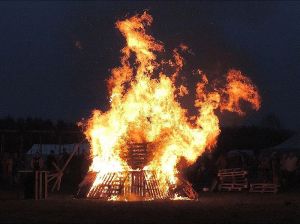
Happy Beltane!  We could use a holiday right about now.  For those of us who are under the spell of intelligent horror, May Day brings The Wicker Man to mind.  Not the remake, please!  I first saw it about a decade ago—my career history has made watching horror an obvious coping mechanism—and I was struck by the comments that the film was a cautionary tale.  One of the problems with being raised as a Fundamentalist is that you tend to take things literally and I supposed that the cautionary tale was against Celtic paganism.  The Wicker Man is about the celebration of Beltane on a remote Hebridean island, and it was only as I watched it a few more times and reflected on it that I came to realize the caution was about those who took their religion too seriously, pagan or not.

Photo credit: Stub Mandrel, via Wikimedia Commons

Lord Summerisle, after all, admits that his religion was more or less an invention of his grandfather.  More of a revival than an invention, actually.  In other words, he knows where the religion came from, and he has a scientific understanding of the soil and how and why crops fail.  That doesn’t prevent him from presiding over May Day celebrations to bring fertility back to the land.  The people, as often is the case with religions, simply follow the leader.  Of course, Beltane is a cross-quarter day welcoming spring.  It is celebrated in Celtic countries with bon fires and obviously those fires are to encourage the returning of the sun after a long winter.  The days are lengthening now.  I can go jogging before work.  The light is returning.

Capitalism, which is showing its weak side now, doesn’t approve of too many holidays.  Like Scrooge they think days off with pay are picking the pockets of the rich.  The government stimulus packages show just how deeply that is believed in this country.  Celts we are not.  So as I watch the wheel of the year slowly turning, and see politicians aching to remove restrictions so that money can flow along with the virus, I think that cautionary tales are not misplaced.  The love of money can be a religion just as surely as the devotion to a fictional deity.  Herein is the beauty of The Wicker Man.  Beltane is upon us.  As we broadcast our May Day it could be wise to think of the lessons we might learn, if only we’d consider classic cautionary tales.


Misreading Melville

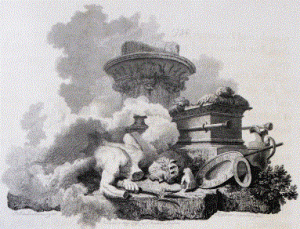
I make it a practice not to discuss books I’m still reading on this blog.  There’s no reason I shouldn’t, I suppose, but it just feels like cheating getting more than one post for a book.  Besides, there’s so much other stuff to blog about!  I’ll make an exception this time, because it involves an unusual typo.  Well, it’s not so much unusual as it is apt.  In chapter 82 of Melville’s classic, Moby Dick, “The Honor and glory of Whaling,” he discusses the mythical history of whaling.  In typical Melvillian style, he takes mythical stories to support his contention of how honorable whaling is.  After Perseus and St. George and the dragon, he mentions the curious biblical episode of Dagon and the ark of the covenant, found in 1 Samuel 5.  It’s here that my edition has a typo.  Melville writes “this whole story will fare like that fish, flesh, and fowl idol of the Philistines, Dagon by name” but my edition reads “Dragon by name.”

Image credit: Vignette by Loutherbourg for the Macklin Bible 12 of 134, via Wikimedia Commons

My very first academic publication was on this story about Dagon (I had intended to write my dissertation on that deity).  I had no idea of H. P. Lovecraft’s appropriation of Dagon at that point.  The interest was purely based on the fact that you couldn’t find much information on this curious god.  It was clear that he was well known among ancient cultures of West Asia.  He was attested at Ugarit, specifically as the father of Baal.  (Both would later be assumed to be demons.)  Further east, he was apparently a fairly major deity in Mesopotamian religions, although we are still awaiting a readable synthesis of that massive corpus of texts and the religions toward which it points.  In other words, Dagon is mysterious.  Lovecraft likely picked him up from the biblical story.

The tale in 1 Samuel is provocative.  After defeating Israel, the Philistines (who would eventually give Palestine its name) took the ark to the temple of Dagon as spoils.  The image of their god fell face-down before the ark overnight.  Disturbing as this was, the next morning after they’d replaced him, Dagon was again tumbled but also decapitated and with his hands broken off.  That meant his body was all that was left.  Somewhere along the line the name Dagon (close to the Hebrew word for “fish”) was interpreted as a maritime entity.  This seems unlikely, given what we know of his origins, but the idea stuck, leading to some compelling horror fiction.  Dagon does indeed become a kind of dragon in that realm.  My edition of Moby Dick has a typo that we today would blame on autocorrect, but in reality was likely the result of a copyeditor not knowing his or her Bible as well as Melville did.


Moralizing Gods

In my more radical moods I sing along with John Cougar about fighting authority.  Living in society means never being completely free.  This pandemic only amplifies that.  What I want may not be best for others.  Not to mention excessively corrupt authority *ahem* Washington DC [coughs into elbow].  Still, a friend sent me an article titled “Did judgmental gods help societies grow?  The piece by Lizzie Wade appeared in Science recently.  The article begins by noting that judgmental gods are rare.  It then suggests complex societies seem to have had judgmental gods at their beginnings.  Moralizing gods demand cooperation.  People want to do what they want.  If we’re going to reap the benefits of a highly specialized society we all need to play our part, however.  Authority always does win, I guess.

Wade’s article suggests that this kind of orthodoxy is now being called into question.  Moralizing gods, it’s suggested, appear after a complex society gets started.  Interestingly, these gods tend to be males.  (That point’s mine, not Wade’s.)  I have been wondering for quite some time just how the data from Göbekli Tepe will influence the re-construction of models concerning how civilization began.  It seems that long before settled populations emerged, back in hunter-gatherer days, people still came together to build temples.  Were they afraid of judgmental gods?  Certainly they thought it was important to gather occasionally at numinous places and ponder the larger questions.  Since they left no written records and they’ve all died out the best we can do is make educated guesses.  Who knows what might’ve been their motivation?

The one thing that seems certain to me, no matter how we nuance it, is that religion is integral to society.  Science is necessary for our survival (ancient people weren’t backward rubes, by the way—they had a kind of scientific outlook, but without all the advanced math).  Religion, however, seems originally to have brought us together.  Outside our comfort zones.  Hunter-gatherer societies limit their sizes to people you can know reasonably well.  They tend not to have private property and they share things most people in “civilized” settings wouldn’t.  To grow larger than a roving band that can sustain itself by moving from place to place once the food’s gone, agriculture was necessary.  But Göbekli Tepe suggests it only followed after religion began bringing people together in the first place.  Were their gods authoritarian?  There’s really no way of knowing that.  So when I’m feeling radical I have to remember than when it’s over I turn the volume down, comb my hair and go back into society.  Well, once the pandemic’s over.


Who’s To Blame?

Back at Nashotah House Episcopal Seminary, we were a closed community.  Well, not completely closed, as much as some may have desired it.  When a communicable illness came to campus it quickly spread.  No wonder—we were required to all gather twice daily in the chapel, and there was the passing of the peace during mass.  And the sharing of a common chalice.  The germs of the Lord were readily spread.  One of the faculty members would refer to the vector of the illness as “Typhoid Mary,” a rather sexist remark in the mostly male environment.  Still, Mary Mallon came to mind as the current crises has settled in.  “Typhoid Mary” was an asymptomatic carrier of typhoid fever.  A working-class girl from Ireland, outbreaks of typhoid followed her in the various houses in New York City where she worked.

Photo credit: National Institute of Allergy and Infectious Diseases (NIAID), National Institutes of Health (NIH), via Wikimedia Commons

The current coronavirus outbreak in New York City seems strangely similar in some regards.  Although COVID-19 is less likely passed by asymptomatic carriers, according to what I’ve read from the World Health Organization, it is still a possible vector.  While out getting necessary supplies in the area I recently noticed store employees without gloves or masks, both of which I had on.  One of us was underdressed.  I went home, washed my hands thoroughly, and pulled my copy of The Andromeda Strain from the bookshelf.  Self-medication can come in several forms.  Some people still look at me funny for wearing a mask, but many other customers are now doing the same.  The Center for Disease Control recommends it.

Before I’d ever heard of Nashotah House, I worked in a grocery store.  I was a college graduate with facial hair that had to be removed.  “Customers don’t trust a man with a beard,” I was told.  Back then if you walked into a store with a mask on there would’ve been trouble.  Contagion can drive you crazy.  Nobody wants to be a “Typhoid Mary,” and yet it’s difficult to be out in public with a mask on.  “Who was that masked man?” they used to ask of the Lone Ranger.  From the theater and psychology I’ve studied, I know that hiding behind a mask can be a liberating experience.  Aware that nobody knows who you are, you are free to act most any way you please.  But this is different.  Maybe it’s because my mask is made of a paisley-ish bandana,  the kind old westerns show outlaws wearing.  Or maybe it’s because of the guilt a religious upbringing so generously left with me.  After all these years the old cliches are coming back to life.


Bunny or No?

Since we’re in the midst of a smaller holiday season (capitalistic societies can only get away with one major holiday season because the workers must work) many people are wondering whether they should go to church for Easter tomorrow.  I’ll confess I woke up from a nightmare this morning where I accidentally forgot about COVID-19 and went to church.  I stepped inside and the building was full.  I tried to find an empty pew to socially distance myself from all but the Divine, and there was no room.  I felt infected as others started to cough around me.  In real life I’d just read from the World Health Organization’s situation report (number 80, located here, in case you want to see) that we’ve just reached day 100 since WHO received its first notification of this new disease.  The report has guidance for those who feel compelled to gather for religious services.  It makes for very interesting reading.

WHO, like certain political parties, knows that people will listen to their religious leaders rather than reason.  (And still our universities cut positions in their religion departments since, apparently, it is best not to know about such things.)  Recognizing that a secular, science-based organization simply can’t compete, WHO urges religious leaders to spread the word about evidence-based responses to the outbreak.  Don’t gather large Easter-day crowds (they also mention Passover and Ramadan), but, interestingly, do keep the services going.  WHO recognizes the psychological (you can’t say “spiritual”) value of religious belief.  It gives people hope and comfort.  It keeps them going in difficult times.  Call it mental health, but the World Health Organization has wellbeing right there in its title.

Photo credit: ItsLassieTime, via Wikimedia Commons

Ironically, the same day I saw an email from the other acronym in my life, SBL (the Society of Biblical Literature).  They were releasing their annual report showing the dismal job market figures for the discipline over the last year.  These jobs are fading and although WHO recognizes billions of people are motivated by religion our smartest institutions are shifting their money away from understanding it.  The COVID-19 outbreak puts us in this strange place where disjunctures become focal points.  If you look at a field of uniform gray long enough you’ll stop seeing anything at all.  You need contrast for vision to work.  WHO recognizes that religious observance constitutes a major challenge for the effort to keep people isolated.  Universities now in isolation, continue to see no reason to study this.  I’m waiting to awake from this nightmare.


Holiday Complex

Now that we’re in the midst of a complex of Judeo-Christian holidays (Passover, Maundy Thursday, Good Friday, Easter, as well as other spring rites), I’ve been thinking of obligations.  I’ve had people introduce themselves to me as “Chri-easters.”  This isn’t a new form of religion, but rather a way of indicating that they attend services on Christmas and Easter only.  For others of us it’s never been so easy.  I was raised with the stern belief that Sundays in church were a matter of absolute obligation.  Serious illness was the only reason to miss.  If you were traveling (which was rare for us, being not terribly affluent), you found a local church to attend.  Never mind that you’ll look like strangers and won’t know how it’s done (unless you’re in one of the “liturgical” denominations, where variations are minimal).  Every Sunday was an obligation.

The minister at our church has been offering virtual holy week services.  The idea haunts me.  You see, back in Nashotah House days the sternness of days of obligation was palpable.  Yes, you had to attend chapel twice daily, but there were still days of obligation.  At this time of year we’d have had long rehearsals already for “the Great Three Days.”  Forsaking family and fellowship, we’d be forced to be together for long hours while the dreary events of two millennia ago were replayed.  Of course they were reinterpreted as well.  Made more Episcopalian—even a crucifixion should be done properly and in good order.  Knowing they had to get to their own churches on Sunday, students were kept up until about two a.m. for the Great Vigil and First Mass of Easter.  Obligation, not love, drove all this.

Coronavirus has us separated, of course.  Some of us are daily seeking coping techniques to help us get through a crisis that throws off schedules and sets new priorities.  To have someone suggest in the midst of all this that we could “come to church” (virtually) transports me to those fearful days of obligation.  As a teen I sought them out.  I’d ask to be driven to a different town on Good Friday so that I could spend it in church, hoping to be in connection with the tragic events.  I’d curse the sunshine when I stepped back out after three p.m., if it was shining.  This was supposed to be a dark and dreary day.  Nature, however, had its own ideas.  Spring was in full swing.  It was time to be thinking about life, not death.


All the Tea

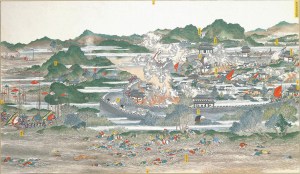
I’ve been reading a lot about China lately.  Political scientists have been interested in its economic growth for some time and it has rivaled the GDP of the United States in such a way that it’s an open question as to which is the larger.  With so many things to keep track of in daily life, I’m loathe to add poli sci to the list, but I’ve always found history fascinating.  China has long been the target of Christian missionaries.  Finding a culture that had developed quite differently, in some sense socially distant, they were anxious to make them in their own image.  China had its own religious heritage of folk traditions, Confucian beliefs, and Taoism (as well as Buddhism and Islam), and Christianity’s claim of being the only true religion caused considerable social turmoil.  One such event was the Taiping Rebellion in the nineteenth century.

Image credit: Wu Youru, via Wikimedia Commons

A complaint of evangelical pastors, even in the United States, after Billy Graham had come through town was that local people, all riled up on revivalism, had unrealistic expectations for what their local churches could do.  Viewing this from a different angle, the issue was that one outlook on Scripture could lead to consequences that others didn’t understand.  The same thing applies to Taiping.  Hong Xiuquan, the leader of the Taiping Rebellion, had read his Bible (the activity encouraged by missionaries) and became convinced he was the brother of Jesus Christ.  He set about trying to establish what is called the Heavenly Kingdom.  This clashed with the government of China during the Qing Dynasty.  Eventually foreign powers even got involved.  The end result was between ten and thirty million deaths.  That’s right, ten to thirty million.

Religious ideas are powerful.  This is one reason that repressive governments often try to outlaw religions.  Other governments (including some not too far from here) use religions for political ends.  True believers are great followers.  I first learned about the Taiping Rebellion only relatively recently.  I’ve been reading snippets about China for several years now.  Its economic power may well be greater than that of the country in which I grew up.  Perspectives are shifting.  Vast numbers of people die because of religious conflicts.  If you’re one of them the real tragedy is that, in Stalinistic terms, you become simply a statistic.  There’s a reason authoritarian governments try to keep the opium from the hands of the people.  I’m no political scientist, but history reveals much about religion and its discontents.


WHO Cares?

During this time of crisis my employer has suggested keeping an eye on the World Health Organization website.  I’ve been doing that with a nearly religious fervor.  I’ve been looking over the daily situation reports.  These not only contain advice not poisoned by government agendas, but also list the new outbreaks and provide pages of statistics.  The numbers differ from many news sources, but WHO tracks new cases, the number of deaths, and the vectors of transmission.  I’m trying to make a learning exercise out of this, instead of just further cause for panic.  More secretive world states, WHO warns, are preventing containment by under-reporting.  You’d think that in a time of global crisis that even autocracies would want to cooperate.  You’d think wrong.  

Photo credit: National Institute of Allergy and Infectious Diseases (NIAID), National Institutes of Health (NIH), via Wikimedia Commons

WHO has indicated that some nations (the usual suspects) are keeping numbers down not through effective measures, but through not reporting them.  Since honest reporting helps to trace, track, and understand transmission, such nations are essentially holding out hope that they’ll somehow bend this crisis to their advantage and appear stronger than they actually are.  I’m guessing these nations are male. 

Interestingly, the names of the countries on the overall list don’t always match those I’ve learned in my own study of geography.  The Vatican, for example, is listed as “Holy See.”  I know that’s its name, but it seems kind of odd against Lichtenstein, Peru, and Mozambique.  The Holy See, last time I noticed, had 6 cases.  The number gave me pause.  With a population of just over 600, Vatican City does seem to be a male nation.  It’s a country of clerics. 

Those in ministry toe a difficult line during a pandemic.  Governments are telling people to isolate themselves to halt the spread of disease, and yet clergy, like medical professionals, often have to put themselves in harm’s way.  I think of how Pope Francis had laid hands on the sick, even when it must’ve been difficult to do so.  Local churches have, for the most part, shut down.  Clergy are self-isolating, social distancing.  It is the socially responsible thing to do.  How it fits within an ecclesiastical view of life, however, must be quite a balancing act.  I often think of how I’d be acting if I were a minister.  Would I go to the home of someone suffering in isolation, or would I be afraid of infecting my own family?  Would I be a nation reaching out to the rest of the world with largess, or would I be a holy see cut off from the people?  I don’t have an answer.  I wonder if anyone does.


Prophets and Exiles

One of the scariest passages in the Bible is Ezekiel 33.7-9.  I first read this before I was a teenager and it scared me deeply.  In case you don’t feel like clicking over to BibleGateway and searching, the pericope is a section where Yahweh is warning Ezekiel about the dangers of giving up hope (in the larger context).  Ezekiel, you see, had lived through the fall of Jerusalem.  Many people of Judah felt that the destruction of the temple was the end of the relationship between Yahweh and the chosen people.  Ezekiel here is being warned to deliver good news.  If Ezekiel doesn’t call out the lie (the sins of Israel weigh it down) he will be punished as if he were the sinner himself.  I knew evangelical friends in college who lifted that verse out of context and said God would punish them if they didn’t warn the people.  They weren’t so worried about the fall of Jerusalem—that was old news by the 1980s—but about some other issue they deemed important at the moment.

Taking verses out of context has a name.  It’s called “prooftexting.”  It can be done to just about any piece of writing, including this blog post.  All it requires is finding a passage that says what you want it to and claim that it means what you say it does.  The Bible’s a big, big book.  Trying to understand its contents in context takes years of dedicated work.  Even then biblical scholars don’t have all the answers because if they did we could all stay home and surf the net for the rest of our lives.  No, engaging with sacred texts is a never-ending task, by definition.  That warning to Ezekiel was for Ezekiel.  What was that message?  Stop saying the exile is the end!  There’s more to the story.  Read the book to the end and see.

The problem with prooftexting, if I might engage in a bit of it myself, is that it takes away from the totality of the Good Book itself.  Not adding too or taking away from the Bible is a biblical command (taken out of context), which means that with the Bible it’s all or nothing at all.  And if it’s the former, it means Ezekiel’s condemnation is contingent upon what follows.  Back in biblical times there wasn’t as much reading material as there is today.  It turns out, however, that there’s a lot more written down than we used to assume.  If we’re going to read it we should do so within its context.  But just in case, please be assured that the exile isn’t the end of the story.


Silent Sundays

Since walks in the outdoors are a good thing, according to government guidelines, my family has been taking them.  Actually, we tend to take walks anyway since sitting before a screen all day is anything but natural.  One fact we’ve noticed on our perambulations through town is that many churches, as a standard of caution, aren’t holding their usual meetings.  The governor here in Pennsylvania hasn’t ordered churches closed—the fine line between church and state is easily violated—but many of the civic-minded religious are able to draw their own conclusions.  The church I attend has gone to virtual services.  In any case, I’m seeing news stories of clergy, particularly on the far-right end of the spectrum, insisting that the show must go on.  Ignoring government guidelines, they try to cram in as many people as they can until the police come along to limit the size of gatherings.

Throughout history religion has generally been in league with local governments.  We don’t know all the religions that have ever existed, but it is clear that some of the first counter-cultural believers were early Christians.  They defied government orders and sometimes died for it.  Today it’s more likely to end up in a stern rebuke or simply being sent home where the rest of us are sheltering in place.  I read this week about a church that’s encouraging cardboard cutouts of congregants so they can see themselves sitting in the pews during virtual Sunday morning services.  At times like this I think back over the history of religions and reflect on how the COVID-19 situation is one entirely new; we’ve never had a pandemic with the internet before.  And pastors can announce online that defying the government is on the docket for Sunday morning.

We weren’t the only ones with the idea of visiting Columcille yesterday.  An outdoor megalith park, Columcille is a place for spiritual reflection.  Since the vernal equinox passed virtually unnoticed this year, it was rejuvenating to take a springtime walk in the park.  Yes, others were there, widely spaced, but we walked the trails and visited the standing stones as a family group, keeping away from other gatherings.  We spent some time watching the new life emerging from the forest floor.  It’s only March but spring has sent its signals to the plant world and green shoots are reaching for the sun before trees leaf out and block the light.  It’s a wonder and a source of awe.  And in its own way, it’s a kind of gathering we might call church.


Finding Fakes

The Museum of the Bible has been a source of controversy since well before it even opened.  Many people don’t understand what biblical scholars actually do, and this leads to misunderstandings and not infrequent accusations.  Turning no basic critical thinking skills toward a museum intended to champion certain social causes (claimed to be “biblical”), those who support it can’t understand why a “biblical” scholar would object.  What do biblical scholars do all day, anyway?  We’ll come back to that in a moment.  The reason I’m writing about the Museum of the Bible in the middle of a pandemic is an article on National Geographic’s website, “‘Dead Sea Scrolls’ at the Museum of the Bible are all forgeries,” by Michael Greshko.  The Dead Sea Scrolls have captured the public imagination for decades now.  Having seen the collection at the Shrine of the Book in Jerusalem, I know it can be an awe-inducing experience.  One thing biblical scholars do is ask questions.

Artifacts are becoming increasingly easy to fake.  Some biblical scholars were fooled by these fake Dead Sea Scroll fragments.  Now, my own specialization was Ugaritic.  Ugaritic is a cuneiform language with clay tablets as the substrate.  One of the things that you learn from looking at a specialized body of material closely and for a long time is how they were written.  Some of the Ugaritic tablets have writing along the edges, like marginal scrawls.  Some are written with large characters in a clumsy hand, while others are clearly done by a professional.  With some practice you can learn to recognize handwriting even in cuneiform.  The Dead Sea Scrolls, mostly written on vellum or leather, are similar: specialists know just how they were written and close examination can reveal if they were made in antiquity or simply made to look antique.

Biblical scholars often get accused of taking the life out of things.  Would it be better to believe in something that is exposed as a fake?  Not exactly debunkers, scholars are those who ask pointed questions of unstated assumptions.  If some antiquities dealer claims to have access to material kept out of official hands, and is willing to charge you a lot for it, it’s best to call in the skeptics.  It works the same in most fields that keep our society going.  We need to trust those who’ve studied a subject in depth for many years.  Devoted their lives to it, in fact.  Many museum items around the world are forgeries and fakes.  It’s not too often, though, that someone specializing in really old stuff gets called in to make an evaluation.  There’s a risk involved—the risk of learning the truth.


Virtual Church

All the way back in seminary my friends and I used to joke about virtual church.  What made it so funny was that the idea seemed ridiculous.  The very raison d’être for church (which essentially means “gathering”) was, well, gathering.  We joshed about putting a communion card into an ATM and getting bread and wine.  Little did we know we’d live to see virtual church become a reality.  While I prefer not to tip my hand as to my affiliation (I began doing this when teaching at secular schools, for if a professor of religion is being academic about their specialization their affiliation should have no bearing on the class) I confess I am the member of a religious community.  That community has become virtual, as of today.

This isn’t a permanent thing.  Unless coronavirus is a permanent thing.  As I spoke with my clergy person about it, I wondered how many people would attend virtual services.  Sermons would need to be stellar.  Who would hear if I tried to sing hymns (this is not a pretty thing, take my word for it)?  My laptop doesn’t even have a disc slot into which I could insert my offering.  Churches, synagogues, mosques—they’re about community.  What does community feel like when you’re sitting there in your pajamas, at least on the part that the webcam doesn’t pick up?  Does the minister see you in virtual church?  Have I, like number 6, been reduced to a numeral?  I suspect the current crisis is going to be a real test for faith communities.  Meeting together would make us all feel like snake-handlers now.

The funny thing was, back in seminary it was a joke.  At Boston University School of Theology in the late 1980s we knew that churches weren’t really growing.  Some megas had started and we now see them following the mushroom cloud to its dissipation stage.  As little as we meant it, we could see devices creeping into the mix.  I did not use a computer until after seminary.  Funnily enough, thinking back to the pre-1990s, we survived without cell phones.  If you were going to church you were going. To. Church.  These days of pandemic in the pews will be a real test of the preacher’s power.  For Episcopalians the mediating of grace had to be done in person.  I remember watching worriedly as the priest, clearly with a sniffle, was the first one to take a sip from the community chalice before holding it out for others to drink.  We wondered about efficacy of ATMs dispensing consecrated hosts.  It was only a joke, then; really it was.


CBD

They found me.  I used to call them CBD, but because of the popularity of a certain hemp-based product, Christian Book Distributors changed its name.  Now I knew about them long before they had me on their mailing list when I taught at Nashotah House.  When I was a seminary student in Boston I made occasional trips to CBD’s Peabody warehouse for sales—this was quite a boon to students who never have enough money (little did I know!).  Books you’d heard about in class were there, for a fraction of the price.  At Nashotah I always looked over their bargain page, because, well, professors like books.  I recognized their catalogue in my mailbox instantly.  The name is now Christianbooks.com.  Grab some munchies and sit down.

Not only the name has changed.  Back in my student days I could find academic resources here.  As religion in America has become more and more polarized, what used to be CBD (if I use their current incarnation my computer insists on putting links in) has become radically conservative.  Page after page of study Bibles reveal no hint of the mainstream bestsellers in the genre.  It’s as if they don’t exist.  More than that, if you leave them out maybe people will come to believe they don’t exist.  Even the bargain books are nothing an erstwhile professor would buy.  Instead of academic titles there are all kinds of Barnes & Noble-type gimmicks to get shoppers to spend their money.  Like junk food for the soul.  I look at the books on my shelf.  Some of them were purchased, cash in hand on the ground in Peabody.  Not any more.

There will be those who claim (fake news is the only news now) that what has changed is me, not them.  The fact is places like CBD used to be more open minded.  They admitted the possibility of doubt.  Now your choices are Scofield or Ryrie.  That should be enough for any appetite.  Not only that, but many of the titles now sound militaristic.  Battlefields and all.  Thumbing through, I wonder where Jesus has gone.  The evangelicalism of my youth was clearly Prince of Peace centered.  Now it’s politicized to the point that I’m not sure what it represents beyond GOP values of greed, opportunism, and power.  Anyone who thinks differently need not apply.  How CBD found me after all these years, I do not know.  I wish they’d consider saving the environment rather than printing catalogues to send me.  The climate, despite what they would claim, has changed.


In the Cult

The word “cult” has fallen out of favor with religionists.  The reason for this is the problematic claim that any one religion makes to being the “only true” religion.  If that religion then sets about to study other religions there is a built-in bias that the study is being done from the perspective of those who know the truth looking somewhat bemusedly toward other religions.  A cult was defined as a relatively new religion with a fairly small number of adherents.  The more correct term is a “New Religious Movement.”  The idea of brainwashing is controversial, but it is clear that people can be made to follow the leader against their better judgment.  We’ve seen this time and time again and not just in places like Jonestown or Waco.  The word “cult” seems to fit.

Branch Davidian compound in Waco; photo credit: FBI, courtesy Wikimedia Commons

A friend recently pointed me to the work of the psychologist Jeremy E. Sherman.  Sherman has been studying the behavior of Trump followers and has illustrated quite well how it is a cult.  This is one place where the use of the term becomes essential.  I’ll lay aside my objections to the word to point out that a cult denotes a group that follows a leader without critical assessment of that leader.  You’ll have noticed that Democrats are quite critical of one another.  They think about and assess what each other say and do.  When someone like Trump, who is well known as a Pez-dispenser of lies, becomes a saintly paragon of his party, capable of no wrong, we’re in the land of cults.  What Sherman does that I can’t, is suggest how to deal with such thinking.

Most of us try to reason with our interlocutors.  If reason is turned off, as in blind following, it simply falls on deaf ears.  The public record of Trump’s doings speaks for itself.  Those who refuse to see it or engage it will never be reasoned out of it.  The parallels with Hitler’s Germany are extremely frightening.  Not even a decade after his death Hitler was understood to have been clearly unstable and driven by evil impulses.  Many of those alive today overlapped with the lifetime of this dictator.  There’s no doubt that Nazism behaved like a classic cult.  Presented with credible evidence of breaking the law while within office, Trump’s followers blithely acquitted him.  Those who study cults would expect no less.  We need to arm ourselves with knowledge of how religious thinking works.  To do otherwise is dangerous, despite what our economically driven bastions of higher education may say.  (See?  I’m critical of those on my side!)  Or we can lay down reason and simply follow.


Symmetry Synergy

Symmetry.  It’s pleasing to the eye.  And significant dates are often the basis for holidays.  Today is one of those extremely rare palindrome days.  As my wife pointed out to me 02-02-2020 is a configuration that hasn’t occurred since 01-01-1010, or over a millennium ago.  The next one will be after we’re all long gone, on 03-03-3030.  Not only that, but today is part of a holiday cluster.  It’s Groundhog Day.  Yesterday was Imbolc, the Celtic cross-quarter day initiating spring.  Imbolc is also known as St. Brigid’s Day.  Today is called Candlemas, by liturgical Christian tradition.  We are living through a truly unique day.  Every day, I suppose, is unique, but the spirits are afoot today.

I’ve written about Groundhog Day before.  With its prognosticating rodent, it tells us if spring is on the way or if it’s going to be delayed.  Imbolc falls about halfway between the winter solstice and the vernal equinox.  In Celtic cultures this was a cross-quarter day, a time of uncanniness.  Spirits cross between worlds on days such as this.  In days of yore, it was also the feast of the goddess Brigid.  Christianity has always been an opportunistic religion.  When missionaries to places like Scotland and Ireland couldn’t convince the locals to give up their deities, they made saints of them.  St. Brigid is a fabrication of a Celtic goddess, not an actual saint.  For similar reasons in the quarter-year counterpart to Imbolic, Samhain, the church moved All Saints Day to November 1 and All Souls to November 2.  The Celts continued using the trappings of their cross-quarter day and eventually gave us Halloween.  Imbolc never caught on in quite the same way.

The early Christians didn’t know when Jesus was born.  Christmas was established on December 25 because of all of the solstice celebrations at that time of year.  All that pagan jubilation had to be subsumed under a more solemn occasion.  Building on that mythical date, New Year’s Day was January 1 because that’s when Jesus would have been circumcised, eight days later.  Thirty-three days after a male child’s circumcision, a woman was to make an offering for purification in the temple.  According to Luke, Mary did this, and 33 days after January 1, in keeping with our fictional date-keeping, is February 2.  A tradition grew that Christians would bring their candles to church to be blessed that day (Jesus being the light of the world).  This blessing of candles was named Candlemas.  I first encountered it at Nashotah House, where it was still celebrated even as a sleepy woodchuck in Punxsutawney was rubbing his eyes.  Not exactly a palindrome, but there’s a remarkable symmetry to it, no?