Looking Back

Image credit: David Hunter McAlpin Fund, 1944, via Wikimedia Commons

Like many I’m shocked and saddened by the fire at Notre Dame cathedral.  At the same time a recurring theme of this blog has been that modern people are disinclined to pay for the past, and some analysts are saying that lack of funds for regular upkeep of the cathedral over many years are at least partially behind the tragedy.  Monuments that have stood for centuries require constant care, but it’s so easy to take them for granted.  Cathedrals aren’t just religious buildings.  They are humanistic in the sense that they stand for our natural tendency to create great markers of our time on earth.  So very human.  Many human acts we wish to erase, but some represent a loss to the very soul of our species when they’re gone.

Even in this secular age the great cathedrals of Europe are on the agenda of many a traveller.  My own recollections of Notre Dame have grown hazy with the years—I do recall the stolid towers and flying buttresses.  Even the doubtless inauthentic but still ancient crown of thorns.  The famously secular French stood in the streets and sang hymns as the fire raged. 

My single trip to Paris was followed by a stop in Germany where we saw towers of cathedrals left standing even when the remainders of the buildings were gone—bombed out during World War Two.  Asking a friend about it we learned that the Germans felt these skeletal churches were appropriate reminders of the horrors of war.  No masses could be said in them ever again, but they stood, in their ruined majesty, as their own kind of monument to human folly.

We live in a post-cathedral world.  Symbols of the unity of a nation, demanding resources beyond what could really be afforded, cathedrals served to unite.  Citizens of London, it is reported, shoved bombs off St. Paul’s Cathedral during the Blitz.  Religion today has been turned into a means of dividing and conquering people.  It builds border walls rather than cathedrals where those of any faith might be allowed in and invited to wonder.  Images of that famous spire helplessly falling amid the flames suggest the shock of the twin towers collapsing.  Although the structure survives, much has been lost forever.  And if people react like they are wont to do, there will be outpouring of resources to rebuild and restore, but only for a while.  We tend to think that looking at the past is frivolous.  Yet, my photos of Notre Dame remind me that a life spent looking back may well be the only kind worth living.


Label Maker

Did you ever have one of those label makers?  The kind with a rotating wheel that embossed a plastic ribbon with letters that you could stick to things?  Labeling is so easy!  I often feel constrained, however, by the chosen labels of extremist groups.  Not all evangelicals are power-hungry or enemies of human welfare.  This is perhaps one of the keys to the success of extremists.  Camouflage has long been recognized by evolution as a most effective tactic.  I have many evangelical friends who do not protest cartoons, or ride around in Trump-laden vehicles, polluting the environment like there’s no tomorrow.  The problem is what to call them since the more radical wing has usurped their nomenclature.  I often think of this because I eschew labels in general, but people in a collective can do quite a bit more damage than a single disgruntled individual.  Perhaps “disgruntled” should be part of their name?

Religions generally begin as efforts to help make the world a better place.  The historian of religions sees, however, that over time many believers begin seeing the peripherals as the central tenets of the faith.  Since I’m familiar with evangelicalism, let me use that as an example.  As a form of Christianity, evangelicalism began with the Reformation.  Pietist groups, freed from Catholicism’s idea of communal salvation, began to worry about their individual souls and how  they might be saved.  Their belief structure eventually came to include the necessity of converting others because, if you read the Bible a certain way, that’s a requirement.  Over time this outlook  evolved into the idea that only one group (one’s own) has truly understood the Christian message.  Once numbers grow numerous, it becomes like the medieval Catholic Church—large enough to take political power.  Somewhere along the line the central message of helping make the world a better place morphs into making the world evangelical only.  Or whatever label we feel constrained to use.

labels are problematic

I’m not picking on the evangelicals here—this could apply to any extremists.  And it certainly doesn’t apply to all evangelicals.  Religion has been part of human culture from the very beginning.  A good case can be made that it is one of the basic components of consciousness itself.  A person has to learn how to become unreligious.  We are also political animals.  Who doesn’t want things their own way?  We can’t all win, however, and some religions have difficulty separating, say, a savior willing to die for others and the insistence on one’s own way no matter what others want.  Like most aspects of life this is a balancing act.  I grew up evangelical.  I have friends who are evangelical.  I don’t want to insult anybody, but what can you do when you feel disgruntled by the degradation of religion into an excuse for hate?  I lost my label maker long ago and I no longer know what to call things anyway.


If Onlyists

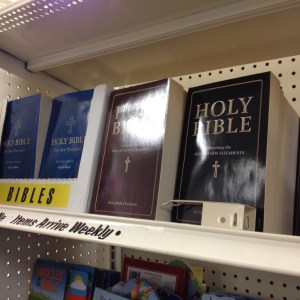
A special brand of Fundamentalism called King James Onlyism is a particularly odd variety of faith simply because of its required backing and filling.  In brief, this particular evangelical position claims that the only inspired translation of the Bible is the King James Version.  It’s best not to look too closely at the KJV, however, or the problems start.  Primary among them is that the version most Onlyists cite is not the original King James.  Published in 1611, this translation is immediately evident by its use of “I” for “J” and for the long s (the one that looks like an f).  Perhaps more troubling for Onlyists, it also includes the Apocrypha.  There was still some debate at the time concerning the status of these deuterocanonical books, and they were part of the actual KJV.

The typical King James used by Onlyists is a revised KJV.  In England, where the translation was done, revisions were made from time to time, leading to an Oxford version (Blayney text of 1769) and a Cambridge version (Scrivener text of 1873).  On these shores further adjustments were made leading to the rather strange situation where there is no single King James Version of the Bible.  There are many King James Versions.  Attempts to control Scripture often end up like that.  The underlying problem is the belief that there is a single version of Holy Writ.  Inerrantists are pledging their faith to something that doesn’t exist.  Defending this approach many would claim that the revisions are minor, but small changes can make huge differences.

The belief in one single version relies on the belief that God inspired not only the original writers, but the translators as well.  It denies that the better manuscripts that have come to light since the early seventeenth century (including the Dead Sea Scrolls) contain any authentic information of what the Good Book says.  Textual criticism, in the absence of any original manuscripts, is the best way we have of discovering what the original likely said.  Onlyists argue that the manuscripts from which King James’ translators worked were the divinely selected ones and their work was inspired—a position against which no empirical proof can be offered.  This faith trades in certainties that only bringing in direct heavenly control can achieve.  And it means that Catholics are wrong, despite King James’ inspired error to include the Apocrypha.  That’s the thing about a trump card like inspiration—once it’s played there’s no way to overcome it.


What’s Wrong with Heroes?

There can be no doubt that under Trump conservative Christians have been flexing their muscles.  Few things corrupt so readily as political power, and evangelicalism—already an unrealistic way of looking at things—is itching to throw punches.  A story on For Reading Addicts that my wife sent to me bear the title “DC Comics cancel latest comic after backlash from conservative Christians.”  The piece by Rowan Jones notes that Second Coming was cancelled due to pressure from evangelicals with the cultural sensitivity of the Kouachi treatment of Charlie Hebdo.  Cartoons, it seems, are a real threat to true believers in a way that reason is not.  Jones notes that the comic was actually largely supportive of Christian values, but like an evangelical Brexit the reaction was taken without understanding the issue.

The anger of conservative religions—it hardly matters whether they are Christian, Muslim, or Aum Shinrikyo—often plays itself out in displays of violence.  I wonder if part of this insecurity comes from the fact that the expectations of their faith don’t work out they way they’ve been led to believe they will.  The myth of the blessed existence of the true believer is given the lie by life in a secular world.  While the evangelicals support Trump, 45’s tax plan takes money from their pockets and hand it to the ultra-wealthy.  This raises no objections, but a cartoon showing Jesus helping the poor?—now that’s offensive!  And still no second coming takes place.  It’s difficult to retain a fantasy view in the face of cold reality.

Who doesn’t like a hero?

Religious beliefs are a deeply personal matter.  It is a dicey business to try to get someone to change their outlook when they’ve been convinced that the consequences are eternal.  Although vaguely aware of other religions all along, Christianity in the “new world” was taken quite by storm at the 1893 World’s Parliament of Religions in Chicago.  Suddenly it was clear that other moral, decent religions had developed similar ethics to what had largely been supposed to have been Christian innovations.  It’s difficult to feel superior when others in the same room seem just as intent on improving the lot of humankind as you do.  Even when a particular religion holds all the political power of a nation it’s overly sensitive to cartoons.  This is a curious situation indeed.  I’m not a comic book reader—I don’t even have time for internet articles unless someone sends them to me with the suggestion that they’re worth my time.  And I, for one, think a little more humor might just make the world a better place.  Either that or we need a hero.


Which Shaman?

It’s a strange kind of vindication when you see someone argue your ideas independently.  Even if they understand those ideas in a different way.  I suppose it’s necessary to say that in academia those who have university posts are assumed to be more authoritative than those of us who don’t. That’s not sour grapes, it’s simply a fact.  Some years ago, after having first seen Christopher Nolan’s The Dark Knight, I wrote a post on this blog suggesting that the Joker functioned as a shaman in that movie.  Being a blog by a non-university academic, the post had a few readers, but it is not peer-reviewed and therefore, officially just a matter of opinion.  I have studied religion professionally for decades now, however, and I would still stand by my assessment.

Recently I came across an article that argued Batman was a shamanic figure in that same movie.  It was affirming that another academic had come to a similar conclusion, however, we differ in our interpretation of who bears shamanistic characteristics.  It doesn’t help, I suspect, that shamanism isn’t well understood, and even the name is a bit of a misnomer.  We don’t really have a word for non-major religious practitioners of indigenous populations who may have little in common, so we call them shamans.  Their religious systems are too specific—“granular” is the favored business word these days—to categorize them easily.  And the reason for this is that we think of religions in the light of the large, organized conglomerations that arose in western Asia a couple millennia ago.  It’s difficult to make room for smaller exemplars.

Something larger religions have done is distorted the idea of religion as a local phenomenon.  Communities used to reflect the religious experience those who lived in them knew.  Catholicism divided the world into parishes and even tolerated some differences between them.  Protestantism gave Europeans (and their New World descendants) a set of choices, and towns in America often sport many steeples not because religion draws a community together but rather because it generally tears it apart.  Hierarchical religions are about as opposite of shamanism as Batman is different from the Joker.  They may have similar ends in mind, but their methods are quite different.  The shaman is a figure that leads to spiritual wholeness for the community.  Their methods seem questionable to larger, highly structured religions.  And the unaffiliated trickster may accomplish more than an establishment figure in a local setting.


Eastern Canon

It’s complicated.  The Bible, that is.  Tracing its origins as a book can easily occupy a lifetime, but the issue that keeps coming up with Scripture is how, definitively, to close the canon.  If we should.  My research on demons lately has led me once again to the books of Jubilees and 1 Enoch.  The latter has long been popular with the paranormal crowd because it has some weird stuff in it.  Thing is, as I mentioned back in November, these two books are part of the biblical canon of the Ethiopian Orthodox Tewahedo Church.  And the Eritrean Orthodox Tewahedo Church.  That makes these two books by definition “biblical.”  You won’t find them in nearly any printed Bible in the western world, although you can locate them in collections of the Apocrypha and Pseudepigrapha.

This privileging of the western canon has implications.  How do we know what really belongs in the Bible?  Judaism never officially closed its canon, but by consensus the same books contained in the Protestant Hebrew Bible (aka Old Testament) are those recognized.  Early Christian writers had different Bibles.  It took almost four centuries for them to agree  generally on what should be included.  In Europe, that is.  Not all branches of the church were represented in the Council of Rome.  Instead of waiting for the consensus of all—there was an urgency to stomping out heresy—the decision was made.  For some.  Meanwhile other Christian groups continued to use certain books that “the official” closing of the canon left out in the rain.  Or the desert.  Whichever.

The question of just what’s in the Bible goes a bit deeper than that.  The Tewahedo Churches of eastern Africa also recognize the books of 1 and 2 Maccabees.  “So?” did I hear you say, “Catholics recognize them too—what’s the big deal?”  These books, however, in the Ethiopian and Eritrean canons are not the same as western 1 and 2 Maccabees.  The books of the Mäqabeyan contain different content while maintaining the same basic name.  This means that we’re gonna need a bigger canon.  What’s more, these books have been pretty much ignored by biblical scholars.  One of the reasons, no doubt, is that they are written in Geez, a language not on the menu of too many seminaries.  Simply to dismiss them, however, is to ignore the belief system of over 50 million Christians.  It seems that the version of the Good Book tucked under the arm of many an evangelist is the condensed version.  Putting together a canon, it appears, is more complicated than it looks.

Not that kind of cannon! (Photo credit: Walther Hermann Ryff, via Wikimedia Commons)


Mission Impossible

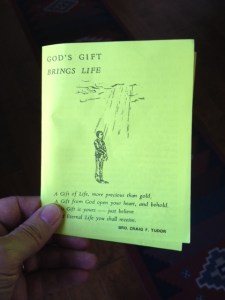
You can always tell Jehovah’s Witnesses by their tracts.  When I heard a tap, tap, tap on my front door the other day I was handed a flier and a cheery invitation to an important celebration (Easter).  The circumlocution used for the holiday made we wonder so I flipped over the tract and saw the familiar JW on the bottom.  I always treat religion at my door with respect because, well, you never know.  It’s this latter bit—the uncertainty—that has always given me pause when it comes to missionaries, domestic or imported.  Missionaries by definition believe their particular spin on religion is the only correct one, otherwise there’s no reason to convert others.  This is often the highest hurdle over which globalism must leap—the willingness to admit one might be wrong.

I could be wrong about this, but I have always considered the willingness to admit you might be incorrect as a sign of spiritual maturity.  I also know from my youth that that kind of uncertainty can drive you crazy.  We want to know we’re right!  But then, who doesn’t?  Those of us who think globalization is a good thing have failed to take into account just how difficult it is for many people to admit possible error.  For the vast, vast majority of human history we were separated from one another by natural boundaries.  Travel for leisure did not exist.  Within a local group beliefs would likely be fairly uniform.  Then you encounter others who might say, well, you’re wrong.  That’s seldom a welcome prospect.

More than air travel, the internet has shown us, as we connect, just how diverse a species we really are.  What about that missionary at my door?  For religions indoctrinated into one doctrine this can’t be easy.  I’ve had conversations with Jehovah’s Witnesses before.  There’s no convincing them they might be wrong.  Missionaries come with the assurance they’re saving you.  Rare is the proselytizer who’s there possibly to learn the truth.  As I think about it, after decades of attending church how many times has anyone wanted to have an in-depth conversation about belief?  Outside confirmation class, that is.  And even there, when most are either teenagers or older specialists in some secular business, discussing deep issues seems to make others uncomfortable.  When the missionaries come, I want the conversation to go both ways.  I’ve spent half a century thinking about these things, after all.  When there’s a tap, tap, tapping at my door, I wonder what tracks will be left behind.


Chapter and Verse

Maybe like me you’ve read some arguments based on chapter and verse.  I should mention that I mean chapter and verse in the Bible.  The typical scenario will go like this: Genesis (say) uses this word three times in chapter 38.  The case then often slips to making a point on the number of instances a word or phrase occurs within a circumscribed set of verses.  (The actual word doesn’t matter—this is a thought experiment.)  When I ran into an example of this a few days ago a thought occurred to me: chapters and verses are later additions to the biblical text.  They were never part of the original and were only added because Bible readers got tired of saying “That part in Genesis where…”  In other words, chapter and verse are artificial means of interpreting the Bible.  They’re very useful for taking quotes out of context.

I used to tell my students that you have to think carefully about what is the Bible and what isn’t.  As a culture where the book has instant recognition, we tend to think of that discrete unit of pages and cover as coming from one person—the author.  In reality most books (I can’t speak for the self-published) are the work of several people.  Just like it takes a community to raise a child, it also takes one to assemble a book.  That includes the Good Book.  Not everything between the covers is sacred text.  I’m pretty sure about that since as I was glancing through the latest edition of the New Oxford Annotated Bible I found my own name in the Preface.  As much as I’d like to claim otherwise I’m not exactly biblical. 

Modern ways of looking at ancient texts require a degree of facility in understanding how God’s scribes of yesteryear went about their work.  While early experiments in binding books may go back close to the time when the latter parts of the Bible were being written, the scroll—without chapter and verse—contained only the words of the text.  Most ancient manuscripts in Greek, anyway, didn’t even bother to put spaces between the words.  That leaves some room for ambiguity in among all those letters.  The Bible is a complex book with a complex history.  We do it a disservice as modern readers treating it as a modern book.  If you read Scripture online, or via electronic media, an even further layer of interpretation has been added.  That’s why we still need Bible scholars tangled somewhere in this world-wide web.


Spoken Against

“Antilegomena” is a word that appears more often in New Testament studies than it does in those of the Hebrew Bible.  Still, it’s an important part of the discussion of “the Bible,” especially since Heaven stands at the end.  Antilegomena is the Greek word for “disputed texts.”  You see, when the Bible was being compiled, there were many books from which to choose.  The twenty-seven books generally recognized as the New Testament included several that were disputed.  The Antilegomena included these books: the Gospel of the Hebrews, the Apocalypse of Peter, the Acts of Paul, the Shepherd of Hermas, the Epistle of Barnabas, and the Didache, all fine and good.  But the list continues: James, Jude, Hebrews, 2 and 3 John, and Revelation.  This final half-dozen made the cut, although Revelation is still disputed in some quarters.  All of these books were, however, in some early Christians’ Bibles.  The exact date that the New Testament canon was fixed isn’t certain, but it wasn’t widely recognized until the fourth century C.E., that is, over 300 years after Jesus.

The first time I learned about canonization in college I was shocked.  Like most people raised on the Bible, I believed that it had come, fully written, from the hand of God.  Maybe there was even an autographed copy somewhere.  Grove City College, at the time, disputed the Documentary Hypothesis of J, E, D, and P, but to the credit of the religion department they did tell us about it.  Moses, of course, we were taught, did the actual writing.  But then there was the problem of the New Testament.  There were other gospels, some as old as those that made it into the Bible.  The realization dawned that “the Bible” was much more complicated than I had been led to believe.  And what was up with the Apocrypha?

One of my professors said that the problem with inerrancy is that it proposed a Bible more perfect than God.  I’m not sure that I follow the logic there, but I take his point (they were all “he”s, whoever he was).  The Bible may not be a perfect book  There are parts missing and repeated bits.  It is nevertheless one of many sacred books from around the world, and it is the holy book of much of Christianity.  From the very beginning some of the contents were disputed.  Even as an undergraduate I had some inklings that a journey that involved taking the Bible seriously was going to lead to some strange places.  That single book that had always been presented to me with a definite article—“the” Bible—was actually a book that the earliest followers of Jesus didn’t know.  And they seem to have got along fine, as far as getting to Heaven goes.


Quoth Hardy

There are days when the quote from an author is the best thing to happen to me.  You probably know those kinds of days—days when there’s nothing really to stay up for so you go to bed early.  Lengthy days when your Muse wins easily any game of hide-and-seek.  You see, I save most of my fiction reading for bedtime.  If I turn in soon enough I can read quite a bit before falling asleep.  Not to sell you a false bill of goods, but that’s not the source of the quote.  It actually came to me from an unrelated email about the Bible.  The quote, while lengthy, comes from Thomas Hardy:

By the will of God some men are born poetical. Of these some make themselves practical poets, other are made poets by lapse of time who were hardly recognized as such. Particularly has this been the case with the translators of the Bible. They translated into the language of their age; then the years began to corrupt that language as spoken, and to add grey lichen to the translation; until the moderns who use the corrupted tongue marvel at the poetry of the old words. When new they were not more than half so poetical. So that Coverdale, Tyndale, and the rest of them are as ghosts what they never were in the flesh.

This comes from a letter to Professor D. A. Robertson of the University of Chicago, dated to February 1918.  Hardy was a known critic of religion, but like most writers of his day he knew the Bible.  Now, I’d never generally put myself on the same page with Hardy, but something similar to this thought had occurred to me long before I saw this quote.  We treasure ancient writing simply because it has survived.  This should be a sobering thought to any of us who try to forge our thoughts into words.  We have no way of knowing if, at the time, an author was considered great.  Merely the passage of time can make writing unfashionable in its age appear brilliant.  Like rocks tumbling over each other at the base of a cataract, they find polish over time.

My particular context for receiving this emailed quote was the King James Version of the Bible.  Often considered sacred in that translation, it was not uniformly well received when first published.  There had been English Bibles before, and since the Good Book is the foundation of western literature, a new translation commanded attention.  It had its critics, but over the centuries the translation itself became holy, whether it deserved it or not.  Similarly, Martin Luther’s translation of the Bible helped to codify the German language.  We shouldn’t be too quick to dismiss Scripture, not for its theology, but for its immense influence on western thought.  As Hardy noted, it may be the passage of time that makes writing great.  Even so we might be wise to pay attention.


A Saint Lent

Photo credit: Andreas F. Borchert, Wikicommons

Lent, among the denominations that observe it, is intended as a time of intense reflection.  Beginning on Ash Wednesday the fact of one’s own mortality becomes a foremost consideration as the faithful are reminded that they will die.  It has always struck me as paradoxical that St. Patrick’s Day always falls in Lent.  Those who abide by the liturgical calendar readily acknowledge that Lent is a punctuated season; saints’ days and feasts can still occur, temporarily disrupting the heavy contemplation.  While at Nashotah House we never celebrated St. Patrick beyond a brief mention during a collect of the seventeenth.  His day, rich in Celtic mythology, it seems, was inappropriate to the mandated gloom so highly valued by the soul-sick.  Having some Irish ancestry, I always felt a little slighted by this aloofness regarding a saint most people can actually name.

College campuses, I later learned, tend to schedule their spring breaks to include Saint Patty’s Day because of the damage drunken students may exact.  The stereotypical besotted Irish have become an excuse for excess during Lent, although, I suspect the forty days have little to do with it.  A saint becomes a justification for sin, it seems.  And Lent continues the morning after.  There’ll always be Lent.  The tray holding the ashes of last year’s palm branches is never empty.  Two once religious observations clash in mid-March of each year.  During a brief spell the historically oppressed Irish are celebrities for a day.  Such are the vicissitudes of liturgical calendar clearing.

Today many people celebrate a saint they wouldn’t otherwise recognize.  One that mythically drove the snakes from the Emerald Isle, and who perhaps hid a pot of gold at the end of the rainbow.  A holy man who has made it possible for anyone to be Irish for a day.  Leprechauns and clovers are in fashion as the ironic luck of the Irish closes down major thoroughfares for parades in the midst of ashes and dust.  Outside there may be snow or budding trees.  Perhaps both at once.  There’s a richness to these conflicting symbols that belies the commemoration of a missionary with alcohol.  The day is part of the complex of equinox holidays, whether intentional or not.  The green man of yore begins to awaken as light starts to outstrip darkness for half a year.  We’ve had enough of dusk.  Anticipate the light.  The rules state that Lent will still be here tomorrow.  But the light is beginning to grow. 


Culpability Defined

What seems to be lacking in the United States government is any realization that actions have consequences.  While in Christchurch, New Zealand at least 49 people have been murdered only for being Muslim, Trump feels that tweeting “heartfelt” condolences somehow exculpates him from fostering an atmosphere of hatred.  Indeed, the main shooter in that travesty cited Trump as an inspiration.  The sickening lack of awareness that deeds have consequences has once again led to a body count.  Meanwhile in these states the Republican Party refuses to condemn the daily and consistent message of racism coming from an edifice that is more and more appropriately called the “White House.”  Do you have to pull the trigger to be guilty?  History will decide.  

Politics has always been a crooked game, but until 2016 most elected to the highest office—God help us, even George W. Bush—realized that the office had responsibility associated with it.  It wasn’t a place you could play loose and easy and tweet from the hip and think it was your right as “just another citizen.”  Muslims have been part of American culture from very nearly the beginning of this experiment in colonialism.  Freedom of religion was one of the pillars of democracy that Trump has been chopping down like a cherry tree while tweeting “No I didn’t.”  The GOP applauds.  Here’s how to instill one religion as the norm, not considering the consequences.  Massacres in the name of Christ don’t make you Christian.  Not cutting history class should be a requirement to run for elected office.  Or at least taking basic civics.  Instead we have a government that refuses to recognize that it can inspire murderers around the globe and then offer heartfelt condolences with no apologies.

Where is the condemnation of racism?  Where is the line between black and white?  Where is the sense of any culpability for creating and sustaining the warm, moist environment where the bacteria of hatred thrives?  When you awake to the news that yet another white supremacist has taken inspiration from an angry white man who has nothing to be angry about and has consecrated murder as patriotism how can you look the world in the eye?  Hiding behind a tweet does not bring back the dead.  How do we get the message through?  Millions of us have repeatedly marched in protest.  We flipped one house of congress and we daily sign petitions until our fingers bleed but no response comes from those who won by a mere technicality.  If there are indeed ghosts in this world there will be mass immigration and it shall be richly deserved.


Stranger and Stranger

Like many fans of the X-Files and the early years of Sleepy Hollow, I’ve fallen into the Stranger Things orbit.  While I don’t have a Netflix account, I have friends who do and they got me hooked.  If you’ve watched it you’ll know why, and if you haven’t I’ll try not to give too many spoilers away.  The reason I raise it now, when we’ve gone such a long time without a new season, is that Stranger Things 2 took on shades of The Exorcist, but without any of the attendant religion.  Secular exorcists do exist, and possession is a feature of cultures with all different kinds of belief systems.  Exorcism works based on the belief system of the possessed, it seems, and if there’s no religion there’s no problem—call a secularcist!

Spoiler alert: Will is possessed by the mind flayer.  As the authorities flail around and get eaten by demidogs, his mother figures out how the exorcism has to work.  The thing about possession is that nobody really knows what demons are.  Dungeons and Dragons, which I confess I’ve never played—my life is too complicated already, thank you—gives the analogy for the possessing entity.    No matter what the demon, however, the only way to get it out is through exorcism.  Quite apart from sci-fi and fantasy, this is also the case in real life.  Part of the appeal to Stranger Things, I suspect, is that it indulges in the mysterious without the burden of religion.  While religion makes for good horror, good horror may exist without it.  Or can it?

Contrast this with Sleepy Hollow, now defunct.  Possession was a trope there as well, but the story had obvious elements of religion embedded in it.  As I point out in Holy Horror, religion often drives the fear.  That doesn’t mean it’s the only driver.  People fear being taken over by something else.  Stranger Things knows that if nobody can really figure out what that something else is, it can be scarier still.  We know it comes from the upside down.  We know it can possess people.  And we learn that it can be exorcised.  Although the setting is completely secular, there are elements of religious thinking even here.  It’s simply part of the human psyche.  We can deny it exists.  We can try to describe it only by analogy.  We can try to exorcise it.  It is there nevertheless, even as we eagerly await the advent of the third season.


Christianity sans Christ

Pieter Breughel the elder

“He that is without sin among you, let him first cast a stone at her.”  (Please pardon the sexist translation, but the King James is in the public domain.)  That verse, and many others, have been going through my head since my former United Methodist Church decided to close its doors to those who are different.  The reason this verse sticks out is pretty obvious—according to the Good Book we’re all sinners.  The “Christianity” that the UMC has embraced is that of Paul, not that of Jesus.  In fact, Jesus seems to have exited, stage left.  You see, only with a great deal of casuistry of exegetical caliber can anyone claim that Jesus (aka God) said anything about homosexuality.  Not a single word.  His response in the famous story of an adulteress (what of the adulterer who partnered in her crime?) caught in flagrante delicto, he gave our opening quote.

At one point Peter, exasperated with his master’s kindness, sputtered how many times did he have to forgive—seven times?  More like seven times seventy.  The one without sin has itchy fingers where stones are abundant.  Once at Nashotah House we had a student from Kenya.  He was already a priest, and he had a family back home.  At one point I asked him about his wife.  He informed me that his brother now had her as wife while he was gone.  It was the way of their culture.  This same student—for we are all students all the time—had harsh words for American sexual practices.  He later tried to find a way to stay in the United States, leaving family behind.  The Bible may turn a blind eye to polygamy, but polyandry is definitely stone-worthy.  Who is without sin?

Ironically the UMC has lined up against the Gospels.  Christianity’s sexual hangups began with the apostle from Tarsus, not the carpenter from Nazareth.  We have been forced to see, time and again, what comes of making priests remain celibate.  It’s against nature, and none of us has a free hand to grope for a stone.  Instead, we queue up ready to judge.  Love, the church says, is wrong.  God, says the Gospel, is love.  There’s a mansion with many rooms above our heads.  We’re not told if the doors come with locks or not.  Unless this seem unnaturally profane, anyone who has truly loved another knows it is more than just a physical act.  Such spiritual intimacy is difficult to spread too thinly without cheapening it to the point of a tawdry sit-com.  Even then, however, we shouldn’t judge.  There aren’t stones enough in the world for that.


Like a River

It still gives me the creeps, to be honest.  Although a myth, well, let’s not dignify it with that noble term—although an urban legend, the origin of the “peace sign” with “Nero’s cross” upset me as a child and still has its hooks in me.  I remember distinctly the Christian comic book that showed a “Christian hater” turning a cross upside-down and breaking it.  The physics of it puzzled me even as a youngster—to break something like that you needed to have some kind of tension.  Snapping two arms off a cross simultaneously must’ve required some kind of magic.  In any case, it was a scary thought.  Now I’ll be the first person to admit that I need more time to study the symbols here, but it seems that “Nero’s cross” was a myth—er, urban legend intended to demonize the peace sign.

The “peace sign” has a documented history going back to the 1950s.  Gerald Holtom designed it based on the superimposed semaphore letters N and D which stood for “nuclear” and “disarmament.”  This was part of the British Campaign for Nuclear Disarmament, a cause that even then evangelical Christians did not support.  Being hawkish, this aggressive, masculine belief system wanted no long-hairs wearing a sign that to them looked like an inverted, broken cross.  Back in Nero’s day crucifixions were disturbingly common.  I suspect many people would’ve been only too happy to see crosses broken and government behaving a bit kinder.  Did they actually circulate a “Nero’s cross” as a hate sign for Christians?  You have to wade hip-deep through Evangelical websites claiming so before you can get anywhere near a site that has actual history on it.  Even then you’ll be left scratching your head.

Some liturgical vestments (sorry to talk shop) such as a chasuble, occasionally have a cross with “broken arms” on them.  Back in the 1950s Evangelical cats hated Catholic dogs and even as a kid I heard rumors about how such symbols were “anti-Christian.”  Were they inverted “Nero crosses?”  Religious symbols have long, rich histories.  We know that the “peace sign” first appeared in the 1950s to protest nuclear buildup.  We know that Evangelicals prefer to sacrifice doves on the altar of “national security.”  Might as well use some olive branches for kindling while you’re at it.  Although I know the origins of the “peace sign,”  I still always hesitate a moment before using it.  Such is the power of early indoctrination.  Even if it defies the laws of physics.