Christian Story

The problem with the Bible is anybody can “interpret” it. As a book of unrivaled status in the American imagination, it can be tapped for anything from advertising to justifying pedophilia. So when stories of Roy Moore’s sexual dalliances with minors emerged, Alabama’s state auditor, Jim Zeigler drew the comparison with Mary and Joseph from his half-hearted knowledge of the Bible. There is no auditor for Bible interpretations. It’s the ultimate free market. Many, including evangelical clergy, were quick to jump on the inappropriateness of the analogy. What they didn’t see is that the Bible can justify just about anything. Despite what it says. That’s the problem with worshipping a holy book.

What the Good Book says about Mary and Joseph is very, very little. We do not know their ages—they are never mentioned in the Bible. The tradition about Joseph being older seems to go back to having to explain his continence to preserve Mary’s perpetual virginity—also not in the Bible. The church, in the early days, had issues with ideas such as “original sin.” When Augustine suggested it passed, along with bodily fluids, during sex, it became clear that Mary could have none of that. Even if she was a virgin by misquoting Isaiah, then she still had original sin from her parents. So Mary had to have been immaculately conceived. The Bible, of course, knows of none of this. Anybody can interpret it. And what senator-to-be wants to be bothered with consulting a Bible scholar? They’re hard to find. And besides, they might not interpret it the way you want it.

GOPolitics have sunk so low as to pressgang the Bible into justifying pedophilia. What’s more, the faithful don’t seem to mind. The Bible’s big enough that you can find just about anything in there. Except morality, apparently. You’d think that anyone running for public office would examine his—and it’s usually a guy problem—life pretty closely for possible scandals. We’ve lived to see the radical right, diligently groomed and oh-so-righteous, go after anyone who can spout insanity and be counted on to vote against women’s rights. You can be sure Roy Moore will be forgiven—already has been by many—because the Bible swings that way. We’ve already seen what happens when people like Moore take public office. They make America grope again. For the Bible tells them so.


Joshua Fit

“Horrible things are going to happen!” shouts Grandpa Simpson. He ends his epiphany in church with the strange words “Epa, epa!” The Simpson’s Movie, among many other popular outlets, has had some fun at the expense of the Environmental Protection Agency. Over the years many people have concluded that it is ineffectual and that the heart of the government isn’t really behind it. One of the Dominionist creeds is that the government as we know it must be disbanded. Trump has been working hard at that, on his breaks from the back nine, since January. Appointing heads of agencies tasked with dismantling them, the underlying plan (not Trump’s, for he has no plan) is to take the current government apart while self-important Republicans simply can’t understand that they’re being used as pawns to be sacrificed as soon as a knight or rook comes along. Bishops don’t seem to be of much use anymore.

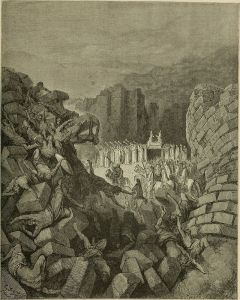
So when the head of the EPA cites the book of Joshua as science, some were surprised. Scott Pruitt, according to a story on BuzzFeed my wife sent me, has decided that the Old Testament is the new frontier. You have to choose who you’re going to follow. As for Pruitt and his house, it will be the Lord. And by “Lord” I mean money. Those who stand to gain by deconstructing the EPA are big businesses. Those who stand to loose? Only Homo sapiens and every other species on the planet. Although, in all fairness, rats and cockroaches have a way of thriving in our wastelands. In fact they seem to be thriving in Washington DC. I almost tripped over a rat on my way to work just the other day. They’re not just for the subway tracks anymore.

The Bible is the most abused book in history. This is what idolatry looks like. You take an object and make it a god. Nobody would be more surprised to find their words worshipped than those who wrote the Bible. Not one of them realized that their words would be taken the way that they are today. It’s pretty obvious that Paul of Tarsus would’ve taken a little more time in his letter writing had he known they’d be one day mistaken for God’s words instead of his own. And Joshua—well, we don’t even know who wrote that material. Whoever it was believed the earth was flat and that to stop a day from progressing all God had to do was hold the sun still for a day. No hot mitts needed either. This is, after all, the most powerful government in the world.


Stranger Things

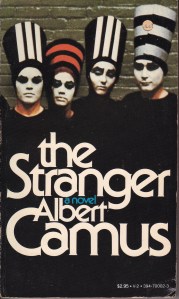
Albert Camus preferred the label “absurdist” to “existentialist” to describe himself. The problem with labels is that we don’t always get to pick our own. As a young man fascinated with existentialism, I was introduced to Camus as one of their number that I should read. Categories, of course, are only abstractions to complex realities. So, for learning about existentialism Camus was recommended reading in those days. I selected The Stranger. So many years have passed since then that I only recollected a single part of the plot. Coming back to it as an adult is like walking down that beach a second time, unaware that you’ve just been down this way and something bad happened last time. Existentialism is like that.

Meursault is little effected by life. He has no strong opinions since, at the end of the day, everything seems pointless to him. He sheds no tears at the death of his mother because death is to be expected. When a heat stroke confuses him sufficiently he unintentionally kills a man. At his deposition the examining magistrate finds Meursault’s atheism inexplicable. In the face of the possible consequences of his actions, such indifference leads him to refer to the prisoner as “Mr. Antichrist.” Awaiting his execution, Meursault has a final confrontation with the priest that has come to his cell unbidden. The prisoner is convinced that even on death row he believes more sincerely than the man of the cloth. Camus’ story is surreal but realistic. A parable for his day and ours.

I’ve lamented before about the decline in philosophical literature. Taking philosophy straight requires the kind of concentration that I lack on the bus or before going to bed. Novels like The Stranger express such ideas in digestible form. The reader identifies with and despises Meursault. Why doesn’t he do something to help himself? Boredom and indifference will literally kill him. He is, however, steadfast, and that is something to admire. Along the way existential ideas are woven into the character’s thoughts and dialogue. Everyone is like an actor in a play—they did not write it, they simply perform the roles assigned to them. When it’s all over they end up in the same place. Absurdism and existentialism aren’t very far apart. They’re both categories devised to help us comprehend the enigma that we confront in books such as The Stranger. Meursault can’t give the chaplain any false belief since, as he notes, those who believe have more need of convincing than those who don’t.


Turn the Other What?

The man next to me on the bus is reading his Bible. At one point in my life that would’ve made me feel safe. I would’ve known that the person next to me was committed to the same value system as mine—love for all, peace, equality, and acceptance. Now, however, I see that Bible and I’m afraid. You see, I’m reading Chris Hedges’ American Fascists: The Christian Right and the War on America. I can’t remember the last time I’ve been so scared. Hedges’ book was published a decade ago. What he wrote about then is coming true now and it’s because the elites of society—university folk and all—don’t take the radical religious seriously. In their delusional ways, they assume all will be well. If you think like that, read this book.

Dominionism is fascism dressed in Christian garb. It has no room for tolerance. It teaches that those outside its circle are to be ignored at best, and murdered without compunction at worst. This is not exaggeration. It is their teaching. It’s like that computer game that used to come with Macs where a time-traveling dinosaur collected the eggs of other species to save them from the coming asteroid. You could kill other dinosaurs without guilt because you knew they were going to die in 20 minutes anyway. That is very much the way Dominionists feel about you and me. We aren’t saved—their word is “Christian”—God has rejected us, and therefore we deserve to die. Many of them stockpile weapons just for this reason. Their goal, not at all hidden, is to take over the United States and make it a Christian nation. Already many in the houses of Congress are their candidates. They have a president who shares their values. We should be very afraid.

Hedges does a very good job providing the statistics that back his assertions. There is no question that this is real. Those who blithely vote Republican out of fiscal conservatism have risen to the bait. Trump has proved that once and for all. These “Bible believers” do not value or treasure love. They treasure treasure (many of them are very wealthy) and what they desire is power. Tolerance, in their view, is evil and compromising with the literal Satan in which they believe. Their Jesus does not love. He fights. And he fights for white, straight, privileged men. If you’re willing to forsake sleep, read this book. And if you think it’s exaggerating read the headlines.


Colleagues

The death of a colleague is a shocking grief. Although my teaching career was cut short at Nashotah House, the faculty there was always small, and often close-knit in a way that an insular school promotes. I had been teaching there for about eight years when Daniel Westberg was hired to teach ethics and moral theology. Dan was kind, gentle, and non-political. At first he was part-time, but eventually he became a regular member of the faculty at some personal expense. We came to know him and appreciate his wisdom and patience. Dan was a priest and had earned his doctorate at Oxford University. Just over a decade my elder (the faculty from which I left was generally at his age; I was the youngster), Dan kept in good physical shape, as befits a truly spiritual person.

Nashotah House takes its name from the lake by which it was built. Colleagues sometimes joked about the fact that the seminary was wooded, lake-front property and implied that recreation time belied research time. It was, however, a place of intense study for the faculty. It did also offer the opportunity to experience nature. Dan drowned in a boating accident on Upper Nashotah Lake this past week. The image of that lake is etched forever in my mind. The night before I learned of my colleague’s death I was reflecting how I stood on the shore of that very lake late one night to photograph comet Hale-Bopp burning in the western sky. I had been reading about comets and that night by the lake stands out in my mind as a numinous moment. The lake, it seemed, had always been there.

After I left Nashotah House I let my colleagues fall into the safe mental compartments of memories. A few of my students kept in touch, but in general I heard from my colleagues only very rarely. Some may assume I spend more time on Facebook than I do. There are painful memories associated with the seminary. Now one more painful memory is added to the rest. I ate with Dan and his wife. Talked with him. Attended chapel with him. We had that distance that always separates clergy from laity, but I considered him a man that could be trusted. A priest with integrity. We went through quite a lot together in that small community on the lake. The death of a colleague comes with a guilt for not having kept in touch. A sadness for an opportunity missed. A life of kindness extinguished is a shocking grief.


Church Vampires

For people my age manga is a new form of reading that is easily ignored. Although I’ve read a graphic novel or two, “comic books,” no matter how adult the theme, seem juvenile. Note that word “seem.” I do know some younger folks, and one of them insisted that I read Kouta Hirano’s Hellsing. This particular friend is as interested in vampires as I am, and, knowing my history with religion, suggested this might down my alley. Dubious, I gave it a try. In this manga universe Hellsing is a Protestant organization for fighting vampires and ghouls (non-virgin vampire victims who come back as zombie-like creatures who are very hard to stop). Their activity is in England, but when they cross into Ireland they encounter a Catholic organization that kills all vampires, including the “secret weapon” of Hellsing, who is indeed a vampire.

What made reading this tale so interesting is that the reader’s sympathy is drawn to the Protestant sect. The Hellsing characters are engagingly drawn—handsome or beautiful, resilient, and naturally good fighters. The Catholic characters are ugly and maniacal. They kill all monsters, regardless of their “heart.” In this the direction from the movie Van Helsing is reversed. There Van Helsing is a hireling of the Catholic Church who won’t kill a monster unless it’s evil. The idea of the graphic novel is that religious rivalry runs deep between these two Christian organizations. Thinking about this, I wondered how Christianity might look to someone from Japan. In this context, it makes sense. Christian missionaries penetrated east Asia from both Protestant and Catholic evangelistic efforts. Although they worship the same deity, they are quite different religions. At least it must look so to anyone not raised in this strange milieu.

Colonialism, in all its forms, has forced peoples to make decisions about new religions in a somewhat violent way. Imagine someone confronting you with your way of life and warning you that you’re going to suffer never-ending torment unless you accept a faith of which you’ve likely never heard. Then you discover that there are two very different versions of that faith that mutually condemn each other. The natural result, if you acquiesce at all, would be to choose the one that either makes the most sense, or the one that got to you first. Hardly the way to gamble with eternal life. I’m not sure Hellsing is intended as commentary on the experience of the colonized. It seems reasonable to me. And if vampires are a problem, you’ll want to be sure to select the right belief system the first time around.


Diverse Colors

After a warm snap, we’re not at peak color here in New Jersey. Some trees have changed, yes, and leaves have begun to fall, but green prevails. While on a walk with my wife—a luxury only available on weekends with my commuting schedule—I spotted a bit of red amid the leaves on a local stream. Litter, and not just the leaf kind, is a bit of a problem in Jersey, but this splotch of red seemed intentional. It was taller than it was wide. It was standing in the middle of a shallow brook. Its placement looked intentional. What couldn’t be discerned from the bank is just what this was. It might be a Buddha. It might be Ganesh. It does seem, no matter how it’s reasoned out, to be religious.

Archaeologists often find objects with no known utility. If an artifact has no practical function such an object is generally deemed religious. For much of human history, before the madness of capitalism, people owned only the necessities. Life was hard and lifespans were short. Accumulating stuff as an end in itself was a luxury only for kings and priests and the relatively few merchants in urban settings. An object found from that time, then, with no known function, must somehow be religious. An object of cultic devotion. Those of us trained in the history of religions would sometimes laugh at this predisposition. Religion is the basket for anything that can’t be otherwise explained. So it seemed with this red statue—it was clearly human-made—standing in the stream. We were walking by a ritual site, perhaps. Maybe it was just a joke.

Then I recalled Ganesh Chaturthi, the ritual submersion of Lord Ganesh that transpired in late August this year. It is a numinously charged season, this descent into autumn. My Jewish friends have just celebrated a new year. Pagans made proper observation of the equinox. Preparations, at least of the commercial kind, are well underway for Halloween. They are all colors. Although spring’s first buds are welcome after a monochromatic winter, soon we transition into the green of summer. We miss the benefits of many colors. At moments like this on the banks of a brook with yellow and brown highlighting the green that remains on the trees, I’m again reminded how wonderful diversity truly is. I am in the presence of a god. It may not be my deity, but I’m not threatened by the difference. Nature is a patient master for those willing to attend to the lessons.


Learning to Evolve

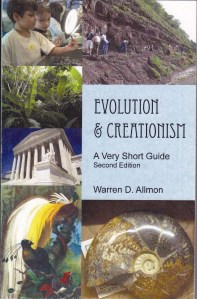
Not to beat a dead hadrosaurus, but creationism is in danger of driving us extinct. On a visit to the Paleontological Research Institution’s Museum of the Earth in Ithaca, I picked up a copy of Warren D. Allmon’s Evolution and Creationism: A Very Short Guide. Although I’ve read plenty of books on the subject, a refresher is never a bad idea. When it came to statistics, though, it grew scary. The majority of Americans do not accept evolution, despite all the evidence for it. What’s even scarier is that a large percentage of physicians—particularly Protestant ones—do not accept it either. Allmon is writing for a local readership, but these issues are quite large. World-wide, in fact. One thing most scientists don’t understand is that “religion” isn’t to blame. Literally reading of texts is.

Were it not for the creation myth in Genesis 1 there would be no conflict over evolution in Christianity or Islam. The question comes down to how one understands a sacred text. Many religious believers can’t get beyond the basic issue of if it took more than six days to create the world then that house of cards called biblical truth collapses. There’s a panic involved here. A very real and visceral fear that heaven itself is on the falling end of the balance. No amount of scientific reasoning will help with that. Hell is just too scary. And reason tells us that reason can’t solve this dilemma. Those raised religious by caring parents can’t believe that Mom and Dad would teach them wrong. Emotion plays a stronger role here than reason. More Kirk, less Spock. When even a majority of high school science teachers feel that “teaching the controversy” is okay, we’re in trouble.

Allmon’s book is well-intentioned. Of course, it was written before the post-fact world evolved. The stakes for not accepting reason (think Trump) are extraordinarily high. Having a figurehead that doesn’t accept rational explanations for what the educated can see plainly encourages widespread copycat ignorance. In the rational world there is no doubt about evolution. Most mainstream biblical scholars and clergy accept it. Don’t try to convince others with an argument, however. This is a matter of belief. Allmon does point out that science can’t speak to non-physical processes. It can say nothing about God. But a certain book can and does. Had it been written in modern times none of this might have become an issue. Until we realize the power of that book, we’re going to continue to struggle to come to grips with simple facts.


Getting Exorcize

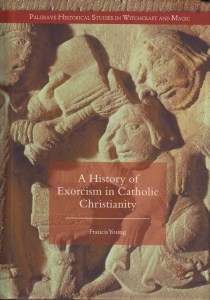
Supply and demand may seem to be an odd framework to apply to religion, but it obviously exists within the polity of churches, synagogues, and mosques. What the people want does influence what’s on offer. Watching movies about demonic possession isn’t something that comes naturally to me. Demons are scary, and it doesn’t help that, historically speaking, they’ve never really been properly defined. Francis Young has provided a service to the curious with his book A History of Exorcism in Catholic Christianity. The book is just what it says, an examination of how Catholics have formally dealt with demons, or more properly, demoniacs, over the centuries. Young notes the protean nature of demons at the beginning—they meet cultural expectations of their time rather than obeying theological niceties. What to do about them?

Long relegated to the realm of epilepsy and mental illness, possession has gone through several periods of ascendency and decline. Indeed, in the nineteenth century it looked as though exorcism, in Catholicism, might have been on the endangered species list. Science was calling the reality of the spiritual world into question and nobody likes to be thought naive. With few exceptions, the move toward eliminating the role of the exorcist was gaining steam. Then in the twentieth century the demand for exorcism revived. As Young notes, a large part of the increasing interest arose from the novel and subsequent movie, The Exorcist. Possession was something so little talked about for so many years that it proved a rich ground for a new kind of monster that was eminently believable. The church, after all, never said there weren’t demons. Since that time, interest has been waxing once again.

Part of the reason would seem to be that humans are meaning-seeking creatures. When our main sources of authority in that realm are eroded, we start looking elsewhere to find succor. Ironically, outside Catholicism the mainstay of exorcism has been among various evangelical Protestant groups. They may not have an ancient ritual to use, but what they lack in experience they make up for in enthusiasm. Their demons are culled from a literal reading of the Bible. And interest among Catholics, in this strange supply and demand rubric, has meant that more exorcists are being trained and made available. The world that Young leads his readers through is one in which strange things reside. He makes no judgment about demons or their reality. He does, however, provide a very thorough history of what the Catholic Church has done about them, when the demand exceeds supply.


Books Anonymous

If you stick with something long enough, you’ll get onto all the mailing lists. These days even if you innocently click on an internet ad it will come back to haunt you for weeks on every web-page your visit. One kind of ad I don’t mind is the book catalogue. For those of you old enough to remember print catalogues, you’ll know what it was like, paging through. You’d see volumes you didn’t know about, but suddenly you couldn’t live without reading them. Around the time of the American Academy of Religion and Society of Biblical Literature Annual Meeting, your mailbox would fill up with these catalogues from anyone who publishes books on religion. Not a single year passed when I didn’t come up with a wishlist based on those catalogues.

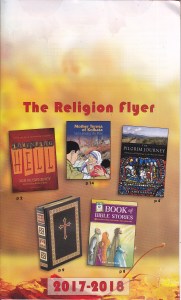
The other day one arrived called simply “The Religion Flyer.” I flipped it over to see from whom it came. No indication. Inside the offerings were largely Catholic. But then some evangelical publishers appeared there too. And the Society of Biblical Literature. The only commonality I could find here was the Bible. These were biblical books. Again, as I taught Bible for nearly two decades, this was no surprise. Still, who was to benefit from these sales? I’ve been in publishing long enough to know that books aren’t produced if they aren’t projected to make money. Sad, but true. So who sends out a catalogue with no contact information? Who benefits? The backside has a list of bookstores, along with an order form. As in the catalogue itself, the stores are mainly Catholic, with a few Evangelicals thrown in. The Society of Biblical Literature, which sells its own books, didn’t make the cut.

Could this be truly altruistic book advertising? Not many people suppose that biblical study is good for the world, so I admire the conviction of these stalwarts, whomever they may be. Publishing is a business like any other. The powerful voices that say knowledge should be free don’t, I notice, office their classroom instruction without university tuition to pay their salaries. We’re all the victims of capitalism, I fear. Someone, or ones, took from the limited time that they have to produce a catalogue simply to promote the subject. They were likely hired to do so—I’m not really that naive—but they did so without drawing attention to their own efforts. There once was someone who said that acts of goodness should be done by one hand without the other hand knowing. Not many believe that any more. Even though it’s biblical. Who benefits? Those who have eyes to read.


Healthy Hurricanes

Three major hurricanes into the season and our Republican government has nothing better to do than try to think up new ways to take away our healthcare. In an effort—no victory is too insignificant—to show that the swamp is being drained, the Grand Old Party wants its own constituents to sicken and die off just to prove a point. Meanwhile Thurston Howell can’t find a charted island even after being marooned on it. Puerto Rico is a territory of the United States. Perhaps the White House should use some of its tax money to purchase a map and a history book. Houston is still recovering from Harvey and 45 spends his time campaigning for the loser in Alabama. Not even Shakespeare could have come up with tragedies like this.

Morality, at least in the post-Reagan elephant wing, used to be in line with evangelical Christianity. When I grew up in that tradition I was taught it meant fair treatment for all, regardless of race or social location. Since my childhood that brand of Christianity has become more exclusive, it seems. God now, contrary to the Gospels, rewards the wealthy. He tends to favor gentiles, but only those of caucasian stripe. Those who are poor and suffering should learn to speak English and stay out of the sun. Act like proper suburbanites and hurricanes will never strike you. Oh yes, and you need not fear being stuck by the sun by day either. You don’t even need to read your Bible. In fact, you can ignore it as long as you know enough to proclaim to others you alone know what it means.

So far 2017 has been a year of natural disasters. Earthquakes, hurricanes, and further from home, multiple landslides and monsoons. And even volcanoes. It’s tempting to see some biblical correlations here, but that’s playing fast and easy with the great torment from which our fellow human beings are suffering. Far more important is to show that we can repeal healthcare in a nation that has been spared, to a great extent, the worst the world has had in store so far this year. Oh, except for Puerto Rico. Does anybody have a map app on their phone? And while you’re at it, check to see if maybe some developer has come up with software to help govern an affluent nation. Preferably one linked somehow with Twitter. We mustn’t forget our priorities.


Good Wrinkles

Since I was late getting my Banned Book in order this year, I went to something that I could read within a week. While my bus time is generally reserved for non-fiction reading, I had to pick something fairly easy so that I could get back to more serious stuff. Madeleine L’Engle’s A Wrinkle in Time was published the year I was born, and I’d never read it. It has ended up on banned and challenged lists every decade since it was published, so I was prepared for some radical stuff. Instead what I found was a well-written book for young readers that quoted the Bible quite a bit and even had a worldview that was appropriate to the Gospel of John. When the Murry children try to name the forces that fight the encroaching darkness, the first name offered is Jesus. The differences between good and evil are the subject of discussion among the characters and it’s pretty clear there’s an obvious distinction. So why is it a challenged book?

Never underestimate the sententiousness of the self-righteous. Objections to a medium, and characters—perhaps best understood as guardian angels in the book itself—perceived as witches, have led to the now familiar accusations of the occult. Here is a book that quotes the Bible, upholds the distinction of good and evil, and encourages children to fight for the former rather than the latter. Yet it also teaches tolerance. Parents who want children to think that only those like them can possibly be righteous start to shudder a little at that. The only good heretic is a dead heretic.

When I saw just how benign A Winkle in Time was, I had to think back over my own Bible. In addition to stories of horrendous violence, explicit sex, and with even a “witch” or two, the Bible contains diverse views. Paul argued with Peter in public, after all. Madeleine L’Engle was concerned about the book burning tendencies of Nazis. We now seem to think that the place for illiteracy is in the White House and, more recently, Alabama. Reading the news convinces me more and more each day that a steady diet of banned books is just the catholicon our society needs. Different viewpoints, like the rays of the sun, will shrink the mildew that finds its ways into dark corners, rotting the very fabric of our universe. A Wrinkle in Time may not sway adults in the same way it has engaged the wonder of children for the past half-century, but it is a start in a battle against darkness that is never-ending. There’s always time to read a banned book.


More Conjuring

Among the most revered traditions of the horror film is the sequel. Originally a financially driven feature, sequels have now become an expectation among fans. And although in general we prefer to appeal to our higher cultural aspirations, many horror movies do remarkably well at the box office. I’m not much of a sequel-watcher, but sometimes in my effort to understand the close connection between religion and horror, I succumb. So it was I watched The Conjuring 2. As with the formula for the initial movie, cases actually investigated by Ed and Lorraine Warren are brought together with exaggerated special effects and demonic entities. Starting out in Amityville, the demon Valak is introduced. It later appears as the source of the Enfield poltergeist.

In real life controversy never strayed far from the Warrens and their investigations. Amityville and Enfield have both been implicated as hoaxes. The Hodgson girls, just like the Fox sisters in upstate New York, confessed to some faking, and, of course once that dam has been breeched, there’s no stopping the flood to follow. Nevertheless, such incidents make for good horror film fare. In the case of The Conjuring 2, bringing a named demon into the mix keeps the religious pot roiling. Ironically, the demon takes the form of a nun. This character is a complete departure from both the Amityville and Enfield of record, although demonic influences were posited for both cases. Valak appears to go back to The Lesser Key of Solomon, a grimoire familiar to watchers of the now departed Sleepy Hollow.

Even with the hoax light cast on the “based on a true story” tagline, The Conjuring is well on its way to spawning a cinematic universe. Annabelle was a spinoff, and Annabelle: Creation scored high marks this summer. The success of The Conjuring 2 has led to work on The Nun, scheduled out next year. There’s talk of a third Conjuring film as well. As religion becomes less obvious in the traditional forms of weekly worship gatherings, it crops up more in other areas of culture. Don’t get me wrong—there’s plenty of secular horror as well. What does stand out is that when religion knocks at that creaking door of horror, nobody’s especially surprised. The Conjuring 2’s climax is quickly resolved once the demon’s name is remembered. The fallen angel is banished, not so much back to Hell as to another sequel. Eternal life is, after all, a religious idea as well.


Shipping Good News

Some say the infrastructure of this country is crumbling. It’s something I try not to think much about when I’m on the Helix or in the Lincoln Tunnel, but the concrete of those aging piers doesn’t look too healthy to me. So when I see a truck with a religious message, I guess I’m supposed to take comfort. On a recent drive along interstate 80, the great New York to San Francisco highway, we passed a Sam Kholi truck. You can tell a Sam Kholi truck because they declare “Jesus Christ is Lord, not a swear word” in bold letters on the side. The back has just the first part of the aphorism followed by “Almighty God the First and the Last.” A little research revealed that Sam Kholi is from Syria and now lives in San Diego. Many Americans, in these days of Trump, don’t realize that many “middle easterners” are indeed Christian. I got my start in publishing from a Syrian Christian. Prejudging is seldom a good idea.

Sam Kholi is combining his faith with his practice—something that harkens back to more ancient forms of religion. Lived religion used to be the only kind of religion. Once it was systematized, it became an academic pursuit. Knowing precisely what you believed became more important than what you did with it. Today’s religion, at least in these hallowed states, seems to be purely a matter of what you believe. Whether you live morally, treat others justly, or even pay attention to what the Bible says about caring for those in need, none of this matters as long as you believe the right thing. The result is people suffer. No matter, orthodoxy is secure.

Since our actions are more vocal than our words, I’m amazed and perplexed by what many evangelicals say. They are the ones who claim for themselves the literal truth of Jesus’ words. How they can deny the rights and needs of others based on race, gender, or sexual orientation is a mystery given the many passages in the Bible concerning forgiveness and love. When it comes to religion as how you live, apparently it is one size fits all. Driving, it seems to me, is one of the places where lived religion is put to its harshest test. Religion is how we live with others, and driving is how we show what we really believe. It takes a tremendous amount of faith to paint your belief on the side of a truck.


Doomsday, Again?

It’s hard to keep a good apocalypse down. Ever since Jesus of Nazareth did his best Arnold Schwarzenegger impression of “I’ll be back” some of his followers have obsessed when just when that will be. Sorry for the late notice, but the current prediction is for tomorrow. If you’ve got any weekend plans, you might want to rethink them. I know traffic in Jersey is already bad enough without white horses breaking through the clouds. An article my wife promptly sent me from NPR, “Is The Apocalypse Coming? No, It Isn’t!” by Marcelo Gleiser, addresses the documentary The Sign. No doubt about it, there’s some impressive astronomical gyrations here, but planets moving through constellations do not an apocalypse make. As Gleiser points out, the real question is why people believe such predictions so passionately.

Larry Norman’s song “I Wish We’d All Been Ready” captures the mood nicely. Growing up in a tradition that believed, as only literalists can, that this world is the center of the cosmos, Norman’s song haunted my teenage years. These were the heady days of Hal Lindsey and a very hot Cold War. I had to register for the draft. There was unrest in the Middle East. Sonny and Cher had split up. The signs were aligned, it seemed. As they had been nearly every year since about 30 CE. Paul of Tarsus was waiting. And John of Patmos. And Timothy LaHaye. True believers all. Conviction begets conviction. Seeing another fully convinced is a powerful incentive.

Even now, if I’m honest, I shudder a little when I hear such predictions. What if, by some odd chance, they are right? Raised in that tradition, it’s nearly impossible to jettison that private fear. Rationally I know that clever people can make all kinds of connections that have nothing to do with the Bible. I know that John’s Revelation isn’t about the end of the world. I know that the views of Paul were bound by the developments of his age. I know the Rapture was invented in the nineteenth century (CE). Still, the chill slithers through me when I consider how it felt as an uncertain teen on the brink of Armageddon. I could envision it clearly. Some who were utterly sure swayed me. Specific dates and times weren’t biblical, but the wait for any moment now was even more terrifying. Tomorrow will begin and end just as any other day on planet earth. And another apocalypse will enter the planning stages, coming soon to a universe near you.