Witches in History

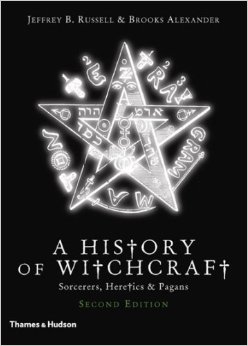
History of WitchcraftIn a rationalistic society, the concept of witches has no place. If only we knew what witches were. Sadly fascinated by the unfortunate—evil would be the more appropriate word—victimization of women in the late Middle Ages as partners of the Devil, I read Jeffrey B. Russell and Brooks Alexander’s time-honored study, A History of Witchcraft: Sorcerers, Heretics and Pagans. With its bold pentagram on the cover, I’d been afraid to take this on the bus, and so it sat in my reading pile until I figured out a way of keeping the cover from view while I perused the contents. The authors wisely spend the introduction with definitions. We define our world through lenses. For the most part, people today use the lens of science, as if that were the only way to view the universe. Still, even with that polished glass in hand, we have a difficult time knowing what “witch” is supposed to designate. Russell and Alexander suggest that it changes over time.

No doubt, witches still exist. The recognition of Wicca as an authentic religion (for tax purposes, the only true measure of a religion’s bona fides) demonstrates that. The problem is that Wicca is not in any sense a direct continuation of the witch hysteria that swept Europe, and parts of New England, centuries ago. As A History of Witchcraft demonstrates, this was a religion practiced by no one, but imagined, and feared, by many. Particularly men. Particularly religious men who had problems with women harboring hidden powers. It was a full-blown and horrible fantasy that led to many thousands dying for a religion that didn’t even exist. Modern witchcraft began in the 1930s and has become a nature religion that sees itself connected to that past, but which really only touches at the very edges.

Witchcraft was a way of looking at the world that saw all things as intimately connected. Russell and Alexander point out the similarity to chaos theory with its butterfly effect. We do see effects at a distance. Science tries to make them less spooky. Those who practiced witchcraft in ancient times, before the Middle Ages could even be dreamed, tried to bring such forces under human control. If some anthropologists are to be believed, some may have succeeded. This idea pulls at our darkest fears. Can we accept a world where we are manipulated by others in unseen ways? It happens every day. Not by spells or incantations, but by forces far more powerful than that. You don’t need to be a witch to see it. You only need to open your eyes.


Rosemary by Any Other Name

Rosemary

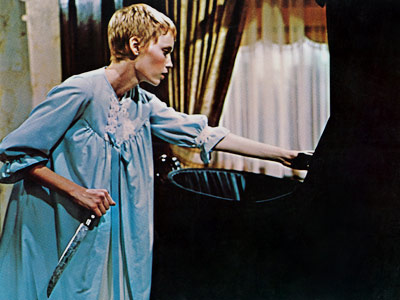
With NBC’s remake of Rosemary’s Baby into a mini-series in the news, I sat down to watch the original again. I’ve blogged about it before, but with most available funds being diverted to college, watching new movies will be a rare treat for some years to come. Besides, the original is a mishmash of religious ideas that despite their lack of coherence still leave the viewer somewhat disturbed. Since the last time I watched the movie, I’ve read several books on witches and have come to recognize the strange brew that Roman Polanski concocted for public consumption. Reaching back to the myth of diabolic witches, the original movie presents such witches initiating a new world by literally spawning Satan on a woman whose name is based on the mother of Jesus and who will ultimately care for the helpless little devil. The viewer, despite the knowledge that Rosemary is carrying evil incarnate, still sides with the vulnerable, pregnant protagonist. It’s the end of the world as we know it.

I’m not sure how you make a miniseries out of this thin plot. I suppose a nine-month pregnancy would lend itself to slow development, but haven’t we grown a little too old for witches and devils? In fact, Wicca is now a recognized religion in much of the industrial world, and the devil’s been on the run for decades. Religious movies, or at least movies based on religious themes and characters, are perennially popular, however, no matter what the secularists tell us. And why not open a series about pregnancy on the weekend of Mother’s Day? Nothing stirs the emotions like putting a young mother at risk. That’s perhaps the insidious side of the original movie—we silently side with the devil.

Rosemary is, of course, manipulated by her husband with the everyman name of Guy. This isn’t in any sense his child and, like any businessman, he stands to gain enormously from someone else’s labor. Exploitation is the cost of the continuation of the human race. It doesn’t take much to figure out that we’re watching a parable here. After all, the Time magazine cover asking if God is dead makes a cameo in Dr. Saperstein’s office. And the setting in Manhattan clues us in from the beginning that this is the place were many millions are asked to make a few very rich. There is a witchery in New York, and for those who know how to look, the devil may be found in the details.


Hotel Nowhere

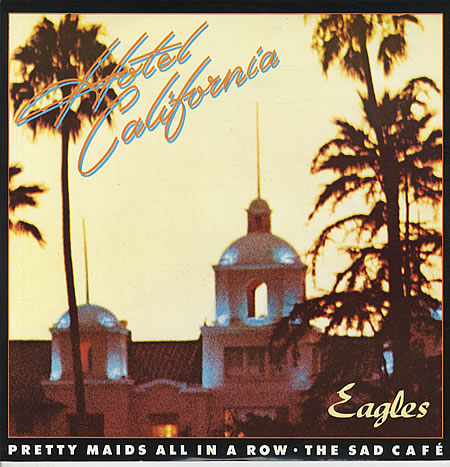
HotelCalifornia1977. I was in junior high school and I wore my hair long. I hadn’t yet donned the cross that I carried through my high school years with a constant fear of Hell on my back, but I did listen to the radio. The haunting song “Hotel California,” by the Eagles, scared me. There was something lurking there—something undefined and yet compelling. Cults were in the news, and after the People’s Temple suicide a year later, we were all pretty well convinced that the song was based on fact of some sort. Religious analysts concluded that the song referred to everything from the Antichrist (“they just can’t kill the beast”) to a New Religious Movement that had taken over a western mission (“we haven’t had that spirit here since 1969”). Members of the Eagles, when asked, said their intentions were to expose the darkness of the music industry as idealistic hippies came of age and realized, yes, it’s just business. Still, I shivered.

Nashotah House used to be on the frontier. Although it is only 30 miles from Milwaukee, it could still feel terribly isolated less than two decades after the Eagles had flown. Indeed, there were sotto voce suggestions that “Hotel California” should be the official seminary hymn. “You can check out any time you like, but you can never leave.” The nights could be very dark in the Wisconsin woods, and for those attuned to some of the more honest aspects of a religion based on exclusion this didn’t seem too far to stretch. “Hotel California” came forcefully back to mind reading about Oneiric Hotel in Wired. (Mentioning Wired makes me look smart.) The Oneiric Hotel is a lucid-dreaming device by artist Julijonas Urbonas, the kind of thing Wired finds newsworthy. The story mentions that Urbonas’s previous project—called Euthanasia Coaster—was designed to kill its passengers.

Now my mind checks into Bates Motel. I know Psycho is set in Arizona, but the desert southwest is terra incognita to an easterner, and besides, it’s just a metaphor. It looks like California to me. I saw Psycho as a college student, and was rather afraid to watch it while at Nashotah House. Indeed, the night I moved to campus I found a dog-eared script from a play about a murderous maid at the seminary left on my coffee table. “This could be Heaven or this could be Hell.” Psycho, it is asserted, was based on the macabre case of sociopathic killer Ed Gein who had roamed these self-same woods of Wisconsin, and who had died less than a decade earlier just down the road in Madison. There was, I knew, a psychiatric hospital just across the small lake that the campus bordered. We don’t call them cults anymore, but we all know what we’re talking about. There are indeed places that you can never check out, even if you leave.


The Cow Jumped

While digging through the attic for some reference material for a colleague this weekend, I came upon a box of Bibles. I actually have many Bibles around the place—often within an arm’s reach—despite the ease of internet biblical access. One thing of which I own few are leather-bound Bibles. Trying to be as vegetarian as I can, I have avoided leather in my apparel as much as possible (sometimes the alternatives are even more expensive), and apart from a rare, old book, I prefer cloth to leather, and, generally, paperback to cloth. Still, working in the Bible industry, I know that among the best selling Bibles are the leather variety—those that involve the ultimate sacrifice, although not of the human kind. Leather as a book-binding material is an early development. Leather is durable, and strong, even if a little kinky. Before synthetics, it was used to protect tomes that had been written by hand, representing hundreds, or thousands, of human-hours of work. You wanted it to last. So kill the fatted calf.

I was amazed, therefore, to discover that most leather Bibles are bound with pigskin. That’s right, the material tossed around the grid-iron Sunday afternoons from September through February is kin to the very binding on your standard Bible. Pig leather (never called that) is cheap and durable and is the routine binding for leather Bibles. You want a kosher holy book, you’ll need to buy calf-skin (one thinks of a savior dying at only 33), and it will cost you. Pigs, generally eaten by Christians, are unclean to Jews and Muslims, and books bound in pig cannot be touched by the most religious of the monotheistic sibling faiths. To me, I just see dead animals all around in any case, and wish we might find some way to protect our pages with something else.

Photo credit: Ben Salter, Wikimedia Commons

Photo credit: Ben Salter, Wikimedia Commons

A larger issue (isn’t there always a larger issue?) is a porcine one. Pigs, we are told, are very similar to humans. We use their organs to transplant for our own, and some scientists think they may have played a role in human evolution (although this is not the conventional view). Although I can’t claim Babe led me to vegetarianism, it certainly didn’t hurt. For that matter, neither did Charlotte’s Web. Still, the idea of swearing atop a deceased pig to tell the truth, or watching a televangelist beat a dead pig, definitely has some theological implications. So as I sit here staring into a Hammermill box full of Bibles, I wonder about the hidden costs. Not just to calves and pigs, but to the species who claim that this box of books contains a truth deeper than the many other tomes all around me. And I wonder just how naive I may have been on the finer points of the religion based on these books as well.


Lord Have Mercer

Samuel Alfred Browne Mercer was an Assyriologist who failed to establish an academic legacy.  I quickly learned, when consulting his The Tell El-Amarna Tablets that his work was considered inferior, and that it would not have been published, had it not been for his wealthy wife.  Not a very ringing endorsement for a guy who wrote a grammar of Assyrian.  It was a little odd, then, in the library at Nashotah House when Mr. Tolan was clearing out shelf space, that he asked me if I would like a copy of Mercer’s autobiography.  The library had two and, well, needed more shelf space.  I thanked him for the slim volume and took it home to read.  The little book is self-published, and it had been typed with a sans serif font, something rare for a published volume in those days.  It had been annotated by hand, I presume by the author.  And it told a most interesting story.
 
Mercer, I was to learn, had been a student at Nashotah House.  Now, in my days at the seminary the internet had not yet made it that far into the backwoods of Wisconsin.  We eventually did get a dial-up connection and we thought we were so twenty-first century.  In any case, Nashotah House, when it finally established a website, did nothing so vainglorious as to list noted alumni or faculty.  The only two I ever heard praised were Gustaf Unonius and Michael Ramsey, the former for being the first graduate, and the latter as an adjunct instructor (and, incidentally, the Archbishop of Canterbury).  Samuel A. B. Mercer, as he styled himself, would not likely have raised even a unibrow.  He had written a couple of books on a learned topic, but had failed to impress.  Reading his life story was somewhat intimate, however.  He tells of riding on the top of a train in Russia to get from city to city with little money, and of visiting Ethiopia where, it seems, he was convinced the Ark of the Covenant might just be.  Had I not studied Akkadian and read about Assyriology, I might not have ever come across his name.  We were, however, touching at an odd juncture.
 
Not even rating a Wikipedia article, Mercer disappears into obscurity after his informal accounting of his life.  He apparently had a wealthy wife (home life is not the focus of his brief story), and a lasting desire to spend time in Kush.  Although it has been years since I’ve read his story, I recall that he did have a life of adventure and a little intrigue.  Maybe we were spiritual kin after all, for we each tried and failed to make an impression on an ivory tower world where those who tarry too long at Nashotah are deemed among the least important of academics.  After all, even the relatively comprehensive list of institutions of higher education on the University of Texas website (and Texas and Nashotah have a lasting connection) fails to mention the seminary.  Its little library, nevertheless, does hold evidence of a lost life-story or two.

SABMercer


Irrational Reform State

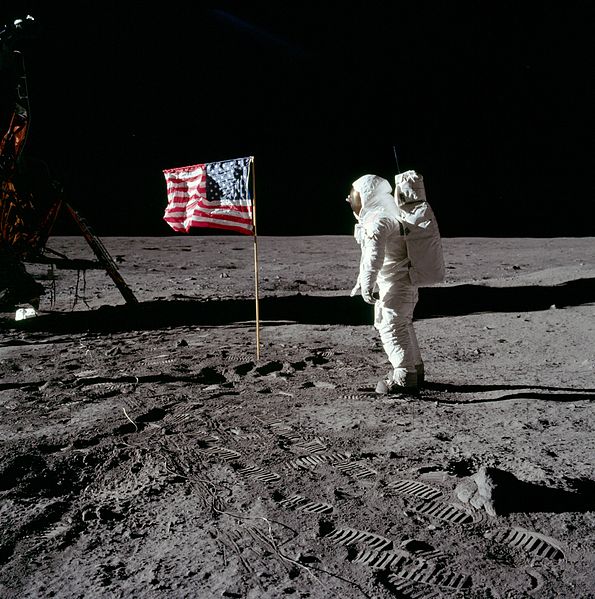
Since 1954, after the cut-off date for new religions (see yesterday’s post), American children have been making a pledge to an inanimate object with the words, “under God.” Despite the fact that all parents know that children take liberties, the reality is that conformity is deeply embedded in young people. Totalitarian states everywhere have recognized that indoctrinated children are difficult to deprogram. In the chilly heart of the great panic known as the Cold War, the pledge of allegiance was emended to declare America a nation under God. And the American Humanist Association is backing a New Jersey family in suing to have a castrated pledge on offer. I always felt swearing fealty to a flag was a decidedly pagan activity anyway. Did not Jesus say, “let your communication be, Yea, yea; Nay, nay: for whatsoever is more than these cometh of evil”? Good Christians aren’t supposed to swear. In a land where the IRS controls what counts as a religion, we might consider substituting “under capitalism.” Isn’t that what we really mean anyway?

Nobody has control over where s/he is born. I’m not sure that many people would want to have the burden of making that decision. Still, we have to learn to adjust. Religion is a matter of where you’re born. We may grow to believe, but what we believe depends on what our guardians teach us. In my case, being born into a Fundamentalist family in Pennsylvania led me to nearly a decade-and-a-half teaching stint in an Episcopal seminary in Wisconsin. Who knew? My religion also taught me that swearing—i.e., “pledging” allegiance—was vaguely suspect. I was never discouraged from the pledge of allegiance, however. After all, it said “under God.”

When my daughter was very young, we were in a store in Wisconsin (where she did not choose to be born) when a couple of guys, being guys, let a few choice adjectives slip. One of them looked over, saw us there (my daughter too young to comprehend what was said), and said, “Oh, sorry! I didn’t see her there.” I found his chivalry admirable, but misplaced. We hear what we hear. So I’ve always found it odd when people want to sue if their children are forced to hear the words, “under God.” How does that threaten an atheist’s home teaching any more than swearing to a piece of cloth undermines a Fundamentalist’s? And aren’t we all taught that globalization is the way of the future? Under those multitude of young hands beat the hearts of Jews, Christians, Muslims, Buddhists, Hindus, Sikhs, Jains, Atheists, and any number of other faiths. We’re told the Cold War is over. Maybe the government should consider turning down the thermostat.

595px-Buzz_salutes_the_U.S._Flag


Irrational Revelation System

In an article on Obamacare in last week’s paper, Kathleen O’Brien pointed out an interesting dilemma. Some religions, such as the Anabaptist traditions (Amish, Mennonites) must comply with modern regulations on healthcare or face a fine. Under pressure, the Internal Revenue Service grants exemptions to some such religions, but those religions have to have been established before 1950. Maybe I’m paranoid, but just having read about Scientology, I have to wonder about two things: what is the IRS doing defining religions, and why 1950?

Photo credit: Ad Meskens, Wikimedia Commons

Photo credit: Ad Meskens, Wikimedia Commons

1950. Like the Roman Empire, frustrated with new religions (like Christianity) popping up all over the place, governments sometimes default to a religion’s age as a sign of its validity. Rome required conformity, but Judaism, demonstrably already an ancient religion, was granted an exemption from some of the regulations. We have a tendency to think that if a religion is valid, it must have been discovered/revealed long ago. All religions, however, were new at one time. Even the first shaman offering the first propitiatory gesture to the first recognized nature spirit, was experimenting a little. Did that stop in 1950? That line in the sand must stand for the cutoff date for new religions. Why? Well, you see, it has to do with money.

The IRS, as an organization, doesn’t really care what you believe. As long as it includes paying your taxes. One of the burdens of citizenship, too quickly forgotten, is that life together in a complex society is not possible without incurring considerable costs. Religions have long claimed tax-exempt status under the rubric of disestablishment. If they pay the government, then it is like the government is receiving kickbacks from the Almighty. The biggest donor should get the biggest favors. Soon you have a state church. So it is just easier to let religions be tax exempt. But since nobody has ever adequately defined what a religion is, the doors have been wide open for entrepreneurs in the faith industry. Instead of letting religious experts decide how to define a religion, that has become a government job. I picture a simple, bearded Amish man pulling his buggy up outside the IRS headquarters in a frenetic Washington, DC to go argue his case. Don’t worry, Bruder. Divine revelation, whatever that is, apparently stopped in 1950 and you’re clearly pre-McCarthy era. Suddenly a whole lot of things seem to start making sense.


Fleeting Meaning

Just a year before I had been unceremoniously dismissed from a fourteen-year teaching job at Nashotah House, devastating everything I thought I knew. I’d found a temporary job at the University of Wisconsin, Oshkosh and the head of the department encouraged us to go see the mandala that some Buddhist monks were constructing in Oshkosh one weekend. My family came up and we breathlessly watched as the orange-draped, shaven monks meticulously tapped brightly colored sand into an intricate pattern of incredible beauty. My daughter, quite young at the time, wondered what they would do with it when they were done. We’d been told, in the department, that the sand would be safely flushed into a local waterway, as Buddhism teaches about the transitory nature of life. My daughter was upset at the thought of such a nice piece of art being destroyed. But that’s part of the point of a mandala. As the Buddhists say, too many people concentrate on the hand pointing at the moon rather than on the moon itself.

Photo credit: Kamal Ratna Tuladhar, WikiCommons

Photo credit: Kamal Ratna Tuladhar, WikiCommons

I’m no expert in Buddhism. It is a complex way of thinking, and, like many religious systems, it is not unified into one particular thought-structure. Nevertheless, one of the main teachings of Buddhism is that life is, pardon the crass translation, suffering. We experience desire and we will continue to experience desire until we die. Then we’re reborn to experience desire all over again. Those who are enlightened may break out of this system into Nirvana, or a kind of non-existence where desire can no longer afflict us. There is an appeal to this way of thinking in a universe that science tell us will eventually burn out so that we’re all just a bunch of cinders in infinite, but expanding space. Almost Buddhist in its conceptualization, actually.

So when this morning’s New Jersey Star-Ledger had a front-page, below-the-fold, story of a mandala incident in Jersey City, I had to read. This entire past week, three monks have worked on a mandala at City Hall in Jersey City, for up to ten hours a day. Having watched this work, I know it can be backbreaking, and it is incredibly meticulous. Yesterday, after four days of work, a three-year old, while his mother was distracted, jumped on and ruined the mandala. A mayor’s aide, horrified, had to show the monks what had happened. A mandala is all about the transitory nature of life. Its fleeting moments are, after all, suddenly swept away. Despite the drama, the monks repaired the mandala and one of them quipped that perhaps the child’s action had underscored the lesson the mandala was intended to teach. Indeed. Many religions recognize that children know something about life that most adults simply forget. It’s the moon that’s important, not the hand.


New York Calvin

So I’m standing at the corner of Fifth Avenue and 29th Street, gazing at Marble Collegiate Church, of the Reformed Church in America.  A cold breeze is blowing, and I wish I’d thought to dress a bit more warmly.  Although the building in front of me was erected in the nineteenth century, the church was founded in 1628, making it among the oldest continuous Protestant congregations in the New World.  It is regularly passed by tourists and shoppers who give it nary a glance, not realizing that the Dutch who gave us New Amsterdam also gave us a Reformed Church that has stood the test of time in an increasingly secular New York City. 

IMG_1294
 
I am not now, nor have I ever been, a Calvinist.  That may seem odd coming from a religion scholar who attended a very Presbyterian College and earned a doctorate at a Presbyterian department at the University of Edinburgh.  Nevertheless, despite the many belief systems I’ve indulged, the Reformed wing has never appealed.  That’s not to say that I don’t appreciate what Calvinists have to offer: where would we be without the many good things Presbyterians have brought to us?  In any case, I was recently considering how I automatically equate Calvinism with Presbyterianism, and how I really need to get over that habit.  The Swiss reformers were a far more fragmented sect than the Lutheran contingent ever became.  That still shows in the many historic Calvinistic traditions out there.
 
Presbyterianism, on its own, is not a uniform denomination anymore.  For the time being, however, if we consider all Presbyterian groups as one stream of Calvinism, we need also to consider the Reformed groups.  Although all Calvinists are reformed, the Reformed Church had its historic stronghold in the Netherlands.  Doctrinal differences continued to fracture the Reformed Church into several denominations, two of the most prominent in the New World being the Reformed Church in America and its splinter, now larger, of the Christian Reformed Church (not to be confused with the Christian Church, (Disciples of Christ)).  Congregational churches, which have no overarching governing body, frequently fall into the Calvinistic theological tradition, although that is not necessarily the case.  Other Protestant denominations, such as Methodism, have equally diverse origins.  Others, like the Baptists, have an early history that is unclear even today.
 
The Calvinist theological family tree is well studied, and it stretches back from where I’m standing to Huldrych Zwingli and John Calvin and their peers, some five centuries ago.  Although it never reached the size of the Baptist and Methodist growth spurts during the Great Awakening, Calvinism did make a lasting imprint on the landscape of North America, and still continues to bring some of us out on a chilly day just to look and wonder.


Clearly Religion

GoingClear“There is no point in questioning Scientology’s standing as a religion; in the United States, the only opinion that really counts is that of the IRS;” so Lawrence Wright partially concludes Going Clear: Scientology, Hollywood, and the Prison of Belief. This is an important book, and one which once again demonstrates how seriously religions should be taken. New religious movements offer a ringside seat to how orthodoxies are born. Facts may be distorted or covered up, but there is information to be had on L. Ron Hubbard, Joseph Smith, and Mary Baker Eddy. We can learn from the way their ideas may move from fiction to fact, and how intelligent people still feeling spiritual yearning can turn to a religion invented recently as well as those invented millennia ago. As Wright points out, all religions make improbable claims. Fact-checking, however, is much more difficult for periods long gone that left only meager records. The distance in time may lend ancient assertions the benefit of the doubt, but the real decision-maker is money.

Given universities’ interests in lucre, one might logically conclude that religions would be of great interest. It is telling that, especially in the case of Scientology, that the factor most important to the status of the church is its money. Religions may claim tax-exempt status, setting them apart from purely commercial enterprises. This gives religions an advantage when they are careful with their finances, and the whole question of whether a religion is a religion is not left to scholars but to the lawyers of the Internal Revenue Service. The truth of religion lies in its bank-books, not its holy books. No doubt in the case of Scientology this is because of the high-profile court cases in which the status of the religion was challenged by government agencies. Nevertheless, when it comes to the laying down of the law, only money really matters in defining a religion.

As Wright discusses, one of the problems we face is that religion is poorly defined. Nobody can really assert much beyond that religions involve belief of some kind. Beliefs, in this case, about L. Ron Hubbard and his ideas. Although facts about his life are disputed, there can be no doubt that Hubbard was an intriguing man. He was a prolific writer with great imagination, and he clearly had keen insight into psychology. A religion used to be measured by the good it produced. Now it is measured by the dollars. As Going Clear illustrates, trying to construct an unbiased account of Scientology is a fraught enterprise. Like many modern religions, Scientology is very secretive. Even the early Christians knew that if everybody could join, then the club loses its appeal. Apart from belief, religions also must have outsiders and well as insiders. In a world measured by consumerism, wealth is the surest sign of blessing. No one should be at all surprised, therefore, that it takes the IRS to decide that which used to be taken by faith alone.


Dark Sight

TimeDarkBarbara Brown Taylor is a name about which I wish to learn more. Although Time magazine predictably runs a religious-themed issue around Easter, the year’s cover story, “Finding God in the Dark,” hit some resonant chords immediately. A friend of mine writes a blog called Bleak Theology, and my own posts often linger in those nether regions where, if we’re honest, we don’t know what we might find. Barbara Brown Taylor has been exploring these themes for years on a spiritual journey that has her deciding, as many of us know, that the dark is not evil. Fear is a kind of spiritual elixir. I watch horror movies. I read gothic novels. I awake daily before the sun, and do my best thinking in the dark. The key, as I would humbly suggest, is to be honest about life. When I preached, the students who understood that would say they appreciated my honesty. After all, before the beginning, all was darkness.

The article on Taylor, by Elizabeth Dias, is moody but appreciative. Taylor has the experience of being an Episcopal priest, a professor, a preacher, and a recognized author as her journey has led her to appreciate the dark. Some of us understand that the biblical books that are the darkest—Ecclesiastes, Job, and Psalms—are also the most honest. These are books to read in the dark.

Nature has evolved us to trust our eyes for survival. Fear of the dark is not something instilled in humans by protective parents—it is a consequence of having to survive in a jungle where you too are prey. We can’t see well at night, so that is the time we close our eyes and make ourselves vulnerable to the nocturnal beasts. Those beasts are, of course, spiritual. Somewhere on our journey to shallow religions of the modern era, we’ve come to believe that religion is all about sunshine and light. Evangelicals often believe that feeling good is a sign of blessing and depression is from the devil. Religion, however, from the beginning, has not shied away from the heavier side of human existence. If all were clear and bright, what need would we have of religion? In our experience, however, life has a substantial amount of trials and difficulties. There’s a lot of fumbling in the dark. If we can learn, with Barbara Brown Taylor, that not seeing is true insight, we might indeed learn a lesson about life in a world that is dark, literally, half of the time.


The Plague

Plagues&Peoples Sitting on the bus next to some guy with a consumptive cough may not be the best place to read Plagues and Peoples. But William H. McNeill’s book is considered a kind of modern classic, and since the Middle Ages have been on my mind, I persisted anyway. I did wrap my scarf around my face, though. Plagues and Peoples isn’t just the story of the Black Death, however. It is a sweeping account of pandemic and endemic outbreaks and how they form recognizable patterns with human populations. Perhaps the most striking aspect of McNeill’s study is how determinative plagues have been for many decisive aspects of human history, including religious ones. Indeed, religion keeps cropping up in the book. One reason is because of the roles religions play in human suffering—to be more precise, I should say in trying to alleviate human suffering. (Yes, some religions definitely cause it as well, but that’s a story for another time.) McNeill even suggests that fear of disease might have led to the parting of the ways between Swiss and German Reformers, playing a role in the divergence of what would become the Presbyterian and Lutheran flavors of Protestantism. The spread of some religions was facilitated by the ravages of disease.

During the period of the spread of the Plague, however, McNeill notes that those cultures attended by Christian and Buddhist institutions managed to fare better than irreligious, or, perhaps more accurately, folk-religion ones. Once people figured out Plague was contagious, they sensibly kept away from the sick, but the moral teachings of Christianity and Buddhism compelled the religious to tend to the ill, with the result that more people in those religious traditions survived. That’s not a universal declaration on McNeill’s part, but it is a fact worth bearing in mind. The risk to self paid off when more individuals cared for each other rather than just heading for the hills when the Black Death came along. On the other hand, religions frequently insist on behavior that spreads disease as well. The great pilgrimages to Mecca or the Ganges often brought great crowds together where disease could quickly spread. The passing of the peace in some churches is more like the passing of the plague.

In ancient, pagan times, disease had its own deities. In ancient Ugarit, Resheph, the archer, was also the god of pestilence. Pestilence frequently accompanied the horrors of warfare, and even Apollo opens the Trojan War by firing his arrows at the Greek troops. Gods are the source of disease. One of the ancient truisms, which may not be taken as true today, is that the force that wounds is also the force that heals. Instead of ignoring Resheph, you pray to him, make offerings to him. He can slay, but he can also heal. In the monotheistic and even non-theistic traditions McNeill mentions, the focus shifted to the care of those suffering rather than the offering of sacrifice to unhearing gods. Even the Romans were impressed by Christian care for one another. Of course, that was well before Obamacare offered the hope of medical treatment for those cut off from lucrative employment. The Christian response now, it seems, is to complain about others taking advantage of my surplus cash made over to a program to prevent illness in one’s fellow citizens. Take the bus to work, you’ll see what I mean.


Roman Undead

ZombieBibleLike most monster movie fans, I enjoy a zombie film now and then. I’ve even heard some very sophisticated people commenting positively on Shaun of the Dead. One of the standard features of the zombie is its forthright impossibility—reanimated dead are the stuff of humanity’s earliest nightmares, but in our rational minds we know that bodies missing vital organs, limbs, and blood, don’t just get up and try to eat the living. That doesn’t prevent me from watching zombie movies, and even considering participating in a zombie walk. Nevertheless, I’d not read any zombie books. That suddenly changed when I sat down with Stant Litore’s What Our Eyes Have Witnessed: The Zombie Bible. Literally the day I started reading it, a publisher sent me a copy of Suzanne Robb’s Z-Boat. I was surrounded by zombies.

I had decided to read What Our Eyes Have Witnessed because I was curious what a Zombie Bible might be. I quickly learned that it was an apologetic exercise where zombies are used as a vehicle for evangelization. It was difficult, however, to take the idea seriously. When a zombie breaks through the door of a Roman villa at the start of the book, I found the thought strangely funny. Many zombie movies go in that direction, acknowledging that they could never really happen, so they decide to give viewers a laugh or two along the way. Litore’s parsimony, however, became clear right away. This is a retelling of the martyrdom of Polycarp, but with zombies. It is a curious mix of Roman history, Christianity under persecution, torture porn, and the assurance of salvation. The premise is that Cain’s slaying of Abel resulted in zombies and their soulless souls must be put to rest. If they bite you, you become a zombie—you know the story. Meanwhile, the Roman authorities believe the Christians are to blame and decide to kill off the historical Polycarp.

The story dwells on the emotions of the Christians, in a kind of maudlin evangelicalism, as they try to avoid both flesh-eating zombies and Roman authorities. Zombies, it is said, are driven by their constant hunger and only Christianity has the true bread. This is a creative account of how the early Christian movement dealt with persecution. The zombies, however, feel somewhat superfluous in that situation, for the terror of imperial persecution was real enough. The zombies, however, aren’t after brains, and they don’t speak. They want to eat and the only thing they can digest, even if they have no stomachs, is other people. As an allegory it almost works, but zombies are a kind of fifth column in what was a very real struggle for early religious tolerance. Ironically, the undead and resurrection are never juxtaposed, although they are the most obvious way to connect the dots.


Apocalypse Then

Krakatoa Sometimes everything blows up in your face. Literally. Simon Winchester’s Krakatoa has been on my reading list for years. Boys seem to have a fascination with volcanoes that they never outgrow, and given the world-wide implications of Krakatoa’s 1883 eruption, it is a tragedy that keeps me ever curious. We live on an angry planet. I know that’s projecting agency on nature, but like thunderstorms, to a human sensibility, volcanoes are raging phenomena. As Winchester points out, many indigenous cultures in the “ring of fire” consider volcanoes either gods or messages from the divine world. Honestly, I didn’t read Krakatoa to find out about religion, but it was there nevertheless. For human beings, it has an unparalleled explanatory power.

Krakatoa caused a stint of global cooling after its nineteenth-century eruption, leading to failed crops throughout much of the world, and perhaps played into larger political issues that would stress a world already attempting to cope with fast changes in technology. The story of the volcano is fascinating enough, but the religious dimension, it seems, played itself out more than just in a Gilligan’s Island sort of way. Despite what analysts say, people take their religious beliefs very seriously. So when I reached the end of the eruption, I wondered how Winchester was going to spin this book out for another fifty pages. It turns out that among the effects of the volcano was a religious rebellion. The East Indies, as they were called, were under Dutch colonial rule. This led to a bit of tension with the native Muslims (Islam has long been a major religion in Indonesia). As Winchester points out, the Islam in the region before the eruption was a syncretistic, almost laissez faire, faith. It blended with Hinduism and local beliefs, and even tolerated the Christian Dutch.

Symbolically, or literally, after the explosion that killed thousands, a religious movement that had been waiting for a sign came to life. A more strict Muslim sect saw the events as a predicted display of divine anger. A short-lived rebellion broke out, cut off by Christian repeating rifles, that led to a more strict version of Islam in the region. Although Winchester doesn’t linger on this too long—he is writing about a natural disaster after all—it does raise many very human responses. In the event of a cataclysm, science is cold comfort. We may rationalize, but human beings also feel. And it is religion that will attempt to answer for that pit in your stomach or that worry in your head. That’s what it does best. Science tells us that we can’t really stop volcanoes—we are too small and the planet too overwhelming. Religion, on the other hand, offers a grip on the very forces behind cataclysm—imagined or not. Although seeing natural disasters as divine punishment is never reasonable it is, in the words of a famous philosopher, human, all too human.


Why Crusade?

CrusadeAn invitation to join a crusade is a dicey proposition these days.  Perhaps Pastor Ock Soo Park is not aware of the burdensome theological freight the word carries these days.  The Bible Crusade is, nevertheless, coming up on April Fool’s Day, and, I’m glad to see, admission is free.  The tract I clutch in my gloved hand is more like a pamphlet and it is number 3 in a series, “Woman Caught in Adultery,” causing me to wonder what numbers 1 and 2 might have been.  Still, it’s Good News Publishing, so I suppose it can’t be bad, whatever the topic.  The young lady on Seventh Avenue seem surprised when I accepted the booklet she held out with a simple “Bible Crusade?” invocation.  I often accept what the shills hand out; a more thankless job is difficult to imagine.
 
The concept of biblical crusades has a strong resonance with my youth.  Although I attended the occasional revival at our local church, I never actually went to a crusade.  I did watch Billy Graham, however, on television.  I would sit glued to the screen, hanging on every word of the sermon, feeling once again the flush of my sin and the urgent necessity of repentance, then and there.  I was terrified of never giving enough of my life to the Gospel, of backsliding, of hypocrisy, of Hell itself.  As a youth I had no idea of Graham’s political agenda or of the close friendship he had with Richard Nixon.  For me, it was purely a matter of what I had witnessed on the screen as Beverly Shea lead the repetitive chorus of “Just As I Am” that reduced me to tears every time.  When we were asked to list an important person for history class in high school, I felt compelled to write Billy Graham on my slip of paper, and I wondered why people laughed when no one in the room could manage to guess who it was after 20 hints.  As guileless as a dove, but not as wise as a serpent. 

Crusades are all about conquering territory.  Sometimes, historically, that territory is physical and the violence is palpable.  It is charging fully ahead with the conviction that there is no way you could possibly be wrong, even in the face of others from foreign faith traditions willing to fight to the death over the issue.  It is invasion.  Conquest.  In the name of the prince of peace.  Evangelistic crusades are not much different.  The battlefield may be metaphorical, but it is not less real for all that.  The human psyche is not infrequently victimized in the worldview of utter conviction.  Often the driving force is the same as the Templar on his steed—control of the infidel.  With control, as the Templars soon learned, there is great wealth to be had.  As a poor boy in a run-down house, I never questioned that Billy Graham or any other evangelist deserved the money that accompanied such solemn longing of heartsick souls.  It was self-evident.  Now, standing among the crowds on Seventh Avenue, beneath a huge sculpture of a needle sewing on a gigantic button, I have to wonder about the economics of scale.  Reality is seldom what it seems.