Fall Silent

Some books impact an individual profoundly. Others are powerful enough to influence an entire society. Rachel Carson was the author of both. Tributes to the fifty year landmark of the publication of Silent Spring have appeared this month, and although the players have changed, the plot remains the same. Bryan Walsh’s tribute in Time a few weeks back captures the essence of the situation: an environmental danger is discovered, “industry” will at first deny it, then attack the science, and then try to frighten the population with the inevitable escalation of costs. Sometimes common sense wins, but only after a long tantrum by those whose main desire is personal enrichment.

Silent Spring is credited with starting the ecological movement. Until the early 1960s the world seemed vast enough to absorb our filthy, toxic run-off. We were only on the cusp of understanding that the world is much smaller than we had ever imagined. Disney had not yet published the theme song that would get through to the American imagination. We had yet to stand on the moon and look back at just how tiny our troubles were in an infinite universe. Using pseudo-religious backing, industries often claim the planet was made for us. In truth, we evolved to adapt to this planet. The sad story after sad story of those who’d figured out how to line their pockets at the expense of the health, and often the lives, of others constitutes an ignoble hall of shame. Rachel Carson, who truly deserves the title of prophet, was considered the enemy of progress. Better living through chemicals—who hasn’t heard the phrase?

The science behind DDT, which nearly drove the bald eagle to extinction, is not the culprit. The radium that rotted the teeth, mouths, and jaws of young women employed to paint it on watch hands, had always been radioactive. The coal still burning under Centralia suffers from properties properly discovered by science. In case after case we find greed running away with the science. Science unlocks the secrets of our universe, but it also gives ideas to those who are always looking to make a buck. It may be that Rachel Carson knew she was slinging stones at giants when Silent Spring was published. This one biblical metaphor might come in useful for those who are able to see the larger picture. We’ve only got one planet and if we want it to survive we’ve got to make it last. Giants should come to fear the disadvantaged who know how to use slings, whether with rocks or words.



Where is it?

When I step outside to pick up the morning newspaper, I always look at the sky. I think this is a very early evolutionary trick. It may be because there was a time when primates were smaller and birds of prey larger, or it may be because some big cats like to drop on prey from trees. It may be simply that we don’t like to get wet, especially unexpectedly. For whatever reason, the sky is a source of endless fascination. Helen T. Gray, in a piece written for the Kansas City Star yesterday, ponders the place of Heaven in the space age. 80 percent of Americans report believing in Heaven, she points out, and she describes how Heaven has shifted from an improbably physical place to a transdimensional or neurologically embedded place. We, as a people, believe that there must be a better place than this. No matter where we locate it, Heaven is always a decided improvement on this place where too many people suffer too much and all of us suffer some of the time.

I once considered astronomy for a career. My high school, built in the fretful days of the Cold War, had an actual planetarium as the space race was burning over the red line. I took a high school class in astronomy and when I got to college I followed it up with an undergraduate course in the same. While I enjoyed learning about all the strangeness of space, it soon became clear that astronomy was simply another word for mathematics; the class involved intensive equations stressing a regularity that Metamucil would be proud to claim. And, of course, since we live on a sphere every direction is up. The belief in a better place is nothing if not resilient. It survived the knowledge that “up there” is either nowhere or everywhere, depending on your point of view. Most theologians after Galileo’s day finally admitted that. When I go for the paper, I still look to the sky, however.

In Hebrew the word translated “heaven” is the same word that is translated as “sky.” The Hebrew Bible knows no separate place called Heaven, but the latest parts do indicate a life restored after death. I wonder if Rick Nowels and Ellen Shipley might not have gotten it right when they wrote the song that would help solidify Belinda Carlisle’s solo career. Maybe Heaven is a place where love prevails. Not just the erotic love of pop music, but the love that sees not a Muslim, an African, a Hindu, or an Oriental, but human beings. That stranger experiences those same feelings, hopes, aspirations that all of us do. He or she should not be left shivering, hungry on the street corner begging for quarters to buy his or her next meal. If it’s clear outside I linger as I gaze at early morning stars and planets, feeling deep yearnings I can’t hope to express. No, Heaven may not be a Mormon planet where you get to become God after you die (ahem). Heaven is not a mansion in the clouds (I’m sure some satellite would’ve picked it up by now). Heaven is not where I get to go and you don’t. Heaven is here and now, but we all have to work for it.


The Future of Theological Education

It is almost like stepping into a time warp. To be honest, it is difficult for me to admit that I graduated from Boston University School of Theology a quarter of a century ago. Standing here outside 90-92 Bay State Road, where I once lived, is like looking into a shattered mirror. Behind those doors much of what made me who I am took place. Perhaps I left some of myself there. I don’t even know if the property is still the single student “dorm” for the school of theology or not. Kenmore Square has transmogrified from an area that felt like Times Square in the ’80’s to an upscale dogtown. When I stepped into 745 Commonwealth Avenue, it was like being hit in the face with a combination of nerve gas and roses. The hallways look wider now then they did back then. The hallways where so many of my assumptions curled up and died. They still have chapel and community lunches. The Boston Book Annex is closed.

Boston University has sure poured a lot of money into the Back Bay redevelopment. Whence that sense of personal offense when I see a multimillion dollar new building there and recall the financial aid interviews where I was told, like in a Bruce Springsteen song, “we’d like to help you out, but we just can’t”? Has social justice come to live in these halls? In those days anyone who didn’t have an oppressed status was a minority. And I learned as much about hate as I did about love within these implacable walls. Is it ghosts that I feel rushing through me as i walk down Bay State Road, and stare out over Storrow Drive? I’m not sure of the future of theological education. Until schools of theology can lay down their swords and become truly ecumenical, can any change truly occur?

Theology is an exercise in the unknown. When I donned my red robe and graduated here, the world seemed to be full of possibilities. A lot of erosion can take place in twenty-five years, you know. I thought I was contributing to the future of theological education when I studied the Bible so minutely that no single letter existed that didn’t have a prehistory deep in the realm of pre-Israelite society. I assumed that truth was the end goal of theological inquiry. Problem is, for many, the end goal was written two millennia ago and we of the lost generations ever since have as our task simply to reinforce the crumbling foundations and assure our benefactors that we did have it right, we have had it right, all along. As I write this a very able colleague at another seminary is undergoing what can only be considered heresy trials for teaching the truth. Is theological truth so fragile? Maybe this is why it has taken a quarter century to return. Maybe this is the future of theological education. Those of us who still believe in theological education seem to be a dying breed, along with the ghosts of Bay State Road.


Oil City Millionaires

Oil City Junior High School. Ninth grade. As a kid who grew up politically naive, Mr. Baker’s words felt like the Gospel. “People will never elect a president against their own economic interests,” he once said. Then came the Reagan years with “trickle down” bs, and, let’s be honest, the working class has been hurting ever since. Reading the political headlines, I’m frankly distressed that politicians no longer have any clear idea what working class life is like. Online I see working-class friends following, zombie-like, the richest man to ever run for President, daily proving Mr. Baker wrong. I’m not naive enough to think that most career politicians of either party know what it’s like to struggle for a living, but I have seen time and time again the Democratic Party trying to stretch out safety nets for those who receive no trickle down hand-outs. I do know what it is to struggle, and I do know that getting an education does not equate to getting a job. I also know that no Republican since Eisenhower has tried to be fair to the working class.

I grew up just outside Oil City, Pennsylvania. It was a town founded by potential millionaires because petroleum had been discovered in the region. Many get-rich-quick schemers settled these pleasant hills and valleys, but the oil pools were as shallow as a politician’s sympathy, and some of the towns in the region became ghost towns. The Oil City I knew was working class families, trying to get by; many grasping religion when politics never ceased to disappoint. We were children of Damocles. Somehow the message has morphed from when I was a child paying attention in school. The issue is now, “I’m not well off, but I sure as heck don’t want the government helping those worse off than me!” Trickle down indeed. To me it seems obvious why the wealthy skew “pro-life”—their schemes cannot succeed without a constant stream of desperate workers. Keep those kids coming!

Because as a child I read all the time, I knew there was a life outside Oil City. Paying my own way through college with crippling debts, I managed to get out and earn an advanced degree overseas, just to be fired by a Republican who thought my advocacy for fair treatment had no place in a seminary. Yes, I’ve felt the barbed lash of unemployment. I spent years wondering what might become of my small family as trickle-downs began defying gravity and wormed their way back up to the wealthy. I’ve never owned a house; none has ever trickled down to my income level. Those Oil City millionaires never gave me any handouts. But Oil City did give me an education. I learned to see through those who say they are protecting me and my future. The only thing they are protecting is securely tucked into their back pockets. I’ve seen their ads castigating Jimmy Carter, a president who is actually out there building houses for the poor. I’ve heard them blaming Obama for not filling in a trench that took Bush the Less eight years to dig. I say let’s just let trickle-down fill that hole. I’m sure the Oil City millionaires will be glad to kick in a greenback or two; after all no one ever votes against their own economic self-interest.

Trickle down.


Good-bye Lia

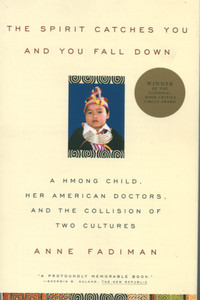
While The Spirit Catches You and You Fall Down, by Anne Fadiman, is not about religion, it is all about religion. The tragic story of Lia Lee is one where Hmong lives, completely immersed in what we would term “religion,” came into conflict with American perceptions of what religion should be. One of the events in Lia’s life involved the government removing her from her parents for their failure to follow doctor’s orders. Fadiman notes that this has been an issue is court cases with Christian Scientists and Jehovah’s Witnesses and other groups that refuse certain kinds of medical treatment for religious reasons. Adults may refuse—it is their constitutional right—but children cannot be subjected to an adult’s religion if it endangers their lives. Here is the rub; American religion only stretches so far. Sure, many of the faithful pray for loved ones, but they also trust the doctor’s knowledge. Not too put too fine a point on it, God doesn’t seem to do the healing unless the physician is involved. For many from traditional religions, like the Lee family, that is hardly trust at all.

Much of the problem in Lia’s case came down to taking the soul seriously. It is clear that the Hmong believe, really believe in the soul. It is the essence of a person. Reductionism declares that when all the matter is burned off, no soul remains to be found. Lia’s parents, however, could tell whether her soul was present or not just by looking in her eyes. Although she never recovered from her major seizure, the physicians had tried to prepare her parents for Lia’s immanent death. Removing her from the feeding tubes and sterile conditions of the hospital, the Lees took her home where she survived for years, although in a persistent vegetive state. Even as the book ends with Lia at seven, they are hoping for her soul to return. Lia died just two months ago, at the age of thirty. She was diagnosed as terminal at the age of four.

Diversity adds color (from Wikipedia Commons)

The story of Lia Lee is sad and one with no real villains (after the Secret War in Laos, and its aftermath). One of the most interesting aspects revolves around how the Hmong observe American religion. Well-meaning missionaries tried to convert them, but psychological studies have demonstrated that those who are the worst off are those who converted to western religions. At one point a Hmong girl, at a sacrificial ceremony to placate the spirits, tells Fadiman that she’s a Mormon. In another instance a Christian family tried to give their Hmong neighbors advice before a long drive, telling them they should pray to the Lord, not their ancestors. The Hmong honestly replied that the Lord had given him too many problems in America. It seems to me that the real issue here is just how seriously religion is taken. To the Hmong, it is their life. In capitalist America, it is very difficult to make religion your life. Even clergy have to have bank accounts, bills, and oil changes—all very secular aspects of life. If religion were taken as seriously here as among the Hmong, we would be facing a very different race this November.


Disease Divine

Diseases, for most people of the modern West, are difficult to diagnose as divine. At my wife’s urging, I’ve been reading Anne Fadiman’s The Spirit Catches You and You Fall Down: A Hmong Child, Her American Doctors, and the Collision of Two Cultures. I have a feeling I’ll be commenting on various aspects as I read through it, but something caught me almost immediately. Although the book is not about religion, the culture of the Hmong (about which I knew nothing just hours ago) is truly imbued with religion. Our medical science is, well, science (unless perhaps you’re from Athens, Georgia). Western culture since the Enlightenment has come to understand many of the body’s systems intimately, discerning just which chemicals to proscribe to treat this or that electro-chemical reaction in the body. And we consider it normal. Epilepsy, the condition of Lia Lee, is a disease that, as Fadiman points out, has had a long divine pedigree even in the west. The Judaic tradition at various stages considered it demonic possession, the Romans understood it as a kind of deity-induced madness.

Interestingly, Fadiman uses the case of Tony Coelho, an epileptic and congressmen, to make a point about the Hmong community. Coelho, she notes, had been intending to enter the priesthood but the Church has a canon forbidding ordination to an epileptic. This gave me a considerable pause. Clergy in many cultures must be “perfect” physical specimens. According to the Hebrew Bible, men who had certain deformities “down there” were disqualified, although, one notes, that they would have served fully clothed. Epilepsy, having been putative cured by Jesus many times, might seem a strange disqualifier from priesthood. I wondered why it was singled out from among the many maladies that might have seemed more pressing. Even in our enlightened age, epilepsy still bears the scars of the divine.

Narrating the experience of the Hmong in a Thai refugee camp, Fadiman notes that the subtext was often conversion. As she points out, for the Hmong medicine is religion. Although the missionaries had converted some, their very enthusiasm ensured that the Hmong would not generally go to them for treatment. Here is a stark difference between a people whose religion permeates every aspect of their lives and westerners for whom religion is compartmentalized in a different place than medical science. For the Hmong, wellness is part of a larger picture from which religious belief simply can’t be separated. For some epilepsy is a disease to be cured, if possible. For others it is a sign of a budding shaman. I look forward to reading more, as it is clear that by shifting perspectives, even the enlightened might have something to learn from those they deem uneducated.


Parsing God

Being married to a Girl Scout leads to many benefits beyond just the cookies. Not that cookies are unimportant, of course. Having been a Boy Scout briefly back in the 1970’s, I recall three-finger salutes, rambunctious meetings, and the occasional camping trip complete with the rabbit coming out of the hole, going around the tree and then something else. I’m sure there was a Boy Scout pledge, but I can’t remember it. Like most group activities, Boy Scout meetings served mainly to remind me of my own inferiority, and so my mind does not often enjoy visiting those places. Having attended a few Girl Scout meetings over the years as my daughter was growing up, I heard the Girl Scout promise a few times, and was a little surprised that the phrase, “To serve my God” has remained unaltered, even with the changing face of the population. When I attended an event hosted by the Elks, the civic organization, the presenter began by explaining the rules for who might join. It too, is limited to theists. The reason for such admission requirements has me pondering if there was a time God was an endangered entity in the United States. If not, why insist on this proviso?

I’ve been reading about religion’s role in society. Something that those who seek primarily the deep, personal and experiential aspect of religion may not realize is that religion is a form of social order. Scientific knowledge about God, if God be incorporeal, non-material, and beyond space and time, is impossible. Religions don’t prove God’s existence, but they serve to reinforce the sanction of the sacred for human society. They have an essential role in that drama. By limiting membership to believers organizations such as the Elks are merely asserting their belief in the working of the system. Of course, from the beginning those who do not believe risk little by claiming they do believe.

But what of the doubter, who may be the truest believer of all? Some Girl Scout literature has a footnote, parsing God: “The word ‘God’ can be interpreted in a number of ways, depending on one’s spiritual beliefs.” Belief is a form of commitment more than a mental certainty. In the Hebrew Bible belief was not as strong a suit as obedience; and thus it had been for the history of organized religion. Starting perhaps as early as Jeremiah, a shift began to take religion more toward a matter of internal commitment. In the face of utter loss, Jeremiah (or one of his fans) suggested that belief was more important that unthinking obedience. Belief is very subtle but vitally powerful. Lives are staked, and sometimes lost, on it. So while you’re enjoying another cookie, try parsing your belief. Me? I’m still trying to figure out when that rabbit goes back in the hole.


Bart’s Gospel

One of the near constants of the entertainment world is the social commentary on The Simpsons. The morality issues that get frequent play had led to a book entitled The Gospel According to the Simpsons some years back. And since Americans like their morality straight from the popular media, The Simpsons is not a bad place to look. The episode “My-Pods and Boomsticks,” although a few years old now, raises issues that are still current in our culture. I watched it with my daughter recently and she commented, “It’s just like Zeitoun.” My family read Zeitoun this summer (some high school reading programs have a way of involving more than just the student) and the revelation of just how deeply suspicious the nation is of Muslims disturbed us all. This particular Simpsons episode involves a Muslim family from Jordan moving into Springfield. Although Bart befriends their son, Homer just can’t get over the assumption that Muslim equals terrorist. In the end, however, it is Homer who ends up dynamiting a bridge rather than believing Muslims can be good citizens.

Apart from being the longest running primetime animated feature in history, The Simpsons bucks the convention of veering away from religious topics. Indeed, many episodes foreground religion and feature Hinduism, Judaism, and Buddhism as well as Christianity and now Islam. The religions may be gently chided, but they are not mocked, and we are given a glimpse into our own religious biases. Islam, as a religion, is not evil or bent on destruction. Like Christianity, it has many varieties and believers range from the sacred to the profane. It is not the religion that is a problem, but the society that gives the lie to true equality. Believe what you will; harm no one.

At work the other day I received an office memo about lunchtime Yoga. Whenever I see such notices I consider how this religious practice, in American minds, has become completely secular. The same may be said of some of the martial arts which, in original contexts, have a deep base in eastern spiritualities. These things do not bother us because we do not bother to learn about them as religious activities. Even Kung Fu Panda has a spiritual undertone. Religions display a wide variety of expressions throughout the world. Going to church one day a week and condemning those who believe differently all seven, many people do not stop to think of the contributions that other religions have made to our society as it exists today. American culture, while predominantly evolving from a Christian base, has strong elements of most of the major religions that go unrecognized or packaged as secular self-helps. We could still stand to learn a thing or two from Springfield.


Ban This

It should be a scarlet letter week. In honor of Banned Book Week, I’ve started to re-read Kurt Vonnegut’s Slaughterhouse-Five. Somehow I made it through high school and college without having been exposed to Vonnegut. A friend started me reading his works when I was about ready to start my Master’s degree, and I’ve always enjoyed coming back to him. When my daughter asked me why Slaughterhouse-Five had been placed on The List, I honestly couldn’t guess. Banning books, of course, is a scheme chiefly intended to keep children unexposed to ideas that adults find uncomfortable. We can’t go around telling other adults what not to think (although that hasn’t stopped many a religious tradition from trying), so some individuals figure that we can protect our unthinking young by putting in the corner literature that asks awkward questions. More radical conservative elements suggest destroying them. These are the true grapes of wrath.

Ideas can be wonderfully dangerous things. We now face a brave new world of internet access where ideas float lightly on the web and unless we watch our children constantly, we can’t control what they might see. Ideas as traditionally expressed in literature go through a tremendously long and convoluted birth process. We even use the language of conception to describe how they begin in one’s mind. Ideas implant, gestate, and grow. For the writer this might represent weeks, months, or years of writing, erasing, re-writing, and yes, parenting the idea. The written book has to meet the approval of publishers and only after yet another editing process are they pronounced fit to see the light of day as books. Having passed through many hands, many heads, such ideas become part of their culture. If we find them objectionable, well, isn’t that just part of life? Perhaps that is the largest message to be gleaned from the world of books: no one will be pleased with them all. Even the diary of a young girl will raise alarm.

Some of the finest literature to escape human minds has been challenged or banned. Ironically, in the land of the free and the home of the brave fear of books runs at a fever pitch seldom encountered elsewhere. Afraid of mice and men. What has made this country such a wonderful experiment—the embracing of diversity—has somehow morphed into a neighborhood where nobody feels safe if there are objectionable words on the bookshelf. Ironically Ray Bradbury’s critique of banning books, Fahrenheit 451, is itself a banned book. What most proponents of stopping literature probably don’t realize is that according to OCLC, the source for library data, the most banned book of all time is the Bible. To be honest, those who’ve read it know that it has sex and violence and many other adult situations. In the original languages there are even “swears.” Maybe it’s time people just grew up. The best way to accomplish that is to read a book. Hey, it’s a jungle out there.


Who’s Got the Keys?

Having grown up Protestant, I assumed that was normal. Adults, who have the benefit of years of negotiating with other adults in ways that may seem unsavory to children, have the definite advantage here. Children believe what their parents tell them, and should the matter come down to eternal life or everlasting damnation, you sure want them to have your back. Sunday’s New Jersey Star-Ledger has a perspective piece by Tom Moran, whose parents raised him Catholic. Catholics and Protestants are Christians divided by a common religion. As I have studied the teachings of each over the years, it has sometimes felt impossible to fit the two together in any meaningful way. They both think Jesus is cool, but beyond that, the disagreements almost immediately begin. Moran notes that in the US fewer than one in four adults identifies as Catholic although one in three was raised in that tradition. His article goes on to outline how Catholicism has frequently aligned itself with law at the sacrifice of compassion. Sounds like religion to me.

Religionists place great, perhaps even eternal, stock in being right. The Catholic Church has traditionally considered itself expert in issues of reproduction, a conceit that is only more bold when it is regulated by celibate men. And the source can’t really be the Bible since there are plenty of places where the good book is a little naughty. The biblical understanding of reproduction was a conclusively unscientific postulate. When microscopes, not telescopes, revealed what was going on at the microscopic level, theology should’ve blushed and excused itself from the room. Instead, the church proclaimed that it knew better than any bespectacled intellectual; after all, unwavering tradition must count for something. This bears the imprint of a system with little left but theological bluster. And it’s losing its thinking members.

Moran interviewed Newark Archbishop John Myers, a man concerned with the sanctity of marriage and who has a questionable record of reporting abuses, for his story. As Moran pointed out, Myers has not been the outspoken advocate of the poor, but he does back the candidate with sacred underwear. I’m not sure when the last time was that the good Archbishop took a drive around Newark. It is hardly a little piece of heaven on earth. Even waiting for a train in the station can fill a customer with a sense of despair. God’s will, apparently, is somewhat more narrowly focused on what consenting adults do behind closed doors. The level of disjunction is enough to throw the Popemobile out of alignment. Of course, I write all this from the sidelines. I was raised Protestant, and no matter what the Mormons or the Catholics say, I was taught from my youngest years that they’re just plain wrong.

Those are some big keys…


Watch, and Pray

Religion is a lucrative business. There is likely a deep, evolutionary urge for fair play nestled somewhere in primate DNA. Monkeys and apes seem concerned about it, and certainly nothing gets people more upset than a cheater who does prosper (unless he, less often she, is the protagonist of some gangster movie). Most of us work pretty hard to make a living, often doing tasks that push us beyond our comfort range in order to ensure some kind of success. The same is true of clergy. Yes, stories of lazy or lackadaisical ministers abound, but many work long hours under often stressful conditions. Most are not paid very well. Their eyes, according to unwritten writ, are turned toward a larger prize. In an economy that has become a nearly universal capitalism, everything has a price. People want to feel that they are pleasing God but there are oh so many rules and regulations! The Hebrew Bible alone has 613, and then add the Christian Scriptures and two millennia of ecclesiological dogmatism and you’ve got one hefty bill. We don’t mind paying a bit of that for a religious specialist to take care of the details while we get on with the real business of life.

Now add a little math. How many people does it take to add up to a small fortune? Already by the Middle Ages the Catholic Church, really the only show in town across Europe, had amassed a real treasury. Although individually the clergy could claim to own nothing, collectively they were flush. Even today the wealth (and therefore power) of the Vatican is nearly beyond comprehension. A colleague recently pointed me to a story I had missed back in April. This involved the computer age and lucre in an unexpected place. Russian Orthodox Patriarch Kirill I was photographed sitting at a high-gloss table, wearing a Breguet watch valued at $30,000. There was an outcry. The Russian Church, long under the pressure of a communist state, could hardly be described as opulent. Well, liturgical vestments and accouterments are expected to be costly, but personal items such as watches, are expected to be modest. Thirty-thousand dollars is a lot of money to be reminded of when to show up for mass.

In response, some church leaders turned to technology for a solution. The watch was Photoshopped out of the picture and, as if a miracle, the scandal disappeared! Except they forgot the glossy tabletop—the reflection of the watch, like Dorian Gray’s portrait, remained as evidence. (The story may be found here, along with the damning photos, if you can stand the snarky writing.) Owning such a watch may be considered bad form among the humble clergy, hiding it, however, is even worse. I don’t mean to single out Patriarch Kirill—the Russians have had a pretty rough go of it, what with Stalin and Reagan and all—but religions seldom like to have their coffers examined. The laity will pay handsomely to avoid the extra work salvation demands. Herein lies the rub: salvation has become less tangible as material wealth has expanded. Many people have mistaken one for the other. It’s just that they don’t want to get caught enjoying a little too much of the one at the expense of the other.

Now watch this, for time is fleeting


A Cougar’s Mother

While on a stroll between appointments at Indiana University in Bloomington, I came across a tree with flowers laid underneath and a memorial plaque at its base. I glimpsed the name Mellencamp, and for a fan of rock, it didn’t take much imagination to tie it to John Cougar. Indeed, the memorial is dedicated to his mother, an artist, who died earlier this year. I first came to know of Indiana University because of music. I married a musician who, like myself, had to sacrifice a career doing what she loved in order to “get by.” Although she hadn’t studied at Indiana, my wife knew the reputation of the campus well. At a sunny moment between appointments I sat outside one of the music buildings listening to students practice through the open windows and read about Marilyn Mellencamp. An article in a local paper explains that this week an exhibition of her art is on display in Bloomington. When I read the quote from Waldron Arts Center Gallery Director Julie Roberts that the arts “are viable ways to make a living and they are vital part of being a happy and alive person,” I felt a renewed sense of hope. There are others, it is clear, who see that the arts are called the humanities for a reason. In a culture where only money matters, there is no culture. Think about it.

Since the industrial revolution we’ve been told that the measure of a human is how much money they are able to make. Something profound has been lost since then as great universities cut programs for the arts and humanities while business departments build new facilities. Talk about gaining the world but losing your soul—business cattily replies, “I have no soul.” While John Mellencamp never rivaled the biggest bands for income, his work, particularly Scarecrow, is full of human empathy. I listened to that album over and over in 1985, recounting the farm crisis and the demise of those not driven by corporate greed. And looking at this maple tree I wonder when the last time was that someone honestly mourned the death of a corporate mogul.

It is the mark of a deeply schizophrenic society that we all aspire to what fails to inspire. Our economy is driven by the material—money—and not that which speaks profoundly to what it means to be a human being. We keep the arts alive because the wealthy require something worthwhile upon which to spend their lucre. Is not buying art buying part of another person’s soul? We can’t define souls materially, science must conclude they don’t exist, but every time you say, “I feel happy/fulfilled/satisfied” you belie the facts. Souls may not be material, and they may never be found in laboratories. They are nevertheless part of the human constitution, and I for one, would lay a flower under a tree and know that it is more than just fertilizer for the next growing commodity.


Private Property

I’m receiving a government-sponsored massage at Newark’s ironically named “Liberty Airport.” Like most federal freebies, this massage leaves me wanting. Now, I’ve had many pat-downs to protect me from people like myself, and each time I find myself feeling like so much meat for politicians’ pork-bellies in this culture of fear. I am afraid. It isn’t terrorists who worry me, but my own elected (sometimes) guardians. When being a citizen is considered the same thing as an enemy of the state, there is a problem. In the line next to me is an infant-in-arms being given a pat-down by a stranger. Yes, ma’am, my tax dollars help pay for that. Please, don’t bother to thank me. It will be only the first of many.

The last time I flew was from London to New York. In Heathrow US citizens aren’t sent through the humility of full-body scanners. Only a nation afraid of its own does that. I often ponder what this means. Frequently I hear, “these colors don’t run.” I wonder if it’s because they’re too busy sticking their hands down their own citizens’ pants. Home of the brave? Only if bravery means giving in to the intimidations of terrorists. I’ve fallen off a bicycle a time or two. One time it was with pretty messy results. I’ve even actually fallen off a cantering horse. (That may explain a thing or two.) As a child I was always told that you need to get right back on and try again. After 9/11, however, our country showed its naked fear in the overregulation of air security while continuing deregulation of the airlines. Money does not guarantee a secure future.

If our government has a desire to see its citizens naked, what more need they do? They know every penny we earn or exchange, taking a cut each time, and the only way to get on a plane without hassle is to let them view everything. It’s not good for my Constitution. Our Constitution. Moral outrage, however, is apparently a thing of the past. Full-body scanners may be science, but I still believe in the humanities. And when a babe in arms is considered a threat to national security, I have to wonder what we’re truly afraid of. And next time do you think you could use a little more pressure on my neck? I feel like I’m coming down with a wicked headache.

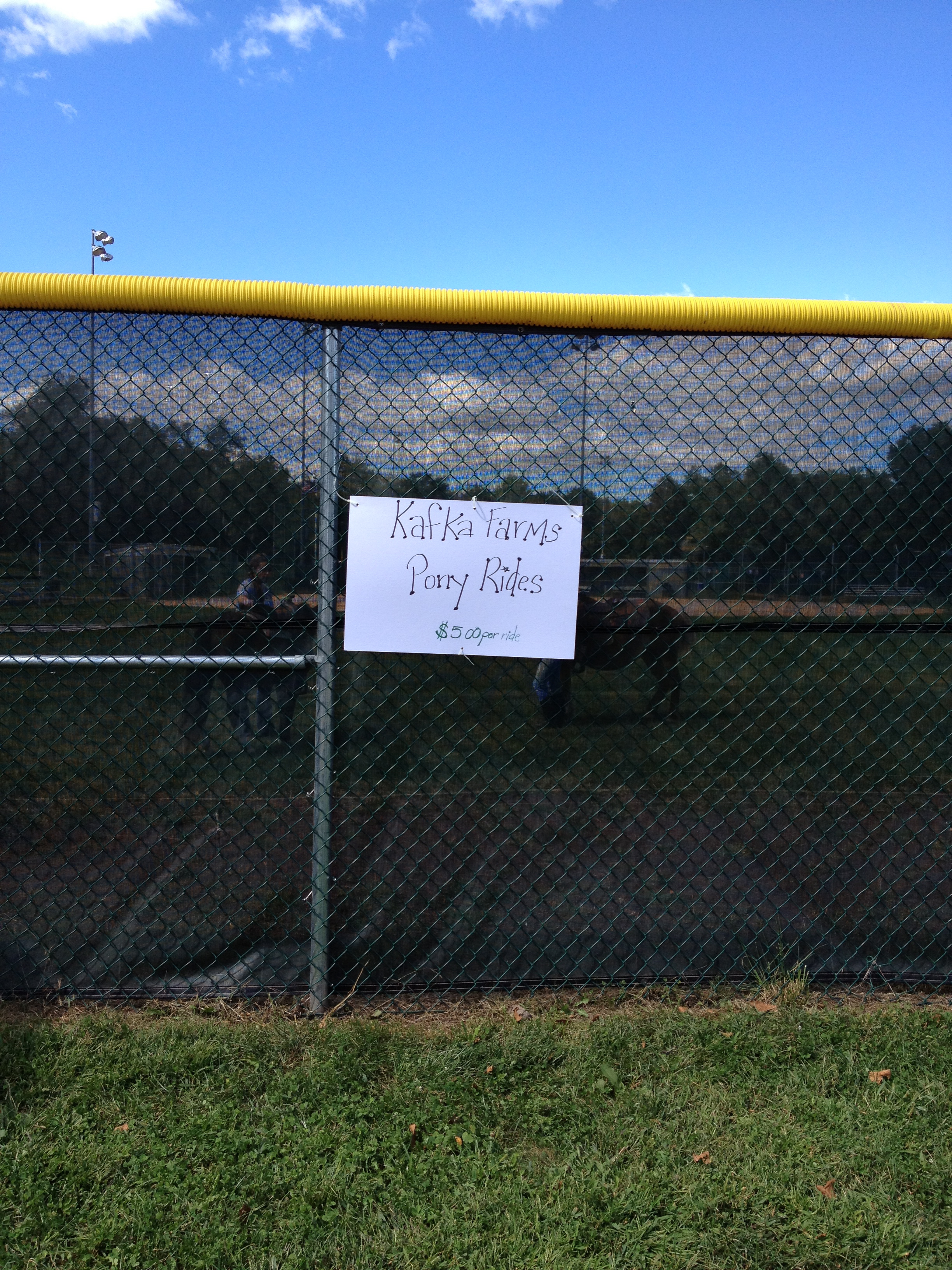
Read the sign


Assaulting Pepper

“I’m a Pepper, he’s a Pepper, she’s a Pepper, we’re a Pepper,” so goes a jingle that is still in my head decades after I last heard it. Early in my marriage I learned that Dr. Pepper was my wife’s favorite, and we sometimes purchased it by the case when we felt daring. I seldom drink soft drinks anymore, having converted to a more juice-oriented penchant with the increase of years and poundage. I always found it to be a pleasant flavor, however, and it was a frequent choice in those halcyon days when I could eat or drink without much regard for potential tonnage. My wife resurrected my interest in the cola with a link to Time’s NewsFeed announcing that some Creationists are boycotting the soda because of an ad that looks like evolution. The ad campaign shows the evolutionary progress chart we’ve all seen with the tipping back of a Dr. Pepper making the ape human. Creationists aren’t known for their sense of humor, but boycotting a drink because of implied heresy implies a fascinating study.

Boycotting companies that offend moral sensibilities is not an unreasonable response to ethical dilemmas. I haven’t shopped for some products for years because I don’t like what the company does. My choice, I’m sure, has little impact but it makes me feel better about myself. Sometimes the choice is religiously motivated—if I don’t want to support a particular group I won’t buy a product they offer. Secular companies, however, seldom offend theological sensitivities. I, for one, would seldom know the guilty party: the founder of the company? The current CEO? Someone in upper management? An advertising director? Do all employees have to agree with my religious outlook? Ahh, but then there is the political angle.

This is a presidential election year and the first one since 1980 without a Republican candidate who is a darling of the Religious Right. Not to suggest that Reagan or Bush the First were really as religiously orthodox as they were presented, but the perception of their friendliness to conservative Christian causes went unquestioned. With a “liberal” in the White House and the only viable alternative a mysterious Mormon, frustration must be building. On top of it all, Dr. Pepper is showing a funny image that might be interpreted as suggesting a simian forebear to those who drink the stuff! I think I understand the anxiety, and it might help if they just had a drink to calm down. After all, “wouldn’t you like to be a Pepper too?”

Dare to evolve


Last Call

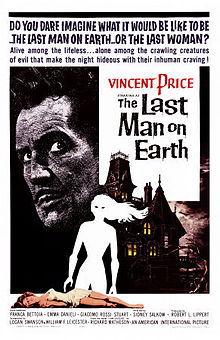
A believer in equality across media, I decided to balance out my recent viewing of The Last Woman on Earth with its chronological sequel, The Last Man on Earth. I have seen I Am Legend a time or two, but I have not yet read the Richard Matheson novel. Knowing that the first cinematic attempt at the story was the Vincent Price version, I was curious to see what the last man and the last woman had in common. Not surprisingly, it was a church. The story has been around long enough that spoiler alerts are superfluous, so here goes: basically, vampires have taken over the world. Somehow Robert Morgan has survived and spends his days hunting vampires and whiling the nights away with jazz and booze. As the opening sequence rolls, the camera lingers on a church where the marquee reads “The End of the World.” Of course, in a quasi-literalist sense this is true. Robert is the only non-infected person left. He is eventually located by the infected-but-inoculated crowd and chased down to be staked to death at the altar of a church. The culmination is strikingly similar to The Last Woman on Earth where the final scene also involves a death at the altar in a church.

The noticeable difference, however, revolves around gender. There is very little in the way of sexual suggestibility in The Last Man. Even the scenes of Robert with his wife are chaste and emotional distant. The appearance of Ruth does not even tempt him after three years alone. The Last Woman, however, revolved precisely around this axis—one woman, two men. The sexual tension is the fuel that moves this entire movie along. Of course, the 1960s became the decade of the sexual revolution, but even so the female is decidedly an object in Last Woman. Even in The Last Man, the woman leads to Robert’s death. She was sent to betray him, and although she changes her mind and attempts to save him, it is in vain. Robert dies in her arms. This fear of female power has never dissipated. How many women have been elected president since the 1960s?

While maybe not the heart of the matter, religious constructs may be the lungs or stomach of the situation. Although current religious thinking often insists on equality of the sexes, a tremendous cultural freight placing women in an inferior status continues to weigh heavily on our cultural mores. The largest Christian body in the world still denies women access to the priesthood. Even the idea of denying access underscores just how deeply this sentiment runs. The movies of the early 1960s had neither the budget nor the cultural support to suggest that things should change. Indeed, in both Last pictures the message was that the world had ended already—why bother trying to change anything at this late stage? The final shot, the stolid interior of a church, underscored the message: the status quo has the sanction of the divine.