Like Clockwork

It is probably safe now to reveal something that occurred at Grove City College over a quarter of a century ago. I often feel I must justify my choice of college, but I was a first-generation college student who knew nothing about higher education. I was raised with a Fundamentalist orientation, Grove City was a “Christian college,” and it was only about 30 miles from home. I do give Grove City credit for shaking me out of my Fundie way of thinking; as a religion major I met some genuine honest thinkers in the department who let me question the inconsistencies of Fundamentalist beliefs. I broke free in my own time. One of the literature professors, however, insisted that we both read and watch the movie version of A Clockwork Orange. It was my senior year and I felt ready to handle it. As I watched the movie again over the weekend, the first time since college, I was shocked that the institution Grove City College has become would have ever allowed such a movie to be shown. Although there is Kubrickian nudity, the movie was initially given its rating because of the violence, which, by today’s standards, is somewhat tame.

Anthony Burgess’ book is so well known that I don’t need to summarize the story here. What struck me in a new way was the religious element in the plot. While Alex is in prison, and wanting to be reformed, it is the prison chaplain who advises him against it. Undergoing the famous movie treatment, Alex indeed proves docile after testing, leading the priest to declare, “He has no real choice, has he? Self-interest, fear of physical pain, drove him to that grotesque act of self-abasement. Its insincerity was clearly to be seen. He ceases to be a wrongdoer. He ceases also to be a creature capable of moral choice.” Of course, the government is satisfied with this kind of morality, the sort that upholds appearances at any price to humanity.

What I find particularly disturbing is Burgess’ prescience. A Clockwork Orange was published fifty years ago, and since that time we have seen politics shift from care of the citizen to the ultimate window dressing of courting the Moral Majority to make it look as if all governmental decisions are moral. The Tea Party seeks to underscore that charade, claiming that all who would argue for Alex’s humanity deserve the fate that he so wrongfully dispensed before his “reform.” This view of the world suffers for its lack of complexity. Humans do not come in black and white. Ironically, Burgess chose to make the clergyman the only the objector to the inhuman treatment imposed on Alex. This is the kind of dilemma on which Stanley Kubrick thrived, but it has become even more poignant in the decades since his movie was released. True, Kubrick’s film is based on the apocopated American version of the novel, perhaps obscuring the intended meaning of Burgess. But isn’t that exactly what he was attempting to do?


New Salzburg

For some reason Austria is on my mind. It been more than two decades now since I have been there, but I recently decided to read a little of the history of Salzburg. My interest revolved around a case of religious intolerance that took place well before the days of political correctness, but after the idea of religious freedom was being promoted in New World colonies. Two centuries after Martin Luther’s theses stirred the world (perhaps the last time in history a religious thesis has received such attention), the Roman Catholic Archbishop—and Count! (rank has its privileges)—Leopold Anton von Firmian decided to expel the Protestants from Salzburg. Religious diversity was frequently seen as a threat to civil authority. Either Protestants would recant or be forced from their homes in the winter, often losing everything they had in the process. A substantial number of citizens were exiled and found little in the way of refuge. Prussia finally offered some quarter and others made their way to England or to a then religiously tolerant Georgia.

Religious imperialism is a funny phenomenon. Religions, as sets of teachings, often emphasize the just and fair treatment of other people. When powerful people (or power-hungry people) become religious they find a great mind-control technique available in it. Popes, for instance, very quickly ceased being pastors and instead styled themselves as princes. This was a safe move since Jesus was king, and since he’s in heaven any attempts at usurpation are bound to be suspect. As a co-regent, however, various privileges apply! This is something Protestant reformers very swiftly learned as well. John Calvin was practically in charge of Geneva, and who can think of Lynchburg, Virginia without accounting for Jerry Falwell or Virginia Beach without Pat Robertson? Religion, by its genetic nature, seeks to take over and control.

In this it is not so different from other aggressive ideologies such as capitalism or communism. The problem is that religions claim sanction from the highest authority, and once a believer is convinced of that no amount of reason is sufficient to dissuade him or her. So it was that an Austrian Count, also an Archbishop, decided to turn out members of his own putative religion (Christianity) into a harsh winter where many would die and others would live the remainder of their lives in exile. Were this the hallmark of one religion alone we might have united together as a species and cast it out. Unfortunately history has repeatedly shown us that even the most placid religions can quickly form the dark face of a demonic storm front if certain of their privileges are threatened. No one likes to be wrong. In the game of religions, however, there must be losers if anyone is right. Where is the New Salzburg? It may be going by a different name these days.


Digging Deeper

A propos of apes, I’m not sure whence derives the draw of Planet of the Apes on me. I watched the movie with fascination as a child—since the obviously satanic delusion of evolution was impossible this had to be pure fantasy (and perhaps just a little dangerous). The movies just kept on coming, Beneath the Planet of the Apes, Escape from the Planet of the Apes, and Battle for the Planet of the Apes, each with their new twist on the theme that we are the beasts. Recently I watched the second installment, Beneath the Planet of the Apes. It had been years since I’d seen it, although I remembered the terrible mutants and their possession of an atomic bomb. Although the geography is badly distorted, it is made amply clear that the church where the bomb is stored is St. Patrick’s Cathedral on (beneath?) Fifth Avenue. As Brent makes his way into the partially intact cathedral he finds a priest praying to a missile with the letters alpha and omega inscribed on one of its fins.

Since last seeing the movie I spent a lengthy stint among the Episcopalians. Naturally I became thoroughly acquainted with the liturgy and therefore could appreciate subtleties in the movie I had missed before (nothing is ultimately wasted, it seems). As the mutants prepare to set off the doomsday bomb that will obliterate the entire planet—both apes and humans—they recite many prayers from the mass, substituting the word “bomb” for “God” and “Holy Fallout” for “Holy Spirit.” Okay, so maybe “subtleties” was the wrong word. Of course, back in the early 1970’s this was a very real concern, the arms race was well underway. Despite the overacting and forced script, the movie did offer considerable social commentary. Ironic and iconic Charlton Heston condemns the unadulterated praise of such a lethal weapon (or was it just missile envy?), even as he falls, shot, onto the controls, accidentally destroying the earth.

The fascinating aspect of this social critique is that the players may have changed, but the drama remains the same. Those who protest evolution praise the build-up of native strength so that the true Christians might obliterate their enemies first and better than they will obliterate us. One gets the feeling that destruction is not so bad a fate as being proven wrong. Somewhere along the millennia religion slipped its mooring from being an ethical way of life to become an extreme way of believing. And yet people are still the same. And the Planet of the Apes movies continue to appear, ever evolving. When it comes down to the final scene, however, it is not the evolved apes who destroy us. No, it is the utterly self-righteous humans who decide that if they can’t have it all, nobody will have any of it. In the name of the bomb, and the holy fallout, amen.


The Times they are a’Chanin

Across from Grand Central Terminal in Midtown Manhattan rises the Chanin Building. Named for Irving S. Chanin, the tower is no longer easily picked out among Manhattan’s dizzying skyline, but the building is a monument to the humanistic spirit that was beginning to flower in the 1920s between the harsh realities of the world wars. Outside the building, above the ground floor shops, runs a bronze frieze that still catches the breath of visitors who stop to stare for a moment or two. Interestingly, the frieze is a monument to evolution, showing the development of “lower” life forms among the water flourishing into birds and fish. Although prosperity gospelers would object to its inherent Darwinian message, they would appreciate a huge monument to the triumph of capitalism in Chanin’s dream, as much of Manhattan reflects.

Antipodes are a fact of geography and human understanding. It would seem that they are also a paradigm for those who “want it all.” Perhaps it is ironic in coming from a Disney movie, but I’ve always found Mary Poppins’ maxim apt: “enough is as good as a feast.” Indeed, leaving the table after eating more than I need I feel miserable and disgusted. There is only so much that people can have, and this is a matter of physics as well as biology. If God wanted us to be wealthy, why didn’t he make us that way? (Surely the God who promotes personal wealth must be male.) Evolution and capitalism could be a dangerous mix should we forget that evolution is not goal-oriented. Natural selection works by trial-and-error, only the trial isn’t planned or intelligent.

This dialectic reminds me of that old chestnut, Beneath the Planet of the Apes. Ursus, the gorilla warlord, gives a jingoistic speech concerning the Forbidden Zone. “It is therefore our holy duty to put our feet upon it, to enter it, to put the marks of our guns and our wheels and our flags upon it.” Of course, this second, lesser installment of the Planet of the Apes movies raises the entire specter of nuclear war to a disturbingly sacred level, but that’s a topic for another post. What I notice is the full circle of evolution here—not just human to ape, but human to capitalist ape. Apes that wish to own and control their entire world, including that region where, in the original movie, both ape and human fear to go. It should not surprise me to see talking apes in Manhattan, but then again, it might just be the bright sun reflecting off the bronze of Irving Chanin’s monument to economic growth.


For the Love of Gold

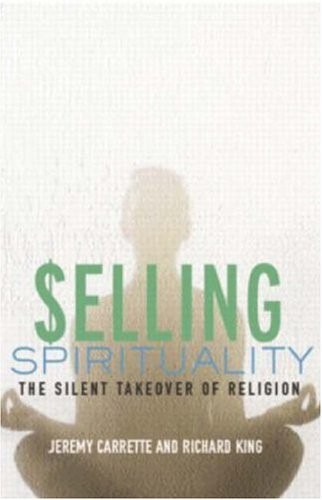
Do you ever get that feeling that you’ve been led along by a false premise that has gotten out of hand, like a practical joke that has gone too far? If I had to rate the books discussed on this blog in terms of urgency, Jeremy Carrette and Richard King’s Selling Spirituality: The Silent Takeover of Religion would top that list. I’ve felt for a long time that something’s been wrong, but I didn’t possess the training or resources to discern what it might be. I think Carrette and King may have named it. Just a few pages in and I knew there was profound insight here. Religion has been taken over by capitalism and the result is that alternatives to the godless, sanctified free market are rapidly disappearing. In a truly Orwellian sense, we have been taught the language of capitalism and have lost the ability to frame our ideas in any other way. Free markets take no prisoners—one must assimilate or die. Religions, which had traditionally served as correctives to selfishness and greed, have been co-opted into the forces of unbridled gain for the few. Amorphously marketed as “spirituality,” what sounds like religious conviction now lives in the service of consumerism.

By slowly shifting all our language and metaphors into those of Reaganomics (the very fact that you know what that means shows how far gone we already are) the capitalist machine, supported by the flaccid terms of spirituality, has established a new god—capital—and has pilloried any who dare question it. Think of the trashy phrase “prosperity gospel” for just one minute and you’ll see what I mean. Those of us who disagree with the orthodoxy that meaning can be found in money have become the resistance in a war we did not start. The twin hellions of privatization and corporatization have sunk their fangs deeply into the jugular of society and its old-fashioned value of caring for others. People are, like strangers in a strange land, just marks for the powerful. We’ll buy anything if it looks attractive enough.

The problem with consumerism is that it is easy. We all love to play along because—who knows?—we might end up getting rich in the process. We have gained the world and lost our souls. Carrette and King show clearly how entrepreneurs have learned to market the language of religion while divesting it of its venom. Go along, it urges, everything is fine. Even the economic collapse brought on scarcely two decades after Reaganomics has failed to convince the average citizen that they are but a petroleum bi-product to grease the unrelenting gears of commerce. Anything, even salvation, can be sold. Back in April I stood beside the graves of Eric Arthur Blair (George Orwell) and Karl Marx. And maybe in an unguarded moment I shed a tear or two that critical thinking seems to have been buried along with those who were brave enough to state the obvious.


Double Exposure

Back when I was teaching full time, one of my favorite television shows was Northern Exposure. In fact, the fictional town of Cicely, Alaska, had quite a lot in common with Nashotah House. Both were populated by quirky characters in a relatively remote location. Both were small, insignificant places with visions of grandeur. Both were effectively run by conservative forces that liked to imagine themselves as benign or downright noble. Both distrusted outsiders with ideas that might challenge the status quo. One of my favorite characters was Maggie O’Connell, the woman in a man’s world who refused to let the male establishment set the limits to what she could do. A strong woman character whom the men all respected served as an antidote to daily life at the seminary. My wife and I liked the program so much that we even stopped in the town of Roslyn, Washington, where the outdoor scenes were shot, a couple of times on our way out west.

We don’t have television now, so we have to watch Northern Exposure on DVD. While at a hotel recently, however, the name of Janine Turner on the television made me look. I had known that the actress portraying Maggie O’Connell was a political conservative in real life, but here she was advocating an “anyone but Obama” type campaign or some such nonsense. I felt as if I’d been sold a false bill of goods for all these years. Like Margaret Thatcher, Turner believes in socially conservative causes. Margaret Thatcher, that contradiction of a woman who felt that females belonged in the home, had undue influence on a once great Britain. Where was the woman who played such an ardent feminist in a male world? How could anyone pretend that kind of passion in front of a large audience for six years and spent her real life trying to deconstruct a cause that has everyday ethical implications? It’s all an act.

Women have been relegated to positions of lesser prestige for millennia for the crime of caring for their offspring. Men have been free to abandon responsibility and seek selfish ends, if so inclined. No matter what our gender, we pursue in life what is most meaningful to us, and it amazes me when strong women support a structure that has consistently shown itself interested in keeping them down. Vaunted as a show where diverse characters come into constant conflict but always “strive to accept their differences and co-exist,” Northern Exposure displayed depth without eschewing what is laughable about the human condition. Real life, I suppose, it is much more like the small town of Rosyln, Washington. For a few years it was an out-of-the-way tourist stop where actors could play characters they really didn’t believe in while living in a fictitious town where everyone at least attempted to tolerate everyone else.

Do you recognize this character?


Cabin Fervor

It’s a sure sign that work is growing overwhelming when I’m too tired to watch my weekend horror movies. Well, I decided to fight back the yawns and pull out Cabin Fever this past Saturday night. I’d seen the movie before, and I’m not really a fan of excessive gore. The acting isn’t great and the characters aren’t sympathetic, yet something about the story keeps me coming back. In short, a group of five teenagers (it always seems to be five) are renting a cabin for a week when they get exposed to a flesh-eating virus. They end up infecting just about everyone in the unnamed southern town before they all end up dead. It doesn’t leave much room for a sequel, but that hasn’t stopped one from being made. One of the unfortunate victims of the virus is torn apart by a mad dog. The locals, fearing their safety, decide to hunt down the surviving youths.

On the way to the now gore-smattered cabin, one of the locals mutters that they’ve been sacrificing someone—a natural enough conclusion when body-parts are scattered around, I suppose. He says, “it ain’t Christian.” Well, yes and no. Sacrifice is at the putative heart of Christianity, although human sacrifice (beyond infidels and women) was never part of the picture. As is often the case with horror film tropes, the victim who has been dismembered is a woman. The guys whose deaths are shown are all shot. Now, I have no wish to attribute profundity where it clearly is not intended, but there does seem to be a metaphor here. Our society and its staid religion tolerate the victimization of some over others.

One of the hidden treasures of the best of horror movies is the social commentary. George Romero made an art form of it in Night of the Living Dead and its follow up Dawn of the Dead. Many other writer/directors have managed to do it quite effectively. We can critique our world when hidden behind the mask of the improbable. While the commentary for Cabin Fever may be entirely accidental, I still find a little redemptive value in it. That, I suppose, is the ultimate benefit of social commentary—it is true whether intentional or not. Is there a larger message here? I wonder if the fact that when women are victimized no one survives is pushing the metaphor a little too far. It’s hard to say; I’ve been working a little too much lately.


Ancient Wisdom

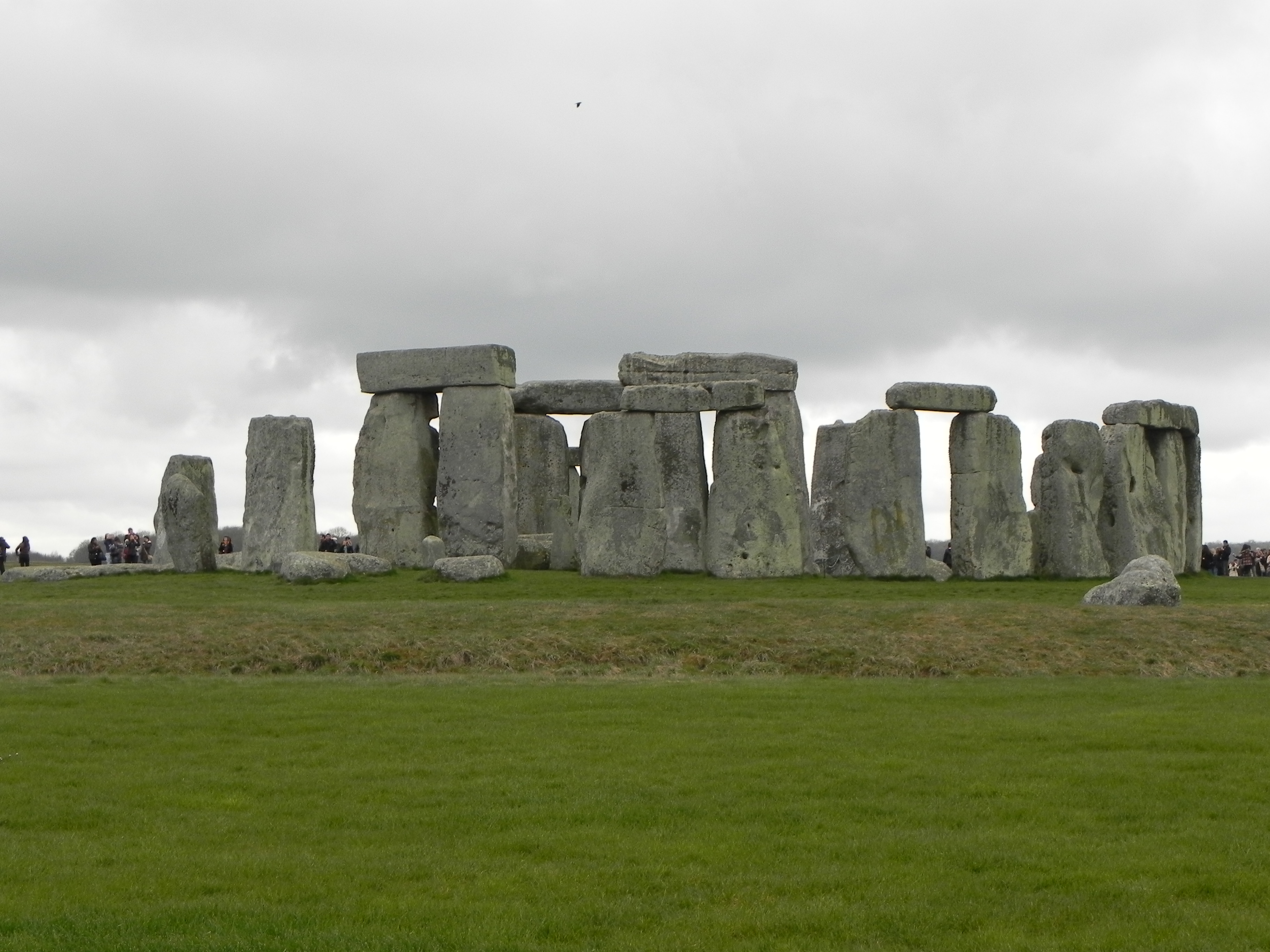
The Huffington Post recently ran a story on Stonehenge. Part of the endless fascination with the ancient monument is that no one really knows why it was constructed. Given the tremendous amount of effort the building represents, it is clear that this was important to the cultures constructing it. The article in Huffington cites archaeologist Mike Parker Pearson as suggesting that Stonehenge was a monument to the unification of Britain. While not as sexy as explanations that draw on human sacrifice, precision astronomy, or alien visitation, something rings true about it. In the long course of human development, we’ve had to overcome many, many hardships. At one time humans were relatively easy prey animals for large predators. Our evolution didn’t endow us much in the way of body armor or built-in weaponry. Our eyesight and other senses pale next to various other animals. Even with all these deficiencies, our biggest challenge hasn’t been nature, but other people.

Archaeologists have also been discovering that a peaceful prehistory to humanity does not match the facts. Warfare and strife have been as much a staple of human behavior as the perennial hunt for food and safe shelter. Civilization involved cooperation at unprecedented levels. People had to trust one another and work to maintain the infrastructure that allowed diversification of talents and abilities. Fighting and wars still occurred, of course, but less frequently and with less brutality. With economies of surplus, however, capitalism also eventually evolved. It is an aggressive organism. It is visible in the greed embodied in the thought process that the only good in life is financial and the only worth of humans can be calculated in dollars and cents. It is this thinking that has erected the monuments more familiar to us today in our cities and centers of civilization.

Stonehenge could never have been a money-making venture (not until the development of capitalism at least). It is in the middle of nowhere, in a sense. The Salisbury Plain is fairly empty—no large cities nearby, no grand scenery as one might find in Cornwall or the Grampians. According to the theory, its location has to do with it being in a very rough middle between various regional cultures. Building impressive monuments is very difficult to do if one has to watch constantly over one’s shoulder. I suppose in my Romantic notions Stonehenge will always represent a mysterious past suffused with unanswered questions. For the present, however, Pearson’s explanation seems more than likely—it sounds absolutely vital in a world so dangerously divided as ours. Perhaps it is time to start a truly monumental building enterprise involving every nation. It will give future generations something to wonder about.

Time to build another henge.


Ms. Found in an Email

The other day I received a distressed message from a friend that I met in college. Marvin’s career somewhat parallels mine; he went on to get a PhD, taught for a few years in New Hampshire until the economy claimed his job, tried to make it as a fiction writer and adjunct instructor for awhile before moving to Boston to work with a publishing company. He’s never made any money for his writing, but that may be for his own good because the money that authors make goes to support the CEO of whatever corporation owns the publishing house. Still, I wish him luck. Yesterday he emailed me about a book he’s reading, The Last Professors, by Frank Donoghue. He’s convinced me that I should read it, but I thought his message would be appropriate for this blog. In Marvin’s words:

“If a more bleak preface has ever been written, I’m an illiterate ape who never reads. The writing has been on the wall for years, but those of use who are able to see it have been hopelessly myopic. In the preface he tells how industrialists since the end of the Civil War have been dead-set against liberal arts education as useless. People like the two of us who studied ‘useless’ fields, they would have as the cogs in their efficient machines, suppressing our thoughts. The only useful education they can deign to approve is one that earns them more money. There’s only one value system in the world, it seems.

“Don’t you feel like a sell-out, working in New York City, that cathedral of capitalism? Is NYU on anybody’s list of tourist stops for people down there in New York? Who goes to visit a university when there’s so much of commercial interest to see?

“And yet, corporate types are the ones who can afford tickets to shows written and put on by people educated in their ‘useless’ craft, but who are in reality their unwitting chattels. And who wants to be seen with authors and intellectuals to enhance his personal prestige, so that he will appear smart? Who are the dogs in the manger who keep everything they can’t possible use for themselves, for fear that others might enjoy it?

“We all play along with their game—we wear jeans on casual Friday and declare how good we have it. We speak their demeaning language, using humiliating phrases like ‘best practice,’ ‘core competency’ and ‘corporate values.’ In this dehumanized state we all live in cages that we’ve helped build. Corporate moguls hold their power over us because we let them. We, the workers, have the power to change it. They make the rules and we obey because we all want to be in their place.

“Education is the way out—that’s why they hate it. There’s an entire support industry built around it; those of us in the book business rely on educated readers. What happened to Borders looks prophetic to me. Time to close—I’ve just arrived at work.

“Sent from my iPhone”

Just another useless lay-about


Hair Cut

“This is the dawning of the age of Aquarius.” So we hear in the first number of the musical Hair. Since my daughter is learning about the 1960’s counter-culture in US History, she asked her middle-aged parents what life was like then. Well, my wife and I were both born in the early sixties and were a little young to get the full scope of things through juvenile eyes. Besides, I was raised in a biblically literalist family—probably not the best place to gain a great deal of insight into popular culture. We decided to watch Hair instead. One of the few aspects of that era I recall is the Vietnam War (something George W. Bush apparently didn’t remember). The optimism of the hippie movement never really came to fruition leaving an entire era of disillusionment to hang over the remaining years of the millennium. Nevertheless, there is a sense of freedom in Hair that conveys the exuberance of young idealism—something I can honestly claim to have never outgrown. Without idealism we, as a species, are lost.

As I watched the movie for the first time in years its biblical subtext occurred to me this time around. The identity of the youthful protestors is in their counter-cultural hair. Indeed, the show takes its very name from that aspect. Apart from the ubiquity of the hirsute righteousness on the screen, it is essential to the plot. As Claude Bukowski stops in New York City on his way to join the army, he falls in with the Philistine element of society—the long-haired (read uncircumcised) misfits who defy the principles of decency. The dinner party at the Franklin residence makes that perfectly clear. When thrown in jail Woof protests over-strenuously to having his hair cut, leading to the title number. When the friends decide to visit Claude on the army base on the eve of his departure for Vietnam, George Berger has his hair shorn (by a woman) and subsequently loses his strength. His vital force of arguing his way out of any predicament is sapped as he marches to the troop transport plane that flies him to his death. Singing about believing in God as he goes.

I have never used drugs—life has a way of being weird enough already without them—but the sixties seem to have had a moral righteousness that the Tea Party just can’t claim. It was a righteousness borne of speaking the uncomfortable truth to a society that honored the status quo above all else. The very status quo ante the Tea Party craves—a society of bigotry and inequality. A society of privilege and strict conformity. A balding society that has lost its voice. Drugs are not necessary to see unbelievable things. One of the Bible’s original Avengers, Samson tears his Hulk-like way through any crowd, felled only by the cutting of his hair. Hair also led to the death of Absalom, the son whose life David valued more than his own. At the end of the show it is quite clear where the righteousness really lies.


Lunchtime in Midtown

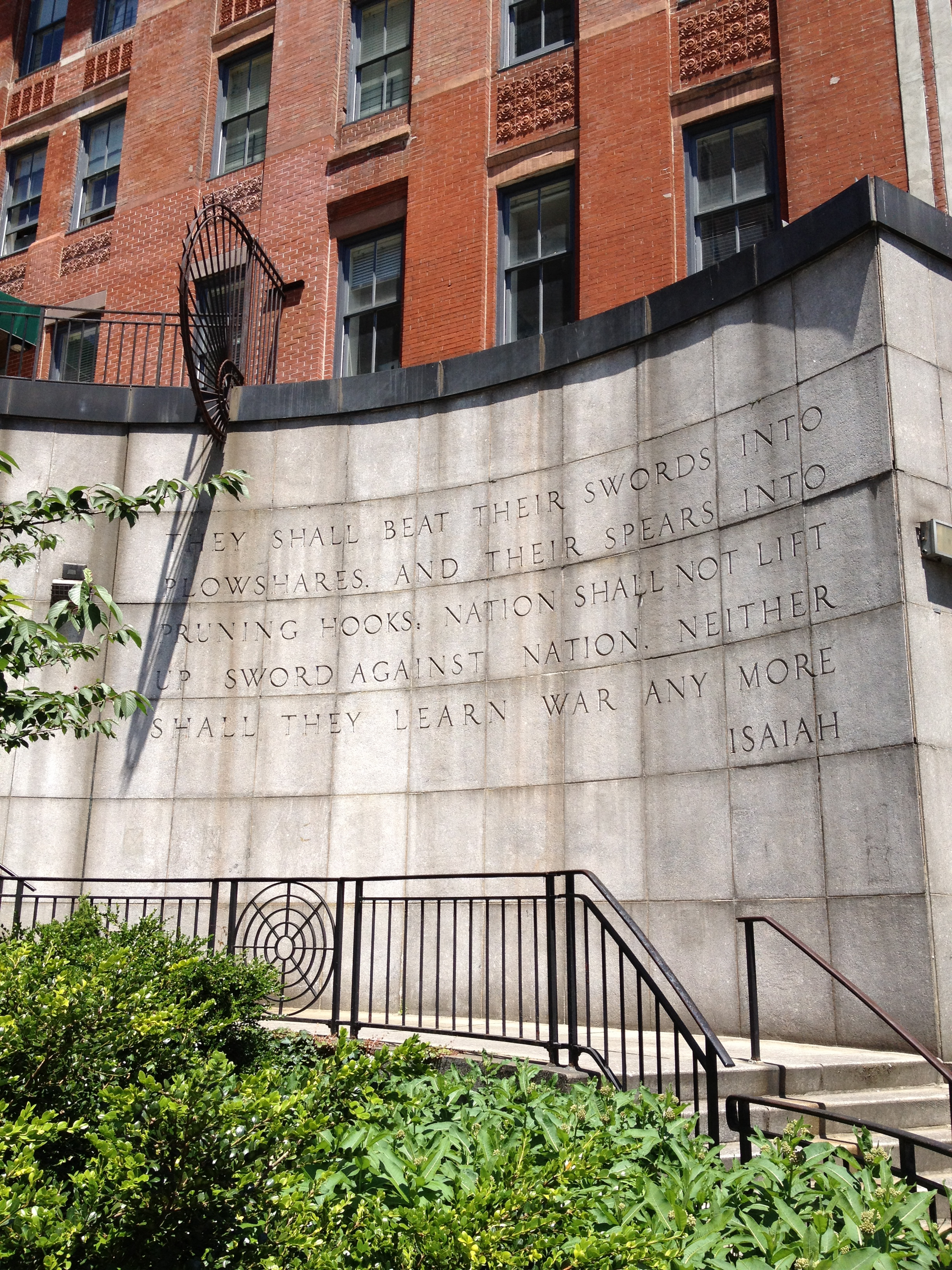
It was a brilliantly sunny day and there seemed to be rain nowhere in sight. It wasn’t even hot. Days like this have been rare this spring, so I went out for a lunchtime walk in my neighborhood. I’d been by the United Nations with some visiting family the day before, so I went down again and pondered the words attributed to Isaiah carved in the wall across from one of the largest intentional organs of peace in the world. I was reminded that a copy of the Edict of Cyrus resides in the UN; as a historical text it is often considered to be the first document promoting religious tolerance among lesser powers allowed by a greater power. The world could use a few more like old Cyrus the Great these days. I think Deutero-Isaiah would agree. So with biblical thoughts in my head, I strolled back toward Grand Central.

Along the way I saw a phrase from the Eucharistic Prayer on a building and it was like meeting someone from college that moved halfway around the world to disappear from your life. I saw that I was standing outside 815 Second Avenue. To the majority of the world—even the majority of Christians—this will mean nothing. At Nashotah House, however, “815” was regarded as the source of all evil. It is the headquarters of the Episcopal Church in America. It is hard, as a disowned son, to describe the feelings that assailed me there. Those good Christians who intended me such harm did not seem to realize all I had sacrificed to join them. Some of the clergy whose daggers remain in my back are well-paid priests right here in New York. Yon Cassius has a lean and hungry look, I thought.

With that cloud in my sky, I turned the corner back to work. Parked in the street was a truck labeled “Divine Moving & Storage.” That sounded an awful lot like a trope for my life. The reproduction of Michelangelo’s God reaching to Adam contrasting with a phone number ending in 666, this bundle of contradictions might just have been a small sample of the human experience. Caught constantly between Heaven and Hell with doleful prophets and profit-loving dolers of sacramental grace living one next to the other. New York is a religious city in every sense of the word. Somewhere off in the shadows I think I hear Isaiah whispering, “I make weal and I create woe…” I love a sunny day in Manhattan.


Brown Out

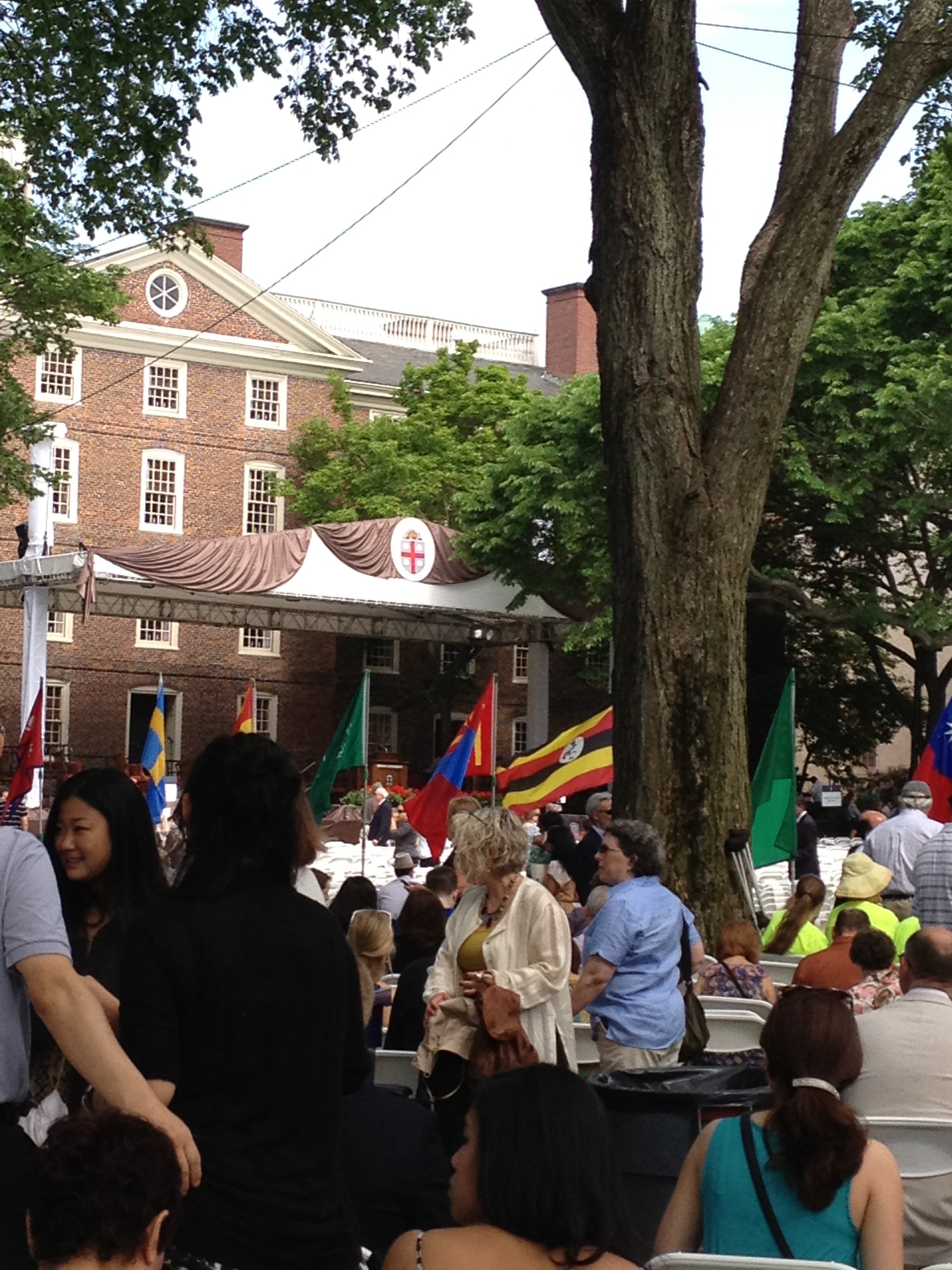
Brown University’s commencement ceremonies include a deluge of academic mythology. The curse of my chosen field of academic study is the tendency to see mythology everywhere. Some individuals see dead people, others see myths. I always feel an inordinate sense of pride in the graduates, especially those who are related to me, but the whole arrangement takes part in the mythology of higher education. Who wouldn’t feel awe in the presence of the illustrious recipients of honorary degrees? There on the Jumbotron, Viola Davis, Marilynne Robinson, Diane Sawyer, and John Lewis. In the program book the seemingly arcane symbols of academia are explained. These are the scriptures backing the mythology. I always wondered why some old professor always carried a mace in academic processions.

But the mythology of higher education runs deeper than the symbols and ceremonial. Education itself is under intense fire for participating in the realm of finance that it helped to create. Despite constant affidavits to the opposite effect, there is more to life than money. The cost in educating our young requires a greater input than becomes obvious in the immediate return on the investment. Often I hear concerns expressed over the cost of higher education, and there are certainly excesses that must be addressed. The real profit in this transaction, however, is our future. Who can look at the ocean of mortarboarded potential and not feel, deep down, a sense of optimism, no matter how guarded?

The mace is a symbol of violence. Education, if done right, is violence against ignorance and ossified old ways of prejudice, discrimination, and selfishness. For those of us who have tried—and some of us have not been successful—to shed some light on future generations, commencement is a humbling experience. While at Nashotah House I sat through many of them, and sometimes the mythology mingled with hypocrisy as I saw raw hunger for power and the lust to control the lives of others. It was refreshing to experience the mythology anew in a setting where genuine hope seemed to linger among faces full of optimism and pride of achievement. Perhaps it was the obvious inclusiveness instilled by outgoing president Ruth J. Simmons, but prayers by women clergy, and honorary degrees conferred across the spectrum of humanity are signs of hope. The mythology of academia is one myth worth believing in, if it is truly a commencement.


Blazing Forest

Back in 1996 an angel was on the big screen. In a manner of speaking. Michael, starring John Travolta as the archangel Michael, may not have been an instant classic but it did have a memorable line or two. The image of a smoking angel had been contrived by Van Halen over a decade earlier, but the idea of the prince of the army of Yahweh being a guy just like the rest of us was strangely refreshing. No Park Avenue deity this. When the reporters first meet Michael and wonder if he’s the real thing, one suggests tugging on his wings to see if they’re real. Michael responds by asking if he should pull the reporter’s privates to see if they’re really attached. His companion comments, “An angel that says ‘pecker.’” While the very idea of “bad words” is an unusual one, it is well-nigh a universal. In just about every culture there are words or phrases that just aren’t uttered in polite company. Those who can’t control their mouths, suggests the book of James, can’t control their lives. So it is with a kind of perverse wonder that I read about the bullying bravado that issues from the lips of New Jersey’s governor.

Don’t get me wrong. I never fault anyone for speaking like they were taught. I was raised in a blue collar family and at times the talk could get pretty blue as well. I would, however, point out that you’ll not find a student I taught over my two decades in the classroom that every heard me cuss in class. It is a matter of standards. Emotions, those great clawing monsters inside us, rage to escape. The building blocks of society—restraint and control, and dare we even wish? subtlety and refinement—are signs of civilization. Some of us were taught to leave name-calling on the playground. I am profoundly saddened when politicians believe they are the best America has to offer when in reality they reveal themselves coarse, vulgar bullies. Enter Chris Christie.

In a public venue on Wednesday New Jersey’s governor called the chief budget officer for the Office of Legislative Services, “idiot,” “jerk,” and “numbnuts.” Here’s where we see Tea Party values incarnate. Belittling others, especially in a public forum, reveals a nature that should make all civilized civilians hang their heads in a surfeit of collective shame. America has come to this? Admiring bullies and slashing and burning services for those who need a little communal support? And he has been posturing for a vice presidential nomination. And angels will be smoking cigarettes in the wings. A President/Vice-President who says “numbnuts?” America deserves far better than this. Where is Michael when we need him?

Take that, you #!@&$!


Children Shall Lead Them

One of the perks of moving to New Jersey was landing in a town with strong support for the arts. Every time I attend a middle or high school concert, I consider how the old image of painful evenings of parents patiently pretending to enjoy the music has ended. The kids in this town could be professionals. If I close my eyes, I forget they’re all under nineteen. Last night at a school concert one of the pieces was “Always Look on the Bright Side of Life,” Eric Idle’s chestnut from the Life of Brian (now featured, I hear tell, in Spamalot). I first saw the Life of Brian with some trepidation while in seminary—I had been sounded warned that it was a profane movie, making fun of Jesus. Considering that all the actual references to Jesus in the movie are quite positive, I eventually realized what all the fuss was about. The movie doesn’t make fun of Jesus, it does, however, show the laughable nature of those who follow a religion blindly. This, I gather, was the real root of the problem.

Next to this fun piece, the concert also included several pieces taken from originally sacred contexts such as Mozart’s Dies Irae and settings of Veni, Sancte Spiritus and Ave Maria. Spirituals, likewise, are a perennial favorite. Performed along next to these pieces of religious origin were also decidely secular pieces such as “Scarborough Fair” and the Beatles’ “Hello, Goodbye.” In concert the sacred and profane blend beautifully. Perhaps there is a paradigm hidden in plain sight here. Religions need not be defensive and unbelievers need not attack them. The world is surely big enough for differences of opinion.

Music has a power that sometimes frightens me. I don’t often address it in my blog because of how much it affects me. Theorists often note that music is part of nearly every religion ever invented—we know that something special is going on when we hear it. And music has the ability to move large groups of people simultaneously. I’ve not attended many professional concerts (the last one was Alice Cooper in Atlantic City back in 2008), but no matter how secular the artist the experience is profoundly spiritual. I’m not sure I can adequately define what that means, but when it is felt there is no mistaking it. So maybe that’s why school concerts have such power. It seems that schools that support the arts also tend to have excellent academic records as well. The truth is hidden in plain sight.


After Before the Dawn

Apropos of reading Nicholas Wade’s Before the Dawn, as a sometime scholar of religion a number of points struck me. According to both material artifacts and DNA, several changes took place among human beings some 50,000 years ago. Having just read P. W. Singer’s Wired for War as well, the early coalescence of war and religion in human history was unavoidable. Wade ties the emergence of both with the development of language. It is only when we can speak that we can begin to express our theological speculations and, as history continues to teach us, despise those who disagree with us. It becomes clear quite early in the tome that Wade has an interest in explaining religion. Like many science writers he struggles with the issue of why religion persists, despite the explanatory value of science. We know how multiple aspects of our world work, yet we still defer to a divine that no one has ever seen or registered in any empirically verifiable way.

Not only does this tendency stretch back to our distant, distant relatives. The Natufians, about whom I generally lectured my students (itself ancient history), are marked as well by the dual achievements of religion and war. Wade is one of the few scholars I’ve discovered who concurs with my assessment that religion was among the earliest of human behaviors. In my mind, it is tied to consciousness and its evolution. Once we begin to realize that we are not in control of our destiny, we start to seek explanations from above, and hope that God loves us. Otherwise the picture isn’t so pretty. Indeed, Wade suggests that religion evolved as a socially cohesive force. Tying the concept to ethics and trust, he suggests early people had to learn to get along with strangers and religion cemented that bond.

I’m not a scientist, so I cannot assess whether this explains religion or not. It does seem clear, however, that if Wade is right religion itself has evolved into a more aggressive beast. Sure, religions still serve to bind people together—but only so far. As populations separated, their various religions evolved and led them to distrust one another. Instead of bonding humans together, religion began to put them into competition for the truth. Here, Wade’s analysis is sadly true—religion and war evolve together. Our small planet is yet too big for everyone to get along, to know and trust the stranger. Religion had helped us at the critical stage when we needed social bonding, and now it has naturally evolved into the opposite—a socially divisive force of orthodoxy and heresy. If Wade is correct, we all need religion to take on its most ancient role and bring people together instead of giving us excuses for war.

Waiting for the dawn