Sci-Fi Culture

I’ve recently taken up rereading Ray Bradbury stories from my childhood.  Bradbury’s difficult to classify, but he’s often genrefied as science fiction, but many of his stories are horror and fantasy related, or just plain stories.  One aspect upon which future readers, I believe, may pick up—and this isn’t just a Bradbury thing—is how people were projected into the future with the culture of the past remaining intact.  Things like characters smoking in the most unlikely of places.  I picked up on that the first time I watched Alien.  In space, where no-one can hear you scream, air has got to be a precious commodity.  And yet there they are, smoking in space.  Same thing with Bradbury.  The culture of the 1940s and ‘50s when he was writing such stories simply couldn’t see beyond the time when culture was what everyone did.  It seems weird in 2019.  How much weirder it will look in 2050 (presuming we make it that far).

There’s almost a “gee-whiz” quality to such stories of the past.  People in the future, and in space, drink coffee and wear blue jeans.  They may have more technological homes, but their home lives reflect the forties and fifties as well.  The women are housewives and the husbands go to the office, or outer space, to work.  I suppose cultural verisimilitude was a different thing back then.  Did nobody really consider that patriarchy might be a problem?  Did everyone think clothing would never really change?  And not a hint that vegetarianism might catch on.  What makes the future the future in these stories is tech.

These days we’re loaded with tech.  In some ways we have more of it on our person at any given moment than all of Bradbury’s space-workers ever had.  In one of his stories a character was born in the impossibly far year of 1993.  I used to watch a show called Space 1999.  We haven’t colonized the moon yet (we may be working on it, but considering how long things like an obvious impeachment take, I wouldn’t hold my breath).  Speaking of holding breath, I’m pretty sure some of the characters were smoking on Moonbase Alpha.  Or my memory is cloudy.  (The earlier, and more lasting series Star Trek pretty much avoided several earth-bound habits, although Captain Kirk was pretty fearless when it came to the possibilities of space-spread STDs.)  I read Bradbury as a throwback to my childhood.  His stories have both an prescience and naivity that make them compelling period pieces.  From our current standpoint, one wonders if there will be any culture left at all in the future.  Perhaps we should enjoy what we have, while we still can.

Aging Goddesses

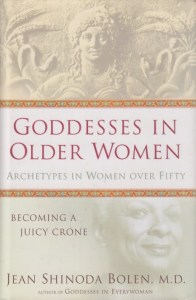
While not a woman, I am over fifty and I have both a personal and professional interest in goddesses.  Some friends recently asked how I came to write a dissertation on a goddess, and thinking about that has revealed some aspects about my outlook, but those will need to wait a little.  We read Goddesses in Older Women by Jean Shinoda Bolen because my wife wanted my opinion on it.  We read books together while washing dishes—we’ve been doing this since we married over thirty years ago—and despite my not requiring the subtitle, Becoming a Juicy Crone, I was game.  I have been curious about the experience of others since I was quite young.  Since half the others in the world are female, it makes sense to be in dialogue and to be willing to learn.

Bolen uses classical goddesses as Jungian archetypes to help post-menopausal women sort out their feelings and spirituality in what has been called the “crone” phase of life.  This is part of an antique triad that many would rather dismiss: virgin, mother, crone.  Still, Bolen embraces it as fairly common in women’s experience.  Men, although they can be elected to the White House while doddering old fools, don’t pass through such distinctive stages.  In fact, some never mature.  Women’s lives are defined by reproductive capabilities in ways men’s simply aren’t.  Instead of dismissing half of human experience as irrelevant, we should listen to the accumulated wisdom of women.  Bolen, who is an M.D., isn’t an historian of religion, but her remarks about the various goddesses explored (Asherah isn’t one of them) are insightful.  I listened as my wife read, and this was quite a learning experience.

We have, as a species, often failed our females.  Males, using that “might makes right” physiology and theology, have often assumed masculine agendas are the only ones that matter.  Look around the world today and see where that’s gotten us.  We’re killing our own planet in the name of greed and ignorance just so that nobody can be richer than me.  I think it’s time we let the women have a chance to run things.  Even though ancient mythologies often reflect the patriarchies under which they were written, many allow women more powerful and authentic roles than they currently have.  Even El, the head of the Ugaritic pantheon, could change his mind when approached by Asherah.  I learned much from this book, just as we learn so very much by listening to those who differ from ourselves.  And the goddesses, almost always, are the ones who possess true wisdom.


I Swear

The ongoing political fiasco of our nation (and within several states as well), raises a very basic issue.  We trust our legislators to do what we pay them to do (they’re our employees) because they take an oath to uphold the Constitution.  Problem is, liars don’t keep their word.  When an elected official opts to lie pathologically rather than to tell the truth, how can we expect him (or her) to uphold an oath they took?  Doesn’t lying behavior suggest that they were lying when they took that oath?  A hand on the Bible means nothing if you don’t suppose God is waiting with a lightning bolt in the metaphorical Heaven described, none too clearly, in the Good Book.  This is the greatest crisis a democracy can possibly face—lying leaders.

This isn’t just alarmist talk.  Societies—even capitalistic ones—rely on a great deal of trust.  Those who don’t mean what they say end up on the business end of the Better Business Bureau, or fail to stay solvent.  There are laws that ensure you are protected if someone sells you a false bill of goods.  What then, if the highest office in the land is occupied by someone who can’t be trusted?  Instead of appealing to the rule of law to set such a person on the right path, the Republican (Church) Party has decided that lying is now a commandment.  I may be lying, but how can you tell?  If no one has the backbone to stand up and declare that the whole system has toppled, what can a nation do?  An even more worrisome fact is that there’s no going back once this has happened.  The Republican Church has instilled this behavior for three years and is showing no sign of repentance.

Oaths were taken very seriously in the world of the Bible.  Violating one (lying intentionally) was considered the surest way to arouse God’s anger.  Ironically the Republican Church, which claims to be biblically based, is, according to its own Scripture, angering God.  I often consider myself a cynic, but my cynicism falls far short of this.  Psychological studies have demonstrated that the average person is reluctant to outright lie when the idea of God is introduced into conversation.  God’s Own Party, however, has inured itself to that minor phobia.  The Good Book, after all, says God’s the father of lies, right?  If they’d bother to open that book they’re thumping, I think they’d discover that that is truthfully the worst kind of blasphemy a human can utter.


Assume Nothing

You know what I’m talking about.

It’s rude.

Disorienting, isn’t it?

One of my greatest bêtes noires is the email that only gives enough information to frustrate or irritate.  I get them all the time, mainly from business-people.  Look, I know you’re busy.  We’re all busy.  A single-sentence email that doesn’t explain anything is rude and exasperating.  One of the reasons, if I might speculate, that I always received very good teaching evaluations boils down to a simple trick: good explaining assumes little on the part of the listener/reader.  When I write an email, for work or for whatever life outside work is called, I explain why I’m emailing and I use common courtesies such as “Dear X,” and “Best wishes.”  They take me all of seconds to type, and they make the receiver, I believe, feel human.

The other day I sent such an email and received a one-sentence response that assumed I knew a lot more about the topic than I did.  It frustrated me so much that I had to write this blog post before going back to it and asking, yet again, that sender explain (in this case) himself.  What was he trying to say?  Who was he, even?  I’d been asked to contact him by someone else.  I had no idea who he was (I briefly explained who I was in my initial email).  Electronic communication, IMHO, even if brief, need not be rude.  If we’re all that busy maybe it’s time to step back and consider that life’s too short for generating hurt feelings and generating negativity.  Emails without niceties are rude.

Of course, there are people you know well and that you contact frequently.  I still try always to give them the courtesy of opening, body, and closing.  I grew up in the generation of letter writing.  One thing even businesses knew in those days was that rude behavior lost you customers and/or clients.  Now in Generation Text rudely apocopated emails are standard and I have to wonder if anyone’s done a study on how much business money is wasted on the time it takes to recover from receiving a rude email.  The writer may not be intending to be rude.  Many of us were taught growing up that a “please,” “thank you,” or “I’m sorry,” went a long, long way in avoiding hurt feelings.  Go ahead and call me a snowflake.  But remember, it’s December.  So I’ve just had to spend a quarter-hour of my busy day writing this rant before responding to an email that made me mad by its brevity.  I’m not a texter, and I think I’m discovering why.


Job’s Jobs

Many years ago, after Nashotah House decided it no longer required my unique outlook, I bought a book.  (That’s my default reaction.)  This book was on how to write killer cover letters.  I don’t remember the title or the author, but I followed the advice, well, religiously.  It got me nowhere.  Business tricks, at least historically, don’t work in academia.  Sitting at home, pondering my sins, I flipped to the chapter on advice to take if none of the rest of this was working for you.  Here’s where the human side began to show through.  Have you been eating onions or garlic before your interviews? it asked.   Do you need to lose weight?  Try dressing nicer.  It occurred to me that the business world lacks the imagination required for denying jobs.  And besides, who was getting any interviews before which I shouldn’t eat garlic?

Business advice is, in a word, shallow.  It assumes that if you’ve got the goods there’s no reason you won’t get hired.  Reality is a bit more complex than that.  I often ponder how people simply go for what they want.  They reach for the biggest piece without pondering the repercussions of their actions.  I see it in my small world of publishing all the time.  Those who are “hungry” (read “greedy”) succeed.  Those who wait behind to help others simply can’t compete.  So the cover letter book did get that part right.  Is it possible, however, to devise a society where everyone fits?  Not all are created equal, perhaps, but do we have to reward those who seem to care only for themselves?  Let them eat garlic.

The cover letter book, in the end, never really did me any good.  I found my way into publishing by being willing to aim low.  I’ve written many cover letters since leaving Nashotah House, and only two ever led to a job.  Those who work in business, what with their concerns about readers’ aromas and weights, seem never to have considered the intricacies of the intellectual job market.  What strikes me as particularly odd is that there are plenty of smart people out there, and yet they haven’t organized to offer alternatives to the greed-based structure on which our work lives are based.  They can’t, it seems, gaze beyond capitalism as a mechanism for helping individuals lead productive lives.  Business operates on the principle of replaceable parts, many of which happen to be human.  And even those who know how to write can’t hope to compete against those who prefer cogs that know to avoid onions.


New Religion

Republicanism, it seems to me, has become its own religion.  It started off when the GOP married evangelical Christianity, but the offspring of that unholy union has become a religion all on its own.  It certainly doesn’t adhere to classical Republican principles (tariffs?  Really?).  Nor does it adhere to Evangelical standards (turn the other cheek?  Love thy neighbor as thyself?).  Like most blendings, this new religion has some elements of each parent and it has no lack of fanatic supporters.  The traditional Evangelical, for example, considered the Devil “the father of lies”—one of his biblical titles.  The Republican, however, considers pathological lying to be signs of messiahood.  There’s a tiny disjunction here, but it proves that what we’ve got is the birth of a new religion.

Books and articles have begun to appear on how Evangelicalism has changed.  I don’t believe it’s so much a matter of Evangelicalism evolving as it is Republicanism fulfilling the need for intolerant religion.  In every culture there are those who want to go back to the day of Moses and golden calves and stoning those you hate.  It’s a little more difficult these days, what with secular laws that protect the rights of others, but the GOP has found a way.  My heart goes out to old fashioned Republicans, it really does.  Fiscal conservatives have found themselves in church with a bunch of people with whom they agree on very little.  They have no choice, for their political party has been sanctified.  And the only thing worse than an Evangelical is a bleeding-heart liberal.  Next thing you know the Democrats will start quoting the Bible at you.

The lying thing really takes some wrapping my head around, though.  I’ve always said nobody believes in a religion they know to be false.  This new development challenges that, if it doesn’t challenge the very idea of religion itself.  Republicanism is a religion based solidly on bearing false witness.  Self-aware of it, even.  You can’t tell me that these educated white men don’t know a criminal activity when they see one.  That they can’t read, and reason, and trust their intellect (although it takes the back seat to their overwrought emotions).  Sound like a religion to you?  It sure does to me.  It’s been coming a long time, but it took the last three years (the tradition length of Jesus’ ministry, it’s often said) for this to dawn on me.  The religion of the lying messiah.  I’ve got to wonder what kind of future it’s got.  I smell the fires rekindling in the burnt over district and wonder who’s for dinner.


What Remains?

As our government continues to pretend it has an interest in anything but enriching the individuals in Washington, a rather constant refrain of “broken system” has emerged.  It heard that phrase repeatedly in conversations in San Diego, on a variety of topics.  Now, I’m no stranger to buzzwords, but this strikes me as particularly apt to describe what we’re seeing.  A democracy within a republic builds safeguards to prevent the abuse of power, but when abuse of power occurs and one political party insists on enabling such abuse, the system is indeed broken.  Not only that, but there’s no will evident to fix it.  The GOP glories in it, feeling like it’s somehow winning the game as families and individuals suffer as a result of it.  In the past, it seems to me, there was a desire to repair what was an obvious problem.

Self-delusion, it seems, has become very common.  That, and some older politicians may not be aware how frequently they’re shown in their foibles on the internet.  Information that used to take weeks or months to filter out is now known instantaneously, and everybody’s overloaded and confused.  Politicians, instead of trying to show us the way in such a landscape are rather acting like my late stepfather in saying “Do as I say, not as I do.”  A fine bit of hypocrisy, that.  At least he tried to mend his ways, even if not successful in his efforts.  He would’ve known, however, that he had no business being president.  I reflect on this broken system quite a lot and I wonder what is next for us.  When trust in government is completely eroded, where do we turn?

Many have celebrated the decline of religion.  Let’s be more precise here and say organized religion.  Survey after survey reveals that we aren’t necessarily becoming less religious, but we’ve been watching prominent religious leaders throw their unstinting support behind a broken system.    Many of them continue to ignore the truth to support an incumbent who’s demonstrated that he’d just as soon turn on them as help their cause.  And for what?  Simply to prop up a tottering system, to squeeze out the last drops of what can be used to make things better for themselves before it all falls down.  As I was flying essentially coast to coast, it was evident from the air just how diverse a nation we are.  For nearly 250 years we’ve been able to make it work.  Now that it’s clearly broken, it seems the will to make it better has vanished.  And only politics remain.


Post Facto

“Yea, though I walk through the valley of the shadow of death,” Psalm 23 asserts, “I will fear no evil.”  Nor should one fear evil when flying over Death Valley, as I did coming out of San Diego, but I did.  There are perhaps not too many national monuments that can be appreciated from 30,000 feet, but the only way I’ve seen both the Grand Canyon and Death Valley is by plane.  My flight home from AAR/SBL had me sitting over a wing, so a photograph of the famed graben would simply show mostly wing and a bit of Death beyond.  This valley holds the record for the hottest ambient temperature recorded on the surface of the earth (134 degrees) and is famed as one of the filming locations for Star Wars.  Still, from the air the juxtaposition of mountains and salty, flat dearth was impressive.  I had no one with whom to share my excitement; the kid next to me was watching a movie on his phone and I had no idea who he was or if he’d be interested.

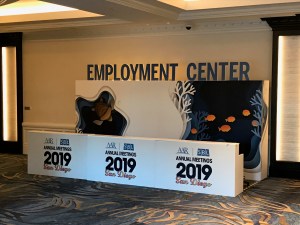
Disneyland, they say, is the “happiest place on earth.”  While I have my doubts about than endorphin-laced claim, I do know one of the opposite locales.  The hotel in which I stayed, the Grand Hyatt, San Diego, hosted the AAR/SBL Employment Center.  The hotel is not to be blamed for holding the most unhappy place on the planet, but as I looked at the booth I wondered if this was truth in advertising.  Should it not read “Unemployment Center”?  That two-letter prefix would make this at least honest, if not cheery.  I have spent some of the most miserable hours of my life in the employee hopefuls’ lounges at past conferences.  Hours and hours wasted, waiting to see if anyone, anyone at all was willing to grant you an interview.  I saw more than a few tears shed in that horrid place.  Some of them mine.

Now I’m high over Death Valley.  It feels far too sanitary to experience it in this way.  The professorate, which seeks to improve the world, is generally a powerless lot.  Signs scattered throughout the Convention Center and hotels asked such things as Does your school have over 50% contingency faculty?  And statements like Tenure track is not the norm.  The psalmist, it seems to me, got it right.  If you want to face the valley of the shadow of death and not fear, you have to walk through it.  The more people who do, the better the hope that we’ll land this plane with some kind of resolve to do be open to visions and to act upon them.


Armed Forces

You ought to feel safe with the U.S. Navy so close by.  The naval base at San Diego is the second largest surface base in this particular branch of our sprawling military system.  From my hotel room I can watch the ships chugging through the harbor and from the Convention Center you can see quite a spread of naval real estate.  Still, all this hardware doesn’t make me feel safe.  Perhaps because I’m a child of the sixties, I can imagine a world at peace where military budgets don’t literally take food from the mouths of hungry citizens.  The last time I was in San Diego for AAR/SBL I toured the USS Midway aircraft carrier.  It’s clearly visible from my room.  I was amazed at both the technology and the obvious expenditure for such a craft.  It can’t be easy to set a city afloat.

Whenever I experience things like this I can’t help but wonder what we might accomplish if we loved each other as a species and put our heads together to try to solve our problems.  Lack of water—perhaps ironically in this naval city—is a serious global issue.  Poverty is the ghost of civilization.  The grasping of power by the driven but inept is clear worldwide.  We build great, complicated war machines.  The noise generated by the helicopters charging overhead bespeaks their weight and weaponry.  Down here in the southwest there are places civilians just can’t go because our military is busy keeping us too safe to allow us to wonder what they’re up to.  Black budgets must be nice.  I stand here among religion scholars and dream.

Ironically religion often leads to the fear that leads, in turn, to militarization.  We want to protect our “way of life.”  We’ll follow the prince of peace into war any day.  Just give the signal and release the missiles.  It doesn’t make me feel safe at all.  One time on a family visit, we drove through Norfolk, Virginia.  We stayed at a cheap hotel, because, well, we’re cheap.  The metal door was heavily reinforced with a stolid steel lock.  Navy men, we were informed, didn’t always behave well while ashore.  The locks were to keep us safe from those protecting us.  We stayed only one night and left early the next morning.  So I while the annual meeting away under the watchful eye of our largest line item on the budget.  They’re keeping our bodies safe, but who’s keeping track of our souls?


Focus on Religion

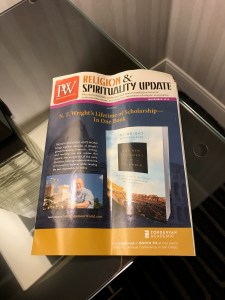
Publishers Weekly, or PW to those in the biz, is a great place to get information about, well, publishing.  I often spend AAR/SBL telling authors and prospective authors something that I wish I’d been told when teaching: time spent learning about publishing is never wasted.  PW every year has a “Religion and Spirituality Update” released in time for this meeting.  Despite the relatively small number of sales, religion is a discipline that loves its books.  I’ve only been quoted in PW’s special edition once, and it’s not been for a few years, nevertheless I always learn a thing or two from this free—yes, if you’re here in San Diego it’s free!—update.  It may seem odd to suggest that religion titles can be hot, but it is indeed possible.  Sexuality is hot.  I suppose that goes without saying.

A number of titles dealing with religion and sexuality appear every year.  What caught my attention, however was an observation from Jennifer Banks, from Yale University Press.  Noting the rancor that sexuality often introduces to discussions of religion, she observes that (and this is a quote from PW, not directly from Banks) “some Christians apparently need others to go to hell.”  (I can send the full citation, if you want to know.)  In an era when academics have been stressing inclusion, the retrenched religious world has been spinning in the opposite direction.  Instead of inviting everyone to Heaven, as might, say a Universalist, many conservative Christians consign fellow believes to Hell, and gleefully so.  It’s almost as if Christianity and capitalism have merged into a zero-sum game.  If some win, all the others have to lose.  They haven’t however, studied the history of Hell very well.

It’s kind of an insidious idea.  Given that we all want to justify ourselves, some go to the extremes of demonizing those who see things differently.  This form of religious thinking was original neither with Christianity nor the Judaism from which it grew.  There was no Hell in the Hebrew Bible.  The idea, when it did develop, wasn’t a place to torture your enemies, but rather a place demanded by justice.  Those who were utterly and unrepentantly wicked couldn’t hobnob in God’s country club with those who tried to be righteous.  In the modern evangelical narrative those who make certain medical decisions for basic human situations are among the utterly wicked.  Not surprisingly their sins are usually sexual.  If you want to see this in a wider context, pick up a PW when you pass by the stand.  “Anything free,” to quote another sage, “is worth saving up for.”  And who knows, it might keep you from Hell?


Sister Monsters

Every once in a while you read an inspirational book.  I’m hoping readers will keep in mind that inspiration comes from different locations for some of us.  Monster, She Wrote: The Women Who Pioneered Horror and Speculative Fiction, by Lisa Kröger and Melanie R. Anderson, is a source of inspiration.  With the usual Quirk Books touches, this isn’t a tome heavy on literary criticism, but it is a wonderful compendium of brief bios on women who walk(ed) on the dark side.  I find books like this encouraging in a number of respects.  First of all, these are women who did what they loved and were recognized for it.  Secondly, it gives the rest of us some hope that getting through the establishment to actual publication isn’t as impossible as presses would have us believe.  And third, it’s also a lot of fun.

It isn’t often pointed out that women played a major role in the development of the horror genre.  Some of the earliest Gothic novels were by Ann Radcliffe and Margaret Cavendish.  Probably the first fully fledged horror novel was Frankenstein, by Mary Shelley.  The real learning kicks in when the other names come out—many women found, and continue to find, the genre compelling.  Most of them, like most of us, are lost to history, but many of them have been rediscovered.  Here again is cause for hope; those of us who write, I think, have our eyes set on the far distant future.  We’re inscribing our “Kilroy was here” on paper—I still can’t think of ebooks as actually existing—in hopes that those down the road might know us a little better.  The fact that some of our sisters have been found suggests that we too may be resurrected some day.

There’s no plot here, and the point isn’t to present some great discovery.  This is a book that encourages women to be who they are through example.  The fact that it involves monsters and horror is simply a bonus.  As a non-female reading this it struck me time and again that women have long been informed of what they should or could do by men.  Men don’t like to see women knowing as much as they do about the shadow side of human existence, even as they relegated them to the shadows.  It’s my hope that this book will inspire women to be themselves.  And if they want to invite monsters along, so much the better.


What I Meant to Say

So I try to illustrate each of my posts. I do this because in the days when the internet was young I often found blogs during image searches. I’ve grown more cautious over the years, regarding copyright. I try to stick to the “fair use doctrine”—and that’s what it’s called, a doctrine—or images I “own.” In the latter case it often means searching WordPress for a picture I’ve posted before. Since nobody has time to name all their photos, I use the assigned DSCN or IMG nomenclatures. There aren’t so many that a search won’t turn up an image in my library. Thing is, WordPress likes to anticipate what I’m looking for. What’s more, it “autocorrects” after I’ve begun scrolling through everything. DSCN becomes “disc” in its addled electronic brain, and IMG becomes “OMG.” Naturally, the image you’re seeking can’t be found until you manually correct autocorrect.

OMG has become very common shorthand these days. Growing up evangelical, there was a debate whether “o my God” was swearing or not. Those who like to hedge their eternal bets argued that this was taking the Lord’s name in vain, thereby breaking one of the big ten. This was to be avoided at all costs. Those with a little less fear (or perhaps a bit more courage) argued that “God” wasn’t “the Lord’s name.” God is a generic word and can refer to any deity, except, of course, for the fact that there is only one God. This led straight back to the conundrum. Exegetes tell us that technically this commandment isn’t about saying the deity’s name, but rather it’s a prohibition against using said name when you don’t intend to do what you say you’ll do. In other words, lying.

It’s truly one of the signs that evangelicalism has evolved that the world’s best known liar is unstintingly supported by this camp. When I was a kid, saying, well, OMG, could get your mouth washed out with soap. Lying could lead to other forms of corporal punishment, such as being, in the biblical parlance, smitten. Now it gets you elected to the highest office in the land and supported by all those very people who won’t spell out OMG, even when they’re busy cutting you off in traffic with their Jesus fishes flashing in the sun. When I was a kid presidents would step down rather than go through the humiliation of being shown a liar in the face of the world. Times have changed. And I have no idea how to illustrate such a post as this. What comes up when I search OMG?


Who Cares?

America’s all about money.  I read quite a bit about care-related exhaustion, and being in a situation where several family members are requiring care I’ve begun to notice that our government just doesn’t care.  Talking with a family member recently, his exhaustion was clearly evident.  Not affluent, he has to care for a spouse with Alzheimer’s and continue to work ten hour days because nobody pays you simply to help another human being in need.  Care can be monetized, of course.  Then Republicans sit up and take notice.  Until then, however, I try not to be overwhelmed by what is clearly a growing crisis.  Some call us the “sandwich generation”—we support our children longer as more and more jobs become obsolete, and we care for our parents longer as lifespans extend and extend.  For the working poor, the benefits do not keep pace with life expectancy.  And what child wants to see his or her parent suffer?  Why doesn’t our government care?

Instead of devising new ways to deal with a massive crisis (I know many people who are constantly running on empty from having both to caregive and to work), Washington tweets about how the wealthy are the objects of “witch hunts.”  Those with too much are so oppressed, but they just can’t see their way to share what they have.  Meanwhile even those of us with educations find ourselves not knowing what to do.  Politicians play their games forgetting that the pieces they move about the board are alive and sentient.  After all, there’s only one king on each side.  And who feels too bad if a pawn or two gets bumped off, as long as the monarch is kept safe?

There are solutions.  Not perfect, of course, but societies with a dash of socialism realize that if those on the bottom can’t do their jobs, those on the top will tumble too, when the foundation fails.  Any builder knows the importance of secure footings.  One guy, often cited by the GOP but never really listened to by them, said houses built on sand fall.  Giving care takes time, money, and energy.  Employers want those exact same things and should you fail to provide them, you will find yourself also requiring care.  Even if your reason was that you were caring for another.  Meanwhile policies will be made to favor those who line the pockets of the political.  Who cares?  Certainly not the officials we “elected” to “lead” us.


Frozen Streams

I was walking in Ithaca, with my feet not far from Sagan.  Winter had settled in prematurely, as it often does in upstate.  I was wearing a hoodie and old fleece combo and I suppose I looked a bit tatty.  My wife and daughter had gone to see Harriet, but movies about how badly people have mistreated others, strangely for a guy who watches horror, really depress me.  Ithaca, until recently, supported three independent bookstores, so I figured I could pass the time easily enough.  It was growing dark and breezy, and I visit bookstores only with a list, otherwise it’s too dangerous.  Autumn Leaves, a used vendor, I’ve visited many times.  Their religion section is disappointingly small, but I tend to find offerings in other areas when I blow in.

Buffalo Street Books is the last remaining indie that handles new books, but I stopped by The Bookery, now closing, on my way.  This was saddening.  Ithaca houses both the ivy league Cornell and the highly regarded Ithaca College.  I suspect many of the street sweepers hold doctorates.  Has book culture entirely bent the knee to Amazon?  At the end of the last millennium, Ithaca housed 25 independent bookstores.  Today it’s evident that Buffalo Street (formerly The Bookery II) struggles to keep its hold.  I feel ethically obligated to buy something there, to take one for the team.  I had a short list and the shelves in The Bookery had been nearly bare.  It was just too depressing to stay there.  I found an inside bench and sat to read until the movie was over.

Or so I thought.  I ventured back outside and now it was fully dark, being six p.m., and I wandered back to the familiar Ithaca Commons.  I went into a couple of shops, but they looked at me as if I were homeless.  (I suppose I was, in a sense.)  I haven’t had a haircut in a while, and my beard is scruffy and white.  My hoodie and fleece don’t speak to affluence.  I had unconcealed books—I routinely refuse bags—and I suppose I could come across as a touch eccentric.  (I don’t have enough money to be authentically eccentric.)  I wondered how street people do it.  Outside the east wind was decidedly sharp and windbreaks on the pedestrian zone are few.  I came to the monument to Martin Luther King Junior.  I was walking in Ithaca but I really felt that books could make that dream come true.


Outdated Commandments

Recently, according to an ABC story a friend sent me, some self-righteous Catholics stole indigenous statues from the Amazon from a location in Rome.  The statues had been a gift to the Pope and placed outside the church of Santa Maria in Traspontina.  Like mass shooters these days, the Christians responsible filmed themselves doing this and shared it on social media.  I’ve experienced a lot of religious intolerance in my life.  I lost my job and my childhood to it, among other things.  Stories like this are beyond sad because religion really does have the capacity to bring people together rather than to tear them into warring factions.  Unfortunately it tends to draw in the hateful looking for excuses for their violence.

Not unrelatedly, I attended a church program on gun violence.  Before this gets immediately blown up into “anti-gun,” please note—the program was about violence, not guns.  During the Q&A after the presentation someone asked who the panelists were trying to reach, “preaching to the choir.”  After that he admitted to being a gun owner and felt that his position was unfairly represented.  Tension mounted.  One of the panelists, the one who’d witnessed his first murder at age 11, and who’d spent time in jail himself, broke in and said “This is about violence, let’s not make it about guns.”  I was struck by his focus and control.  He’d told us earlier that if a gang member could be convinced to wait 24 hours before getting his gun after an insult or injury a shooting almost never took place.  Violence is often a spur of the moment thing.

What’s so troubling about those who smirk as they film themselves doing violence, like stealing statues outside a church, is that this is not an impulse act.  This is planned, hateful violence.  It wears the mask of religion, often titled “orthodoxy” or “conservatism” but it is in reality simply a way of excusing your hatred.  Ironically, the Jesus they claim to be following said, “Let the one without sin throw the first stone.”  I guess we’ve got quite a few sinless conservatives out there, although I have to wonder if filming yourself might not count as pride.  It used to be called a deadly sin, but who’s counting?  Self-righteousness isn’t quite the same thing as vanity, although they sleep in the same bed.  But let’s not get lust involved, once that happens there’ll be no telling one sin from another.