Read a Book

A huge shout-out to Andrew Laties for conceiving and organizing the Easton Book Festival!  Easton may not be the largest city in the state, but the Lehigh Valley is Pennsylvania’s fastest growing area.  As we discovered when we moved here almost a year-and-a-half ago, it is a region that supports bookstores.  Even before the Festival we’d explored some six or seven and after moving from central New Jersey—where keeping a small shop or two open was a struggle.  We’ve become spoiled for choice.  Writers may not be the easiest people to herd—many of us are quiet and tend to live in our own heads quite a bit—but the festival has brought some 200 of us together, and we write on all kinds of things.
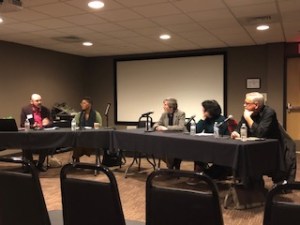
Although the panel on which I participated had religion as one of its themes, my wife and I noticed that at each session we attended religion was mentioned.  Either it was in an author’s background, or it figured into their writing, or most embarrassingly, it objected to and tried to silence them through censorship.  Although my book’s subtitled The Bible and Fear in Movies, it was evident that I wasn’t the only person who found the Bible’s effect on people scary.  And the theme continued into the evening as I attended the author’s banquet solo.  Many of the people I met had religion in their background or in their present motivations for writing, and not one of them was judgmental toward a guy like myself who’s trying to find his way.

The Easton Book Festival is in its first year.  Although by late afternoon the weather had deteriorated into the rain we can’t seem to shake around here, it was wonderful to see people walking around with festival booklets (there are enough events to warrant one) and not bothering to conceal and carry.  Books, that is.  For a moment, they were cool.  My second session is this afternoon.  As I learned both last weekend at my book signing and at sessions yesterday, a sell-out crowd is unlikely.  This is a free event and even authors who had more fingers than attendees were gracious and glad for the opportunity to explain what they were trying to do with their writing.  And they unstintingly shared what they’d learned with one another.  This was community, centered around books.  It was a small slice of what Heaven could be like, if we’d all just take an interest in each other.  Even if we’re shy and secretly would rather be home writing.

Im Peaches and Whatnot

Like most thinking people I’m wondering what’s wrong with our government.  If such wrong-doing were so out in the open any of the rest of us would be in jail, but because 45 stacks the courts the way GOPers want them, they think he’s God.  Using the Constitution for toilet paper, the Republican party believes itself above the law so it can, well, make up the law.  These are some angry, messed up people we’ve got in elected office.  I’ve seen some interviews with the key players, and it’s clear they literally—and I mean literally in the literal sense—think of politics as a game.  They don’t care how many lives get ruined; they just want to win.  They give the male gender a bad name.

This whole shambles reminds me of something I learned a few administrations ago—nobody really has the answers.  A low-functioning president is one thing (we’ve survived them before), but one who refuses to obey the law is quite another thing.  Subpoenas ignored, catastrophic foreign policy decisions made, and rallying since day one, we are being led by lawmakers who stand in contempt of the law.  All of this makes me think of deals with the Devil.  While I await the results of the peer review of Nightmares with the Bible, I recall what the outcome of diabolical deals always is.  It’s not true that “cheaters never prosper,” but it is new that it is being codified into law.  Hammurabi is rolling in his grave.  Even Caligula would be giving his forehead a palm smack.

America’s desire to become inbred has made us the spectacle for the world.  Growing up in the sixties the message of inclusivity was in the air.  I had no idea that those a generation older were resenting it, holding grudges, waiting quietly until they could throw inequality back into the mix and use it to stay in power even as they flouted the very law that was used to put them into office.  It’s no wonder that three biographies of Adolf Hitler have been published this year.  I guess there’s a fairly easy way to tell the difference between an average person and a politician.  The average person is fed up with this charade and ready for some actual leadership.  A politician, on the other hand, revels in the game he is playing, not concerning himself in the least with the consequences.


Spiritual Fear

There’s an old adage that if a headline asks a question the implied answer is “No.”  I’ve found that to be true, largely.  I hoped differently when I saw the article titled “Are Horror Films Secretly Spiritual?” by S. Rufus in Psychology Today.  Rufus, admittedly not a fan of horror, ponders whether it might not meet a spiritual need for some.  She would not count herself among that number, should the assertion prove to be the case.  Indeed, her post has more sentences ending in question marks regarding this assertion than it has straightforward declarative ones.  Rufus notes that ancient religions involved a kind of fear-based response appropriate to the lifestyle of those open to constant threat by the natural world.  She seems to believe that civilization has saved us from that.

Now one of the questions with which I constantly struggle is why I watch horror.  I do not like being afraid, and when people find out about my fascination with horror they tend to treat me as if there’s something wrong with me.  I guess maybe I think that civilization has not so much eliminated the sources of threat so much as changed them.  Those who grow up poor know fear.  Fear of want is extremely prevalent in our capitalist society.  I see the “street people” when I go into New York City.  They are not few.  Once you start to get away from affluent suburbs just about anywhere you start to see the run-down houses of those who can’t cope with the demands of a consumerist society.  Even those of us with an education are liable to joblessness and the very real terror that attends it.

Civilization, in other words, comes with its own costs.  Religions originally began—some of them at least—largely from the fear response.  Yes, people were afraid.  The gods, properly propitiated, stay the hand of disaster.  For now.  Some religions, such as those in the monotheistic family tree, tend to suggest higher principles like love can be the motivation.  These religions, however, quickly begin to make threats against those who are heterodox, and reintroduce fear into the formulation.  I suspect, from my own experience of all of this, that the answer to the question may actually be “yes”—horror films do offer something spiritual.  There is a catharsis, if I may borrow a term from psychology, in them.  The spiritual element may, however, run much deeper than that.  Until human society truly takes love and justice as its operating principles, we will have horror films to help us learn to cope.


Anthropocene

The word “Anthropocene” has been showing up quite a bit lately.  For a period of many years I was an avid, self-taught amateur geologist.  In my dreams I still am, I guess.  My interest in the ages of rocks began when I, like Charles Lyell, began to consider the implications of their extreme longevity.  The Bible, of course, famously intimates we live in a comparatively new neighborhood.  Having grown up believing that literally and firmly, and also having started a modest fossil collection, I failed to see the conflict.  I mean, there were fossils right down there by the river.  Tons of them.  Some Young Earth Creationists had already begun, by that point, to suggest they’d arisen because of Noah’s flood, but dinosaurs still seemed to be a problem.  In many ways rocks broke me out of my fundamentalist stupor.

While at Nashotah House I taught electives on Genesis 1-11.  I read about the geologic ages of the planet and would fall into Devonian dreams of a world entirely different from ours—a world in which there was no Bible for there were no humans to make God in their image.  I knew that we lived in the Quaternary Period of the Holocene Era.  I don’t think the term Anthropocene was in wide use then.  Parsing it is simple enough—it is the “human age.”  The age in which the planet was, has been, and is being altered by human behavior.   There’s no agreed-up start date for the Anthropocene, but it will likely be set in the twentieth century; the twentieth century in our way of counting.  There have been millions of centuries before that.

A couple of weekends back I attended a church program on plastics.  These useful polymers are deeply, deeply integrated into our lives and are promoted by the far too powerful petroleum industry.  The problem with plastics is that they break down and invade the bodies of animals and humans.  And although they do decompose it takes many centuries for them to do so.  Naming the Anthropocene is an effort to get us to see that a human perspective is far too brief to deal with the many issues we raise.  Our practices on this planet will likely not destroy the earth, but they may very well make it uninhabitable by us, or by creatures we like to see.  Life is persistent, and rock lasts for eons.  Even stone’s not eternal, however, and the idea of the Anthropocene is to get us to look at ourselves and realize that our use of this planet, as toxic as it is, is shortsighted.  We will someday be the fossils under a bridge long crumbled to dust for those in the future who know of no such thing as Genesis.  Perhaps we should act like it.


Autocracy and Its Victims

Human rights ought to be fairly simple.  The recognition that all people are human is complicated by that infamous human construct of money, even when autocracy’s involved.  I recently became aware of the plight of the Uyghurs.  If it were not for the efforts of some local faith communities, I would never have heard of them.  The Uyghurs are a Turkic population in what is now northwest China—a disputed area that has fallen under one of the superpowers of the Asian world.  Muslim by heritage, the Uyghurs fall into the category of peoples adhering to an organized religion, which the government of China has consistently resisted—indeed, feared.  The current plight of the Uyghurs is that they are facing “ethnic cleansing” by the Chinese government, which uses claims of terrorism to lock at least hundreds of thousands (perhaps significantly more) Uyghurs into “reeducation camps.”

Like most governments with secrets to hide, China does not permit foreign journalists or academics into these camps.  Children are being separated from parents—those of us in the United States would be well served to pay attention to this—so that the young may be culturally assimilated into the China that Beijing envisions.  The Uyghurs, like the Tibetans, are seeking international political protections and recognition.  Minority groups like this easily fall under threat.  In many communities men are taken to the reeducation camps (from which they never come out) and their families are supplied with a male Chinese boarder who watches to make sure they no longer adhere to their Islamic faith.  Reports from those who visit the region demonstrate how much at threat all of us are from autocratic governments, especially when other governments are easily bought.

We in the western world are prone to accept the propaganda that Islam is a terrorist religion.  It is not.  Most people are surprised to learn that the nation with the highest Muslim population is Indonesia.  Iran is not even in the top five.  Iraq is not in the top ten.  Our western bias blinds us to the religious realities, and diversities, of east and south Asia.  China, however, has long repressed organized religions, making it irresistible to many Christian missionaries.  It has, despite being the home of Daoism and Confucianism, become hostile to movements that allow people to organize.  Religions, of course, have long been such organizing movements.  If we do not support the rights of other religions, especially under the whims of autocracies—which are growing even in “the free world”—then we are gazing at our own future. 


Snow in September

One of the trendy things when I worked in United Methodist youth camp was “Christmas in July.”  Although not quite six months out, the idea was to inject some fun when it was starting to feel too hot out and, as evangelizing efforts go, to talk about Jesus.  The origins of this tradition predate me, actually.  Even secular camps were using the idea in the mid 1930s.  By introducing the mystery of the unexpected, I suppose it might’ve helped to deal with camper homesickness, a perennial problem.  It worked, in my experience, because nobody was really thinking about Christmas in July.  It was a ploy.  Just after the summer solstice, Christmas would have to wait until after the winter solstice to materialize.  Now this past week we observed the autumnal equinox.  I usually write a post about that, but I’ve been kind of distracted lately.

Over the weekend I had to head to a big box home goods store.  I prefer to visit our local independent hardware store, but they don’t carry lumber and I needed some.  I walked in to find the store decked out for Christmas in September.  This was just a bit disturbing.  It’s not even Halloween yet.  In fact, it’s not even October!  For many people in temperate regions autumn is their favorite season.  Harvest themes, apple and pumpkins, turning leaves, falling leaves, and Halloween.  Putting on the occasional sweater for the first time after a long and hot summer.  Big boxes are leaping past all that to get to your Christmas bucks, even while you still have to mow the lawn when you get home.

Okay, so I’m not the only one to grouch about the premature appearance of Santa Claus and the extreme commercialization of Christmas.   I know that Bethlehem is called “Christmas City,” but as we wandered to the Celtic Festival underway downtown, people were sweating in the eighty-degree heat.  The leaves have begun to turn around here, reminding us all that Halloween and Thanksgiving are coming.  The holiday season.  I enjoy it as much as anybody else, but I don’t want to rush it.  I suspect the internet has accustomed us to instant gratification.  You want it?  If you can type it and click on it, it can be at your doorstep in two days.  You don’t need to wait for Christmas to catch up any more.  Meanwhile our landfills overflow with the stuff we throw away from Christmases past.  Christmas in July I think I get.  Christmas in September is just a little too much.


Grasses and Bans

It’s been so busy that I didn’t realize it was Banned Books Week until yesterday, when there was but one day left (today).  I usually make a point of reading a banned book during this week, but I suppose I read so many of them normally that the observance might lose its edge.  But that’s just an excuse—in this world of uber-corrupt governments, preventing censorship is a sacrament.  We’ve seen just this week how dictators try to silence those who expose them.  Banned books, whether we like what they say or not, should be available for reading.  This is an amazingly bipartisan holiday.  Some places have banned the Bible, to which true believers in the principles of Banned Books Week would respond “Even books we might disagree with should be made available.”  Censorship seeks to cut off discussion.

Although I won’t finish in time, after work yesterday I quickly grabbed my unread copy of Walt Whitman’s Leaves of Grass to begin to make up for my oversight.  Leaves of Grass has been called America’s homegrown Bible and it has an almost religious following, as it has for decades now.  Poetry has a way of moving people that frightens autocrats.  It taps into something that skirts around our conscious mind at times, opening up possibilities that censors would rather keep closed.  Over the past couple of years books of poetry have again begun to appear on the New York Times Bestseller list.  People read to be moved.

One element banned books tend to have in common is that they’re honest, even when they’re fiction.  Honesty is a source of great anxiety for many.  We don’t like to let our true selves be seen because, truth be told, we feel vulnerable.  Banned books take us into uncomfortable places.  And sublime places.  Not all books are great literature, of course.  Even I have been known to part with a book after reading it because it simply didn’t speak to me in the way I like to be spoken to.  Still, I’m loath to give such a book a negative review.  It didn’t speak to me, but it spoke to the author and the publisher, obviously.  It is a voice that deserves to be heard.  That’s what Banned Books Week is all about—defending the right of human expression.  I may not finish my banned book by the end of today since weekends tend to be busier than many work days.  Still, I’m looking forward to my encounter with America’s other Bible.


Moral Compass

Recently I was introduced to The Poor People’s Campaign, in its most recent iteration.  I was drawn in because I was raised in a poor family and have struggled to make up the shortfall my entire adult life.  Those raised in middle class (and above) households often don’t realize that when you start below zero, in a humanities-based career it may take literally decades to catch up, if you ever do.  There’s no safety net and there’s no inheritance.  You begin with years of higher education debt and sub-standard pay in your profession.  But I digress.  The Poor People’s Campaign: A National Call for a Moral Revival is non-partisan and it is about more than just the poor.  It’s about restoring true morality to our political system.  Organized by the Rev. William J. Barber II, it has had some success in presenting the plight of the poor to a congress that has largely failed to care.

Politics is full of dirty money and lobbying to the point that many people are cynical and convinced that morality has no chance of survival in this city set on a hill.  The pony and puppet show in a White House run by an entrenched narcissist shows just how far concerns for justice are from the aims of our government.  Barber and his colleagues actually read from the Bible (which, it turns out, advocates justice) rather than just saying that they do.  Compared with Martin Luther King’s 1968 campaign by the same name, The Poor People’s Campaign today is smaller, but growing.  More and more citizens with a conscience realize that our government requires rescue if any semblance of fairness is to throw its hat into the political arena.  We’ve become the victims of to government’s bread and circuses, but without the bread.

The most disturbing aspect of our current political spectrum is the complete lack of a moral compass on the side of politicians who cynically use issues to win elections only for personal enrichment.  We have an Oval Office occupant who refuses to divest himself from his own business interests while using his position to increase his own wealth.  Others in his party follow suit.  The Poor People’s Campaign is non-partisan because corruption easily crosses the political aisle.  At least one party seems to be aware that the poor really do suffer even as the White House tells them tax breaks for the wealthy will make everything better.  When a government proposes “camps” for the homeless to get them off the streets, we should see that we’re clearly in trouble.  And unless someone sounds the alarm the wealthy will never bother to take notice. 


The New Purple

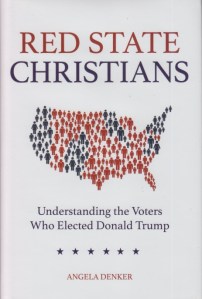
Those of us who grew up Evangelical hold an unusual place among our liberal peers.  We’re often able to peer around, over, and under that wall that has been built between those who want a faith-based nation and those who want a free one.  Angela Denker is a fellow traveler on this road, and her book Red State Christians: Understanding the Voters Who Elected Donald Trump is a useful roadmap.  Some of us fall further from the tree than others, but one of Evangelicalism’s more endearing traits, when taken seriously, is the love of those who are different from you.  That love is often forgotten in the political rhetoric daily whipped into a froth by an unstable president being used by his party to install agendas that hardly fit the moniker “Christian.”  That’s why books like this are so important.

I confess that reading studies such as this make me uncomfortable.  Uncomfortable because my Evangelical past haunts me worse than any ghost, but also because Denker is clearly right that basic humanity is being left in the garbage as battle lines are drawn up in what could be a great, diverse nation if a leader were determined to work for unity.  I recently wrote about lunar landings.  Kennedy was a Catholic who had to work to bring a nation together around a common goal.  Instead of tearing the country apart for his personal aggrandizement, he pointed to the moon.  Sure, there was a xenophobia concerning the Soviet Union, but at least in this pocket of the world there was a sense that we should work together.  When religion entered politics with Richard Nixon and his followers, a deep rift opened up.  The two topics you were never to discuss—religion and politics—were now in the same bed.

Red State Christians is an extended road trip on which Denker interviews people who largely fall under the Evangelical umbrella.  Some of them are Catholic.  Some of them are Hispanic.  Some of them are less concerned with social issues, but are hard-working laborers often overlooked by the Democratic Party.  The resulting pastiche is one in which Americans are cast not in sharp relief, but rather with the hazy edges that are a far more accurate way of understanding human beings.  Many, it becomes clear, elected Trump out of fear, or out of fear of his opponent.  These aren’t bad people, but they are people afraid.  This wasn’t an easy book to read, but it is an important one.  And those who want to work for a future that might include realms beyond the moon might find this work a small step in the right direction.


Power of Parables

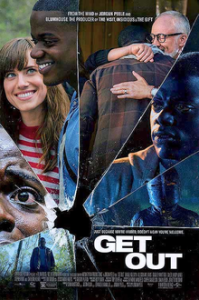
Parables come in all sizes and shapes, horror movie-shaped, some of them.  In my perpetual struggle to catch up, I finally got to see Get Out.  One of the raft of well-made, intelligent horror films that have been released recently, it’s been out long enough that I suspect my spoilers will be well known.  The Armitage family, resident in upstate New York, has been kidnapping and using African-Americans to make up for the perceived weaknesses of their family and friends.  One of their main means of obtaining victims is through their daughter Rose, who brings her boyfriends home for the weekend so they can be hypnotized by her psychiatrist mother and operated on by her neurosurgeon father.  The reveal comes slowly, but the discomfort begins early on.

Released early in the Trump White House tenure, the movie is a study in an intense xenophobia that nestles somewhere between Guess Who’s Coming to Dinner and The Stepford Wives.  It’s inherently uncomfortable watching Chris Washington, the protagonist, being treated as if his very presence requires constant comment in the world of white privilege.  He, of course, had misgivings before ever climbing into Rose’s car, but her convincing display of liberalism was enough to overcome his hesitation.  For me, watching the film made it clear that privilege is something assumed, even when it isn’t had in any explicit way.  The Armitage family and their friends are well-to-do but even if the setting were more mundane the message would still have worked—our culture imposes and reimposes its message of white superiority in subtle ways that the camera captures here.

Quite apart from its nature as a parable, Get Out is a demonstration of the social consciousness of horror.  Its reputation as a debased, low-brow appeal to all that’s unsavory to watch is misplaced at times.  While Get Out is uncomfortable it’s that way for a reason.  Were it not, it would lose its important message.  All privileged people need to be able to see through the eyes of those who are culturally disenfranchised, and although the “us versus them” mentality is problematic it has to be faced honestly and openly.  The very fact that a human construct like race could be used as the basis for a horror film in America raises questions that ought to make all of us squirm.  Setting the story in New York, where prejudice might be supposed not to remain only underscores how deeply its roots have grown.  Horror with a conscience is perhaps as much a vehicle for social change as it is a genre more honest than often supposed.  That’s how parables tend to be.


Burger Impossible

On the way home from Ithaca, we’ve learned the hard way to avoid I-80 through the Poconos on a holiday weekend.  Past experience indicates that about 80 percent of the population of New Jersey (to be fair, a percentage of that may be those from New York City) tries to squeeze through the Delaware Water Gap at just about dinner-time the day before work starts again.  There is a longer alternate route, I-476, the turnpike, which you catch north of Scranton and exit in Allentown.  The only issue with this plan is that, unless you want to exit the turnpike to try to find food in rural Pennsylvania, there’s only one travel plaza between our entrance and exit.  It’s a nice enough stopping point, but for a vegan on the road options are limited.  As we pulled in we noticed there was a Burger King.  Would they have the much touted “impossible burger”?

It turns out that they did.  Having last had a whopper well over two decades ago, mouth memory may have faded a bit, but I can honestly say this was like the whopper I remembered.  If you hold the cheese and mayo, you have a vegan version.  This discovery made me strangely happy.  For years at remote locations (and some urban) we’ve stopped when the only other options are meat based and had the BK veggie burger.  It’s not too bad most of the time, but if you want to think you’re eating meat while not contributing to the massive environmental degradation of industrial farming, the impossible burger seems like a reasonable option.  This is one area of technology that I’m glad seems to be catching up with ethics.

I often ponder how much our western point-of-view is based on the Bible.  Our reluctance to include animals in our ethics is another example of how the hard line between species has been applied.  Even scientists are susceptible to worldview bias.  When we realize we’re all part of a continuum of biological relatedness, it’s a lot more difficult to argue for our special place in the divine eye.  At the same time, insisting one’s ethics be applied to all is a form of fascism.  I’m just glad my conscience can be assuaged with some plant-based food options.  After all, I’ve been on the road for a few hours and I’m sitting here happy to be eating at Burger King.  It’s a matter of perspective.


Masked Reality

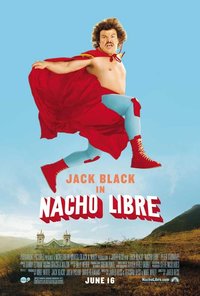
Before I make my confession you need to consider that I spent much of my professional life as a seminary professor.   Never ordained, I nevertheless donned the cassock and taught future priests what they’d be assumed to know (the Bible) while trying to earn an academic reputation through my publications.  It was a double life in which one half involved the church.  Shortly after that job ended I saw trailers for Nacho Libre, a movie in which Jack Black plays a monk who moonlights as a luchador, a Mexican professional wrestler.  I never saw the film, but I had been raised on a white trash diet of World Wrestling Federation fandom, back in the day when that involved gathering around the television to watch grown men posturing and preening while knowing that none of it was really real.  I secretly wanted to see Nacho Libre.

Recently I visited friends who had the movie.  They warned me that it was corny, but I had already supposed that.  What I didn’t realize until after it was over (for movie viewing is now followed by internet viewing) is that it is based on a true story.  “Based on a true story” doesn’t mean, of course, that a movie accurately portrays events, but I had no idea that a Mexican priest had actually supported an orphanage for over two decades as a masked wrestler under the name of Fray Tormenta.  I followed up the movie with a little web research because the film was remarkably respectful of the church.  The character of Ignacio never criticizes Catholicism, and he clearly cares for the orphans for whom he serves as the cook.  His wrestling winnings go toward purchasing better food for them.

Earlier in the day we watched the movie I’d talked to one of my friends about how religious life, no matter how seriously it’s taken, involves acting.  People generally put on masks before going to church (or any other function in which they interact with others).  Religion requires a level of piety impossible to sustain in the real world.  Early in the history of Christianities it became clear that the church would hire some religious specialists to try to take on the lifestyle toward which all faithful should aspire.  I’ve trained many priests.  I’ve seen them when they’re in mufti.  I know that in the vestibule, at the altar, or in the pulpit they’re wearing masks.  Many of them have the heart of Nacho Libre, but outside the church doors they still have bills to pay and family and friends who know them as they really are.  As we slipped the DVD in I didn’t know what the movie might be like, but it was based on a true story in more ways than one.


Meatings

It was almost a little too real.  As I looked at the fake blood—this wasn’t a horror movie—I had a hard time accepting this wasn’t the real thing.  I mean Beyond Meat’s vegetable-based sausage.  My daughter recently sent me a captivating article about artificial meat.  Unlike many paeans to its virtues by fellow vegetarians and vegans, this was written by an omnivore who unabashedly stated that we’ve reached the point where synthetic meat has surpassed the real thing in flavor and the eating experience.  The piece on Outside made me glad.  Feedlots, apart from being the largest industrial polluters in this country, are a horror film based on a true story.  The way we treat “food animals” violates just about every ethical stance in the book, and it’s a big book.  We do it for profit, of course.  Now that artificial meat is turning a substantial profit, those who slaughter are starting to pay attention.

I recently ate at a local restaurant where our waiter recommended the cauliflower burger.  The thought wasn’t appealing.  Don’t get me wrong, I do like cauliflower.  I prefer it raw, however, since cooking brings out its more cruciferous qualities.  In any case, our server said, “It’s new on the menu.  We offered it once before and so many people requested it that we’ve made it a regular item.”  Now we don’t exactly live in a hippie haven here.  Still, enough people are asking for alternatives that we’re discovering it pretty easy to find plant-based protein in some pretty remarkable places.  It put me in mind of my most challenging course in college: biomedical ethics.

A class that asked, and then pressed on very sensitive questions, biomedical ethics required a term paper.  I wrote mine on animal testing.  This was back in the 1980s, and technology has moved on since then.  Even back in those dark ages of Reaganomics, artificial tissue was being lab grown, eliminating the need for animal testing on many products.  Now we’re reaching the point where the same may apply to comestibles.  I’ve long used vegetarian alternatives (now vegan ones) and they’ve increasingly improved.  When I had the most recent alternative, however, I couldn’t believe it wasn’t meat.  It was too real.  I’m not morally opposed to verisimilitude, I assure you.  The closer they get to the real thing, the better it is for the animals who’ll never need to be born to be killed by us.  It’s just I find the fake blood upsetting, and I’m happy to be reminded that this is only a simulacrum after all.


Somebody’s Coming

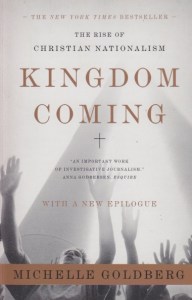
Sometimes updates don’t help.  That’s because evil is so good at masquerading as righteousness that constant vigilance is required.  Michelle Goldberg’s Kingdom Coming: The Rise of Christian Nationalism was recommended to me by someone at a local church.  I’ve been giving educational talks to help people understand what Evangelicalism is, so I figured I’d better read it.  The optimistic epilogue to this otherwise excellent book allowed relief after the 2006 midterm elections.  Of course, nobody back then could’ve believed an even less intelligent president than W could ever be put forth by the GOP.  That doesn’t mean Kingdom Coming shouldn’t be read.  It should.  And it should be required reading (aw, gee!  Homework?).  There have been many studies that have demonstrated repeatedly that Christian Nationalism is highly organized and well funded.  Meanwhile intellectuals scoff that religion is dead.

I spent most of the last week in a kind of panic.  I have another public talk coming up, and I needed to read Goldberg before that.  Yes, it is dated.  But yes, we have Trump’s bumbling form of “leadership” with a well funded, highly organized Evangelical subculture calling the shots.  Forget the politicians—they’re only interested in money—it’s everyone else who suffers from America’s growing fascism.  The fact that the GOP won’t stand up to 45 shows that we’ve already turned the corner toward das Vaterland.  Anyone the Republican Party elects from now on could be the new dictator.  Christian Nationalism stands behind this as journalists scratch their heads.

Goldberg’s book has likely been shelved because eight years of Obama made it seem like the threat was gone.  The problem is, silence works to the benefit of Christian Nationalists.  Perhaps the most frightening thing about all of this is that many intellectuals simply don’t take the threat seriously.  At the same time I was reading this, I was also reading about Nazi Germany (because I’m such a cheerful guy).  The parallels are blatant and entirely too obvious to miss.  Christian Nationalism has an agenda and it is fascist in nature.  Even obeying the words of Jesus takes second place to the political objective of making America in their own image.  This may sound alarmist, but it’s based on solid information.  The Devil, they say, is most powerful when people don’t believe in him.  Those who would make America into a theocracy would claim to follow the other guy, but looking at their tactics, it’s pretty clear who’s really in charge.


Private Matters

Mercenaries have long been part of human culture.  With some exceptions, people really don’t like to fight to the death meaning that wars have often relied on those willing to fight for pay.  As society buys more and more into capitalism—and capitalism always means you want what someone else has—we’ve had to pay armies to become a massive part of our national existence.  In the United States the military budget is the most massive drain on taxpayers’ dollars, dwarfing all other areas of government spending.  Even Dwight Eisenhower, himself a military man, warned the country of the military-industrial complex.  It was becoming too powerful, he believed.  Knowing better, we continue to spend to curb our fears—generally unfounded.

The other day I was reading about the private military industry.  I didn’t even know there was such a thing.  Yes, I’ve known of mercenaries since I was a kid, but I think was got to me was the word “industry.”  This has apparently now become a legitimate line of work, I suspect with tax breaks and other kickbacks.  What’s more, it’s recognized by governments as a legitimate business.   Perhaps I spend too much time in my own headspace—I am a Bibles editor after all—but I felt like I’d just crawled out from my scriptural rock.  There’s an entire industry where your job is to be a fighting force for hire?  Victory to the highest bidder?  The ultimate, weaponized free agents?  How does that feel?  Mercenaries have often suffered in reputation.  Now we recognize them as just another job.  I guess that’s one way to handle unemployment.

While the Good Book is considered outmoded by many, I do think it has many things right.  One of its most compelling messages is that we should be peacemakers.  We should love one another, seek to help, not to harm.  Nobody’s going to pay a lot for that, however.  War is more profitable.  Meanwhile the education industry—even it can be capitalized—suffers.  We don’t want to pay for cooperative ventures where the entire human race, and other species, might benefit.  That we deem too expensive.  After all, there’s only so much money to go around for bombs and missiles and whatnot.  How are we supposed to protect that which we’ve extorted from others if we don’t have a massive military?  I suppose we could hire freelancers, but then, that costs money.