Eye of Survivor

I don’t watch television. This isn’t any kind of moral stance. It’s financial. We can’t afford any “triple play” plans for the little free time we have for television. My wife and I both work long hours. We like to read, so we don’t have time for the tube. We buy the shows we want (it’s more honest than advertisements) and movies are a one-off thing. I sometimes lose track of culture, though. Maybe I’m two-faced. I grew up watching television. Then I grew up. But I still occasionally read about television. When we stay with relatives or in a hotel sometimes we imbibe. What I’ve noticed the past few times we’ve been away from home is reality television. Programs with more and more bizarre “real” situations fascinate those who don’t get out much on their own. One of the venerable ancestors of the genre is “Survivor.” I’ve never seen it but even I know what getting “voted off the island” means.

A recent piece in the New Jersey Star-Ledger celebrates a local young man on the show, now in its thirty-third season. This youth, who fancies himself, well, a survivor, notes that his role models are Jesus Christ and Ronald Reagan. I shudder for the future of our species. This young man says he likes to “screw with people’s heads and lie every chance I get.” Is that Reagan or Jesus? Or is it all just a game? The piece by Amy Kuperinksy goes on to quote the boy as saying his tactic for survival is to manipulate people, getting one over on others. But then he’ll use Christianity to build bonds. Machiavelli might have been a better choice of role model here, but then, who has time to read when “Survivor” is on TV?

Photo credit: Smithsonian Institution

Photo credit: Smithsonian Institution

This isn’t going to devolve into an old person’s jeremiad about the younger generation. Nor is it a castigation of television. (As Homer Simpsons reminds us, many of us were raised by television.) Rather, this is a question posed to our future selves. Perhaps we simply can’t see far enough ahead to get an idea of the consequences of our actions, but my question is what values do we wish to see in our society? Rugged individualism may have worked in the early days, but it led to genocide. Have we gotten over all that? Have we come to the point where we make stars out of those who don’t even pretend to be someone else any more? Maybe I’ve got that wrong—lying and manipulation may well be acting after all. Reagan was among that pantheon. I’m just not sure where Jesus Christ enters the picture.



Not Quite Dead

Duria_Antiquior

Extinction is a cause of fear. Having evolved a certain level of self-aware consciousness, we fear becoming the next tyrannosaurus-rex or spinosaurus, or whatever the next top predator turns out to have been. We’re here to stay. So we like to think. Data have been known to interfere with comfort zones, however. Take religion, for example. America has always been a religiously diverse “country,” but many people suppose it has a Christian beginning. Moreover, the historically uninformed suppose that generic Christianity to have been Protestantism (which is not really a single religion) and white (which isn’t really a race). Now, it seems, that white Protestantism is slowly going extinct. An article in the Washington Post by John Sides contains an interview with Robert P. Jones of the Public Religion Research Institute. Jones has written a book about the end of this particular hegemony.

Demographics tell the story. The powerful cultural force of the mainstream Protestant churches hasn’t disappeared, and really isn’t likely to become extinct. It has, however, diminished. As soon as we began to embrace technology this was a more or less inevitable trajectory for the human race. We made oceans smaller and came to see that we’d evolved different religions in different regions. And that Christianity wasn’t quite unique as we’d thought. “Orthodoxy” was actually a form of prejudice for a past that may never have been. We saw the writing on the wall and went on scribbling. Making claims the data don’t support.

One of the drivers—and this is a complex phenomenon—behind this shift has been the ossified positions of religions in the light of increased understanding. For example, most people see no problem with homosexuality. They believe shooting someone because of their race is wrong. Women, they radically suggest, should have the same rights as men. The hold-out positions on these issues have historically been religiously based. Just listen to the rhetoric of televangelists and see if it has changed. Meanwhile, the world moves on. Many religions are holding still. Or racing to see if their diminishing number of feet might make the world spin backwards after all.

Religion is a human invention. Many protect themselves by claiming direct revelation by a God who used to live in a glass ceiling above our heads. Trips to the moon, probes to Mars, and out of our solar system have proven that view false. If the view of something as basic as the universe was wrong, what else might’ve been a mistake? Jones’ new book will no doubt cause some panic. Extinction, at least not imminently, doesn’t seem to be in the cards. Protestantism seems to have reached a stasis. Religion still has an important function in society. When it takes the lead on issues of equality, we may begin to see a miracle.


Foiled Again

Few things travel as well as curses. Or so it seems in a news report from Serbia. Archaeologists in Kostolac, according to The Guardian, have excavated skeletons nearly two millennia old. That’s not news, since people have been dying as long as there have been people. What makes the find extraordinary are the gold and silver metal foils that have been found at the gravesite. Inscribed in Aramaic with Greek letters, these tiny missives were rolled and placed in lead tubes to be buried with the dead. Although translations of the inscriptions aren’t given, the fact that they contain the names of demons would suggest these might be curses against anyone seeking to disturb the tombs. Such devices go all the way back to the Pharaohs, and perhaps earlier. Nobody likes to have their sleep disturbed.

Serbia, for those unfamiliar with geography, isn’t exactly next door to ancient Aram. The burials and inscriptions seem to fall into the Roman Period, however, a time of cultural diversity. When cultures come into contact—in the case of Rome and prior empires, through conquest—new ideas spread rapidly. And sometimes old ideas. The Romans, in general, didn’t like competing religions. Then again, their idea of religion was somewhat different than ours. Ancient belief systems were more or less run by the state. They served to support political ends—at least they were upfront about it. Your offerings and prayers were to be given in support of the king, or emperor, and beyond that nobody really cared. Unless, of course, you were making curses.

Curses, it was believed, really worked. Even today in cultures where belief in curses persists people tend to be physically susceptible to them. We don’t want others to wish us ill. Perhaps that’s the most surprising thing about politics today. Our society has taken a decided turn towards the more secular. Candidates for political office, even if they personally believe nothing, can still cast curses on those who are different. They can claim support of their “faith” to do so as well. Words, in ancient times, were performative. They meant something. Curses were taken seriously because if someone were serious enough to say it, they probably meant it. They could be written down and preserved beyond death. Today, however, words are a cheap commodity. You can use them to attain your personal ends and discard them once they’ve outlasted their usefulness. Perhaps we do have something to learn from the past after all.

Copper scroll from Qumran, replica. Not a curse, just an illustration.

Copper scroll from Qumran, replica. Not a curse, just an illustration.


Simply Complex

What does it mean to be a man? Or a woman? Or intersex? As a society we seem to spend quite a lot of political time thinking about this. We want to regulate something we don’t even understand. An opinion piece by Rabbi Mark Sameth in the New York Times raises this question to a new level. “Is God Transgender?” the title asks. The Bible, which most of the belligerents in this battle claim to follow, doesn’t present as hard and fast a rule on sex as it might seem. As Sameth points out, the language of a number of passages seems “gender confused” and even the gods of olden times could slip from female to male and back. The Ugaritic deity of Athtar could be called Athtart, depending on her or his gender at the time. We human beings prefer our genders to be fixed, but nature doesn’t always agree.

IMG_2578

Not only gender identity, but gender itself occurs on a spectrum. In cases of “ambiguous” gender doctors often make the decision at birth. Gender is assigned, and sometimes made surgically. And lawmakers will use an outdated binary system to assign bathrooms. We make industrial, multi-occupant bathrooms because they’re cheaper. At the same time we raise our children telling them that bathroom use is a private function. Of course, when money’s involved the story changes. We thought we understood what gender was. Like most aspects of life, however, our understanding is only partial. Some species have such complex reproductive techniques that the term “gender” just doesn’t apply. Some species naturally change gender in the course of their lives. Which bathroom should they use? Nature doesn’t support our laws here.

For human beings the experience of gender is no doubt important. More important, it might seem, would be the acceptance of difference. A rainbow doesn’t have sharp divisions of color. Light blurs from one hue to another and we say it’s beautiful. When it comes to sexes we only want two. Black and white. As the rabbi points out, however, nature prefers the rainbow. The acceptance of difference in the face of the evidence would appear to be prudent. But many people read the Bible only on the surface (although even here it’s not as straightforward as it might appear at first). The biblical writers probably thought of gender in binary terms. In those days congenital “defects”—at least those visible to the naked eye—were cruelly set aside as a divine curse. We’re at last learning to see this “curse” as a blessing of diversity. As long as we don’t have to share bathrooms.


Gray Magic

Fashion. Okay, I’ll wait here while you check your URL to make sure you’re on the right webpage. Back? Okay. Fashion is something about which I care so little that it surprises even me that I’m addressing it. I can blame my wife, since she sent me the article. In The Guardian. Entitled “Salem style: why this is the season of the witch.” Now it all starts to add up, even if it doesn’t make sense. Witches are among my favorite topics. If I have to go through fabric swatches to get there, I will. So it seems that the fashion world has cast its eyes back on Salem this year. A number of recent, high-profile books have addressed witches, and a number of movies have backed them up. As Priya Elan points out in his article, the political situation helps too. We’ve got a witch-hunter as the GOP candidate and, like in the good old days, being a woman is enough to qualify you as as witch in the language of elephants. Could it be that the fashion industry is making social commentary?

DSCN0565

Why are witches so compelling? Perhaps the failure of true gender equality to take hold has spawned a backlash. Women are still paid less than men for the same work. White men line up at the white elephant sale to say how marginalized they are. How hard it is to exist in a world where you can’t even buy a slave or two any more. Unless you call them employees and then you have to pay them something. Primate society rebels against unfairness. This, pure and simple, is evolution. Biologically, we’re told, evolution has no goals. Where we are, however, is progress. We don’t live in the Dark Ages, after all. In the Dark Ages they believed in witches. Wait, what?

Our throwbacks to Salem should be telling us something. The Witch remains one of the most haunting movies of last year. In just a month the Blair Witch reboot opens in theaters. The Harry Potter series has come back from the dead. Like Rosemary opening the brown paper parcel, we realize witches are everywhere. We fear those with power over us. We call them evil and try to find legal ways to burn them at the stake. Or hang them. Or invoke the second amendment. I may not care for fashion, but I can still spot a prophecy some distance off. It doesn’t take a witch to see the future. Or perhaps it does.


Circus of the Absurd

As long as I’m thinking about ethics, my thoughts turn to the fair. Every August our county 4-H Fair becomes an event in our lives. Since my family has been involved with 4-H for many years, we always try to spend as much time there as we can afford. Jobs and daily life tend to get in the way, of course. While there we get to see the animals that are missing from our lives, and reconnect with art and culture. Robotics are now part of our local fair, and this is the first year that I’ve ever seen pigs there. And there were the political booths. Just around the corner from where the sheriff’s office was giving out free gun locks to prevent kids from shooting someone accidentally was the booth supporting Trump. I’ve never been so strongly tempted in my life to walk up to a total stranger and say, “You are kidding, right?” But no, like the Donald himself, a flashy large sign displayed their ignorance for all to see. We live in the era of the delightfully uninformed.

IMG_2908

I’m no political pundit. I tend not to trust any politicians much. I distrust businessmen even more. The fact is the only thing you need to be a viable candidate for President is money. Over the past several weeks Trump has shown himself to be anything but qualified for political office. Major newspapers run articles that seriously question his sanity. And yet here are good people who don’t have the sense to maybe put up an embarrassed, small sign saying “Sorry folks, we’ll try again in 2020.” We find it hard to admit our mistakes. Especially when the stakes are so terribly high.

I go to the fair to support 4-H and to enjoy an evening out with my family. Although I spend most of every day in a different state working in an isolated cubicle, I can always count on seeing people I know at the fair. I enjoy the arts tent where young folks are making their first steps into lives filled with creativity and imagination. The more technical tents can be intimidating where kids a quarter my age are launching model rockets and those under half my age are building robots. In the herpetology tent I see a snake amid a bed of shredded newspaper. He’s hiding under the photo of a prominent non-politician who has a large booth displaying his name just across the grounds. And I remind myself this is the first year they’ve had a swine tent. I wonder if anything will be the same next year.


Food for Thought

You probably know the ritual. On a given day of the week (often the weekend—your “time off” for good behavior) you troop to the grocery store. You toss the items you’ll need for the week into a cart and trundle home to fit them into the interstices of a crowded kitchen or pantry. Then you start to notice that funky smell when you open the fridge. Or you eat a snack chip and find it gives no resistance to your teeth. Something’s gone off and needs to be tossed again, but this time into the landfill (or hopefully, compost). We’re all so busy that we don’t really have time to ponder this much. After all, the work’s the thing, and we only have a few hours at home anyway, and we can go shopping again soon. Now here’s where it starts to get ironic: we subscribe to Consumer Reports. I’m about the least consuming person you’ll be likely to meet (or not meet), unless, of course, the topic is books. I don’t buy stuff unless I have to. My jobs have been financially disappointing since earning a doctorate and I’ve got tuition bills of my own to pay. Every penny counts. But I digress.

Consumer Reports, in its September issue, discusses the problem of food wastage. Since I’m a simple man statistics impress me. 52 percent, for example, of the produce Americans purchase is thrown away. Math class was some time in the past, but even I can see that’s over half. This is something we’ve paid for and we simply jettison because it’s gone bad before we use it. This particular figure hit me because I like to have fresh produce with my boringly consistent lunch. When they’re in season I buy snow peas. Problem is, our grocery store only sells snow peas in massive packages, hermetically sealed. I can’t get through them before they go bad, and I can’t buy just what I need. For my convenience, I’m told, these tasty greens are prepackaged and pre-priced (at the cost of a small automobile) so I don’t have to dip my grubby hand in the basket and weigh out just what I need. And it’s not just peas. I can’t remember how to make a salad any more because, well, they come in bags, right? The natural habitat of greens.

Free-range peppers

Free-range peppers

The problem goes further than that. Here’s where the stats get scary. According to the article 28 percent of the agricultural land of the world generates food that isn’t consumed. Over a quarter, if memory serves, is ultimately wasted space. A full quarter of our freshwater usage is for stuff we throw away. In the land of overabundance we’ve learned to squander our resources and think nothing of it. It’s just food, after all. It’s not like there are starving people in the world. Perhaps the greatest ethical crimes are those that are so ordinary as to become forgettable, like that trip to the grocery store. Let someone else do the packaging. Anything I don’t eat I can always throw away. We can grow more. It’s a ritual, after all.


In the Details

To a certain mindset, nothing conveys a threat quite like Satanism. Many parts of the world witnessed this dynamic during the “Satanic scare” of the 1990’s. In reality, however, most groups identifying as Satanism do not believe in a Devil and, often enough, don’t engage in worship. These groups are a reaction against aggressive Fundamentalism. For example, a Washington Post article timed as parents (at least) are thinking of back-to-school worries, announces “An After School Satan Club could be coming to your kid’s elementary school.” News headlines are intended to make you want to read a piece, and this one worked in my case. It turns out that the Satanic Temple, the group behind this current initiative, is one of those rationalist groups that doesn’t believe in the Dark Lord. They object, however, to schools allowing Good News Clubs to meet after school hours and want to make a point by offering alternative programing. Devil-themed, but not Devil-believing.

It’s difficult to imagine this kind of situation developing in many world cultures. It raises some very basic dilemmas where two conflicting freedoms co-exist: freedom of speech and freedom of religion. Most people would agree, upon reflection, that public schools should not be used for religious instruction. After school programs, in the minds of kids, still take place “at school” and are not easily separated from regular instruction. (Just ask an undergraduate what an adjunct instructor is and you’ll see that they pay little attention to administrative issues like that.) Fundamentalist groups, such as Good News Clubs, use freedom of speech as their wedge to offer after school programs. It’s not “school,” and it’s after hours. Don’t we allow freedom of speech, and isn’t there space available? Good News Clubs are, of course, evangelistic engines. The Satanic Temple makes the claim that if one religious group can meet after school, so can another.

Neither academics nor society have a good understanding of literalist beliefs. Those of us who once believed—sincerely believed—Fundamentalist teachings are a resource academia has chosen to ignore. Higher education is still an “old boys network” where jobs are offered on the basis of who you know and not on the basis of the knowledge they might offer to students. This, I suppose, is yet another clash taking place. Fundamentalism may seem laughable from the outside, but from the inside the untenable beliefs are taken with deadly seriousness. After school programs are an expression of a very deep-rooted fear that such religions promote. Satanist groups will get headlines by taking them on, but they will continue the conflict rather than offering dialogue to try to understand. They’re only doing what higher education teaches them to do—support those you like instead of trying to move knowledge ahead. Perhaps that’s the real work of the Devil after all.


Flying with Strangers

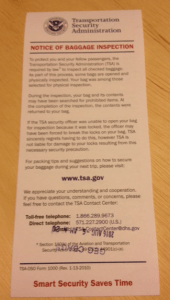
TSAThe world is safe now. It’s okay—you can unlock your doors and windows at last. I have the proof right before me. Two weeks ago I was out of town. To get to my final destination I had to fly. I travel light. Seeing families at the airport with stacks of suitcases, I often wonder what people find necessary to take with them. It depends on the destination, I suppose. If you’re skiing you’ll need different gear than if you’re snorkeling. Or spelunking. In my bag there’s just the same old togs I wear at home. Never a clothes horse, I seldom update my wardrobe. I’m not into extreme sports, and for hiking, well, I can wear what I’m wearing right now. One thing is universal, I suspect. Underwear. We all have tucked away in our bag somewhere that necessary item of human social politeness. That’s why the world is safe, you see. I have in front of me a slip of paper informing me that the Transportation Security Administration has looked at my underwear and declared it safe. Go ahead and fly the friendly skies. Just make sure your underwear is clean.

Long ago I learned that if I fly alone I will be singled out for added security checks. I’m a bearded man. A non-conformist. My beard isn’t one of those consisting of trendy hipster stubble either. Just a regular beard. No fuss, no muss. My life is far too busy for me to spend extra time scraping off hair that will only grow back. I have enough pointless tasks as it is. But once you’ve seen the TSA agents looking you in the face and pointing you to the extra-search line time and again, you start to notice patterns. Especially since nearly every TSA agent in Newark parks in the same airport lot as I do and rides the same shuttle in. Sometimes there are so many of them that they ask if I’m lost. No, just looking for a restroom so that I can check my underwear before you do.

The truly ironic part—and I appreciate irony so I know that there’s no way that an agent can know this—is that I’ve been a life-long pacifist. The draft was reinstituted when I was just the right age to sign up. I was a conscientious objector. One of my uncles was too, during the Second World War. The very title of the conflict should’ve made the need for more objectors obvious. I wouldn’t knowingly hurt another person. Or animal. I step over worms after it rains and will yield to an ant on the sidewalk. Still, you’d better check my suitcase just to be sure. To me, it seems the world might benefit from teaching more people to respect those who are different. Bearded men and those whose skin tone differs are not evil. We just don’t have the time to get to know them before we throw their bag onto the conveyor belt.


Opposites Distract

In the current political climate—and not just in the United States, as Brexit reminds us—opposites seem to be the order of the day. The middle ground seems to have fallen out as those frantic for turning back the clock to a day that never really ever existed make their voices louder and more strident. After seven millennia of progress, the apogee of mankind—and let’s be explicit that we mean rule by white men—was reached in “the greatest generation” and the happy days that followed in the 1950s. Those of us born to protest for an even greater idealism have, by our very nature, disrupted the smooth calm that fictitiously prevailed through the first half of the last century. In a new millennium the ghosts of the last century dictate policy. Would I have felt safer then?

The more I ponder this stark dualism, the more it seems that the origin is religious. In its most recent iteration that religion is branded as Christianity, but in actual fact the dualism goes much deeper than that. The adjective “Manichaean” has become popular with writers who discern a certain black and whiteness to our outlook. Mani wasn’t the first dualist in history. In fact, he was somewhat late to the game. We don’t know much about Zarathustra, or Zoroaster as the Greeks called him, but we do know that he set out to devise a new religion. His outlook was one that saw the world as opposites. For every good god there had to be a bad god. There was a struggle that would result in either going to a heaven or a hell. Just about every religion that has developed ever since has shared his conflicted outlook.

DSCN2077

As political pundits bellow more like hippopotami than elephants, trumpeting that those who are different are not to be trusted, we’ve come once again into a dualistic world. Pluralism and globalization are not without their critics. Technology, however, has ensured that they will continue apace. Some governments have tried to “switch off” the internet. Those on the other side of the Berlin Wall didn’t want the truth of what was happening on the other side to be known. They had invented a dualism that was protected with rifles and threats. The problem is things aren’t as simple as the Manichaeans would have us believe. Ours is a world of beautiful, glorious complexity. It takes religion, it seems, to make such a wonderful chaos into something far too simple to match reality.


Nightmares

I spend a lot of time thinking about monsters. Could there be any more statement of the obvious? The deeper issue, however, is why. Why am I, among countless others, drawn to the monster? This may not be politically correct—I apologize in advance—but that which is unusual naturally draws our gaze. Humans, along with other conscious creatures, are curious. (There’s another trait that reductionism hasn’t adequately explained; we’d be far more secure sticking with what we already know works.) The out-of-the-ordinary will keep our attention although we’re told not to stare. The monster is defined as something that isn’t “normal.” We’re captivated. We stare. Indeed, we can’t look away.

477px-Frankenstein's_monster_(Boris_Karloff)

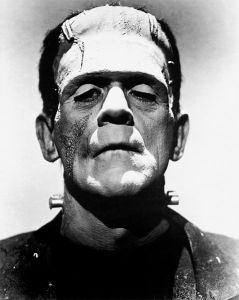
The media play into this with their coverage of Trump. I realize I risk participating in that rude behavior by even addressing the topic, but as I hear intelligent people everywhere asking why Trump has captured the imagination I have to ask, have you seen the headlines? Newspapers that don’t endorse him run huge headlines when his name is in the news. It’s horrible, but I can’t look away. Historians scratch hoary heads and wonder how Hitler came to power. Populism combined with an undereducated population in a democracy may be an equation that political analysts should try to solve before it’s too late. Meanwhile, my thoughts turn to monsters. Ugly, large, and threatening, they rampage through my dreams and now my waking reality. I watched in horror as the electorate lined up behind Reagan. Bush, I told myself, was an aberration. Until the second time. Then I realized it was the summer of Frankenstein indeed.

From my youngest days I recall the antipathy that my classmates showed toward school. I didn’t mind school that much, or at least the learning part. Gym I could’ve done without. I never did get the socializing thing down. Feeling a bit like Frankenstein’s monster myself, I realized I was a pariah (that was a vocabulary word). When did monsters shift to being worthy of emulation? The monsters of my childhood were to be feared, and curious creatures will always keep an eye on that which causes fear and trembling. The media say we don’t want Trump but they give him all the air time he could wish and more. In headlines in massive, almost misshapen letters. They’ve expended their superlatives on what they tell us we shouldn’t see. They have, perhaps unwittingly, played into the very hand bitten by that which it feeds. I can’t help it. I’m staring.


Equal Frights

Ghostbusters_2016_film_poster

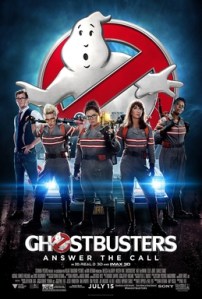
Working in Midtown Manhattan, it’s rare for a week to go by without passing through a street that’s set up for a film or television shoot. New York isn’t the largest city in the world, nor does it have the tallest buildings, but it is a city instantly recognizable at a glance. It is also a haunted city. The original Ghostbusters was a New York movie, but the reboot may be even more so (although largely shot in Boston). I’m having difficulty remembering the last time I enjoyed a movie so much. I laughed until the tears came, and the theme of spirits loose in the city appealed to that part of me that loves the strange and unusual. With several nods to the original, and cameos from the surviving cast, this is a child of love that outshines its parent. It’s almost as if it makes the original even better than it was to begin with. This is a movie with a mission.

Clearly one of the factors in making the film so good was the fact that women were the leads. They show at once the empathetic, and funny, intelligent, and challenging—roles that women routinely both possess and face. The characters have trouble being taken seriously by the males around them, yet they are fully as qualified as and indeed, know more than the establishment. Discouraged and downtrodden, they press on, saving New York City. This may be the first time women have been envisioned is such a salvific role. They are scientists, scorned for their brains and for their gender, and yet they overcome.

Sure, there’s fantasy involved here, but fantasy with a message. I applaud this movie that not only entertains, but also makes profound statements at the same time. It gives a rare glimpse of what the world would be like if men were treated with the demeaning outlooks that they already frequently give to women. It is a feminist movie, but not an angry one. I left the theater genuinely elated. Of course, I loved the first Ghostbusters, despite all the cigarettes and sausages. Still, those who made the movie had the grace to bless this new venture that takes viewers into a world where we rely on women to solve the problem. Once it’s solved, however, they are shoved into the background so that the powers that be can take the credit. It is a movie for our times. I would’ve gone to see it for the ghosts alone. I came out, however, knowing that I had seen something not only enjoyable, but which might, if taken seriously, begin to change attitudes and prejudices which haunt us to this day.


Pagan Virtue

We are products of our place of birth. One of the truly amazing things about human culture is how quickly it can evolve. As biologists have noted, populations separated by natural barriers such as mountains, big rivers, or oceans, tend to evolve in different directions. They adapt to their environment. So far the world-wide web hasn’t flattened our differences out completely with a cultural creole, and it may be best to celebrate it while we still can. In an article in The Atlantic, “Why the British Tell Better Children’s Stories,” by Colleen Gillard, answers her titular query with religion. The British, she suggests, are better attuned to their pagan past. In the United States children’s stories tend toward the moralistic, reflecting the Puritan values that some decry as absent from culture. British stories lean toward magic and earthiness in a way that American stories don’t.

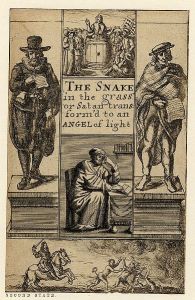
Any generalization opens itself for criticism. (Including the generalization I’ve just made, I suppose.) Still, I think Gillard is onto something. Children are magical thinkers and have to be taught not to see what they think they see. We acculturate them into the dull, adult world of making money instead of magic. American kids get started on the entrepreneurial pathway with early moralizing about hard work and attaining goals—just glance at the titles mentioned in the article and see if you can disagree. Christianity arrived in Britain much, much earlier, of course. There it encountered a pagan sensibility that tempered its increasingly harsh edges. Puritanism took the remaining joy from the good news and made it into a very serious belief system, indeed, with eternal consequences that persistently threaten any enjoyment of life. You constantly have to examine and prove yourself. The British allowed their former earthiness to survive, as early epistles to Augustine (not of Hippo) demonstrate.

389px-The_Snake_in_the_Grass_or_Satan_Transform'd_to_an_Angel_of_Light

The article ends by reflecting on recent American dystopian novels for young adults. These, Gillard suggests, reach toward fantasy in a way earlier efforts didn’t. I wonder if a bleak future is the natural consequence of founding a nation under the eye of an ever watchful, and vengeful, deity. Even a Trump may appear righteous with a Pence in his pocket. We’ve got to return to those old Puritan ways of subjecting women to men to make America great again. As this mass insanity continues to grow and infects the internet, dystopian futures appear to be strangely prescient. The C. S. Lewis of real life was not the grinning evangelical that modern-day candy Christians suppose. He knew a faun wasn’t what it seemed.


Look Both Ways

Like many kids of the sixties I grew up watching Batman. I mean Batman—the campy, goofy, live-action version of the caped crusader that was must-see TV for young boys and other hero wannabes. This was all hung upside-down, as it were, by Tim Burton’s reboot of the troubled crime-fighter. Then came Christopher Nolan’s canon. The Dark Knight remains one of my favorite movies as it seems unstintingly honest. We are all part Joker and part Batman. Neither is ideal. More than that, this movie was my first introduction to Harvey Two-Face Dent. You see, I didn’t grow up reading Batman comics, and the television adventures never featured him. At least not as far as I can remember. Two-Face is a fearful foe because you can never tell when he’s telling the truth. That can be very scary.

The other day I asked my mother about someone I remembered from church growing up. This was a woman I hadn’t seen since the Nixon Administration and I was curious how she was doing, and even if she was still alive. My mother told me she was still around, but she doesn’t talk to her any more because the friend is “two-faced.” Among evangelical Christians this is one of the most feared of epithets. Telling different “truths” to different parties is a certain way to demonstrate want of moral fiber. Hypocrisy. It’s also a non-refundable ticket on the bus heading south, if you get my meaning. Christians want to be thought of as honest, if nothing else. Harvey Dent would’ve had real trouble being an evangelical (with some noteworthy exceptions).

JanusVatican

Businesses, however, are disciples of Janus. I often ponder the sheet number of items that companies classify as “public facing.” What, I wonder, is the antonym? I’ve even heard of corporations that will take legal action against former employees who honestly admit how business is done. No one is permitted to speak of what happens in the entrepreneurial boudoir. Corporations, under the law, are persons. They are afforded the secret inner life of real individuals. There was a “naked business” craze in early in the millennium, but that petered out. We have a public facing face and a reality that no one is allowed to know. Trade secrets. Information that only one corporation may have. Over in Gotham, Two-Face slips into a dark alley and escapes. In little white churches across the country, those who speak different truths are shunned. In the corporate high-rise, businesses are now people. They are, however, two-faced. I miss the Batman of my youth.


Up, Up and Away

OurSuperheroesIntellectuals often have difficulty, it seems, taking popular culture seriously.  I remember feeling slightly guilty taking a class on Science Fiction in college and actually getting credit for it.  At the time—I remember the Dark Ages—a course on comic books, or even superheroes, would’ve been laughed out of the academy.  And not in a good way.  Monsters, likewise, were considered the opiate of the small-minded.  I’m not sure what happened to turn all of this around, but I think my generation growing up may have had something to do with it.  Scholars began to pay attention to more than the cheap paper and eye-catching, if impractical, costumes.  There were, unnoticed by standard readers, messages embedded in comics.  Superheroes may have been telling us something about ourselves.  Now tenured professors can write about various caped crusaders without fear of ridicule.  Some of the books are quite good.

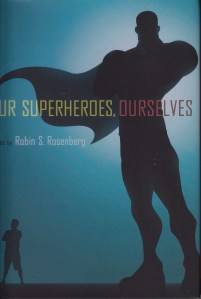
Robin S. Rosenberg’s Our Superheroes, Ourselves, is a rare example of a uniformly fascinating edited volume.  Contributions from a variety of psychologists and psychologists explore several of the deeper aspects of  the superhero phenomenon.  Insightful and thought-provoking, this little book gives the lie to the frequent admonition of my youth that reading such things was a waste of time.  Anything but.  Now, I didn’t have the level of commitment to comics that Big Bang Theorists do, but I recall being entranced by much of what I read.  Some comic panels are still vivid in my head, although I haven’t seen the original in more decades than I’d like to admit.  They are, as one of the essays suggests, a form of modern mythology.  Another form of modern mythology is the movie.  Superhero movies are discussed as well as the print versions.  These cheap, easily read books were more, it seems, than meets the eye.  I’ve fallen a little behind in my superhero movies, but perhaps it is time to start trying to catch up with Superman.

What is really striking, to me, is the discussion of super-villains.  As more than one contributor points out, you can’t have a superhero without the nemesis of an arch-criminal.  This quite naturally leads to the discussion of abstracts: good and evil.  Early comics tended to be Manichaean in this regard.  In our world evil may be much more subtle than it appears on the outside. The book appropriately ends with a reflection on morality. More than one ethical system may be found in superhero tales. Super-villains, apart from becoming role models for some political candidates, allow us to explore our own dark sides. In the end, however, we know that Batman must overcome the Joker, no matter how appealing he may be.