Biblical Stories

The Bible had quite a week last week. It went from being vetoed as the “state book” of Tennessee to making it onto the list of the ten most challenged and banned books of the year for the first time. Did you ever get that feeling that you should’ve thought a bit more closely about career options? I mean, the Bible’s not half bad. Yes, it has some naughty bits, a few instances of cursing, and adult situations. There are homicides, suicides, and genocides. It endorses slavery and advocates religious intolerance. It’s not all bad news, however.
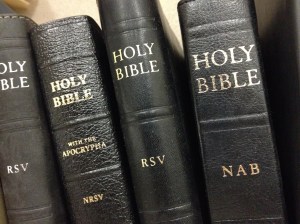
IMG_2634

We find it easy to make summary judgments based on our own tendency to elevate human products to divine status. That which is most holy, after all, becomes the most profane when it’s defiled. The Bible itself can be like any other book. Printed on paper, bound between two covers, it contains ideas that must be interpreted. There’s no such thing as “just reading.” Even that road sign that says “slow children” is open to hermeneutics. What is objectionable is the use to which the Bible is put. And that use is objectionable due to the claims made about it. Saying that God rolled up his immaterial sleeve and took a transcendent pen into his incorporeal hand and began to scrawl is a bit naive. We know that people wrote the Bible—and much of it is sublime—and other people compiled it into a book that eventually acquired sacred status. It wasn’t born holy, it had to grow into it.

Once the Bible became objectified it turned into what people eventually use all objects for: a weapon. We can take sticks and stones and break your bones (no, that’s not in the Bible), and we can take paper and ink and hang you as a witch. Or pillory you as a liberal. Or say that it forbids the love you feel in your God-given heart. Something strange has happened here. The Bible’s not a bad book. It’s a bit on the long and repetitious side, but it has many, many memorable sayings and noble sentiments. Entire civilizations have been based on it. Or readings of it. They’ll ask you to put your hand on it and swear in court, and then they’ll ban it so your kids can’t read it. It’s been a tough week for the Good Book. Somehow, however, I don’t think we’ve heard the last of it because people love a conflicted story.


Le sacrifice humain

The thought of lying tied to an altar while you know someone is about to murder you is a terrifying one. For several reasons. Clearly, you don’t want to die. A more potent fear, however, may be that a darkly savage deity lies behind the dead. An angry, demanding god who desires nothing less than your annihilation. A story in the Washington Post by Sarah Kaplan suggests new findings by anthropologists now suggest a much more frightening rationale behind the world-wide phenomenon of human sacrifice. Kaplan reports that the article in Nature suggests human sacrifice was a means of social stratification. Maintaining control. Surely it must be obvious that those sacrificed are never the powerful and elite, unless, in a reversal of power structures, they suddenly find themselves on the wrong side of the might that makes right. Think of England’s King Charles I, for example. The societies scrutinized in this study, however, are less “civilized” and human sacrifice is a means to remind people who’s in charge.

404px-Ofiara_Abrahama1

What I find interesting about this is how easily the discussion slips into religion being part of the mix. Those of us who’ve spent our professional youths earning advanced degrees in the field have long realized that there is a political element to religion. Temples, yes, were built to the glory of their gods. They were also built to help finance the monarchies in power. Even the temple in Jerusalem was only erected after the monarchy was finally entrenched. Priests supported kings and kings supported priests. They were the elites of society. As Nathan so aptly pointed out, you don’t sacrifice your own lamb when you’re rich. You take someone else’s. Thus it has always been with the exercise of power.

The Nature study examines stratified and egalitarian societies. Human sacrifice is most pronounced in the most stratified. Those where—let’s not be too blunt here—the top one percent want to demonstrate their obvious control over the rest, human sacrifice is most common. Is it really religious? I think the answer is obvious. The gods people worship are those that are most like themselves. The difference is largely one of power. Might, despite all protestations to the contrary, does make right. Or at least right-wing. Human sacrifice still occurs. If the new study is right (and who can argue with science?) there is only one way to avoid being at the wrong end of the sacrificial knife. Or stone. Or torch. And it is to sacrifice the potential to become rich in order to ensure true equality.


States Slights

States, at least the united kind, can have personalities. Some of us move after the diminishing herd of jobs and so end up in places we hadn’t really planned to live. In each state where I’ve made by domicile (six, as of the present), I’ve met people born and bred, down home and with no intention of ever leaving their native land. To such people, I imagine, state symbols may be important. I always felt unjustly proud of Pennsylvania’s Keystone status. I was born there, but neither of my parents and none of my grandparents were. I don’t live there any more myself. I was pleased and just a little surprised to learn that New Jersey has a state dinosaur (the hadrosaurus), discovered right here in the Garden State. This past week, according to an NPR story my wife sent me, Tennessee is trying to garner its own state dinosaur, in the form of the Bible as the State Book. I think it would be a great idea for each state to have an official book, but I would think that it might be a book written by someone from that state.

IMG_1363

Senator Steve Southerland, according to the story, put forward the legislation due to the Bible’s importance in the Volunteer State. The problem is, of course, the Bible is a religious book and that by choosing a religious book you’re getting dangerously close to choosing a state religion. “There used to be a wall here,” you can almost hear the constitutionally minded saying. The Bible is important. Whether we want to acknowledge it or not, no well-informed individual can deny that the United States has had a long and complicated love affair with the Good Book. As I try to show in many of my posts, the Bible still permeates our society in unexpected ways. Nobody’s trying to erase that history, but really, which state is going to select the Rigveda for its own book? Or the Qur’an? The Analects?

States are justly proud of their contributions to the whole. We have state flowers, mammals, trees, and birds. Tennessee’s is the Mockingbird. We have state slogans and mottos. But can any single state claim the Bible more than any other? I have to be just a little suspicious about claims that there’s no religious jingoism at play in suggesting it should be any state’s book. Yes, many Bibles are printed in Tennessee. Many writers have called the state home as well. Wouldn’t the more distinctive contribution come from a book that Tennessee actually had a hand in producing? Bibles, like it or not, can be claimed by all. I can see a tug-o-war coming with Texas, should this state symbol be canonized.


Rainbow Nation

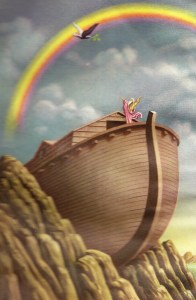
By now I suppose it’s old news that North Carolina has joined the wall of ignominy as the latest state to try to discriminate against gays. It seems our aging leadership just doesn’t get it that a large majority of people in the younger generation just don’t have a problem with accepting homosexuals for who they are. Laws are generally still made by old white men, though. One might be tempted to say “good ole boys.” They may make the claim that this is political, but as one astute editorial in the New Jersey Star-Ledger pointed out, this is about religion. The editorial, which ran on Saturday, notes that studies have shown that when people learn a law sequestered under “religious freedom” is actually discriminatory, the law loses support. The government by the people thing seems to be working backwards. What will it take for elected officials to realize that we are a rainbow nation? And rainbows, according to the Bible, are good.

MyFavoriteNoah

I’m always amazed at these attempts to turn the clock back. It is the season of “spring forward” is it not? Religions that have a problem with homosexuality also have an unscientific understanding of human sexuality as well. Not one person in the Bible had a clear idea of how conception worked. If they didn’t understand the facts of life, how can we expect to learn the life of facts from them? What amazes me most is that such views don’t take the whole picture into account. Intersex individuals—of whom there are many—demonstrate that easy definitions of gender are sure to be wrong. Even tying the concept of gender to sex seems to be misguided. And yet we pass laws the favor a first-century understanding of what it means to be human.

In the end what will change the minds of the corporations will not be their heads or their hearts. The decision will be made by their backsides where their wallets will be growing a bit lighter as corporations decide to take their facilities elsewhere. It’s a sad commentary on our society when justice isn’t enough to strike down a prejudicial law. It takes money to do that. It is a strange world indeed where it take lucre to lead to light.


Taking God to Bed

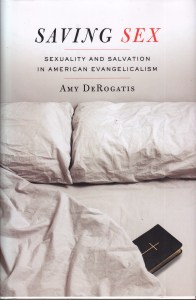
SavingSexThere are varieties of evangelical experience. It is so convenient to put people into neatly labeled boxes that we tend to forget religious experience can be very different, even to conservatives. This point is made very clearly in Amy DeRogatis’ Saving Sex: Sexuality and Salvation in American Evangelicalism. The title of the book requires some further disclosure. DeRogatis is offering an academic study of evangelical sex manuals and teachings about sexuality. If you’re anything like me, the very concept sounds strange. I grew up in an evangelical household and we would’ve been scandalized to learn that such things as godly sex manuals existed. In fact they did, but we didn’t know about them. Although evangelicals share a common idea that there are appropriate and inappropriate varieties of sexual experience, they disagree, according to the evidence, over what some of those boundaries are.

DeRogatis’ book offers some fascinating insights even within this circumscribed field of study. For example, some writers of such manuals give rather permissive instructions as to what might happen in a heterosexual, Christian boudoir, while others keep to the basics. Some suggest that the very practice of sexuality opens its participants to demonic infestation, so much so that they consider STD to be Sexually Transmitted Demons. This is an intriguing and frightening world to enter. Many of the writers of such books suggest that women should indeed be under the authority of their husbands in all things. No room for Lilith there! Others, however, are surprisingly broad minded. More so than some Episcopalians I’ve known.

This brings me, as a former evangelical, to my concern about academic studies of such groups. It seems to me that to truly understand what are undoubtedly irrational beliefs, you must have had the experience of truly believing. If I might be excused of the pun, are you experienced? As much as we wish it were, evangelicalism isn’t a neat packet of propositions that people simply accept. It is a complex, emotional, and, in its own universe, logical response to the belief that the Bible is the owners manual. Sola scriptura gone wild. How individuals deal with this impossible truth is widely divergent. We’re taught not to discuss sex in polite company, but we just can’t help ourselves. For some that’s good news indeed. For others it is the very definition of wickedness. As Saving Sex shows, there is more than one position to be taken.


Resurrecting Color

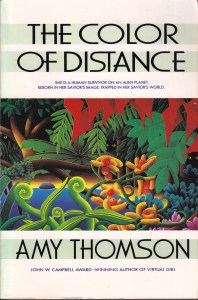
ColorOfDistanceIf you’re one of those people who’s attached to books, you know the frustration of someone who borrows a book and never gives it back. Many years ago I stopped lending out books for that very reason. I do, however, sometimes give them away. A friend recently reciprocated the gift of a book, giving me Amy Thomson’s novel, The Color of Distance. It is a profound story involving, as is common on this blog, themes of resurrection and transformation. A science fiction tale, it is set on another planet where something has gone wrong with an Earth survey team. The humans are dying on this alien world when one of them, Juna, is transformed by the alien into something like one of them. She comes back to life transformed. It wasn’t until I finished the book that I read the cover blurb that reads “Reborn in her savior’s image, trapped in her savior’s world.” Not a bad summary, capturing as it does the deep religious elements in the story.

The religious aspect, however, comes through most clearly in the environmental elements of the novel. Humans, somewhat optimistically, had set in place protocols not to interfere with alien life. So much we know from Star Trek’s prime directive. What makes this so interesting in the case of The Color of Distance is that Thomson knows that any contact is contamination. Two worlds cannot meet. They must collide. There is a gentleness, however, in her narrative. Juna, marooned (long before The Martian) on a foreign planet, has to learn to see things through alien eyes. And every little thing that humans have done has left a footprint on the planet. Protecting our own planet is a profoundly religious undertaking.

It is clear that Thomson has influenced later writers and stories. Not only does The Martian pick up on the stranded aspect, but Avatar clearly presents a world similar in many respects to the planet of the Tendu. The Color of Distance is a book not easily forgotten. The world into which the reader is drawn is indeed one of transformation and resurrection. I suppose spoilers aren’t an issue with a book two decades old, but I will satisfy myself merely with noting that another resurrection takes place as the story winds to its close. Deeply hopeful, and almost prophetic, this novel should be more widely read, for the sake of the world on which it arose.


The Philosophical Neanderthal

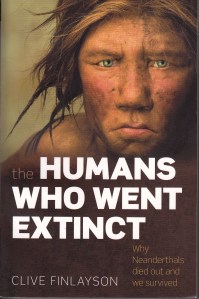
HumansExtinctExtinction. It’s a depression concept, but one that nevertheless constitutes a reality in evolution’s world. When applied to members of our own species we term it genocide and declare it an evil. Our perspective—not to dispute the value judgment—is hopelessly foreshortened. Our brains have evolved to promote individual survival, not to see the longue durée. How often do we worry about the extinction of Homo erectus? Or the australopithecines? Without them we wouldn’t be here, and yet, they’re gone. The case of the Neanderthals is perhaps closer to home. We now know that Homo sapiens overlapped with Neanderthals. Some of the questions raised by Neanderthal extinction are given serious consideration by Clive Finlayson in his study, The Humans Who Went Extinct: Why Neanderthals Died out and We Survived. To get a sense of how this works out, and how it applies with our current contribution to global warming, we must be prepared to view the extreme longue durée. Duration beyond comprehension.

One thing that becomes clear from the very beginning here is that climate has driven evolution perhaps more than we often think. Species, which tend not to live through the relatively long reach of climate change timescales, adapt to the circumstances of their environment. They either do, or they go extinct. Climate, however, is a balancing act teetering toward equilibrium. Hot and cold, evening each other out. Over an even longer duration, our sun will run out of metaphorical steam and things will get quite a bit chillier out there. For the meantime, however, shifts between ice ages and periods of warming will continue to seesaw across time and our race, among many, will need to adjust to survive. Perhaps acknowledging our own role in the current global warming might be a way to start. Our species tends to be short-sighted.

There is an irony here. History and prehistory have shown that, as Finlayson points out, that those best equipped to survive radical changes are the poor. Extinctions—some of them quite dramatic—have occurred before. They will surely come again. When times get tough, it seems, the comfortable get going. Going extinct, that is. Those who climb the corporate ladder the highest have the longest distance to fall when things go bad. The poor, who have to struggle every day to survive, are the ones who know how to get along in circumstances that turn sour. I have called this an irony for what might seem obvious reasons. There is another as well; here we have science pointing again in the direction of the Bible. There it was noted long ago that the meek would inherit the earth. And that’s a bit, it seems, that should be taken literally.


Heroic Gestures

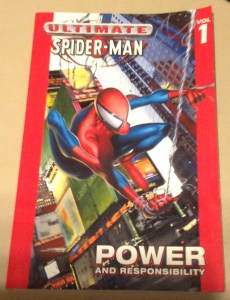
It seems like superheroes have been around forever. They are really, however, the product of comic books from the 1930s on. Adapting well to the big screen, a generation of kids is growing up that may have had their first taste of caped crusaders on the silver screen. I haven’t seen Batman V Superman, only the latest of a long string of the recent procession of such movies. Even so, the character of Superman—among the first superheroes—is less than a century old. Since the meme was conceived, however, it has mushroomed out into all kinds of outsiders offering deliverance. Superheroes are clearly about salvation. Even the anti-heroes. Otherwise they’re a hard lot to classify. Some have super powers. Others have only a lot of money and highly honed physical abilities. Or exceptional intelligence. The one thing they all offer is some kind of salvation. You might have to look for it, but it’s there.

Comic books in general, and superheroes in particular, have recently gained academic credibility. The ivory tower is often a location from which to look down on popular culture—the unwashed crowd—and seek more rarified topics of investigation. Superheroes, however, have proven resilient enough to this academic kryptonite to garner some attention. Comic books can be works of art. More than that, if a meme won’t let go, well, that itch should be telling us something. Sociologically, in a world of near constant uncertainty (who’d have guessed Trump would ever be where he is today?) superheroes seem to offer a stability that daily life lacks. Call it escapism, but what is salvation if not a form of escape? Let somebody else don the cowl and take care of the dangers we never even knew existed.

IMG_0037

Like many kids, I grew up making my own comic books. I invented a couple of superheroes that never found any adoring audiences, but the process taught me something. Looking back at those times in my life, they were periods of extreme crisis. My own superheroes were coping mechanisms. We couldn’t afford a lot of comic books, but once I started working, during junior high school, I started buying Doc Savage novels and consuming them like popcorn. I was trying to get through difficult times. I’ve seen editorials suggesting that the era of superhero movies is dwindling. I doubt that it is. They may eventually fade from the silver screen, but they will still lurk in the graphic novels and recesses of the internet. We need our heroes. We need deliverance.


Unlearning Prejudice

With the terrorist attacks in Belgium on our minds, people are asking once again, “What’s up with Fundamentalists?” My jeremiad that the only solution to religious violence is to study religion reaches few eyes, I realize, but the internet has the capability of spreading memes far and fast. It is merely the hope of a closet optimist. One thing that Fundamentalists believe—I know from personal experience—is that the stakes are based in eternity. In Christian fundamentalism, for example, Hell or Heaven will be forever and any parent would be depraved indeed not to teach their children this belief from their earliest days. That parent-child bond is strong to the point of being unbreakable. That’s why what children learn about religion tends to stay with them all of their life.

IMG_0922A story on the Freedom from Religion Foundation website describes how it is fighting the distribution of Gideon Bibles in public schools in Delta County, Colorado. I was under the impression that Gideons contented themselves with hotel rooms and county fairs. I had no idea that they were active in public schools. In response, the Freedom from Religion Foundation has provided counterbalances to be available to students, including materials calling the Bible into question, and, somewhat more surprising, atheist and Satanist literature. It is clearly a political move to prevent the district from allowing Gideons to distribute Bibles, but it feels an awful lot like a battleground to me. We want the best for our children, but is it best to put our adult biases out where they can be so plainly seen? In a pluralistic society, religion will always raise extreme responses where children are concerned.

The question here is not whether children should receive religious teaching or not, but where such teaching should occur. We are a nation founded on the principles of religious freedom, and although the concepts have changed since the founding days, the ideal is still valid. No matter how one wants to argue the point, people will be religious beings. They may express it in enormously different ways, but express it they will. Children trust us to act like adults. We want what’s best for them but the risk is very high. What should be done? Educate adults. But then, that’s a screed you’ve heard from me before.


GF or TGIF?

For some today is Good Friday. Others are saying “TGIF!” There’s a basic disconnect that has grown between days of remembrance (okay, let’s just call them “holidays”) and the days required of capitalism. Easter is not generally considered a work holiday. As I’ve mentioned elsewhere, coming on a Sunday, it is safely out of the reach of much commercialism. Although, vis-à-vis Christianity, it’s a stronger holiday than Christmas, it isn’t a federal holiday. In a world of religious pluralism, that’s no doubt correct. Still, for those who ponder deeply the tradition that wrought them, shouldn’t we be allowed to contemplate our loss without spending a vacation day?

It will come as no surprise to my regular readers that I often think about the ministry as a vocation. After all, I paid my good money and attended seminary. When I was teaching at a seminary and there was some pressure to move that direction, however, I felt that I was adequately served by daily masses and the opportunity to minister in the classroom. Before those days, however, I trudged into work in Ritz Camera in Brookline, Massachusetts, on Good Friday wearing black and feeling depressed. From long habit I wished to be in church. From financial necessity I stood behind the counter and smiled. Good Friday is that way. It’s hardly a holiday when loss lies all around. It’s a bleak day, one might say. Few bosses who don’t feel the depth of symbolism can quite understand. Work week interruptus.

No doubt it’s vain of me to try to encapsulate this into words. As a culture we prefer the bright, sunny colors of Easter—a holiday with considerable spending but without loss of work efficiency. We should be smiles all around. “Smiles, everyone! Welcome to Fantasy Island!” But we can’t get there without going through Good Friday. Meanwhile, those who don’t observe the day are glad that it’s Friday. Not exactly a holiday weekend, but a weekend nonetheless. Have we outgrown Good Friday? I should think not. For although we bring our cheery flowers and bonnets out for all to see, we all know that Monday is just another day at work.

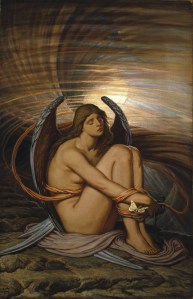
Elihu_Vedder_-_Soul_in_Bondage_-_Google_Art_Project


Palms and Psalms

At Nashotah House, where I spent many years of my career, it was often felt that the weather during Holy Week was, in the best of circumstances, appropriate. With spring just around the corner, however—the date of Easter is based on the Vernal Equinox, after all—a number of surprises came. Particularly in Wisconsin. The ideal scenario would look something like this: sunny then partly cloudy on Palm Sunday; it was a a joyful day for a parade, but clouds make for nice foreshadowing. Nobody really commented on the weather for Monday through Wednesday, and Thursday—Maundy Thursday—was largely spent inside the chapel. Good Friday, however, should be rainy. Saturday gloomy. And, of course, Easter Sunday should be a perfect, sunny spring day. It seldom, if ever, worked out that way. The weather is not beholden to liturgical celebrations. The same holds true for New Jersey. At least the snow has been removed from the forecast today, only to come in the night.

It was at Nashotah House that I wrote Weathering the Psalms. Being a lexically driven book, it was never intended to be a commentary on global warming. It should have been, in retrospect. Already by then we were nearing the point at which, even if greenhouse gas emissions were stopped, runaway melting of the polar ice would continue apace and the weather would grow more and more unpredictable because of human action. Human action of everyone except the industrialists, of course, since they don’t believe in global warming. We cling to our palms and shout “Hallelujah” while the sea level’s rising and our weather grows increasingly erratic. We have a theology with which the weather disagrees.

IMG_2721

The liturgical year is, like its Jewish predecessor, cyclical. Some have suggested that holidays were invented to remind the laity of when it was safe to plant again. Of course, the climate in the “Middle East” is quite different than that of northern Europe and the United States where the Bible seems to have its proper setting. As I was walking yesterday, I enjoyed the daffodils that I always associate with Easter. When I returned home I saw snow in the forecast. Leap year, Daylight Saving Time, and my general level of sleepiness conspired to cause me to overlook that today is the Vernal Equinox. I look for the snow, grasp my palm, and think of spring.


Ethology Theology

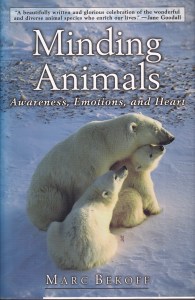
MindingAnimalsProminent public intellectuals, we’re used to hearing, often lament the survival of religion into a rationalist age. As an obscure private intellectual—if I may be so bold—I am always pleased to see when a credentialed scientist asks if we are being too hasty. No, but actually says we’re misguided to dismiss the evidence of our own observations. Marc Bekoff’s Minding Animals: Awareness, Emotions, and Heart is an encouraging study by a balanced individual. Bekoff, unlike many scientists, realizes that emotion does play into observation and reasoning. More than that, materialistic reductionism does not account for human or other animals’ experience of life. Historically motivated by religions to separate ourselves from animals, we have only come to know slowly—painfully slowly—that the distinctive markers of humanity are shared in degree by other animals. Bekoff is bold enough to give the lie to the belief that animals have no emotional life. Traditionally science has said that we cannot know what goes on in animal brains so it is best to take animal emotions off the table. Then scientists go home and love their dogs, who love them in return. When’s the last time I read a scientist writing about love?

Minding Animals is a manifesto. We have, in our arrogance, made unwarranted assumptions about both animals and our unique status on the earth. We drive other species of animals to extinction at a rate that required an asteroid collision or some other catastrophic event in the past. And we use animals as if they had no interests of their own, even such basic interests as avoiding pain and suffering. “They’re just animals,” we’re told. Bekoff is an ethologist—someone who studies non-human animal behavior. As common sense, both the sine qua non and bête noire of science, reveals, animals experience and express happiness, anger, and love. They can be depressed. They can be overjoyed. And we treat them as if they were objects to do with as we please.

Bekoff admits some of his fellow scientists treat him as if he’s gone soft. Like Diogenes, however, I search for an honest man and I think I have found him. Instead of castigating religion, Bekoff ends his book with a chapter on theology. Not to make fun of it, but to show that even scientists must integrate different kinds of knowledge. Not only is the science that Bekoff describes appealing to the emotions, it also makes sense. No scientist is completely objective. Even Mr. Spock breaks down once in a while. We all have perspectives. And that includes our fellow earthling animals. We evolved from the same ancestors and yet treat them as if we own them. Minding Animals will—or at least should—make us feel guilty about that. Being human and being humane, after all, are only a silent e apart.


St. Pat Tricks

What does it say about a saint when the celebration of his day is excessive drinking? Virtue and vice, while not nearly as Manichean as sometimes made out to be, nevertheless conflict in such a setting. Like many American mutts, I have some Irish heritage. I wear green on St. Patrick’s Day, as it’s the done thing. I avoid any celebrations, however. When my job calls for travel to college campuses, I know to avoid the time around St. Patrick’s. Indeed, I’ve taught on campuses where Spring Break was always scheduled around St. Pat’s so as to minimize property damage on campus. Send them off to Florida, where they can be some other electorate’s problem.

IMG_2681

This is an interesting dichotomy. We live in a fairly permissive culture, at least when it comes to things like sex and violence. We nevertheless have built a Prohibition-Era-like mystique around alcohol consumption that makes our college-aged kids a little too curious. Binge drinking and its predictable aftermath have become far too common. Put them together with an Irish saint and all bets are off.

Historically, the Irish have been maligned in what is an acceptable way. Few complain when a nationality is non-ethnic on the surface but non-welcome nevertheless. The Irish have been historically oppressed, but today we forget all that. We hold parades with bagpipes to bolster solidarity, but only if the taps are freely flowing. Drinking with holidays is nothing new. Even Judaism has its Purim and other religions may, from time to time, relax strict rules on the evils of alcohol. But what does it say about a saint that there is apparently no other way to celebrate his day? Wearing green, yes, but that may be entirely accidental. It is, after all, a Dionysian rite of spring, our apparel matching the verdure we soon anticipate as winter wends its weary way out. Even so, I’m glad not to have to be on the streets of a major city when the parade marches by. Even with my Irish ancestry, I prefer to celebrate in my own quiet way, just by wearing green.


Retrograde Motion

How wondrous it feels, after a winter of dark skies, to see dawn beginning to break even before I crawl onto the bus in the morning. Almost pagan in my desire for the longer days, I anticipate this every year after standing in the dark since October. Then everything changes. Darkness falls again. I’m inexplicably weary, despite the sleep of a weekend. It’s Daylight Saving Time. Every year I wonder at this inane wartime madness that we keep going, despite its lack of applicability in an electronic age. Employers, I should think, with an eye toward efficiency, would lead the charge to end changing clocks twice a year to yawning employees and the inevitable depression of taking a step back into darkness. It will be another month before the sun again appears at my bus stop. Meanwhile, it will be light when I’m getting ready for bed in the evening. Perhaps I’m the only one who thinks about this. Religion, however, has always held time sacred.

IMG_2439

Quite apart from “sacred time”—holidays and festivals—religions have always been about the appropriate use of time. Counterintuitively, they suggest the rushing about we do to make money, to ensure our material well-being, might be misplaced. There might be a better use of the allotment that we’re given on this earth. Time to ponder. Call it prayer or meditation, studies show that it is good for us to spare some of our time for quiet reflection. Every second counts. And time sets the very patterns of our lives. Bodies know when to awake and when to eat. Until we go and shift the entire calendar on them.

Daylight Saving Time was a wartime measure to ensure the most efficient production of arms. Now, in days with lights blazing constantly, telecommuting, and farming being done largely by automation, we still religiously keep to this barbaric ritual. Eyes heavy with sleep, I stand in the utter darkness again, wondering when I might see some glimmer of light. It will only come when I’m ensconced in my windowless cubicle. It is so dispiriting. I, for one, would gladly forfeit a mere extra hour’s sleep in the autumn, just to keep progress going in the spring. Instead, I follow the crowd as we waste an hour that becomes five, six, ten, or twenty as we try to readjust our bodies to rising an hour earlier. For those of us up before four a.m., it is a sacrifice indeed. All I really crave is to allow the light continue to grow.


Can of Worms

A great variety of food comes in cans. My mind naturally turns to vegetables and beans, but “tinned meat” was a staple of my childhood, including the now derided Spam. When I see octopus and squid in cans I’m glad I’m now a vegetarian. Once—it may have been in Canada—I even saw bread in a can. My wife and I used to can vegetables at home when we had a garden and commuting didn’t eat up every spare second of the day. For the store-bought can, however, a can opener is essential. The idea is to seal the outside world out, to avoid contamination. To get to the goodies inside you need a tool. A can opener. In these days of emergency preparedness, a can opener can be a matter of life and death, or so we’re led to believe. Dry goods can survive without special preservation, but most require cooking and if the power’s out, well, cans can be much easier. I’m writing about cans because our can opener doesn’t work. We don’t have one of the electric machines that takes up counter space and would be useless in an emergency, but the basic hand-held device that’s designed to remove the lid from a can. I hope there are no hurricanes before we can get another.

A little context is in order here; after all, this blog is about profound things. We’ve gone through four can openers in the past six months or so. (Similar statistics apply to rotary cheese graters and garlic presses, but they are less crucial in an emergency.) The underlying issue is ethics: when you buy something durable, you expect it to last. Now you’re probably thinking, “don’t buy cheap merchandise, then.” We tried getting all of these devices from kitchen stores (not outlets!) and for a price that edged us beyond the comfort zone for a basic tool. These were the ones that went defunct the quickest. Our economy is built on the premise that people have to spend. When I was a kid, we had a can opener that remained the same through my childhood and college years. And we were poor. Now that we’re warned of terror on every side, you’d better have access to a store when that emergency comes because your can opener can fail you.

I know how to use a pocket-knife can opener. In fact, over the holidays I had to resort to one since stores weren’t open and our most recent addition to the can opener family had died. I made sure to show my daughter how to use the pocket knife device. When we lived in Wisconsin we learned how to make our own candles too. During Hurricane Sandy, a decade after they were dipped, these candles proved their worth. With no electricity for three days, we did rely on a can opener. Since then we have not found one that lasts. It seems that our economic plan as a nation is at odds with our national emergency preparedness. Even in the event of a war, we’re told, companies won’t produce weaponry unless they can make a profit. In days like these it seems that a pocket knife might be the wisest investment of all.

Why would anyone need two?  Now I get it!

Why would anyone need two? Now I get it!