The Invasion

So I’m sitting here thinking it would be great if Liz Cheney were to run for president.  Then I think, have things really got so bad that Dick Cheney’s daughter would be an improvement for the Republican party?  At least she believes in democracy.  And something has to break this trumpstipation that seems to have plugged up the GOP.  You don’t want to stand behind a constipated elephant.  I look at the hero worship spawned by a man who’s been known for lying his entire life and wonder where our critical thinking failed.  People far smarter than me have been writing about how democracies die, and this seems to be the case, all because a guy ran six years ago to give his personal business a boost and has been showing us the extreme distortions money causes ever since.

It’s sad really.  Once in a while I think about how Eisenhower was a Republican.  He was a smart man and he clearly had the best interest of America at heart.  Nixon not so much.  Some politicians are motivated by ego rather than the good of others.  I stopped being Republican when Reagan got the nomination.  Maybe it was at Watergate, but I was really too young to grasp what was going on then.  Of course, that was before politics became a real life soap opera.  As the GOP became less G with each passing president, the party seems to have lost its fortitude.  Young people are progressive so we take measures to prevent them from voting.  When Blacks vote we find ways of tossing out their ballots.  Minority rule rules.

Cheney was ousted from her own party for stating the obvious.  Trump is a sore loser.  Not only that, he’s willing to take the entire country down with him rather than admit he was ever wrong.  Stealing government secrets is just another day in office in Margo-la-la land.  I sit here and scratch my head.  It used to be that no matter which party ran things they at least believed they were doing things for the sake of the country, not for the sake of the country club.  All that’s changed in our new plutocracy.  I’m no politician, but I am a guy who tries to make sense of the world.  I see a country of people who go so riled up when they thought Martians were invading not even a century ago.  An event so important that there’s a plaque in Downer’s Grove.  And when a real invasion takes place we now side with the Martians.


Burdens

Listening is very important.  Sometimes there’s nothing really to say but “I hear you.”  This kept occurring to me during All That She Carried: The Journey of Ashley’s Sack, A Black Family Keepsake.  Tiya Miles is a history professor, and she helpfully includes an afterword telling how she came upon the topic for this book.  Ashley’s sack is just that, a sack.  On it, the owner, a female descendent of enslaved African-Americans, stitched a short inscription about the history of the sack, how her grandmother had given it to her mother when the latter was a child under ten, sold away from her mother in South Carolina.  This isn’t an easy book to read.  I have difficulty being faced with what “religious” “white” folks did to Blacks and justified themselves that people can be bought and sold.  Listen, I told myself, just listen.

Those who would deny that any of this ever happened need to learn to listen.  In order to capitalize on the resources this country offered, our ancestors engaged in morally reprehensible acts.  And the cruelty didn’t end with the shipping and the selling.  The treatment of unfree Black people itself was a crime, and their white captors knew full well what they were doing.  Preventing their slaves from having nice things while they themselves lived in luxury.  Beating, raping, and murdering when they didn’t get their way.  Selling their own offspring born of slaves to make a profit.  All the while claiming to be good Christians.  It’s often this part that I have trouble understanding.  Even a literalistic reading gives no license for treating other human beings this way.  Only money does that.

The style of history in this book isn’t that to which many of us are accustomed.  At the point of raising mental critiques I repeated, “You must learn to listen.”  Those who have made the rules showed themselves to be corrupt, and they must be willing to consider alternative ways of telling a story.  Miles makes the point that the history of unfree Blacks was largely erased, leaving the possibilities for histories and heritages slim; if the regular rules are themselves oppressive then it may be time to listen to those of others.  It seems impossible in the age of the world-wide web and all that it implies that we live on a planet where people repeatedly deny their sins while clutching their Bibles in their fists.  We need to learn to listen.


The Magic of Cairns

They’re one of those things, my daughter explained, that people do that make them so likable.  She was talking about building cairns.  Cairns are piles of stones, but not exactly the kind a farmer might make at the edge of a rocky field.  Cairns are intentionally built.  And they have been for millennia.  The thing is, while people could choose to knock them over, instead most people add to them.  When we’re out hiking we add rocks to cairns, and we’ve started our own from time to time.  I first became conscious of them in Scotland.  While out with some friends we spied a carefully stacked pile of rocks—I think it was at some remote location on the northern Scottish coast—and they told of of the tradition of adding to them.

While recounting this, I also recall seeing a pile of rocks—it wasn’t called a cairn at the time—at Walden Pond.  Some friends from seminary and I went to visit Thoreau’s famous site and although his cabin hadn’t survived, other pilgrims had started a rock pile.  It was, if I correctly recall, conical because the stones weren’t flat.  Most cairns involve the flat kinds of rocks that break off of bedding planes.  They are fairly easily stackable and they quite often tumble due to the forces of nature.  I recall building or adding to cairns in Ithaca, near Ithaca Falls.  Such cairns would be fortunate to survive the harsh winter and torrents of the spring thaw.  And yet still we build them.

While on the red trail at Bushkill Falls, where picking and taking items is forbidden, we found cairns.  There were isolated stacks along the river, dotted here and there.  Then, at about the halfway point we came across a field of cairns.  Alongside the trail, cairn builders had obviously seen the beauty of repeated patterns.  Other hikers were snapping pictures there as well.  It was clear that this was a joint venture that had spanned years of cooperating with strangers.  Nobody asks your race or gender or orientation when you add to a cairn.  In fact, those who start them are unknown and leave them for other strangers to carry on the work.  This is frequently the case with human ventures, but when they involve money we become very specific about who might be considered a proper owner.  Stones are common, and although useful are generally not valuable.  Make them into a stack and they become a symbol.  And that symbol can be a guidepost for future travelers, left in the spirit of cooperation of those we don’t know.


First Images

I awoke to an image from the James Webb Space Telescope.  Looking at the universe at it was 4.6 billion years ago is a humble and terrifying experience.  Our universe is so incredibly vast and we are tiny.  As we on this planet bicker and kill and destroy, out there something truly wondrous looms.  Those tiny pinpricks of galaxies.  Our own galaxy so massive that we can’t comprehend it.  Our own midsize star large enough to hold more than a million earths.  Our own planet big enough that no human being can see it all in a lifetime.  What in the world are we fighting for?  This image is just a patch of sky about the size of a grain of sand held at arm’s length.  How many grains of sand would it take to fill the visible sky?

Many people argue that such things are a waste of money.  Yes, there are very real, human-created problems right here on earth.  The siren call of space, however, has the potential to save us.  If we look into that immense universe just out there and realize that we are part of something larger than ourselves, we can stop fighting and hating and electioneering.  Keep looking up instead.  Costs, after all, are relative.  Our entire economic system is arbitrary.  We decide what’s valuable and what’s not.  We make rules that allow individual human beings to control the lives of countless others based on nothing more than agreed-upon principles.  Food could be freely distributed.  Medicine could be given to the sick.  What’s required is perspective.  If looking at the universe doesn’t provide perspective, what can?

I often wonder about life in those distant galaxies.  Given the sheer numbers it’s practically impossible that life evolved only here.  We’re told that teleological thinking is wishful and naive, but looking at the way life behaves I have to wonder if that’s true.  Life may be seeking goals.  If it is, than intelligence may be among them.  We’ve got billions of years and billions of lightyears to work with.  And when I look at the headlines I find those of the James Webb Space Telescope to be the most hopeful of all.  Galaxies are all about possibilities.  Stars being born where the outcomes may be better than one gender assuming it’s better than another.  Or that the “right to bear arms” means  stockpiling assault rifles to kill others in a fit of pique.  No, this money’s not wasted if only people might listen and pay attention to the stars.


Closed System?

Photo credit: NASA, public domain

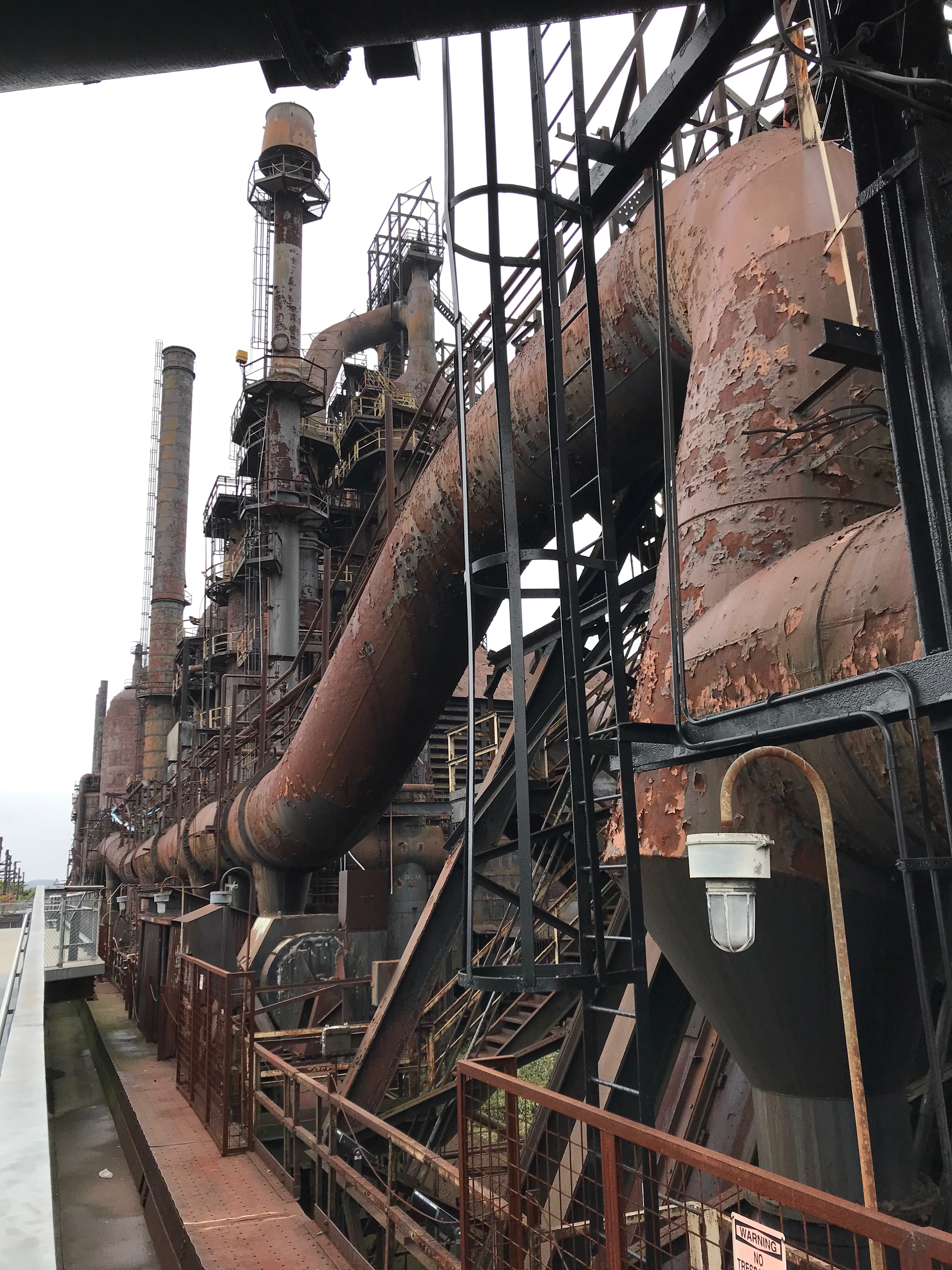
Nothing is wasted.  Not in nature.  Maybe that’s the true economy of life.  We humans come in and make our habitat in our own image and then start throwing things away.  I’m no great fan of yard work.   I would just as soon let nature take its course, but if it did I’d soon have no place to live.  Trees find their way into the cracks in the foundation and those flaccid white roots we see dangling from the ends of weeds can insinuate themselves into tiny places and slowly expand.  Buildings left without maintenance soon begin to crumble.  I’m reminded of this every time I visit Bethlehem Steel.  Weather, plants, even the occasional raven, slowly tear down what human hubris has built.  And it doesn’t stop there.

We set up a composting area for all those weeds, yes.  A place where we could make our own soil.  After three years it was pretty full and when I went to cut back the ever-growing trees and vines, I learned the bees had claimed our pile for their own.  Not happy to see me poking around their home—not happy at all—they began to hover aggressively.  I got the message.  Nothing is wasted, not even compost.  

Our species is in love with petroleum products.  We can’t live without plastic.  Looking at all the plastic litter around is evidence enough of this one-sided affair.  Our plastics cause so many problems.  They do break down, but never go away.  They get eaten.  Undigestible, they can slowly poison animals.  Whatever isn’t recycled becomes part of us.  Nothing is wasted.

Yard work monopolizes my weekends from May through October.  This year it started in April.  I had to mow the lawn in November.  Really only four months to make it through without the endless cycle of birth, growth, death.  Those who are worried that nature won’t recover from our foolish species haven’t paid close attention.  Even as we live here the seeds find every crevice and life, life is irrepressible!  Scientists try to tell us life is unique to this planet, but looking at its tenacity, how can that possibly be the case?  The tardigrade can survive extreme dehydration, very high pressure, very low pressure, radiation, air deprivation, and starvation.  It seems like the perfect space traveller.  We try to make the world in our own image.  We like to think our version of the world is the one to endure.  Nothing is wasted.  Nothing short of human hubris.


Solstice Thoughts

At the equator, the difference is nil.  The longest day and the shortest day don’t deviate from the standard day length.  The further you move from the equator, the more dramatic the effect is.  Here in the northern hemisphere this is our longest day, the solstice.  Historically, particularly in countries to the northern edge of the northern hemisphere, this is a holiday.  Midsummer marked the days of sun and growth.  Light is abundant—too abundant to sleep well in the furthest reaches.   Being visually oriented creatures, we enjoy the surfeit of light.  Light has long been a symbol of the divine for, I suppose, just that reason.  It makes us feel secure and safe.  We can see what’s going on around us.

In Antarctica, today is the shortest day of the year.  Indeed, around now there is seldom any light at all.  On the exact same day there are literally polar opposites on this planet.  The summer here is winter there.  It’s the first day of winter in the global south.  Their understanding of this day is completely different.  Of course, once you reach the shortest day, things can only improve.  The climb to summer lasts half a year, only to have the decline immediately begin again.  The difference is as subtle as it is inexorable.  For those of us who wake before the sun, it’s already obvious that sunrise is coming later than it did last week.  The earliest sunrise was the fourteenth.  Sunset will come later and later for the next few days, to compensate for the lost morning light, but overall there will be less and less until we are the winter half of the world.

There are many lessons to learn here.  In a world where the longest and shortest days are the same day—solstices depend on where you live—we don’t fight over it.  This despite the fact that light is our most precious commodity.  We simply accept that we celebrate light when we have it, and await its coming when we don’t.  Other resources we fight over.  Potable water.  Petroleum products.  Arable land.  Silently, radiantly, light shows us the way.  There’s an inevitability here.  Through long experience on the earth we simply accept it.  The other option is to fight over what we can’t control, which is futility defined.  There are lessons to learn from the longest day.  And if it’s your shortest day, you know that all will be forgiven at the next equinox.


Thanking Teachers

Those who know me personally are often surprised to hear that my high school gym teacher was one of the most influential people in my life.  It is true.  He, and a handful of others I can still remember by name, set me on the path of knowing that I should be a teacher.  It is a very important profession, habitually underpaid.  To hold the future in your hands is a responsibility like no other.  I complained, like all kids do, about having to go to school.  Once there, however, I was fascinated by the learning.  I still am.  I think of those women and men who really wanted to mold young minds.  Who knew they’d never be paid as well as their peers, but who had a message worth preserving.

I suppose I’m thinking about them because I recently watched Dead Poets Society again.  It’s a poignant thing to do since Robin Williams’ death, but the movie makes a powerful statement about teachers.  Knowledge, once planted, grows.  I don’t name people on this blog unless they say I can, and although I’ve connected with a few high school teachers through Facebook, I don’t bother them in retirement.  I can say, though, that one English teacher, my German teacher, a couple history teachers, a math teacher, and my gym teacher made significant impacts.  The math teacher, of course, helped me realize that my thinking process veers in quite a different direction from equations and proofs.  Ironically, now I tend to think that way and often think I could’ve done it, but I needed several years for the ideas to settle into place.

Thinking of them by name may not be a daily occurrence, but in my actions I live out what they taught.  I’m not sure what leads a young person to pursue a teaching career, but clearly some of them have gifts that make them influential in lives long after the classroom relationship ends.  The young mind is receptive in the way that a more experienced one tends not to be.  Even as we reach our teens the natural confidence of youth seems to take over for many.  We might still, however, listen to those with more experience.  Teachers, under-paid and often having to take summer jobs to makes ends meet, are almost as influential as peers.  The twenty years of my life from the age five on were under the sway of teachers.  Time set aside for learning.  It wasn’t nearly long enough.


Paper not Paper

I’m sure other people have this problem.  I read hardback books with the dust jacket off.  Lest anyone accuse me of being consistent, my wife reminds me that I debated the opposite side early in our marriage.  I guess I’m complex.  In any case, the problem I face is with things pretending to be what they’re not.  This particular book is “cloth-bound.”  I own quite a few cloth-bound volumes, but this one is so slick that I keep dropping it.  It slips right through my fingers.  The reason this happens is because “cloth-bound” seldom means “cloth”-bound.  Modern binderies offer a textured paper covering that looks like cloth but it’s not.  In other words, although this book is not a paperback, it has, in fact, a paper back.  This is more than just semantics.

When looking for a house one of my non-negotiables was that it couldn’t have vinyl siding.  Vinyl siding pretends to be wooden cladding, and I require authenticity.  I don’t want a substance saying it’s something that it’s not.  You see, I grew up in a plain-speaking, blue-collar environment.  The last time I visited my mother’s trailer to get something from her former neighbor who’d moved in, it was summer.  I stepped out of the car and although I’d said maybe less than two sentences to this man in our meetings over the years his first words to me were “What are you all dressed up for?”  A bespectacled, white-bearded veteran, he was wearing a tank-top tee-shirt.  I had on a button-down that had been recently laundered.  I loved his authentic approach.  It was hot out, so why was I “dressed up”?

Book-binding actually has a fascinating history.  Books were originally sold as sheaves of paper in a “book block.”  In the early days booksellers often did the binding themselves, or customers would buy a book block and take it to a bindery of their choice.  That’s why there’s no uniformity in old book covers.  Eventually, however, mechanization allowed for books to be bound before being shipped to book sellers.  Early binding tended to be leather, which is why many Bibles are still sold that way.  I found all of this out from reading various books.  Which ones they were have slipped my mind.  Probably they were bound in paper, pretending to be cloth.  Cloth binding is more expensive than paper-pretending-to-be-cloth binding.  That’s why publishers use it.  The same applies to vinyl siding, I suspect.  Only with human beings does pretend authenticity become more expensive.  


Companies

Perhaps you’ve seen them too.  Big companies that express what they do purely in platitudes that apparently impress business types.  I’ve looked at some of their websites and after considerable poking around I can’t conjure even a ghost of an idea of what they do.  Love ‘em or hate ‘em, we all know what companies like Exxon, Random House, or even Planned Parenthood offer.  They have a function—a product or service that you can recognize.  Some of these vague large corporations seem to exist simply to exist.  And get paid for it.  It reminds me of that episode of The Simpsons where Lisa asks a corporate executive woman what her company produces and she answers “Synergy.”  We see these “centers of excellence” popping up here and there.  Excellence in what?  Excellence is a quality, not a commodity.  Or maybe I think too small.

Someone I know recently changed jobs and I looked up the company she’d switched to.  It obviously had money for a slick website and an office in Manhattan.  The list of industries it supports as clients was wide and impressive.  But what does this company actually do?  They spew platitudes.  Corporate climbers apparently like this lingo.  You’ll never catch me citing “best practices.”  Are they trying to imply that the rest of us use worst practices?  Do they mean a better way of doing things?  Why not say what you mean?  I like to play with words.  It doesn’t pay very well, but I’m wondering if I’m perhaps missing an opportunity here.

We could form a company that spins out new corporate phrases to make business sorts sound intellectual.  We wouldn’t actually need to do anything except attend company meetings about our company and throw out a few phrases likely to become trendy.  Maybe hire a publicist to get those phrases going.  Surely some company has the money to spend on that.  Those of us who actually do peddle words for a living have trouble getting big corporate money.  Publishing is a low profit-margin business.  But a company that makes you sound intelligent?  Priceless.  Growing up there seemed to be only a few standard jobs.  Of course, I lived in a small town where the options were indeed limited.  Each of them, however, had a defined role.  You knew what the job entailed.  This new company, which will have a vague name, will be in keeping with the times.  Who’s with me?  Just be sure to bring your checkbook.


False Focus

I seldom use my iPhone.  I admit that I like having a camera with me most of the time and I don’t look like a tourist.  I don’t text and when I feel like tweeting I do it from my laptop.  I often forget where I put my phone and walk out of the house without it.  What I’m trying to say is that it’s not a distraction.  Now I realize companies (which seldom undertake to comprehend those of us who are anomalous) have to appeal to the lowest common denominator.  In iPhone world this means that they now want you to use “Focus.”  In other words, if you’re behind the wheel or in danger of losing your job for being distracted all the time, you can filter what gets through.  I recently had a request from my phone to send me Focus notifications when I’m home.  Of course it knows when I’m home!

It seems unnerving to me that we need to have our devices remind us not to use them.  What does it say about our love-love relationship with devices?  We use them to guide us when we’re driving—no longer experiencing the wonder of getting lost.  We read on them, forgetting the feel, smell, and non-reflective look of a book.  Some people even smoke their devices.  Many people now protect their houses with devices that allow them to see who’s at the door.  Do we really feel safer with our devices taking care of us all the time?  Perhaps we do.  Perhaps the cyborg revolution has already begun.

When I see how simple things like telling an apple from a tomato still flummox machine sensors (and even if they learn to tell this difference, the point remains the same), I realize just how much life experience teaches us.  We’re constantly taking in sensory data and interpreting it.  Often subconsciously.  I can smell and feel the difference if the same shirt is dried in a dryer or on a line.  I know which is better but I struggle to find the words to describe why.  I can tell the difference between the taste of this peanut and that one.  Some scents can trigger euphoria while others warn that a mustelid is nearby and wants to be left alone.  I know to look around for a skunk, to honor its wishes.  I can infer that the apples that have started to go bad are why that opossum is in our compost bin.  Perhaps I’ll pull out my phone and take a picture.


Evening Out

It feels like magic.  The morning after staying up late for something special has a transcendent quality to it.  You can almost touch the veil.  Now, for me it’s an admittedly low bar.  I get up around 3:00 a.m. most days, so “late” is when I venture past about 8:00 p.m.  And I don’t mean for a board meeting where you’re trying to solve the problems of the world.  No, I mean staying up for something you anticipate.  Or even if it’s something you experience only by association.  I had to pick somebody up in Easton after an evening event recently.  It wasn’t over until after I’m normally asleep, but I made plans to hole up in Dunkin’ Donuts and perhaps even sip a coffee if I had to, for the drive home.

This was a Tuesday night so most businesses were closed.  After parking the car I found out that Dunkin’ wasn’t keeping evening hours either.  I try always to travel with a book.  The one thing I learned from my brief stint in Boy Scouts was “be prepared.”  With no Dunkin’ the only places open were bars and clubs.  Thankfully it was a warm evening, so I found a free bit of curb on which to sit to read my book.  Easton’s a college town so young people were out and about.  It was good to see other folks enjoying life.  Then a woman stopped and leaned down.  She was looking at the cover of my book.  “Just wondering what you’re reading,” she said.  “I’m always on the look out for something good.”

Reading in public

I can’t recall the last time a stranger struck up a conversation with me.  Especially about literature.  I was reading Toni Morrison’s Beloved (more anon) and she asked what it was about.  (You, dear reader, will need to wait a few more days if you don’t already know.)   I told her as best I could in a sentence or two, but I was in shock that someone I didn’t know was taking a moment out of her busy life to ask me about a book.  Her companion was ready to get going, so she left.  Shortly after that the event ended and I picked up my charge and headed home.  The next morning had that magic feeling.  I slept later than normal although it was a work day and when I went for my morning walk a startled bald eagle took off from the ground and flew less than twenty feet over my head.  Staying up late, talking about books, and a dawn-time walk in the morning.  Even everyday life can be magical, when it’s rare enough.


Status Check

It took many months, but one of my few Twitter followers was removed not for trying to take the nation by force, but because he’d died.  If I learn to tweet from beyond perhaps I’ll score a few more followers.  The situation, however, is one of the oddities of our socially mediated world.  I was trying to find some information on a potential author the other day and the only online presence I could locate was LinkedIn.  I clicked on the profile only to see the latest update was “Deceased.”  More than that, the Experience column indicated that “Deceased” continued from the date of passing up to the present.  I guess once you’re gone, your gone for good.  Social media, however, will perhaps find a way to keep you alive.

When I’m gone, I imagine WordPress will shut this blog down because nobody will be paying for it.  It’ll probably take a while for Facebook or Twitter to figure out I’m in the new category of “deceased.”  I do hope Academia.edu will keep my downloaded papers there for free. Real immortality, it seems to me, lies in the writing of books.  They too will eventually disappear, and who knows about the real longevity of social media.  It’s pretty difficult to believe Facebook wasn’t even around at the turn of the millennium.  I drive a car that’s older than Facebook.  I keep thinking of LinkedIn listing “Deceased” as a vocation.  Isn’t it really the ultimate vocation for all of us?  If you can’t be found online, do your really exist at all?

While experts debate social media, my job prevents me from using Facebook or Twitter during the day.  After work I’m anxious to get on to the other things in life that virtual friends and followers have to wait.  Early in the mornings I write and research.  I have mere minutes a day to look over social media.  I check Facebook only for alerts.  Life is short.  Is social media making it better?  It’s easy enough to be overlooked in real life, so why indulge in it virtually as well?  Of course, many see social media as a place to vent their spleen.  Why not try to inject some good into the virtual world instead?  There is hope for the dead, for they may still publish.  Their tweets may become somewhat less frequent.  Only the most callous, however, would drop them as friends for being dead.  Let’s just wait for Zuckerberg or Musk to notice.  It may take a few months.


Tweets from Heaven

What do the ultra-rich know about morals?  I read recently that now that Elon Musk has purchased Twitter for billions and billions of dollars, that he’s going to allow Trump back on because it’s “morally wrong” to prevent him.  Heaven help us when the plutocrats start dictating morals.  One of the odd things about my strange career is that I was an undecided major in college.  I settled eventually on religion, but my transcript shows a restless mind.  One subject that I came back to time and again was ethics.  I want to know what is right.  Shutting up a deranged narcissist who wants to run the country only to enhance his image of himself seems a moral no-brainer.  The case was different before he was elected the first time.  Now we know.  Now we have a responsibility.

Those who can afford to buy the moon shouldn’t make declarations on what is moral.  The church, however, has largely become irrelevant.  “It’s easier for a camel to pass through the eye of a needle,” a famous moralist, whose name is unfortunately forgotten, once said.  The moral compass of the uberwealthy is irrevocably squewed by a massive loadstone known as personal wealth.  Indeed, our very laws are made by the wealthy to protect the interests of the wealthy.  They do this by courting biblicists who seem to have forgotten—what is his name again?  You know, the one who seemed to have a problem with the rich?

Photo by Sharon McCutcheon on Unsplash

Morality has somehow become confused with concerns about other people’s genitalia.  We don’t ask what the wealthy do with theirs—it’s pretty clear what one tweeting resident of Mar-a-Lago has done with his.  Ironically Protestants broke away from the Catholic Church largely because of the sale of indulgences.  The idea that the rich could buy their way out of sins rankled sixteenth-century moralists into saying sola scriptura.  But now they have lost even their solaScriptura, for its part, is unequivocal about one thing—the problem of the rich.  The poor aren’t the problem.  In this new gospel, however, victims are blamed while the powerful rightly rule all.  The divine right of riches.  The wealthy, so misunderstood; the poor are the way they are because they’re lazy.  There’s no systemic cause for anyone not to have as much money as he wants (and it seems they’re generally he’s).  And they have a right to say whatever they want because their word comes down from heaven, echoing out from their private space rockets to the stars.


Heat Pump

We’re preparing our home to welcome a new resident.  It’s not human.  Those of you who are home owners know how you move from crisis to crisis, paying to repair this just in time to start paying for that.  Our current issue is a dead dryer.  We knew it wasn’t long for this world when we moved in.  The previous owners, as most working class folk do, let things go until a machine forces  the issue by dying.  Being concerned for the environment, we like to replace appliances with more environmentally friendly ones, if we can.  They are, of course, much more expensive.  With the dryer it was also a space issue.  Snuggled together like young lovers in bed, the washer and dryer leave less than an inch clearance total from either wall.  The first issue we faced—modern dryers are bigger.

Small and energy efficient is what we wanted.  I learned about heat-pump dryers.  They don’t require a vent and they’ve been used for decades in Europe because of both space issues and environmental friendliness.  Here they cost more and you’ll have to wait because they’re in demand.  We decided to side with the environment.  Then there’s the problem of the old vent.  I gingerly walked out the old dryer and was amazed at the detritus I found.  Now, I’m an archaeologist at heart, so instead of sweeping it all in the trash, I sorted through it.  I found a dollar bill.  And 32 cents—this helps defray the cost of the new dryer.  Three guitar picks and a heap of cosmetics.  A box of rubber bands for braces.  There was ancient history in this pile!  The lighting’s bad in that corner so I put on a headlamp like a phylactery.  Let there be light.

I had to use most of my tools to tug the old vent out.  You have to stuff the hole with insulation and put some furring strips in place to hold the new drywall.  Cut out the patch to fit the hole and mud the whole thing up.  Why bother painting where nobody will see?  By the end of the weekend we were ready for our new resident.  It still wouldn’t be here for at least a couple of weeks.  The clothesline is strung in the backyard where the even better method of using nature’s dryer is free.  For those days without sun and on which we have time to do a load, we’ll be glad for our heat-pump dryer.  Particularly when the weather starts growing cold again and global warming enacts its chaos.  Hopefully we’ll have a stop-gap solution by then.


Places and Books

I recently had the opportunity to travel to a new town and spend the night there.  This is a rarity in the days of pandemic and I’d forgotten the magic of waking early in a new place and looking out the windows at the deserted, artificially lit streets.  It’s so peaceful and full of wonder.  The place we were staying was next to a public library and I noticed that there was a light on in the cupola in the pre-dawn hours.  I like the idea of books watching over us in the night.  Often when I’ve traveled to conferences I’ll arise early and look out on that orangey, artificial light while most other people are still asleep.  Even the city in pre-dawn can be a peaceful place.  This is a pleasant displacement since it’s only temporary.

One of the things about the pandemic is that it has accustomed us to life just so.  The controlled environment of home.  There’s a comfort to routine, but there’s wonder in breaking it as well.  When it’s not a conference and still a new city, I begin to look for a bookstore.  One of the common misconceptions—perhaps bolstered by the cookie-cutter experience that has been Barnes and Noble—is that bookstores are all the same.  They aren’t.  Each reflects the minds of the owners.  They reflect their knowledge of their public.  New ways of looking at things.  I suppose this fascination with books has been enhanced by my starting to read some Jorge Luis Borges again.  Those of us who read for pleasure are in the minority and we find the open book to be open arms welcoming us in.  Welcoming us home.

I always travel with books.  My travel bag carries my laptop and my reading.  New technology having to learn to adjust to the old.  I’m not a particular fan of technocracy.  I’ve always preferred paper to plastic.  In a new town I look for authenticity.  We lived for many years in Somerville, New Jersey and one of my concerns was that it couldn’t seem able to support a bookstore in the shadow of that equalizing Barnes and Noble.  The new owner, James Daunt, believes that bookstores should reflect local interests.  His own stores in Britain are cathedrals to books.  Unlike other industries, bookselling isn’t all about the business.  Much of it is about the place.  We travel to see new places, and we read to visit them as well.  And perhaps to reflect in the artificial orange glow before the city awakes.