Spring Forward

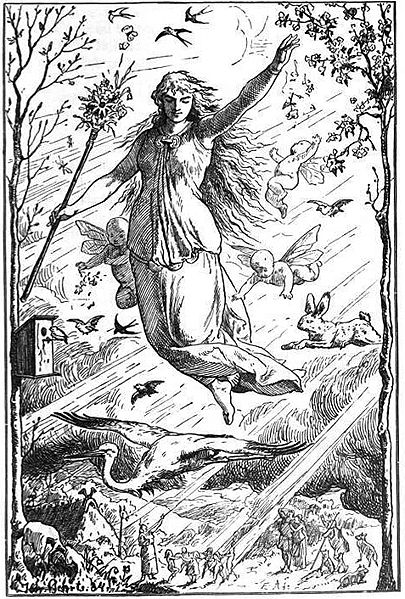
Spring officially arrives in the northern hemisphere today.  Days will be longer than nights for six months after this and many pagans will be celebrating Ostara.  Named after Ēostre, the goddess who apparently gave Easter its name, Ostara is an amalgam of the various equinox feasts and observations of antiquity.  The ancient Celts, as far as we know, held four particular holidays that fall roughly halfway between the solstices and equinoxes, with February marking Imbolc and Beltane yet to come in May.  We don’t know that they celebrated the equinox, but we don’t know that they didn’t either.  Equinoxes are a bit difficult to measure precisely with the sun’s position overhead, but we know the clever folks responsible for Stonehenge and Maes Howe could do such things, even in antiquity.
Ostara, maybe

According to Bede the Anglo-Saxons had several feasts for the goddess Ēostre.  Luckily (from his perspective), Christians had Pascha (Easter) some time near the equinox.  It’s late this year, however, since we just had the full moon (the “Worm Moon”) on Friday.  Easter is the first Sunday after the first full moon after the vernal equinox.  So today we’ve got Ēostre.  We know little of her beyond Bede.  Ancient Germanic peoples, like the ancient Celts, didn’t keep extensive written records.  Their religions, based on what we know of most ancient religions, were likely lively affairs.  Spring is a celebratory season and already buds and blossoms are appearing around here.  Goddess or no, there’s a feminine wonderment about the season.  It’s difficult not to feel at least a little hopeful.

Ancient deities have long been a source of fascination.  Eclipsed by an aggressively political Christianity, many of them vanished without leaving us many traces at all.  The human mind seems inclined to create gods to explain this strange but wonderful world we inhabit.  It’s clear that it wasn’t made just for us.  The birds and insects, and even the elusive reptiles and amphibians, are beginning to reappear.  Many mammals and some birds rough it through the cold hoping to emerge again into the warmth of spring.  We’ve had some warm days already, but there are likely more cold ones to come.  As the pagan gods, as Ēostre remind(s) us, transitions come in fits and starts.  Setbacks are part of progress.  Many of us believe the moral arc of the universe tends toward what is good and right.  It may take a long time to arrive, but the equinox, in its very name, bears the clue.

Going Green

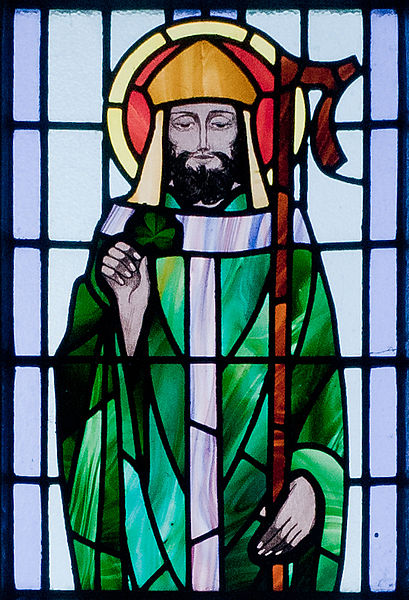
It’s easy to get eager at this point in the year.  A month and a half after Groundhog Day, we’re at St. Patrick’s, and just a few days from the equinox itself.  Around these parts we’ve had some warm weather after last weekend’s bomb cyclone and most of the snow is now gone.  We’re ready for progress.  We’re tired of winter and huddling indoors.  The crocuses are defiantly open although the warning saying in Wisconsin went “three snows on the crocuses.”  St. Patrick’s green is the fecund green of spring.  Although nobody gets them off from work, the seasonal holidays are signs of hope.  It doesn’t matter which season into which we’re transitioning, there’s beauty ahead.  It’s the kind of change many people enjoy.

Look closely at a flower.  (If the crocuses aren’t up yet in your area they will be soon.)  Open and inviting, it offers insects what they need in return for a bit of cross-pollination.  Yesterday I saw my first wasp looking for a place to build a nest on our house, reminding me to be careful opening doors now because no transition is completely smooth.  Spring is hope in season form.  As much as we may appreciate winter with its pristine chill, spring reminds us that food is soon to be available from the bosom of the earth itself.  The songbirds, now back in force, have been eagerly anticipating it.  They are the heralds of transition, the little winged messengers of assurance.

Photo credit: Andreas F. Borchert, Wikicommons

It’s time to step outside and breathe deeply.  The muddy smells of a thawing earth blend with the first fruity hints of buds beginning cautiously to open.  The transition’s not straightforward.  There will be setbacks and chills yet to come.  Nevertheless, the die is cast—St. Pat waves his clover as if to say “This is what lies ahead, as brown becomes green.” Our world tilts as it spins and brings us the delight of seasonal changes.  Saints and birds and flowers must agree on this, even should they differ on the details of what is needful.  It’s a day for celebration, even though it’s a Thursday, a work day with perhaps a respite—after hours of course—to have some fun.  Green is about to reappear.  We wear it today to encourage the timid plants, yes, we need hope.  We look around the world and know that hope is what we really all crave.  


Thinking, Critically

A woman—I don’t know her name—photobombed a Russian newscast with a sign telling the Russian people that they’re being lied to.  Detained by police, her whereabouts are unknown.  I admire that woman.  She may pay with her life  in her effort to encourage what is dear to every teacher everywhere: critical thinking.  Many of the world’s problems are the result of the dearth of critical thinking.  There’s no other way to explain the election of Trump and his main squeeze Vlad.  Thick as thieves, the saying goes.  I recently gave a talk to a small group about publishing.  One of the points I was making is that critical thinking is essential in getting to the truth.  Compare sources, use reason, and never trust a snake-oil salesman.

People vote with their feelings rather than with their rational faculties.  Trump openly admires Hitler, as Putin does Stalin.  These should be signs of warning to those who think critically.  The Second World War wasn’t even a century ago and we’ve apparently forgotten all the lessons it should’ve taught us.  In high school we were shown examples of propaganda and told how to avoid it. Now we see it and can’t recognize it at all. Critical thinking is often frowned upon in modern society.  Being comfortable with the status quo is perhaps valued higher than social justice and the necessary work to get us to where it might happen.  It’s easier to hate than to think.  It’s easier to follow than to question what you’re following.  Education teaches us survival skills, and among them are the ability to think through a situation.  Authoritarianism is seldom—I’m tempted to say “never”—the way to a good result.

Perhaps the saddest irony of all is that those who run outlets like Fox News (and its Russian equivalents) are thinking critically of ways to get followers not to.  Realizing that critical thinking will lead to a more fair and equitable world, they decide to keep their positions of privilege by discouraging their followers from engaging with the basic comparison of sources and weighing of facts.  Instead, promoting “alternative facts” and emotionally outraged rhetoric, they are able to stir up crowds to try to take over the government.  Conspiracy theories are easier to believe if you don’t know how to check facts for yourself.  And the internet has made us all experts on everything.  Russia’s narrative about the war is far from the reality on the ground.  Objective observers have seen what is really happening.  One heroic woman in Russia said enough is enough.  In all likelihood nobody in the world will ever see her again.


Better Things

It’s only a store brand, but still.  Maybe like me you remember opening a box of Raisin Bran and pouring out the first bowl.  And finding only bran.  Maybe a raisin or two.  By the time you munched your way to the bottom of the box you’d get a bonanza in that last bowlful.  It was more fruit than cereal.  Then they somehow figured out how to suspend raisins so that didn’t happen.  My mind hasn’t caught up yet, I guess.  I was down to the last bowl, and I was eagerly anticipating it.  Especially since the day before I’d only had three raisins and it was clear that the end was near.  Then the last bowl.  One raisin.  That’s a lot of bran to start your day, like C. S. Lewis’ always winter but never Christmas in Narnia.

Speaking strictly for myself, I like to save the best for last.  When I receive snacks in my Christmas stocking, I keep my favorites until all the others are gone.  In my personal myth of scarcity I’m quite aware that good things run out.  And they’re not always easily replaced.  Therefore I tend not to buy the things I like best.  This is the kind of psychology that drives economists mad.   As a child I was taught to put others’ needs before my own and that lesson has dovetailed with the running out of good things.  Of such things monasticism was made.  The raisins are now near the top of the box, but the crumbs are still on the bottom.

I often find breakfast to be the most philosophical of meals.  Perhaps it’s because I write my blog posts in the early morning.  Perhaps it’s because others are awake when I eat lunch and supper.  Perhaps it’s because that valuable things are rare.  It’s the nature of what we find most meaningful.  We live in a culture of largeness and acquisition.  What we truly want, however, may be very small indeed.  Ours is a culture of choice and plentifulness.  Raisin Bran is a choice, as is the store brand.  And it’s even possible to open the box at the bottom and return to my old form of expectation.  I doubt I will ever outgrow the idea, however, of trying to save the best for later.  It’s a form of optimism, after all.  And isn’t it best to start the day with the knowledge that better things are coming?


Routine Change

A certain type of mindset thrives in routine.  Perhaps you’ve noticed that these posts appear each day about the same time.  This happens because the routine states that work comes next and it will be largely the same day after day after day.  After work there’s also a pattern until I fall, exhausted, into bed.  Hit repeat.  In the midst of this routine change has crept.  Partly it’s the pandemic, but mostly it’s technology.  And spending habits.  People don’t buy academic books like they used to.  Overall books are booming—so much so that paper shortages aren’t uncommon.  In order to try to keep up with electronic lifestyles, publishers have to integrate the newest technology and to do that everyone has to learn far more tech than technique.  The pace of change is dizzying.

For those who thrive on routine, such rapid-fire alterations make it feel like we need a personal change manager.  “How do I do this now?”  The way we’d done it for years has suddenly shifted and it is only one of many moving parts.  Meanwhile, outside work, other aspects are shifting even as many people still survive without computers at all.  We’re left, those of us tied to routine, in a haze of uncertainty.  It’s like that dream where you’re driving and you can’t slow down but you can’t see out the windshield either.  To make it through we look for routine.  I type this posts on a laptop.  I prefer to write things out by hand, but there’s no time for that any more.  The routine has been broken and the shop that repairs it has gone out of business.

Perhaps this is a malady of those of us who look to the past.  Technological changes used to be measured in centuries, not seconds.  Ancients thought a spout on a jar was a pretty rad invention.  For a hundred years.  Maybe two.  Now if you don’t buy a new iPhone every couple of years you’re hopelessly outmoded.  What was my routine again?  I still awake at the same time and begin each day with writing.  I’ve learned to do it via laptop.  Then it’s to the work laptop where updates seem to be loaded daily and I’m the dog chasing that stick now.  I wonder whose vision we’re following?  Technology’s in charge now.  The rest of us mere humans should be able to get along, as long as we establish a routine of routine change.


Love on a Monday

I hope you may find love on a Monday.  I have a feeling that if we took Valentine’s Day more seriously the world would be a better place.  Capitalism, however, abhors interruptions (unless you buy lots of stuff) so many of us are at work this Monday.  I was recently reading how the full, unbroken eight hours’ sleep is a product of the industrial revolution.  I’d never thought of that before.  Everyone is different, of course, but it is natural for our species to wake in the night and be up for an hour or two and then to fall back asleep.  That, of course, interferes with the nine-to-five (925) that capitalism holds so dear.  In response, humans have altered their natural sleep patterns to conform.  The results are predictable: a line at the coffee machine every day at the office.

When I raised this with a friend, I was reminded that much of our life-style has been determined by the industrial revolution.  Certainly the concept of the weekend was.  And the constant feeling of never having enough time to, well, exist.  I awake when my body tells me it’s slept enough.  Generally that’s around 3:00 a.m.  I begin work early because Protestants have this work ethic going, but then I always get sleepy around 8:00 a.m.  Napping on the job is essentially the same as being a communist, so like many others I struggle through the rest of the day, not quite as efficient as I was for the first couple of hours.  In many cultures a nap is built into the after lunch slump.  Intravenous coffee is preferred by capitalists everywhere.

What if love catches you on a Monday?  Is it a sick day?  A vacation day?  A personal day?  Or all of the above?  It’s an opportunity to be human, but less than a true capitalist.  Someone could be making money off your time!  And whoever heard of more than ten paid holidays in a year?  I’m not complaining.  I love weekends and the scattering of holidays I receive, I really do.  Still, I miss the spontaneity of life.  The flight from a predator.  The shutting of the eyes when tired.  The celebration of love when it’s found.  A Faustian bargain was made when Christianity wed capitalism.  We’re encouraged to buy valentines for our sweeties, but show up to work and be there bright and early again the next morning.  May you nevertheless find love on your Monday.


Relinquishing Control

Controlling the weather is a dream as old as humanity itself.  Once when I was fervently praying for a rain-free day as a child, my mother pointed out that other people could be praying for rain.  I realized then that weather was a personalized preference and that, on some level, prayers cancel each other out.  Well, it’s Groundhog Day and we’re all wondering whether those who love winter and want more or those who are ready for spring will prevail.  For this we’ll rely on a woodchuck.  The observation of animals for signs of spring seems to have been a germanic practice, and it could also involve badgers (which I’ve never, ever seen in the wild) or bears as well as groundhogs.  The idea is that the majority are looking forward to spring when they can plant and grow food, hopefully enough to last through the next winter.  And so the cycle goes.

We hear a lot about January as a month of transitions.  It is, but so are they all.  February, both the dead of winter and start of spring, provides variety as we continue the cycle.  I’ve already seen my first robin of the year and I’ve been hearing sporadic bird song.  The mating season, after all, comes around the middle of the month.  According to some renditions of the Celtic calendar, Imbolc, which was yesterday, is the start of spring.  Celebrated with fires to encourage the light and warmth, we know that cold and snow and wind chill still lie ahead.  We are reminded, however, that this wheel is still turning.  Slowly, slowly, but ever turning.

I’m writing this post before Punxsutawney Phil even awakes.  The sky is dark and it’s cold outside.  Like Phil Connors I’m thinking about how we want things to stay the same, but when they do they quickly haunt us.  Time forever moves and all seasons are mere transitions to the next.  In this endless cycle we have to come to appreciate where we are at the moment.  There’s a stark beauty to winter.  A snowy landscape can become a transport of rapture.  We have to heat our houses, however, and pay the bills to do so.  We keep our house cool enough that some days I just don’t have the heart to venture outside at all.  Still, I wouldn’t change it.  These cycles are old friends now.  I’ll glance to the west and wonder what Phil might see, but I’ll be praying that we will never control the weather.


Footprints in the Snow

Although my back’s grateful, many of the snowstorms rolling across the country have left just a small bit of snow here so far.  Small bits of snow create their own hazards, however.  A snow covered trail quickly becomes hazardous for jogging, so I walk.  This past week we had a little snow and temperatures low enough to dissuade many of those who normally walk or run the trail.  Those of us with desk jobs really have to make an effort to move.  When I was out I was surprised by a couple of things.  There were no other lunch-time walkers and it was above freezing.  The almost untrodden snow gave under my feet and in the patches where the sun made it through, was actually wet.  I took my usual constitutional and headed back to work.

These short, cold winter days are too treacherous for walking in the dark.  Black ice isn’t a myth unless you can slip and fall on a myth.  The next day it was bitterly cold.  Still, skipping exercise a day is a slippery slope.  I headed back to the trail.  At first my footsteps from the previous day had led to a regular set of tracks where the snow had melted down and the pea gravel had dried out.  Walking was safe here.  As I reached the further, more wooded end of the trail it was quite different.  Sheltered by the trees, my foot prints from the previous day had slightly melted and then refroze, leaving a track of ice that could easily twist an ankle.  I began to think of the concept of following.

We find those whose wisdom compels us.  We hear them in the classroom, the pulpit, or the street corner.  Or we read them in a book.  We might even see them on television or the internet.  They seem to have something we lack, so we follow them.  Their tracks often start out secure enough.  Dry patches in an otherwise slippery covering of snow.  We follow on, thinking we’ve found our way.  Somewhat further down the path, however, the tracks become icy, showing us that even the great leaders have their own hidden secrets.  The places where they too slip and fall.  The wisdom we seek is collective.  No one person has all the answers.  If that were so it should be obvious to us all.  Instead we need to strike out on that nearly unbroken snow to discover for ourselves.


Phobia Therapy

I don’t like being scared.  That’s why I watch horror.  You see, many people deal with fear by running away from it.  Embracing artificial fears, however, prepares you for the horrors life will inevitably throw at you.  We humans have created an artificial environment for ourselves with many natural dangers removed.  For example (and there are always exceptions) we’ve been able to seal ourselves up in our homes and wear masks in public to avoid a killing virus.  For the most part we’ve destroyed our large predators.  As a society we tend to avoid the things that make us afraid which, in turn, makes us fragile when we have to face truly frightening situations.  I wouldn’t suggest becoming a fear junkie, but experiencing scary scenarios can diminish the overall  fear factor.

People often make assumptions about those of us who watch horror, even though it is the majority of Americans.  We’re seen as creepy people who lurk in dark places, unable to get along with our fellow human beings.  Perhaps it’s true, or perhaps it’s a reasonable coping technique.  I tend to think of it as a spiritual practice.  Spirituality is often about feeling, but it’s not completely divorced from rationality.  Often it has to do with that gut feeling that this is really real.  This is something that my years on this weary old globe have taught me is true.  Many times it’s this way in the face of evidence.  Others have trouble believing it, although some bearded guy alone on a mountain top says it’s true.  So life goes.

Spirituality is important.  I have many humanist friends and they are often uncomfortable thinking about spirituality.  It seems dangerous, a superstition that somehow survived enlightenment.  Enlightenment, however, is itself a spiritual idea.  There’s something inside of us that makes us who we are.  Whether it’s something physical or something else, it requires nourishing in order that we might thrive.  We expend a lot of energy arguing about the right (only right) way to do it.  The way to be a more spiritual person.  To me it seems that it’s about discovering what replenishes us.  What makes us into better people.  You find that and you feed it.  Spirituality comes in many forms and shapes.  Some of us have it fed by what others dismiss as mere horror.  There’s more to it than meets the eye, however.  I watch it to learn not to be afraid.


Anticipating Holidays

There’s that mundanity that sets in after the twelve days of Christmas are over that reminds us we’re back into regular time.  Many people no longer believe in the sacred, but the holidays are still sacred time.  January can be kind of stark that way.  Once we reach Halloween the rest of the year seems achievable, but there’s a lot to do between now and then.  Reemerging from the run-up to the holidays—it’s the long period of anticipation for the rest that comes at the end of the  year—back to what is now being called BAU (business as usual) is like cold water on your face first thing in the morning.  Each time I wonder if I’ll have the energy to do it all again.

Holidays punctuate and define our year.  It may be that your December holiday is fading now to a (hopefully) pleasant memory, but depending on your employer you might have Martin Luther King Day coming up soon.  I’ve known people to complain that it comes too soon after they’ve already had a few days off and they’d rather have a different day, later.  That kind of misses the point.  Business analysts (whom business leaders listen too except when they don’t like what they say) suggest that the four-day work week is sufficient to achieve what we need, now that we’re connected all the time.  Some jobs, of course, require your physical body to be in a specific geographic location and there’s not much that can be done about that.  Hours can be reduced if more people are hired, but we’re going through a strange period of people quitting their jobs.  I’ve always wondered what that must feel like.  Is it like a long holiday, only with even more financial worries?

The twelve days are over, and although I didn’t have all of them off I kind of wonder where they went.  Some folks are eager to get the tree down and decorations put away.  To look out at the blank canvas of snow and envision how to paint the year ahead.  Others of us see the wisdom of hibernation.  Bears seem to have the right idea.  Still, I enjoy the starkness of January.  The cold can be bracing and the snow a chore to remove.  But being out in it can become a kind of holiday in its own right.  Our time on earth should be a time of celebration, even as we look forward to the holidays later this year.


The Nature of Epiphany

Last year on January 6 we had an epiphany.  Many of us thought, I suspect, that since the angry mob wanted to kill Republicans and Democrats both that their actions would be condemned unilaterally.  Instead we learned that the Republican Party said, “Boys will be boys.”  And of course boys like to kill things.  A year later the GOP has stalwartly refused to condemn the attempt of a violent takeover of the government by a legitimately defeated candidate.  If the other party tried this they’d be calling “treason.”  We had an epiphany of a double-standard masquerading as evangelical Christianity.  Now, instead of thinking of today as the Christian epiphany, well, wait a minute.  Maybe that’s the epiphany we had—understanding what Christianity can become.

One of the tenets of democracy includes the freedom of religion.  Studying ancient religion can be quite revealing.  For one thing, we get a better idea of what religion was.  Few ancient authorities were concerned about what individuals actually believed.  Religion was largely what the powerful and influential did to placate gods who were easily bribed by sacrifice and praise.  The role of the average person was to be taxed to support this, and the monarchy.  I’ve been watching how, since the 1970s, the United States has been going that route.  We’ve always been a religious nation (“Christian” is much more debatable), but Richard Nixon’s ploy to swing evangelicals to the Republican Party worked.  Those not blinded by ideology will know that evangelicals tended to be staunchly Democrat.  Through the ensuing decades we watched Republican presidents giving our tax money to religious organizations they supported.  Why not throw another lamb on the altar while you’re at it?

The sacrificial system, you see, supported the temple staff.  Somebody had to eat all that meat!  Even in the Bible it was recognized that God didn’t exactly consume it the way a human being would.  Then last year on Epiphany, the party that’s supported just this kind of thing tried to throw all but Trump—yes, even Pence—onto their sacrificial pyre.  A year later we see those very senators saying, “well, it might be useful to have such people in reserve, just in case.”  Early Christians believed that you could tell another believer by their actions.  In that they weren’t wrong.  And those who are able and eager to kill in order to get their way have revealed, by their actions, their true beliefs.  It was, and still is, an epiphany indeed.


Salvation by the Book

I’ve never been to Iceland.  Part of me says that if I ever get to go I’d want it to be on Christmas Eve.  Ah, the light would be in short supply, no doubt, and it would be cold.  But the draw of Jolabokaflod is strong.  Jolabokaflod isn’t a difficult word to figure out, if you’re familiar with Indo-European languages. “Jol” (maybe the “a” is included) looks a lot like Yule.  “Bok” is English book missing an “o” (again, maybe the “a” is part of it).  And “flod,” likewise with another “o” becomes “flood.”  The Yule Book Flood.  The tradition is to give books on Christmas Eve and spend the long hours of darkness reading.  Iceland has the reputation for being a very literate culture.  I’ve read a number of books (in translation) by Icelandic authors.  If there’s ever to be peace on earth and goodwill to all, it will be through books.

If you observe Christmas, today is that great time of anticipation, Christmas Eve.  Churches, whether virtual or in person, will be humming places this day.  Last-minute shoppers will be out and frantic.  Some will be insisting we keep Christ in Christmas while others will be dreaming of sugarplums and fairies.  Some will be tracking Santa on NORAD.  In Iceland they’ll be exchanging books.  Politicians will continue their calculated plotting but I dearly wish they’d spend the day reading instead.  Perhaps there would be fewer tanks at the Ukraine border if those in Moscow would curl up with a good book.  Check the progress of their Goodreads challenge.  Open up the flood-gates and let the books pour in.

There are those who believe this world should be consumed by God’s awful fire, and that right soon.  But God, as I understand it, is a writer of books.  Perhaps the divine plan is different than so many suppose.  Even the angels sang about peace on earth in one of those books.  You never know what’s going to be under the tree, but in our house books are always a certainty.  The words that describe this season—joy, peace, goodwill—can come in a few ounces of paper, ink, and glue.  And if God’s own book tells us to love one another, who are we to argue on Christmas Eve?  And if it’s true today won’t it be true also tomorrow and every other day beyond that?  Iceland has grown out of its warlike past.  And today they’re exchanging books.  Perhaps there’s a lesson there for all of us.


What’s Poppin’?

“How are things in the world of finance?” Admiral Boom calls to a passing George Banks.  The bland answer of fine as everything is good with the pound sterling assures the seaman that everyone is doing their job properly.  This may be a throwaway scene from Mary Poppins, but it captures an anxiety I’ve been experiencing for some time now.  Admiral Boom doesn’t have to be an expert in finance—he knows that Banks and his ilk are taking care of that so that he can oversee his household, keeping it ship-shape.  With the shenanigans of the Republican Party, however, all of us—bankers, seafarers, editors, it doesn’t matter—have to become experts in politics.  Why?  Politicians can no longer be trusted to do their jobs.  Corruption is so rife that they saw no problem with Donald Trump (“How are things in the world of finance?”) being elected.

The internet has given people the idea that they know more than they do.  If you read enough you soon realize just how little you actually know, and that humility (note, Mr. Trump) is the only proper response.  Now we have people all jazzed on the idea that you can express your personal hatreds and be rude to others because, well, that’s what 45 did.  Now we all have to learn about what schemes (and they are schemes) the Republican Party is up to at all times to try actually to steal power.  Come on folks, gerrymandering is a blatant attempt to game the voting system, as is the retention of the electoral college.  And the filibuster.  

Sure, voters should be informed.  We are responsible for gathering facts, and not alternative facts, before we head to the polls.  Beyond that we used to be able to trust politicians to do their jobs.  Yes, there was always corruption—power inevitably leads to corruption—but there were checks and balances.  Those checks and balances are gone.  Now instead of keeping his house Bristol fashion, Admiral Boom must spend hours a day trying to sort out lies handed out like candy on Halloween, trying to figure out what is the truth and what is republicanism.  Don’t be listening for that boom on the dot anymore.  Mr. Binnacle is too busy trying to memorize the names of everyone running for the school board who are anti-masker, anti-vaxxers who stand for Trump and his original stolen election.  How are things in the world of finance?  How can we ever possibly know since we now all have to spend our time back in civics class?


Paper Chase

Maybe you’ve done it too.  Kissed the posterior of technology.  Up until three years ago I didn’t pay bills online.  I waited for a bill, wrote a check, stamped an envelope, stuck it in the slot and forgot about it.  Then I started getting overdue notices.  My payments were failing to reach their recipients.  I switched to online payment—it seemed like the only option.  That has worked fine for two years but then something else started to happen: my email notices failed to show up.  I started to get overdue notices again.  I went to websites and enrolled in auto-pay for all my regular bills.  Then the emails began showing up stating accounts were overdue.  The actual websites said the bills had been paid.  There seems to be no pleasing the technological beast.

You see, I’m a simple man of pen and paper.  I don’t read ebooks unless I have to.  I don’t trust most of what I find on the internet.  Mine is the mindset of a working Post Office (or at least Pony Express), paper payment for which you receive a copy back.  Some solidity.  Live Science ran a teaser headline that the next solar storm could lead to an “internet apocalypse.”  All records wiped out.  With no shoebox full of receipts, how are you going to prove you’ve got the money you say you do?  (That could be a boon to braggarts such as Trump, but the rest of us will be waiting timidly for a letter from our banks.)  Technology seems to be chasing an invisible goal.  Doing it because we can without thinking of the consequences.  Shooting rockets into space with no certified astronauts on board—what could possibly go wrong?

Tech isn’t bad, of course.  It has preserved many of our jobs through a pandemic.  It makes it easy for forgetful guys like me to be able to find information quickly.  But functioning is only as good as the coding behind it, and it feels terribly vulnerable to me.  Coronal mass ejections, apart from sounding slightly dirty, are rare according to the story by Brandon Specktor, but they tend to happen every century or so.  A century ago a working landline telephone was a luxury.  The computer as we know it hadn’t been invented.  We were about to plunge into the madness of a second world war in which tech would be used to kill on a massive scale.  Now I guess we await the apocalypse.  The safe money says to have plenty of paper on hand.


Banning Banning

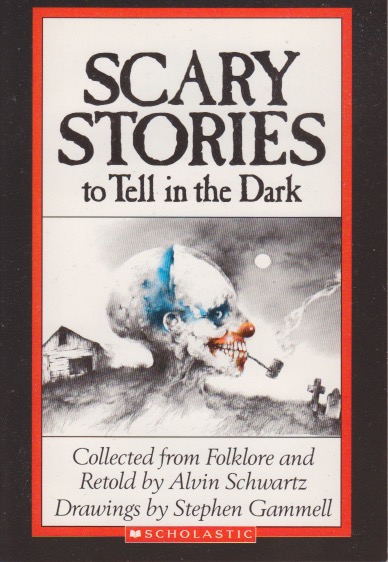
Banned Book Week gets me all aflutter.  There have been years at I’m so busy that it slips by before I notice it, but each year I try to incorporate it somehow into my reading challenges.  This year my book was Scary Stories to Tell in the Dark, by Alvin Schwartz and Stephen Gammell.  Yes, it’s a young readers’ book.  Most banned and challenged books are.  Why censorious adults feel the need to keep ideas out of print is pretty obvious in these Trumpian times.  (Please note, dear Republicans, many Democrats criticize Biden on a regular basis; we do not worship him.  American Marxist my donkey!)  Book censoring only serves fascist tendencies.  Ideas will find a way to be born, regardless.

Scary Stories, of course received a shot in the arm by Guillermo del Toro and his interest in making a movie based on it.  The stories themselves are drawn from folklore—they’re populist, you might say—and reflect what passes around from perhaps less insane times.  As an adult a reader tends not to find these stories frightening.  For one thing, many of them are stories we’ve heard before.  For another, life has already thrown many scary things at us.  Not only that, but we try to ban books to make adulthood even scarier.  You see, folklore doesn’t go away just because children are kept from the books.  These stories find the gaps just as water does.  They get told in the dark.  Instead of trying to censor them we should try to talk about them.

Adults’ own discomfort with ideas such as death and decay often stand behind our efforts to “protect” our children.  Then they reach maturity not prepared for the adult world of sex, exploitation, and dying.  Our modern comfort-based lifestyle tries to shut away the unpleasant aspects of existence.  Books, however, are the food of the imagination.  To ban them is to try to suppress the truths that authors have uncovered.  Growing up in a conservative household, we weren’t subjected to censorship.  I couldn’t afford many books, but my mother never said “No, you can’t read that.”  Some of my early reading faced uncomfortable facts.  I read both Jaws and The Godfather long before I ever saw the movies.  I read Scary Stories to Tell in the Dark as a form of solidarity with young minds.  There are benefits to learning to deal with fear early on in life.  And Scary Stories, even if not so frightening, has an appropriate place in it.