A Bird’s Life

Among the early signs of spring are birds.  Cold and silent, winter mornings have their own form of beauty, but hearing the birds is cause for hope.  The bird world looks cheerful and peaceable but it is a competitive and often harsh place.  My office window looks out onto a porch roof and a stand of trees across the street.  Electric wires constitute a part of the scene as well, giving birds plenty of places to alight and negotiate their bird business.  Like humans, birds are vulnerable, particularly when they’re young.  While teaching at Nashotah House, walking home from chapel one morning after a thunderstorm, I found a baby bird, not yet fully fledged, dying on the sidewalk.  I glanced up and couldn’t see any nests.  I’m not much of climber anyway.  Not knowing what to do I scooped it up and took it home where I could put it in a box.

I didn’t have an early class that day so I called a wildlife rescue center.  Being the days before the internet took over, this was a matter of looking it up in the yellow pages.  We piled the family in the car and drove it down.  They’d told me to keep it warm and try to comfort it.  My daughter held it.  Once we got there they said they weren’t sure if it would survive.  It was weak and chilled, but they would do what they could to revive it.  For several days we all worried about that hatchling.  I thought it might’ve been a finch because of the beak, but otherwise we knew little about it.  Several weeks later the rescue center called.  Our rescue was ready to be released—did we want to do it?

They handed us a brown grocery bag that weighed next to nothing.  “Open it when you’re outside near where you found it,” they said.  Back on campus we opened the bag and our foundling flew off so fast we could barely see it.  Adult birds, confident and socialized, seem more sure of themselves.  They perch out in the open even though hawks scan the area, and even the occasional eagle.  They go about their bird business with a confidence I sometimes envy.  They don’t worry about a 925.  They know what nature’s about.  They may have survived a near-fatal childhood.  They may have pushed siblings out of the nest to have thrived.  They peck and flap at each other in their efforts to mate.  And, above all, they carry spring on their wings.

Shadows of Childhood

While it may not seem to fit my current re-fascination, I’m not really a “fan”personality.  My interests are far too diverse.  Since I’ve been thinking about Dark Shadows a lot lately I decided to do some reading on it.  There’s a genre of nonfiction that involves small format, short introductions to various media.  I’ve read a few of the Devil’s Advocates series about horror movies and I recently discovered the similar TV Milestones series about, well, TV.  They have a volume on Dark Shadows by Harry M. Benshoff, and I knew it would help scratch my current itch.  You see, I wasn’t really a devoted fan of the show—I watched it after school like a lot of kids did in the late sixties and into the early seventies.  I read a few of the novels.  I never attended any conferences (they exist) and never wrote any fan fiction.  I think my level of engagement was different.

Nevertheless, this is an informative little book.  I found out that there’s even more to the phenomenon than I already knew I didn’t know.  I never really followed the whole plot line.  I didn’t realize just how complex the story is.  Perhaps on some level I knew the series was culturally significant.  As a child I didn’t know much about the wider culture.  We were working class poor, how was I to find out about such things?  For me, Dark Shadows was a kind of escapism, I suppose.  A fantasy that met a need, not a plot to be unraveled.  I wasn’t aware of how sophisticated, if cheap, it was.

By the time I got to college and started to meet different people, it was a moment that had passed.  I really didn’t think much about Dark Shadows again until after my own gothic tragedy of Nashotah House.  During the days of my career malfunction I rediscovered my childhood, perhaps looking for something better.  I started collecting and reading the novels again, and if I’m honest, were it not so expensive I’d consider watching the original series again.  Like all things nostalgic, I know my Rosebud will never be today what it was back then.  My reading sense wasn’t developed enough to see what might’ve been going on behind the scenes.  Benshoff does a good job of bringing much of that to the light.  I’ll likely read more on the series as time goes on, but I now have a better framework for looking at this particular milestone.  Not, however, as a fanatic.


Sexist Instructions

The thing about cars is there’s so much that can go wrong.  And when it does it’s costly to fix it.  Yet, even when working from home, we need them.  We have two, both quite old in car years.  One is approaching twenty.  We bought it new—the first time we’d ever been able to achieve such a feat.  This was one of the new Beetles and it has had never-ending electronic issues.  Warning lights come on that seem to be a malfunction of the warning lights—if you ever wanted an existential situation that’s one right there.  How do you know if there’s something wrong with your engine or is it just something wrong with the warning light?  A worrisome one came on just as winter was settling in and we didn’t need to drive it much before inspection time and we let it sit a little too long.

The battery, naturally, died.  We have an old, seldom used battery jump-starter, which, in the cold of the garage, also died.  We’ve been trying to find time on the weekend when both my wife and I are free (rare) so that I can drive it a ways to try to recharge the battery, but with someone home who can rescue me if I get stuck.  So it was we came to buy a new jump-starter.  These new ones are the size of a cell phone on steroids—much smaller than the old kind.  Ours came from China, I’m guessing, and the instructions are sexist.  They imply that women can use this because it’s easy.  Part of the description reads “It can be used more than 30 times, giving you peace of mind, no matter where you are, if the battery runs out, you can start it without looking for women who are not smart at night in an empty parking lot, such as a college campus or forget you.”  I don’t know about you, but this sounds like the writer had a past he’s trying to deal with.

I was indeed once left stranded because of a dead car battery.  It’s a story I’m saving for my autobiography, if I ever write one, but let me assure you all the people responsible for that abandonment were men.  Men with a car that wouldn’t start while I sat in the middle of nowhere in the dark.  (This was before cell phones.)  I didn’t want to buy a sexist device.  Both men and women have batteries die and I’m always a little scared to jump-start a car.  At least now we can get the Beetle rolling again and drive toward a future where women are rightfully seen as equal to men.  And I hope that instruction writer has found some help, perhaps with therapy.


The Campus Library

Perhaps it’s an odd kind of nostalgia.  Many people can’t wait to be done with school and get on with “life.” Some of us remain fixated at the learning stage and society used to shuffle us into colleges and universities where we could be safely ignored.  One of the refrains in the very long song that is this blog has been the lack of a university library.  Although I’ve tried to get to know the academics in the Lehigh Valley really only one has made an effort to befriend me and when I was asking him about library access he actually did something about it.  Such acts of kindness are rare and require a kind of thinking that takes into account the circumstances of the academically othered.  I’ll be forever grateful.

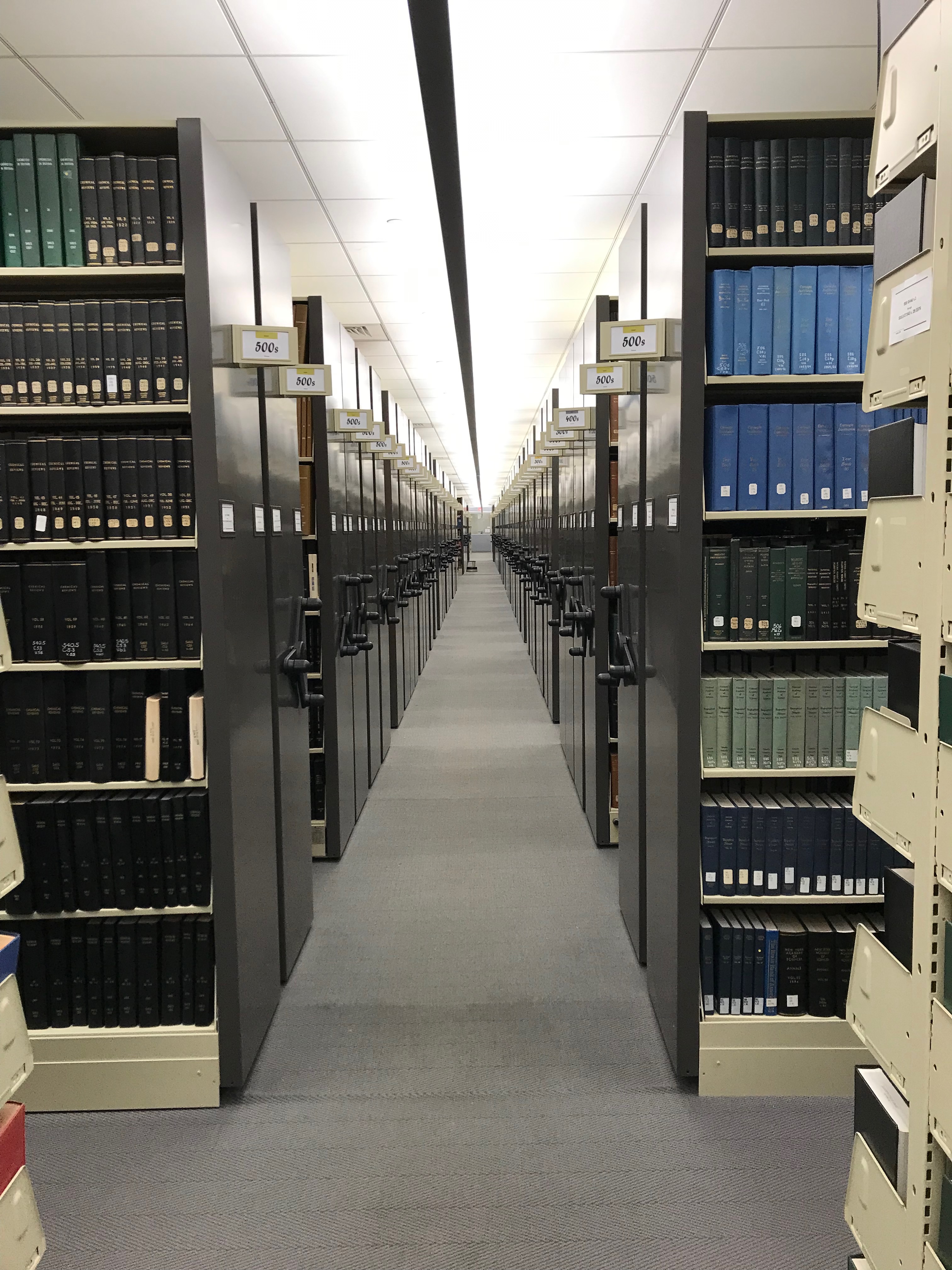
It’s been a long time since I’ve been in a college or university library.  Many are protective and/or restrictive, as if knowledge is only for those academically employed.  I had to look up a couple of references for an article I was writing.  My colleague checked with his institution and yes, I was welcome to come in and use their collection.  The night before going to campus I had a series of nightmares of various librarians barring my attempt to get to the books.  I’d been trying to get there (in real life) for weeks.  Between family work schedules, the occasional weekend blizzard, and the library being closed for spring break, it ended up taking about six weeks to find the time to drive there, negotiate parking, and look up the references.

Everyone has a place they belong.  Mine has unwaveringly been the college campus.  It is home to me, even if it doesn’t recognize me.  I’d almost forgotten the feeling of being let loose in the stacks.  It was a Saturday morning and there was almost nobody else there.  As early as Grove City College I cherished the feeling of spending time in the library.  Few other students were hanging out there, but those of us who belong on campuses know that being surrounded by books is the only place that will ever feel like home.  Having looked up my references I wished that I had more to do.  I’d been to both the Dewey and the Library of Congress sections and, being a weekend, I had much else to do.  Stepping back out onto campus I was filled once again with a poignant nostalgia.  Getting to where you know you belong is a lengthy journey.


Spring Holidays

March and April, despite having their holidays, tend to be months of pretty solid capitalistic work.  Congress may take its April recess and universities have their spring break, but the working stiffs just keep going.  I’ve worked for a couple of British companies and they have a dilemma in the Human Resources department.  Britain has a lot more days off per year than American business practice does.  The dilemma?  How to tell your colonials that the head offices will be closed around Easter when those of the New World will remain open.  You see, very few American companies recognize what some Christians call Holy Week as a time for anything other than work.  Back in the days when I was still trying to work myself into the Episcopal priesthood, I had to ask my manager for Good Friday off and permission was only reluctantly given.

The two major Christian holidays of Christmas and Easter are vastly different in their public expression.  Despite the outlook of Scrooge, most companies consider Christmas a holiday, even to the point of giving you a Friday or Monday off if it falls on a weekend.  A present, as it were.  Easter, on the other hand, reliably falls on a Sunday.  Viewed in isolation there’s no need to give people any days off.  Since I was a teen, however, I took Maundy Thursday and Good Friday seriously.  You were, even in the Methodist church, encouraged to spend the latter in church, especially around the middle of the day.  If at all possible, it should be raining.  It wasn’t a day off for rest and relaxation, but for contemplating sin and its costs (hardly conducive to capitalism).

Universities, however, have tended to shift spring break to St. Patrick’s Day so as to get the damage of drunken students off campus.  Indeed, Purim, the Jewish spring holiday, also advocates drinking until Haman and Mordecai become indistinguishable when spoken.  Sort of like Hamilton, it was the holiday that saved the book of Esther, just like the Broadway show preserved the ten-dollar bill.  When it comes to business, however, Americans are all business.  (Did someone  mention a ten-dollar bill?!)  Money, as MC reminds us, makes the vorld go round.  And holidays are viewed as constant interruptions.  The typical work calendar will have no holidays from President’s Day in February until Memorial Day at the end of May.  It’s typically the longest stretch without a paid holiday.  Just when the weather’s starting to get nicer.  But let’s not forget, money is fully in charge here, for where your treasure is, there your heart shall be also.


Raven about this Book

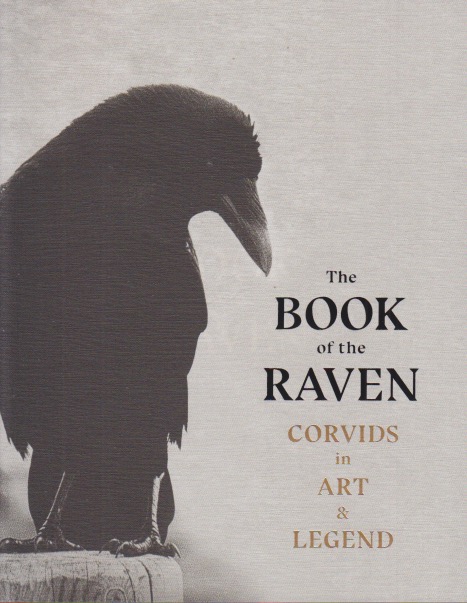
Some books are meant to be looked at.  Being busy most of the time, even on weekends, I’m guilty of not enjoying art enough.  The Book of the Raven: Corvids in Art and Legend is a work of art.  In it Caroline Roberts and Angus Hyland have compiled paintings, photographs, and prints that feature ravens, crows, magpies, and jays, interspersed with facts, poems, excerpts, and bits of lore.  It’s not a comprehensive book, nor is it intended to be.  It is, however, a deeply moving book for a certain kind of person.  It was an accidental find in a visit to The Book & Puppet Company in Easton.  When we’re in town we like to support the independent bookstores.  (I was saddened to discover that Delaware River Books, one of the two used bookstores in town, had recently closed.)

Corvids are, on a scale, about as intelligent as we are.  They think, solve problems, make tools, and recognize human faces.  They remember acts of kindness and reciprocate.  They recognize their dead and they also play.  They’re very much like us.  The book includes, of course, Poe’s “The Raven,” but also other poems that draw inspiration from these smart, magnificent birds.  The artwork is arresting.  One of the great sins of modern life is its busyness that robs us of the time for appreciating art.  And reading.  Learning how to thrive in a world that has become purely about profit and ownership.  Art is intended to be shared.  An artist produces so that others might see.  A author writes so that others might read.  And corvids exist to bring wonder into our lives.

I find the strident call of jays comforting.  I often hear them even on my winter walks.  There are murders of crows in the neighborhood from time to time.  They gather on roofs and in the trees across the street.  Recently I spied a large black bird while on my daily constitutional.  It had left a tree full of crows and was flying straight down the path toward me.  As it flew overhead I had a good look at its tail in flight—one of the best ways to tell a raven from a crow.  It was indeed a raven, and even common ravens are rare in this area.  We live on the edge of their habitat.   I was honored by its momentary attention.  I wished I had more time, perhaps to follow that magnificent corvid and to learn from it.  Instead, I will ponder The Book of the Raven with wonder.


Son of Comfort

So the other day I was reading a book proposal for another editor.  It mentioned the mononymous Barnabas.  Since the proposal wasn’t from a biblical scholar I wondered if this was the same Barnabas mentioned in Acts as the sometime traveling companion to Paul of Tarsus.  As I began to type this into the search box—and this was on my work computer, which, I hope, doesn’t know my reading habits—it autosuggested Barnabas Collins as the first choice.  One of the frustrating things about devices these days is they know who we are and sometimes we want an objective opinion from the internet.  Is Barnabas Collins as popular as I like to think he is, or is it just a case of my work computer anticipating my off-hour whims?  I sincerely hope it’s the former.

The proposal, by the way, was surprisingly referencing Paul’s Barnabas.  I wasn’t aware that he was much known outside biblical studies circles.  Probably about as rarely as Barnabas Collins is known in such circles.  There has been a resurgence of interest in Dark Shadows that has taken place in spite of, or perhaps partially because of, Tim Burton’s movie.  The film made many missteps, but people from my generation who’d never heard of him before began to reference Barnabas Collins to me.  I’ve never been a soap opera watcher.  It does seem that many college students used to go through such a phase—again, it’s the story that draws them in—but that never really happened to me.  I’d grown up watching Dark Shadows, however, and I’ve been tempted a time or two to start watching the series again.  With well over a thousand episodes, some of which are lost, it would be a major time commitment.  And besides, it wouldn’t recapture those grade-school afternoons watching what my mom thought was a waste of time.

The name Barnabas probably means something like “son of comfort.” I don’t know how the somewhat desperate writers, trying to gain back a slipping audience, came up with the name.  Their introduction of the supernatural into the daily drama did, however, transform television.  The usual demographic for the show was a bit older than me when it was being aired and I didn’t by any stretch see the entire series.  I did see enough, however, to forever frame my view of vampires.  There have been efforts, including one current, to reboot the series on television.  It may eventually rise again from its coffin. Featuring, of course, Barnabas.


Spring Forward

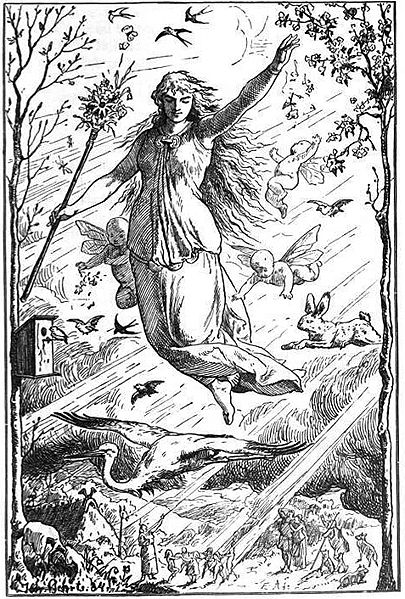
Spring officially arrives in the northern hemisphere today.  Days will be longer than nights for six months after this and many pagans will be celebrating Ostara.  Named after Ēostre, the goddess who apparently gave Easter its name, Ostara is an amalgam of the various equinox feasts and observations of antiquity.  The ancient Celts, as far as we know, held four particular holidays that fall roughly halfway between the solstices and equinoxes, with February marking Imbolc and Beltane yet to come in May.  We don’t know that they celebrated the equinox, but we don’t know that they didn’t either.  Equinoxes are a bit difficult to measure precisely with the sun’s position overhead, but we know the clever folks responsible for Stonehenge and Maes Howe could do such things, even in antiquity.

Ostara, maybe

According to Bede the Anglo-Saxons had several feasts for the goddess Ēostre.  Luckily (from his perspective), Christians had Pascha (Easter) some time near the equinox.  It’s late this year, however, since we just had the full moon (the “Worm Moon”) on Friday.  Easter is the first Sunday after the first full moon after the vernal equinox.  So today we’ve got Ēostre.  We know little of her beyond Bede.  Ancient Germanic peoples, like the ancient Celts, didn’t keep extensive written records.  Their religions, based on what we know of most ancient religions, were likely lively affairs.  Spring is a celebratory season and already buds and blossoms are appearing around here.  Goddess or no, there’s a feminine wonderment about the season.  It’s difficult not to feel at least a little hopeful.

Ancient deities have long been a source of fascination.  Eclipsed by an aggressively political Christianity, many of them vanished without leaving us many traces at all.  The human mind seems inclined to create gods to explain this strange but wonderful world we inhabit.  It’s clear that it wasn’t made just for us.  The birds and insects, and even the elusive reptiles and amphibians, are beginning to reappear.  Many mammals and some birds rough it through the cold hoping to emerge again into the warmth of spring.  We’ve had some warm days already, but there are likely more cold ones to come.  As the pagan gods, as Ēostre remind(s) us, transitions come in fits and starts.  Setbacks are part of progress.  Many of us believe the moral arc of the universe tends toward what is good and right.  It may take a long time to arrive, but the equinox, in its very name, bears the clue.


Going Green

It’s easy to get eager at this point in the year.  A month and a half after Groundhog Day, we’re at St. Patrick’s, and just a few days from the equinox itself.  Around these parts we’ve had some warm weather after last weekend’s bomb cyclone and most of the snow is now gone.  We’re ready for progress.  We’re tired of winter and huddling indoors.  The crocuses are defiantly open although the warning saying in Wisconsin went “three snows on the crocuses.”  St. Patrick’s green is the fecund green of spring.  Although nobody gets them off from work, the seasonal holidays are signs of hope.  It doesn’t matter which season into which we’re transitioning, there’s beauty ahead.  It’s the kind of change many people enjoy.

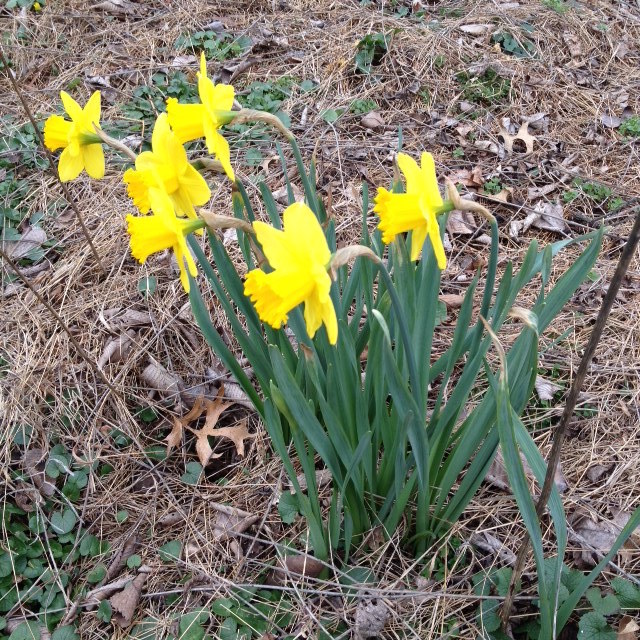
Look closely at a flower.  (If the crocuses aren’t up yet in your area they will be soon.)  Open and inviting, it offers insects what they need in return for a bit of cross-pollination.  Yesterday I saw my first wasp looking for a place to build a nest on our house, reminding me to be careful opening doors now because no transition is completely smooth.  Spring is hope in season form.  As much as we may appreciate winter with its pristine chill, spring reminds us that food is soon to be available from the bosom of the earth itself.  The songbirds, now back in force, have been eagerly anticipating it.  They are the heralds of transition, the little winged messengers of assurance.

Photo credit: Andreas F. Borchert, Wikicommons

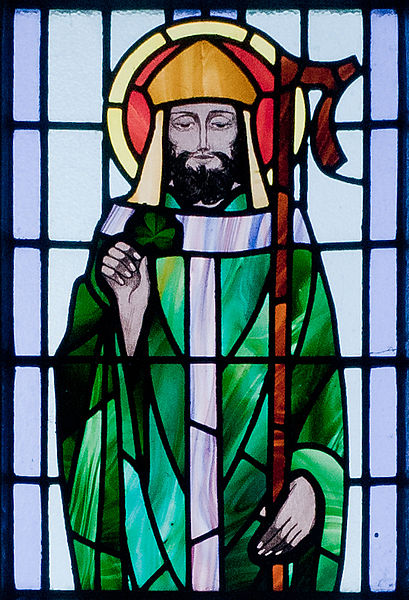
It’s time to step outside and breathe deeply.  The muddy smells of a thawing earth blend with the first fruity hints of buds beginning cautiously to open.  The transition’s not straightforward.  There will be setbacks and chills yet to come.  Nevertheless, the die is cast—St. Pat waves his clover as if to say “This is what lies ahead, as brown becomes green.” Our world tilts as it spins and brings us the delight of seasonal changes.  Saints and birds and flowers must agree on this, even should they differ on the details of what is needful.  It’s a day for celebration, even though it’s a Thursday, a work day with perhaps a respite—after hours of course—to have some fun.  Green is about to reappear.  We wear it today to encourage the timid plants, yes, we need hope.  We look around the world and know that hope is what we really all crave.  


Thinking, Critically

A woman—I don’t know her name—photobombed a Russian newscast with a sign telling the Russian people that they’re being lied to.  Detained by police, her whereabouts are unknown.  I admire that woman.  She may pay with her life  in her effort to encourage what is dear to every teacher everywhere: critical thinking.  Many of the world’s problems are the result of the dearth of critical thinking.  There’s no other way to explain the election of Trump and his main squeeze Vlad.  Thick as thieves, the saying goes.  I recently gave a talk to a small group about publishing.  One of the points I was making is that critical thinking is essential in getting to the truth.  Compare sources, use reason, and never trust a snake-oil salesman.

People vote with their feelings rather than with their rational faculties.  Trump openly admires Hitler, as Putin does Stalin.  These should be signs of warning to those who think critically.  The Second World War wasn’t even a century ago and we’ve apparently forgotten all the lessons it should’ve taught us.  In high school we were shown examples of propaganda and told how to avoid it. Now we see it and can’t recognize it at all. Critical thinking is often frowned upon in modern society.  Being comfortable with the status quo is perhaps valued higher than social justice and the necessary work to get us to where it might happen.  It’s easier to hate than to think.  It’s easier to follow than to question what you’re following.  Education teaches us survival skills, and among them are the ability to think through a situation.  Authoritarianism is seldom—I’m tempted to say “never”—the way to a good result.

Perhaps the saddest irony of all is that those who run outlets like Fox News (and its Russian equivalents) are thinking critically of ways to get followers not to.  Realizing that critical thinking will lead to a more fair and equitable world, they decide to keep their positions of privilege by discouraging their followers from engaging with the basic comparison of sources and weighing of facts.  Instead, promoting “alternative facts” and emotionally outraged rhetoric, they are able to stir up crowds to try to take over the government.  Conspiracy theories are easier to believe if you don’t know how to check facts for yourself.  And the internet has made us all experts on everything.  Russia’s narrative about the war is far from the reality on the ground.  Objective observers have seen what is really happening.  One heroic woman in Russia said enough is enough.  In all likelihood nobody in the world will ever see her again.


Better Things

It’s only a store brand, but still.  Maybe like me you remember opening a box of Raisin Bran and pouring out the first bowl.  And finding only bran.  Maybe a raisin or two.  By the time you munched your way to the bottom of the box you’d get a bonanza in that last bowlful.  It was more fruit than cereal.  Then they somehow figured out how to suspend raisins so that didn’t happen.  My mind hasn’t caught up yet, I guess.  I was down to the last bowl, and I was eagerly anticipating it.  Especially since the day before I’d only had three raisins and it was clear that the end was near.  Then the last bowl.  One raisin.  That’s a lot of bran to start your day, like C. S. Lewis’ always winter but never Christmas in Narnia.

Speaking strictly for myself, I like to save the best for last.  When I receive snacks in my Christmas stocking, I keep my favorites until all the others are gone.  In my personal myth of scarcity I’m quite aware that good things run out.  And they’re not always easily replaced.  Therefore I tend not to buy the things I like best.  This is the kind of psychology that drives economists mad.   As a child I was taught to put others’ needs before my own and that lesson has dovetailed with the running out of good things.  Of such things monasticism was made.  The raisins are now near the top of the box, but the crumbs are still on the bottom.

I often find breakfast to be the most philosophical of meals.  Perhaps it’s because I write my blog posts in the early morning.  Perhaps it’s because others are awake when I eat lunch and supper.  Perhaps it’s because that valuable things are rare.  It’s the nature of what we find most meaningful.  We live in a culture of largeness and acquisition.  What we truly want, however, may be very small indeed.  Ours is a culture of choice and plentifulness.  Raisin Bran is a choice, as is the store brand.  And it’s even possible to open the box at the bottom and return to my old form of expectation.  I doubt I will ever outgrow the idea, however, of trying to save the best for later.  It’s a form of optimism, after all.  And isn’t it best to start the day with the knowledge that better things are coming?


Routine Change

A certain type of mindset thrives in routine.  Perhaps you’ve noticed that these posts appear each day about the same time.  This happens because the routine states that work comes next and it will be largely the same day after day after day.  After work there’s also a pattern until I fall, exhausted, into bed.  Hit repeat.  In the midst of this routine change has crept.  Partly it’s the pandemic, but mostly it’s technology.  And spending habits.  People don’t buy academic books like they used to.  Overall books are booming—so much so that paper shortages aren’t uncommon.  In order to try to keep up with electronic lifestyles, publishers have to integrate the newest technology and to do that everyone has to learn far more tech than technique.  The pace of change is dizzying.

For those who thrive on routine, such rapid-fire alterations make it feel like we need a personal change manager.  “How do I do this now?”  The way we’d done it for years has suddenly shifted and it is only one of many moving parts.  Meanwhile, outside work, other aspects are shifting even as many people still survive without computers at all.  We’re left, those of us tied to routine, in a haze of uncertainty.  It’s like that dream where you’re driving and you can’t slow down but you can’t see out the windshield either.  To make it through we look for routine.  I type this posts on a laptop.  I prefer to write things out by hand, but there’s no time for that any more.  The routine has been broken and the shop that repairs it has gone out of business.

Perhaps this is a malady of those of us who look to the past.  Technological changes used to be measured in centuries, not seconds.  Ancients thought a spout on a jar was a pretty rad invention.  For a hundred years.  Maybe two.  Now if you don’t buy a new iPhone every couple of years you’re hopelessly outmoded.  What was my routine again?  I still awake at the same time and begin each day with writing.  I’ve learned to do it via laptop.  Then it’s to the work laptop where updates seem to be loaded daily and I’m the dog chasing that stick now.  I wonder whose vision we’re following?  Technology’s in charge now.  The rest of us mere humans should be able to get along, as long as we establish a routine of routine change.


Love on a Monday

I hope you may find love on a Monday.  I have a feeling that if we took Valentine’s Day more seriously the world would be a better place.  Capitalism, however, abhors interruptions (unless you buy lots of stuff) so many of us are at work this Monday.  I was recently reading how the full, unbroken eight hours’ sleep is a product of the industrial revolution.  I’d never thought of that before.  Everyone is different, of course, but it is natural for our species to wake in the night and be up for an hour or two and then to fall back asleep.  That, of course, interferes with the nine-to-five (925) that capitalism holds so dear.  In response, humans have altered their natural sleep patterns to conform.  The results are predictable: a line at the coffee machine every day at the office.

When I raised this with a friend, I was reminded that much of our life-style has been determined by the industrial revolution.  Certainly the concept of the weekend was.  And the constant feeling of never having enough time to, well, exist.  I awake when my body tells me it’s slept enough.  Generally that’s around 3:00 a.m.  I begin work early because Protestants have this work ethic going, but then I always get sleepy around 8:00 a.m.  Napping on the job is essentially the same as being a communist, so like many others I struggle through the rest of the day, not quite as efficient as I was for the first couple of hours.  In many cultures a nap is built into the after lunch slump.  Intravenous coffee is preferred by capitalists everywhere.

What if love catches you on a Monday?  Is it a sick day?  A vacation day?  A personal day?  Or all of the above?  It’s an opportunity to be human, but less than a true capitalist.  Someone could be making money off your time!  And whoever heard of more than ten paid holidays in a year?  I’m not complaining.  I love weekends and the scattering of holidays I receive, I really do.  Still, I miss the spontaneity of life.  The flight from a predator.  The shutting of the eyes when tired.  The celebration of love when it’s found.  A Faustian bargain was made when Christianity wed capitalism.  We’re encouraged to buy valentines for our sweeties, but show up to work and be there bright and early again the next morning.  May you nevertheless find love on your Monday.


Relinquishing Control

Controlling the weather is a dream as old as humanity itself.  Once when I was fervently praying for a rain-free day as a child, my mother pointed out that other people could be praying for rain.  I realized then that weather was a personalized preference and that, on some level, prayers cancel each other out.  Well, it’s Groundhog Day and we’re all wondering whether those who love winter and want more or those who are ready for spring will prevail.  For this we’ll rely on a woodchuck.  The observation of animals for signs of spring seems to have been a germanic practice, and it could also involve badgers (which I’ve never, ever seen in the wild) or bears as well as groundhogs.  The idea is that the majority are looking forward to spring when they can plant and grow food, hopefully enough to last through the next winter.  And so the cycle goes.

We hear a lot about January as a month of transitions.  It is, but so are they all.  February, both the dead of winter and start of spring, provides variety as we continue the cycle.  I’ve already seen my first robin of the year and I’ve been hearing sporadic bird song.  The mating season, after all, comes around the middle of the month.  According to some renditions of the Celtic calendar, Imbolc, which was yesterday, is the start of spring.  Celebrated with fires to encourage the light and warmth, we know that cold and snow and wind chill still lie ahead.  We are reminded, however, that this wheel is still turning.  Slowly, slowly, but ever turning.

I’m writing this post before Punxsutawney Phil even awakes.  The sky is dark and it’s cold outside.  Like Phil Connors I’m thinking about how we want things to stay the same, but when they do they quickly haunt us.  Time forever moves and all seasons are mere transitions to the next.  In this endless cycle we have to come to appreciate where we are at the moment.  There’s a stark beauty to winter.  A snowy landscape can become a transport of rapture.  We have to heat our houses, however, and pay the bills to do so.  We keep our house cool enough that some days I just don’t have the heart to venture outside at all.  Still, I wouldn’t change it.  These cycles are old friends now.  I’ll glance to the west and wonder what Phil might see, but I’ll be praying that we will never control the weather.


Footprints in the Snow

Although my back’s grateful, many of the snowstorms rolling across the country have left just a small bit of snow here so far.  Small bits of snow create their own hazards, however.  A snow covered trail quickly becomes hazardous for jogging, so I walk.  This past week we had a little snow and temperatures low enough to dissuade many of those who normally walk or run the trail.  Those of us with desk jobs really have to make an effort to move.  When I was out I was surprised by a couple of things.  There were no other lunch-time walkers and it was above freezing.  The almost untrodden snow gave under my feet and in the patches where the sun made it through, was actually wet.  I took my usual constitutional and headed back to work.

These short, cold winter days are too treacherous for walking in the dark.  Black ice isn’t a myth unless you can slip and fall on a myth.  The next day it was bitterly cold.  Still, skipping exercise a day is a slippery slope.  I headed back to the trail.  At first my footsteps from the previous day had led to a regular set of tracks where the snow had melted down and the pea gravel had dried out.  Walking was safe here.  As I reached the further, more wooded end of the trail it was quite different.  Sheltered by the trees, my foot prints from the previous day had slightly melted and then refroze, leaving a track of ice that could easily twist an ankle.  I began to think of the concept of following.

We find those whose wisdom compels us.  We hear them in the classroom, the pulpit, or the street corner.  Or we read them in a book.  We might even see them on television or the internet.  They seem to have something we lack, so we follow them.  Their tracks often start out secure enough.  Dry patches in an otherwise slippery covering of snow.  We follow on, thinking we’ve found our way.  Somewhat further down the path, however, the tracks become icy, showing us that even the great leaders have their own hidden secrets.  The places where they too slip and fall.  The wisdom we seek is collective.  No one person has all the answers.  If that were so it should be obvious to us all.  Instead we need to strike out on that nearly unbroken snow to discover for ourselves.